
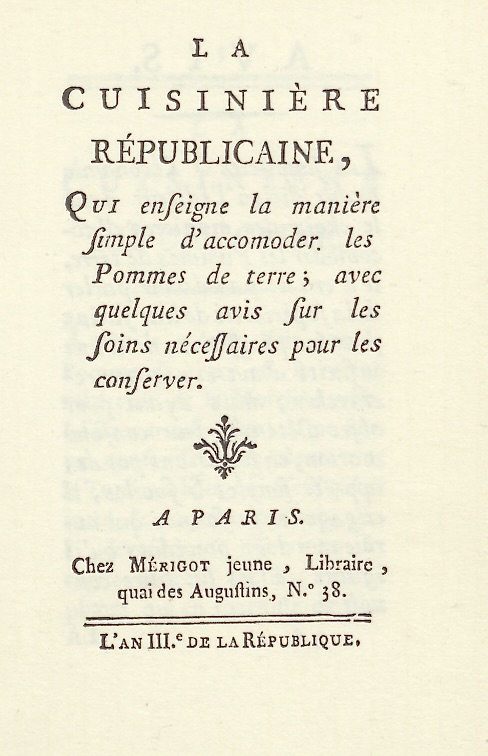
In the third year of the French Republic (1795) La Cuisinière Républicaine (The Republican Cook) was published. The book teaches the simple way to prepare potatoes, along with some advice on how to store them. The book was published or written by Madame Mérigot. If she was the author, then she was the first woman to write a cookbook in French.
Focusing on potatoes seems to make a lot of sense, after all in 1795 France was at war with most (if not all) European countries and it suffered from food riots and famine. On the other hand, until 1772 it was forbidden in France to cultivate potatoes because they could cause various diseases.
In 1763 Antoine-Augustin Parmentier returned to Paris, after having been a prisoner of war in Prussia. During his detention he had to eat potatoes. Shortly after his return he began promoting potatoes by hosting potato dinners, developing a recipe for potato bread and successfully fighting famine by introducing potatoes to hungry people. Thanks to his efforts the ban on potatoes was lifted in 1772. He continued educating government and public about the value of the potato as important staple food.
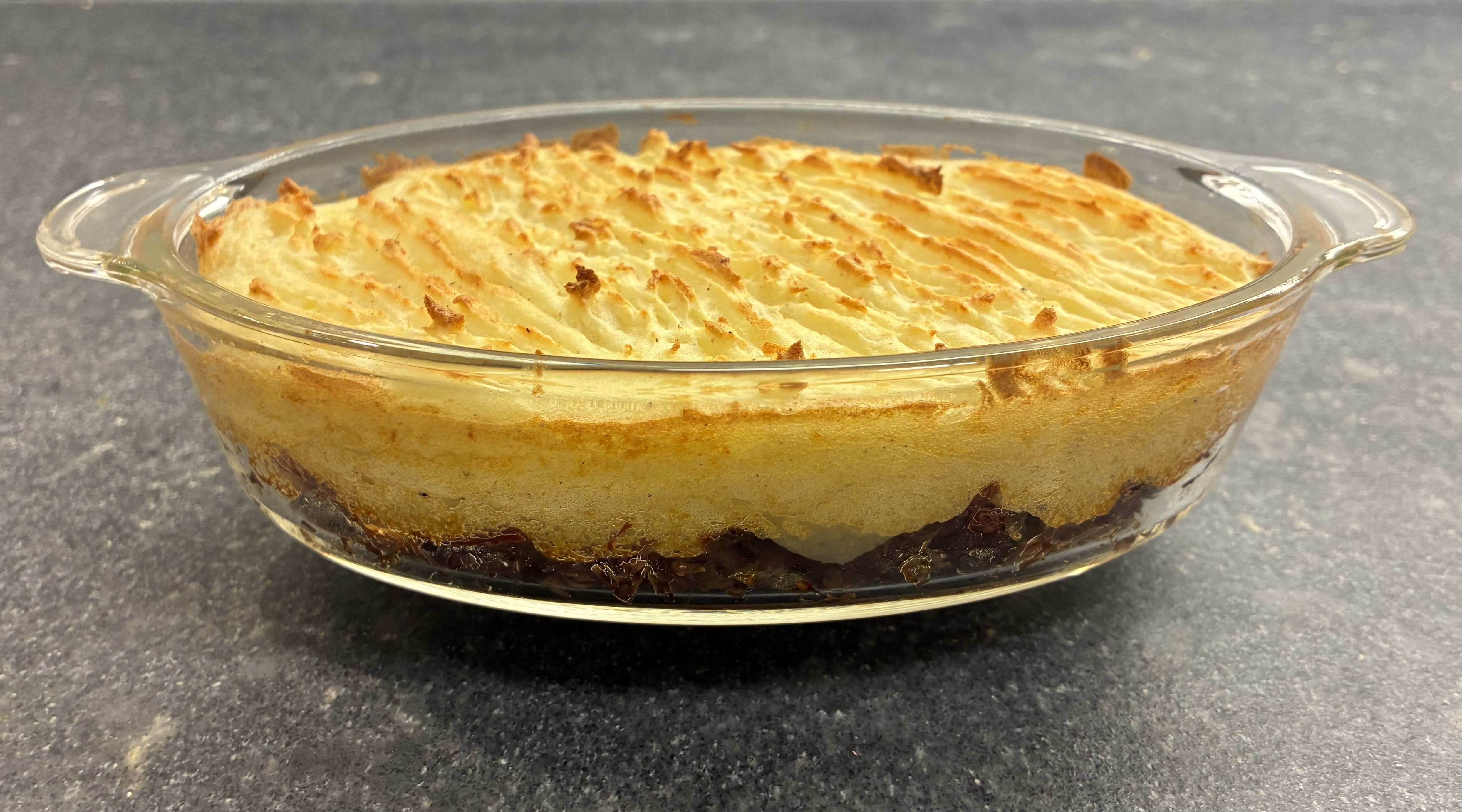
In honour of his ongoing commitment to the potato, many dishes are named after Antoine-Augustin Parmentier, including this delicious Parmentier de Canard.
Wine Pairing
We enjoyed a glass of Cabernet Sauvignon produced by Abbotts & Delaunay. It’s a red wine from the Pays d’Oc in France. The wine has a bouquet of ripe blackberry and plum. On the palate, it’s smooth and well balanced, with fresh acidity. Great combination with the rich Parmentier. In general you’re looking for a simple yet juicy and medium bodied red wine with little to no oak.
What You Need
- one Confit de Canard
- one Shallot
- one Garlic Clove
- 1/4 sprig of fresh Rosemary
- Potatoes
- Milk
- Crème Fraîche
- Butter
- Olive Oil
- White Pepper
- Salt
What You Do
- Preheat your oven to 90˚ C or 200˚ F
- Place the confit in the oven for some 10 minutes
- Take the confit out of the oven and remove the skin
- Use a fork or your hands to shred the duck
- Increase the oven to 180˚ C or 350˚ F
- Warm a heavy iron skillet and add olive oil
- Chop shallot, garlic and rosemary
- Add the shallot to the pan and glaze
- Add the garlic to the pan
- After a minute or so, add the chopped rosemary
- Add the meat, combine and allow to integrate on low heat for 10 minutes
- Peel and cube the potatoes
- Add the potatoes to a steamer basket, cover and steam until tender when pierced with a knife, 10 to 15 minutes
- Remove the basket from the steamer and allow the potatoes to rest for 5 minutes
- Warm the milk
- Add potatoes to a bowl
- Mash with a fork
- Add milk, butter and crème fraîche to the potatoes
- You’re looking for a fairly firm puree
- Add salt and white pepper to taste
- Butter the baking dish
- Add a layer of confit and cover with the puree (best to use a spatula)
- Use a fork to create a nice pattern
- Transfer to the oven for 20 minutes or until golden
- (optional) Serve with a green salad
Discover more from Cook and Drink
Subscribe to get the latest posts sent to your email.


This is delicious
LikeLiked by 1 person
Thanks Sheree, it is!
LikeLiked by 1 person
ive never heard of this and it sounds delish
LikeLiked by 1 person
Thanks Beth, warm, rich and tasty!
LikeLiked by 1 person
Oh how lovely! I. Had a similar dish in Paris a while back. I also saw a show where they showed where Monsieur Parmentier is buried!
LikeLiked by 1 person
Glad you enjoyed it. He is buried at Père-Lachaise in Paris I believe?
LikeLike
It’s interesting learn about how potatoes were introduced in France in 1700s. I know that it’s challenging today to get people to adopt new foods (for example, perennial grains that are good for the environment), and it’s fascinating to learn about how people have been promoting new foods for hundreds of years.
LikeLiked by 1 person
Thank you for mentioning perennial grains! A topic that needs more attention. We were surprised by the succes of oat milk, invented in the 1990’s and 30 years later it’s a mainstream product.
LikeLike
I often think about how food trends ebb and flow, but I never thought about oat milk before and how quickly it became a mainstream product. It’s fascinating how some new foods quickly become mainstream while others never do.
LikeLiked by 1 person
The succes of oat milk is impressive! We haven’t tasted or used it, but plan to do so.
LikeLiked by 1 person