Bouchée à la Reine

Crispy, fluffy, flaky puff pastry and a rich, warm filling with mushrooms and parsley, what better way to turn leftovers into a tasty starter. Bouchée a la Reine: a classic in Belgium and France. Not modern at all, but such fun to serve (and eat). You could fill the pastry with poultry, with mushrooms, shrimps, sweetbread, just about anything will go, as long as you use a rich roux as basis.
Making our own puff pastry is a bit too much for us, making your own bouchée is not too difficult, but buying them at the bakery is also fine. 

Wine Pairing

It all depends on the filling of your Bouchée a la Reine. It could be a light red wine if you have some left over veal, if it’s sweetbread then a lightly oaked chardonnay is fine et cetera. In all cases keep in mind that the filling comes with a generous amount of butter.

What You Need

  • 2 Bouchées
  • Some left over Veal or Chicken or Shrimps
  • Mushrooms
  • For the Roux
    • Butter
    • All Purpose Flour
    • Stock
  • Parsley
  • Lemon
  • Black Pepper
  • Butter

What You Do

Chop the (already cooked) meat and the mushrooms. Gently heat some butter in a pan, add the mushrooms and leave them for 10 minutes or so. Add the meat. Taste and add black pepper, perhaps some lemon juice, spices and herbs, definitely lots of parsley. In parallel make the roux. Warm the stock. Add butter to a pan, add the equal amount of flour plus a bit more (remember you also have some butter in the other pan). Softly fry the flour until you begin smelling that typical cookie aroma, then start adding the warm stock, slowly at first, constantly whisking. Add the meat, the mushrooms, some black pepper and the chopped parsley. Don’t turn the roux into a sauce, it must be ragout like. At this stage you could cool the filling for use later on.
Heat the bouchée in an oven at 180 °C or 355 °F for 10 minutes. Transfer from the oven onto a plate, add the filling and serve immediately.

Bouchée a la Reine ©cadeau

Bell Pepper Soup with Grains of Paradise

The first time we read about Grains of Paradise (or Melegueta Pepper) was when we prepared Sauce Cameline. The grains are common to the North and West African cuisine and were brought to Europe in the thirteenth century. According to some as a cheap substitute for black pepper. Recently we were fortunate to buy them and now we are impressed by their flavour: spicy, citrus and a touch of vanilla. When used in a stew it becomes less pungent. They gave a delicious and complex boost to the redd bell pepper soup.

Grains of Paradise are used to give flavour to craft beers, especially dark, seasonal beers. It can be a component of Has el Ranout. American chef Alton Brown uses Grains of Paradise in a stew with Okra and Tomatoes, in Apple Pie and in Lentil Soup.

For some reason it’s crucial to combine grains of paradise and lemon juice, As if the acidity amplifies the flavour of the grains?

What You Need

  • 2 Red Bell Peppers (or 1 Red and 1 Orange)
  • Shallot
  • 2 Garlic Cloves
  • 5 cm Carrot
  • 10 cm Celery Stalk
  • 250 ml Vegetable Stock
  • 5 cm of Fresh Rosemary
  • ¼ teaspoon of Grains of Paradise
  • Lemon Juice
  • Crème Fraîche
  • Olive Oil

What You Do

Clean the bell peppers and cut in 4. Transfer to the oven and grill or roast for 10 minutes or until well charred. When still hot, put the bell peppers in a plastic container and close it. After one hour it’s easy to remove the skin of the bell pepper. Chop and set aside.
Chop the shallot, the garlic, the celery and the carrot. Add olive oil to a pot and add the shallot. Glaze. Add the carrot, the celery and the garlic. Leave on low heat for a few minutes. Add the bell pepper. After a few minutes add the stock, the rosemary and the crushed grains of paradise. Leave on low heat for one hour. Remove the rosemary. Use a blender to make a smooth soup. Pass through a sieve. Taste the soup and decide if you want to add some extra grain of paradise. Leave the soup on low heat for 30 minutes. Just before serving add one or two teaspoons of fresh lemon juice, depending on the flavour and your taste. The soup should be smokey, aromatic, a touch spicy and refreshing. You could add more crushed grains of paradise, that will make the soup spicier. Make a swirl with crème fraîche an serve.

Red Bell Pepper Soup ©cadwu

Spaghetti Carbonara with Guanciale

This must be one of the tastiest dishes from the Italian cuisine. Creamy, rich, moist, salty, aromatic, delicious and not difficult to prepare. It’s also not difficult to ruin the dish, that’s why Antonio Carluccio recorded a video showing you exactly how to prepare it and how to make sure your Carbonara is creamy.

About the ingredients: If possible, use guanciale, cured pork cheek. It’s also used for another delicious recipe from the same Italian region: Bucatini all’amatriciana. The pork meat is rubbed with salt, pepper and various herbs and cured for a number of weeks. Guanciale is not smoked and therefore its taste is very different from bacon. Pancetta (made from pork belly) could be an alternative, provided it’s not smoked.

As emphasised by Carluccio, most certainly no cream. And no garlic, basil, parsley, onion or white wine we would like to add.

Wine Pairing

We enjoyed our Spaghetti Carbonara with a glass of Bardolino 2022, produced by Monte del Frà from Italy. The wine has a beautiful deep red colour and the aromas made us think of red fruit and perhaps pepper. The wine is medium bodied with some acidity and fruitiness. In general, you’re looking for a fruity red wine with a touch of acidity, for example Chianti Classico, Montepulciano or Barbera. If you prefer a white wine, then a Pinot Grigio or Soave is a good choice.

What You Need

  • 125 grams of Guanciale
  • Spaghetti
  • Parmesan Cheese
  • 2 organic Eggs
  • Olive Oil
  • Black Pepper

What You Do

Cut of the cured edge of the guanciale. Dice the meat. Heat a pan, add olive oil and reduce the heat to medium. Fry the guanciale. In parallel cook the spaghetti al dente, this will take some 10 minutes. Whisk the eggs, add some freshly grated Parmesan cheese and whisk again. When the pasta is ready, remove the pan from the heat and add the spaghetti straight from the water to the pan. Combine and make sure the spaghetti is nicely coated with the fat and juices from the meat. Now it’s time to create your creamy carbonara! Check if the spaghetti and the pan are not too hot. If so, better wait a minute. Add the egg mixture, combine, keep moving the spaghetti, add some freshly grated black pepper, keep stirring and then serve immediately on a warm plate with some extra Parmesan cheese.

Your Favourites in 2022

We have been baking our own bread for several years, based on the method of no-knead bread (see Jim Lahey’s book My Bread for more detail) and using the ingredients of the French Talmière. The technique is a bit challenging, so we were very pleased to test the simplified method described by Le Creuset. You were also pleased to learn about this easier method for No-Knead Bread, because it’s our number one post this year!

Kimizu is the classic, golden sauce from Japan, made from Egg Yolks, Rice Vinegar, Water and Mirin. The recipes for Kimizu and Kimizu with Tarragon continue to be very popular. Although this is a classic sauce, we use a microwave to prepare it. A great tool to be in control of temperature and consistency.

If you’ve been following this blog for a few months, perhaps years, then you’ll know we love mushrooms. We are especially interested in the seasonal ones, such as Morels, St. George’s mushroom, and Caesar’s Mushroom. We combine these with Japanese Udon, creating a very tasty starter, full of flavours and texture. Also one of our personal favourites.
Another favorite is the Bay Bolete. Actually a fairly common mushroom, as tasty as Cèpes, but much more affordable.
During the season we saw lots of interests in Bay Boletes and Caeser’s Mushroom, so next season we will publish new recipes with these two delicious mushrooms.

The classic Cèpes à la Bordelaise was also amongst your favourites. You can also use more available mushrooms for this great combination. Always a pleasure to serve, with eggs, with meat, with more present fish.

Ajerkoniak was a dish we looked into when we were exploring dishes/drinks based on egg yolks, such as caudle, eggnog and advocaat. Perhaps not our personal favourite, but why nog give it a try?

We wish you a happy and inspiring 2023!

Your Favourites in 2022 ©cadwu

Bouchot Mussels

When you buy champagne, Cornish Clotted cream, Parmigiano-Reggiano or Kalamate Olives, you want to be sure it’s really champagne, clotted cream, Parmigiano or a Kalamata olive. There are various ways of protecting food (and wine) for instance by law, by creating and protecting a brand, or by systems such as the Appellation d’Origine Protégée (AOP) also known as Protected Designation of Origin (PDO). AOP/PDO is based on unique aspects of a region. For instance, the AOP for Comté cheese reflects the use of milk from specific cows from a region in the French Jura with a unique flora. This determines the cheese, its flavour and quality.

Another system focuses on the way food is produced. If this is done in a unique traditional way, the product can be labelled with Spécialité Traditionnelle Garantie (STG) or Traditional Speciality Guaranteed (TSG).

Bouchot Mussels carry both labels and they come with a special logo. Obviously, you wonder why.
The mussels grow in a unique way, benefitting from the large tide near Mont-Saint-Michel in Normandy. They grow on ropes strung from wooden poles (so called bouchots) in the sea. During a significant part of the day the mussels sit above sea level and therefore they grow slowly. The influence of the tide makes the bouchot mussels typical for the region and the use of poles makes the way the mussels grow unique.

Perhaps you also wonder if these aspects have an impact on the mussel and its taste. The answer is yes. They are small, clean, very tasty, flavourful, juicy and meaty plus they are free of sand and grit.

Preparing bouchot mussels is very simple, because adding flavours will only interfere with the already delicious taste.

Perhaps a bit more expensive than other mussels, but given they are so very tasty and rich, we think it’s perfectly fine to buy less than usual.

Wine Pairing

We enjoyed our Bouchot Mussels with a glass of Muscadet Sèvre et Maine, Domaine Raphaël Luneau. The wine originates from the Loire Valley and is made with 100% Melon de Bourgogne. The wine is stored on its ‘lees’ for several months before bottling. Lees are leftover yeast particles. They add flavour and structure to the wine.
In general, you’re looking for a white wine with minerality, fruit, structure and expression. It must be aromatic with a long taste.

What You Need (Starter)

  • 500 grams of Bouchot Mussels
  • White wine
  • One garlic Glove
  • Parsley
  • Crusted Bread

What You Do

Finely chop the garlic and the parsley. Add white wine to a pan and add the garlic. Bouchot mussels don’t release much liquid when you cook them, so use a little more wine than you would do with regular mussels. Leave for 10 minutes. Clean the mussels. Cook the mussels as quickly as you can, lid on the pan, until they are open. Add the parsley and combine. Serve immediately on a hot (soup) plate.

Mushroom Fricassee

A few weeks ago, we wrote about History on Our Plate (2019) written by food historian and award-winning author Peter G. Rose. She writes about America’s Dutch past and the influence of the Dutch settlers on today’s American food. She explains how the founders of New Netherland (1609 – 1664, currently the states of New York, Delaware, Connecticut and New Jersey) brought Dutch recipes, tools, herbs and fruit to the US. Most recipes are based on publications like Een Notabel Boecxken van Cokeryen (a Notable Little Book of Cookery, 1514) and the 13thcentury publication Le Viandier de Taillevent. Peter Rose includes both the original and a modern version, allowing you to recreate food from the 17th century. 

Two Recipes

We were intrigued by a recipe for Mushroom Quiche without a Crust that made us think of a savoury clafoutis. We were also intrigued by another mushroom recipe, called Mushroom Fricassee, partly because of the unusual combination of eggs, mushrooms, onion, marjoram, thyme, orange juice, sherry, nutmeg and (optional) beef juice. The recipe is included in a manuscript written by Anne Stevenson Van Cortlandt (1774- 1821). She was married to Pierre Van Cortlandt, a well-known influential family with Dutch origins. Anne Stevenson was born in Albany, a city linked to Dutch settlers until the British took over in 1664.
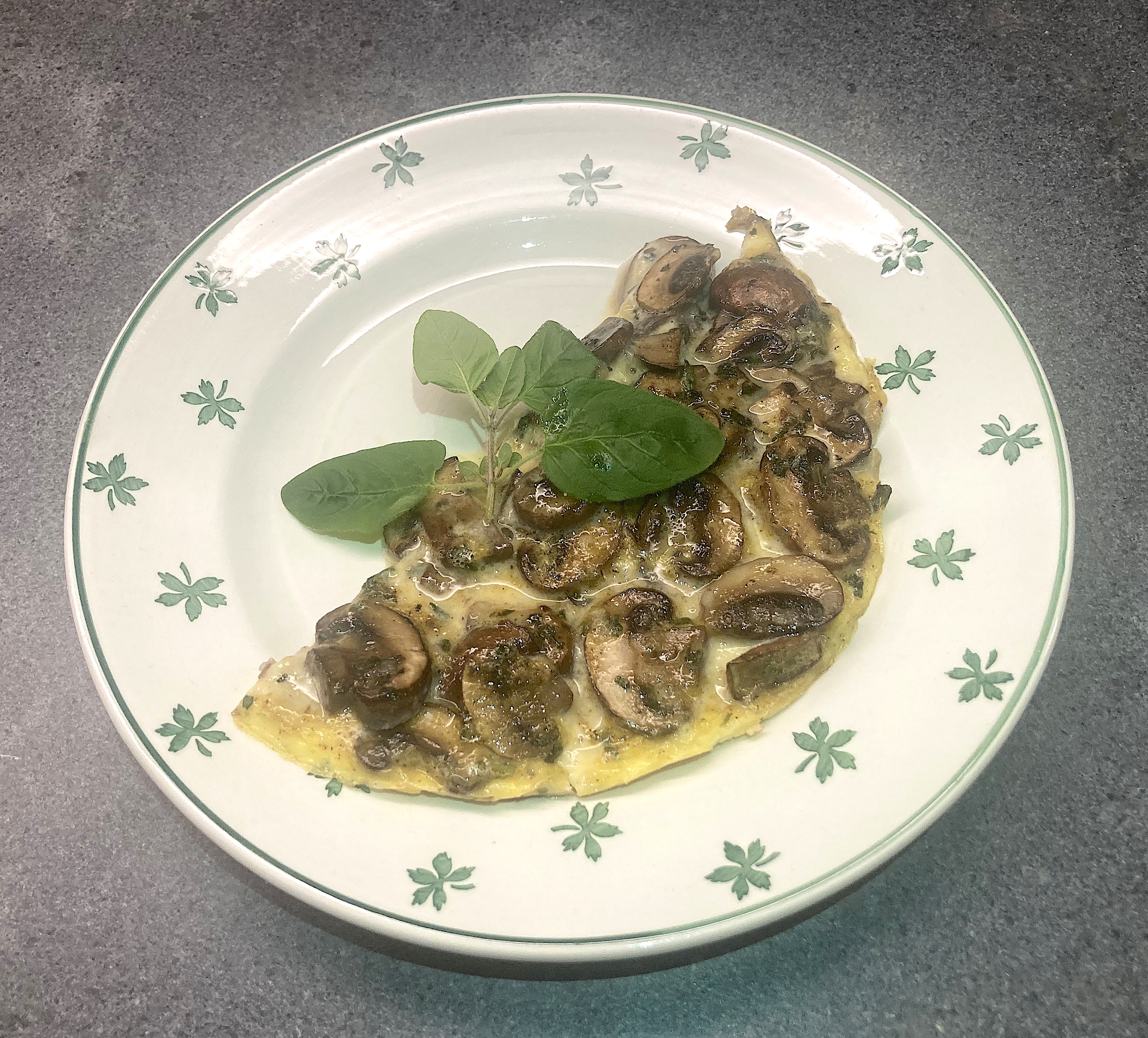
We tried this imaginative combination of ingredients and prepared an omelette. The result was tasty and beautifully balanced, with a nice twist thanks to the herbs, sherry and orange juice. Peter Rose suggests preparing it like scrambled eggs, which is probably a better idea. Turning the mixture into an omelette was a bit of a challenge.
You’ll find a detailed recipe in History on Our Plate.

Wine Pairing

We enjoyed our Mushroom Fricassee with a glass of Conde Valdemar Tempranillo Blanco Rioja DOCa 2020, produced by Bodegas Valdemar. Its colour is slightly yellow with greenish tones. The wine has notes of tropical fruit (pineapple) and its taste is fresh and pleasantly persistent. A beautiful, unoaked white Rioja made with 100% tempranillo blanco grapes.
In general, you’re looking for a lean, dry, slightly fruity white wine with notes of lemon, melon and/or pineapple, preferably with a long finish.

Buy The Book

History on Our Plate is available via the well-known channels and your local bookstore for approximately 15 euro or 10 US$.

Guacamole

It’s very tempting to buy ready-made tapenade, guacamole, mayonnaise or fish paté. It’s easier, much quicker and you don’t need to worry about ingredients and recipes. Very true. On the other hand, we also know that most of these ready-made products contain far too much salt plus additives that shouldn’t be in there. For instance, we found a trout paté with rapeseed oil, vinegar, egg, salt, lemon juice, sugar and paprika. The ingredients in a jar with guacamole included mascarpone, cellulose gum, sugar (again) and coconut oil.

The good news is that making your own guacamole is very simple. The only challenge is to buy ripe and tasty avocados. When in doubt, ask your greengrocer.
Guacamole combines very well with nachos, chips and toast, but also with baked potatoes, fried fish and smoked salmon. We like to enjoy it with our beloved (Flemish) grey small shrimps.

Wine Pairing

If you serve guacamole with small shrimps as a starter, then we suggest a refreshing white wine, for instance a glass of Viognier. You could also serve a glass of dry rosé.

What You Need

  • 2 Ripe Avocados
  • Small Red Onion or Shallot
  • Small Garlic Clove
  • Red Chili Pepper
  • Lemon
  • Soy Sauce
  • 100 grams Small (Grey) Shrimps
  • Black Pepper
  • Cilantro (optional)

What You Do

Peel both avocados, remove the seeds and chop coarsely. Finely chop the shallot, the garlic clove and some red chilli pepper. How much you use depends on the spiciness of the pepper and your preference. Add one avocado to the beaker of your blender. Add the shallot, garlic and chili pepper. Add a small splash (start with half a teaspoon) of soy sauce and a bigger splash of lemon juice. Add the remaining avocado and blender until smooth. Taste and decide if you want to add more lemon juice or soy sauce. Transfer to the refrigerator.
Serve with small shrimps, black pepper and cilantro.

PS

We know, we start by mentioning that ready-made guacamole contains odd ingredients like mascarpone and then we suggest adding soy sauce to this typical Mexican dish. Inconsistent to say the least. Well, guacamole needs a pinch of salt. You could (of course) add regular salt, but by adding a drop of fish sauce or soy sauce, you also add some umami, which seems to work well with the avocado and the shrimps. 

Guacemole ©cadwu
Guacamole ©cadwu

Green Gnocchi

We love eating Gnocchi, preferably as a starter with some olive oil and Parmesan cheese. Tasty and rich. Perhaps sometimes a bit too rich and too filling, especially the ones you can buy at your local shop or supermarket. Therefore it’s best is to make your own gnocchi, which is not too difficult, just time consuming.

We were pleasantly surprised when we found Green Gnocchi in Nice (France), made with Swiss Chard. The chopped leaves help improve the structure of the Gnocchi and add complexity and freshness to the dish. Yummy!

So all is good? Well, the name is a bit odd, to say the least. This Niçoise speciality is called Merda de Can, which translates into something from a dog – not very pleasant and certainly not something you want to eat. Very odd.

The name shouldn’t stop you from enjoying it. Merda de Can with Sage Butter is truly delicious.

Wine Pairing

We enjoyed our Merda de Can with a glass of Saint Roman Sable de Camargue Rosé. In general you’re looking for a well-balanced, fresh wine. Given the butter and sage sauce you could serve a Chardonnay or perhaps an Italian white wine such as Gavi di Gavi or Soave

What You Need for 8 starters

  • For the Merda de Can 
    • 600 Grams of Starchy Potatoes
    • 300 Grams of Swiss Chard, Spinach or Water Spinach (cleaned and ready to use)
    • Olive Oil
    • Nutmeg
    • 1 Egg
    • All Purpose Flour
  • For the Sauce
    • Butter
    • Sage
  • Parmesan Cheese or (preferred) Vacherin de Fribourgeois)

What You Do

Best is to follow the instructions by a Niçoise chef. 
Or prepare gnocchi as you would normally. Quickly fry the leaves in olive oil, remove from the pan, chop finely and drain. Add to the potato mixture, add the beaten egg, add freshly grated nutmeg and combine. Now start adding flour until you have the right consistency. You’re looking for a flexible, non-sticky dough. Flour your hands and start making short, small, thin, sausage like pasta. (Perhaps this is the moment to think about a small dog. Or perhaps not.) Don’t worry about the shape, it’s okay if they are not very similar. Devein the sage leaves. Warm butter in a pan and add the sage. In parallel heat a generous amount of water. Add the pasta to the boiling water and wait until the pasta surfaces. Remove from the water, add the pasta to the pan with sage butter, coat the pasta and freshly grated Parmesan cheese and serve.

PS

The Merda de Can we enjoyed was bought at a local Niçoise shop and had a more elegant shape.

Green Gnocchi (Merda de Can) ©cadwu

Spanish Tortilla

We have fond memories of the Mercat Central in Valencia, one of the largest markets in Europe. Its architecture is amazing, but even more stunning are the products on sale: fruit, vegetables, mushrooms, chicken, fresh meat, sausages, hams, herbs, spices, fish, bread, wine, pickles, snails, weeds, offal, rice, nuts: anything and everything you can dream of.
And of course various bars with the tastiest tapas ever. We would go shopping early in the morning, buy what we needed that day (perhaps a bit more than just that) and buy two bocadillos de tortilla: a small crunchy roll with tortilla made with egg, onions and potato. We would run back to our apartment, make coffee, sit down and enjoy the rich, velvety, long taste of bread and tortilla.
Fond memories indeed.

Making Spanish tortilla is a matter of combining the best ingredients and being patient.

What You Need

  • 200 grams of Potato (waxy ones, we used Roseval)
  • 1 large Spanish (White) Onion
  • ½ Grilled Red Bell Pepper
  • 4 Eggs
  • Black Pepper
  • Olive Oil

What You Do

Heat a pan and gently fry the thinly sliced potatoes, slowly, in plenty of oil. You don’t want crunchy, golden potatoes, they should be nearly done, that’s all. In a separate pan glaze the quartered and sliced onion, also for let’s say 15 minutes. Let both cool. Dry the sliced grilled red bell pepper with kitchen paper. Beat the eggs and add potatoes and onions. Allow to rest for 15 minutes. For some reason this is a crucial step, one that should not be skipped. Add sliced red bell pepper and fresh black pepper. Warm a medium sized non-stick pan (22 cm or 9 inch), add oil and fry the tortilla until the top is slightly set. It could take 20 minutes so please don’t be tempted to increase the heat. Transfer to a plate, put the pan on top of the tortilla and flip. Fry a few minutes.
Serve lukewarm, perhaps with some chopped parsley and a crunchy roll.

PS

You could peel a fresh red bell pepper, but better is to clean it, slice in 4 to 6 chunks, flatten these and grill for 10 minutes. This should char the pepper significantly. Transfer to a plastic container and close. Leave for a few hours. Now you can easily remove the skin. This way a bell pepper has a richer, more complex taste and is easier to digest, but it is of course not as crunchy as a fresh bell pepper. 

Fennel

The bulb, the seeds, the leaves: fennel is such a generous plant! The bulb (the swollen base of the stem) can be cooked, grilled, stewed, used in salads or steamed. The leaves are great for decoration or in a salad and the crushed seeds can be used on their own or in a combination like five-spice powder. Overall fennel has an anise-flavoured, warm, sweet taste. 

We slow cook the bulb, capturing all the lovely flavours and creating a soft, fibrous texture. You could add star anise or some orange peel to the stew. We prefer adding a splash of pastis, because it adds depth to the fennel. We recommend pastis as produced by Henri Bardouin, because of its excellent, delicate taste.

We prepare the fennel using a cartouche. This way you get the tastiest moist fennel ever.

What You Need

  • Fennel Bulb
  • Pastis
  • Butter

What You Do

Use baking paper to make a cartouche. Remove the outer leave(s) of the fennel if so required. Slice the fennel in 4, from top to bottom. Slice every quarter in 3 to 6 segments, from top to bottom. The idea is that every segment looks a bit like a fan. Trim of parts that don’t look nice, but don’t remove the bottom. If you do remove it, the fan will fall apart.

Warm a heavy pan, add a very generous amount of butter, a splash of pastis and the sliced fennel. Cover tightly with the cartouche and leave on low heat for an hour or so, perhaps longer. Feel free to stir gently every 15 minutes. The fennel should be soft, sweet, anise-flavoured and rich. When serving, poor the remaining liquid over the fennel.
We served our fennel with Confit de Canard and enjoyed it with a glass of Bardolino.