Mushroom Tapenade

Years ago our favourite green grocer was the shop of Joop and Trudi Petersen, close to Amsterdam’s China Town. Not only did they sell the tastiest vegetables, fruit and mushrooms, but they also sold homemade mash (the one made with potatoes and rapini (or broccoli rabe) was wonderful), desserts, ravioli with pumpkin and Trudi’s mushroom tapenade. When Joop turned 65 in 2008 they retired and closed the shop. Obviously, we asked for the tapenade recipe, but alas, all we got was a nice, friendly smile.

In our post about the Mushroom Book by Michael McLaughlin and Dorothy Reinhardt (Illustrator) we mentioned that the recipe for Mushroom Tapenade is amongst our favourites. His tapenade is a combination of mushrooms, garlic, various herbs, red wine, anchovies, black olives and capers. Very nice, tasty and powerful, but not as delicious as Trudi’s version.

Mushroom tapenade comes with lots of umami, thanks to the mushrooms and the olives. Thinking back of Trudi’s tapenade, we’re pretty sure she enhanced the umami flavor, probably by adding some oyster sauce from the toko next door. We think that the recipe below is very close to what she created.

What You Need

  • Fresh Button Mushrooms and Shiitake (ratio 2:1)
  • 2 Garlic Cloves
  • Olive Oil
  • Thyme and Rosemary
  • White Wine
  • Black Olives
  • Excellent Olive Oil
  • Black Pepper
  • Half a teaspoon of (Thai) Oyster Sauce

What You Do

Don’t use dried mushrooms. In general they have a nasty, bitter taste, not even close to the flavor, aromas and textures of fresh mushrooms.

  1. Clean and chop the mushrooms.
  2. Finely chop the rosemary, the thyme and the garlic.
  3. Fry the mushroom in olive oil in a heavy iron skillet.
  4. Reduce heat, add herbs and garlic.
  5. After 10 minutes add a splash of white wine.
  6. Continue on low heat and wait until the wine and juices have evaporated. No rush.
  7. Transfer the mushroom mix to a plate, let cool
  8. Chop a few black olives and add these to the mix.
  9. Transfer to a kitchen aid and on low-speed start adding excellent olive oil. The result should be a tapenade, so not smooth and not oily.
  10. Add black pepper to taste.
  11. Add a small amount (1/4 teaspoon to begin with) of (Thai) Oyster Sauce. Be very careful, it should only enhance the umami.
  12. Store in the refrigerator for at least one day before using.

Earthly Delights

The Mushroom Book by Michael McLaughlin and Dorothy Reinhardt (Illustrator) is a lovely, small book with some 35 recipes and 60 very delightful full-colour wood-cut illustrations. Just look at the cover! It’s the kind of book that we bought because it looks good. A book you simply want to have.

Only later did we find out that it discusses the history and other interesting back ground information of various mushrooms, including information on choosing, storing and preparing them. The book offers an introduction to the joy of cooking with mushrooms such as button mushrooms, morels, oyster mushroom, truffle, trompette de la mort, chanterelle, shiitake, cèpes and huitlacoche, a Mexican mushroom that grows on corn.
Michael McLaughlin is also known as co-author of The Silver Palate Cookbook with recipes from Manhattan’s celebrated gourmet food shop.

Amongst our favourite recipes are Mushroom Tapenade and Raw Mushroom, Fennel and Provolone Salad.

The Mushroom Book was published in 1994. It’s available (in most cases second hand) via channels such as Amazon and e-Bay for something like 15 euro. Ii is an ideal and friendly introduction to the world of earthly delights. 

The Mushroom Book
The Mushroom Book

Oden

A traditional Japanese dish, often enjoyed in winter. It is tasty, light and full of surprises. Oden is a meal that requires a bit more work (and of course time) then you would expect. It also requires some shopping, given some of the ingredients are not easy to find. We enjoyed our first Oden at the Taishunken restaurant in the famous Sankeien Garden in Yokohama. Loved it!
We are not from Japan so we humbly present our version of this classic. We hope it inspires you to cook Oden and enjoy it as much as we did.

Pairing

A cup of Japanese green tea is the obvious choice.
You could also combine your oden with a glass of Chardonnay (with a touch of oak perhaps), for instance if you serve it for dinner. Oden is rich in flavours, umami of course, but not spicy, so we would not suggest a Gewürztraminer or a Sauvignon Blanc.
A glass of cold, dry sake will also be great.

What You Need
  • For the Dashi
    • 1 litre of Water
    • 20 grams of Dashi Kombu (Rishiri Kombu)
    • 20 grams of Katsuobushi (Bonito Flakes)
  • For the Stew
    • One Daikon
    • One Pack of Konnyaku
    • 1 sheet of Hayani Kombu
    • Chikuwa Fish Cakes
    • One Pack of Gobo Maki Burdockroot Fish Cakes
    • 2 boiled eggs
    • Abura Age Fried Tofu
    • Mochi (Sticky Rice Cake)
    • Soy Sauce (preferably one with less salt)
    • Mirin
  • Karashi
  • Rice with ginger
What You Do
  1. Peel the daikon and slice it (2 centimeters is best)
  2. Use a sharp knife to plane of the edge of the daikon. This improves the presentation, and it is supposed to stop the daikon from falling apart
  3. Cook the daikon for one hour in water
  4. Drain and set aside
  5. In parallel: cut the konnyaku in triangles and cook these in water for 15 minutes. Konnyaku is made from the konjac plant and is specific for the Japanese cuisine
  6. Also in parallel: cook the sheet of Hayani Kombu for 5 minutes. This is young kombu and edible, different for the one you use when preparing dashi. Let cool a bit, slice and knot ribbons. Not sure why but is looks great when you serve it. (Yes, well spotted, it’s not in the picture; unfortunately, we couldn’t find Hayani when we prepared our oden.)
  7. Make 1 liter of dashi. This seems simple but requires precision. Clean the kombu with a wet cloth and put into one litre of cold water. Gently raise the temperature to 80 °C or 175 °F. Remove and discard the kombu. Bring the liquid to a boil, add the katsuobushi, bring to a boil and immediately set heat to zero. Wait 5 minutes or so. The katsuobushi will sink to the bottom of the pan. Now very gently pass the liquid through a wet towel or a sieve. Do not squeeze, just give it time. The result will be a great, clean dashi.
  8. Now it’s time to add the dashi to the pan (should be a clay pot, but we stick to our Le Creuset)
  9. Add one tablespoon of mirin
  10. One (or two, depending on your taste) of light soy sauce
  11. Add the daikon, the konnyaku, the chikuwa fish cakes and the gobo maki burdockroot fish cakes
  12. Allow to simmer for at least 2 hours
  13. 30 minutes before serving add boiled eggs, two Hayani ribbons, fried tofu and mochi
  14. The last two ingredients must be combined by putting the mochi into the tofu
  15. Serve with karashi (Japanese mustard, which is different from wasabi by the way) on the side
  • Oden ©cadwu
  • Oden with names of Ingredients ©cadwu

The Mushroom Feast

Yes, it’s a bit early, but we can start thinking about enjoying the first mushrooms of this season, such as the Mushroom of Saint GeorgeMorels, Bianchetti and the Fairy Ring Mushroom. Let’s be prepared for the season and think about books, recipes, web sites and food-wine pairing.

A classic book on mushrooms was written by chef and author Jane GrigsonThe Mushroom Feast, originally published in 1975. The book Is beautifully illustrated by Yvonne Skargon.
Jane Grigson is known for many other classics such as The Fruit Book and The Vegetable Book.

The Mushroom Feast includes a chapter on the best edible mushrooms and ways to preserve mushrooms. Other chapters describe how to combine mushrooms with fish, meat, poultry and game. One chapter discusses mushrooms in the Japanese and Chinese kitchen.
Jane Grigson also provides interesting background information, like Colette’s view on truffles. Worth reading, with or without truffles.

It isn’t a handbook for foragers, but no book ever is.

The Mushroom Feast covers a wide range of mushroom recipes: soups, salads, pies, sauces and intriguing combinations like creamed cucumbers with mushrooms and classics like mushroom soufflé. The recipes are clear and well-written.

You may perhaps think the recipes are a bit old fashioned, but that shouldn’t stop you from reading them. Be inspired by one of Britain’s finest writers on recipes and food.

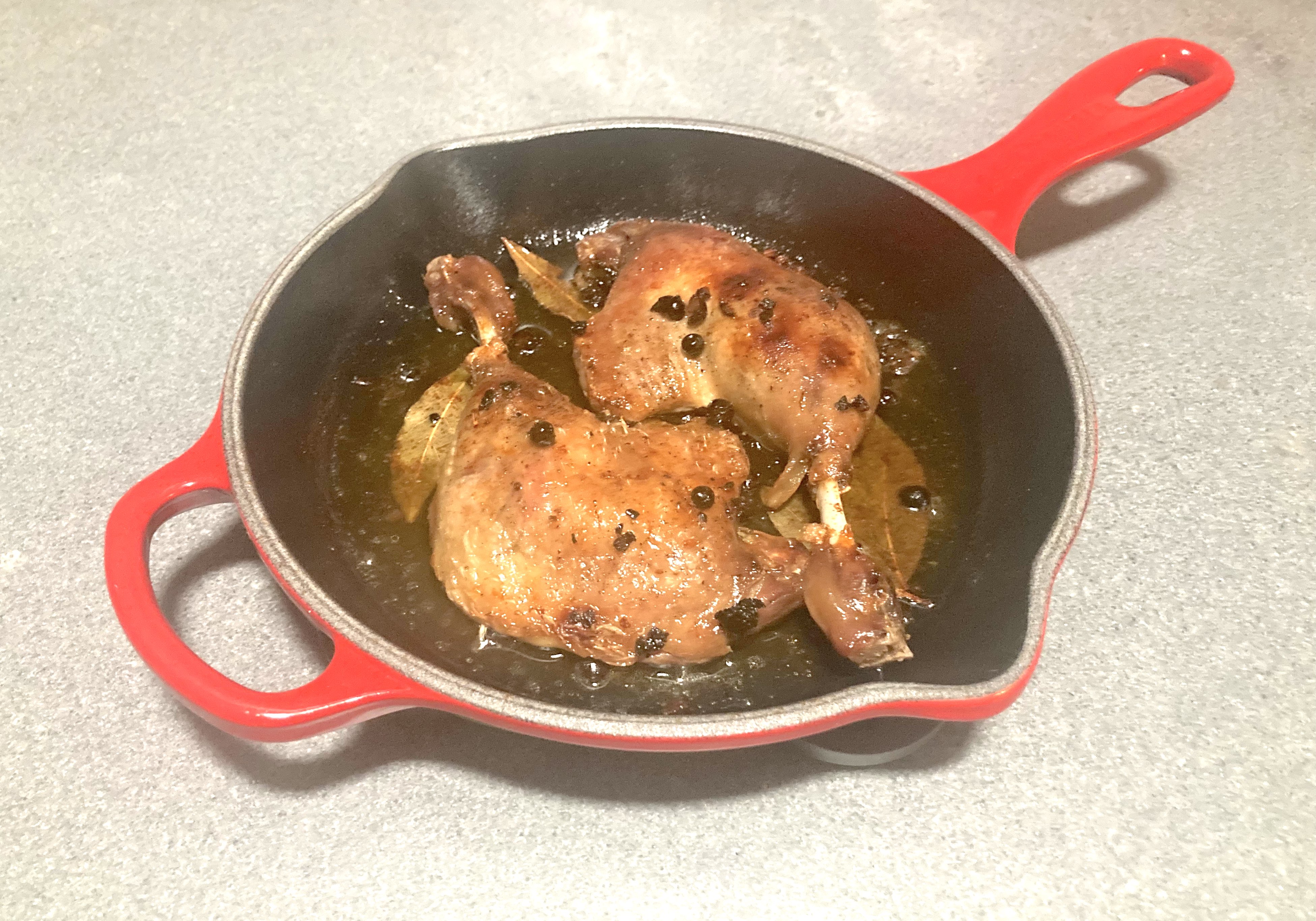
Confit of Duck: a home made alternative

The traditional way of making Confit of Duck is not complex. It’s a bit time consuming and it requires some planning, that’s all. The principle is to cure the meat in salt with various herbs (thyme, cumin, rosemary) and garlic. After 24 hours or so the duck is washed with water, patted dry and then slow cooked in goose or duck fat for several hours. When ready cool and store in fat.

We take a different approach by slow cooking the duck legs in olive oil. The result is remarkable: juicy, full of flavours and aromas, provided you use first class duck (label rouge for instance). If not, the meat can become dry and tough. Another benefit: we don’t cure the meat so it’s not salty at all.
We serve the confit with celeriac mash. It’s light, nutty and refreshing compared to a mash made with potatoes.

Wine Pairing

Best choice is a full bodied, red wine with ripe fruit and smoothness. We decided to open a bottle of Herdade de São Miguel Colheita Seleccionada 2020 as produced by Casa Relvas. Such a pleasure! Its colour is deep ruby and the aromas made us think of ripe black fruit and dark cherries with some spiciness. The wine is well balanced with a nice structure and smooth tannins. Works very well with the juicy duck and the mash with its creamy texture and lemonish, celery flavours.

What You Need

  • For the Confit
    • 2 Duck Legs
    • Juniper berries
    • 4 Bay Leaves
    • Olive Oil
    • (optional) Garlic
  • For the Celeriac Mash
    • 1 Celeriac
    • Slice of Lemon
    • Cream
    • White Pepper
    • Nutmeg

Confit

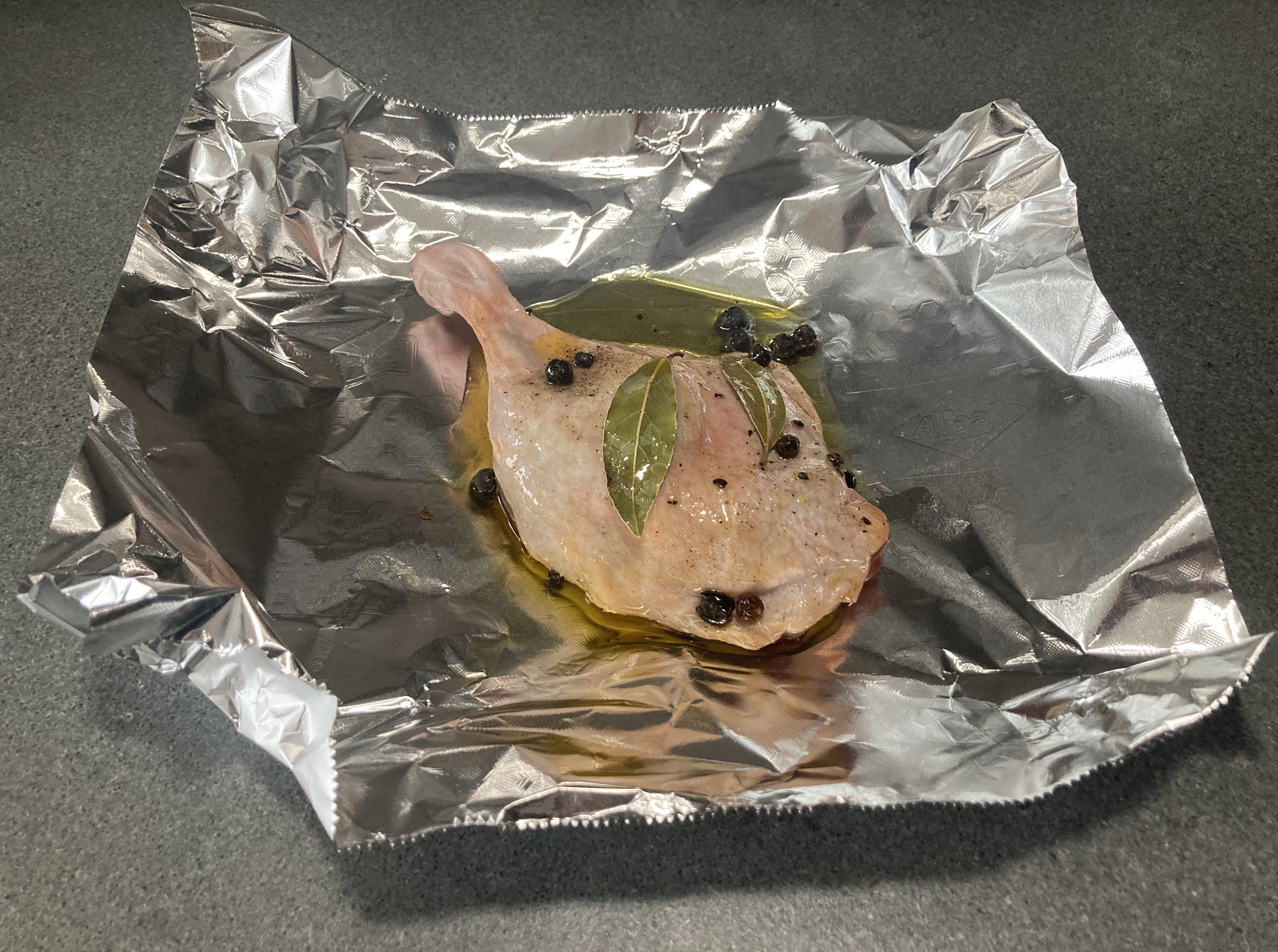
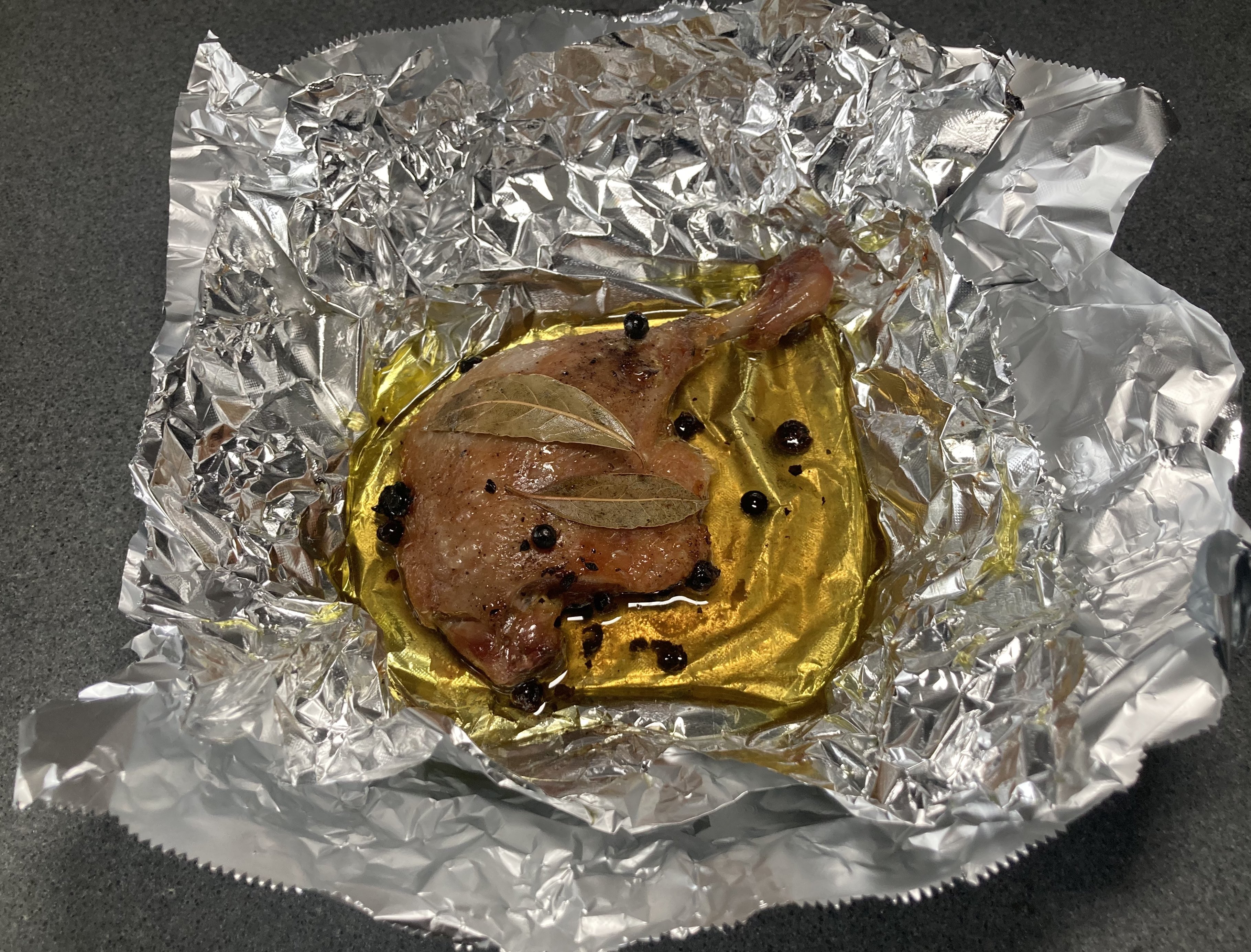
Take a sheet of aluminium foil and place the leg in the middle. Add lightly crushed juniper berries and two bay leaves. Perhaps some crushed garlic. Add a generous amount of olive oil and make sure everything is covered. Wrap foil around the duck. Take a second sheet of foil and wrap it around the package, making sure it’s closed. Repeat with the second leg. Transfer both packages to an oven at 120 °C or 240 °F. After one hour reduce the heat to 100 °C or 210 °F. After in total 4 to 5 hours, depending on the size of the legs, remove the legs from the oven, open the package and let cool. Then transfer to the refrigerator for use later on.

Heat the oven to 200 °C or 390 °F. Put the legs in an iron skillet, transfer to the oven and 15-20 minutes later the legs are ready. If the skin is not yet crispy, use the grill for 2 or 3 minutes.
Another idea is to pull the meat and use it to top a salad.

Mash

The Celeriac Mash: clean and dice the celeriac. Cook in minimum water with a nice slice of lemon until nearly done. Remove the lemon and drain. Add cream. Put on low heat for a few minutes; the celeriac should absorb the cream. When the celeriac is done, use a blender to create the puree. Pass through a sieve. Perhaps add extra lemon or cream. Just before serving add white pepper. Serve with freshly grated nutmeg.

Hilaire Walden

Some chefs love the limelight, some prefer to stay in the background, focusing on cooking and writing. Hilaire Walden is clearly one of them. 

She is author of some 40 books and she has written for prestigious magazines and newspapers about food, cooking and restaurants. She wrote The Great Big Cookie Book, The Book of Tapas and Spanish Cooking, the Book of French Provincial Cooking, The Singapore CookbookQuick After Work Summer Vegetarian CookbookThe Book of Fish and Shellfish and more recently I Love My Barbecue. Indeed, a broad culinary spectrum!

The Loire

One of our favourites is Loire Gastronomique. In this book she follows the course of the French river and describes the various regions, local products, local recipes and of course the wines that go with it. Cheese, cookies, pies, everything. The Loire region is known as the Garden of France. In this garden you’ll find wonderful castles (Azay-le-RideauChambordChinon), great wine (MuscadetSancerrePouilly-Fumé) and beautiful food (asparagus, lots of fruit, artichokes and of course Lentille Verte du Puy). The book is inspiring and it will make you dream of a walk along the Loire, with a view on Amboise and a glass Crémant de Loire in your hand.

Recipes

One of the benefits of Hilaire Walden’s recipes is that they are always correct. Sounds odd, but as we all know, unfortunately, often recipes are simply not complete or correct.
If you prepare a dish for the first time, simply follow her instructions and you’re fine.

She started publishing books around 1980, so perhaps your favourite book will be second hand, but don’t worry, it will not be outdated.

Mirepoix

A combination of three ingredients that is essential when preparing stocks, stews and sauces: onion, carrot and celery (ratio 2:1:1). It’s intriguing that this combination works so well. All three bring sweetness when cooked, the combination is balanced and it brings depth to the result.

The celery could be a bit confusing: should it be celeriac, the root (knob) or celery, the fibrous stalks? Some suggest using the root in winter and the stalks in summer. We suggest using the stalks in all cases. They are very aromatic and they come with a touch of saltiness, very different from the root.

When for instance you want to make a beef stew, then first sear the beef, remove it from the pan, perhaps add some oil or butter and then add the mirepoix. Leave to simmer on low heat for 15 minutes or so or until soft. It’s all about creating flavours and aromas. Make sure you don’t brown the mirepoix. 

Another approach is to add it to (cold) water. This works well when making a white stock. And of course, when you want to make a powerful, tasty vegetable stock.

What You Need

  • 1 Large Onion
  • 3 Celery Stalks
  • 1 Carrot
  • 1 Leek
  • 1 Small Tomato
  • 2 Garlic Cloves
  • 1 Bouquet Garni (Parsley, Bay Leaf, Thyme)

What You Do

In the Netherlands an extended version of Mirepoix is fairly standard: onion, carrot, celery and leek (ratio 1:1:1:1) , also known as WUPS (Wortel, Ui, Prei en Selder). We prefer this version because the leek seems to bring extra flavours. Or perhaps because we’re Dutch?
Clean and dice the celery, the carrot, the leek and the tomato. Peel and chop the onion and the garlic. Add all ingredients and the bouquet garni to a pan with cold water and allow to simmer for one hour or so. Pass through a sieve and decide if you want to reduce the liquid. It freezes very well, so ideal to make ice cubes for use in sauces.

Mirepoix ©cadwu
Mirepoix plus extra ingredients for vegetable stock ©cadwu

Fish Cakes by Jean Beddington

Jean Beddington: a culinary, passionate creative! She was chef at five restaurants, owned her own successful restaurant, and still is an inspiration to many. One of her motto’s is ‘seemingly simple’, not with the intention to impress but with the intention to surprise and enhance the sensation when enjoying her food and the way it is presented.

Background

In her book Absolutely Jean Beddington she writes about her background, her youth in England, her eagerness to cook, the holidays with her father when they would stay at budget hotels and eat at Michelin Star restaurants, her travels, her years in Japan and her education (she studied Arts and Chemistry). When she moved to the Netherlands, she decided to become a chef, which is the obvious choice for someone with such a talent. She was one of the first to bring new ingredients to the classic French cuisine. For instance, she began using cilantro and yuzu. She was also inspired by the Japanese way of presenting food: beautifully designed and served on a variety of plates. She began doing this when most guests still expected bread and garlic butter at the beginning of their lunch or dinner.

Books

She published several books. One is dedicated to stock: the basis of soups, sauces and dishes. She explains how to make stock and how to create delicious food, for instance green vegetables in stock with couscous, yogurt and harissa sauce. 

Her book Absolutely Jean Beddington is very dear to us. It has three main chapters: the first one is called Glossy with beautifully presented food, the second one is called Real Time with food as you could expect to eat at her restaurant (which is closed, unfortunately) and our favourite chapter is called Daily. Indeed, recipes that are easy to follow and help prepare tasty, wonderful food, every day.

Fish Cakes

We prepared her fish cakes with a beetroot, ginger, apple and onion chutney. The fish cakes are intriguing and the chutney is the perfect accompaniment. Yummy!

Belgian Endive with Cheese Sauce and Ham

When asked for a typical Flemish dish, award winning chef Jeroen Meus immediately mentioned Belgian Endive with Cheese Sauce and Ham.
At home we found the recipe in my mother’s kookschrift, a notebook with recipes she learned as a young woman. She would cook the dish often, typically on a Sunday evening, and serve it with mashed potatoes. Her recipe is fairly straightforward: wash and clean the Belgian endive and cook it for 30 minutes (the recipe is from 1950!) in salted water. Then make a béchamel sauce, add cheese, wrap the endive in ham, spoon the sauce over the vegetables, add butter and breadcrumbs and transfer the combination to the oven for 15-20 minutes. Done!

Actually, her recipe is not very different from how Jeroen Meus prepares the dish. He doesn’t use breadcrumbs and he adds nutmeg and a splash of lemon to the sauce. He suggests steaming or braising the endive.

Most recipes mention removing the bitter core of the Belgian endive. Perhaps that was necessary in 1950, but today’s Belgian endive is not as bitter, so there is no need to do that. Belgian endive must have some bitterness.

Wine Pairing

Enjoy your Belgian Endive with a nice glass of red wine, one with a bite and not too complex. For instance a blend of Cabernet Sauvignon and Syrah from France, a Carmenère from Chili or a Spanish Rioja (Crianza or Joven). 

What You Need

  • For the Endive
    • 4 Belgian Endive
    • 4 slices of Excellent Organic Cooked Ham
    • For the Cheese Sauce
      • 20 grams of Flour
      • 20 grams of Butter
      • Milk
      • 75 grams of grated Cheese (preferably a combination of Gruyère and Emmentaler)
      • optional: one Egg Yolk
    • Nutmeg
    • White pepper
  • For the Mash
    • Root Parsley
    • Parsnip
    • Nutmeg
    • Fresh Parsley
    • White Pepper

What You Do

  1. Chop the bottom of the base of the endive and remove the outer leaves if they don’t look great
  2. Steam the endive or braise in butter. We prefer braising in butter, which may take 30 minutes on low heat. This way you keep all the flavors and the texture. If steamed: make sure you squeeze the endives gently to get rid of the water excess
  3. Make the cheese sauce with flour, butter and milk, adding most of the grated cheese when the béchamel is ready
  4. Add grated nutmeg and white pepper to taste
  5. You could turn it into a classic Sauce Mornay by adding one egg yolk to the sauce
  6. Preheat the oven (200°C or 390 °F). Wrap a piece of ham around each endive and arrange in a shallow baking dish. You don’t want any space between the endive
  7. Spoon the sauce over the endive
  8. Sprinkle remainder of the cheese over the sauce
  9. Bake until golden brown on top, 15 to 25 minutes
  10. We prefer using the grill

For the Mash

  1. Clean and dice the root parsley and the parsnip (ratio 1:1)
  2. Cook quickly in a limited amount of water
  3. When ready, drain and mash using a blender
  4. Add nutmeg and white pepper
  5. Just before serving add lots of finely chopped fresh parsley.

The 2022 Johannes van Dam Prize

Today the program of the 7th Amsterdam Symposium on the History of Food closed with the Prize-giving ceremony of the 2022 Johannes van Dam Prize and the 2022 Joop Witteveen Prize. Previous winners of the prestigious Johannes van Dam Prize include Yotam Ottolenghi, John Halvemaan, Carlo Petrini, Alice Waters, Claudia Roden and Alain Passard.

Joop Witteveen Prize

The Joop Witteveen prize was awarded to Marleen Willebrands, Christianne Muusers and Alexandra van Dongen, authors of Het Excellente Kookboek van doctor Carolus Battus. This book focus on the culinary world of doctor Battus, who lived from 1539 until 1619. His cookbook was published in 1593.

Two publications were shortlisted: Dirk-Jan Verdonk, Dierloos: Een geschiedenis van vegetariërs en veganisten in Nederland and Ingrid de Zwarte, Hongerwinter.

Marleen Willebrands and Christianne Muusers

Johannes van Dam prize

The 2022 Johannes van Dam prize was awarded to Belgian Chef Jeroen Meus. He is well known for his inspiring daily TV program Dagelijkse Kost (Daily Food). In this 15 minutes program he shares the fun of preparing food, for instance crumble pie with pears and raisinsmonkfish with a mustard crust or penne with chorizo and red bell pepper. His aim is not to cook on Michelin Star level, his aim is to help everyone prepare tasty, good food, every day of the week. His books and website (in Dutch only) support this goal in a very helpful way.

Professor Louise O. Fresco, President of the Executive Board of Wageningen University & Research and chair of the jury, emphasised that Jeroen has a true talent to bring food and people together. She also highlighted his passion to prepare good food, and the fact that he shares that passion not only through cookbooks, but also via social media and a daily show on television. She mentioned he is an inspiration to all of us who love to cook and enjoy food.

Jeroen thanked the jury and all those who supported him over the years. He mentioned that he shared the love for meatballs with potato mash and endive (Chicorium endivia) with culinary journalist and food expert Johannes van Dam. He promised to prepare this dish next week on television, as a tribute to good food and to the prize.