Fish Cakes by Jean Beddington

Jean Beddington: a culinary, passionate creative! She was chef at five restaurants, owned her own successful restaurant, and still is an inspiration to many. One of her motto’s is ‘seemingly simple’, not with the intention to impress but with the intention to surprise and enhance the sensation when enjoying her food and the way it is presented.

Background

In her book Absolutely Jean Beddington she writes about her background, her youth in England, her eagerness to cook, the holidays with her father when they would stay at budget hotels and eat at Michelin Star restaurants, her travels, her years in Japan and her education (she studied Arts and Chemistry). When she moved to the Netherlands, she decided to become a chef, which is the obvious choice for someone with such a talent. She was one of the first to bring new ingredients to the classic French cuisine. For instance, she began using cilantro and yuzu. She was also inspired by the Japanese way of presenting food: beautifully designed and served on a variety of plates. She began doing this when most guests still expected bread and garlic butter at the beginning of their lunch or dinner.

Books

She published several books. One is dedicated to stock: the basis of soups, sauces and dishes. She explains how to make stock and how to create delicious food, for instance green vegetables in stock with couscous, yogurt and harissa sauce. 

Her book Absolutely Jean Beddington is very dear to us. It has three main chapters: the first one is called Glossy with beautifully presented food, the second one is called Real Time with food as you could expect to eat at her restaurant (which is closed, unfortunately) and our favourite chapter is called Daily. Indeed, recipes that are easy to follow and help prepare tasty, wonderful food, every day.

Fish Cakes

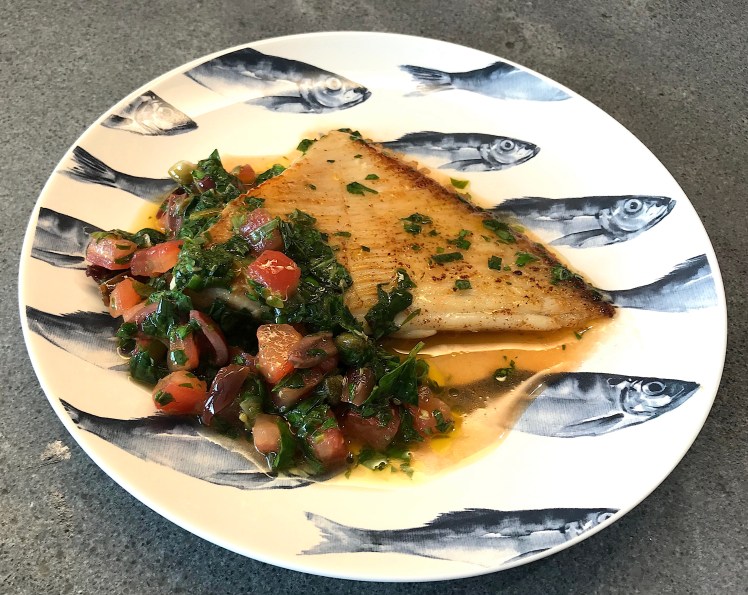
We prepared her fish cakes with a beetroot, ginger, apple and onion chutney. The fish cakes are intriguing and the chutney is the perfect accompaniment. Yummy!

Belgian Endive with Cheese Sauce and Ham

When asked for a typical Flemish dish, award winning chef Jeroen Meus immediately mentioned Belgian Endive with Cheese Sauce and Ham.
At home we found the recipe in my mother’s kookschrift, a notebook with recipes she learned as a young woman. She would cook the dish often, typically on a Sunday evening, and serve it with mashed potatoes. Her recipe is fairly straightforward: wash and clean the Belgian endive and cook it for 30 minutes (the recipe is from 1950!) in salted water. Then make a béchamel sauce, add cheese, wrap the endive in ham, spoon the sauce over the vegetables, add butter and breadcrumbs and transfer the combination to the oven for 15-20 minutes. Done!

Actually, her recipe is not very different from how Jeroen Meus prepares the dish. He doesn’t use breadcrumbs and he adds nutmeg and a splash of lemon to the sauce. He suggests steaming or braising the endive.

Most recipes mention removing the bitter core of the Belgian endive. Perhaps that was necessary in 1950, but today’s Belgian endive is not as bitter, so there is no need to do that. Belgian endive must have some bitterness.

Wine Pairing

Enjoy your Belgian Endive with a nice glass of red wine, one with a bite and not too complex. For instance a blend of Cabernet Sauvignon and Syrah from France, a Carmenère from Chili or a Spanish Rioja (Crianza or Joven). 

What You Need

  • For the Endive
    • 4 Belgian Endive
    • 4 slices of Excellent Organic Cooked Ham
    • For the Cheese Sauce
      • 20 grams of Flour
      • 20 grams of Butter
      • Milk
      • 75 grams of grated Cheese (preferably a combination of Gruyère and Emmentaler)
      • optional: one Egg Yolk
    • Nutmeg
    • White pepper
  • For the Mash
    • Root Parsley
    • Parsnip
    • Nutmeg
    • Fresh Parsley
    • White Pepper

What You Do

  1. Chop the bottom of the base of the endive and remove the outer leaves if they don’t look great
  2. Steam the endive or braise in butter. We prefer braising in butter, which may take 30 minutes on low heat. This way you keep all the flavors and the texture. If steamed: make sure you squeeze the endives gently to get rid of the water excess
  3. Make the cheese sauce with flour, butter and milk, adding most of the grated cheese when the béchamel is ready
  4. Add grated nutmeg and white pepper to taste
  5. You could turn it into a classic Sauce Mornay by adding one egg yolk to the sauce
  6. Preheat the oven (200°C or 390 °F). Wrap a piece of ham around each endive and arrange in a shallow baking dish. You don’t want any space between the endive
  7. Spoon the sauce over the endive
  8. Sprinkle remainder of the cheese over the sauce
  9. Bake until golden brown on top, 15 to 25 minutes
  10. We prefer using the grill

For the Mash

  1. Clean and dice the root parsley and the parsnip (ratio 1:1)
  2. Cook quickly in a limited amount of water
  3. When ready, drain and mash using a blender
  4. Add nutmeg and white pepper
  5. Just before serving add lots of finely chopped fresh parsley.

The 2022 Johannes van Dam Prize

Today the program of the 7th Amsterdam Symposium on the History of Food closed with the Prize-giving ceremony of the 2022 Johannes van Dam Prize and the 2022 Joop Witteveen Prize. Previous winners of the prestigious Johannes van Dam Prize include Yotam Ottolenghi, John Halvemaan, Carlo Petrini, Alice Waters, Claudia Roden and Alain Passard.

Joop Witteveen Prize

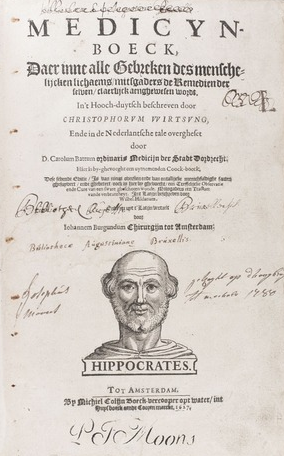
The Joop Witteveen prize was awarded to Marleen Willebrands, Christianne Muusers and Alexandra van Dongen, authors of Het Excellente Kookboek van doctor Carolus Battus. This book focus on the culinary world of doctor Battus, who lived from 1539 until 1619. His cookbook was published in 1593.

Two publications were shortlisted: Dirk-Jan Verdonk, Dierloos: Een geschiedenis van vegetariërs en veganisten in Nederland and Ingrid de Zwarte, Hongerwinter.

Marleen Willebrands and Christianne Muusers

Johannes van Dam prize

The 2022 Johannes van Dam prize was awarded to Belgian Chef Jeroen Meus. He is well known for his inspiring daily TV program Dagelijkse Kost (Daily Food). In this 15 minutes program he shares the fun of preparing food, for instance crumble pie with pears and raisinsmonkfish with a mustard crust or penne with chorizo and red bell pepper. His aim is not to cook on Michelin Star level, his aim is to help everyone prepare tasty, good food, every day of the week. His books and website (in Dutch only) support this goal in a very helpful way.

Professor Louise O. Fresco, President of the Executive Board of Wageningen University & Research and chair of the jury, emphasised that Jeroen has a true talent to bring food and people together. She also highlighted his passion to prepare good food, and the fact that he shares that passion not only through cookbooks, but also via social media and a daily show on television. She mentioned he is an inspiration to all of us who love to cook and enjoy food.

Jeroen thanked the jury and all those who supported him over the years. He mentioned that he shared the love for meatballs with potato mash and endive (Chicorium endivia) with culinary journalist and food expert Johannes van Dam. He promised to prepare this dish next week on television, as a tribute to good food and to the prize.

Choucroute

A classic choucroute is a tribute to winter food. You could go for a rich version with confit de canard or pheasant (Choucroute d’Alsa­ce) or for an unexpected combination with fish (Choucroute de la Mer). We decided to make a simple but very tasty version with pork sausages, bacon and pork meat.
The choucroute is moist and soft, the meat comes with some nice fat and a light smoky aroma, the juniper berries are full of flavours. Ah, it makes you love winter.
Preparing choucroute can be done in various ways, including cooking in water. We prefer the slow approach in an oven at 80° Celsius or 175° Fahrenheit during four to six hours.

Some add goose fat to the choucroute to enhance the taste, but that’s too much for us. We actually prefer a light version of the vegetable, allowing the meat to bring fat to the dish and a velvety mouthfeel.

Wine Pairing

The obvious choice is probably a white wine from the Alsace region in France. Which is exactly what we did. We were looking for a refreshing, round white wine and decided to drink a glass of Pinot Gris as produced by Cave de Beblenheim. Perfect with the present flavours of the choucroute.

What You Need

  • 400 grams of Sauerkraut
  • One Shallot
  • Juniper Berries
  • Caraway seed
  • 4 strips of Bacon or Pancetta
  • Dry White Wine
  • Olive Oil
  • Two Bay Leaves
  • Various Sausages and Pork Meat (all organic)
  • Dijon Mustard
  • Optional: a mash made with Parsnip and Parsley Root

What You Do

Taste the sauerkraut. If too much acidity, then squeeze and remove some of the liquid. Peel and slice the shallot. Crush the juniper berries and the caraway seed lightly. Slice the strips of bacon or pancetta in 6 or 8. Combine the sauerkraut with the shallot, the caraway seed, the berries and the bacon. Add some white wine, a splash of olive oil and two bay leaves. Transfer the mix to a heavy (iron) oven dish. Put some aluminium foil on top of it, making sure you press it on the sauerkraut (as if it’s a cartouche). Leave for 4 – 6 hours in the oven on 80° Celsius or 175° Fahrenheit. Check the choucroute every hour to make sure it’s sufficiently moist. Also move the slightly browned choucroute at the edge to the centre of the dish. One or two hours before serving add the meat to the dish. Serve with some Dijon mustard.

Antonio Carluccio’s Oysters with Bianchetto

Last Saturday we were extremely lucky. Not only did we buy the very first fresh morels of the season, we also bought a small bianchetto. This affordable white truffle is available from mid January to the end of April. It is also called March truffle (marzuolo).

In his book Complete Mushroom Book, Italian chef Antonio Carluccio combines fresh oysters with a white wine sabayon and white truffle: Ostriche con zabaglione e tartufo bianco. The result is spectacular. The combination of the distinct aroma of the white truffle with the oyster is intriguing. The sabayon brings everything together in terms of taste, consistency and structure. And just to show you how clever Carluccio’s combination is: the sabayon in itself is not pleasant. We prepared the dish with bianchetto. Maybe less subtle than when prepared with a white truffle, but the result is nevertheless wonderful.

Wine Pairing

With such a great dish you many want to drink a glass of Chablis or Champagne. We enjoyed a glass of Crémant de Bourgogne, produced by Vitteaut-Alberti. A refined wine, soft and with delicate fruit. The bubbles are small and pleasant.

Oysters a la Carluccio © cadwu
Oysters à la Carluccio © cadwu

Coq au Vin

One of our favourites for a grey, wintery evening. Warm, rich and full of flavours.
Let’s first talk about the chicken: we prefer using chicken thighs, organic, obviously. Great texture, layered and a bit of fat. You could also use chicken legs, but then we suggest removing the main bone; you don’t want to struggle while eating.

The second main ingredient is the red wine. A classic Coq au Vin is made with Bourgogne, a relatively expensive red wine from France made from Pinot Noir grapes. According to some people the wine you use for the stew must be the same that accompanies the dish. Which would mean that part of your beautiful Bourgogne ends up in the stew. Hm. We think that the background of this ‘rule’ is about the quality of the wine you use for the stew: it must be a nice, dry, red wine; one you would be perfectly happy to drink. So not some left over red wine, or a wine you didn’t like. A perfect stew requires quality ingredients, that’s all.

The third main ingredient is the pearl onion, that lovely small, silver onion. Great to pickle, but for a Coq au Vin you need fresh ones.

Wine Pairing

We enjoyed our Coq au Vin with a glass of Révélation Pays d’Oc Syrah-Viognier produced by Badet Clément. It’s a full-bodied wine with flavours of blackberry and spices. Touch of oak as well. The 15% Viognier gives the wine a nice, light touch. Great wine for a very reasonable price.

What You Need

  • 2 Chicken Thighs
  • 4 strips of Pancetta or Bacon
  • 14 Pearl Onions
  • 100 grams Mushrooms
  • 2 Garlic Gloves
  • Chicken Stock
  • Red Wine
  • Water
  • Bouquet Garni (Bay Leaf, Parsley, Thyme, Rosemary)
  • Black Pepper
  • Chopped Parsley
  • Olive Oil
  • Snow Peas (Mangetout)
  • Nutmeg

What You Do

Clean and quarter the mushroom, slice the strips of pancetta or bacon in four, peel the onions, slice the thighs in two or three, peel the garlic and chop. Add olive oil to a warm heavy pan. Begin by frying the pancetta or bacon until crispy. Remove from the pan and let drain on kitchen paper. Add (whole) pearl onions to the pan and fry until golden. Remove from the pan and let drain on kitchen paper. Add mushrooms to the pan and fry until golden. Remove from the pan and let drain on kitchen paper. Add chicken thighs to the pan and fry until golden. When golden add the garlic and fry for 3 minutes on medium heat. Add pancetta, mushrooms and onions to the pan. Add chicken stock, red wine and perhaps some water. The chicken should be nearly covered. Add bouquet garni and leave to simmer on low heat for 30-45 minutes, depending on the size of the chicken. 

Remove chicken, mushroom, pancetta, garlic and bouquet garni from the pan. Discard the bouquet. Return one or two mushroom to the liquid. Transfer the remaining ingredients to an oven at 60 °C or 140 °F. Blender the liquid for one minute. Reduce the liquid until it has reached the right consistency. The fun is that a liquid thickened with blended mushrooms doesn’t split. Return the ingredients to the sauce and boil the snow peas. Combine the coq au vin with the parsley, add some black pepper. Steam or quickly cook the peas, coat with excellent olive oil and add some freshly grated nutmeg.

Coq Au Vin ©cadwu
Coq Au Vin ©cadwu

The Chef of Kings

Just a few years before the height of the French revolution, Antonin Carême was born in the poorest area of Paris. He was abandoned by his parents and at the age of 10 he started his career by sweeping floors of a chophouse. It turned out to be the career of a celebrity. He was not only King of Chefs, he was also Chef of Kings: amongst them Napoleon, the Prince Regent (later George IV) and Tsar Alexander I.

365 Menu’s

At the age of 21 the influential politician Talleyrand asked him to become chef at the Château de Valençay. On instruction from Napoleon, Talleyrand would entertain 4 times per week for at least 36 (foreign) guests. Carême was asked to create a menu for every day of the year, without repetition. And since meals were served a la Française (a variety of dishes served simultaneously) this meant Carême had to create many dishes. Fortunately, he kept note of what he served and how he prepared it.

In his inspiring book Cooking For Kings, the live of Antonin Carême, The First Celebrity Chef, author Ian Kelly introduces us to the world of Antonin Carême. In a very easy to read, inviting way he describes the menus and food as created by Carême.  For instance, on page 76 he includes the menu as served on June 8th, 1806 at the Château: two soups, followed by twelve dishes and four desserts, including intriguing dishes such as Young Turkey in Watercress and Flan Milan. All menus and recipes from his days at the Château are included in his book Le Maitre d’Hotel Français (Paris, 1822).

Potage

Soups were important to Carême and since he served at least two soups per menu, the number of soups he created is more than impressive. Some seem a bit outdated (Potages d’anguille de Seine au pêcheur (with eel from the Seine)), others would be perfect in today’s kitchen (Potage de purée de d’oseille et du cerfeuil (with sorrel and chervil)).

At the end of his career Carême was asked by James Mayer and Betty de Rothschild to become their chef. Carême, who basically had already retired because of his very poor health, was tempted by a more than generous budget and accepted. The couple also supported his writing. De Rothschilds, very much nouveau riche, intended to achieve a position in the Parisian high society by hosting gala’s, lunches, dinners and receptions.  Of course, with Carême leading, they were very successful. Amongst their regular guests were Heinrich Heine, Frédéric Chopin, Victor Hugo and Gioacchino Rossini. They also regularly invited the press enhancing the celebrity status of Carême even more. And in his slipstream, they became more important.

Last Years

During his last years (he died aged 48 probably due to inhaling toxic fumes of the coal burning stoves) Carême wrote L’Art de la cuisine française au dix-neuvième siècle. Traité élémentaire et pratique. Five volumes, nearly 1700 pages with menus, recipes and drawings. A clear legacy of a Chef who is still remembered for his Charlotte Russe, the Tournedos Rossini, his systemisation of the kitchen and the four mother sauces.

Cooking For Kings, the live of Antonin Carême is a tribute to a devoted, extremely talented chef. The book includes several very interesting recipes, for instance Gelee de Verjus and Petits Croustades de Cailles. Perhaps old school, but nevertheless worth trying!

Quails and Snails in a Green Sauce

Many years ago we were looking for a place to eat in Fréjus. It was our last evening in France before returning home and obviously we were looking for something special, something typical Provençal. The area of our hotel wasn’t very promising, so we were ready to settle for pizza until we saw a small restaurant with a very interesting menu. It offered Tisane de RomarinCailles et Escargots and many other exciting dishes we unfortunately can’t remember. We entered the restaurant and had a perfect evening.

Combining quails and snails isn’t the most obvious idea, but rest assured, it works beautifully, also thanks to the very intriguing green sauce. It took us some time to make the sauce as it should be, but after a few attempts we think this is the right bridge between the quails and the snails.

Of course, we made a note of the name of the restaurant and of course, we lost it. A pity, although preparing this dish brings us back to a lovely evening in Fréjus.

Wine Pairing

Enjoy your Quails and Snails with a glass of Bourgogne: a chardonnay with a touch of oak. The wine must be dry, mineral and medium bodied. We enjoyed a glass of Bourgogne as produced by Louis Jadot. The wine partly matured in stainless steel tanks and partly in oak barrels. The result is a wine that has citrus and apple aromas in combination with oak and vanilla. Great with the freshness of the herbs and the richness of the sauce. It balances very well with both the quails and the snails. Two sides to everything in this dish!

What You Need

  • 2 Quails 
  • 6 Snails (click here when you want to know which snail to buy)
  • For the Sauce
    • 1 Bunch of Parsley
    • ½ Bunch of Tarragon
    • A few Leaves of Young Spinach
    • Cream
  • Vegetable Stock
  • Olive Oil
  • White Pepper

What You Do

Wash the snails with plenty of water. Set aside. Clean the quails. Best is to use the breasts only. (You could also serve the legs, provided you remove the main bone. It’s a bit of extra work, also for your guests.) Make sure you have a warm heavy iron skillet ready and a small pan with warm vegetable stock. Set your oven to 60 °C or 140 °F.

Blanch parsley, tarragon and spinach in boiling water and cool immediately in ice water. Blender parsley, tarragon and spinach with some ice water until you have a very smooth green liquid. Set your blender to turbo! Press using a sieve and store the green liquid. It will remain stable for at least an hour.

Fry the breasts quickly in olive oil. Warm the snails in the vegetable stock. Transfer the breasts to the warm oven. Clean the pan with kitchen paper, add cream and chicken stock. Let reduce for 5-10 minutes or until you’re happy with the consistency. Add liquid from the quails. Stir and taste. Perhaps some white pepper? Add green liquid until you have the right colour and taste. Be very careful, if you overheat the sauce it will lose its vibrant green colour. Serve the breasts and the snails in the sauce.

Quails and Snails in a Green Sauce ©cadwu

The King of Chefs

He was born in the Rue du Bac (Paris) in June 1784. Today a fashionable street, well known to many because the prestigious department store Le Bon Marché is located on the corner with the Rue de Sèvres. In his days the area was a swamp with housing for the very poorest of Paris.
He was named after Queen Marie Antoinette, which wasn’t a great idea because she was beheaded only 9 years later during the peak of the French Revolution. He changed his name to Antonin and later he would sign his books and menus with Antonin Carême de Paris.

Abandonded

When he was only ten years old, his father left him at one of the gates of Paris. Fortunately, he was picked up by the owner of one of the many Parisian chophouses. This is where he learned his first cooking skills. Six years later he started with the famous Pâtissier Sylvain Bailly. He became a Master of Pastry, Sugar and Pâtisserie in general. It wasn’t long before his talent was recognised by the influential statesman Talleyrand.

As a young man Antonin Carême would spend his free afternoons at the library, studying and researching ancient recipes and (Greek and Roman) architecture. He became an expert in drawing, a skill he used to design and create pièce montéesextraordinaires, huge table pieces made from sugar, reflecting a roman temple, a Greek building, a fountain etcetera. These extraordinaires could be used to serve food, but more importantly they were elegant masterpieces. In some cases, it took him 6 weeks to create a pièce montée.

Author

He made notes of everything he prepared and published various cookbooks (that sold very well). His aim was to explain how to prepare a dish, not to impress the reader. The cookbooks include his own beautiful drawings and many detailed menus. Amongst his creations are over 100 soups and the delicious Charlotte Russe. He perfected and popularised Mille-Feuille, Vol Au Vent and Croquembouche. He is one of the three main chefs of the Haute or Grande Cuisine (the others are François-Pierre de La Varenne and Auguste Escoffier). He was one of the first to study how to combine wine and food. As part of the systematisation of French cuisine he introduced the four main sauces: Béchamel, Velouté, Espagnole and Allemande.

Cooking For Kings

In his inspiring book Cooking For Kings, The Life of Antonin Carême, The First Celebrity Chef, author Ian Kelly introduces us to the live of Antonin Carême. In a very easy to read, inviting way he shows us how Carême developed from a poor boy into a culinary, artistic talent. One that not only influenced his own generation but also many to come. His focus on detail, hygiene, the use of fresh ingredients and aesthetic presentation is still very much part of today’s kitchen.

Cooking For Kings, the live of Antonin Carême is a tribute to a devoted, extremely talented chef. The book includes several very interesting recipes, for instance gâteau pithivier and cold salami of partridges. Perhaps old school, but nevertheless worth trying!

PS

We’re still looking for a hard copy of French Cookery: comprising L’Art de la Cuisine Francaise; Le Patissier Royal; Le Cuisinier Parisien (translated by William Hall; published in London, 1836). Anyone? Thankfully the book has been digitised!

Escargots de Bourgogne

We noticed that more and more supermarkets and shops sell snails. Canned, frozen or with garlic butter ready to be cooked in the oven, all very tempting. Snails are high on protein, low on fat, high on minerals, low on calories. A glass of white wine and some crusted bread; what more do you need as a healthy starter?
But before buying snails it’s important to look at the label and find out what kind of snail you’re buying.

The snail used for the classic Escargots de Bourgogne is called Helix Pomatia. It’s protected in many countries. Farming of this snail is not profitable. Excellent taste, expensive and hard to find.
There are three alternatives: Helix Aspera (either the small one called Petit Gris or the large one called Gros Gris) and Helix Lucorum. The last one is considered to be less tasty than the other three, but when prepared well, it’s a very nice, affordable alternative. All three can be farmed.

It could also say Achatina on the label. This is a different kind of land snail, much larger than the first four. It’s taste and texture are okayish.

Sometimes it simply says ‘Escargots’ and ‘Gros’ on the tin. Sounds good, doesn’t it? Well, it may and it may not. Some companies cook larger (sea) snails, chop these, and sell the chunks as ‘Escargots’. The term ‘Gros’ is supposed to make you think of the Gros Gris. Don’t be fooled: they are rubbery, tasteless and a waste of money.

The classic Escargots de Bourgogne are prepared with butter, garlic and parsley. We like to add a bit of tarragon and a pinch of salt. Traditionally they are served in the shell and you need a tong and a special fork to eat them. The ones we use are from a can, so no special equipment required. 

Wine Pairing

The obvious choice is a glass of Bourgogne: a chardonnay with a touch of oak. The wine must be dry, mineral and medium bodied.

What You Need

  • 12 snails
  • Butter
  • Parsley
  • Garlic
  • Tarragon
  • Salt
  • 2 Snail Plates

What You Do

You could of course buy fresh snails (which makes us think of the amazing market in Valencia! So much choice, such excellent quality. Also various kinds of snails, fresh and alive, obviously, also the Caragolus, the snail that is required when you prepare a traditional Paella Valenciana) but otherwise buy them canned. Remove them from the can, wash carefully with lots of water and set aside.

Chop parsley, tarragon and garlic very fine. Using a fork, combine butter, herbs, garlic and a pinch of salt. Transfer six snails to a snail plate, add a chunk of butter to every snail, transfer the snail plate to an oven at 160 °C or 320 °F for 10 minutes or until boiling hot. Serve the snail plate on a cool plain white plate.

Escargots de Bourgogne ©cadwu