Roasted Bell Peppers

The recipe of Peperoni alla Piemontese goes back to 1954 when Elizabeth David published it in her (third) book Italian Food. The dish is a true classic. Super simple, tasty, uplifting and a tribute to summer.  The recipe as published by Elizabeth David was popularised by Delia Smith in her TV series and her book Summer Collection, published in 1993. A helpful video is available via her website.
Bell peppers are popular in Piemonte and it seems they were originally prepared with anchovies and parsley only. It was probably Elizabeth David who came up with the idea to add tomatoes. Later others added tuna, which we think takes away the lightness of the dish. Another option is to replace the anchovies with black olives, making it a vegetarian dish.
We prefer using sweet long bell peppers. They combine very well with the flavour of the tomatoes and the juices. Delia Smith uses quartered, peeled tomatoes which helps to brings the flavours and textures together. Our alternative is a bit more work: we use tomato confit. The tomatoes are very tasty with hints of garlic, rosemary and thyme.

Wine Pairing

Enjoy the roasted peppers with a crisp white wine or rosé. If you want to spend some money, then buy a bottle of white Piemonte wine, made with the arneis grape. The wine is made in the Roero area close to the village of Canale. A wine with a bright, intense yellow colour, present aromas of ripe fruit (especially apples), very fragrant. The taste is delicate and fruity with good acidity and a long finish.

What You Need
  • 2 Sweet Bell Peppers
  • 8 Tomato Confit
  • 4 Anchovies
  • 1 Clove of Garlic
  • Black Pepper (optional)
  • Olive Oil
What You Do

Preheat your oven to 180 °C or 350 °F. Halve the bell peppers lengthwise. Slice the garlic. Chop the anchovies. Use a shallow baking dish. Add 2 tomatoes, some garlic, some anchovies and a generous amount of olive oil (and/or cooking juices of the confit) to each halved bell pepper. Transfer to the oven. The peppers will be ready in 30+ minutes. Enjoy with crusted bread. No need to serve with basil!

Apricot Chutney

It’s the time of the year to benefit from summer fruit, such as peaches, watermelon, raspberries, nectarines, strawberries and of course apricots. With a bit of patience (and sugar, lemon and perhaps nutmeg) you can turn apricots into a delicious jam. But why not make apricot chutney? Great to enjoy with grilled lamb chops or something nice, simple and vegetarian, for instance with rice, lentils and cilantro.
Chutney is a balance of sweet (fresh fruit, onion, garlic, cinnamon), sour (vinegar), bitter (the skin of the apricot or tomato), spiciness (ginger, red chilli, garlic) and depth (cardamom, nutmeg, cumin). Too much sugar will only disturb the balance. Chutney needs to integrate, much more than jam or marmalade. So cook it for an hour or so and leave it in a jar for at least a week before using it.

What You Need

  • 1 kilo stoned Apricots (meaning 1,25 kilo of Apricots)
  • 2 Shallots
  • Olive Oil
  • 4 gloves Garlic
  • 1 Red Chilli
  • 100 ml Vinegar
  • 100 ml Water
  • 100 grams of Sugar
  • Fresh Ginger
  • Spices such as
    • Cardamom
    • Mustard Seed
    • Coriander (Cilantro)
    • Cinnamon
    • Nutmeg
    • Cumin
    • Clove

What You Do

Stone and quarter the apricots. Cut the shallots in 4 and slice (not too thin). Slice the fresh garlic. Same with the seeded red chilli. Cut let’s say 5 cm of ginger in small bits. Start by glazing the shallots for 10 minutes in olive oil, making sure they will enhance the sweetness of the chutney. Then add all other ingredients to the pan, mix, add the grated ginger, the spices of your choice, mix and bring slowly to a simmer. We used vinegar and water given the acidity of our apricots. If your apricots are really sweet and ripe use 200 ml of vinegar. Spice-wise we prefer using cardamom, cinnamon, and a touch of cumin and nutmeg. Leave to simmer for at least one hour. Stir occasionally but gently. After an hour increase the heat and transfer to very, very clean glass jars. Close the jars, leave them to cool a bit, then put in cold water and later on transfer to the refrigerator.

Slide show Apricot Chutney

Salmorejo

A delicious, rich, creamy, velvety, elegant, complex, delicious, cold tomato soup from Andalucía (southern Spain) with lots of generous flavours. It is ideal on a hot summer’s evening and great as a vegetarian starter. It is very simple to make: purée skinned, fresh, ripe tomatoes with stale, white bread, olive oil and garlic. Garnish with Jamón Serrano (also from Andalucía) and hard-boiled egg.

Salmorejo and Gazpacho are very different soups. Gazpacho comes with red bell pepper, chili and onions; Salmorejo is purely about tomatoes and is much creamier and softer, because bread is a key ingredient. It’s nice to decorate gazpacho; Salmorejo must be garnished. Salmorejo is a beautifully balanced soup.

Removing the skin is mandatory when making Salmorejo. The idea to roast the tomatoes is a twist that enhances the flavours of the tomatoes, but it is not part of the original Salmorejo, so feel free to skip this step.

What You Need

  • 500 grams of Excellent Ripe Tomatoes
  • Slice of stale White Artisanal Bread without the crust
  • 1 small Garlic Clove
  • 1 tablespoon of Jerez Vinegar
  • Olive Oil
  • 1 hard-boiled Egg
  • (optional) diced Serrano Ham
  • Black Pepper
  • (optional) Salt

What You Do

Peel the tomatoes. Soak the bread in water for 10 minutes. Optional: slice the tomatoes in two and transfer to an oven (200 °C or 390 °F) for 15 minutes and let cool. Chop the garlic clove. Blender the tomatoes, the bread (and the water) and the garlic until very smooth. It should be really smooth, cream like; this may take 1 minute on turbo! On low speed add the vinegar and slowly add the olive oil. Taste, add salt and pepper if required and perhaps some more olive oil. Allow to cool for at least 2 hours.
Serve in cold bowls and garnish with roughly chopped hard-boiled egg and diced Serrano ham.

PS

If you enjoy cold soups as much as we do, then we have more recipes for you: Gazpacho, Ajo Blanco and Avocado and Cucumber Soup.

Salmorejo ©cadwu
Salmorejo ©cadwu

Fleurs de Courgettes Farcie

Such a pleasure to see courgette flowers in your garden or at the greengrocers. The young courgette is firm and tasty; the flowers a beautiful yellow. Simply stuff the flowers, fry in a pan or cook in the oven and you have a great side dish or starter. And then you start wondering: ‘Stuff with what? Cheese? Salmon? Mushrooms? Tomatoes? Ricotta? Vegetable Mousse?’
Earlier we described a simple, tasty vegetarian version. This recipe requires a bit more work, but the result is delicious and beautiful. Crab and courgette go together very well; it’s a well balanced combination with surprisingly delicate flavors.

Wine Pairing

Obviously a nice glass of Côtes de Provence Rosé is an excellent choice. But you could also go for a white wine, for instance a Macon-Villages as produced by Bouchard Père & Fils. In general a subtle wine that goes well with the gentle flavors of both the crab and the courgette.

What You Need

  • One Courgette (small and firm)
  • One Garlic Clove
  • Olive Oil
  • Six Small Courgettes with their flower
  • Crab
  • Black Pepper

What You Do

Wash the courgette, dry and grate coarsely. Warm a small cooking pan, add olive oil and the grated courgette. Fineley grate the garlic and mix with the courgette. Leave for 20 minutes minimum on low heat. When ready, set aside and let cool.
Best is to use a leg of a fresh (littoral) crab, but you could also buy a can of most excellent crab. If using fresh crab, heat a pan with water, bay leaf and crushed black pepper corns; cook the crab for 10 minutes, remove from the water, set aside until cooler and then remove the meat from the shell. Be sure to remove all shards of shell. Set aside and let cool.
Remove the stamens from the flowers. Remove the end of the small courgette. Use a very sharp knife to slice the courgettes lengthwise in 3, making it look like a fan. Heat water in a pan and poach the small courgettes (not the flowers!) for 60-90 seconds depending on the size. Add some crab meat to the courgette mixture and taste. Keep adding crab until you’ve reached the perfect combination (or the end of the crab). Add some black pepper. Stuff the flowers, close them by slightly twisting the leaves of the flower, sprinkle with olive oil, making sure they are completely coated with oil. Heat your oven to 200° C or 390° F. Using the grill is a good idea. Transfer to the oven and cook for 10 minutes. The flowers should be crisp and perhaps a touch golden. Allow to cool for a few minutes before serving.

  • Fleurs de Courgettes Farcie ©cadwu
  • Macon Villages and Cotes de Provence ©cadwu

Cold Soup: Ajo Blanco

It’s September, time fo buy fresh almonds, walnuts and hazelnuts; time to make Spanish Almond Soup. It’s made of white almonds, water, old bread, garlic, olive oil, vinegar and perhaps a pinch of salt. And trust us, there is no need to add anything else. No cucumber, green apples, jalapeño, chicken stock, pepper, flowers, white grapes, milk, aioli, Balsamic vinegar, raisins, cream, yoghurt, pine nuts or melon. We love creativity, but the ingredients people suggest to brighten up Ajo Blanco, it’s amazing. Especially because there is no need to add anything to the original.

Mention Ajo Blanco and someone will say ‘white gazpacho’. Because both are cold soups, because both are from Spain? We can’t think of any other reason, so please, please don’t even think about gazpacho when you serve Ajo Blanco.

What You Need

  • 70 gram White Almonds
  • 200 ml ice-cold Water
  • 30 gram old stale White Artisanal Bread without the crust
  • 1 medium Garlic Clove
  • 1 tablespoon Jerez Vinegar
  • Pinch of Salt
  • 70 ml Olive Oil
  • 10 gram of Roasted Almonds

What You Do

Buy excellent almonds, so not the soft, bland ones from the supermarket. Start by very, very lightly roasting the white almonds in a dry non-stick pan. Let cool. Soak the bread for 10 minutes. Roughly chop the garlic. Using a heavy blender or food processor whizz the almonds, the garlic and some of the water until nearly smooth. Squeeze out the bread. Add bread and remaining water to the mixture. Continue blending. Add vinegar and salt. Check the mixture for taste and smoothness. It should be very smooth, cream like; this may take 1 minute on turbo! When happy with both smoothness and taste, slowly add olive oil with the blender running on low speed. Transfer the mixture to the refrigerator for at least two hours. Also cool the bowls you want to use.
Just before serving crush some roasted almonds and sprinkle these on the soup.

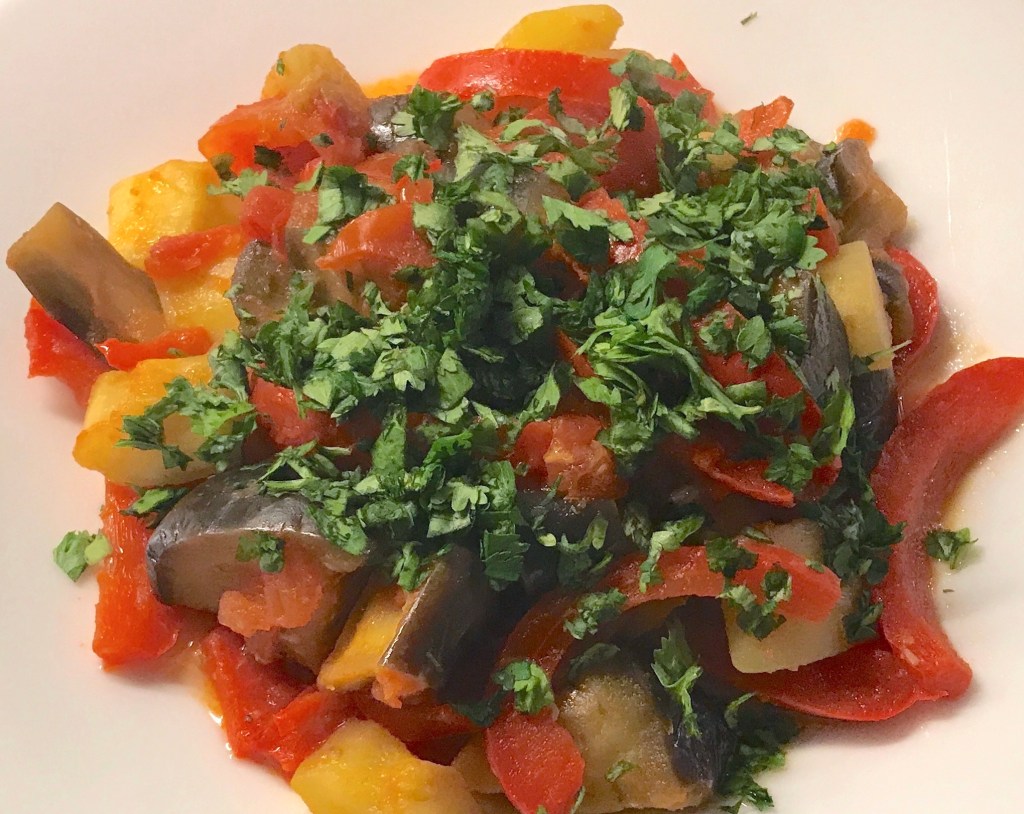
Ratatouille

Think summer vegetables, think Ratatouille! Which is also the title of a film released in 2007 about a rat called Remy with a passion for cooking. If you want to see how he prepares ratatouille then simply go to YouTube (or buy the DVD if you’re old fashioned like us).
Ratatouille brings back memories of summer, of the South of France, of the Mediterranean. It combines very well with a simple sausage, with lamb, with grilled chicken.
However you prepare your ratatouille, be sure to prepare it a day ahead. The taste becomes much more integrated after a day (or two) in the refrigerator. Unfortunately it doesn’t freeze well due to the eggplant.

Our recipe is very much the recipe of a dear friend. She taught us how to make ratatouille in her summer kitchen, overlooking the pool and the garden with herbs and vegetables. Indeed, fond memories.
To our surprise she added cilantro (you would expect thyme or basil) and many years later we are still grateful for this twist. The cilantro enhances the feeling of summer and it supports the various vegetables in a beautiful way.

Wine Pairing

We enjoyed our ratatouille with a glass of simple, red wine with lots of red and black fruits. Spicy with subtle tannins. A wine that brings summer to your glass.

What You Need (4 people)

  • 1 Eggplant or Aubergine
  • 1 Courgette or Zucchini
  • 1 Red Bell Pepper
  • 1 Chili Pepper
  • 4 Excellent Tomatoes
  • Cilantro
  • Olive oil

What You Do

Start by cutting the aubergine in small but not too small chunks. Drizzle with salt and mix. Let the mixture rest for a few hours, allowing for the aubergine to loose water and become firm. Best way to do this is by putting the aubergine in a sieve and let it rest above a bowl.
The tomatoes require some attention as well. You could peel them, but that’s optional. What is not optional is to separate the tomato meat and juices from the pits. First step is to remove the internal hard bits and the pits and put these aside. You now have the outer part of the tomato, which you can slice. Cut the remainder of the tomatoes roughly, add to a sieve and by using the back of a spoon make sure you capture the juices. Be surprised about the volume of tomato juice and the small amount of tomato bits and pits that remain in your sieve.

Cut the bell pepper into long slices and fry these in the pan with olive oil. Peel the courgette, slice in the way you sliced the aubergine and add to the pan. Continue frying. Add the finely chopped chilli pepper (not the seeds of course). Add the firm aubergine after having removed the remaining salt with water. After a few moments add the tomato chunks, fry a bit more, add the tomato juice and leave on low to medium heat for 60 minutes. Try not to stir too much; otherwise you risk creating mashed vegetables. Cool, set aside and store in the refrigerator.
The next day: if you have excess liquid, remove the vegetables from the liquid, reduce it until thickened and transfer the vegetables back into the pan. Otherwise gently warm the ratatouille, add some chopped cilantro, mix gently and add more cilantro just before serving.

Ratatouille ©cadwu
Ratatouille ©cadwu

Daube Provençale

On a warm summer’s evening, sitting on your terrace, relaxing and sipping rosé, you wonder what to eat. Perhaps something that will make you think of the beautiful Cote d’Azur, with the chirping of cicadas and aromas of pine trees? A Salade Niçoise or something more substantial?
That’s the moment to dive into your freezer and look for that last portion of Daube Provençale. Excellent beef, stewed in red wine and packed with flavours, olives and mushrooms.

Fortunately preparing Daube Provençale is not too much work (and it keeps well in the freezer). You can also be fairly flexible with the recipe. Well known chef Hélène Barale (La Cuisine Niçoise, Mes 106 Recettes) uses beef, veal and pork with tomatoes and dried mushrooms, Hilaire Walden (French Provincial Cooking) suggests marinating the beef in red wine and also adds orange peel and olives whereas the classic La Cuisinière Provençale published in 1897 and written by Jean-Baptiste Reboul suggests adding vinegar to the marinade but doesn’t use tomatoes, mushrooms or olives.

Wine Pairing

We prepared our daube with red wine from France, made from Cabernet Franc grapes and produced by La Tour Beaumont. In general you need a full bodied, fruity red wine, with a good structure. You could of course enjoy the daube with the same red wine, but the daube is flexible. Just remember that the flavours and aromas are intense. 

What You Need (2 portions for 2)

  • 750 grams of Excellent Marbled Beef (Blade Steak for instance)
  • ½ Carrot
  • Shallot
  • 3 Garlic Gloves
  • 250 grams of Mushrooms
  • 50 grams of Black Olives (Kalamata or Taggiasca)
  • Olive Oil
  • Bouquet Garni (Bay Leaf, Thyme, Oregano, Rosemary, Parsley, Chives and/or Sage)
  • 500 ml Red Wine

What You Do

Start by slicing the meat into nice, big cubes. Heat a heavy large pot through and through, add olive oil and fry the meat until brown. Probably you need to do this in two batches. Set the meat aside and fry the chopped shallot, the carrot and the garlic until smooth. Transfer the meat to the pot, stir well, add the red wine, the (halved) olives and the bouquet garni. Keep on low heat for 2 hours. Clean the mushrooms and add these to the pan. Keep on low heat for another two hours. Check if the meat is soft and tender. Quickly cool the pot and transfer the content to the refrigerator.

The next day label off some of the fat (we prefer not to do this, but feel free to do so). Divide the daube in two portions. One for the freezer, the other one to enjoy today. Warm the (halved) daube and remove some of the bigger mushrooms and four tablespoons of cooking liquid. Blender the liquid and mushrooms very fine and transfer back to the pan. This mixture will thicken the cooking liquid. Leave the daube to gently simmer for an hour. If the sauce has not yet reached the right consistency, then transfer cooking liquid to a separate pan and reduce on medium to high heat. Transfer back to the main pan and combine.

Serve with red bell pepper salad, pasta, polenta or boiled potatoes.

  • Daube Provençale ©cadwu
  • Ingredients of Daube Provençale ©cadwu
  • Daube Provençale ready to be stewed ©cadwu

Grilled Asparagus with Parmesan Cheese

We enjoyed this dish as a starter when in Milan, on a beautiful evening, eating al fresco and enjoying the wonderful combination of the sweetness and bitterness of the asparagus, the slightly caramelised sugars as a result of grilling the asparagus and the salty and sweet cheese. A glass of Pinot Grigio was all we wanted.
In Milan we enjoyed grilled green asparagus, but it works equally well with white asparagus.
This is typically a dish to prepare when the asparagus season is at its high and outside temperatures feel like summer.

Wine Pairing

Serve with a glass of Pinot Grigio, a Muscat or Pinot Gris from the Alsace region or a rosé with character. The wine needs to combine with a range of very diverse flavors so it should be a bit complex.

What You Need

  • 3 Asparagus per person
  • Olive Oil
  • Parmesan Cheese
  • Black Pepper

What You Do

Peel the asparagus and cook or steam until slightly tender. Depending on the size we would say 10-15 minutes in the Russel Hobss steamer. Leave and let cool. Take a plate, add some oil to the plate and use it to coat the asparagus with oil. Heat the pan and grill the asparagus for 4*1 minute, making sure you have a lovely brown (not too dark) pattern. Or use a contact grill for 2*2 minutes. Serve on a plate, add some grated Parmesan cheese and pepper. Add a generous drizzle of very excellent olive oil.

White Asparagus with Chervil

A salad can be an excellent starter of your lunch or dinner, provided it’s one with lots of flavour and gentle acidity. For instance a Salade Ni­çoi­se, a Salade Caprese or a salad of White Asparagus and Chervil.

Chervil is a very delicate herb. It tastes like anise, but it is much more refined. Chervil looses its taste almost immediately when heated. The salad needs to be prepared well in advance, allowing for the flavours to be well integrated.

Honey can easily ruin a salad (and sugar will always ruin a salad). In this case we use only a touch of honey to create an environment for the sweetness of the white asparagus. The honey should act as a trigger.

The salad is a great example of the complexity of white asparagus: you will taste the sweetness and the freshness of the asparagus. The mouth feel of the salad is very nice, because the asparagus will be both juicy and crispy, with the chervil, honey and vinegar in a supporting role.

After having mixed the salad you will notice that the asparagus and chervil absorb the dressing. During the time in the refrigerator the asparagus will loose some juices, which is actually the beginning of a great dressing.

Wine Pairing

Combining salad and wine is not straightforward. Especially the acidity of the dressing creates a challenge. One solution is to use verjuice and not vinegar. Verjuice is made by pressing unripe grapes. The idea is that verjuice links to wine, whereas classic vinegar or lemon juice would compete with wine. In this case we choose a wine that reflects the flavours of the salad: a hint of anise, a touch of sweetness and florality. Typical notes you will find in a wine from the Alsace region, for instance a Pinot Blanc or a Pinot Gris.

What You Need

  • 2 White Asparagus per person
  • Excellent Olive Oil
  • White Wine Vinegar or Verjuice
  • Lots of Chervil
  • Touch of Honey
  • White Pepper

What You Do

Steam the asparagus for 10 minutes. Let cool. Dry with kitchen paper if needed. Prepare a dressing with the olive oil and vinegar. Chop the chervil and add to the dressing. Add a touch of honey and stir well. Add some white pepper. Taste the dressing: it should be a balance, meaning that none of the ingredients is overly present. Now slice the asparagus in nice chunks, let’s say 3 centimetres long. Mix, cover and transfer to the refrigerator for 6 hours. Mix the salad every two hours. Check the taste after 4 hours, you may want to adjust. Mix the dressing just before serving.

Artichoke Salad

Love Your Artichoke

A beautiful flower and an intriguing ingredient. A large artichoke with some mayonnaise, mustard and vinegar makes for a wonderful, relaxing starter. The smaller ones are great when turned into a salad or when served with tagliatelle as a starter.
Steaming is the ideal way to prepare artichokes. The flavour remains intact and the leaves will become soft yet firm.
Don’t be tempted to buy preserved artichokes hearts. In most cases these are only about marinade, vinegar, sugar and unidentified spices. Whereas artichokes should be about taste and especially texture. It’s a thistle you’re eating and not something white and fluffy from a jar.
Key to this salad is the combination of artichokes and thyme. Lots of thyme! Enjoy the light, earthy and slightly bitter flavour of the artichokes in combination with the aromatic thyme.

Wine Pairing

You can serve this salad to accompany an aperitif, or with some bread as a starter.

What You Need

  • 6 small Artichokes
  • Olive Oil
  • (White Wine) Vinegar
  • Mustard
  • Thyme
  • Black Pepper

What You Do

Remove the stem of the artichokes and steam the artichokes for 30 – 45 minutes, depending on the size. Remove and let cool. Peel of the first layers of the outer leaves. Make the dressing by combining the oil and vinegar and then adding the mustard. Cut the artichokes in 6 or 8 parts. Add the dressing to the artichokes, mix well, making sure all artichokes are coated. Sprinkle lots of thyme and carefully mix again. Put in the refrigerator for at least 3 hours. Mix again, taste, add black pepper and perhaps some more thyme and serve!