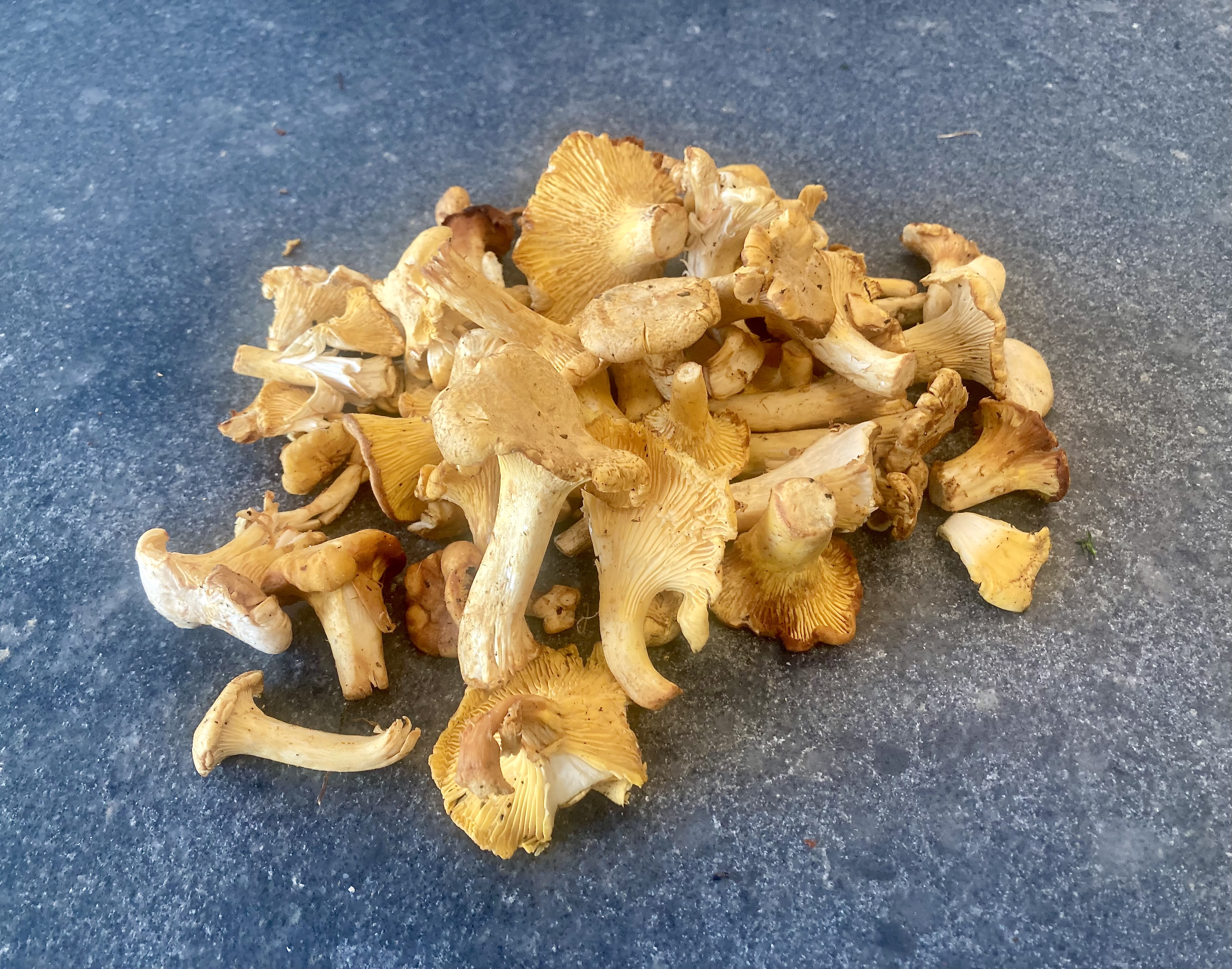
Tuberous chervil, also known as turnip chervil and bulbous chervil, is a forgotten vegetable. It was popular throughout continental Europe in the 19th century, but today it’s hard to find. Tuberous chervil is very tasty and easy to prepare. Its flavour will make you think of chestnuts, without a hint of bitterness. The ‘chervil’ in the name does not mean it’s the tuber of the chervil plant (like parsley and parsley root are related). It’s included because the leaves of tuberous chervil look like the leaves of chervil. The two are not related. As more often, the tubers were replaced by potatoes: cheaper, easier to handle and easier to grow.
Earlier we made a purée with tubers, cream, butter and nutmeg. Combine it with lamb chops and you have a very tasty meal.
This colourful, flavourful and aromatic oven dish goes very well with pork and chicken.
What You Need
5 Tuberous Chervil
1 Parsnip
1 Shallot
1 Carrot
1 Garlic Clove
1/2 teaspoon of Cumin
3 Pruneaux d’Agen
Handful of Chick Peas, drained and washed
Chicken Stock
What You Do
Preheat your oven to 180 °C or 355 °F
Chop the shallot
Chop the garlic
Chop the pruneaux
Wash and peel the parsnip and the carrot
If the tuberous chervils are young and fresh, you don’t need to peel them. The ones we bought were a bit older, so we peeled them
Quartered tuberous chervils
Slice the carrot
Dice the parsnip
Gently fry the shallot
Add garlic
Add cumin
Transfer to a shallow dish
Add tuberous chervils, parsnip, pruneaux, carrot and chickpeas
The combination of rhubarb and strawberry is delicious. It’s sweet, sour, tangy and tart with a touch of bitterness. The seasons of rhubarb and strawberries overlap for only a few weeks (late spring, early summer) so don’t wait too long if you want to make jam or this dessert. The crumble brings warmth and depth to the dessert, thanks to the use of allspice, cinnamon and nutmeg. Filling and crumble are complementary with regard to texture, flavour and aroma.
What You Need
Filling
4 stalks of Rhubarb
400 grams of Strawberries
1 tablespoon of Lemon Juice
2 teaspoons of White Sugar
Crumble
40 grams of Unsalted Butter
40 grams of Light Brown Sugar
30 grams of All Purpose Flour
70 grams of Almond Flour
1/2 teaspoon of Cinnamon
dash of Nutmeg
3 finely ground Allspice berries
What You Do
Pre-heat your oven to 180 °C or 355 °F (traditional)
Wash and dry the rhubarb and the strawberries
Slice the rhubarb in 1 cm (0,4 in) slices
Slice smaller strawberries lengthwise in 4, bigger ones in 6
Combine sugar, flour, almond flour, cinnamon, nutmeg and allspice
Cut the butter in small cubes
Use your hands to combine butter and the mixture until you have a crumbly dough
Combine rhubarb, strawberries, lemon juice and sugar
Add the fruit mixture to a ceramic oval oven dish
Top with the crumble
Transfer to the oven for 25 minutes
The crumble is ready when the colour is golden brown and the fruit is bubbly around the edges
If the fruit needs more time, reduce the heat to 150 °C or 300 °F
Serve at room temperature with a scoop of vanilla ice cream
PS
As many other we thought allspice should be spelled ‘all spice’ and that it is a mixture of various spices. It isn’t. Allspice is the lightly fermented and dried unripe berry of a tree called Pimenta Dioica. Best to buy berries and ground these in a mortar. A few days later we added ground allspice to a beetroot salad. A winner!
Today, April 27th, we celebrate the birthday ol King Willem-Alexander of the Netherlands. Hip hip hurray! The Dutch royal family is also known as ‘de Oranjes’, which is reflected in the use of the colour orange when referring to Dutch royalty. There is no link between the royal family and the colour. The ‘orange’ in their name refers to the French city of Orange, a Principality one of his ancestors inherited in 1544. Over the years we prepared Orange Sabayon, Queen’s Soup, Orange and Almond Cake, Bouchée à la Reine, Orange Flan, Canard à l’Orange, Baba au Mandarine Napoléon and Orange Parfait on this day.
This year we prepare a Carrot Cake. Given its English origin we thought it would be best to use an English recipe as a starting point. What better cookbook to use than Harrods Book of Traditional English Cookery by Hilaire Walden! It includes recipes for dishes such Jugged Kippers, Rabbit in the Dairy and Dorset Apple Cake. Buy this wonderful book via the usual channels for a few euros or dollars.
Bake the cake 2 days before serving. Add the topping, transfer to the refrigerator and serve cold.
The recipe is for a 19 cm (7,5 inch) baking tin and the cake will serve 8 people.
What You Need
Cake
125 grams of Butter
150 grams of light Brown Sugar
3 Organic Eggs
3 teaspoons of Orange Rind
15 ml of Lemon Juice
175 grams of Flour
8 grams of Baking Powder
35 grams of ground White Almonds
75 grams of chopped Walnuts
50 grams of White Raisins
250 grams of grated Carrot
Topping
200 grams of Soft Cheese
1 teaspoon of Honey
1 tablespoon of Lemon Juice
25 grams of chopped Walnuts
45 grams of white Marzipan for the carrots
10 grams of white Marzipan for the green part
Food colouring: Red, Yellow and Green
What You Do (Cake)
Preheat your oven to 180 °C or 350 °F, traditional
Coat a round cake tin with butter
Coarsely grind the almonds
Coarsely grind the walnuts
Sift flour and baking powder and combine
Soak the raisins for 10 minutes; discard the water
Grate the carrot
Grate the orange rind
Melt the butter until soft
Combine butter and sugar until relatively fluffy
Combine flour, baking powder, chopped walnuts and almonds
Separate the eggs
Whisk the egg whites until stiff
Add the egg yolks to the butter and sugar mixture, combine
Add orange rind, raisins and lemon juice to the mixture, combine using a spoon
Add the combination of flour, baking powder and nuts to the mixture
Add carrots to the mixture and combine
Fold in the egg white
Transfer to the oven for 50 minutes
Leave to cool on a wire rack
Keeps well on room temperature for at least 2 days
What You Do (Topping)
Make 3 small orange balls
Press these into the shape of a carrot
Use a knife to make a few superficial slices
Roll out the green marzipan, cut out 3 circles and create the green part
Beat cheese, honey and lemon juice
Taste and adjust; we added extra lemon juice
Spread evenly over the cake
Sprinkle with walnuts
Decorate with three carrots
Once you’ve added the topping, store in the refrigerator
We love white asparagus and traditionally we make classic white asparagus at the start of the season. We have prepared a range of dishes with asparagus and are always keen to try something new. Recently we saw a recipe for Spaghetti Carbonara with Asparagus. Wrong idea. Spaghetti Carbonara is an iconic Italian dish, made with spaghetti, guanciale, eggs, Parmesan cheese and/or Pecorino and black pepper. No reason to change or add anything. The picture showed penne, asparagus, basil and a creamy, rich sauce. Well, we must admit, it did look tempting. What if we would skip the penne and basil? That combination is not too dissimilar to the classic one. Knowing how tasty the combination of grilled asparagus and Parmesan cheese is, what’s stopping us? Let’s give it a try!
Before you dash of to your kitchen: the recipe comes with a challenge. The starch of the spaghetti helps thicken the sauce of Spaghetti Carbonara. There is no starch in this combination. Even more challenging, the asparagus are moist which will make the sauce thinner. When you’ve added the egg mixture to the pan, you will have to increase the heat to thicken the sauce. Too quickly or not enough stirring and your sauce will become an omelette. Be careful!
Wine Pairing
A Pinot Gris form Northern Italy will go very well with this dish. In general, a white wine with aromas of for instance lemon, green apple or pear. Some refreshing acidity is perfect with the rich sauce. The wine should be light to medium bodied.
What You Need
500 grams of (white) Asparagus
100 grams of Pancetta
2 Organic Eggs
Parmesan Cheese or Pecorino
Black Pepper
What You Do
Peel the asparagus
Steam the asparagus for 10 minutes, depending on the size. The asparagus should remain crunchy
Cut the asparagus in 4 or 5 pieces
Cut of the rind of the pancetta (if any)
Dice the meat. Small cubes are best, the salty meat should become a condiment
Warm a pan to medium heat
Fry the pancetta
Whisk the eggs, add some freshly grated Parmesan cheese, add some black pepper and whisk again
Reduce the heat to minimum
Add the asparagus to the pan
Combine and make sure the asparagus are nicely coated with the fat and juices from the meat.
Now it’s time to create the creamy sauce!
Check if the pan is not too hot. If so, better wait a minute
Add the egg mixture and combine
Now for the difficult part: carefully increase (!) the heat while moving the asparagus, the pancetta and the sauce, keep moving, add more grated cheese, it helps thicken the sauce, taste, keep moving, and do so until the sauce has the right consistency. This may take a few minutes.
Serve immediately on a warm plate
PS
We decided to use pancetta instead of guanciale because pancetta has a milder taste, which combines better with the bitterness of the asparagus.
We haven’t prepared the dish with Green Asparagus. Anyone willing to give it a try?
A delicious combination of tomatoes, zucchini, eggplant and onion. Add flavoured olive oil (garlic and Herbes de Provence), assemble and transfer to the oven. That’s all! The result is a Tian, a vibrant and very tasty dish. Thanks to the preperation in the oven, without additional liquid or sauce, the taste and aromas of the vegetables are pleasant and intense.
A few weeks ago, we prepared Ratatouille Niçoise. We read about variations such as Confit Bayaldi and saw beautiful presentations by Remy (Ratatouille) and other chefs. We also came across a recipe for Tian. Then it all made sense: the nouvelle cuisine version of ratatouille combines the ingredients and preparation of a classic ratatouille with the presentation of Tian.
Tian is the name of a ceramic casserole dish used in the Provence and other parts of France. The dish prepared in it is also called Tian. We found lots of versions, including a Tian d’Anchois, in Hélène Barale’s book La Cuisine Niçoise. A combination of a rich tomato sauce, fresh anchovies and bread.
When shopping for our Tian we wondered if we should add onion. Our greengrocer on the Cours Saleya in Nice was clear: white onions are mandatory.
What You Need
1 Courgette or Zucchini
1 Eggplant or Aubergine
Tomatoes
White Onion
2 teaspoons (or more) Herbes de Provence
2 cloves of Garlic
Black Pepper
Olive oil
What You Do
Wash the zucchini, the tomatoes and the eggplant
Heat your oven to 200 °C or 390 °F
Slice the zucchini, the tomatoes and the eggplant into thin, evenly sized pieces.
Cut the eggplant and/or zucchini slices in half to make layering easier.
Slice the onion, but thinner
Crush the garlic
Combine garlic, olive oil and herbes de Provence
Coat the dish with half of the oil
Assemble the dish
Drizzle with the remaining oil-mixture
Add some black pepper
Sprinkle with some extra herbes de Provence
Cover the dish with aluminium foil
Bake for 20 minutes
Remove the cover and continue baking for another 20–25 minutes
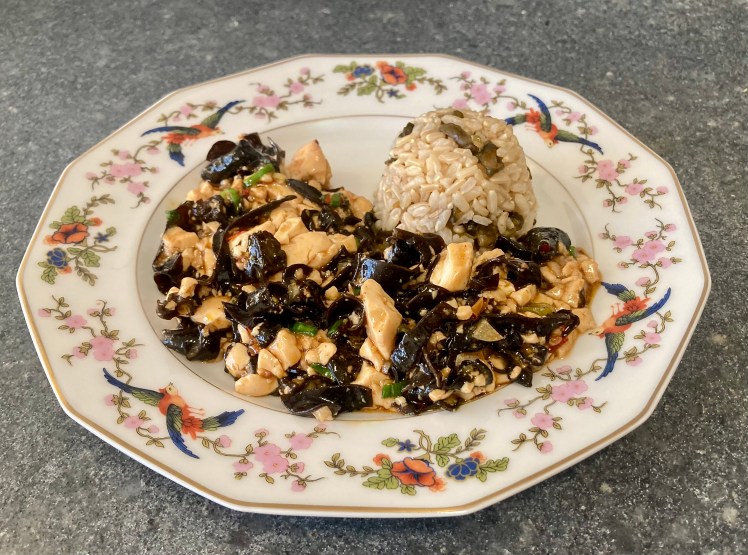
When shopping in an Asian Supermarket you will probably notice bags with ‘dried Black Fungus’. Not the most appealing name. Two popular edible mushrooms belong to the Auricularia family, Wood Ear and Black Wood Ear. Both are known as Black Fungus. The mushrooms grow on decaying wood and old logs. Wood Ear is common in Europe and Black Wood Ear in Asia. Alternative names are Cloud Ear, Jelly Ear and Judas’s ear. The mushrooms have a chewy, gelatinous consistency and are often used in dishes such as hot and sour soup, stir fries, casseroles and even salads. Their flavour is rather bland which makes them ideal to absorb flavours.
A few days ago, it was our lucky day, fresh Wood Ears! First time for us and we had to buy them. We used 75 grams in a variation on Mapo Tofu and 25 grams for the soup. Both dishes were delicious and special, thanks to the structure of the Wood Ear.
We can hear you thinking, ‘Shouldn’t that be rack of lamb?’.
Isn’t it interesting how much we are focused on specific parts of an animal? We love our steak, but what to do with an oxtail? We love pork loin, but how about the pig’s nose? And we enjoy grilled rack of lamb, but how about the neck? Supermarkets know everything about our focus and preferences. So if you would like to cook pig’s feet (or trotters), kidneys, liver, sweetbread or lamb’s neck: where to go? Try finding a ‘real’ butcher, one that buys the whole animal, not just the popular parts.
Lamb’s neck is very underrated. Some feel it’s okay for your dog only, but that’s silly. When cooked slowly it becomes tasty, nicely structured, juicy and tender. It combines very well with strong flavours such as ginger, cilantro seeds, star anise, soy sauce and the leaves of the Makrut or Thai lime (also known as Djeroek poeroet or Djeruk purut). You will get a flavourful, complex sauce in combination with lovely, aromatic meat.
Wine Pairing
If you decide to pair with white wine: we enjoyed our Neck of Lamb with a glass of Alsace Gewurztraminer, Cave de Beblenheim. The wine has a beautiful gold colour, and an expressive aromas of roses. The palate presents a nice structure with a fruity and spicy association which of course goes very well with the oriental twist to the stew. In general we suggest an aromatic white wine with just a touch of sweetness.
If you decide to pair with red wine: a few weeks later we enjoyed the dish with a glass of Cinsault, produced by Domaine Coudoulet. This is a relatively light wine, to be served chilled (12 °C or 54 °F). Cinsault is a grape native to the south of France. It was somewhat forgotten but is now gaining popularity. It has a floral nose, with aromas of raspberry and fresh fruit on the palate and discreet tannins.
What You Need
300 grams Neck of Lamb
Olive Oil
Shallot
Fresh Ginger (4 cm, depending on your taste)
1/2 red Chili
1 Garlic Clove
Noilly Prat
Cilantro Seeds
Star Anise
Low Salt Soy Sauce
4 leaves of Djeroek Poeroet
What You Do
Cut the meat in not too small cubes – they will shrink during the cooking process
Fry the meat in oil, giving it a nice colour. If so required, do so in multiple batches
In the mean time cut the shallot, peel the ginger and slice, remove the seeds from the chili and cut the garlic clove (but not too fine)
Remove the meat from the pan and glaze the shallot, chili, ginger and garlic
Add a splash of Noilly Prat, the crushed cilantro seeds, the star anise, some low-salt soy sauce and the djeroek poeroet
Stir
Transfer the meat back to the pan and add water, making sure the meat is just covered
Leave to simmer for 6 hours in total
Check the pan every hour, stir and add water is so required
Also check if the djeroek poeroet and/or chilli are not overpowering
After 5 hours check the taste, perhaps add soy sauce, remove the djeroek poeroet or the star anise
After 6 hours cool the stew and transfer to the refrigerator. You could also decide to transfer it to the freezer for use at a later date
The following day remove as much of the fat as possible
Warm the stew, check taste and tenderness
You may want to reduce the liquid in a separate pan
Warm through and through
(Optional) thicken the sauce with potato starch, this way your sauce will remain transparant
A powerful side dish with sweetness, acidity and umami. It’s full of flavours and aromas plus it’s easy to make. If you omit the pancetta, it will also combine very well with grilled fish.
Green olives are olives that are harvested when not yet ripe. Ideal for olive oil. After curing the green ones are bitter and firm. Black olives are olives harvested when ripe. They are sweeter and softer compared to the green ones. They also bring umami to the combination. By using both green and black olives you will have all these aspects in one dish.
Wine Pairing
We enjoyed our Beef with Tomato, Olive and Caper Sauce with an organic red wine from Italy, made by Terra Viva. The wine is made with Sangiovese grapes from the Marche area. It has a Ruby red colour, aromas of red fruit, mild tannins and subtle acidity. In general, you’re looking for a bold, dry red wine with a long finish.
What You Need
1 small Shallot
1 Garlic Clove
10 Green
10 Black Olives
1 Tomato
4 slices of Pancetta (optional)
2 teaspoons of Capers in brine
Thyme
One tablespoon of Red Wine Vinegar
Black Pepper
What You Do
Chop the shallot and the garlic
Quarter or halve the olives
Drain capers using kitchen paper
Chop the tomato in 16
Cut the slices of pancetta in 10 (depending on the size)
Heat a heavy iron skillet and add olive oil
Fry the pancetta
Reduce heat
Add shallot and glaze
Add garlic clove and leave for one minute
Add olives, capers, thyme and red wine vinegar
Wait for a few minutes before adding the tomatoes
Leave on very low heat, the tomato should be warm and not cooked
Taste and adjust, perhaps add some black pepper or red wine vinegar
Serve the sauce with excellent (medium-) rare beef
PS
Not sure if we should call it a sauce, or a (warm) salsa, it’s more like a very tasty side dish!
How about a delicious, vegetarian starter, one that is easy to make and requires only a handful of ingredients? It combines orecchiette, zucchini (courgette), parsley, olive oil, Parmesan cheese and black pepper. Parsley is often used, as decoration, to add a touch of green to a dish. Which is such a pity, because parsley is not just a bit of green: it’s a delicate herb. In this dish it’s crucial: you will taste its slight bitterness and its peppery notes. At the same time, it enhances the flavour of the zucchini and it brings everything together. Pasta-wise we think orecchiette is perfect for this dish. The ‘ears’ allow you to taste everything in the dish, with every bite.
Wine Pairing
We suggest a white wine with the orecchiette with zucchini and parsley, for instance from the Lazio region in Italy. In general a light, refreshing wine with hints of green apple and citrus. We enjoyed a glass of Prima Luna Frascati. This is a white wine made by Mauro Merz with malvasia bianca di candia and trebbiano grapes. Its freshness matched very well with the various flavours of the dish and, obviously, with the parsley!
What You Need
Zucchini
Flat Leave Parsley
Orecchiette
Olive oil
Parmesan cheese
Black Pepper
What You Do
Wash the zucchini. Don’t peel. Chop (think of the size of the orecchiette)
Chop the parsley
Grate Parmesan cheese
Heat a skillet, add olive oil and gently warm the zucchini; no colouring needed
In parallel cook the orecchiette accoding to the instruction
A few minutes before the orecchiette is ready, add half of the parsley to the zucchini, combine
When the orecchiette is al dente, drain but keep some of the cooking liquid
Add the orecchiette to the pan with zucchini and parsley
Add some black pepper and combine
Check if you’re happy with the result, feel free to add cooking liquid, olive oil and/or black pepper
Serve on hot plates, sprinkle with Parmesan cheese
It’s always hard to say what the original version of a dish is, assuming it even exists. In most cases recipes evolve over time, influenced by people, availability of ingredients and culinary trends. Ratatouille is a good example: it originates in the Provence, or more precisely: in the Niçoise region. Its local name is ratatolha. Ingredients are typical for this area: tomatoes, onions, garlic, zucchini, eggplants and herbs like thyme and marjoram. Meaning that we don’t really know what the ingredients were before the introduction of tomatoes and bell peppers in the region.
In 1976 chef Michel Guerard in his book Le Cuisine Minceur introduced Confit Bayaldi, a variation whereby the vegetables (and mushrooms) are thinly sliced and baked in the oven. In 1999 chef Thomas Keller added a piperade and a vinaigrette to the Confit Bayaldi. This is the ratatouille that features in the classic film Ratatouille.
When reading the recipe for Ratatouille Niçoise, we noticed that the vegetables are fried separately, the onions are caramelised and the tomatoes are used to make a sauce that is added to the other vegetables towards the end. The result is a very tasty, rich and powerful dish. Thanks to the way it’s prepared you will be able to taste the individual flavours and the combination. Making your ratatouille this way is perhaps a bit of work, but’s it’s not difficult and it’s worth the effort. We served our Ratatouille Niçoise with grilled lamb chops.
Wine Pairing
We decided to enjoy a glass of red wine from the French Languedoc-Roussillon area, made with Syrah grapes by Les Jamelles. The wine has an intense dark colour and aromas of dark berries and a touch of vanilla. The flavour is a combination of some spiciness, dark fruit and mild tannins. In general, we suggest a not too complex red wine with some oak, dark fruit and character.
Coarsely chop the zucchini, the eggplant and the bell peppers
Slice the onion
Peel the tomatoes (heat a pan with water, dip 1 tomato in the hot water for 10 seconds and use a sharp knife to peel. If it doesn’t come off easily, dip for another 10 seconds)
Chop the tomatoes
Warm a Dutch oven, add olive oil and fry the onion until golden
Add the chopped tomatoes, one crushed garlic clove, the bouquet garni and black pepper. Leave on low heat, no lid required. The sauce must become thick and smooth. This will take some time!
In parallel: heat a skillet, add olive oil and fry the zucchini. When nicely coloured reduce the heat and add 1 crushed garlic clove and some black pepper. After a few minutes transfer to a plate and set aside
In parallel: we used the same skillet to repeat step 8 twice, first with the bell peppers and then with the eggplant
Once the vegetables are fried and the sauce is ready: warm a second Dutch oven, add the vegetables and combine with sauce
Leave on low heat for one hour. No lid required
Set your oven to traditional and 180 °C or 355 °F
Transfer the pan to the oven for 30 minutes, leaving the door slightly open
Just before serving remove the bouquet garni
PS
The recipe is on display in Parc Phoenix in Nice, so it must be the original!