Exploring Asma Khan’s Ammu (Part 3)

We conclude our review of Asma Khan’s cookbook Ammu, Indian Home Cooking to Nourish Your Soul by preparing two dishes: Saffron Lamb and Pulao and asking our esteemed panel (André, Joke, Martine and Rutger) for their thoughts. In Part 1 we wrote about her Pumpkin and Coconut soup and in Part 2 about her Pineapple and Chilli Chutney and Eggs in Tamarind Gravy

Asma Khan is an Indian British chef, cookbook author and restaurant owner. In 2012 her pop-up restaurant started for 12 guests at her home, serving food cooked from traditional family recipes. Today her all-female Darjeeling Express restaurant in London offers Indian Rajput and Bengali home cooking specialties.

In 2024 she won the Johannes van Dam Prize, a lifetime achievement award for an individual who has made an exceptional contribution to the world of gastronomy. Previous winners of the prestigious prize include Yotam Ottolenghi, Carlo Petrini, Alice Waters, Claudia Roden, Jeroen Meus and Alain Passard.

The book is called ‘Ammu’ which translates to ‘Mother’. The stories, the recipes, the whole book is a tribute to the food her mother (and the family’s cook) prepared. But we feel it’s more: it’s also a tribute to original flavours, to people taking time to prepare food, to sharing and enjoying, to communities and heritage.

Saffron Lamb

The recipe calls for a whole leg of lamb. For practical reasons we decided to make a stew using neck of lamb. The meat is marinated for at least 4 hours (or overnight) in a combination of yoghurt, garlic, chilli powder and saffron. Using saffron can be challenging. Asma Khan soaks the saffron in tepid water, which makes it much easier to add the right amount of saffron, not only at the beginning but also just before serving. The stew was a well-balanced combination of lamb, spices and saffron. To quote Asma Khan: “This is a good one to serve friends and family to make them feel loved without having to spend a lot of time in the kitchen!”. It was Rutger’s favourite.

Pulao
Pulao © cadwu with rose petals, cardamom, cinnamon and pistachios. Recipe by Asma Khan

Doesn’t it look amazing? Basmati rice with cardamon, cinnamon, rose petals, pistachios, apricots, cloves, onion, rose water and bay leaf. The pulao surprised us all with its flavours, aromas and vibrant colours. The rice has a sweet undertone which makes it ideal to serve with spicy dishes. It combined very well with the lamb, the chutney and the eggs.

It was Martine’s favourite. Preparing it is, as you will expect by now!, a bit of work but it’s not difficult.

Should This Book Be On Your Shelf?

Our answer is “Yes, definitely” but our esteemed panel didn’t agree with us. They loved the dishes and the range of (new) flavours, the complexity of the aromas and the beautiful colours. They would be happy to enjoy more food from Asma Khan, but the time and effort required to prepare the food would be a problem.
Which means we will plan another Asma Khan dinner, with dishes such as Stir-Fried AuberginesCoconut Ladoo and Prawns with Peas and Potatoes. To be continued!

The Book

Ammu, Indian Home Cooking to Nourish Your Soul by Asma Khan is available via the usual channels or your local bookstore for 35,00 US$ or 26,00 EUR.
Some of her recipes were published by the BBC, other recipes were published by Great British Chefs and these by the Foodnetwork.

Spicy Pumpkin Soup

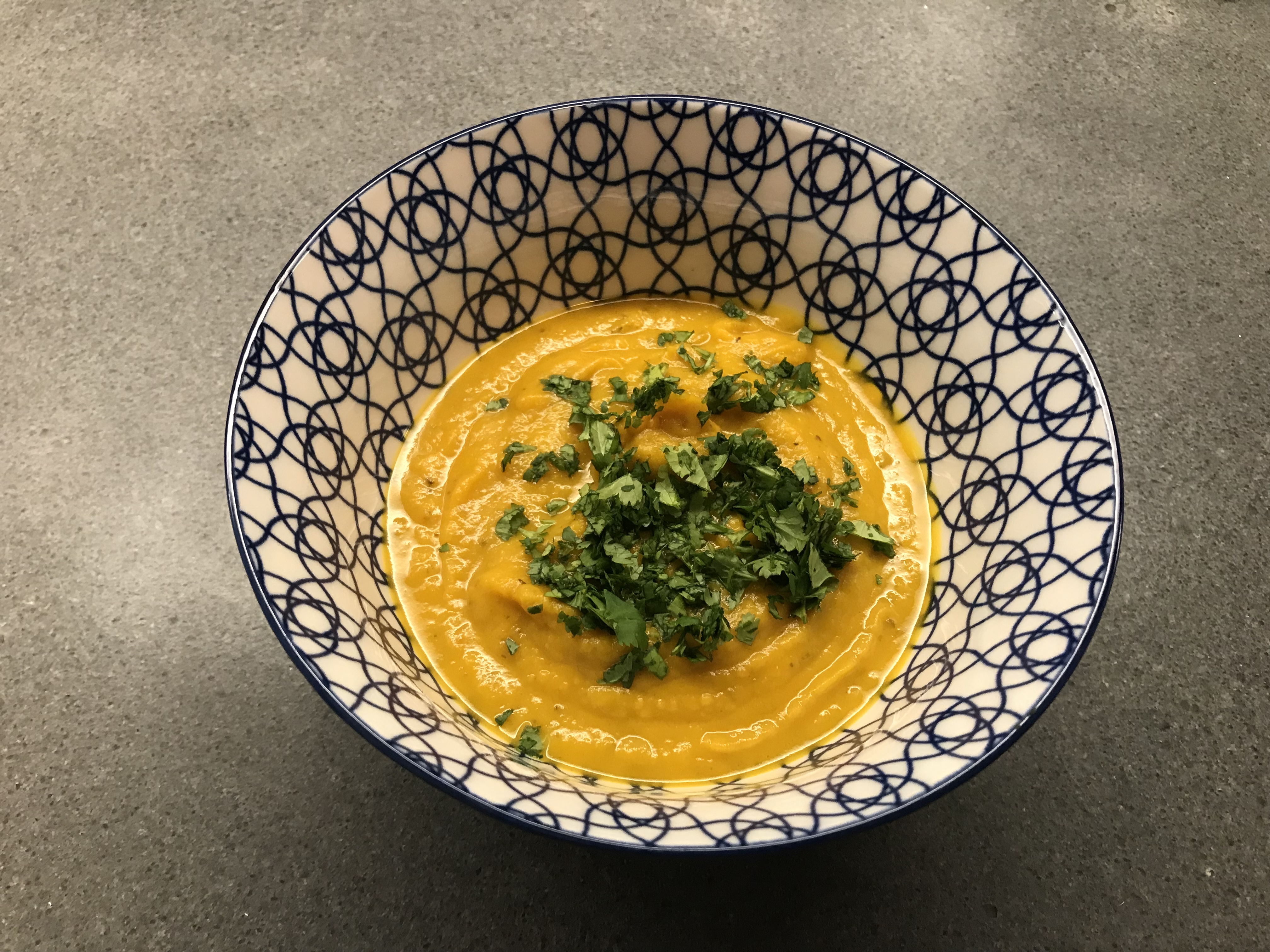
It’s the time of year to enjoy simple, seasonal, rich and flavourful food, for instance spicy pumpkin soup. The trick in this case is in the coconut milk or cream. Coconut milk contains something like 15 grams of fat per 100ml. For this soup you need 25+ grams of fat per 100ml. The fat enhances the coconut flavour and it combines very well with the spicy and aromatic character of the soup (ginger, chili, djeroek poeroet).

What You Need (for 4)
  • Small Pumpkin
  • Large Shallot
  • 2 large Garlic Cloves
  • 4 cm Fresh Ginger
  • Chili Pepper
  • Olive Oil
  • 8 leaves of Djeroek Poeroet  
  • Coconut Cream
  • Cilantro
What You Do

Wash the pumpkin and chop. If the pumpkin is organic, then you don’t need to peel it. Peel and chop the shallot, garlic and the ginger. Ground dried chili pepper. Gently fry the shallot in olive oil. Add chilli pepper. Add ginger. Stir, mix and add pumpkin. Stir and add garlic. Now add the vegetable stock, the djeroek poeroet and allow to simmer for 30 minutes. If the pumpkin is soft, remove the djeroek poeroet and blender the mixture. Taste and adjust. Add 6 spoons of coconut cream, 1 by 1, mix and taste. When you’re happy with the flavours, leave the soup on low heat for 15 minutes. Serve with lots of chopped cilantro.

Spicy Pumpkin Soup ©cadwu

Pumpkin Soup (with Kombu Dashi)

It’s autumn, so obviously we want to cook pumpkin soup. A nice and warm combination of pumpkin, ginger, chilli and orange lentils for instance. Or with Jus de Truffe for a bit of extra umami and exclusivity.  Both are excellent vegetarian dishes, perfect for lunch with some crusted bread or as a starter.
Having recently prepared kabocha with shrimps, we decided to prepare a vegetarian soup with it. The basis of the soup is Kombu Dashi (made with dried Kelp). The dashi and the soy sauce bring saltiness and umami to the soup, which combines very well with the exceptional sweetness of the pumpkin and the mirin.

You could prepare the soup with the skin of the kabocha, but we love the intense orange colour of the inside.

What You Need

  • 20 grams of Kelp
  • 1 litre Water
  • 1 Kabocha
  • Light Soy Sauce
  • Mirin
  • Purple Shiso

What You Do

Add the kelp to one litre of cold water. Put on low heat and wait until it has reached 80 °C or 175 °F. Overheating it will make the dashi bitter. In the meantime, wash and peel the kabocha, remove the seeds and dice. Remove the kelp from the pan, discard and add the kabocha. Allow to simmer on low heat for 20-30 minutes until the kabocha is soft. Remove some of the liquid and blender the kabocha. Add liquid until you have the right consistency. In our experience you will need one litre of water to cook the kabocha but it might be too much liquid for a nice, velvety consistency of your soup. Add 2 or 3 tablespoons of mirin and 1 or 2 tablespoons of light soy sauce.  It’s a matter of your preference, ripeness of the kabocha and the kelp.
Best to decorate with some purple shiso, or with sprouts (as we did), provided they’re not too spicy.

Japanese Pumpkin with Shrimps

The traditional Japanese way of preparing Kabocha (Japanese Pumpkin) requires a bit of work but is not overly complex. The result is a combination of delicate, fresh pumpkin flavours with clear umami as a result of simmering the pumpkin in a dashi-based stock. You could replace the Japanese Pumpkin with a more common winter squash or with a red Hokkaido pumpkin.

Combining shrimps and pumpkin seems a bit odd, but it’s actually very nice. The combination is colourful and the various flavours come together nicely, also thanks to the dashi.
The first time we enjoyed this combination was when we prepared Takiawase, following the recipe from author and Michelin Award winning chef Akira Oshima. The recipe is included in his book Yamazato, Kaiseki Recipes: Secrets of the Japanese Cuisine. It’s a mouth-watering dish but unfortunately fairly difficult to prepare. Typically, Takiawase is a combination of vegetables and fish. Every ingredient requires its own preparation and is simmered in its own dashi-based stock. Indeed: four different kinds of homemade stock. The recipe of Akira Oshima combines kabocha, eggplant, okra and shrimp.

Drink Pairing

We prefer a glass of sake with our Kabocha with Shrimps, for instance a Junmai sake with fresh aromas and good acidity. The sake must be dry and well-balanced with a clean finish. You could enjoy a glass of white wine with the dish, provided it’s dry and mineral. Or a more adventurous choice: a glass of Manzanilla or Fino sherry. Manzanilla is a dry sherry with a flowery bouquet, a delicate palate and subtle acidity. It works beautifully with the dashi and the sweetness of both the kabocha and the shrimps.

What You Need                                                                         

  • For the Dashi
    • 10 grams of Kelp
    • 10 grams of Katsuobushi
  • For the Kabocha
    • Mirin
    • Light Soy Sauce (Usukuchi)
    • Sake
  • For the Shrimps
    • Sake
    • (Olive) Oil
    • Mirin
    • Light Soy Sauce (Usukuchi)
  • Pickled Cucumber

What You Do

Start by preparing 500 ml of dashi.
Peel and devein the six shrimps. We prefer to leave the tail on. Transfer the shrimps to a bowl, add some sake and transfer to the refrigerator for a few hours.
Peel the Kabocha, remove the seeds. Halve and then slice in 6 equal parts. Combine 400 ml of dashi with 25 ml of mirin, 25 ml of light soy sauce and a tablespoon of sake. Add the slices of kabocha and let is simmer for some 10 minutes or until nearly done.
In parallel heat a heavy iron skillet, add oil, dry the shrimps with kitchen paper and then fry them quickly, let’s say 4 minutes. Transfer to a warm oven. Remove the oil from the pan with kitchen paper. Reduce the heat to low. Mix 50 ml of dashi with 25 ml of mirin and a small spoon of light soy sauce. Deglaze the pan and let the mixture reduce. Transfer the shrimps back the pan and coat them quickly with the mixture. Serve the slices of kabocha with the fried, coated shrimps and the pickled cucumber.

Pumpkin Soup

Pumpkin

Such a simple, tasty, inexpensive and vegetarian soup! What more can you ask for? A bit of jus de truffe maybe?
Make sure to buy organic pumpkins. This allows you to use the skin; so two benefits: there is no need to peel the pumpkin and the soup will be better tasting.
Red lentils will become completely soft when cooked for 30 minutes; very different from green or black lentils. We add the lentils not only because of their taste, but also because they improve the texture of the soup.
Give the soup a finishing touch by adding pumpkin seed oil, jus de truffe or truffle flavoured olive oil (for instance produced by Moulins de la Brague).

Here is what you need

  • Small Pumpkin
  • Red Onion
  • Two Garlic Gloves
  • 6 cm Fresh Ginger
  • 2 Chilli Peppers
  • Tablespoon or more Red Lentils
  • Water
  • Olive oil
  • Pumpkin Seed Oil, Jus de Truffe or Truffle Flavoured Olive Oil
  • Cilantro

Chop de red onion in smaller but equal sized bits and put in a pan with olive oil. Put on moderate heat and give it some 5 to 10 minutes. Now add the chopped and seeded chilli pepper, the garlic and stir. Continue for 5 minutes on moderate heat. Add the chopped pumpkin and the lentils and stir for another 5 minutes. Peel the ginger, cut in cubes and put on a small wooden stick. This way you can easily remove the ginger later on. Now add boiling water and leave for 30 minutes to simmer or until the pumpkin is very, very soft.
When done remove the ginger. Taste the ginger and decide how much ginger you want to add to the soup. We just love fresh ginger so we would add most of it. Blender the remainder into a smooth soup. You could pass it through a sieve to make sure it’s like a lovely velouté. Cool and transfer to the refrigerator for the next day.
Warm the soup and add a splash of truffle flavoured olive oil or pumpkin seed oil and lots of cilantro before serving.
You can also make a milder version by reducing the amount of chilli and ginger. Then add jus de truffe, a bit of olive oil and maybe some pepper before serving.

Pumpkin Soup © cadwu