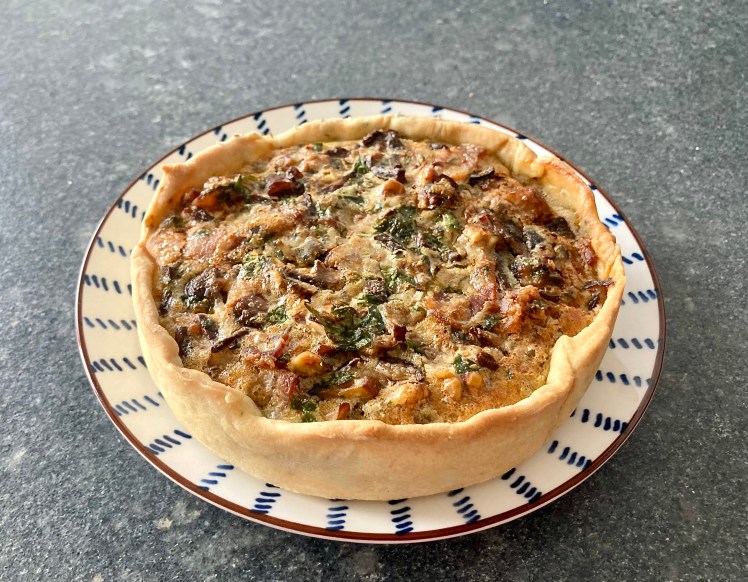
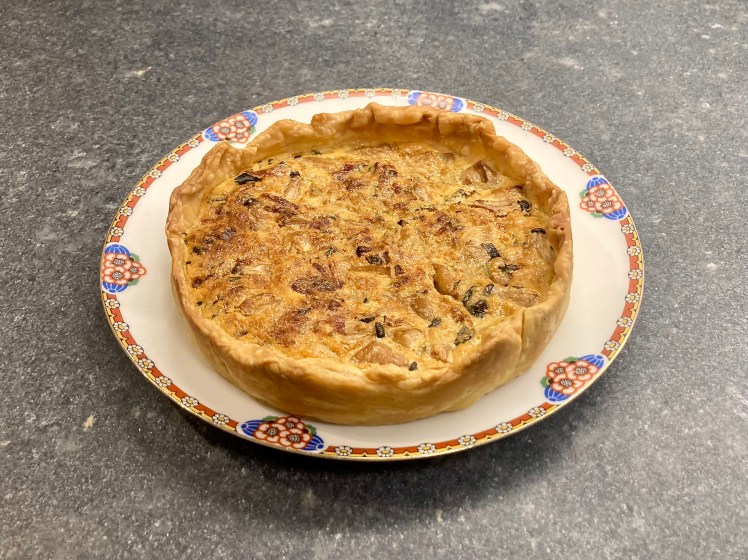
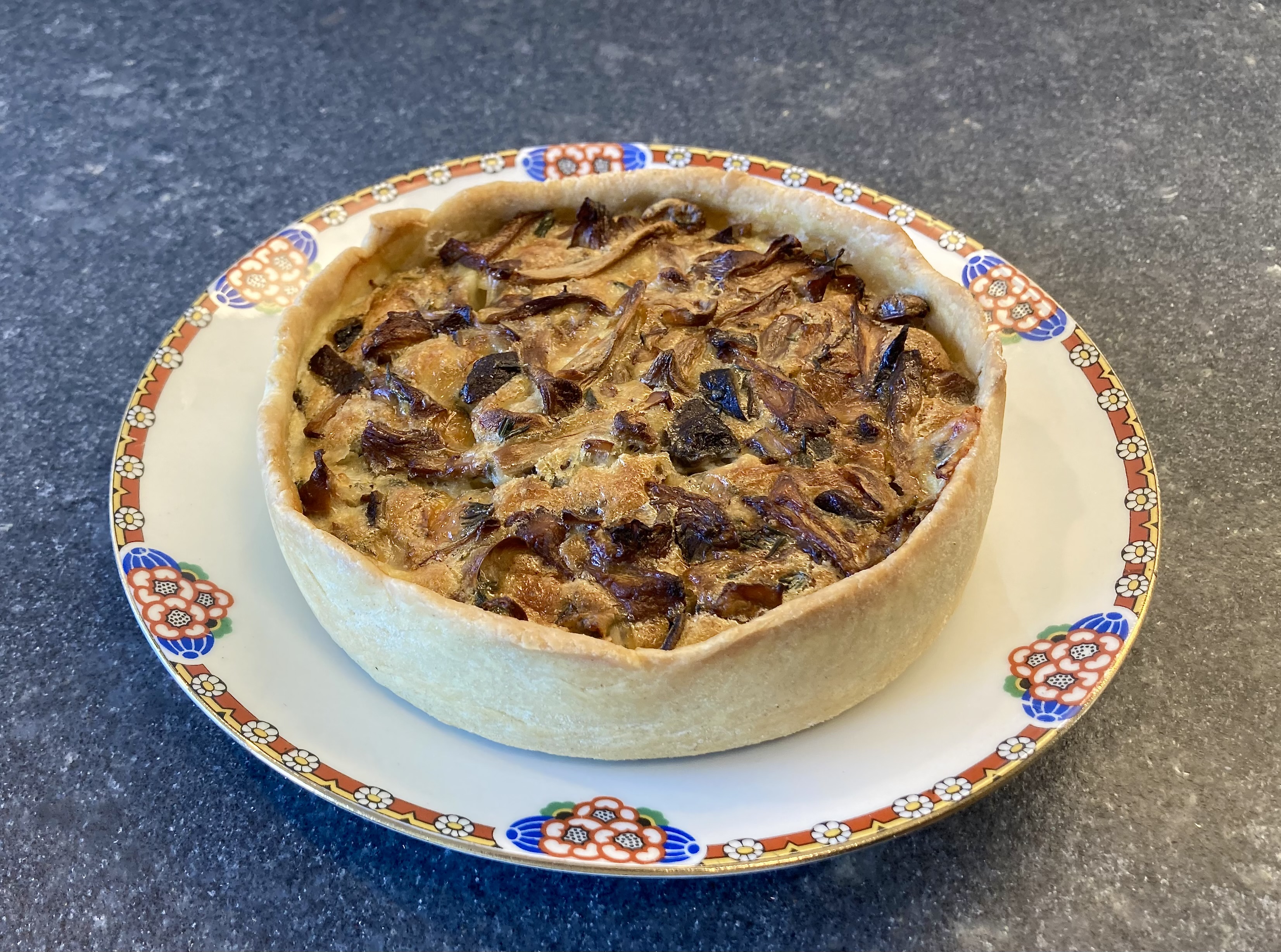
Pie with Walnuts, Mushrooms and Blue Cheese

The walnuts are the star of this pie! They have a drying effect, thanks to the tannins in the seed coat (the brown around the edible kernel) and they are slightly bitter, which pairs beautifully with the Roquefort. The walnuts give the pie a pleasant crunch.
We use a mix of mushrooms. If not possible, use chestnut mushrooms. Don’t use oyster mushrooms, as they release too much moisture.

Wine Pairing

Serve as a starter with a glass of unoaked, dry white wine. A cold beer will also be nice. The cake is not fussy!

What You Need
  • For the Pastry (15 cm or 6 in springform cake tin)
    • 100 grams of Flour
    • 50 grams of Water
    • 10 grams of Olive Oil
    • teaspoon Oregano
    • 1 gram of Salt
  • For the Filling
    • 4 rashers of Bacon
    • 150 grams of Mushrooms (Button Mushrooms, Shiitake, Nameko)
    • small Shallot
    • one Garlic Clove
    • Parsley
    • 2 organic Eggs
    • 50 ml Double Cream
    • 30 grams of Crème Fraîche
    • handful of Walnuts
    • 75 grams of Roquefort
    • Black Pepper
What You Do
  1. Combine flour, oregano and salt
  2. Add water and olive oil
  3. Kneed for a minute or so and store in the refrigerator for at least 30 minutes
  4. Preheat your oven to 180˚ C or 355˚ F
  5. Roll out the dough with a rolling pin on a lightly floured surface
  6. Coat a 15 cm or 6 inch round springform cake tin with oil
  7. Place the dough in the baking form
  8. Use a fork to make small holes in the pastry
  9. Line the pastry with parchment paper or aluminium foil, add baking beans and bake blind for 10 minutes. Best is to use the second level of the oven rack, so just below the central one
  10. Remove the beans and the paper or foil
  11. Leave the pie shell in the oven for 5 minutes
  12. Remove from the oven and allow to cool
  13. Chop the shallot, the mushrooms, the parsley and the garlic
  14. Crush the walnuts
  15. Crumble the roquefort
  16. Heat a heavy iron skillet
  17. Fry the bacon until golden brown
  18. Remove from the pan and allow to cool
  19. Reduce heat
  20. Add the shallot to the pan and glaze
  21. Increase heat, add mushrooms and fry
  22. After a few minutes reduce heat and add garlic
  23. After 5-10 minutes transfer to a plate and allow to cool
  24. Slice the bacon
  25. Add the eggs to a bowl and whisk
  26. Add cream and crème fraîche and mix
  27. Add Roquefort, parsley and black pepper and mix well
  28. Add bacon and mushroom mixture to the bowl and combine
  29. Add the filling to the blind-baed pie shell
  30. Transfer to the oven for 30-40 minutes on on 180˚ C or 355˚ F, same level as earlier
  31. Immediately after having removed the pie from the oven, brush the outside with olive oil. This will intensify the colour of the pastry
  32. Let cool and enjoy lukewarm (65˚ C or 150˚ F)
PS

Feel free to use more cream and less crème fraîche if you prefer a richer filling. If using a blue cheese with less presence, add more of it.

Pie with Blue Cheese, Mushrooms and Walnuts ©cadwu plus bacon, oregano, parsley and eggs
Pie with Blue Cheese, Mushrooms and Walnuts ©cadwu

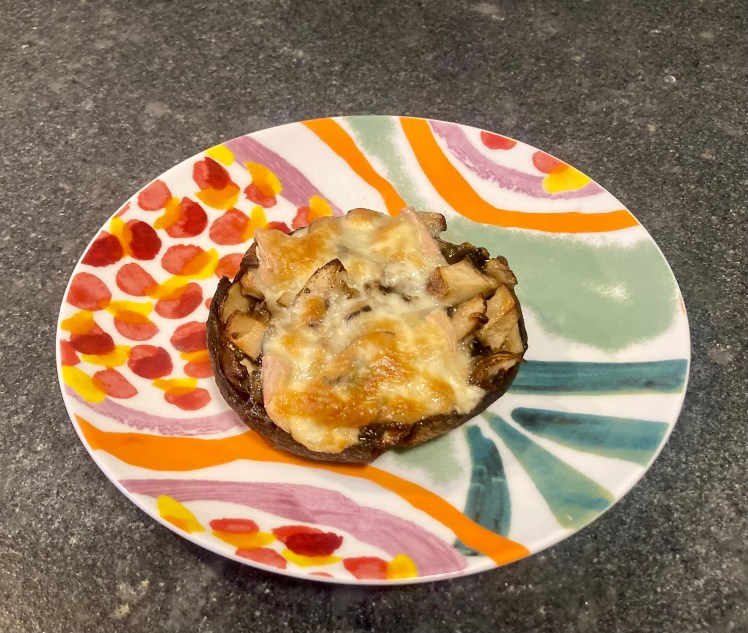
Stuffed Portobello

Portobello mushrooms are mature chestnut mushrooms (also known as common mushroom, champignon de Paris, button mushroom, cremini etcetera). Ideal to stuff and serve as a starter. We found them stuffed with ratatouille, with blue cheese and walnuts, with shrimps, with sausage and peppers: it seems anything goes! We decided to remain close to the flavour of the mushroom by stuffing them with chestnut mushrooms, shiitake and oregano. We topped them with taleggio, a semi-soft cheese from Italy with a mild taste. It melts easily, so you need to keep an eye on your oven! If you can’t get hold of taleggio, then use mozzarella instead and add a bit more flavour to the mushroom stuffing.

Wine Pairing

We decided to enjoy a glass of Viognier, made by Domaine Coudoulet in the Languedoc (France). The wine has aromas of peach and anise. The taste is fresh with a hint of orange zest. In general, we recommend a fresh, lightly fruity, unoaked white wine.

What You Need
  • For the Mushroom Stuffing
    • 150 grams of Button Mushrooms and Shiitake
    • one small Shallot
    • one Garlic Clove
    • Oregano
    • Black Pepper
    • (Excellent) Olive Oil
  • 2 Portobello mushrooms
  • Taleggio
What You Do
  1. Clean and chop the button mushrooms and shiitake
  2. Finely chop the oregano, the shallot and the garlic
  3. Gently fry the shallot in olive oil in a heavy iron skillet
  4. Add the mushrooms and fry on medium heat
  5. Reduce heat
  6. Add herbs and garlic
  7. Continue on low heat for 10-15 minutes
  8. Transfer the mushroom mix to a plate and let cool
  9. Add some olive oil to make the mixture smoother
  10. Taste and add some black pepper
  11. Store in the refrigerator
  12. Preheat your oven to 180 °C or 355 °F and line a baking sheet with parchment paper.
  13. Remove the stem of the portobello
  14. Using a small spoon, scrape out the dark gills from the caps
  15. Generously brush both sides of the caps with olive oil
  16. Slice the taleggio (with crust!)
  17. Stuff the portobello with the mushroom mixture and top with slices of cheese
  18. If you’re a true lover of taleggio: add a slice of cheese to the cap before stuffing with the mushroom mixture
  19. Transfer the mushrooms to the oven for 15 minutes
  20. (optional) During the last minutes increase to 200 °C or 400 °F
  21. Serve immediately.
Stuffed Portobello ©cadwu with button mushrooms, oregano and taleggio
Stuffed Portobello ©cadwu

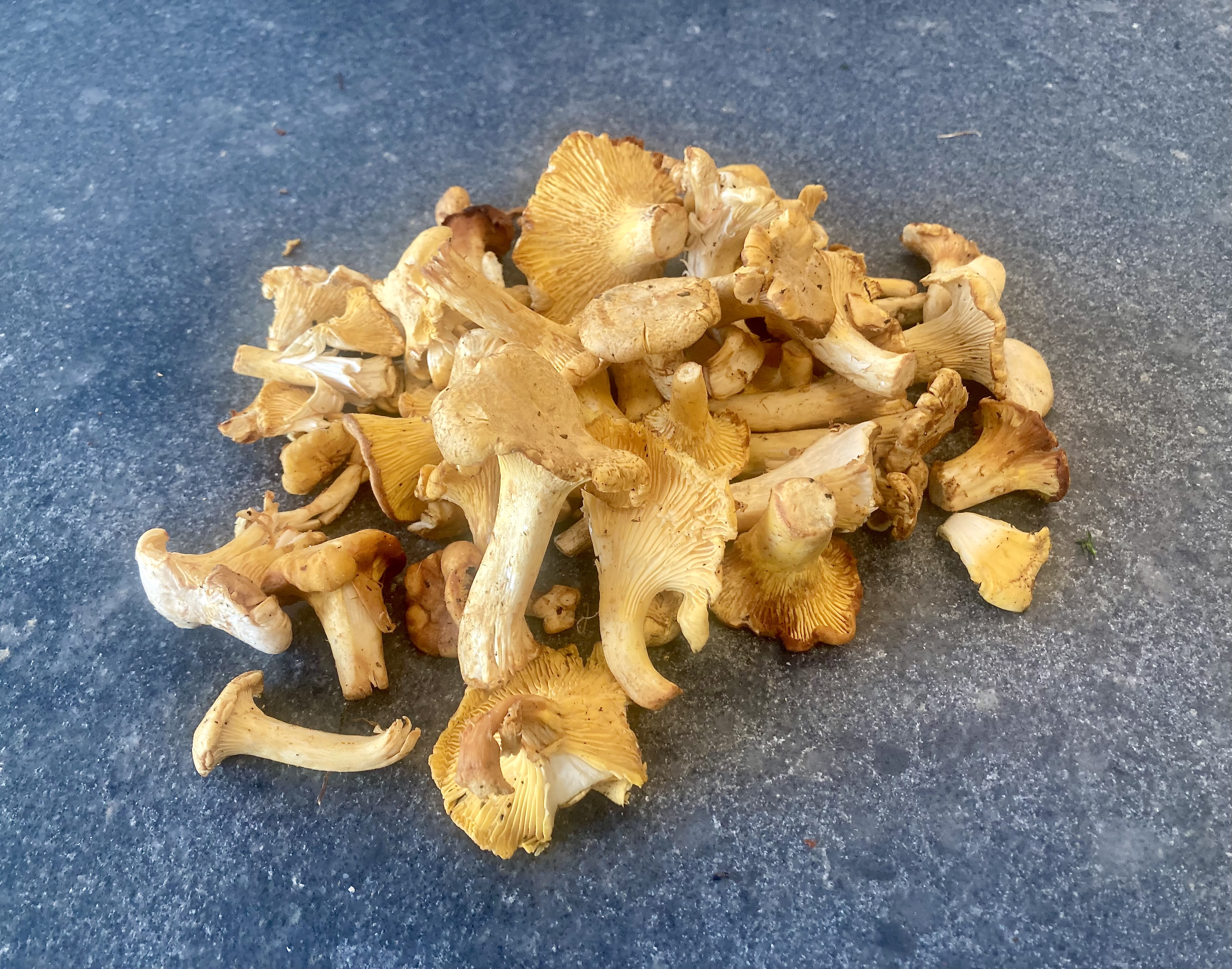
Summer Truffle and Golden Chanterelle

It’s always a great idea to combine seasonal ingredients: asparagus and morels, strawberries and rhubarb, summer truffle and golden chanterelle.
The season of the chanterelle runs from June to December. It’s a firm, bright yellow mushroom with subtle earthy, fruity flavour. It’s native to North America, Europe and Asia.
Summer truffles can be found between May and August. Their aroma and taste is very subtle. If slightly warmed, the flavour is more present (a bit nutty). If heated, the truffle loses its flavour.

The combination of chanterelle, truffle and cream is elegant and complex. The chanterelle gains depth from the truffle and vice versa. The pasta and the creamy sauce support the flavours beautifully.

Wine Pairing

We suggest a fruity, dry, red wine, with light tannins, for instance a Pinot Noir or perhaps a Gamay. We enjoyed a glass of Domaine Coudoulet Pinot Noir. This is a light, red wine from the Pays d’Oc in the south of France. It has a nice, light colour, aromas of strawberries, it’s refreshing and has a long finish. To be served somewhat chilled.

What You Need
  • 200 grams of Golden (Yellow) Chanterelle
  • 20 grams of Summer Truffle
  • 1 Garlic Clove
  • Stock (vegetable or chicken)
  • Cream
  • 1 teaspoon of Mustard
  • Parmesan Cheese
  • Spaghetti 
  • Olive Oil
  • Butter
  • Black Pepper
  • Salt
What You Do
  1. Add olive oil to a heavy iron skillet. Set on low heat
  2. Slice the garlic in 3 or 4 and add to the oil
  3. Leave the oil on very low heat for 10-15 minutes
  4. Clean the chanterelle with a brush. Take your time!
  5. Cut the chanterelle in 2 or 4, depending on the size
  6. Clean the truffle
  7. Grate a quarter of the truffle, slice the remainder
  8. Grate some Parmesan cheese, just to thicken and gently flavour the sauce
  9. Cook the spaghetti in boiling water with some salt until al dente, according to the instruction on the package
  10. Remove the garlic from the pan
  11. Add some butter to the pan and increase the heat
  12. Fry the chanterelle
  13. Reduce heat
  14. Add stock, mustard and cream. Combine
  15. Add Parmesan cheese. Combine
  16. Add the spaghetti to the pan
  17. Taste and adjust
  18. Just before serving add black pepper and grated truffle
  19. Combine and serve
  20. Decorate with the summer truffle slices 

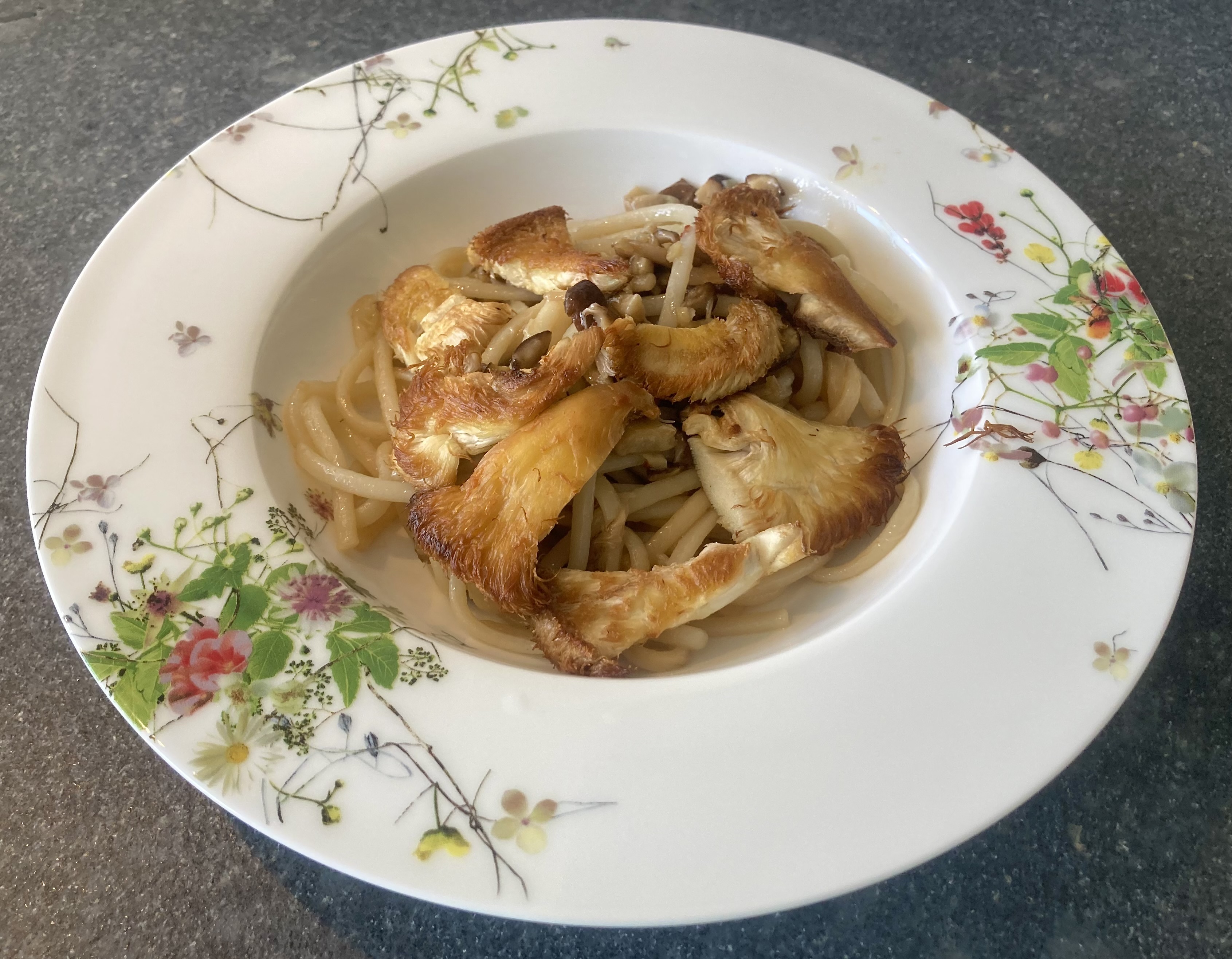
Lion’s Mane

If you search for Lion’s Mane mushrooms, you will find lots of references to supplements with wonderful health benefits, ranging from supporting longevity to improved cognitive functions. It’s also supposed to have antibiotic, anti-fatigue and anti-ageing properties. Sounds great, but how do the fresh mushrooms taste?

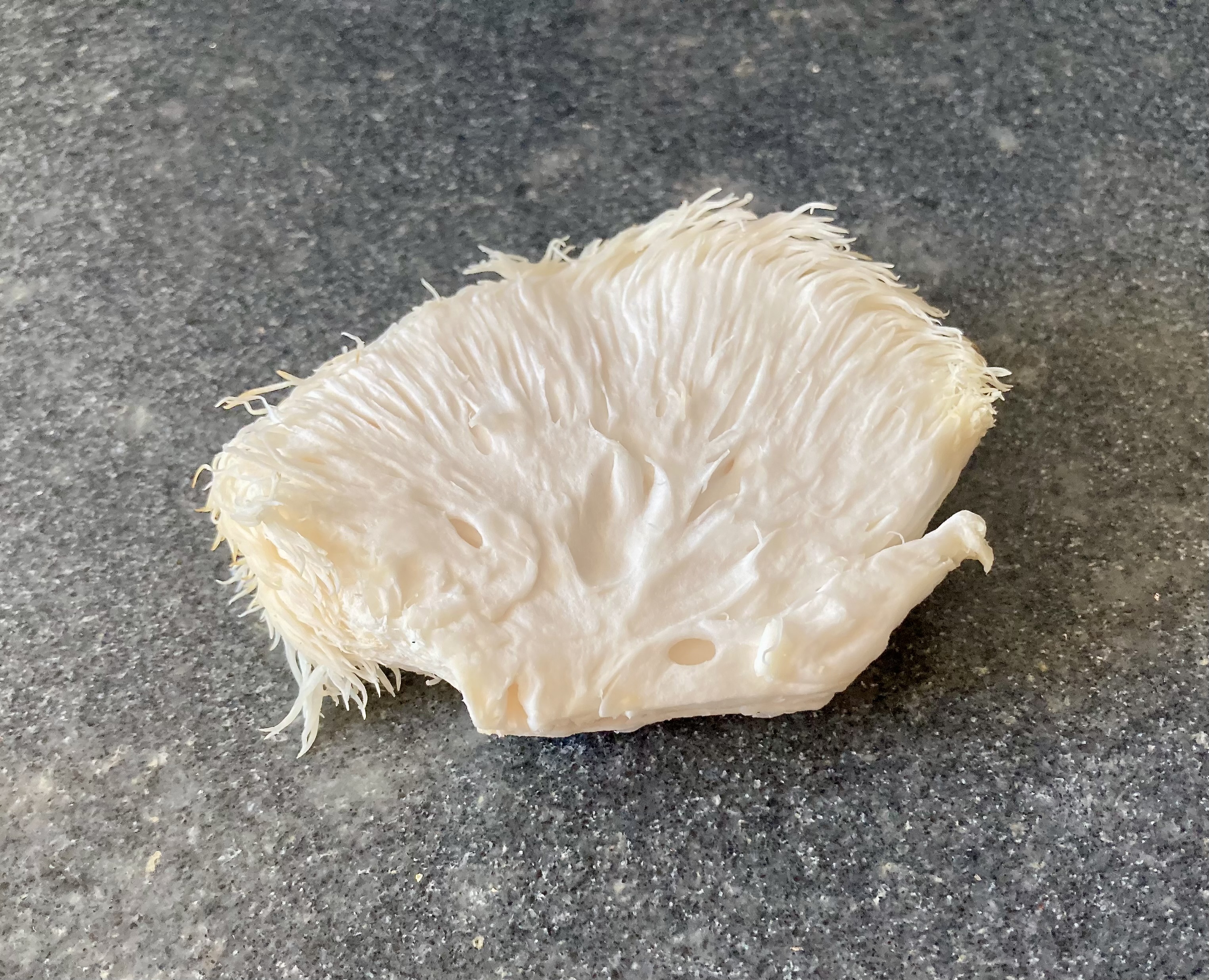
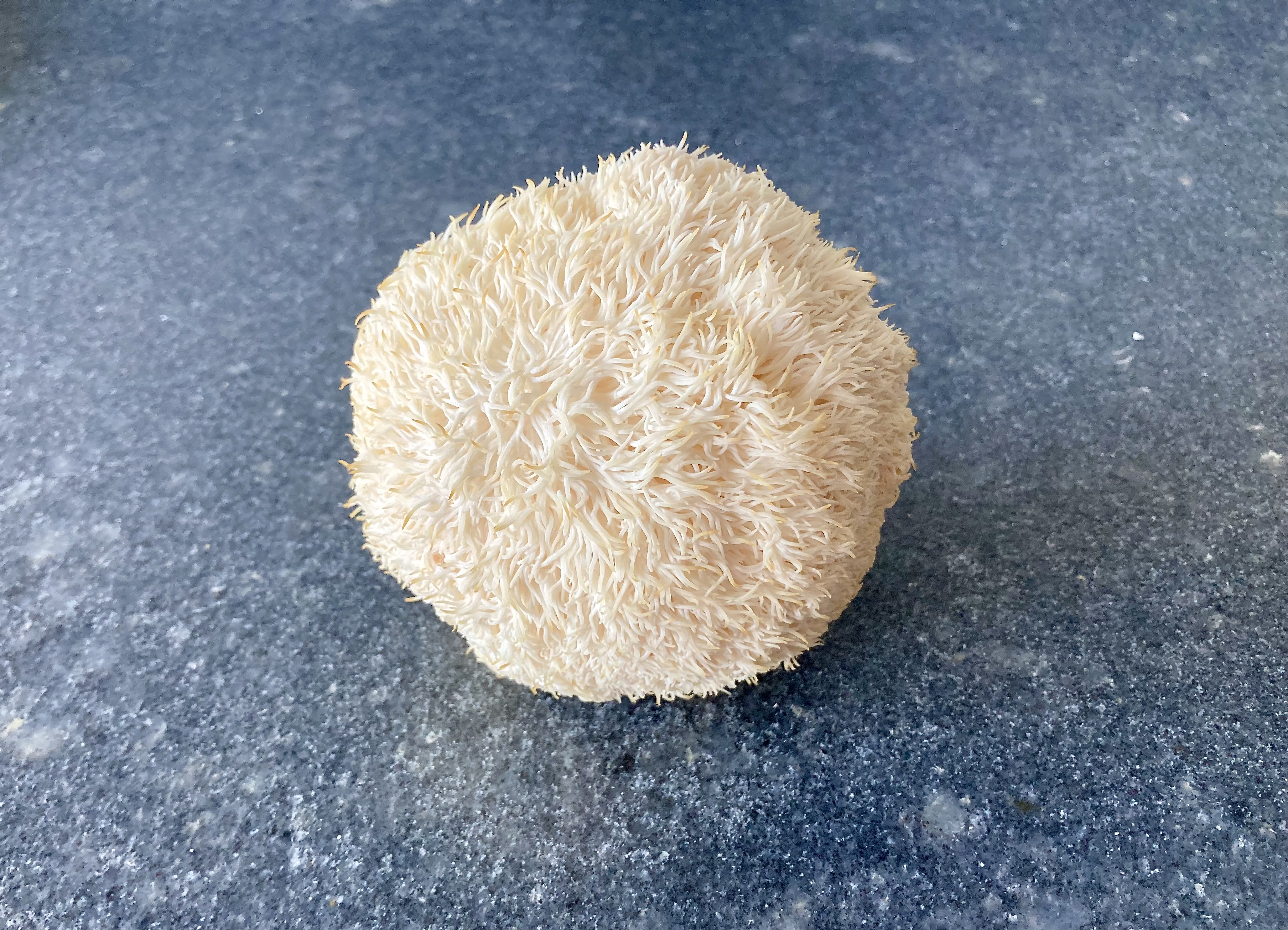
Lion’s Mane (also known as Yamabushitake and Hou Tou Gu) is a mushroom native to North America, Asia and Europe. Their flavour and texture sets them apart from many other mushrooms. A bit sweet, mild, some umami, subtle, a hint of seafood (crab, lobster). The texture meaty and elastic with a unique structure thanks to the spines.

Alan Bergo (the Forager Chef) uses them to make crab cakes. He writes: This is one of my all-time favorites. I guarantee this is so good, some people may not be able to tell it’s a crabcake made from mushrooms instead of crab.

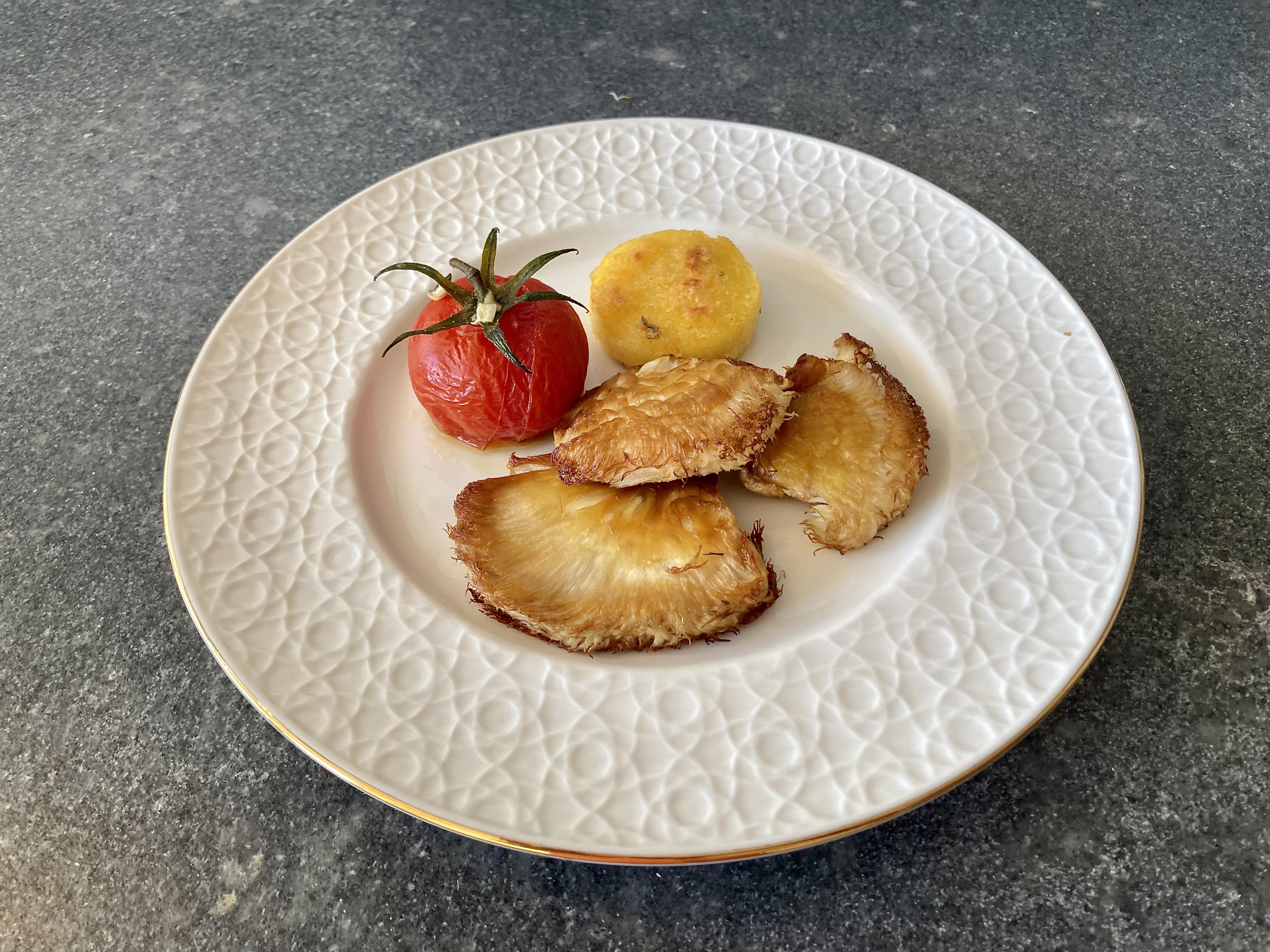
We thought it would be nice to make a dish with various flavours, allowing us to taste the mushroom on its own, but also with the Tomato Confit and Polenta. Combining it with tomato enhanced the flavour of the mushroom and made it more complex (sweet, sour, umami, aromatic). The combination with Polenta was nice, perhaps because of the various textures.

Wine Pairing

Grüner Veltliner is a wine typical for Austria, with flavours such as lime, grapefruit and white pepper. We enjoyed a glass of Grüner Veltliner, made by Eisacktal Valle Isarco, from the Alto Adige region in Italy. It is fruity, fresh and slightly spicy with clear acidity. Very nice with the flavours in the dish. In general we suggest a fresh, dry white wine with hints of green apple and/or citrus. 

What You Need
  • Mushrooms
    • 100 grams of Lion’s Mane
    • Olive Oil
  • Polenta
    • Polenta
    • Vegetable Stock (optional)
    • Parmesan Cheese
    • Thyme
  • Tomatoes
    • Tomatoes
    • Thyme
    • Rosemary
    • Garlic
    • Olive Oil
What You Do
  1. Day before
    1. Cook (in vegetable stock) the polenta according to the package until ready
    2. Add some Parmesan cheese and thyme
    3. Pour the polenta on a plate and smooth it into an even layer (1,5 centimetres) with a spatula
    4. Cool to room temperature
    5. Cover with foil
    6. Transfer to the refrigerator for use the next day.
  2. A few hours before
    1. Wash and dry the tomatoes and add these to a baking dish
    2. Chop the garlic
    3. Add herbs, garlic and a generous amount of olive oil to the dish
    4. Put in the oven for something like 2 hours on 90 °C or 200 °F
    5. Baste the tomatoes once or twice
    6. Don’t forget to use the cooking liquid as well, it’s another pack of flavours!
  3. Preheat your oven to 65 °C or 150 °F
  4. Turn out the polenta onto a cutting board
  5. Cut it into a shape you like (strips, triangles, circles)
  6. Fry in relatively hot olive oil in a non-stick pan until golden, probably 2*5 minutes. 
  7. In parallel clean the mushroom and slice (not too thin)
  8. Fry in olive oil until golden brown, probably 2*2 minutes
  9. Transfer to the oven
  10. Leave for 5 minutes in the oven
  11. Add just a hint of black pepper to the mushrooms before serving.
  12. Assemble and serve on a warm plate.
PS

Best to buy young mushrooms, the size of a tennis ball.

Scallops and Morels

Combining seafood with mushrooms can be magic. We prepared Cod with Horn of Plenty and Beech Mushrooms with Haddock. Both are delicious combinations.
We went shopping on the market, looking for fresh or dried morels. After having bought them, we saw great looking scallops. Why not combine these two complimentary products?
At home we searched for Coquilles Saint Jacques aux Morilles, assuming we would find lots of suggestions in French. Which we did. It turns out to be a ‘recipe from (grand-) mother’, although we don’t know why because it’s such a refined dish. The scallops are delicate; the sauce rich and the morels have a unique taste. Adding finely chopped morels to the sauce helps bringing the two main ingredients together. 

Wine Pairing

We decided to enjoy a glass of lightly oaked chardonnay with our Scallops with Morels, produced by Doudet-Naudin. The wine is fresh with some acidity. Its aromas are floral with some nuttiness. The freshness is nice with the sauce, and the nuttiness is great with the aroma of the fried morels. In general, we suggest a nicely balanced, pleasant white wine with some oak, fruitiness and freshness.

What You Need
  • 10 grams of dried Morels (or 50 grams of fresh Morels)
  • 6 Scallops
  • 1 small Shallot
  • Parsley
  • Cream
  • Stock (vegetable or chicken)
  • Mustard
  • Black Pepper
  • Butter
  • Olive oil
What You Do
  1. If using dried morels, then soak the morels in warm water, wait for 30 minutes, remove morels from water, check for dirt and pass the morel-water through a fine sieve if necessary
  2. If using fresh morels: check for dirt
  3. Clean the scallops
  4. Warm 2 skillets
  5. Finely chop shallot
  6. Remove the white stem of the morels
  7. Halve 2/3 of the morels lengthwise
  8. Finely chop 1/3 of the morels
  9. Chop the parsley
  10. Gently fry the sliced morels in butter in one skillet, for a few minutes or until a touch golden
  11. Wrap the fried morels in aluminium foil and transfer morels to the oven on 50 °C or 120 °F
  12. Glaze shallot in the same skillet
  13. After a few minutes add chopped morels
  14. After 5 minutes add some chicken stock, some morel-water, cream and black pepper
  15. Add ½ teaspoon of mustard. The mustard will add flavour and help thicken the sauce
  16. Reduce and taste
  17. Have morel-water and/or stock on stand-by in case you need to be thinning the sauce
  18. Add some chopped parsley
  19. Taste the sauce and adjust
  20. Quickly fry the scallops in olive oil until opaque
  21. Time to assemble: the sauce, the scallops and the halved morels on top. Sprinkle with parsley  
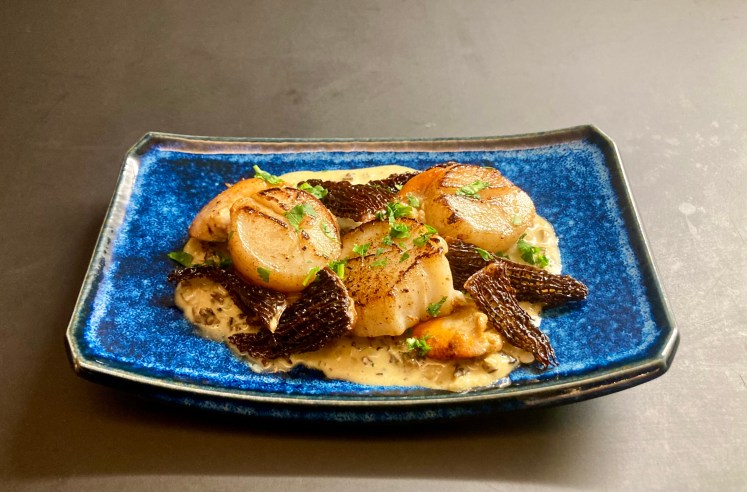
Scallops and Morels ©cadwu with a rich creamy morel sauce with chopped shallots, stock, mustard and chopped parsley
Scallops and Morels ©cadwu

Easy Mushroom Pie

Thyme, oregano, nutty mushrooms and Parmesan cheese: a delicious combination at the heart of this easy mushroom pie. We used ready-made puff pastry, so making the filling is all you need to do.

Oregano (Origanum Vulgare) is typical for the Mediterranean cuisine. The leaves have an intense, earthy, slightly bitter taste. Use it when making tomato sauce, grilled vegetables or a lamb stew. Dried oregano is nearly as tasty as fresh oregano. When buying fresh oregano, make sure you’re not buying marjoram (Origanum Majorana) because its flavour is less intense and a bit sweet. To add to the confusion: oregano is also called wild marjoram whereas marjoram is called sweet marjoram.

Wine Pairing

We enjoyed our easy mushroom pie with a glass of Bardolino, made by Monte del Frà from Italy. The grapes used are Corvina, Rondinella and Molinara. It is a well-balanced, vibrant ruby red wine with lots of fruit and a hint of spices. Medium acidity. In general, you’re looking for a refreshing red wine with lots of fruit that should be served slightly chilled.

What You Need
  • 200 grams of firm Mushrooms, we used small Eryngii
  • 50 grams of Pancetta
  • 3 Eggs
  • 50 grams of Crème Fraîche
  • Parmesan Cheese
  • Thyme
  • Oregano
  • Shallot
  • 2 cloves of Garlic
  • Puff Pastry
  • Olive Oil
What You Do
  1. Warm a skillet
  2. Chop the shallot, the garlic and the oregano
  3. Clean the mushrooms and slice in two if so required
  4. Add some olive oil to the pan
  5. Add slices of pancetta
  6. Fry until crispy
  7. Transfer to a plate with kitchen paper
  8. Add the shallot to the pan and fry on low heat
  9. After a few minutes add the mushrooms and fry over medium heat
  10. After a few minutes add the garlic
  11. Reduce heat
  12. When all nicely done, add the thyme and the chopped oregano
  13. Set aside and let cool
  14. Preheat your oven to 180 °C or 355 °F
  15. Whisk the three eggs
  16. Add crème fraiche
  17. Add freshly grated Parmesan cheese and black pepper
  18. Cut or crumble the pancetta and add to the mushroom mixture
  19. Add the mushroom mixture to the egg mixture, combine
  20. Coat a 19 cm or 7.5-inch round baking tin with thin puff pastry
  21. Add the mixture and distribute evenly
  22. Transfer to the oven for 20-25 minutes or until nice and golden
  23. Allow to cool on a wire rack for a few minutes
  24. Remove from the tin as soon as possible
  25. If the bottom is not done, then transfer back to the oven (without the tin) for 10 minutes and set your oven to 160 °C or 320 °F, lower heat only
  26. Let cool and enjoy at 65 °C or 150 °F
PS

Skip the pancetta for a vegetarian version of this easy mushroom pie. Add extra thyme, oregano and Parmesan cheese.

Easy Mushroom Pie ©cadwu with thyme, oregano, nutty mushrooms and Parmesan cheese. The vegetarian version is as tasty as this one.
Easy Mushroom Pie ©cadwu

Your Favourites in 2025

In 2025 the most popular recipe was Scallops with Roe. We were inspired by the great quality of the scallops on the market in Nice and we were not disappointed. The combination of scallops, roe and mashed potatoes is simple and delicious.

This year’s runner up is an all time favorite: Kimizu. This classic, golden sauce from Japan, is made with egg yolks, rice vinegar, water and mirin. We also made a version with tarragon, let’s say the Béarnaise version of Kimizu. Although it is a classic sauce, we use a microwave to prepare Kimizu and Kimizu with Tarragon. An easy and very effective way of controlling temperature and consistency.

Number three was another classic sauce: Ravigote. We served it with Pâté de Tête Persillé and crusted bread. The recipe we posted goes back to the more or less original version. The Ravigote is light, uplifting and flavorful.

You’ve probably noticed we love mushrooms. Cultivated ones, like shiitake and oyster mushrooms and seasonal ones, such as morels and Caesar’s mushroom. This year we introduced a page with mushroom recipes in Dutch. It turned our to be a great success!

A few years ago we started exploring forgotten vegetables such as mashua and oca. We’re very pleased to see the popularity of this page. Clearly you’re as interested in these vegetables and their flavours as we are!

This year we will continue our series of sauces and of mushroom recipes, we will prepare dishes from illustrious Parisien restaurants and discuss wine pairing. We also plan to review cookbooks, with the help of our much loved tasting panel. In the meantime we look forward to your feedback, suggestions, likes and comments.

Let’s start cooking!

Black Pearl

Remember the Black Pearl, the ship captained by Jack Sparrow, portrayed by Jonny Depp? The ship had black sails and it was faster than the infamous Flying Dutchman. Films such as the Curse of the Black Pearl and At World’s End, characters such as Davy Jones and captain Barbossa, all good. We lost track when watching the third film and, in the end, we gave up on the series, despite the hilarious eccentricity of Jack Sparrow.

When shopping at our favourite mushroom stall, we noticed a cultivated mushroom, one we hadn’t seen before, called Black Pearl
The background of the Black Pearl mushroom (or Shimofuri) is as confusing as the story line of the Pirates-movies. According to some it’s a Japanese hybrid between King Trumpet and Black Oyster Mushrooms, others claim it’s a hybrid between a European and an Asian Oyster Mushroom and some say it’s a combination with Pearl Oyster mushrooms. Or perhaps a Marbled Oyster Mushroom? In all cases the Latin name seems to be Pleurotus Ostreatus, which is the name of the common oyster mushroom. 

Let’s forget about the background and enjoy its earthy, sweet, slightly peppery flavour and its firm texture. We combined the mushroom with an omelette, inspired by Tamagoyaki, the rolled Japanese omelette. We added Kashimiri pepper to the mushrooms, to emphasize their spiciness.

Drink Pairing

We enjoyed a glass of our favourite sake: Junmai Taru Sake as produced by Kiku-Masamune. The sake matured in barrels made of the finest Yoshino cedar, which is reflected in its aroma and flavour.
An aromatic, fresh and fruity white wine, with aromas of citrus and apple will also pair very well. The wine should be uplifting and juicy with a light character.

What You Need
  • 100 grams Black Pearl
  • 1 scallion, white only
  • 1/3 Kashmiri Pepper
  • 2 Eggs
  • ½ teaspoon Dashi Powder
  • teaspoon Mirin
  • teaspoon Soy Sauce
  • Olive Oil
What You Do
  1. Clean the mushrooms and cut in 2 or 4
  2. Thinly slice the white of the scallion
  3. Combine egg, dashi, mirin and soy sauce
  4. Warm a small heavy iron skillet
  5. Add some olive oil
  6. Add the egg mixture to the pan and bake a bavuese omelette
  7. In parallel: heat a small heavy iron skillet
  8. Crush pepper
  9. Add olive oil to the pan and fry the pepper, for a minute or so
  10. Reduce heat
  11. Add mushrooms to the pan
  12. Just before serving add the scallion
  13. Slice the omelette in two
  14. Serve the omelette with the mushrooms on a warm plate
Black Pearl Mushrooms served with an omelette. the omelette is flavored with dashi, soy suace and mirin. we also added crushed Kashmiri pepper ©cadwu
Black Pearl Mushrooms ©cadwu

Risotto with Porcini

Risotto is amongst our favourite dishes, especially risotto with mushrooms. Preparing risotto is not difficult, as long as you pay attention to the cooking process and use the right ingredients.
It’s nearly the end of the porcini-season. We enjoyed them several times this year, but not yet in a risotto. Time to start cooking!

Wine Pairing

We enjoyed a nicely oaked, buttery South African chardonnay with our risotto with porcini. A full-bodied white wine with aromas of tropical fruit and toast. A wine that paired very well with the earthiness of the risotto and its rich flavours.

What You Need
  • 90 grams of Carnaroli or Arborio rice
  • 1 Shallot
  • Olive Oil
  • 150 grams of fresh Porcini
  • Chicken or Vegetable Stock
  • Parmesan Cheese
  • Butter
  • Black Pepper
What You Do
  1. Peel and chop the shallot
  2. Clean the porcini
  3. Slice the porcini; cube smaller parts
  4. Warm the stock
  5. Add olive oil to a pan and glaze the shallot
  6. Add the smaller parts of the porcini
  7. Add the rice to the pan and coat for 2 minutes
  8. Keep the pan on medium heat; be patient
  9. Start adding stock, spoon by spoon and stir frequently
  10. Heat a heavy iron skillet and fry the sliced porcini in butter and oil
  11. In total it may take 15 – 18 minutes before the rice is al dente
  12. 5 Minutes before the risotto is al dente, coarsely cut some of the fried porcini, making sure you have a few nice slices for decoration
  13. Add the coarsely cut and fried porcini to the risotto
  14. When the risotto is ready, transfer the pan to the kitchen countertop and leave to rest for 2 minutes.
  15. Add grated Parmesan cheese and combine
  16. Add butter and combine
  17. Add some black pepper, taste, add more Parmesan cheese and/or butter if so required.
  18. Decorate with slices of porcini
  19. Serve immediately.
PS

We have four other risotto recipes, with squid, with beetroot, with mushrooms and with peas.

Risotto with Porcini is a delicious combination of creamy, rich rice and nutty, umami flavours. Risotto is not difficult to make if you use the right ingredienst and follow the instruction.
Risotto with Porcini ©cadwu

Horn of Plenty with Sole and a Lemon Sauce

In 1989 Antonio Carluccio published A Passion for Mushrooms. The book describes various mushrooms, discusses their habitat and edibility and of course offers a range of mushroom recipes. A Passion for Mushrooms includes some wonderful recipes and combinations we didn’t expect, for instance Truite aux Pied Blues and Ragout de Crevettes Rose et de Morilles. The book also includes a chapter on conservation techniques.
Earlier we prepared two dishes from the book, Sandwiched Parasol Mushrooms and Halibut with Saffron Milk Cap.
A Passion for Mushrooms is a must have for mushroom-lovers. The book is available via the usual channels and perhaps at your local second-hand bookstore. Prices will vary.

Trompette de la Mort

Horn of Plenty is a black chanterelle, also known as Trompette de la Mort, Black Trumpet, or Trumpet of the Dead. A very tasty mushroom, with just one downside: removing all the sand, small leaves and unappetizing bits is a lot of work.
Carluccio poaches sole fillets and combines these with a combination of mushrooms, butter and lemon. Inspired by his recipe we prepared Horn of Plenty with Sole and a Lemon Sauce. 

Wine Pairing

We enjoyed a glass of white Rioja with our Trompette de la Mort. The wine is made by Vivanco with three Spanish grapes: Viura, Tempranillo Blanco (a grape discovered in 1988) and Maturana Blanca (a grape that goes back to 1622). The result is a bright, intense white wine with aromas of citrus fruit and green apples. Fresh, tasty and a great match with the flavours of the mushrooms, the sole and the acidity of the sauce.
In general, we suggest a non-oaked, fresh, dry white wine, with clear acidity. 

What You Need
  • For the Poached Sole
    • 4 fillets of Small Sole
    • 5 cm of Carrot
    • 5 cm of Celery Stalk
    • 1 Bay Leave
    • Crushed black pepper
  • For the Mushrooms
    • 100 grams horn of plenty
    • ¼ Red Bell Pepper
    • Olive Oil
    • Black Pepper
  • For the Sauce
    • 1 Egg Yolk
    • 20 ml Lemon Juice
    • 10 ml Water
    • 1 Teaspoon of Mirin
    • White Pepper
What You Do
  1. Clean the mushrooms
  2. Finely cube the red bell pepper
  3. Warm a pan of water until just simmering. It’s crucial not to overheat the water. The internal temperature of fish should be between 70 °C and 75 °C (or 160 °F and 165 °F).
  4. Add sliced carrot, sliced celery, bay leave and crushed black pepper
  5. Leave on this temperature for 10 minutes or so
  6. Heat a heavy iron skillet and add some olive oil
  7. Reduce heat and add cubed bell pepper
  8. Role up the fillet: skin side on the outside and start with the smaller part of the fillet
  9. Use a simple wooden cocktail stick to fix the role
  10. Poach the sole until done, depending on the size, 4 minutes
  11. Keep the sole warm in an oven at 65 °C or 150 °F
  12. Add the mushrooms to the pan with the bell pepper
  13. Fry gently
  14. Add some black pepper to taste
  15. Keep an eye on the mushrooms
  16. Combine egg yolk, lemon juice and mirin
  17. Make the sauce au bain marie or in the microwave
  18. Add some white pepper to the sauce
  19. Serve the sole on top of the mushrooms
  20. Add the lemon sauce
  21. Serve immediately on a warm plate
PS
  • The sauce is based on Japanese Kimizu. In this recipe we explain how to use a microwave.
  • You could also use grilled and peeled red bell pepper. That will give some smokiness to the dish, which is nice, but not necessary.