The Quiet Hunt

Antonio Carluccio’s The Complete Mushroom book is more than a cookbook. The first part of the book discusses foraging and collecting mushrooms, with clear descriptions of each mushroom and poisonous look-alikes. It’s a pleasure to read, but we’re not brave enough to start our own quiet hunt.

Fortunately, mushrooms are becoming more popular and greengrocers and supermarkets have started selling chestnut mushrooms, button mushrooms and shiitake. Asian supermarkets in most cases sell (king) oyster mushrooms, shiitake, enoki and shimeji.
Don’t be tempted to buy dried mushrooms: expensive, no aroma, nasty taste and not even close to a fresh mushroom.

Recipes

The second part of the book includes some 150 mushroom recipes, ranging from classic Italian dishes to culinary treats. Carluccio’s recipes are well written and informative. You’ll get the feeling that he lets you in on some of his secrets. And given he started foraging mushrooms as a young child, there are a lot of secrets to share!

One of our favourites is a salad made with maitake, fresh scallops, crab and shrimps. It’s an amazing result, with lots of pleasant flavours, also thanks to the cilantro, dill and parsley. Part of the fun is that the scallops are not seared but prepared like ceviche. Maitake is also available as a cultivated mushroom.

Caponata

More favourites? Of course! How about Mushroom Caponata or Tagliolini with black truffle? The caponata is a combination of mushrooms, egg plant and various herbs, so if you can buy button mushrooms and for instance shiitake, you’re ready to go.

Our all-time favourite from this book is the combination of fresh oysters with white truffle (bianchetti). A starter we prepare once or twice a year, depending on the availability of the truffle. Always a pleasure…

The Mushroom Book – the Quiet Hunt was published in 2001. It’s available (in most cases second hand) via channels such as Amazon and e-Bay for prices between 25 and 50 euro.

One of the very best books on mushrooms, written by a true expert.

PS

Later we found an earlier book by Antonio Carlucci called A Passion for Mushrooms, published in 1989. Very little overlap in recipes. A must-have for mushroom lovers!

Mushroom Tapenade

Years ago our favourite green grocer was the shop of Joop and Trudi Petersen, close to Amsterdam’s China Town. Not only did they sell the tastiest vegetables, fruit and mushrooms, but they also sold homemade mash (the one made with potatoes and rapini (or broccoli rabe) was wonderful), desserts, ravioli with pumpkin and Trudi’s mushroom tapenade. When Joop turned 65 in 2008 they retired and closed the shop. Obviously, we asked for the tapenade recipe, but alas, all we got was a nice, friendly smile.

In our post about the Mushroom Book by Michael McLaughlin and Dorothy Reinhardt (Illustrator) we mentioned that the recipe for Mushroom Tapenade is amongst our favourites. His tapenade is a combination of mushrooms, garlic, various herbs, red wine, anchovies, black olives and capers. Very nice, tasty and powerful, but not as delicious as Trudi’s version.

Mushroom tapenade comes with lots of umami, thanks to the mushrooms and the olives. Thinking back of Trudi’s tapenade, we’re pretty sure she enhanced the umami flavor, probably by adding some oyster sauce from the toko next door. We think that the recipe below is very close to what she created.

What You Need

  • Fresh Button Mushrooms and Shiitake (ratio 2:1)
  • 2 Garlic Cloves
  • Olive Oil
  • Thyme and Rosemary
  • White Wine
  • Black Olives
  • Excellent Olive Oil
  • Black Pepper
  • Half a teaspoon of (Thai) Oyster Sauce

What You Do

Don’t use dried mushrooms. In general they have a nasty, bitter taste, not even close to the flavor, aromas and textures of fresh mushrooms.

  1. Clean and chop the mushrooms.
  2. Finely chop the rosemary, the thyme and the garlic.
  3. Fry the mushroom in olive oil in a heavy iron skillet.
  4. Reduce heat, add herbs and garlic.
  5. After 10 minutes add a splash of white wine.
  6. Continue on low heat and wait until the wine and juices have evaporated. No rush.
  7. Transfer the mushroom mix to a plate, let cool
  8. Chop a few black olives and add these to the mix.
  9. Transfer to a kitchen aid and on low-speed start adding excellent olive oil. The result should be a tapenade, so not smooth and not oily.
  10. Add black pepper to taste.
  11. Add a small amount (1/4 teaspoon to begin with) of (Thai) Oyster Sauce. Be very careful, it should only enhance the umami.
  12. Store in the refrigerator for at least one day before using.

Earthly Delights

The Mushroom Book by Michael McLaughlin and Dorothy Reinhardt (Illustrator) is a lovely, small book with some 35 recipes and 60 very delightful full-colour wood-cut illustrations. Just look at the cover! It’s the kind of book that we bought because it looks good. A book you simply want to have.

Only later did we find out that it discusses the history and other interesting back ground information of various mushrooms, including information on choosing, storing and preparing them. The book offers an introduction to the joy of cooking with mushrooms such as button mushrooms, morels, oyster mushroom, truffle, trompette de la mort, chanterelle, shiitake, cèpes and huitlacoche, a Mexican mushroom that grows on corn.
Michael McLaughlin is also known as co-author of The Silver Palate Cookbook with recipes from Manhattan’s celebrated gourmet food shop.

Amongst our favourite recipes are Mushroom Tapenade and Raw Mushroom, Fennel and Provolone Salad.

The Mushroom Book was published in 1994. It’s available (in most cases second hand) via channels such as Amazon and e-Bay for something like 15 euro. Ii is an ideal and friendly introduction to the world of earthly delights. 

The Mushroom Book
The Mushroom Book

The Mushroom Feast

Yes, it’s a bit early, but we can start thinking about enjoying the first mushrooms of this season, such as the Mushroom of Saint GeorgeMorels, Bianchetti and the Fairy Ring Mushroom. Let’s be prepared for the season and think about books, recipes, web sites and food-wine pairing.

A classic book on mushrooms was written by chef and author Jane GrigsonThe Mushroom Feast, originally published in 1975. The book Is beautifully illustrated by Yvonne Skargon.
Jane Grigson is known for many other classics such as The Fruit Book and The Vegetable Book.

The Mushroom Feast includes a chapter on the best edible mushrooms and ways to preserve mushrooms. Other chapters describe how to combine mushrooms with fish, meat, poultry and game. One chapter discusses mushrooms in the Japanese and Chinese kitchen.
Jane Grigson also provides interesting background information, like Colette’s view on truffles. Worth reading, with or without truffles.

It isn’t a handbook for foragers, but no book ever is.

The Mushroom Feast covers a wide range of mushroom recipes: soups, salads, pies, sauces and intriguing combinations like creamed cucumbers with mushrooms and classics like mushroom soufflé. The recipes are clear and well-written.

You may perhaps think the recipes are a bit old fashioned, but that shouldn’t stop you from reading them. Be inspired by one of Britain’s finest writers on recipes and food.

Roulade of Turkey with Mushrooms and Chestnuts

We love to eat this very tasty, juicy, rich combination during winter. We use meat from the leg of the turkey (the thigh) because it has lots of flavours and a great texture.
You could of course make your own chestnut butter, crème or spread; we prefer using Clément Faugier’s Chestnut Spread. It’s nutty, sweet (but not too sweet) and earthy.

Wine Pairing

A medium bodied, red wine will be a great accompaniment of the roulade. In general you’re looking for a red wine with aromas of black fruit, floral notes and delicate wood. The tannins should be soft or well-integrated. We enjoyed a glass of Spätburgunder (Pinot Noir) as produced by Von der Mark-Walter. The winery is located in Baden, Germany, at the foothills of the Black Forest.

What You Need (Filling)

  • Shallot
  • Olive Oil
  • 150 grams of Mushrooms
  • Thyme
  • Chestnut Spread
  • Black Pepper

Chop the shallot and glaze in a pan with olive oil for 5 minutes. Clean the mushrooms and cut into smaller chunks. Add the mushrooms and allow to simmer for 10 minutes. Add a generous amount of thyme. Transfer from the pan and allow to cool. Once lukewarm, use a kitchen knife to create a lovely duxelles. Add a teaspoon of chestnut spread. Taste and adjust by adding more chestnut spread and black pepper.

What You Need (Roulade)

  • One Turkey Thigh
  • Pancetta or Bacon
  • Filling
  • Kitchen twine and needle
  • Butter
  • Olive Oil
  • Cream
  • Black Pepper
  • Brussels Sprouts
  • Nutmeg

Remove the bone (if any) and ‘unfold’ the meat by slicing the thicker part, making it longer. Make a strip of pancetta from left to right, without covering the lower and upper part of the meat. Put the filling on top of the strip and then spread it out, making sure the top and bottom remain not covered. Put 4 or 6 strings of kitchen twine underneath the roulade and start rolling. Not too tight. Use one longer string of kitchen twine to close the sides (so the two strings are at right angles to each other). You may need a needle to close the roulade. Wrap the roulade in plastic foil and keep in the refrigerator.
Ready to cook? Fry the roulade in lots of butter and olive oil to give it a nice colour and then transfer it to the oven at 160 ˚C or 320 ˚F. It’s ready when the centre has reached a temperature of 70 ˚C or 160 ˚F. Transfer from the oven and wrap in aluminium foil. Leave to rest for 15 minutes.
Add some chicken stock to the pan and deglaze. Transfer to the blender and create a smooth, thick sauce. Transfer back to the pan and leave on low heat. Add some cream, taste and leave for 10 minutes or so. In the mean time steam the Brussels sprouts. When ready coat with some olive oil.
Serve two or three slices of turkey roulade per person with the sauce and some Brussels sprouts. A touch of black pepper on the turkey and some fresh nutmeg on the sprouts.

Mushroom Soup with Pancetta and Thyme

This morning when we looked outside, we saw a grey, foggy city. Knowing it would take hours for the fog to clear, we started thinking about something warm for lunch. Perhaps some soup with crusty bread? We opened our refrigerator. Various mushrooms, thyme, rosemary, cream, a carrot, some left over stock. Yes! We knew what we wanted to cook for lunch: Mushroom Soup with Pancetta. A hearty, rich soup, ideal for a cold, grey day. The combination of mushrooms, pancetta and cream works very well; the celery and leek add complexity and the thyme brings character.

Wine Pairing

It was much later that afternoon before the fog left the city, but since we also had some left over Chardonnay in the fridge, which we enjoyed with our soup, we didn’t mind that much.

What You Need

  • Pancetta
  • Shallot
  • Mushrooms (Best is a Mix of Champignons, Shiitake etcetera)
  • Celery
  • Leek
  • Carrot
  • Garlic
  • Stock (Chicken or Vegetable)
  • Bouquet Garni (Thyme, Rosemary and Bay Leaf)
  • Black pepper
  • Cream
  • Fresh Thyme
  • Olive Oil

What You Do

Keep two strips of pancetta apart (to be grilled just before serving). You probably need 4-6 strips in total. Slice the remaining pancetta and fry in olive oil on medium heat. Remove the pancetta from the pan, chop the shallot and glaze it in the fat and perhaps some extra olive oil. Clean and slice the mushrooms, slice half a stalk of celery, half a leek, a small carrot, chop two gloves of garlic and add this to the shallot. Gently fry for a few minutes. Add the pancetta, the stock and the bouquet garni. Allow to simmer for 30 minutes. Remove the bouquet garni. Blender the soup, pass through a sieve and leave on low heat for 10 minutes. The mushrooms will emulgate the soup, so no need to add a roux. Now it’s time to taste the soup and perhaps add some black pepper. Add cream and fresh thyme and leave for another 5-10 minutes. In the meantime grill the two strips of pancetta until brown and crispy. Cut the stripes in five pieces depending on the size. Serve the soup in a warm bowl with the pancetta on top of it.

Pâté with Mushrooms

Let’s celebrate the season by preparing a Pâté! The combination of a crispy crust, a structured, colourful filling and various flavours is always a pleasure. Making a pâté (or better: a Pâté en Croûte) can be a bit intimidating (especially if you look at the pâté’s prepared during the World Championship!) but that should not stop you from giving it a try. It’s a pleasure to think about the ingredients, work on the construction and enjoy the wonderful aromas from your oven while baking the pâté. And the joy when slicing it: is the pâté as beautiful as you expected it to be?
Feel free to make your own puff pastry, but if you buy ready-made pastry, please check it’s made with butter, flower, salt and water only and not with rapeseed oil, palm oil, yeast etcetera.

Wine Pairing

A red, medium bodied wine will be a great accompaniment of this Pâté en Croûte. In general you’re looking for a red wine with aromas of black fruit, floral notes and delicate wood. The tannins should be soft or well-integrated. We enjoyed a glass of Pinot Noir from La Cour Des Dames

What You Need

  • 150 grams of Cèpes
  • 250 grams of Champignon de Paris
  • 1 small Shallot
  • Handful of Spinach
  • Half a cup of Rice
  • Parmesan Cheese
  • Parsley
  • One Egg
  • Puff Pastry
  • Black Pepper

What You Do

Start by cooking some rice, you will probably need a tablespoon of cooked rice. Clean the cèpes and see how they best fit in the pâté baking mould. Perhaps you need to trim the stems or the caps to have the best result when it’s ready. Set the cèpes aside.
Clean the champignons and wash the spinach. Peel and finely chop the shallot. Warm a heavy iron skillet, glaze the shallot, add the cleaned and lengthwise halved mushrooms (and the leftovers of the cèpes) and cook them on medium heat for 10 minutes or so. In parallel blanch the spinach, drain and squeeze. Also in parallel, coat the mould first with baking paper and then with puff pastry. Make sure you have some extra pastry to create the lids for the chimneys. Chop the cooked mushrooms. Chop the spinach. Add the egg to a large bowl and whisk. Add the cooked mushrooms to the bowl, add some black pepper, chopped parsley and finely grated Parmesan Cheese. Add some spinach, just to have some extra colour. Add the rice. The rice will help absorb additional juices from the cèpes, so how much rice you need is a matter of looking at the mixture and the cèpes.

Now it’s time to build the pâté: start by creating a bottom with the mixture, position the cèpes and add the remainder of the mixture. Make sure the mixture envelops the mushrooms. Close the pâté with the pastry. Make two holes in the roof of the pâté and use baking paper to create 2 chimneys. Transfer to the oven (180 °C or 355 °F) for 45 minutes. Use the remainder of the puff pastry to make 4 mini cookies that will function as lid on the chimney (of course, you only need 2, but baking 4 allows you to choose the best). After 45 minutes add the 4 cookies, bake for another 10 minutes. Mix some egg yolk and coat the pâté and the cookies. Cook for another 5 to 10 minutes. The duration and temperatures very much depend on the shape of the mould and the pastry.

Transfer from the oven, remove the chimneys, glue the lids on the chimneys using some egg yolk and let cool. Once cool, remove from the mould, transfer to the refrigerator and wait until the next day. 

Lobster Mushroom with Pasta

The Lobster Mushroom is, obviously, bright reddish orange like the shell of cooked lobster. Not obvious is the fact that it’s actually a parasite that grows on certain mushrooms, making the host completely invisible and even changing its structure and taste. If you slice a lobster mushroom, you’ll see a beautiful red skin, as if the host mushroom is sprayed.
The taste of the Lobster Mushroom depends on the host. The ones we bought tasted fairly bland, but nevertheless the pasta turned out to be very tasteful and uplifting, partly due to the homemade tomato confit.

Wine Pairing

Enjoy a glass of white wine with your Lobster Mushrooms. We drank a Portuguese Vinho Verde, made by Cazas Novas. It comes with floral and fruit notes, has some acidity and a medium body with a good texture and a fresh aftertaste. In general you’re looking for a wine with freshness, minerality and some acidity. A wine that will go well with the intense flavors of the tomato confit and the creamy mushroom pasta.

What You Need

  • 100 grams of Lobster Mushroom
  • Shallot
  • Garlic
  • Thyme
  • 1 Bunch of Udon
  • 10 Small Tomatoes (confit or roasted)
  • Stock (Chicken, Veal or Vegetable)
  • Parmesan Cheese
  • Olive Oil
  • Black Pepper

What You Do

Clean the Lobster Mushroom. This is a bit time consuming due to the structure of the mushroom. Slice the shallot and the garlic. Strip the leaves of the thyme. In a large iron skillet gently fry the shallot in olive oil until soft. Add the garlic. After a few minutes add the sliced lobster mushroom (chunks). Add the thyme. Leave on low heat. In parallel cook the udon for 10 minutes or until ready. Drain the udon but keep some of the cooking liquid. Add stock, just to have more liquid in the pan. Add the tomatoes, mix gently. Now add the udon to the pan, mix, making sure the tomatoes remain intact. Add cooking liquid to get the right consistency. Finish with a splash of excellent olive oil, black pepper and finely grated Parmesan Cheese.

  • Lobster Mushroom with Pasta ©cadwu
  • Lobster Mushroom ©cadwu

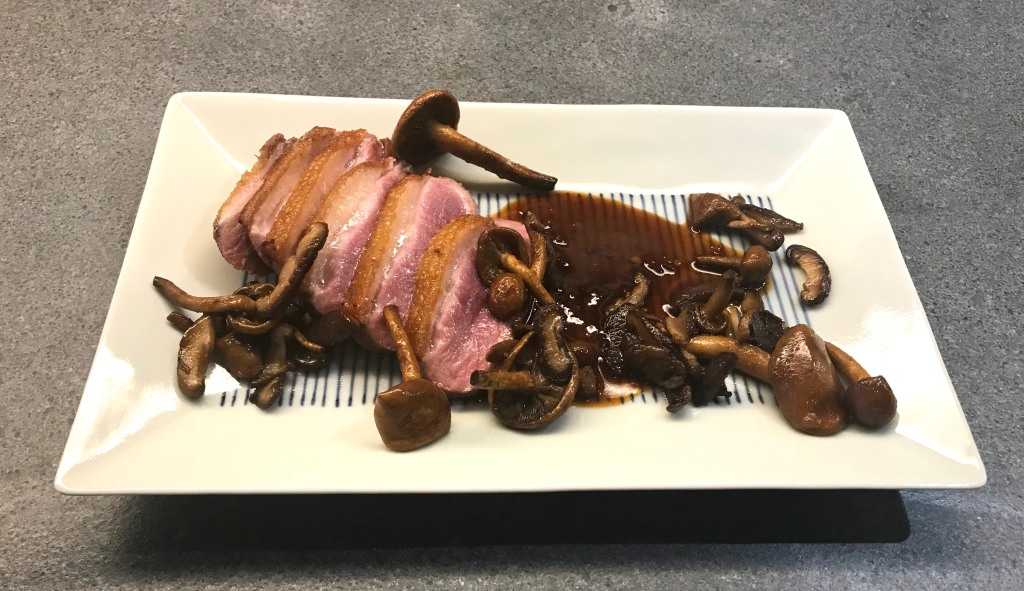
Duck with Soy Sauce and Mushrooms

In his book Yamazato, Kaiseki Recipes: Secrets of the Japanese Cuisine, author and Michelin Award winning chef Akira Oshima includes a recipe for breast of duck, marinated in a soy-based sauce, served with Belgian endive (chicory) and karashi (Japanese mustard). A mouth-watering dish. The book contains some 20 recipes that are technically challenging (at least, we think so) and well written.

In general the combination of duck and soy sauce works really well. It’s all about sweetness and umami. The Japanese mushrooms (shiitake, enoki, nameko and/or shimeji) add nuttiness and texture to the dish.
We use soy sauce and tsuyu: a mix of soy sauce, mirin and dashi, ideal for making a tempura dip and great to give extra flavor to the sauce.

Wine Pairing

We enjoyed our duck with a glass of gewurztraminer (full bodied and long lasting with aromas of lychees and roses) but there are many options in this case. Perhaps a nice rosé or a sake with a touch of sweetness?

What You Need

  • Breast of Duck
  • Japanese Mushrooms
  • Soy Sauce (preferably with less salt)
  • Tsuyu
  • Chicken Stock
  • (Olive) Oil
  • Mirin
  • (optional) Sake

What You Do

  1. Start by cleaning the breast of duck
  2. Heat a non-stick pan
  3. Fry the duck, straight from the fridge, for 12 minutes on the skin-side and 2 minutes on the meat-side in a non-stick pan
  4. Wrap in foil, making sure the skin is not covered.
  5. Clean the pan with kitchen paper and fry the sliced mushrooms for 5 minutes or so in oil until ready
  6. Set aside and keep warm
  7. Add soy sauce, tsuyu and chicken stock to the pan and reduce
  8. Add a splash of sake and some mirin
  9. Add liquid of the duck
  10. Let simmer for a few minutes, add the mushrooms and make sure they are coated with the sauce
  11. Let simmer for 5 minutes
  12. Slice the duck, add liquid to the sauce, stir and serve.
Duck with Soy Sauce and Mushrooms ©cadwu

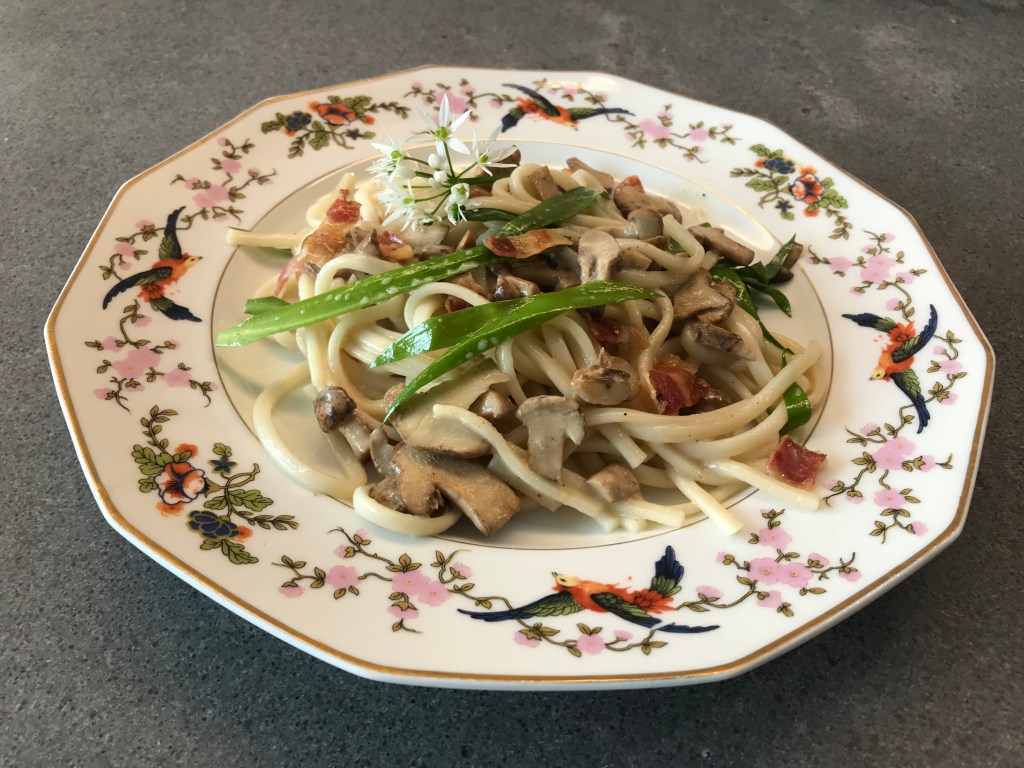
Saint George’s Mushroom with Pasta

Spring brings us several edible or even delicious mushrooms, such as the Mushroom of Saint GeorgeMorels and the Fairy Ring Mushroom.

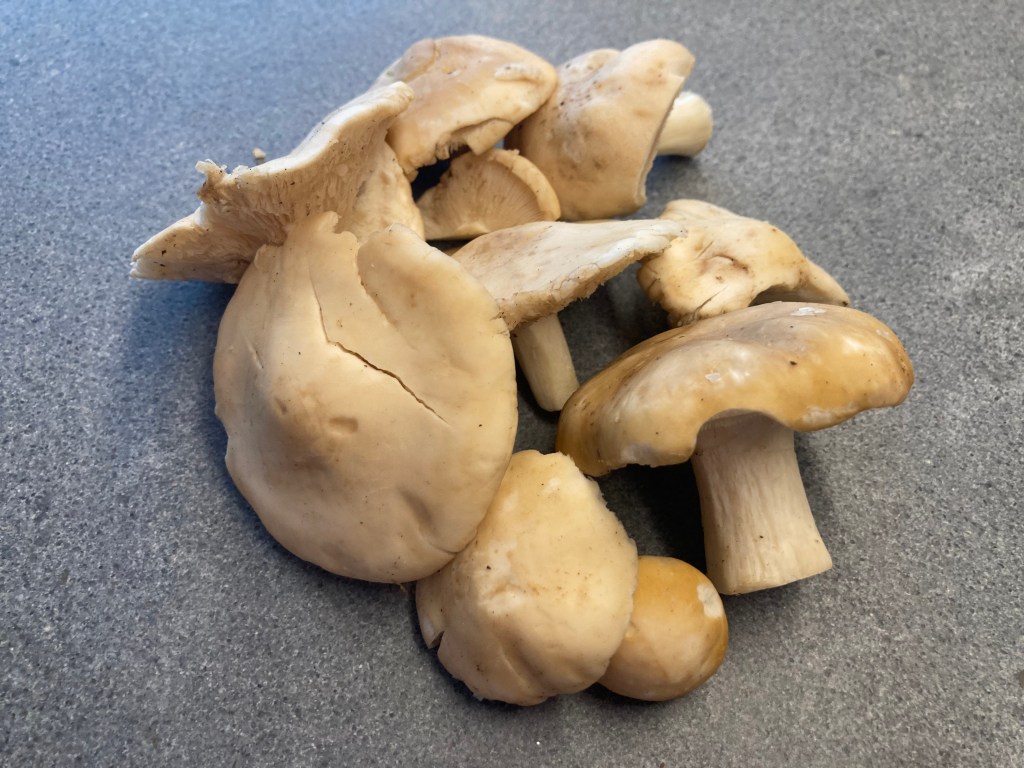
The mushroom of Saint George (Calocybe gambosa) is usually the first edible mushroom to appear. Its name derives from St George’s Day, 23rd April, by which date it can be found in the UK. Its French and Italian name (for instance Tricholome de la Saint-Georges in France) also refer to this day. Its Dutch name (Voorjaarspronkridder) and its Swedish name (Vårmusseron meaning spring mushroom) refer to the fact that the mushroom is available for a short period only.

Famous chef and author Jane Grigson isn’t a fan of the mushroom. In her classic book The Mushroom Feast she writes “I have omitted one or two which our mushroom books follow each other in praising too highly. One of these is the Saint George’s Mushroom.” 

Perhaps because the smell is so rare? Some say the mushroom smells of cucumber; others say melon rind or refer to a mealy scent. We think it’s more like overripe zucchini or even ghee that is a bit offish. In all cases, a not-very-pleasant-smell to remember. The good news is that the smell disappears as soon as you heat the mushrooms.

The mushroom of Saint George is clearly a spring-mushroom, but we think that you will have some reminiscence of autumn when eating this dish. A hint of earthiness. Intense but not overwhelming. However, the combination of ramson (wild garlic) and Saint George’s mushroom is 100% spring.

Confused? Perhaps that’s part of the fun of eating Saint George’s mushroom.

Wine Pairing

We suggest an oaked chardonnay, for instance Domaine De La Prade from the Languedoc region in France. The wine has a pale, yellow colour, aromas of ripe tropical fruit and its taste is intense, buttery and comes with a touch of oak. The wine has a long lasting taste. 

Feel free to go for a US or Australian Chardonnay. A full-bodied, gently oaked chardonnay will go very well with the mushroom and the udon.

What You Need

  • 1 bunch of Udon
  • 150 grams of Saint George’s Mushroom
  • Fresh Ramson (or Wild Garlic, 5 Leaves and Flowers)
  • Chicken Stock
  • Black Pepper
  • Crème Fraîche
  • 4 Slices of Excellent Pancetta
  • Olive Oil

What You Do

  1. Clean the mushrooms with kitchen paper and if necessary clean the stems with a sharp knife.
  2. Slice the pancetta in small slices.
  3. Heat a heavy iron skillet, add olive oil and quickly fry the pancetta.
  4. Transfer to a plate with kitchen paper and keep in the oven on 60° Celsius or 140° Fahrenheit.
  5. Slice the mushrooms, fry them gently in the pan and reduce the heat.
  6. Add chicken stock.
  7. Add some crème fraiche.
  8. In parallel cook the udon for 10 minutes.
  9. Drain the udon and keep some of the cooking liquid.
  10. Add the udon to the mushrooms in the pan, add black pepper and stir gently, making sure all pasta is covered.
  11. Add some cooking liquid to make sure it’s nice and moist.
  12. Add the pancetta and the sliced leaves (lengthwise, remove the vein) of ramson, mix and serve immediately.
  13. Decorate with a ramson flower.
  • Saint George's Mushroom with Pasta ©cadwu
  • Saint George's Mushroom with Pasta - Ingredients ©cadwu
  • Saint George's Mushroom ©cadwu
  • Domaine La Prade Chardonnay ©cadwu