White Asparagus with Chervil

A salad can be an excellent starter of your lunch or dinner, provided it’s one with lots of flavour and gentle acidity. For instance a Salade Ni­çoi­se, a Salade Caprese or a salad of White Asparagus and Chervil.

Chervil is a very delicate herb. It tastes like anise, but it is much more refined. Chervil looses its taste almost immediately when heated. The salad needs to be prepared well in advance, allowing for the flavours to be well integrated.

Honey can easily ruin a salad (and sugar will always ruin a salad). In this case we use only a touch of honey to create an environment for the sweetness of the white asparagus. The honey should act as a trigger.

The salad is a great example of the complexity of white asparagus: you will taste the sweetness and the freshness of the asparagus. The mouth feel of the salad is very nice, because the asparagus will be both juicy and crispy, with the chervil, honey and vinegar in a supporting role.

After having mixed the salad you will notice that the asparagus and chervil absorb the dressing. During the time in the refrigerator the asparagus will loose some juices, which is actually the beginning of a great dressing.

Wine Pairing

Combining salad and wine is not straightforward. Especially the acidity of the dressing creates a challenge. One solution is to use verjuice and not vinegar. Verjuice is made by pressing unripe grapes. The idea is that verjuice links to wine, whereas classic vinegar or lemon juice would compete with wine. In this case we choose a wine that reflects the flavours of the salad: a hint of anise, a touch of sweetness and florality. Typical notes you will find in a wine from the Alsace region, for instance a Pinot Blanc or a Pinot Gris.

What You Need

  • 2 White Asparagus per person
  • Excellent Olive Oil
  • White Wine Vinegar or Verjuice
  • Lots of Chervil
  • Touch of Honey
  • White Pepper

What You Do

Steam the asparagus for 10 minutes. Let cool. Dry with kitchen paper if needed. Prepare a dressing with the olive oil and vinegar. Chop the chervil and add to the dressing. Add a touch of honey and stir well. Add some white pepper. Taste the dressing: it should be a balance, meaning that none of the ingredients is overly present. Now slice the asparagus in nice chunks, let’s say 3 centimetres long. Mix, cover and transfer to the refrigerator for 6 hours. Mix the salad every two hours. Check the taste after 4 hours, you may want to adjust. Mix the dressing just before serving.

White Asparagus with Ham, Egg, Potatoes and Parsley

Finally, it’s spring. The season of white asparagus, morels and many more primeurs. This dish brings together white asparagus with eggs, excellent ham, butter, small potatoes and parsley. Taste the slight bitterness and sweetness of the asparagus, the umami of the potato and enjoy the velvety feeling on your palate as a result of the butter and the egg.
Don’t be tempted to boil white asparagus in water with butter, lemon, sugar or salt. Steaming is by far the best way to prepare them. We love our Russel Hobbs food steamer! Simple, straightforward and the result is a tribute to spring.

Wine Pairing

Ideally we would serve a dry Muscat from the Elzas with our asparagus. The delicate, slightly sweet but dry taste, the hint of bitterness and the rich aromas work very well with white asparagus. Muscat to us means the smell of fresh fruit. As if you taste the original grape. A wonderful wine and a wonderful combination.
Fortunately asparagus are fairly flexible when it comes to wine: a Pinot Blanc or Pinot Gris will also be fine.

We opened a bottle of Vinho Verde from Portugal. A light and vibrant wine with clear notes of citrus and floral aromas that combined rather well with the flavours of the asparagus. Not the most exquisite combination, but it worked for us.

What You Need

  • 6 or 10 White Asparagus
  • 2 Eggs
  • 100 gram Excellent, Organic Ham
  • Small Firm Potatoes
  • Parsley
  • Butter
  • White Pepper

What You Do

Peel the asparagus and steam them for 20 minutes. Steam the eggs medium (10 minutes), making sure the yolk is firm but not dry. Wash the potatoes and steam them for 15 minutes. Timing depends on the size. Melt the butter. Peel the egg and cut in four. Chop the parsley. Serve the asparagus and eggs on a plate. Coat the potatoes with butter and parsley. Dress the plate with ham (please make sure it has a bit of fat) and potatoes. Poor the remaining melted butter over the asparagus. Sprinkle the parsley over the egg. Add some white pepper.

White Asparagus with Ham, Egg, Potatoes and Parsley ©cadwu

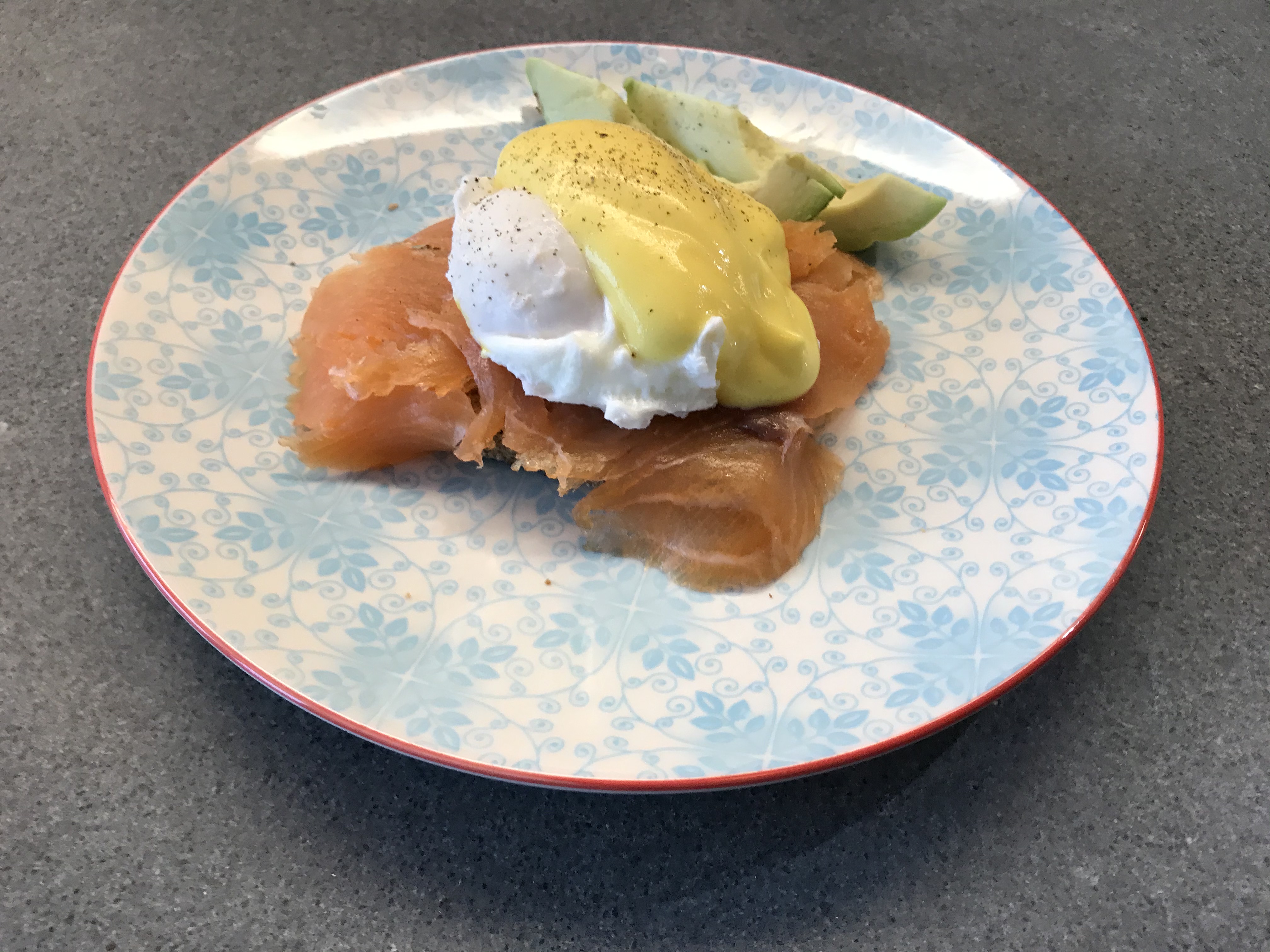
Eggs Benedict with Kimizu

Preparing Eggs Benedict comes with two technical challenges: Hollandaise Sauce (Kimizu in our case) and Poached Eggs.
Poaching an egg seems simple and straightforward when you watch the video made by chef Jacques Pepin, But we know that they’re intimidating to make plus it’s really challenging to get them just right: especially the gooey, liquid yolk.

Chef Pepin makes some very important suggestions: the main protein in egg white is Ovalbumin and it sets at 84,5 °C or 184 °F . According to chef Pepin the egg white becomes rubbery when the water temperature is too high. And he is right! Keep the water hot, but not boiling, when ‘boiling’ or poaching an egg.
He also mentions that the eggs must be cold. Makes sense, because then the yolk will remain runny.
And finally he explains how to store pre-poached eggs, reducing stress in the kitchen.

But the challenge remains: poaching an egg requires skills and experience. Or an OXO good grips egg poacher. Yes, we know, it sounds like another disappointing, expensive, and silly kitchen tool, but it actually works really well. Easy to use, easy to clean and great results, again and again.

What You Need

  • For the Poached Eggs
    • 2 cold, organic Eggs
    • Vinegar
  • For the Kimizu
    • 2 Egg Yolks
    • 1,5 tablespoon of Rice Vinegar (depending on the size of the egg yolks and the acidity of the vinegar)
    • 3 tablespoons of Water
    • 2 teaspoons of Mirin (1 could also be fine, depending on your taste)
  • English muffins or a slice of home made Bread
  • Salmon
  • Avocado
  • Black Pepper

What You Do

Best to make the poached eggs in advance and store them in cold water. Just before serving warm them in a pan of hot water. With the OXO poacher it’s simple: fill a pan with water and add a splash of vinegar. Bring the water to a simmer and crack an egg into the centre of the each poacher. You could also crack the egg into a little bowl or cup and then drop it into the centre of the poacher. After 30 seconds or so you can remove the OXO poacher and use it for another egg. We poached our eggs for 3 minutes maximum. Dry the poached eggs with kitchen paper and trim the egg white if necessary. Serve with toasted muffin or bread, salmon, avocado and of course Kimizu.

Pasta with Sage

We love using wonderful Mediterranean herbs such as basil, thyme, sage, marjoram, rosemary, oregano, saffron and tarragon. So we couldn’t resist buying a large bunch of sage and cooking this very tasteful, simple and uplifting starter. Sage has been around for many, many years and is an essential ingredient in many countries, both for medicinal and culinary purposes. Its taste is somewhat soapy, with a touch of acidity, a little bitterness, subtle eucalyptus and slightly peppery. Did we mention unique?
Preferably use fresh, thin pasta or Japanese udon, lots of butter and your best olive oil when preparing this dish.

Wine Pairing

We enjoyed our pasta with a glass of Bianco di Custoza 2020, made by Monte del Frà from Italy. It is a well-balanced, dry white wine, with a fruity nose. Its colour is straw yellow, with pale green highlights. In general you’re looking for a light, aromatic dry white wine.

What You Need

  • Pasta
  • Butter
  • Bunch of Sage
  • Olive Oil
  • Parmesan Cheese
  • Black Pepper

What You Do

Melt the butter in a large pan, devein and chop the leaves, add the sage to the butter, stir. The butter should embrace the flavours and aromas of the sage. When the mixture is nearly ready (this will take only a few minutes) cook the pasta. Grate some fresh Parmesan cheese. Keep a glass of the cooking liquid of the pasta, drain the paste, add it to the pan, mix, add some olive oil, mix, add a spoonful or two of the cooking liquid and make sure the pasta is fully coated with sage, butter and oil. Perhaps some black pepper. Garnish with Parmesan Cheese and serve on a warm plate.

Artichoke Pie

A few days after we published our recipe for Tourte de Blette a friend told us about the great taste of artichoke pie and how popular this dish is in Italy, especially in Liguria. Since we love artichokes, we dived into our cooking library, looking for recipes.
Interestingly most recipes refer to canned or marinated artichokes. But wouldn’t it be much better to use fresh, young artichokes? Other ingredients are cheese (Prescinsêua, or a combination of Parmesan or Pecorino and Ricotta, perhaps some Crème fraîche or even Feta), herbs (parsley, thyme or oregano) and eggs.
We like the combination of artichoke and thyme (as we did in our salad), but we could imagine oregano to be a good choice as well.
We remained close to Tourte de Blette and prepared a rustic, open pie, but feel free to create one with pastry on top.

Wine Pairing

It’s not straightforward to pair artichokes with wine. According to various researchers this is due to cynarin, a chemical especially found in the leaves of the artichoke. When the wine and the cynarin meet in your mouth, the natural sweetness of the wine is amplified, making it taste too sweet. So you have to pair freshly cooked or steamed artichokes with a bone-dry, crisp, unoaked white wine with clear, present acidity. For instance Sauvignon Blanc, Grüner Veltliner or Albariño.
We enjoyed our Artichoke Pie with a glass of Château Pajzos Tokaj “T” Furmint, a dry, bright, fresh wine with zesty, nutty and mineral flavours made from the Hungarian Furmint grape. A unique wine and perfect in combination with the artichokes.
Cynarin and wine are not a match made in heaven but the good news is that cynarin seems to protect your liver and even helps it regenerate.

What You Need

  • For the Dough
    • 100 gram of Flour
    • 50 gram of Water
    • 10 gram of Olive Oil
    • 1 gram of Salt
  • For the Mixture
    • 4-6 young Artichokes
    • One Shallot
    • Olive Oil
    • 30 grams of Rice
    • 2 Eggs
    • Fresh Thyme
    • 20 gram Freshly Grated Parmesan Cheese
    • Black Pepper

What You Do

Cook the rice and leave to rest.  Combine flour, salt, water and olive oil. Make the dough, kneed for a minute or so and store in the refrigerator for at least 30 minutes.
Clean the artichokes, steam for 30-45 minutes depending on the size and let cool. Chop the shallot. Warm a heavy skillet, add olive oil and gently fry the shallot. Transfer to a plate and let cool. Using a spoon remove the ‘meat’ from the leaves (bracts) of the artichokes. Chop the hearts in four. You may need to remove the centre choke (the hairs). Strip a generous amount of thyme.
Whisk two eggs and combine with the artichokes, the shallot, the rice, the thyme and the freshly grated Parmesan cheese. Add some black pepper.
Roll out the dough with a rolling pin on a lightly floured surface. Coat a 15 cm or 6 inch round baking form with oil (or use a sheet of baking paper). Place the dough in the baking form and add the filling. Transfer to the oven for 40-50 minutes on 180˚-200˚ Celsius or 355˚-390˚ Fahrenheit. Immediately after having removed the pie from the oven, brush the outside with olive oil. This will intensify the colour of the pastry. Let cool and enjoy luke warm.

Artichoke Salad

Love Your Artichoke

A beautiful flower and an intriguing ingredient. A large artichoke with some mayonnaise, mustard and vinegar makes for a wonderful, relaxing starter. The smaller ones are great when turned into a salad or when served with tagliatelle as a starter.
Steaming is the ideal way to prepare artichokes. The flavour remains intact and the leaves will become soft yet firm.
Don’t be tempted to buy preserved artichokes hearts. In most cases these are only about marinade, vinegar, sugar and unidentified spices. Whereas artichokes should be about taste and especially texture. It’s a thistle you’re eating and not something white and fluffy from a jar.
Key to this salad is the combination of artichokes and thyme. Lots of thyme! Enjoy the light, earthy and slightly bitter flavour of the artichokes in combination with the aromatic thyme.

Wine Pairing

You can serve this salad to accompany an aperitif, or with some bread as a starter.

What You Need

  • 6 small Artichokes
  • Olive Oil
  • (White Wine) Vinegar
  • Mustard
  • Thyme
  • Black Pepper

What You Do

Remove the stem of the artichokes and steam the artichokes for 30 – 45 minutes, depending on the size. Remove and let cool. Peel of the first layers of the outer leaves. Make the dressing by combining the oil and vinegar and then adding the mustard. Cut the artichokes in 6 or 8 parts. Add the dressing to the artichokes, mix well, making sure all artichokes are coated. Sprinkle lots of thyme and carefully mix again. Put in the refrigerator for at least 3 hours. Mix again, taste, add black pepper and perhaps some more thyme and serve!

Moules Marinière

A Delicious Classic

Moules Marinière, Mosselen met Look, Mussels in Beer, Mussels with Piri Piri and Mussels with Anise, served with crusted bread, with French Fries or just a glass of wine, as a starter or for lunch: mussels are great to combine. And did we mention delicious?
Preparing Moules Marinière is not difficult at all. Make sure you buy tasty mussels (we prefer small ones) and lots of tarragon and parsley. Don’t simply add the herbs; create a simple sauce. You want to coat the mussels with the powerful flavour of tarragon and parsley. A drop of Henri Bardouin’s award winning Pastis is recommended.

Wine Pairing

White wine of course: Pinot Blanc, Sylvaner, perhaps Pinot Gris or Riesling. In general a fresh, dry white wine with medium acidity and fruit aromas like citrus. Mussels are very flexible, both in preparation and accompagnement.

What You Need

  • 1 kilo of Mussels
  • 1 Shallot
  • 1 Garlic Clove
  • Olive Oil
  • White Wine
  • Bouquet Garni (Parsley, Bay Leaf, Thyme)
  • Tarragon
  • Parsley
  • Pastis
  • Black Pepper

What You Do

Start by finely chopping the shallot and the garlic. Take a large, heavy pan and heat the oil. Add the shallot and the garlic, cook for 5 minutes until soft and glazed. Add a glass of white wine and the bouquet garni. Cook on low heat for 10 minutes. In parallel clean the mussels. Increase the heat to (nearly) maximum, add the mussels, close the lid and cook until all mussels are open; perhaps 4 minutes. Shake the pan during the cooking process or give the mussels a quick stir with a wooden spoon. Remove the mussels with a slotted spoon, transfer to a large plate and put in a luke warm oven. Discard the bouquet garni, add chopped parsley and tarragon, a splash of pastis, some black pepper and leave to simmer for 1 or 2 minutes. Transfer mussels to two warm (soup) plates and pour the sauce over the mussels.

Moules Mariniere ©cadwu

Salade Niçoise

Pan Bagnat

The origin of the Salade Niçoise goes back to the days that life on the French Côte d’Azur was harsh. It was a remote and poor region and people tried making a living trough fishing, harvesting flowers for the perfume manufacturers and growing olives. Not a tourist in sight and no fancy lunches. Bread would be baked once every fortnight and people would soak the stale, day-old bread with water, olive oil or ripe tomatoes. Over the years this developed into what is known today as Pan Bagnat: bathed bread. Interestingly enough the stuffing became a dish in its own right: the Salade Niçoise.

Today’s Salade Niçoise is of course much more than water, olive oil and tomatoes. According to the founders of the label Nissarde Cuisine the Salade Niçoise is a combination of tomatoes, boiled eggs, salted anchovy, tuna in oil, spring onion, small black Niçoise olives, basil and olive oil. Optional ingredients are artichoke, broad beans, green pepper, garlic and radish.
And now I can hear you think: but how about the haricots verts and the potatoes? And haven’t you forgotten the vinegar?

Let’s start with the vinegar: a few drops are allowed but the idea goes back to the Pan Bagnat. So little or no vinegar and certainly no balsamic vinegar, mustard or mayonnaise. 

It was Auguste Escoffier who introduced the haricots verts and the potatoes as ingredients of the Salade Niçoise. For the guardians of the Nissarde Cuisine this is clearly a ‘no go’ (also because Escoffier was not from Nice). We were brave and did a small experiment by preparing both variations.

We expected the Escoffier version to be the winner of our small competition, but the stars clearly go to the Nissarde version: elegant, light, full of flavours and a tribute to the ingredients. Forget about haricots verts, potatoes, vinegar and grilled fresh tuna!

What You Need

  • Tomatoes
  • Salted Anchovy
  • Tuna in Oil
  • Spring Onion
  • 2 Boiled Eggs
  • Small Black (Niçoise) Olives
  • Basil
  • Olive oil
  • Optional
    • Artichoke
    • Broad Beans
    • Green Pepper
    • Garlic
    • Radish
  • Version Escoffier
    • Haricots Verts
    • Potatoes
    • Mesclun
    • Vinegar
    • Black Pepper

What You Do

For the Nissarde Cuisine version: cook the eggs until nearly set, clean the vegetables, wash and slice the anchovy. Then combine quartered tomatoes, sliced spring onion, tuna, anchovy, olives and basil. Drizzle with excellent olive oil and garnish with eggs. Toss briefly to make sure all ingredients are coated with oil.
For the Escoffier version: briefly cook the haricots verts and cool in cold water. Cook the potatoes until done. Cook the eggs until nearly set. Wash and slice the anchovy. Clean the vegetables. Combine quartered tomatoes, sliced spring onion, tuna, anchovy, olives, cubed potatoes, haricots verts and basil. Mix olive oil and vinegar. Drizzle with the dressing and garnish with eggs. Toss briefly to make sure all ingredients are coated with the dressing.
For a more luxurious version replace the canned tuna with grilled tuna.

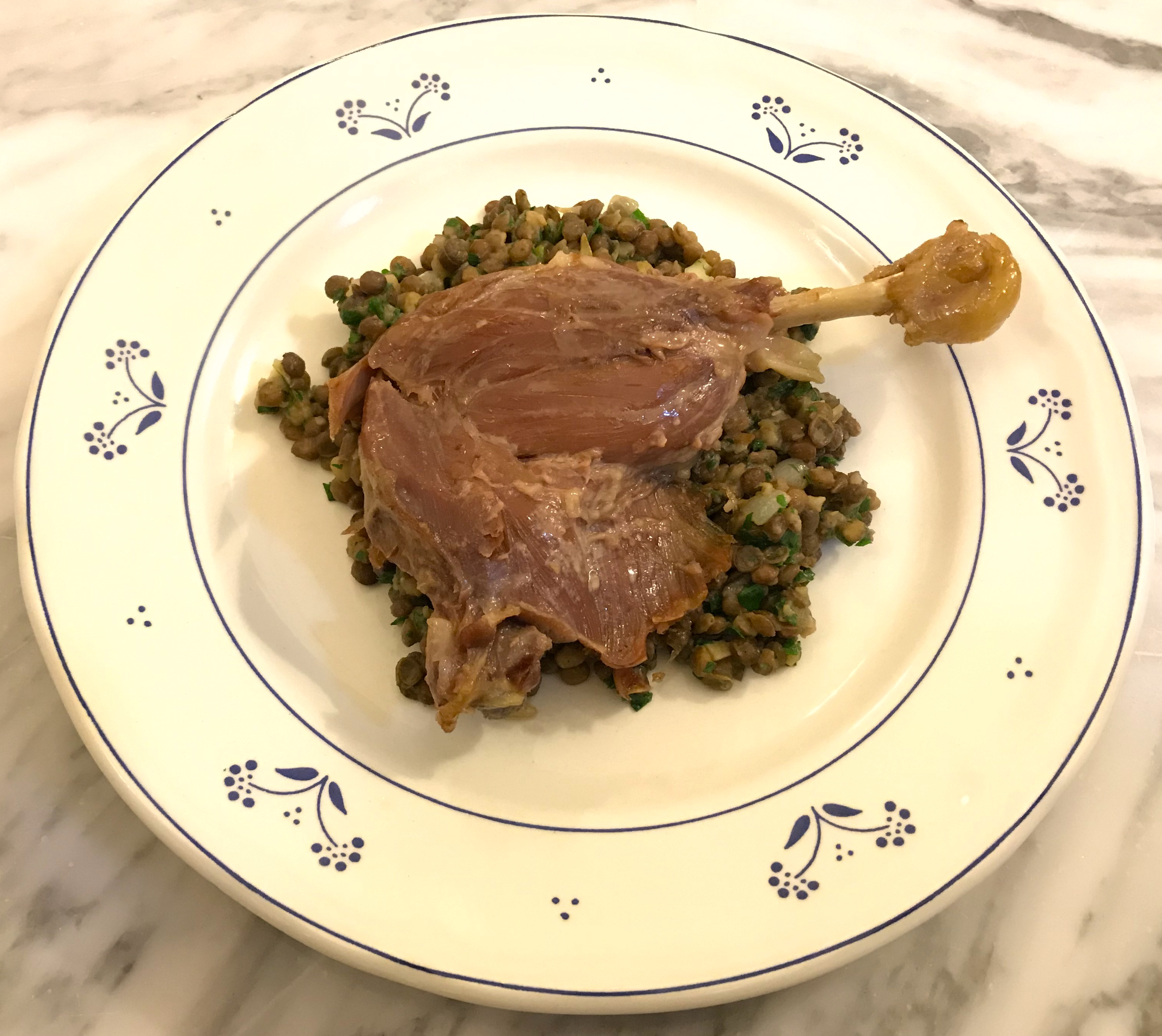
Lentils with Confit of Duck

A Nice Lunch

Think France, think a small restaurant in a small street, nice and simple, no Michelin star in sight. It’s 12.30, time for a quick lunch. You enter the restaurant, take a seat and order today’s dish, the plat du jour. It turns out to be a generous helping of lentils with confit de cuisse de canard and parsley. After having enjoyed your lunch, you think about the joy of good food and the beauty of lentils. Lentille Verte du Puy, such a treat! The combination of the confit, the lentils and the parsley with the sweetness of the shallot and the garlic is elegant, moist and full of flavours.

Feel free to buy ready-made confit. You could of course make it yourself but it is fairly time consuming and not something you would do for two confits only. In our experience most of the confits you can buy (tinned or vacuumed) will be fine. If you’re lucky your local butcher will make his or her own confits. We have included an alternative recipe below.

Wine Pairing

We suggest a glass of not too complex red wine; a well-balanced wine with notes of red fruit, gentle tannins and not too oaky. We enjoyed a glass of Bordeaux-Supérieur, Château Picon.

What You Need

  • 3 Shallots
  • 1 Garlic Glove
  • Coriander Seed
  • Lentils (Lentille Verte du Puy O.P & A.O.C. from Sabarot)
  • Chicken Stock
  • 2 Confits de Canard
  • Olive Oil
  • Parsley
  • Black Pepper
  • Optional: Green Salad

What You Do

Finely chop one shallot and glaze gently in olive oil. In the mean time check the lentils for small pebbles; wash them. Once the shallot is glazed add the crushed coriander seed and the lentils. Heat and stir for one minutes, as you would do with risotto rice. Add some chicken stock and water (the stock is only intended to give the lentils a small push) and leave to simmer on low heat. When the lentils are nearly done, finely chop the other two shallots and glaze gently in olive oil and in the fat that comes with the confit. In parallel warm the two confits. After a few minutes add the finely chopped garlic to the shallot. Chop the parsley. When the garlic and shallot are nicely soft and sweet, add the parsley, some black pepper and then mix with the lentils. Remove the skin from the confit and serve the duck on top of the lentils. Perhaps serve with a simple green salad.

Alternative Way of Making Confit of Duck

Start by crushing a nice amount of juniper berries. Take a sheet of strong aluminium foil, add some crushed berries, a bay leaf and put one duck leg (skin side up) on top. Drizzle with plenty of olive oil. Add the remainder of the berries and a second bay leaf. Wrap the meat in foil, making sure it is tightly closed and the foil intact. If not sure wrap with a second piece of foil. Transfer to a warm oven (90° Celsius or 200° Fahrenheit) for at least 8 hours.

Lentils with Confit of Duck © cadwu

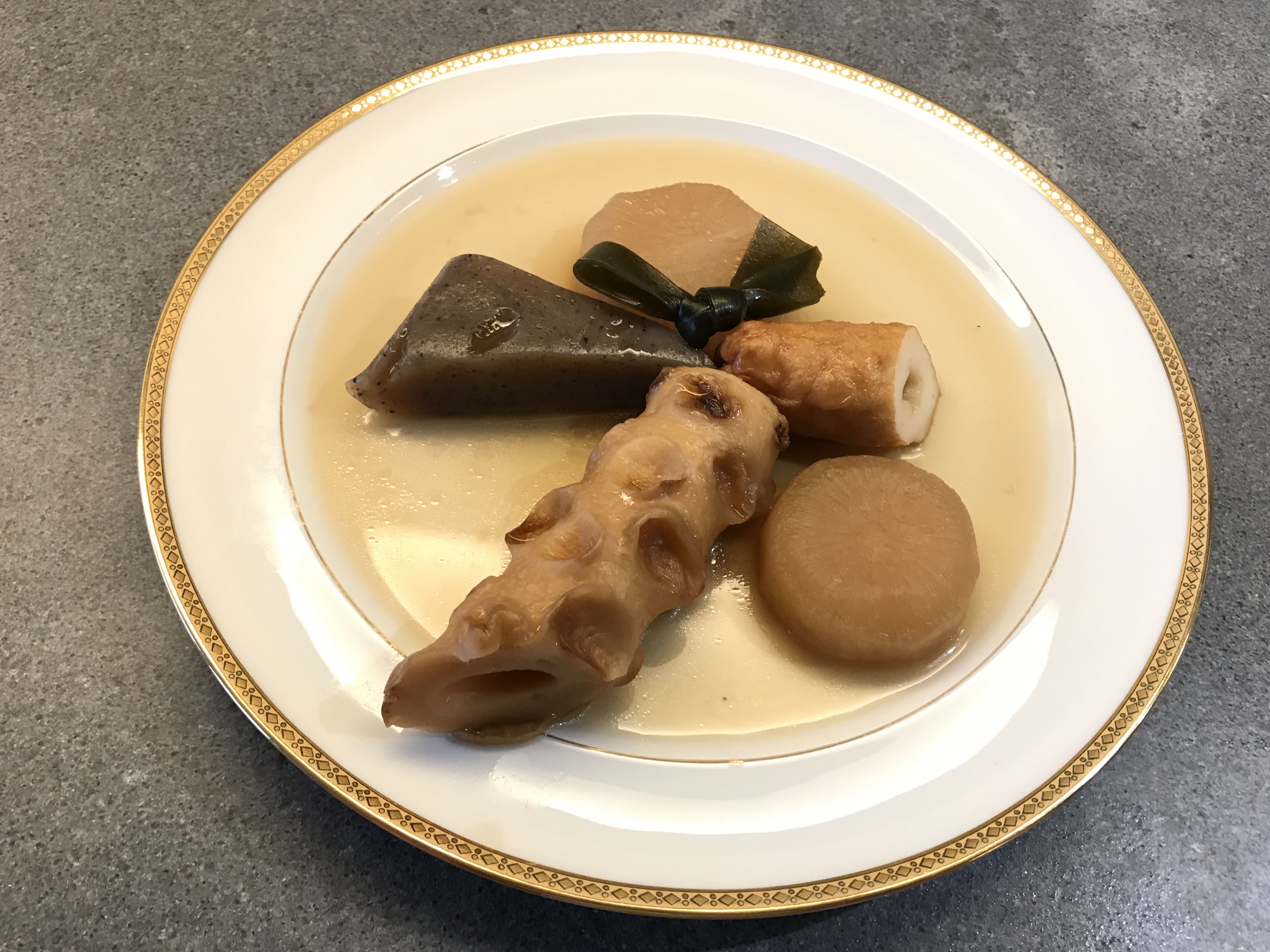
Oden

A Traditional Japanese Dish

If we say ‘Japanese food’, you will probably think ‘sushi’, ‘sashimi’, ‘yakitori’, perhaps ‘udon’. But Oden? Probably not. Such a shame because Oden is a really wonderful dish. Oden for lunch or as a course in a typical Japanese menu: tasty, light and full of surprises. Oden is a stew that requires a bit more work than you would expect and of course time. It also requires some shopping, given some of the ingredients are not easy to find.
We are not from Japan so we humbly present our version of this (wintery) classic. We hope it inspires you to cook Oden and enjoy it as much as we did.

Wine and Sake pairing

We preferred a glass of Chardonnay with the Oden during our dinner; others preferred a glass of cold sake. The stew is rich in flavours, umami of course, but not spicy, so we would not suggest a Gewurztraminer of a Sauvignon Blanc. A Chardonnay (with a touch of oak perhaps) will be a good choice.

What You Need

  • For the Dashi
    • 20 grams of Dashi Kombu (Rishiri Kombu)
    • 25 grams of Katsuobushi (Bonito Flakes)
  • For the Stew
    • One Daikon
    • Chikuwa Fish Cakes
    • One Pack Konnyaku
    • One Pack of Gobo Maki Burdockroot Fish Cakes
    • 1 sheet of Hayani Kombu
    • 2 boiled eggs
    • Abura Age Fried Tofu
    • Mochi (Sticky Rice Cake)
    • Soy Sauce (preferably one with less salt)
    • Mirin
  • Karashi

What You Do

Start by making one litre of dashi. This seems simple but requires precision. Clean the kombu with a wet cloth and put into one litre of cold water. Gently raise the temperature to 80° Celsius or 176° Fahrenheit. Remove and discard the kombu. Bring the liquid to a boil, add the katsuobushi, bring to a boil and immediately set heat to zero. Wait 5 minutes or so. The katsuobushi will sink to the bottom of the pan. Now very gently pass the liquid through a wet towel. Do not squeeze, just give it time. The result will be a great, clean dashi. Cool and set aside.
Next step is to peel the daikon and slice it (2 centimeters is best). Now use a sharp knife to plane of the edge of the daikon. This improves the presentation and it is supposed to stop the daikon from falling apart. Cook the daikon for one hour in water. Drain and set aside.
Step three is to cut the konnyaku in triangles and cook these in water for 15 minutes. Konnyaku is made from the konjac plant and is specific for the Japanese cuisine.
Step four is to cook the sheet of Hayani Kombu for 5 minutes. This is young kombu and edible, different for the one you used when preparing dashi. Let cool a bit, slice and knot ribbons. Not sure why, but is looks great when you serve it.
Now it’s time to add the dashi to the pan (should be a clay pot, but we stick to our Le Creuset), add one tablespoon of mirin, one (or two, depending on your taste) of soy sauce, add the daikon, the konnyaku and the fish cakes.
We served our oden as a course during dinner, so we limited the number of ingredients. If served for lunch add boiled eggs, fried tofu and mochi. The last two ingredients have to be combined by putting the mochi into the tofu.
Allow to simmer for at least 2 hours. Best is, as always, to serve it the next day.
Serve with some karashi (Japanese mustard, which is different from wasabi by the way).

Oden © cadwu
Oden © cadwu