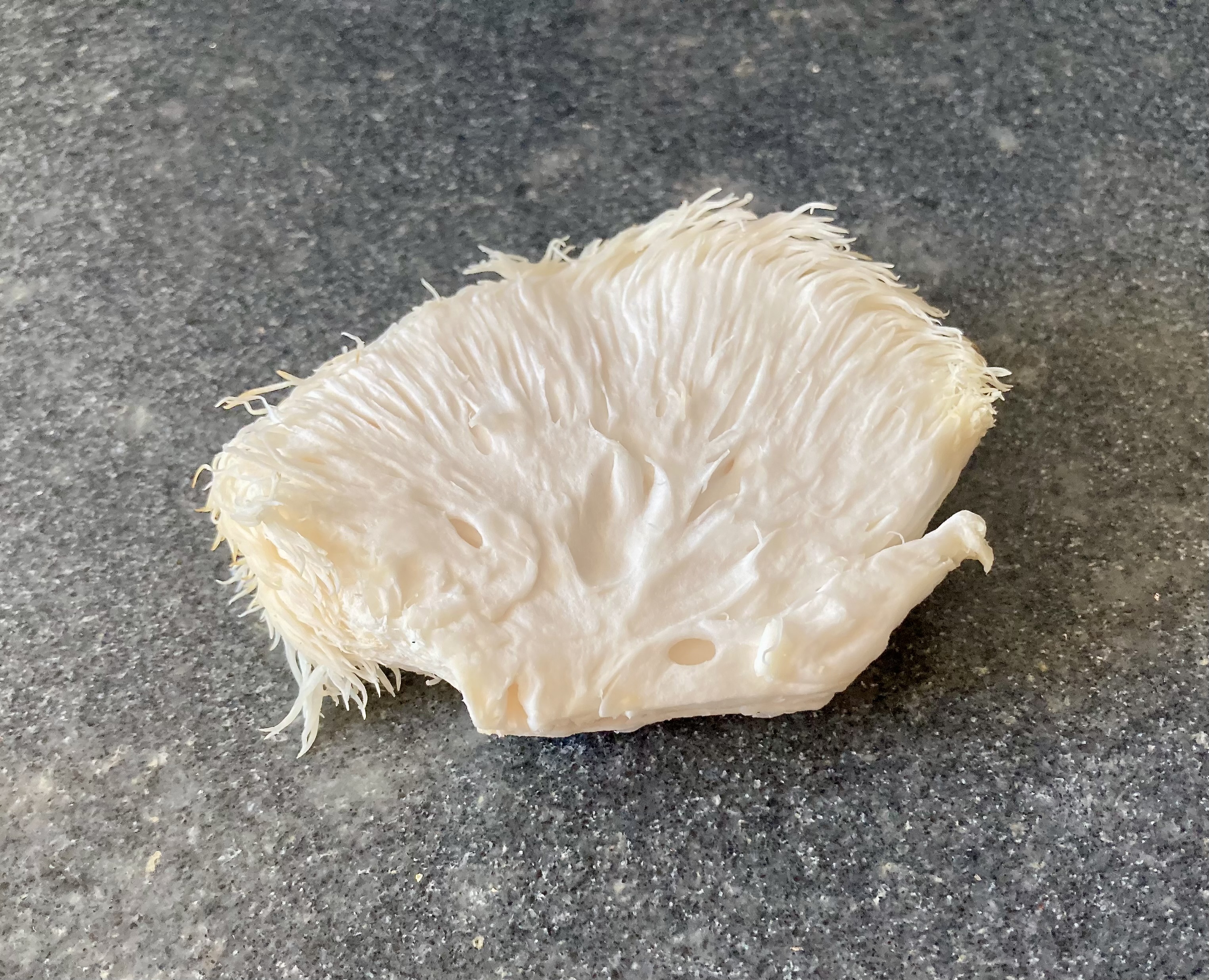
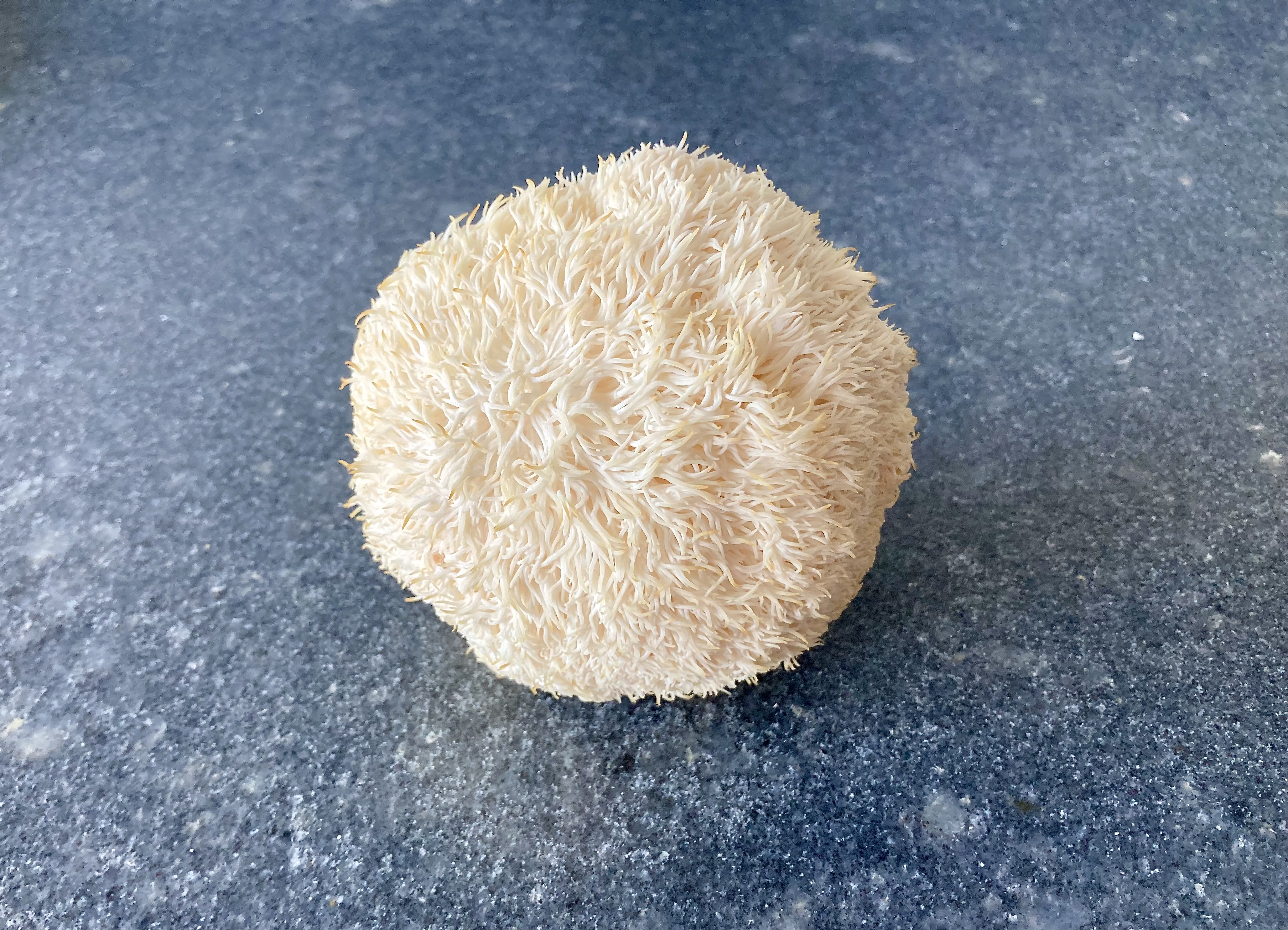
If you search for Lion’s Mane mushrooms, you will find lots of references to supplements with wonderful health benefits, ranging from supporting longevity to improved cognitive functions. It’s also supposed to have antibiotic, anti-fatigue and anti-ageing properties. Sounds great, but how do the fresh mushrooms taste?
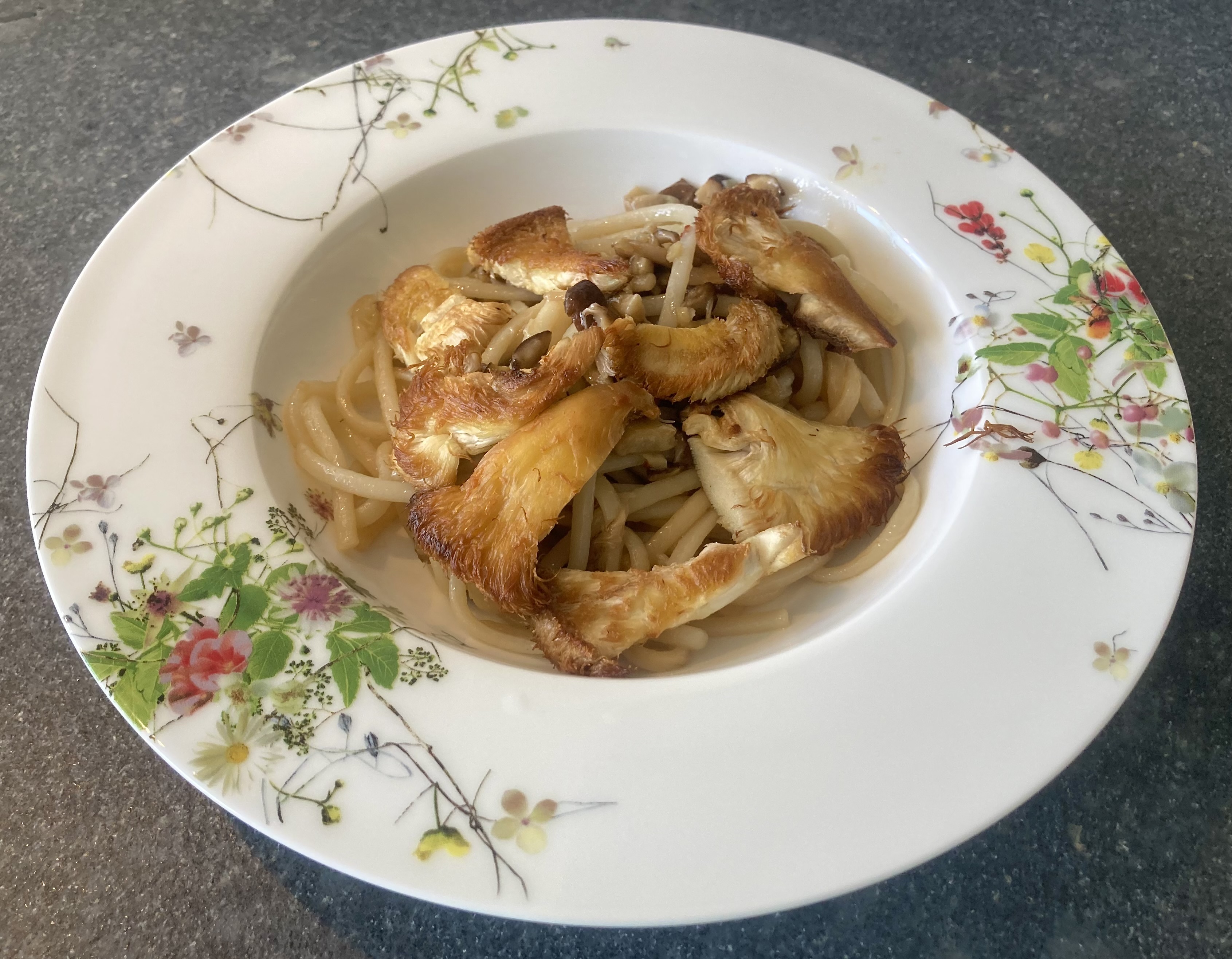
Lion’s Mane (also known as Yamabushitake and Hou Tou Gu) is a mushroom native to North America, Asia and Europe. Their flavour and texture sets them apart from many other mushrooms. A bit sweet, mild, some umami, subtle, a hint of seafood (crab, lobster). The texture meaty and elastic with a unique structure thanks to the spines.
Alan Bergo (the Forager Chef) uses them to make crab cakes. He writes: This is one of my all-time favorites. I guarantee this is so good, some people may not be able to tell it’s a crabcake made from mushrooms instead of crab.
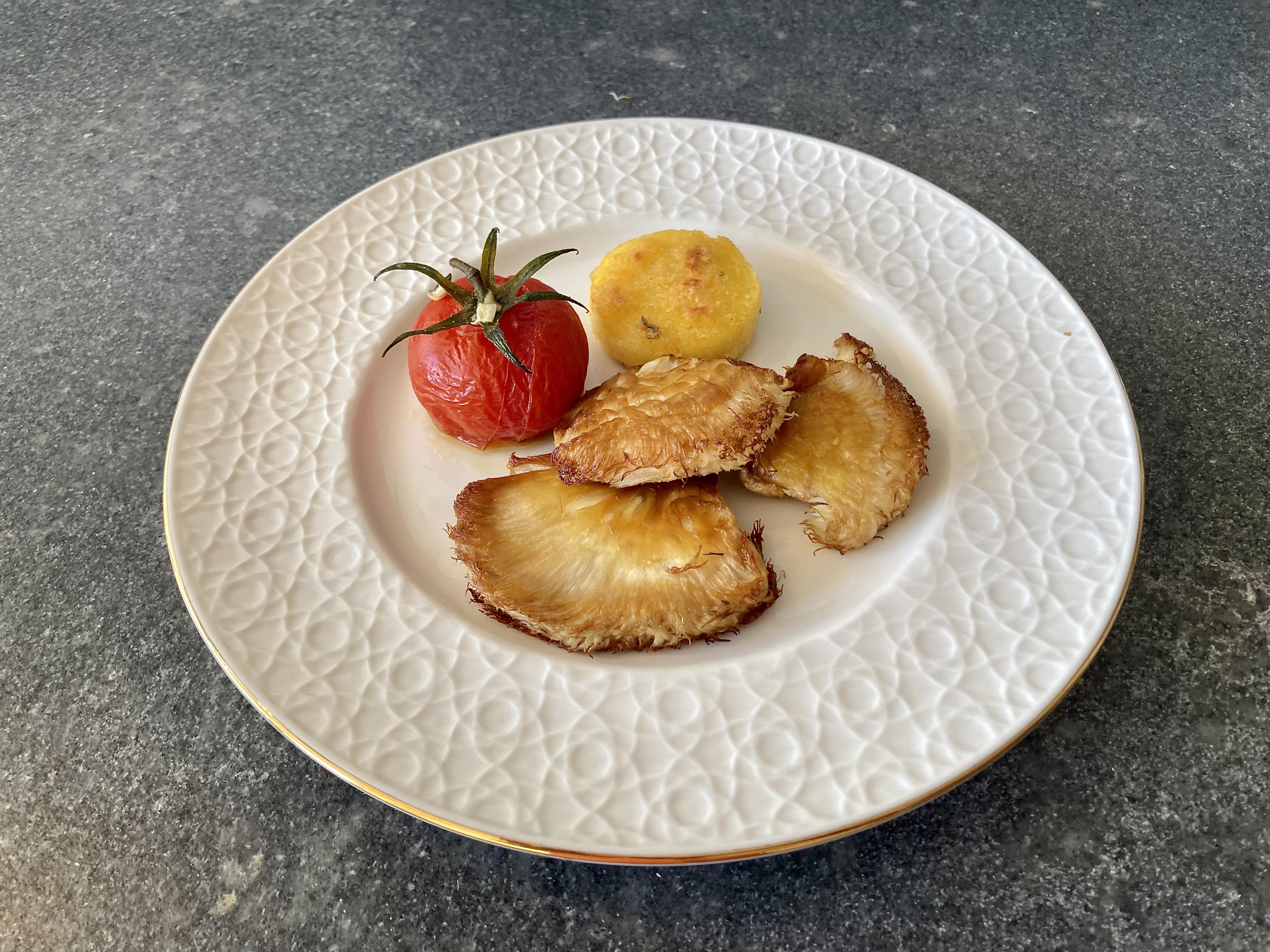
We thought it would be nice to make a dish with various flavours, allowing us to taste the mushroom on its own, but also with the Tomato Confit and Polenta. Combining it with tomato enhanced the flavour of the mushroom and made it more complex (sweet, sour, umami, aromatic). The combination with Polenta was nice, perhaps because of the various textures.
Wine Pairing
Grüner Veltliner is a wine typical for Austria, with flavours such as lime, grapefruit and white pepper. We enjoyed a glass of Grüner Veltliner, made by Eisacktal Valle Isarco, from the Alto Adige region in Italy. It is fruity, fresh and slightly spicy with clear acidity. Very nice with the flavours in the dish. In general we suggest a fresh, dry white wine with hints of green apple and/or citrus.
What You Need
- Mushrooms
- 100 grams of Lion’s Mane
- Olive Oil
- Polenta
- Polenta
- Vegetable Stock (optional)
- Parmesan Cheese
- Thyme
- Tomatoes
- Tomatoes
- Thyme
- Rosemary
- Garlic
- Olive Oil
What You Do
- Day before
- Cook (in vegetable stock) the polenta according to the package until ready
- Add some Parmesan cheese and thyme
- Pour the polenta on a plate and smooth it into an even layer (1,5 centimetres) with a spatula
- Cool to room temperature
- Cover with foil
- Transfer to the refrigerator for use the next day.
- A few hours before
- Wash and dry the tomatoes and add these to a baking dish
- Chop the garlic
- Add herbs, garlic and a generous amount of olive oil to the dish
- Put in the oven for something like 2 hours on 90 °C or 200 °F
- Baste the tomatoes once or twice
- Don’t forget to use the cooking liquid as well, it’s another pack of flavours!
- Preheat your oven to 65 °C or 150 °F
- Turn out the polenta onto a cutting board
- Cut it into a shape you like (strips, triangles, circles)
- Fry in relatively hot olive oil in a non-stick pan until golden, probably 2*5 minutes.
- In parallel clean the mushroom and slice (not too thin)
- Fry in olive oil until golden brown, probably 2*2 minutes
- Transfer to the oven
- Leave for 5 minutes in the oven
- Add just a hint of black pepper to the mushrooms before serving.
- Assemble and serve on a warm plate.
PS
Best to buy young mushrooms, the size of a tennis ball.