In 2025 the most popular recipe was Scallops with Roe. We were inspired by the great quality of the scallops on the market in Nice and we were not disappointed. The combination of scallops, roe and mashed potatoes is simple and delicious.
This year’s runner up is an all time favorite: Kimizu. This classic, golden sauce from Japan, is made with egg yolks, rice vinegar, water and mirin. We also made a version with tarragon, let’s say the Béarnaise version of Kimizu. Although it is a classic sauce, we use a microwave to prepare Kimizu and Kimizu with Tarragon. An easy and very effective way of controlling temperature and consistency.
Number three was another classic sauce: Ravigote. We served it with Pâté de Tête Persillé and crusted bread. The recipe we posted goes back to the more or less original version. The Ravigote is light, uplifting and flavorful.
You’ve probably noticed we love mushrooms. Cultivated ones, like shiitake and oyster mushrooms and seasonal ones, such as morels and Caesar’s mushroom. This year we introduced a page with mushroom recipes in Dutch. It turned our to be a great success!
A few years ago we started exploring forgotten vegetables such as mashua and oca. We’re very pleased to see the popularity of this page. Clearly you’re as interested in these vegetables and their flavours as we are!
This year we will continue our series of sauces and of mushroom recipes, we will prepare dishes from illustrious Parisien restaurants and discuss wine pairing. We also plan to review cookbooks, with the help of our much loved tasting panel. In the meantime we look forward to your feedback, suggestions, likes and comments.
A few years ago we enjoyed an excellent Kaiseki dinner at Yamazato in Amsterdam. One of the dishes on the menu was Kimizu-Ae: a combination of white asparagus and Kimizu. A few days later we prepared Kimizu, a rich and light sauce. It comes with a velvety mouthfeel, a natural note of sweetness, a bright yellow colour and perfect acidity. Over the years we used it as a base for Béarnaise and Sauce Perigord.
Kimizu combines rice vinegar, mirin and egg. Compared to Hollandaise, Kimizu is lighter, easier to digest and fresher, because it does not contain butter (the egg yolk being the only source of fat). The vinegar used to prepare Hollandaise or Béarnaise is often a flavoured vinegar, for instance with tarragon, shallot and black pepper. An idea we simply had to try when making Kimizu, with a twist!
Using a microwave oven to make Kimizu is a great idea (see our recipe for Hollandaise), although it does require more whipping and more attention compared to making Hollandaise.
What You Need
For the Castric (35 ml)
5 ml Vinegar
50 ml dry White Wine
20 ml Noilly Prat
One corn of Black Pepper
One small Shallot
For the Kimizu
35 ml Castric
25 ml Water
1 teaspoon Mirin
2 Egg Yolks
What You Do
Start by making the Castric
Chop the shallot
Combine all ingredients and leave to reduce by 1/2 on low heat
Pass through a sieve; try to capture the juices of the shallot
Set aside
Make the Kimizu
The castric should be at room temperature
Whisk the egg yolks
Add the castric, the mirin, the water and whisk some more
Now transfer to the microwave and give it let’s say 10 seconds of 30%. Power and duration very much depend on your microwave
Remove from oven and whisk
Repeat
You will now feel the consistency changing. If not, don’t worry, just keep repeating the step
You may want to reduce the power or the duration
Whisk, whisk again and feel free to find your own way
When the Kimizu is ready, take it out of the oven and serve immediately
We served the Kimizu with excellent beef and pommes dauphinois
Happy New Year! Let’s begin the new year with the 2024 highlights. For the past two years your favorite post wasNo-Knead Bread, This year’s most popular post was an all time favorite: Kimizu. This classic, golden sauce from Japan, is made with Egg Yolks, Rice Vinegar, Water and Mirin. We also have a version with Tarragon, let’s say the Béarnaise version of Kimizu. Although it is a classic sauce, we use a microwave to prepare Kimizu and Kimizu with Tarragon. An easy and very effective way of controlling temperature and consistency.
This year’s runner up is Scallops with Roe, a recipe we published in January 2023. We were inspired by the great quality of the scallops on the market in Nice and we were not disappointed. The combination of scallops, roe and mashed potatoes is simple and delicious.
On August 19th 2024 Michel Guérard passed away. He was a French chef, author, one of the founders of the Nouvelle Cuisine and the inventor of La Cuisine Minceur. We wrote about his version of sauce vierge and combined it with sea bass and with skate. Very happy to see so many people interested in this post.
You’ve probably noticed we love mushrooms. Cultivated ones, like Shiitake, Oyster Mushrooms, Enoki and Champignons de Paris and seasonal ones, such as Morels, St. George’s mushroom and Caesar’s Mushroom. One of the most popular posts is Cèpes à la Bordelaise. Also very tasty when prepared with button mushrooms. Always a pleasure to serve, for instance with eggs, with meat, with more present fish. Last year we created a special page with an overview of our mushroom recipes.
We were very impressed by the exhibition Food For Thought by Kadir van Loohuizen in the Maritime Museum in Amsterdam. Let’s summarize it by quoting Ralph Dahlhaus, Chef of the National Maritime Museum: “Your choice of food does not need to be perfect, but it must be responsible.”
We continued our series of Sauces. One of your favorites is another classic sauce: Ravigote. We served the sauce with Pâté de Tête Persillé and crusted bread. The recipe we posted goes back to the more or less original version: the Ravigote is light, uplifting and flavorful.
This year we are looking forward to the Amsterdam Symposium on the History of Food on June 5th and 6th. This year’s topic is Food and the City. The symposium takes place in the 750th anniversary year of the city of Amsterdam. The symposium will be organized during an exhibition on the history of food culture in Amsterdam, from April 11th until September 7th 2025 in the Allard Pierson.
Only a few days left before the end of the asparagus season on June 24th! So dash off to your greengrocer and buy some lovely asparagus, white, green, purple, it’s all fine and great, as long as they are locally farmed and fresh.
Last year our favorite way to prepare them was with scrambled eggs and shrimps. A delicious combination. This year our favorite was with Truffle Butter and Egg. A combination that very much relies on the quality of the truffle butter. Other favorites this year were steamed asparagus with kimizu (the beautiful, light, golden Japanese sauce made with egg yolks and rice vinegar), à la Flamande (mimosa of egg, butter, parsley and nutmeg), as a salad and of course as a Charlotte.
Truffle Butter
Products with truffle (oil, tapenade, purée) can be very disappointing. The vast majority is based on oil that has been artificially flavoured using a synthetic agent such as 2,4-dithiapentane. Not a truffle in sight. In case of truffle purée or tapenade the mixture is often dominated by (button) mushrooms, dried cèpes, salt, garlic and again, synthetical flavored oil. In this recipe we use white truffle oil. The two main white truffles are Bianchetti (Tuber Borchii Vitt) and Alba (Tuber Magnatum Pico). Bianchetti is a powerful and remarkable truffle (we use it in combination with oysters) but it is not as expensive and special as an Alba truffle. A Bianchetti truffle will cost you 10 euro per 10 grams whereas an Alba truffle will be priced at 70 euro per 10 grams. When buying a truffle product, make sure you read the label and check which truffle is used.
A dear friend gave us a jar of white truffle butter and a small bottle of white truffle oil, both produced by Il Mondo Del Tartufo. The butter was fantastic and so was the oil. Both are made with Alba truffle. Later we combined normal butter with truffle oil (and perhaps a pinch of salt) to recreate the truffle butter.
Wine Pairing
The obvious choice is a glass of Pinot Blanc, although we actually prefer a dry Muscat in combination with a classic preparation such as à la Flamande. Depending on the dish it could also be a Verdicchio, an Albariño or perhaps even a Portuguese Vinho Verde. We combined our Asparagus with Truffle Butter with a Dutch wine, produced by Hoeve Nekum. The winery was founded in 1988 but the history of the actual farm (hoeve in Dutch) goes back to the 14th century. We enjoyed their Rivaner, a white wine with a light color, a floral aroma and a fresh delicate taste with some acidity. The combination with the rich, buttery slightly bitter asparagus was excellent. In general you’re looking for a fresh, gentle wine, not too complex and one that you would also enjoy as an aperitif.
What You Need
14 White Asparagus
1 Egg
some Butter
White Truffle Oil
White Pepper
What You Do
We use our Russel and Hobbs food steamer to prepare the asparagus. An essential kitchen aid for only 50 euro or US dollar. Towards the end of the season the asparagus can be fairly thin, hence the 14. Clean and peel the asparagus. Put butter in a cup. Start by steaming the egg. After 2 minutes add the asparagus. 3 Minutes later turn the egg upside down and place the cup in the steamer basket. Another 5 minutes later everything is ready. Peel the egg and mash with a fork, creating a ‘mimosa’ of egg. Add two or three teaspoons of truffle oil (depending on your taste and the quantity of butter) to the butter and mix. Add some white pepper to the mimosa. Spoon the butter over of the asparagus and decorate with mimosa. PS If you make this dish earlier in the season, then steam the asparagus for 20 minutes, the egg for 5+5 minutes and the butter for 5 minutes.
Only a few days left before the end of the asparagus season on June 24th! So dash off to your greengrocer and buy some lovely asparagus, white, green, purple, it’s all fine and great, as long as they are locally farmed and fresh.
The classic way of preparing asparagus is to cook (or better: steam) them. You can pair the steamed asparagus with kimizu (the beautiful, light, golden Japanese sauce made with egg yolks and rice vinegar) Hollandaise, morels or scrambled eggs with shrimps. Classic way to serve them is à la Flamande (mimosa of egg, butter, parsley and nutmeg). You could add boiled eggs, ham and new potatoes to have a nice dinner. Or if you want to spent more money, then you serve them with summer truffle or with Sauce Périgueux.
Grilling the asparagus is also possible, simply serve them with excellent olive oil and grated Parmesan cheese.
Parhaps as a salad on a summers evening? Of course, with a delicious dressing made of white wine vinegar, olive oil, a touch of honey and lots of chervil.
A more exotic way of is to fry the asparagus with black olives and basil. Goes very well with lamb.
Wine Pairing
The obvious choice is a glass of Pinot Blanc, although we actually prefer a dry Muscat in combination with a classic preparation such as à la Flamande. Depending on the dish it could also be a Verdicchio, an Albariño or perhaps even a Portuguese Vinho Verde. Feel free to experiment; yesterday we enjoyed our asparagus with a glass of wine made of muscat and picpoul grapes. Delicious combination! The wine comes from the Pont Du Gard region (near Nimes, France) and is produced by Château Mourgues du Grès. A more serious rosé is a perfect choice when you grill the asparagus, for instance a glass of Domaine Vico Corse Le Bois du Cerf Rosé 2021. This exceptional rosé from Corsica is made of grenache and sciacarello grapes. It is medium bodied and fresh with aromas of red fruit with a complex, long and fruity taste. A pinot noir or grenache based wine is great when you fry the asparagus, depending on the preparation of the meat.
The combination of white asparagus and Hollandaise is classic. The sweetness and bitterness of the asparagus together with the velvety, rich flavours of the sauce is just perfect.
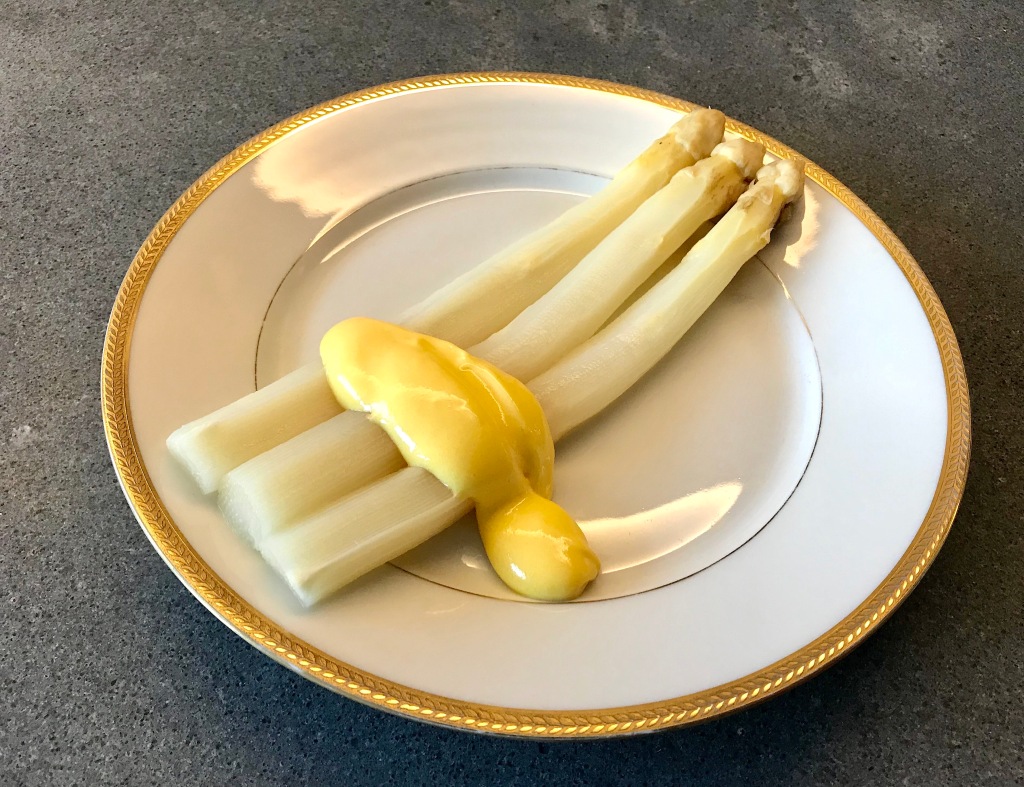
A few years ago we enjoyed Kimizu-Ae (white asparagus with Kimizu) at Yamazato in Amsterdam. We were immediately intrigued by this combination. The Kimizu is a rich and light sauce; it comes with a velvety feeling, a touch of sweetness, a bright yellow colour and perfect acidity. So yes, the next day we prepared our own Kimizu.
Kimizu is based on two main ingredients: egg yolk and rice vinegar. You could add some mirin and a pinch of salt. Kimizu does not contain butter (the egg yolk being the only source of fat) so Kimizu, although it seems similar to Hollandaise, is lighter, easier to digest and fresher. Many recipes for Kimizu include starch, probably because the cook has trouble making a warm, emulgated sauce. Our advice: never use starch or beurre manié. The consistency is an essential element of the sauce and must be the result of carefully heating the mixture of egg yolk, vinegar, mirin and water.
Using a microwave oven to make Kimizu is a great idea (see our recipe for Hollandaise), although it does require more whipping and more attention compared to making Hollandaise.
Wine Pairing
We enjoyed our Asparagus and Kimizu with a glass of Sancerre, Domaine Merlin Cherrier. This classic wine reflects the chalky terroir of Sancerre beautifully. The combination of Sauvignon Blanc (citrus, minerals) and Kimizu (touch of sweetness, present but not overpowering acidity) works really well. A wine of true class and complexity with a long finish.
What You Need
Two Egg Yolks
1,5 tablespoon of Rice Vinegar (depending on the size of the egg yolks and the acidity of the vinegar)
3 tablespoons of Water
Teaspoon of Mirin (optional)
Pinch of salt (very optional)
6 Asparagus
What You Do
The amount of water you’ll need depends on the acidity of the rice vinegar and the size of the egg yolks. Whisk the two egg yolks, add the rice vinegar, the mirin, the water and whisk some more. Now transfer to the microwave and give it let’s say 10 seconds on 30% power. Remove from oven and whisk well. Repeat. You will now feel the consistency changing. If not, don’t worry, just repeat the step. After 2*10 or 3*10, move to steps of 5 seconds on 30% power. Whisk, whisk again and feel free to find your own way. When the Kimizu is ready, take it out of the oven, continue whisking gently and perhaps cool slightly in a water bath. In parallel steam the asparagus (depending on the size 20 or 25 minutes; they should be well done for this dish). Serve the asparagus with a generous helping of Kimizu.
A few years ago we enjoyed an excellent Kaiseki dinner at Yamazato in Amsterdam. The menu featured many wonderful dishes, one of them being Kimizu-Ae: a combination of white asparagus and Kimizu. We were immediately intrigued because Kimizu is a rich and light sauce. It comes with a velvety feeling, a natural note of sweetness, a bright yellow colour and perfect acidity. So yes, the next day we prepared our own Kimizu.
Kimizu brings together two ingredients: egg yolk and rice vinegar. You could add some mirin (or sugar) and a pinch of salt. Within two minutes you will have created a beautiful, golden sauce; one that combines very well with fish and asparagus. Kimizu does not contain butter (the egg yolk being the only source of fat) so Kimizu, although it seems similar to Hollandaise, is lighter, easier to digest and fresher.
Many recipes include starch, probably because the cook has trouble making a warm, emulgated sauce. Our advice: never use starch or beurre manié. The consistency is an essential element of the sauce and must be the result of the combination of egg, liquid and warmth. Same for a sabayon.
Using a microwave oven to make Kimizu is a great idea (see our recipe for Hollandaise), although it does require more whipping and more attention compared to making Hollandaise.
Wine Pairing
We enjoyed our Asparagus and Kimizu with a glass of Sancerre, 2017, Domaine Merlin Cherrier. This classic wine reflects the chalky terroir of Sancerre beautifully. The combination of Sauvignon Blanc (citrus, minerals) and Kimizu (touch of sweetness, present but not overpowering acidity) works really well. A wine of true class and complexity with a long finish.
Now embrace your microwave and start using if for making Kimizu.
What You Need
For the Kimizu
2 Egg Yolks
1,5 tablespoon of Rice Vinegar (depending on the size of the egg yolks and the acidity of the vinegar)
3 tablespoons of Water
Mirin (optional, we suggest adding 1 or 2 teaspoons)
pinch of Salt (very optional)
6 Asparagus
What You Do
Peel the asparagus
Steam the asparagus (depending on the size 20 or 25 minutes; they should be well done for this dish)
After 10 minutes start making the sauce
Whisk the two egg yolks
Add rice vinegar, mirin, water and whisk some more
Transfer to the microwave and give it let’s say 10 seconds of 30%
Remove from oven and whisk well
Repeat steps 6 and 7
You will now feel the consistency changing
If not, don’t worry, just repeat step 6 and 7
After 2*10 or 3*10, move to steps of 5 seconds on 30% power
Whisk, whisk again and feel free to find your own way
When the kimizu is ready, take it out of the oven and continue whisking gently
Serve the asparagus with a generous helping of Kimizu
Asparagus and eggs, it’s a match made in heaven. For instance à la Flamande(with boiled egg, butter, parsley and ham) or more exotic with Kimizu or with scrambled eggs, chives and shrimps.
Shrimps?
Indeed, with small excellent shrimps, preferably freshly peeled; not used as an ingredient but as an element of flavour. The first time we tasted this combination we were surprised by the role of the shrimps. The salty, intense taste, balanced with the very rich eggs and the sweet-bitter asparagus is a very clever idea. The chives in the scrambled eggs lift the dish to a higher level. Unfortunately we don’t know who created it, so we offer the recipe with a caveat.
Scrambled eggs?
Preparing scrambled eggs, it seems obvious and simple, but actually we are looking for a version that is more like a sauce. Gordon Ramsey’s instructive and hilarious video shows you how to make scrambled eggs, so no need for us to explain. You need to stop a bit earlier, given it needs to have a sauce-like consistency.
Wine Pairing
We decided to drink a glass of Rivaner from the house Gales in Luxembourg. The aroma made us think of grapefruit, ripe melon and apple. The taste is elegant with a touch of sweetness, acidity and minerality. Ideal with our dish! The sweetness with the asparagus, the acidity in combination with the scrambled eggs and chives, the minerality with the shrimps. And the taste is surprisingly long lasting, which is perfect with such a rich dish.
What You Need
6 White Asparagus
2 Eggs
Butter
Chives
Crème Fraiche
White Pepper
A Few Small (unpeeled) Shrimps
What You Do
Peel the asparagus and steam for 20 minutes or so. They should have a bite. Prepare scrambled eggs à la Ramsay. Serve the asparagus with the scrambled eggs and just a few shrimps. Done!
The French Périgord is the truffle heart of France. The region is also known for its culinary products, such as Confit de Canard, wines from Bergerac and Monbazillac, Foie Gras and Sauce Périgueux. This sauce is a classic in the French kitchen. Its basis is a white sauce made with shallot, a reduction of white wine, (goose) fat, stock and lots of truffle. The ‘original’ recipe of this truffle sauce can be found in La Bonne Cuisine du Périgord written in 1929 by La Mazille. The sauce works beautifully with Tournedos and Magret de Canard. And since white asparagus love truffles, why not combine them with Sauce Périgueux?
We don’t think a roux-based sauce will go very well with asparagus, so we combined two recipes: the flavors of Sauce Périgueux with the lightness and consistency of Japanese Kimizu.
Wine Pairing
We enjoyed our asparagus with a glass of Riesling, produced by Bott Geyl in the French Alsace. This fresh, aromatic, dry white wine with a hint of sweetness and high acidity combines very well with the sweetness of the asparagus and the intense, rich flavor of the sauce. The wine supports the dish perfectly.
What You Need
6 White Asparagus
1 Small Truffle
For the Sauce
1 Shallot
1 Glass of Dry White Wine
3 Black Peppercorns
½ tablespoon Simple White Vinegar
Two Cubes of Jus de Truffe*
2 egg yolks
White Pepper
What You Do
Chop the shallot, crush the peppercorns coarsely, add to a pan and add a glass of white wine
Leave to simmer for 20 minutes
Add a splash of white vinegar
Leave to simmer for 10 minutes
Add two cubes of jus de truffe and leave to simmer for another 10 minutes
Pass through a sieve
If all is well you should have 4 tablespoons of liquid. If necessary reduce
Set aside and leave to cool
Peel the asparagus and steam for 20 minutes, depending on the size
When there is still 10 minutes on the clock, start working on the sauce
Whisk the two egg yolks well, add the 4 tablespoons of liquid, mix and heat in the microwave on 30% power
Start with one interval of 10 seconds, stir, followed by an interval of 5 seconds, stir and continue with intervals of 5 seconds until you have the right consistency
Total time in the microwave will be approximately 60 seconds
Allow to cool for a minute or two
In the meantime grate the truffle
Serve the sauce over the asparagus, add some white pepper and sprinkle the truffle over the sauce and the asparagus.
* Best to buy a can of jus de truffe and freeze the content in an ice cube bag.
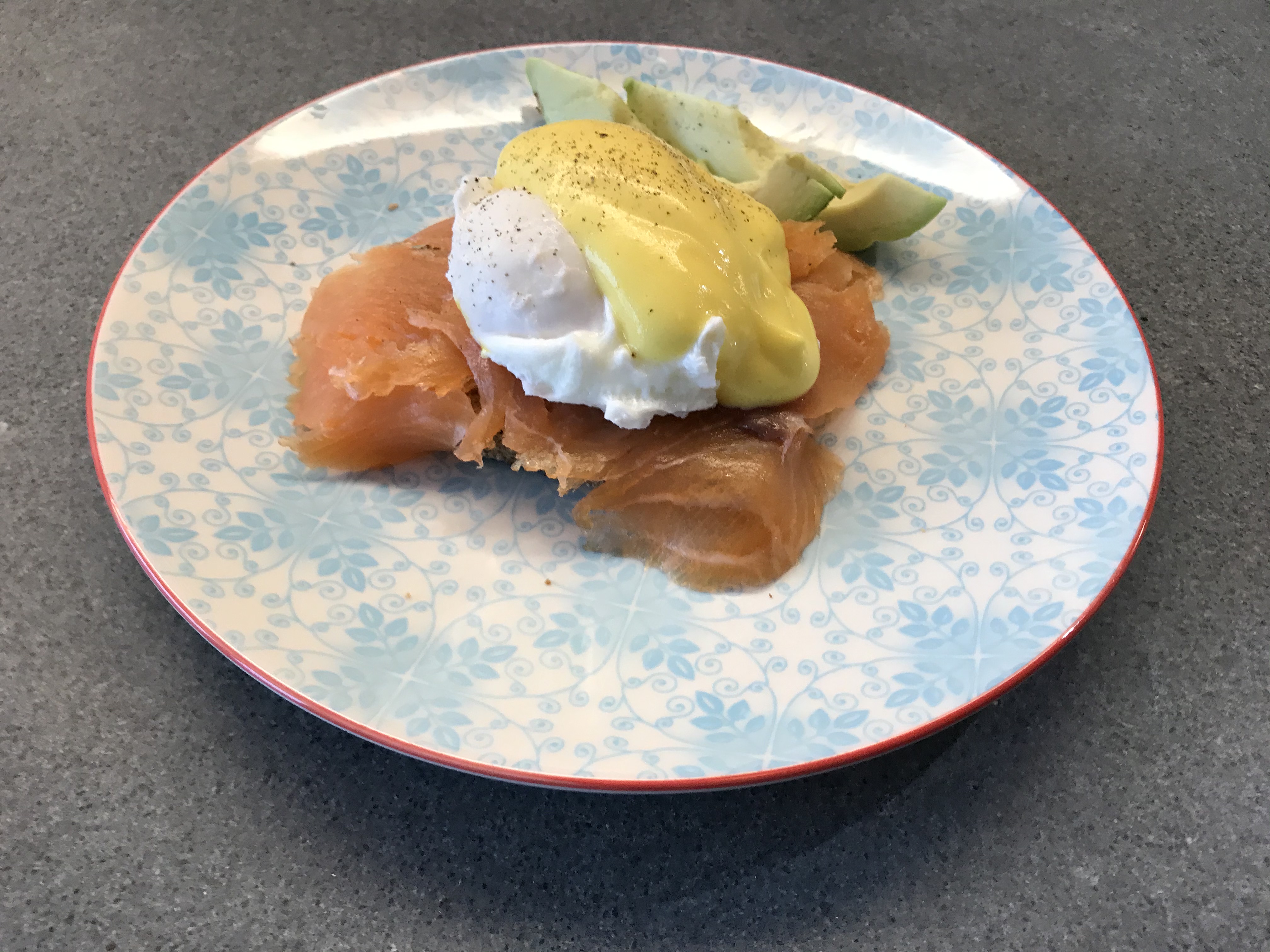
Preparing Eggs Benedict comes with two technical challenges: Hollandaise Sauce (Kimizu in our case) and Poached Eggs. Poaching an egg seems simple and straightforward when you watch the video made by chef Jacques Pepin, But we know that they’re intimidating to make plus it’s really challenging to get them just right: especially the gooey, liquid yolk.
Chef Pepin makes some very important suggestions: the main protein in egg white is Ovalbumin and it sets at 84,5 °C or 184 °F . According to chef Pepin the egg white becomes rubbery when the water temperature is too high. And he is right! Keep the water hot, but not boiling, when ‘boiling’ or poaching an egg. He also mentions that the eggs must be cold. Makes sense, because then the yolk will remain runny. And finally he explains how to store pre-poached eggs, reducing stress in the kitchen.
But the challenge remains: poaching an egg requires skills and experience. Or an OXO good grips egg poacher. Yes, we know, it sounds like another disappointing, expensive, and silly kitchen tool, but it actually works really well. Easy to use, easy to clean and great results, again and again.
What You Need
For the Poached Eggs
2 cold, organic Eggs
Vinegar
For the Kimizu
2 Egg Yolks
1,5 tablespoon of Rice Vinegar (depending on the size of the egg yolks and the acidity of the vinegar)
3 tablespoons of Water
2 teaspoons of Mirin (1 could also be fine, depending on your taste)
Best to make the poached eggs in advance and store them in cold water. Just before serving warm them in a pan of hot water. With the OXO poacher it’s simple: fill a pan with water and add a splash of vinegar. Bring the water to a simmer and crack an egg into the centre of the each poacher. You could also crack the egg into a little bowl or cup and then drop it into the centre of the poacher. After 30 seconds or so you can remove the OXO poacher and use it for another egg. We poached our eggs for 3 minutes maximum. Dry the poached eggs with kitchen paper and trim the egg white if necessary. Serve with toasted muffin or bread, salmon, avocado and of course Kimizu.







 Cook and Drink