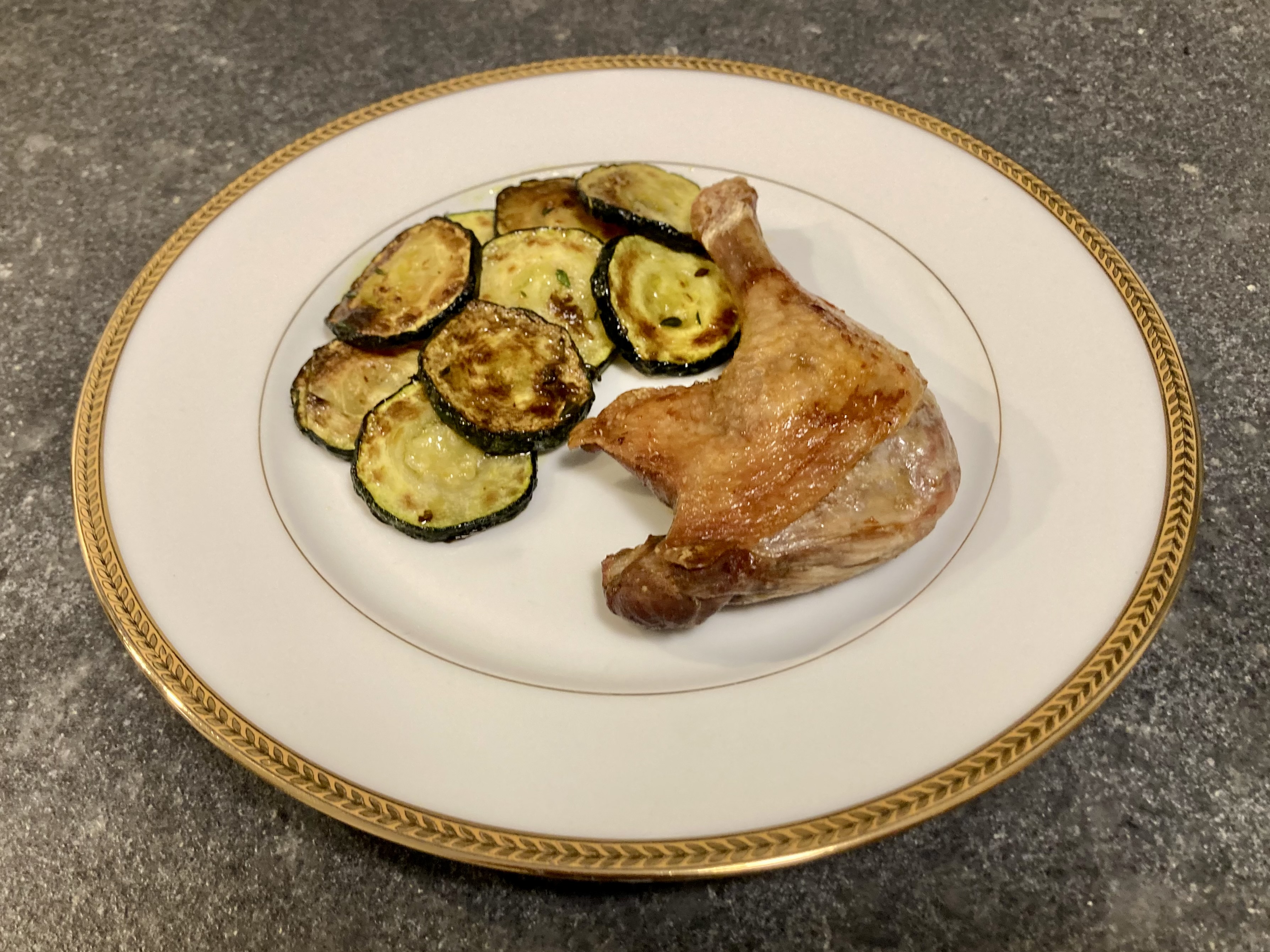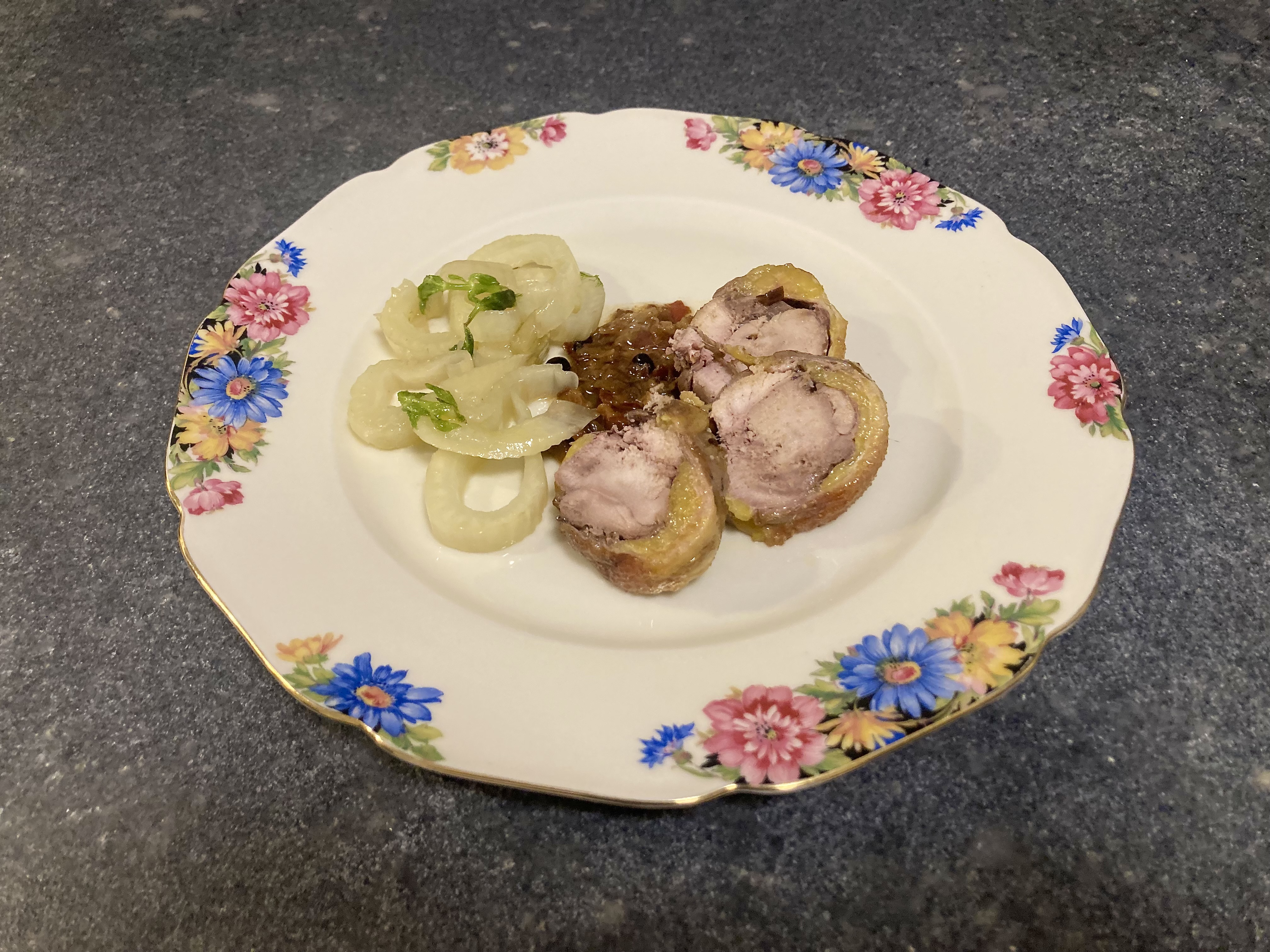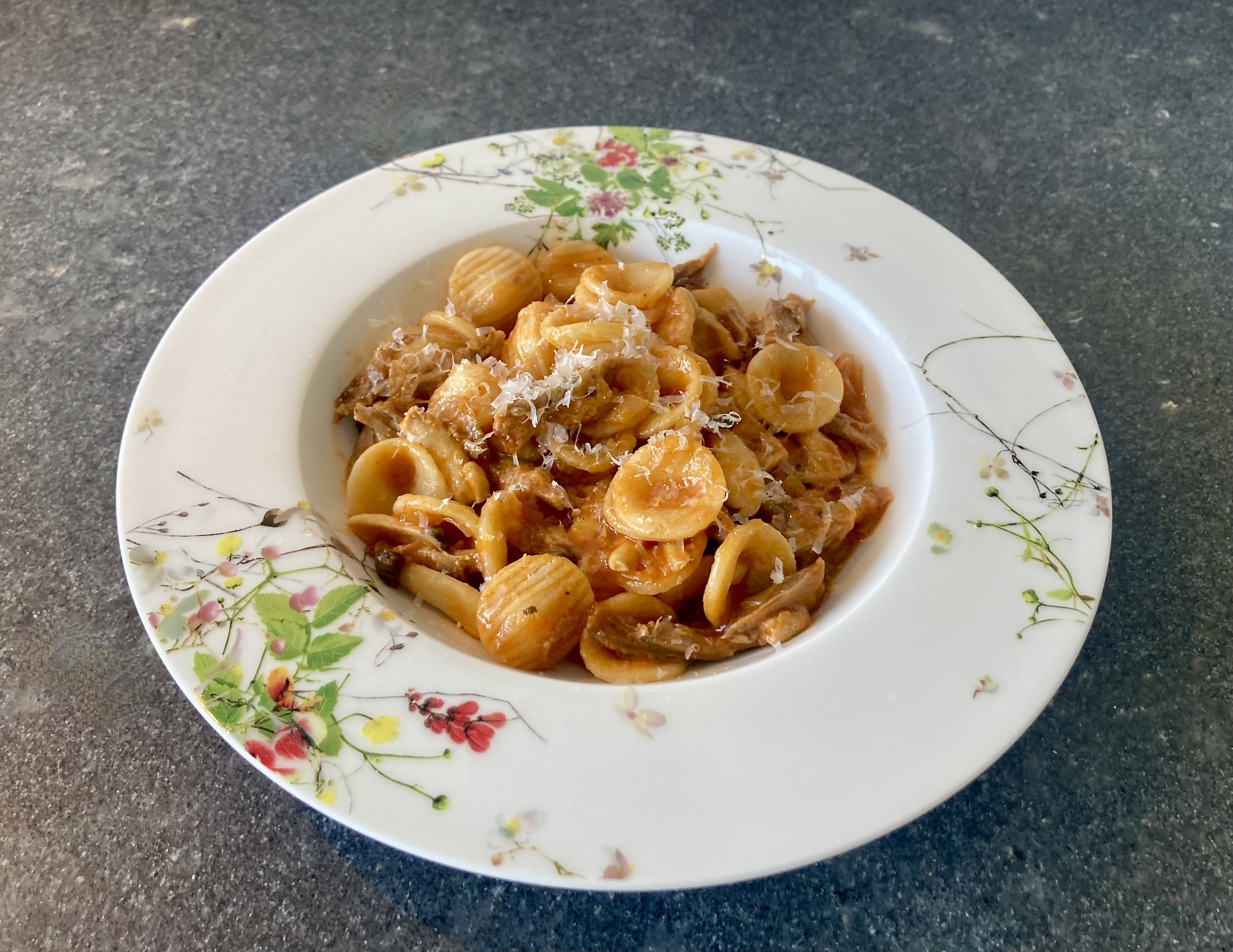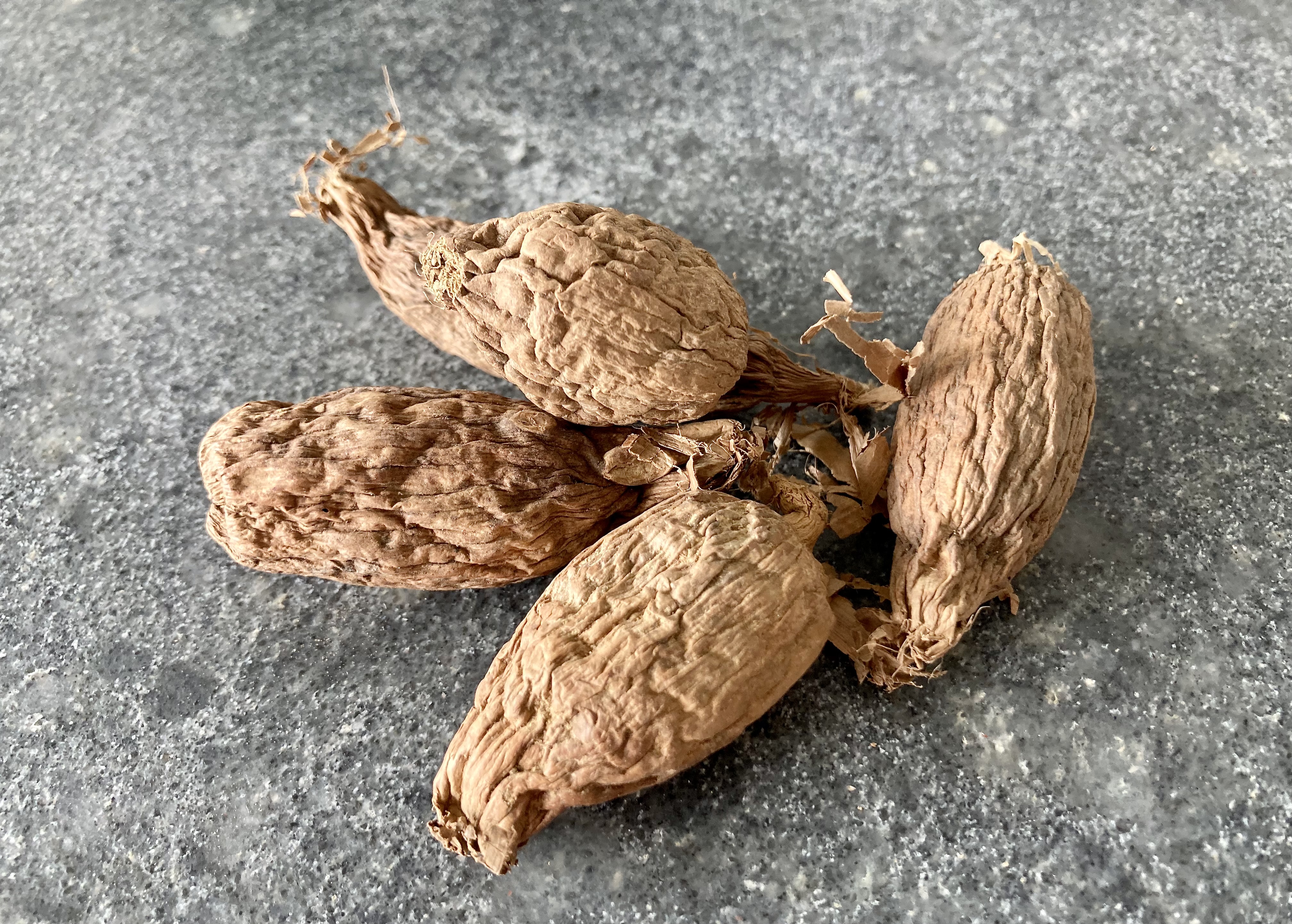
Duck with Garlic Thyme Sauce

Breast of Duck (Margret de Canard) is often paired with sweet ingredients, such as figs and oranges. We love the combination of duck with a green pepper sauce, because the sharpness emphasises the natural sweetness of the duck meat. In this recipe we do something similar. The sauce with thyme and mustard is aromatic and a touch sharp, which is very nice with the duck. The grated garlic adds spiciness to the sauce, making the dish more complex and bold. Delicious when combined with the sweet and sour caponata and crunchy fried polenta.

Wine Pairing

To balance the flavours of the dish, we suggest a fruity, dry red wine, one with subtle tannins and lots of freshness. We enjoyed a glass of Nero d’Avola, made in Sicily. The unoaked wine had a ruby red colour and aromas of cherries and plum. Serving the wine slightly chilled (meaning 15°C or 16°C (59°F or 61°F)) enhanced the freshness, acidity and fruitiness of the wine.

What You Need
  • 1 Breast of Duck
  • Thyme
  • Chicken Stock
  • Garlic
  • Mustard
  • Crème Fraîche
  • ½ grated clove Garlic
  • Black Pepper
  • To serve with the Duck
What You Do
  1. Check the breast for remainders of feathers
  2. Remove the vein on the meat side of the breast (and other bits you don’t like)
  3. Place on a dish, cover with foil and transfer to the refrigerator
  4. Leave in the refrigerator for one hour, making sure it’s nice, firm and cold
  5. Fry the duck in a hot, non-sticky skillet for 10-12 minutes on the skin side. Reduce the heat after a few minutes. You don’t need oil or butter, the ducks fat will do the trick
  6. Now fry for 2-3 minutes on the meat side and remove
  7. Cover with aluminum foil in such a way that the crispy skin is not covered. The foil should only cover the meat
  8. Remove most of the fat from the pan, but not all
  9. Add chicken stock and thyme
  10. Deglaze the pan
  11. Start building the sauce by adding juices from the duck
  12. Add mustard. This will not only add complexity and sharpness to the sauce, it will also make it thicker
  13. Add crème fraîche
  14. Add stock, mustard and crème fraîche to taste
  15. After 10 – 15 minutes add grated garlic, this will give a boost to the sauce
  16. Slice the duck (we like fairly big slices; you may prefer thinner ones)
  17. Add the last juices to the sauce and serve the duck with the sauce, caponata and fried polenta
Duck with Garlic Thyme Sauce ©cadwu served with caponata and polenta
Duck with Garlic Thyme Sauce ©cadwu

Shiitake Salad

We love mushrooms and are always keen to explore new recipes and ideas. This recipe for a salad is very much about the nutty flavour and the moist texture of the shiitake. An easy to make and delicious, aromatic salad with lots of umami and citrus.
We used Grains of Paradise (also known as Maniguette or Awisa). This West African spice was introduced in Europe in the 14th or 15th century as a substitute for black pepper. We like its peppery, citrusy flavour.

Wine Pairing

The fish sauce brings briny, caramel-like flavours with obviously some fishiness. The cilantro is very present with notes of citrus and pepper. The result is an aromatic, umami rich salad, best enjoyed with a glass of Pinot Blanc. We decided to open a bottle produced by Dr. Loosen. The winery was founded over 200 years ago and is well known for its Riesling and other excellent wines from the German Mosel region. In general, you’re looking for a white wine that is fruity and easy to drink, with gently acidity and some minerality.

What You Need
  • 150 grams of Shiitake
  • 2 cloves of Garlic
  • Olive Oil
  • Rice Vinegar
  • Thai Fish Sauce
  • Grains Of Paradise (Maniguette) or Black Pepper and Lemon Juice
  • Cilantro (Coriander)
  • Smoked Breast of Duck
What You Do

Remove the stems of the shiitake (they are chewy and fibrous). If necessary, clean the caps with kitchen paper. Slice. Finely chop the garlic. Warm a heave iron skillet, add olive oil and gently fry the shiitake. After a few minutes add the garlic. Keep on medium/low heat for a few minutes. Combine olive oil, rice vinegar and fish sauce. Ground grains of paradise and add to the dressing. The grains of paradise can be replaced with freshly grounded black pepper and a few drops of lemon juice. Taste the dressing and adjust. Add the shiitake to the dressing and mix. Allow to cool somewhat. Add a generous amount of chopped cilantro. Mix again. Garnish with slices of smoked duck breast.

PS

More mushroom recipes on our mushroom page.

Cèpes, Lentils and Duck

Let’s celebrate the season by preparing a very simple, tasty starter with cèpes, the all-time favourite mushroom of many people. It is great when fried in olive oil with garlic and parsley, wonderful in a risotto and equally tasty when prepared à la Bordelaise. This starter is a bit more complex. It combines the nutty, rustic flavour of lentils with the fatty richness of foie gras and smokiness. The dish is a true appetizer.

Wine Pairing

We would suggest a white wine with some floral notes and only a touch of sweetness. A pinot gris or perhaps a gewürztraminer? Sweetness will go very well with the foie gras and the smoked duck, but it’s not a great match with the cèpes.

We could also imagine opening a bottle of Arbois Savagnin 2018. This complex, white wine is made from the Savagnin grape and is produced in the far east of France, the Jura. It comes with aromas that will make you think of nuts, curry and even umami. When tasting it, you may think the wine is off, given it is slightly oxidized. In this case it’s a good thing. Enjoy the savoury, nutty taste of the wine in combination with the various flavours in the dish.

What You Need

  • 150 grams of Cèpes
  • Du Puy Lentils (from Sabarot)
  • Smoked Breast of Duck
  • Terrine de Foie Gras de Canard
  • Neutral Oil (we used Avocado Oil)
  • Butter
  • Black Pepper

What You Do

Remove the smoked breast of duck from the refrigerator. Wash the lentils and cook for some 20 minutes. Drain and allow to cool. Add one or two teaspoons of oil, to coat the lentils and enhance their flavour. Add some black pepper. Clean the mushrooms and slice. Not too thin, the idea is to have a moist mushroom with a thin crust.  Fry the mushrooms in butter. Plate up by making a circle of lentils and decorate with slices of smoked duck, cèpes and very thin slices of terrine.

PS

Avocado oil seems a bit exotic, but actually it has a very high smoking point so it’s great for frying and baking. When used in a salad, you will notice the oil is light and fresh.

Bistro Cooking

Recently we reviewed Bistro Cooking by Patricia Wells as part of the ongoing cookbook review project by Bernadette. The book made us think about a lunch we enjoyed years ago in Paris. It was a nice small bistro in a small street, off centre, 15th arrondissement, nothing fancy and not a Michelin star in sight. We entered the restaurant and ordered today’s dish, the plat du jour. It turned out to be a generous helping of lentils with two fried sausages, mashed potatoes and mustard. A beer worked beautifully with it. After having enjoyed our lunch, we talked about the joy of good food, French mustard and the beauty of lentils. Time for coffee.

It’s the kind of dish you would expect in a book called Bistro Cooking by. In the book we found two recipes with lentils, one salad and one soup with smoked sausages, the delicious Montbéliard.

Salad

When going through the index we spotted a recipe for a salad with squid, tomatoes, thyme and red wine vinegar. Unfortunately, our fish monger is on holiday, so we had to use pre-cooked octopus as an alternative. The salad is colourful, tasty and uplifting. A great starter, especially when enjoyed with a glass of rosé.

Salad with Octopus ©cadwu
Flo

For many years Brasserie Flo was not only the name of an excellent brasserie in Paris, it was also a chain of restaurants in Nice, Metz, Barcelona and of course Paris (JulienTerminus NordLa Coupole and many more). In 2018 the original Brasserie Flo was renamed Floderer, after one of its founders.

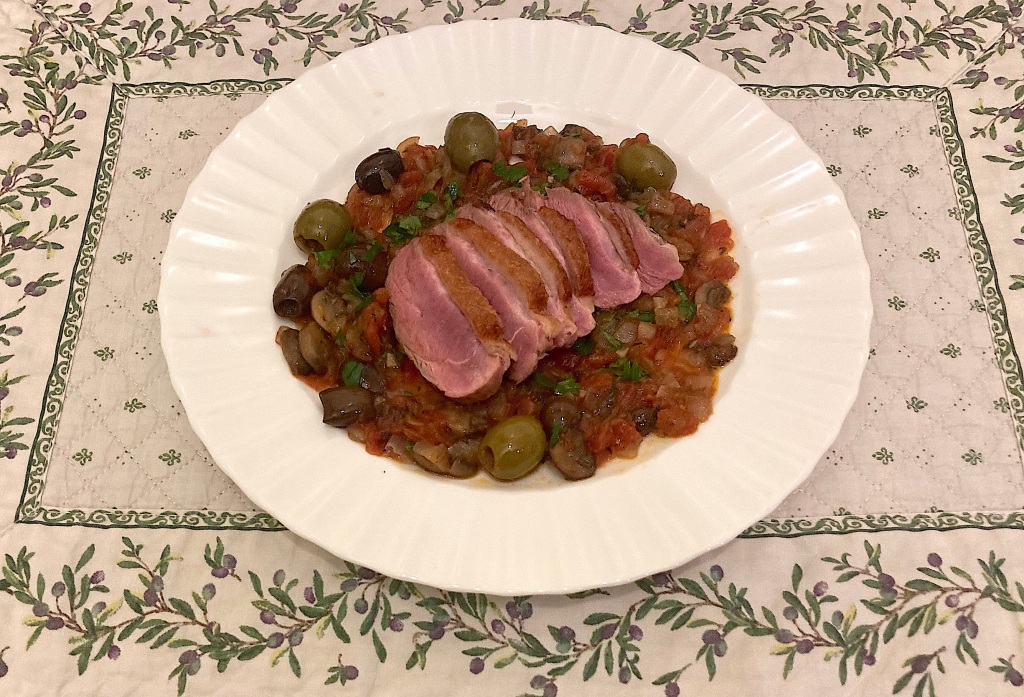
One of the recipes in Bistro Cooking is called Brasserie Flo’s Roast Duck. The name caught our attention and we decided to prepare it. The main ingredient is a whole duck, roasted in the oven. A bit too much for the two of us so we decided to combine the vegetable sauce with pan fried breast of duck. We expected the sauce to be fairly simple (tomatoes, mushrooms, onions, Herbes de Provence) but the result was delicious and a great accompaniment of the duck.

Patricia Wells serves her duck with a glass of Julienas, a cru from the Beaujolais. Very good choice. We opened a bottle of Gamay made by Domaine La Tour Beaumont from the Loire region.

Brasserie Flo’s Duck ©cadwu

The Book

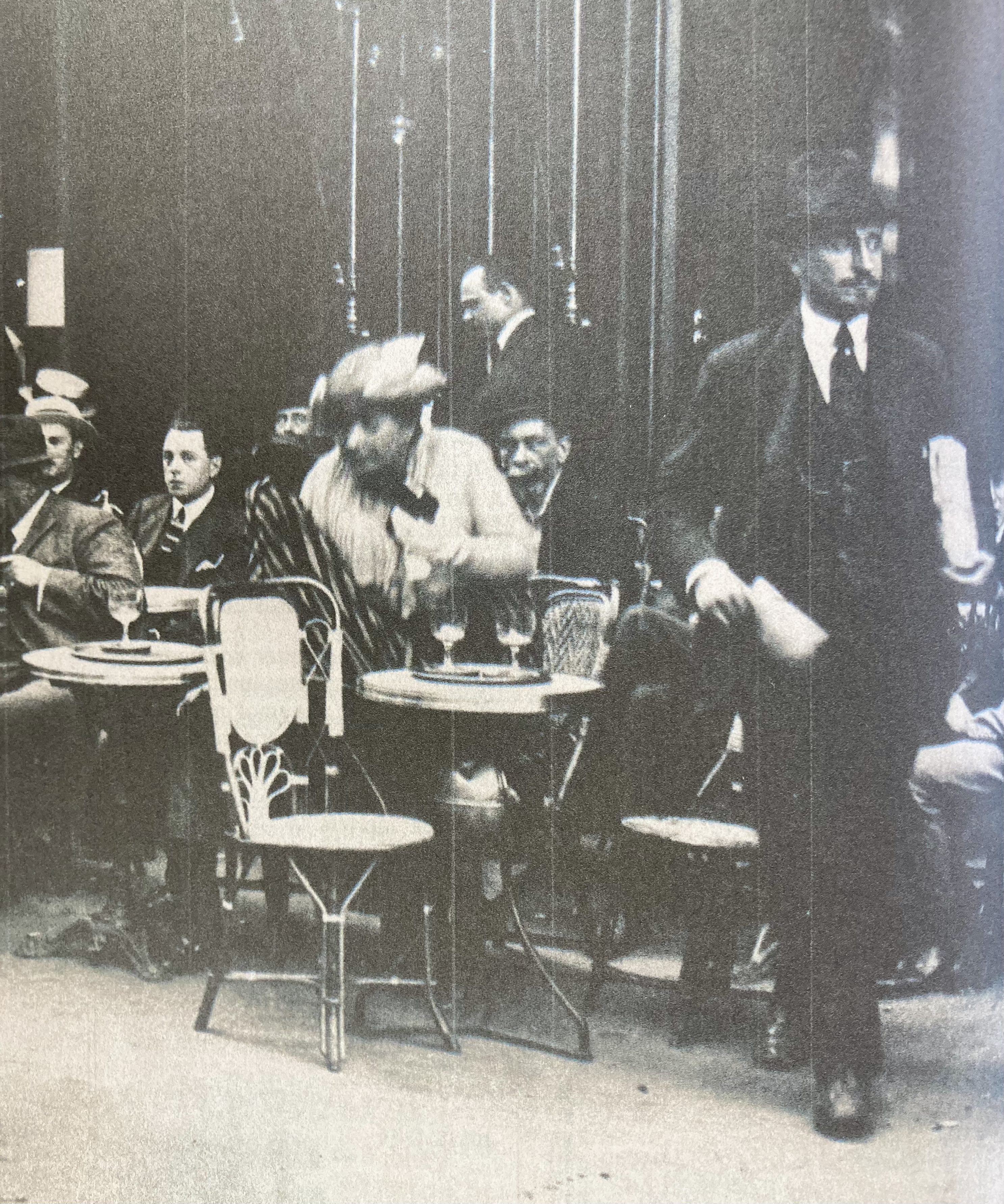
Bistro Cooking includes pictures of typical Bistro scenes showing waiters serving food, people reading their paper and enjoying a small coffee or guests sitting on a small terrace drinking an aperitif while chatting with friends. The pictures illustrate the typical bistro atmosphere and show France like it was and sometimes, if you’re lucky, still is. 
All recipes benefit from a nice introduction, discussing the origin of the recipe or one of the ingredients.

Both recipes can be found on Bernadette’s New Classic Recipe.

Bistro cooking is available via your local bookstore or the usual channels for 25 Euro or US dollar.


Bitter Orange

One of our favourite dishes is Duck Breast with Orange Sauce. Not difficult to make and the result is always tasty. Use a combination of fresh orange juice, thyme, rosemary, butter, Mandarine Napoléon, Cointreau, chicken stock and/or orange peel to make a tasty, not to sweet sauce. Mandarine Napoléon is preferred because it gives bitterness and depth to the sauce. The juicy meat, the sweetness of the duck and the orange, the nice aromas, the herbs and the velvety mouthfeel of the sauce make this an excellent combination.

Last week we were lucky, very lucky when we spotted Orange Amère on our local market. Bitter Orange! Also known as Seville Orange, Bigarade Orange or Pomerans. Finally! The ideal ingredient to make Orange Curd, Marmalade and of course Orange Sauce.

We bought a handful and as soon as we were at home, we wanted to taste it. The Bitter Orange does not contain much juice, their seize is similar to that of a clementine and the seeds are relatively big. The taste is sweet and gentle at first, and then you have bitterness, some astringency and length. Wow! We rushed to our butcher, bought an excellent magret de canard and later enjoyed a perfect Duck Breast with Orange Sauce.

Bitter Oranges are normally available from late December until the end of February. Ask your greengrocer!

Our suggestions: Duck Breast with Orange Sauce and Orange Curd.

  • Bitter Orange ©cadwu
  • Duck Breast with Bitter Orange Sauce ©cadwu

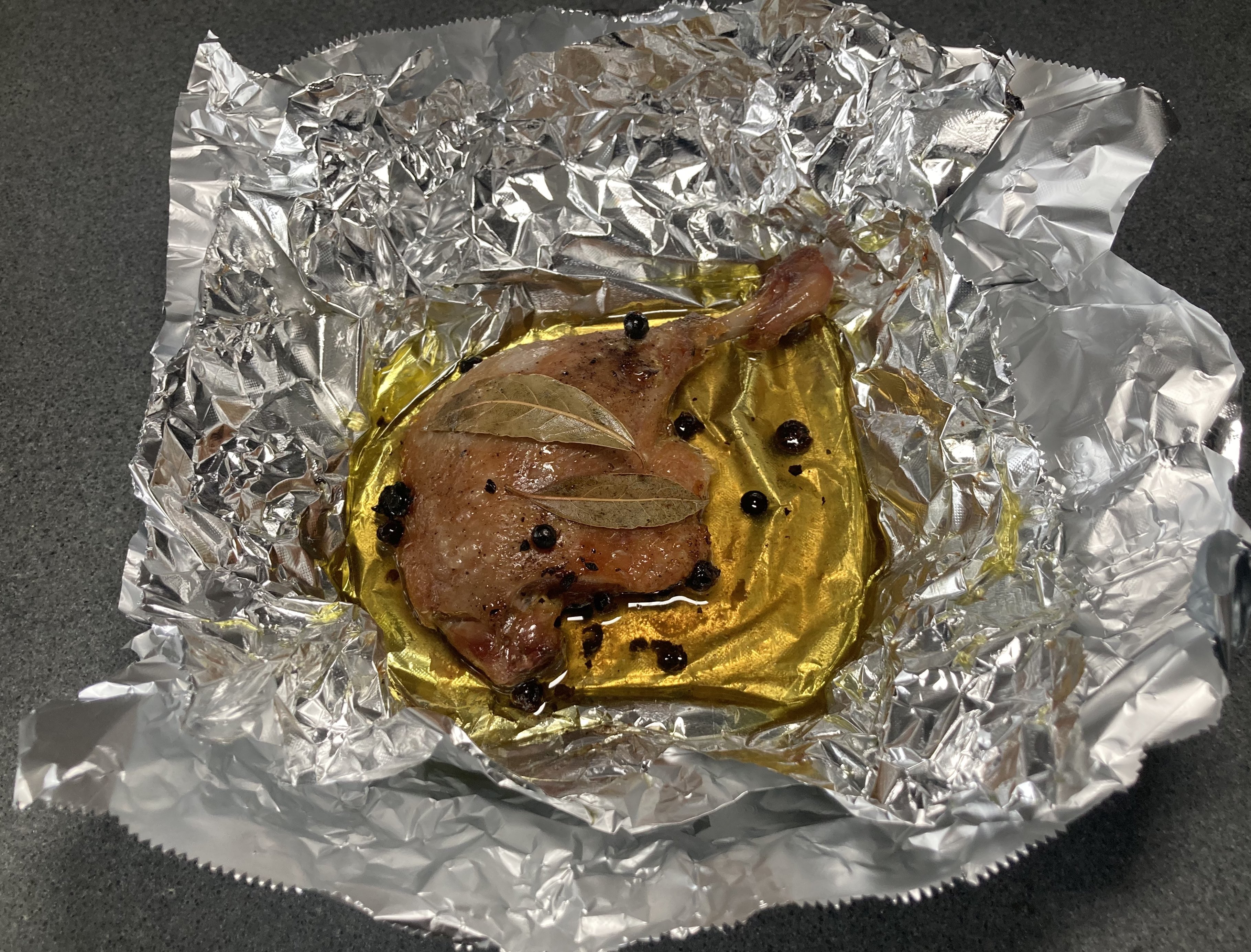
Confit of Duck: a home made alternative

The traditional way of making Confit of Duck is not complex. It’s a bit time consuming and it requires some planning, that’s all. The principle is to cure the meat in salt with various herbs (thyme, cumin, rosemary) and garlic. After 24 hours or so the duck is washed with water, patted dry and then slow cooked in goose or duck fat for several hours. When ready cool and store in fat.

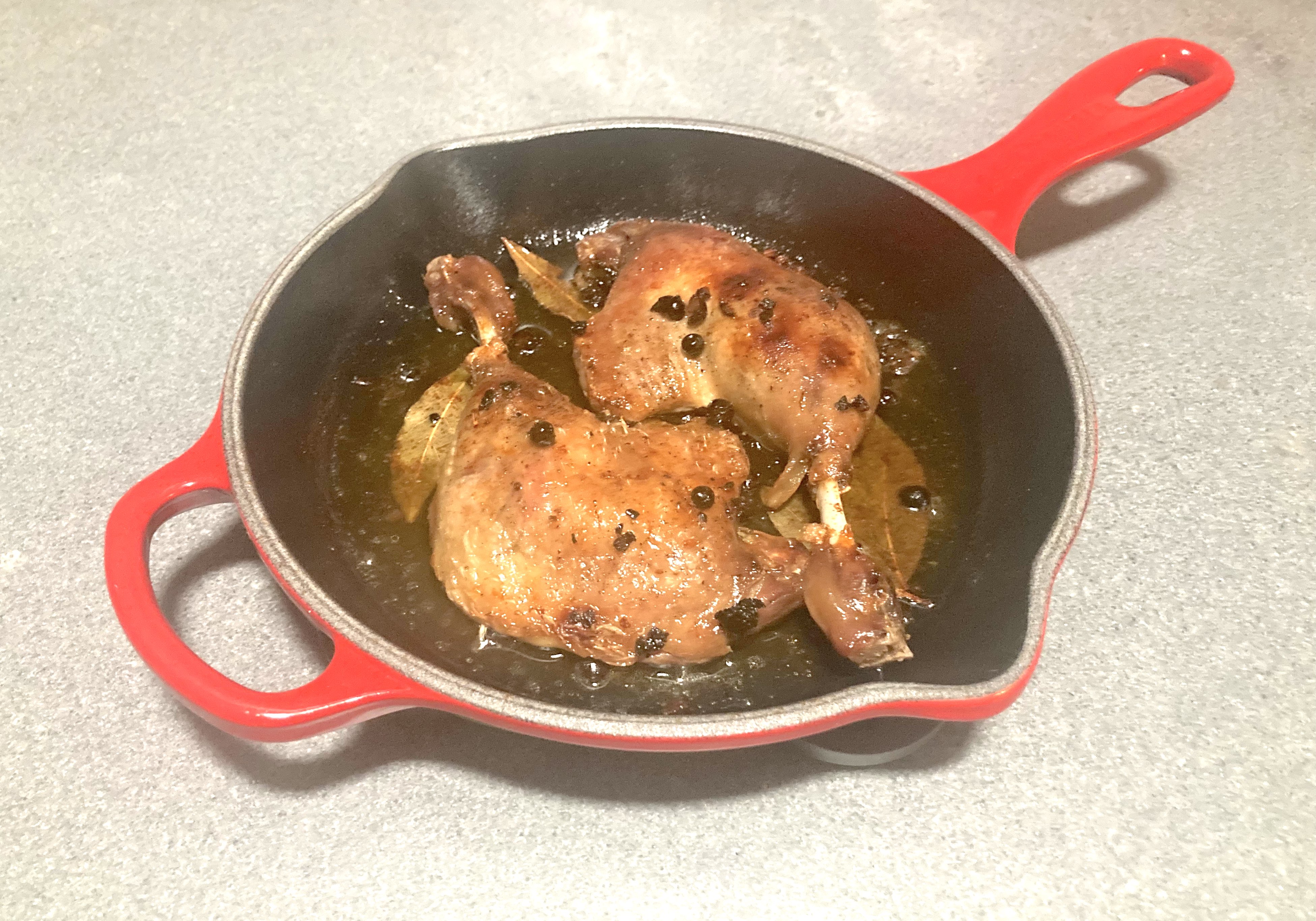
We take a different approach by slow cooking the duck legs in olive oil. The result is remarkable: juicy, full of flavours and aromas, provided you use first class duck (label rouge for instance). If not, the meat can become dry and tough. Another benefit: we don’t cure the meat so it’s not salty at all.
We serve the confit with celeriac mash. It’s light, nutty and refreshing compared to a mash made with potatoes.

Wine Pairing

Best choice is a full bodied, red wine with ripe fruit and smoothness. We decided to open a bottle of Herdade de São Miguel Colheita Seleccionada 2020 as produced by Casa Relvas. Such a pleasure! Its colour is deep ruby and the aromas made us think of ripe black fruit and dark cherries with some spiciness. The wine is well balanced with a nice structure and smooth tannins. Works very well with the juicy duck and the mash with its creamy texture and lemonish, celery flavours.

What You Need

  • For the Confit
    • 2 Duck Legs
    • Juniper berries
    • 4 Bay Leaves
    • Olive Oil
    • (optional) Garlic
  • For the Celeriac Mash
    • 1 Celeriac
    • Slice of Lemon
    • Cream
    • White Pepper
    • Nutmeg

Confit

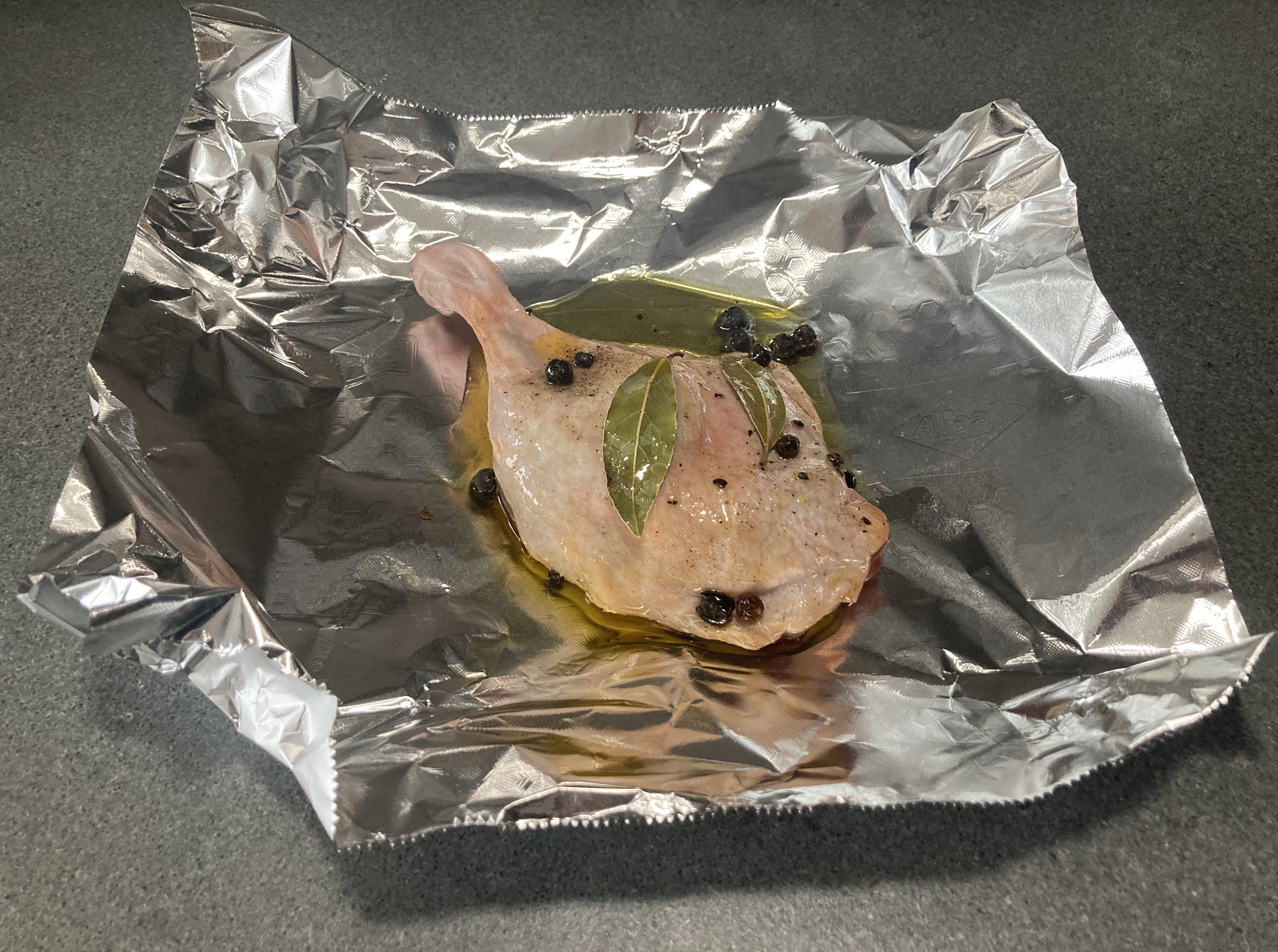
Take a sheet of aluminium foil and place the leg in the middle. Add lightly crushed juniper berries and two bay leaves. Perhaps some crushed garlic. Add a generous amount of olive oil and make sure everything is covered. Wrap foil around the duck. Take a second sheet of foil and wrap it around the package, making sure it’s closed. Repeat with the second leg. Transfer both packages to an oven at 120 °C or 240 °F. After one hour reduce the heat to 100 °C or 210 °F. After in total 4 to 5 hours, depending on the size of the legs, remove the legs from the oven, open the package and let cool. Then transfer to the refrigerator for use later on.

Heat the oven to 200 °C or 390 °F. Put the legs in an iron skillet, transfer to the oven and 15-20 minutes later the legs are ready. If the skin is not yet crispy, use the grill for 2 or 3 minutes.
Another idea is to pull the meat and use it to top a salad.

Mash

The Celeriac Mash: clean and dice the celeriac. Cook in minimum water with a nice slice of lemon until nearly done. Remove the lemon and drain. Add cream. Put on low heat for a few minutes; the celeriac should absorb the cream. When the celeriac is done, use a blender to create the puree. Pass through a sieve. Perhaps add extra lemon or cream. Just before serving add white pepper. Serve with freshly grated nutmeg.

Season’s Greetings

Perhaps you’re looking for some extra inspiration menu-wise for the Holiday Season? Let us help you with a few suggestions.

Apéretif

It’s of course great to serve a glass of Champagne, but why not start with a glass of Crémant de Bourgogne or Alsace? Or a Spanish Cava? The fun is that you can buy a slightly more expensive Crémant or Cava and enjoy a refined sparkling wine. Serve with Terrine de Foie Gras on toast or with a small prawn cocktail, served in a peeled tomato.

Starter

Scallops with fluffy cauliflower purée is a wonderful combination of flavours. The practical advantage is that you can prepare the purée a day ahead and grilling the pancetta is also something you can do in advance. Serve with a glass of Sauvignon Blanc. Dry, some acidity, touch of fruit.

Main Course

Canard à l’Orange, served with steamed Brussels sprouts and potatoes fried in butter: a dish that supports the festive character of your evening: sweetness, a touch of bitterness and crispy, rich potatoes. Enjoy with a beautiful Bordeaux. In general you’re looking for a powerful red wine, with aromas of berries and a touch of oak. The flavour must be round and long with subtle tannins.

Cheese

We tend to go for the classic combination of Stilton and Port. Spend some money and buy a Late Bottled Vintage Port.

Dessert

Continue the British tradition and enjoy a slice of Christmas Pudding with a coffee and a glass of Cognac or Calvados. No need to serve the pudding with brandy butter.

Season’s Greetings 2021 ©cadwu

Beaujolais Primeur 2021

Beaujolais Primeur or Nouveau is made from the Gamay grape, using a technique called macération carbonique. The result is a fruity, light red wine, with little or no tannins. One that can’t be stored for too long. It was (and is) a very popular wine in many a French Bistro, served and enjoyed with lunch.

Over the years we became used to the idea of drinking the first French wine of the year and we started to pay more attention to the quality, only to notice that actually most of the primeur wines were thin, with a bit of acidity but without depth or length.

Today we will open a bottle of Jean-Paul Brun Terres Dorées Beaujolais L’Ancien Primeur 2021. Jean-Paul Brun is a serious and excellent producer of beautiful, tasty Beaujolais wines. We’re sure this primeur will be pure pleasure and a true indication of the quality of the Beaujolais wines this year.

Food Pairing

We will enjoy our Beaujolais Primeur with Confit the Canard and Roasted Seasonal Vegetables.

Beaujolais Primeur at The Art of Wines, Amsterdam ©cadwu

Salad of Cèpes and Smoked Duck

Both Salade Landaise and Salade Périgourdine combine cold ingredients (salad, tomatoes, green beans) and warm ingredients (lardons, confit of duck gizzards) with a dressing made of oil, mustard and (red wine) vinegar. Serve the salad with excellent bread and a glass of rosé and you will have a perfect lunch.
Our salad is perhaps a bit too subtle for a hearty lunch, but it does work very well as an additional starter.

Wine Pairing

Combining wine and salad is never obvious. In this case we need to consider the raspberry flavour, the umami from the cèpes and the duck plus the acidity of the dressing. We choose Domaine de Rimauresq Côtes de Provence Cru Classé rosé. A classic wine from the French Provence with grapes such as grenache noirmourvèdreugni blanc and rolle. The wine comes with delicate fruity, fresh flavours and aromas. It is very well balanced, dry and mouth filling and it combines beautifully with all aspects of the salad.
In general you’re looking for a rosé that has complexity and length, without being overpowering.

What You Need

  • Cèpes (Porcini, Penny Bun)
  • Corn Salad (Lamb Lettuce, Mâche)
  • Olive Oil
  • Raspberry Vinegar
  • White Wine Vinegar
  • Black Pepper
  • Smoked Duck Breast

What You Do

An hour before serving, transfer the slices of smoked duck breast from the refrigerator to a plate. The duck must be at room temperature. Clean the mushrooms and slice. Heat a large iron skillet and add olive oil. Fry the mushrooms and when coloured reduce the heat somewhat. In parallel make a dressing by combining excellent olive oil, white wine vinegar and raspberry vinegar. Taste and adjust. Perhaps some black pepper. Add the salad and toss. Add some of the smaller bits of mushroom and toss again. Quickly serve the salad, adding 2 or 3 slices of smoked duck per person plus the fried cèpes. 

Raspberry Vinegar

Many years ago, we had the pleasure of being regular guests at the Auberge des Seigneurs in Vence, France. In those days the restaurant offered a wide range of beautiful dishes from the days of King François I, such as blue trout, roasted chicken, quail with Pruneaux d’Agen and tender lamb cooked on a spit before an open fire in the dining room.
Ah, Madame Rodi, we treasure these evenings, the beautiful food, the local wine, your dog (known to regular guests as monsieur Tim) and your infinite hospitality. We also remember your wonderful Coca Cola Light, which you would serve after dinner. It came in a huge Biot bottle and to the surprise, astonishment, shock of most of your new guests it was everything but light. It was a strong grappa with Boutons de Fleur d’Oranger (orange blossom buds). We can still see the broad smile on your face when yet another guest would take too big a sip of your powerful concoction.

Adding fruit can be a disastrous idea (just think about strawberry tea or sole Picasso) but the touch of acidity of raspberries makes them ideal to combine with vinegar. We follow Madame Rodi’s approach when making raspberry vinegar: simply combine the two and enjoy.

Use the raspberry vinegar wisely, for instance combine it with strong flavours, preferably umami. We use it in our favourite autumn salad with Porcini and Smoked Duck. The colour, the aromas, the taste: the vinegar and the raspberries integrate perfectly.

What You Need

  • 250 grams of Excellent Organic Raspberries
  • 250 ml White Vinegar

What You Do

Clean the raspberries, crush them with a fork and combine with the vinegar. Put in a jar and transfer to the refrigerator for one week, making sure to stir at least once a day.
Pass the mixture through a sieve, applying light pressure only. Pass the vinegar through a white cloth, squeeze very gentle. The result is probably a bit cloudy, so leave for a few days before using.