Flan with Tofu, Dashi and Ginger

An Asian Coddler

Serving food prepared in a coddler is always good fun. Turn of the lid and be surprised! In this case it’s a light and elegant starter; one that you can prepare the day before. The ginger and spring onion bring spiciness and freshness, the dashi brings umami and the flan a velvety, rich feeling. Making the dish comes with two challenges: the flan should be smooth and the gel not too firm.

Sake Pairing

Sake is best with this dish. The taste of the flan is subtle with a nice fresh touch because of the ginger and spring onion. The gel is a bit salty, given the dish a nice edge. The sake should be straight and crisp (and cold of course).

What You Need

  • For the Flan
    • 8 Small Coddlers (so-called standard size)
    • 100 gram of Silken Tofu (light and soft)
    • 1 Egg
    • 1 Egg Yolk
    • 50 ml Dashi (preferably home-made)
    • Touch of Soy Sauce
    • 1 Teaspoon of Mirin
    • Butter
    • Dill
  • For the Gel
    • 75 ml Dashi
    • Cornstarch
    • Fresh Ginger
    • Spring Onion

What You Do

In a bowl mix the egg and the egg yolk. Use a blender to smoothen the tofu. After blendering it should look like yoghurt. In a second bowl mix the tofu, 50 ml dashi, a touch of soy sauce and mirin. Now combine the content of the two bowls and mix gently. Pass through a sieve. It’s important that the mixture is very smooth, so no lumps or bits of white from the egg. And no bubbles. If not, pass through a finer sieve.
Apply a very thin layer of butter to the coddler, just enough to cover the inside. Pour the mixture in the coddlers, but nor more than 2/3. The mixture will set but not raise (or only a little bit). Close the coddlers, but not too tight. You want to test one during the cooking process and you don’t want to burn your fingers.
Set your oven to ‘classic’ and to 170° Celsius or 340° Fahrenheit. Put the coddlers in a large oven tray and add boiling water. The water should reach ¾ of the coddler, leaving ¼ free. Once in the oven reduce the temperature to 120° Celsius or 250° Fahrenheit and cook for 25 to 30 minutes. The coddlers are done when a metal pin comes out clean.
Remove the coddlers from the oven and allow to cool. You can do this by putting them in cold water, but you can also give it a bit of time. Make sure you dry the inside of the metal lid (condense).
Reduce the dashi. The taste should be relatively strong because the cornstarch will soften it. Better to use agar agar, but cornstarch is perfectly fine in this case. Thicken the sauce with the starch and let it cool. It should work as a gel on top of the flan.
Grate the ginger and very thinly slice both white and green of the spring onion.
Put a bit of ginger in the middle of the flan; sprinkle the onion over the top of the flan and finish by pouring a bit of the gel. Ideally this will cover the top (and the ginger and spring onion) and flow between the coddler and the flan.
Put the coddlers in the refrigerator and let cool. Half an hour before serving take them out of the refrigerator, remove the lid, dry it and put it back on again. Decorate with dill.

Dashi with Matsutake and Shrimps

Celebrate Autumn

This year seems to be an exceptionally good year for Matsutake. Antonio Carluccio once described it is a much-overrated mushroom but we dare to disagree. Just smell it! Pine, pine, pine. A unique mushroom. We tried making this soup with shiitake, but the result is not as refined, delicate and well-balanced. The key elements are of course the (home-made) dashi, the matsutake and the shrimps. Kamaboko (made from processed seafood) and Mitsuba (Japanese parsley) add colour (and some extra flavour) to the dish.

What You Need

  • Dashi
    • 0,5 l of Water
    • 10 gram of Konbu
    • 10 gram of Katsuobushi
  • 75 gram of Matsutake
  • 2 Shrimps
  • Taru Sake
  • Light Soy Sauce
  • Yuzu
  • Kamaboko
  • (Mitsuba)

Sake Pairing

If you want to serve a drink with the soup, then serve taru sake. This is a dry sake characterized by its refreshing taste and the wooden aroma of Yoshino cedar. A wonderful link to the matsutake. And if you bought a bottle of taru sake, then please use this sake for marinating the shrimps.

What You Do

With a damp cloth clean the matsutake. Be careful not to remove the skin. The root should be cut like a pencil. Clean the shrimps and cut lengthwise in two. Let marinade in two tablespoons of sake and transfer to the refrigerator for an hour. Gently warm the dashi, add a small tablespoon of sake and a similar quantity (or less) of soy sauce. Cut the matsutake in 8 similar slices and add to the soup. After a few minutes (depending on the size of the matsutake) add four slices of kamaboko and the shrimps. Taste and add some more soy sauce and or yuzu if needed. Serve immediately when the shrimps are ready. If available add some mitsuba.

Oden

A Traditional Japanese Dish

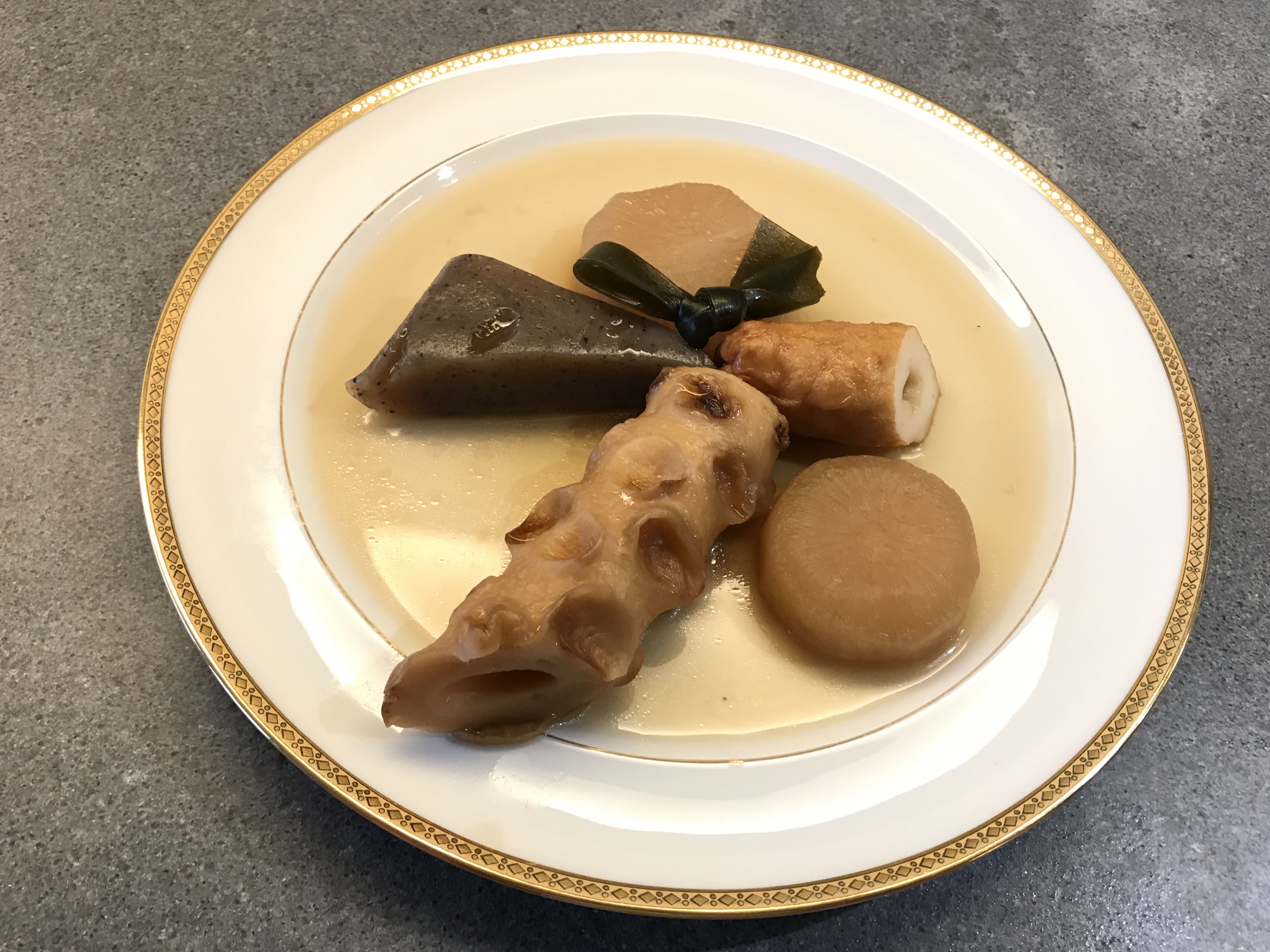
If we say ‘Japanese food’, you will probably think ‘sushi’, ‘sashimi’, ‘yakitori’, perhaps ‘udon’. But Oden? Probably not. Such a shame because Oden is a really wonderful dish. Oden for lunch or as a course in a typical Japanese menu: tasty, light and full of surprises. Oden is a stew that requires a bit more work than you would expect and of course time. It also requires some shopping, given some of the ingredients are not easy to find.
We are not from Japan so we humbly present our version of this (wintery) classic. We hope it inspires you to cook Oden and enjoy it as much as we did.

Wine and Sake pairing

We preferred a glass of Chardonnay with the Oden during our dinner; others preferred a glass of cold sake. The stew is rich in flavours, umami of course, but not spicy, so we would not suggest a Gewurztraminer of a Sauvignon Blanc. A Chardonnay (with a touch of oak perhaps) will be a good choice.

What You Need

  • For the Dashi
    • 20 grams of Dashi Kombu (Rishiri Kombu)
    • 25 grams of Katsuobushi (Bonito Flakes)
  • For the Stew
    • One Daikon
    • Chikuwa Fish Cakes
    • One Pack Konnyaku
    • One Pack of Gobo Maki Burdockroot Fish Cakes
    • 1 sheet of Hayani Kombu
    • 2 boiled eggs
    • Abura Age Fried Tofu
    • Mochi (Sticky Rice Cake)
    • Soy Sauce (preferably one with less salt)
    • Mirin
  • Karashi

What You Do

Start by making one litre of dashi. This seems simple but requires precision. Clean the kombu with a wet cloth and put into one litre of cold water. Gently raise the temperature to 80° Celsius or 176° Fahrenheit. Remove and discard the kombu. Bring the liquid to a boil, add the katsuobushi, bring to a boil and immediately set heat to zero. Wait 5 minutes or so. The katsuobushi will sink to the bottom of the pan. Now very gently pass the liquid through a wet towel. Do not squeeze, just give it time. The result will be a great, clean dashi. Cool and set aside.
Next step is to peel the daikon and slice it (2 centimeters is best). Now use a sharp knife to plane of the edge of the daikon. This improves the presentation and it is supposed to stop the daikon from falling apart. Cook the daikon for one hour in water. Drain and set aside.
Step three is to cut the konnyaku in triangles and cook these in water for 15 minutes. Konnyaku is made from the konjac plant and is specific for the Japanese cuisine.
Step four is to cook the sheet of Hayani Kombu for 5 minutes. This is young kombu and edible, different for the one you used when preparing dashi. Let cool a bit, slice and knot ribbons. Not sure why, but is looks great when you serve it.
Now it’s time to add the dashi to the pan (should be a clay pot, but we stick to our Le Creuset), add one tablespoon of mirin, one (or two, depending on your taste) of soy sauce, add the daikon, the konnyaku and the fish cakes.
We served our oden as a course during dinner, so we limited the number of ingredients. If served for lunch add boiled eggs, fried tofu and mochi. The last two ingredients have to be combined by putting the mochi into the tofu.
Allow to simmer for at least 2 hours. Best is, as always, to serve it the next day.
Serve with some karashi (Japanese mustard, which is different from wasabi by the way).

Oden © cadwu
Oden © cadwu