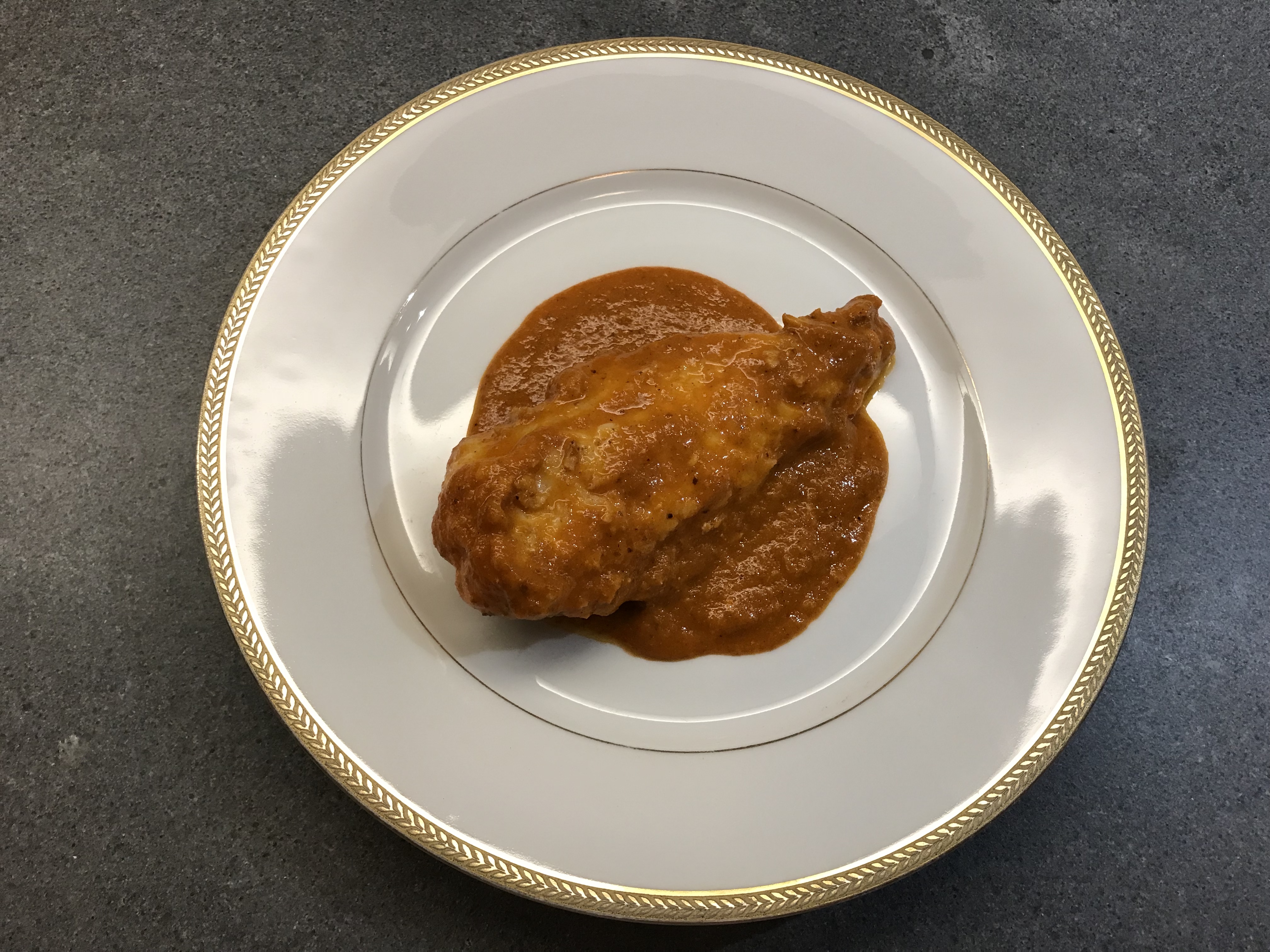
Monkfish with Tomato Olive Sauce

Not the kind of fish you want to meet when swimming in the sea, but definitely one you want to meet when shopping at the fishmonger. Make sure you bring some money because monkfish tends to be expensive. Great meat, delicate yet distinctive taste and not difficult to prepare as long as you’re not in a hurry.
The sauce has to be made a day in advance. It needs time to cook and time to integrate.
You will need to remove the skin of the monkfish. There seem to be several layers of skin and one is (when cooked) really rubbery and inedible. So take you knife, start at the tail end and move forwards, thus removing the membrane. You will find useful videos on the Internet. Unfortunately these videos suggest removing the main bone of the fish, which is a mistake for three reasons. You lose taste and meat plus you lose a natural indicator of the cuisson of the fish.
Pitted black olives. Sounds simple but isn’t simple at all. Buy quality, for instance Niçoise or Kalamate and stay away from cheap and canned. Dry-cured black olives (the wrinkly ones like Nyon) can be overpowering.
Monkfish is an essential ingredient of Zarzuela because of its texture and taste. In this recipe we combine the obvious: monkfish and tomato. We add a bouquet garni consisting of rosemary, thyme and bay leaf. The black olives give the required twist to the sauce and the dish as a whole.

We suggest a glass of Chardonnay to accompany the monkfish, provided the wine is not too woody; a light touch of oak will be best. Soave could also be a good combination.

Here is what you need

  • one Shallot
  • one Garlic Glove
  • Olive Oil
  • two Tomatoes
  • Pitted Black Olives
  • Bay Leaf
  • Thyme
  • Rosemary
  • Monkfish (200 gram per person, bone included)
  • Black Pepper

Start by making the sauce. Gently fry the chopped shallot in a splash of olive oil. After a few minutes add the chopped garlic. Now add the chopped tomatoes and the pitted black olives (depending on their taste we suggest between 10 and 15). Add the bouquet garni and allow to cook on low heat for a number of hours. Make sure to check on a regular basis. When ready, remove the bouquet garni and transfer to a blender. Pass the mixture through a sieve. The sauce should be as smooth as possible. Transfer to the refrigerator and use the next day.
Use a heavy iron skillet to fry the monkfish in olive oil. When nicely coloured, reduce the heat and start adding the sauce. Since the sauce is cold, you need to do it spoon by spoon. Coat the fish with warm sauce, again, and again. Use your knife to try separating the meat from the bone. When this is possible without applying too much pressure, the fish is nearly perfect. Remove the bone, turn the fish on the side that was connected to the bone and cook for one or two minutes. Taste the sauce; maybe you want to add some fresh black pepper.
Serve on a warm plate with some crusted bread.

Caesar’s Mushrooms with Udon

Caesar’s mushroom (or Amanita Caesarea) is a true delicacy, especially when eaten very young. And raw. Since the young ones have the shape of an egg, they are called ovoli in Italian. It is not recommended to pick these young ones yourself, unless you’re an expert. The young Caesar’s mushroom looks very similar to young Fly Agaric, Death Cap or Destroying Angels. Ones we would not like to see on (y)our plate. The mature Caesar’s mushroom looks very distinct from these very dangerous mushrooms, so fewer risks involved.
When you’re in North America, you will probably be able to buy Amanita Jacksonii or Amanita Arkansana, which seem to be very similar, but not completely. As far as we know eating cooked Amanita Caesarea and Arkansana is not a problem; eating them raw could be.

The classic recipe for ovoli is to include them in a salad, with shaved white truffle, parsley, olive oil and parmesan cheese. Another option is to add them to your risotto.

In this recipe we combine the delicate flavour of the Caesar’s mushroom with lots of thyme, rosemary, bay leaf, a touch of garlic, Parmesan cheese and olive oil. Best would be to use Calamintha Nepeta, but using thyme will also do the trick. A garlic glove must be added because the garlic will turn black if your mushrooms are poisonous (not a story to rely on).

Ideally served with Japanese udon because the noodles will be nicely coated with the cooking juices, but feel free to use good pasta as an alternative. One of the benefits of udon is that it is really white, allowing for the yellow of the mushroom to be more present.

We enjoyed our Caesar’s mushrooms with a glass of traditional Burgundy wine from France (100% pinot noir). The wine should have delicate fruit aromas (black cherries, plum) and some earthiness. The wine should be medium bodied and have a crisp acidity. Not too much oak, because oak will overpower the mushrooms. The pinot noir should also be relatively light, allowing for herbal and floral tones.
Pinot Noir wines from the new world are in general rounder and higher in alcohol, making these wines more like Syrah or Malbec. We don’t recommend these wines, however tasty, in combination with the dish.
A glass of Chardonnay is also an option provided it’s fresh with just a touch of oak and butter.

Here is what you need

  • 200 grams of Caesar’s mushrooms
  • Olive Oil
  • Thyme
  • Rosemary
  • Bay Leaf
  • Garlic glove
  • Parmesan cheese
  • Japanese Udon (for instance from Hakubaku)

Clean the Caesar’s mushrooms and remove the white veil (or volva). Make a bouquet garni with lots of thyme, rosemary and a bay leaf. Start by making flavoured olive oil by warming the olive oil in a large skillet and adding the herbs and the garlic glove. Not too hot, you only want the flavours and essential oils to be added to the olive oil. After 15 minutes or so remove the garlic and the bouquet. Now add the sliced Ceasar’s mushrooms and very gently fry them. Just cooked is perfect. In parallel cook the udon. When ready (12 minutes in our case, you don’t want the udon to be al dente), drain the udon but keep some of the cooking liquid. If there is too much starch on the pasta, then think Japan and wash your pasta with cold water. This will remove the starch and allow for a better result. Remove the Caesar’s mushrooms from the pan and keep warm. Add the pasta to the pan, stir and make sure the pasta is fully coated. Add a spoonful or two of the cooking liquid to the pan. Add some grated Parmesan cheese and black pepper. Transfer the Caesar’s mushroom back to the pan and stir very gently, making it into one yellow, tasty mixture. Just before serving sprinkle with extra Parmesan cheese.

Grilled Swordfish with a Spicy Tomato Sauce

Red List

Before we start cooking, be aware that Swordfish is on the Greenpeace red list, so try to find the origin of your swordfish. Having done that assess the quality of the swordfish. No doubt it was frozen, so an extra reason to look carefully and smell. As always: if fish smells like fish, then don’t buy it.
If swordfish looks it has been pre-prepared (sometimes salt or smoke are used) or the flesh is not transparent: don’t buy it. For some reason you need to be extra critical when buying swordfish. But once you’ve found good, fresh swordfish, you have found yourself a great starter.
Also note that swordfish is a predator. Some organisations mention the risk of mercury when eating swordfish, so don’t eat it too often we would say.

If you scan the various recipes for swordfish, you will notice the massive use of marinades. We would not suggest using a marinade when preparing swordfish. The fish has a delicate, slightly sweet taste, which begs for a clever combination, not for a taste bomb like a marinade.
Often the fish is brushed with a mixture of oil and lemon. Sorry, wrong idea. Lemon is probably used to hide a fishy taste (in which case you shouldn’t have bought the fish). The lemon juice will burn when grilling because of the sugar in the juice, so your grilled stake will not just be grilled, it will also show traces of burned sugar. Not tasty, not healthy, not pleasant.
There are only three things you need to do pre grilling swordfish: prepare your tomato sauce, transfer the steak 30 minutes prior to grilling from the fridge to a plate and brush generously with a decent olive oil.

Wine Pairing

We enjoyed our grilled swordfish with a glass of Radacini from the Codru region in Moldova. The wine is made from chardonnay grapes and comes with a beautiful yellow colour. It made us think of apricots and maybe a touch of vanilla. It is not oaked, which is an exception for chardonnay. A wine with a round, velvety taste, but also fresh and fruity. The mouth feel is coating. The velvety aspect goes really well with the fish and the fruitiness is a great combination with the sweetness of the sauce. As an alternative go for an un-oaked, fruit-forward chardonnay.

What You Need

  • Steak of Swordfish
  • Olive Oil
  • Shallot
  • Chilli
  • Red Bell Pepper
  • 2 Garlic gloves
  • 2 Anchovies fillets
  • 2 Tomatoes
  • Bouquet Garni (Sage, Thyme, Rosemary, Parsley)
  • Capers (in brine)

What You Do

Start by slicing the shallot and glaze it gently in olive oil. Cut half of the bell pepper and the chilli in smaller chunks and add to the pan. Stir and then add the garlic. Cut the tomatoes in quarters, add the tomato meat to the sauce and press the remainder through a sieve, making sure you get all the lovely juices. Add the juice to the sauce. Add the bouquet garni and the anchovies. Leave on small heat for two hours.
Remove the bouquet garni, blender the sauce very well and make sure it is a spicy combination of tomatoes and a touch of bell pepper.
Brush the steak generously with olive oil, heat your grill (we use a Le Creuset pan, see picture) and grill for maybe 8 minutes. The meat of swordfish is firm and needs longer than you would expect when grilling fish.
Serve the fish on a hot plate with the tomato sauce. The capers are crucial; they add a bit of acidity, which works really well with the spiciness of the sauce and the gentle sweetness of both the fish and the tomatoes.

PS In case your swordfish looks great but is from the wrong region according to Greenpeace, simply buy the fish, enjoy eating it and donate some money to Greenpeace.


Omelet with Oyster Mushrooms and Nasturtium

Try This at Home

Oyster mushrooms were among the first mushrooms to be cultivated. They grow very well on straw so great to grow at home. See pictures!
The vast majority of oyster mushrooms are grey, but we have seen and tasted the yellow and sensational pink oyster mushroom. Since you can eat oyster mushrooms raw, the pink and yellow variety is great in a salad. Oyster mushrooms can be a bit watery, which impacts the taste. A pity because the taste is delicate and soft anyway. Not a mushroom to combine with more powerful mushrooms like shiitake. Oyster mushrooms cook quickly, so great to use in a stir-fry or a soup. You can try using them in a stew, but make sure your chunks are not too small.

Wine pairing

A crisp, floral white wine goes very well with this omelet. Best would be a Pinot Grigio or a combination of Chardonnay and Viognier.

What You Need

  • 250 grams Oyster mushroom
  • 3 Eggs
  • 1 Spring Onion
  • Butter
  • Olive Oil
  • Black Pepper
  • Chives
  • Nasturtium

What You Do

Harvest your oyster mushrooms or buy really fresh and tasty ones. Tear the mushroom into smaller but not too small chunks. Slice the spring onion in small rings. Fry the oyster mushrooms in olive oil and butter for 3 minutes or so until slightly cooked. Add the white of the spring onion. Perhaps you want to add some butter to the pan. Now make sure the pan is nice and hot. Whisk the eggs well, add the green of the spring onion and add to the pan. After a few seconds reduce the heat to very low and wait 5 to 10 minutes until the egg is nearly set. Take your time but keep an eye on the surface and the consistency. Check with your fingers if the omelet is beginning to set. A good omelet must be baveuse so Timing is All. There is no alternative to baveuse!
Serve the omelet on warm dishes with black pepper, chives and nasturtium (not just for fun, also for the peppery taste of the nasturtium leaves).