Deviled Eggs with a Twist

Easy to make, tasty, and most people love them. You only need a few simple ingredients such as hard boiled (organic) eggs, mayonnaise, Dijon mustard, vinegar (or lemon juice) and black pepper. Sprinkle some paprika on top and they’re ready.

Alas, we’re not huge fans of paprika. Why would you ruin lovely ingredients like egg, mayonnaise and mustard by adding a spice that is at best a touch sweet and in most cases bland?

Paprika (powder) is made from dried red peppers and probably originates from Mexico. When it was brought to Europe, local versions were created, for instance a hot Hungarian version (essential when making goulash) and a smoked Spanish version (pimentón, key ingredient of chorizo and paella). Local peppers were used, including red bell pepper, and the flavours ranged from mild and sweet to hot. By the way, the term ‘deviled’ refers to the spiciness of the dish.
Unfortunately, nowadays factory produced paprika seems to be used for its red colour only.

We combine a bit of everything by adding roasted bell pepper. It adds depths, smokiness, complexity and flavour.

What You Need

  • 6 organic Eggs
  • Mayonnaise
  • Dijon Mustard
  • Lemon Juice
  • Red Bell Pepper
  • Black Pepper
  • Parsley (optional)

What You Do

Grill the bell pepper in your oven until nicely burned, perhaps 10 minutes. Transfer to a plastic container and close the lid. Wait a few hours before peeling the bell pepper. Use a sharp knife to mash the bell pepper. It’s fine if the mash has a bit of structure.
Boil the eggs and let cool. Slice the eggs lengthwise, remove the yolk. Use a fork to crumble the yolks (mimosa) and then combine with mayonnaise, mustard and mashed bell pepper. Add lemon juice and black pepper to taste. Remember the stuffing should be ‘devilish’. Add mixture to the egg whites. Decorating with parsley gives an extra twist to the deviled eggs.

Deviled Eggs ©cadwu
Deviled Eggs ©cadwu

Crostini

You don’t want to spend hours in the kitchen when serving drinks and you want to enjoy a warm appetizer (snack, finger food, quick nibble)? What to do? Of course: serve crostini! You can prepare them in advance and the only thing you need to do is put them under the grill for 3-5 minutes. A nice crunchy appetizer with a rich taste and intense aroma.

We use taleggio, a semi-soft cheese from Italy with a mild taste. It melts easily, so you need to keep an eye on your oven! If you can’t get hold of taleggio, then use mozzarella instead and add a bit more flavour to the mushroom topping.

What You Need

  • For the Mushroom Topping
    • Button Mushrooms and Shiitake
    • Garlic Cloves
    • Olive Oil
    • Thyme and Rosemary
    • Black Pepper
    • (Excellent) Olive Oil
  • For the Crostini
    • Old, stale Bread (Baguette preferred)
    • Garlic (optional)
    • Excellent Olive Oil
  • Taleggio

What You Do

One day before serving the crostini: clean and chop the mushrooms. Finely chop the rosemary, the thyme and the garlic. Fry the mushroom in olive oil in a heavy iron skillet. Reduce heat, add herbs and garlic. Continue on low heat for 10-15 minutes. Transfer the mushroom mix to a plate and let cool. Transfer to a kitchen aid and on low speed add some olive oil. Taste and add some black pepper. You’re looking for a coarsely chopped mixture, one that you can easily distribute over the crostini. Store in the refrigerator.

Also one day before serving the crostini: slice the bread and toast it. Halve a garlic clove, very gently rub the top of the toasted bread with the garlic and then brush with olive oil. An alternative is to preheat your oven to 180 °C or 350 °F, brush both sides with olive oil and bake until golden, 15 to 20 minutes. Perhaps you need to turn the slices over once. Store in a plastic container.

A few hours before serving the crostini: slice the taleggio (with crust!), top the bread with the mushroom mixture and then with a slice of cheese.

Set your oven to grill, transfer the crostini to the top of your oven, wait for a few minutes and serve immediately.

Crostini with Mushrooms and Taleggio ©cadwu

Mapo Tofu (vegetarian)

The first time we ordered Mapo Tofu we naively expected it to be a vegetarian dish. It isn’t but we were immediately impressed by the aromas and flavours. The Sichuan pepper gives the dish a floral, citrusy touch. The combination of the silky, soft tofu with the ground pork and the scallions is very rich. It allows for spiciness, but it’s also fine to be modest with the Chili Bean Sauce.

A wonderful, heart-warming dish, but not vegetarian. We replaced the meat with mushrooms (shiitake turned out to be the best choice) and we think it’s a lighter, equally tasty but different, version of Mapo Tofu.

Sichuan pepper is not related to black pepper or chili. It’s actually not spicy. It causes a pleasant numbing sensation on your tongue and lips, for a few minutes only, which is surprisingly nice when eating spicy food. We recommend lightly toasting the peppers before grinding or crushing them.

Drink Pairing

Jasmine tea is an obvious choice. It has a nice aroma and floral taste. The combination with the spices and the Sichuan pepper works really well.

What You Need

  • 250 grams of mixed Mushrooms (with lots of Shiitake)
  • 300 grams of Silken Tofu
  • 200 ml Vegetarian Stock
  • 2 tablespoons light Soy Sauce
  • 1 tablespoon Mirin
  • 3 teaspoons Sesame Oil
  • 2 Garlic Cloves
  • 1 small Onion
  • 2 Scallions
  • 3 teaspoons of chopped Fresh Ginger
  • ½ -1 tablespoon Chili Bean Sauce (Douban, Toban-Djan)
  • 1-2 teaspoons Black Bean Sauce (Douchi)
  • 1 teaspoon of Sichuan Pepper
  • Oil
  • Cornstarch

What You Do

Toast the Sichuan peppers lightly in a non-stick pan. Remove the peppers from the pan and let cool. Chop the shallot, the garlic and the fresh ginger. Slice the scallions and separate the white from the green. Clean and slice the mushrooms. Slice the tofu and make cubes (2 cm, 1 inch). Warm the stock. Add oil to the pan and fry the mushrooms. After a few minutes, add soy sauce, mirin and sesame oil. Combine and leave to simmer for a few minutes. Remove from the pan and keep warm in the oven at 50 °C or 120 °F. Grind the Sichuan peppers coarsely.
Add oil to the pan. Fry the white part of the scallions, the onion, the garlic and the ginger. Mix. Add the chili bean sauce and fry. Enjoy the aromas! Add half of the grounded Sichuan pepper. Add the stock, the tofu, the mushrooms and the black bean sauce. Use a spatula to mix. Allow to simmer for 15 minutes or so until the sauce is nicely reduced and the flavours mixed. In the meantime, finely crush the remaining Sichuan pepper. Use cornstarch to create the right consistency. Just before serving sprinkle with Sichuan pepper and the green of the scallions.

Side Dish

Serving Mapo Tofu with rice is a great idea. We enjoyed it with some Bok Choy (Pak Choi) simmered in Oyster Sauce.

What You Need

What You Do

Wash and slice the bok choy. Separate the green from the white. Fry the white of the bok choy in olive oil for a few minutes. Then add Thai oyster Sauce and water. Taste and add some soy sauce. Leave for a few minutes. Adjust by adding Thai oyster sauce or soy sauce. Just before serving add the green of the bok choy and mix.

Mapo Tofu (Vegetarian) ©cadwu

Salad of Small Artichokes

The season of artichokes varies depending on the variety and where you are based. In Italy it’s from mid-winter until early spring, in other countries from March to June, or September and October. And in other countries they peak in August. Best is to decide based on quality and price. An artichoke should feel heavy, look fresh and the leaves should be closed. If the leaves are wide open, the artichoke is older and it could be dry with lots of choke (the hairs) and dry inner leaves.

Don’t cook artichokes in boiling water. They must cook for 45+ minutes and during the long cooking process they will lose most of their flavour. Best is to steam artichokes.

Serve large artichokes as a relaxing starter or use them to make Artichoke Barigoule or a Pie. We use smaller ones to make a salad.  You can serve it to accompany an aperitif, or with some bread as a starter. Make sure you have plenty of dressing!

Wine Pairing

It’s not straightforward to pair artichokes with wine. According to various researchers this is due to cynarin, a chemical especially found in the leaves of the artichoke. When the wine and the cynarin meet in your mouth, the natural sweetness of the wine is enhanced, making it taste too sweet. So you have to pair freshly cooked or steamed artichokes with a bone-dry, crisp, unoaked white wine with clear, present acidity. For instance, Sauvignon Blanc, Grüner Veltliner or Albariño.
We enjoyed a glass of Château Pajzos Tokaj Furmint 2019. This dry, white wine made from the well-known Hungarian Furmint grape is fresh, clean and slightly floral. It supports the Salad of Artichokes beautifully.

What You Need

  • 6 small Artichokes
  • Olive Oil
  • Vinegar
  • Mayonnaise
  • Mustard
  • Garlic
  • Thyme
  • Black Pepper

What You Do

Remove the stem of the artichokes and steam the artichokes for 45 – 60 minutes, depending on the size. Remove and let cool. Peel of the first layers of the outer leaves. Make the dressing by turning the mustard and the crushed garlic into a smooth paste. Then gently add the other ingredients and whisk well to make it really smooth, thick dressing. Cut the artichokes in 6 or 8 parts. Add to the dressing, mix well, coating all artichokes. Sprinkle lots of thyme and mix again. Put in the refrigerator for at least 3 hours. Mix again, taste, add some more thyme and serve!

Potato and Truffle Purée

The combination of potatoes and truffle is an interesting one. Because one is the opposite of the other in terms of price and availability? Because both grow underground?

Dutch chef John Halvemaan (also winner of the prestigious Johannes van Dam prize) created a no doubt delicious combination, using butter, veal stock, parsley and cooked bacon. Also very tasty: a recipe for a gratin with crème fraîche and eggs and a recipe by chef Claude Deligne (Le Taillevent in Paris) with foie gras. All far too complex for us, so we prepared a very rich and tasty potato purée with lots of truffle.

If you look for recipes with potatoes and truffle, you will find suggestions using truffle oil. It’s not the real thing, however, if you find quality truffle oil and use only a little bit, your purée will be yummy. The sad news is that some (most?) truffle oil comes with 2,4-dithiapentane, a synthetically produced, aromatic molecule. Producers add this because it gives the impression that the oil contains truffle. Unfortunately, the flavours of 2,4-dithiapentane are not even close to the aromas and taste of a real truffle.

In this case you have to spend some money on both the truffle and the potatoes.

We combined our purée with an excellent rib eye and served it with its own jus and the purée.

Wine Pairing

We enjoyed a glass of Camino de Caza Almansa Garnacha Tintorera-Monastrell 2020. An organic red wine produced by Bodegas Piqueras and made grapes from the Almansa region in Spain. It’s a full-bodied wine with soft tannins and a hint of vanilla and chocolate. In general, you’re looking for a smooth wine with notes of red fruit and oak, medium acidity and with a long, dry finish. One that goes very well with for instance red meat and game (hare, deer).

What You Need

  • Potatoes
  • Butter
  • Egg Yolk
  • Cream
  • Milk
  • Salt
  • Winter Truffle

What You Do

Make your favourite purée! Cook the potatoes until ready (meaning: until the blade of a knife inserted in the potato goes easily through it). Drain. Mash with a fork, add cold butter, combine, add warm milk and/or cream and use a spatula to get the right consistency. You could add a beaten egg yolk (also because eggs and truffle work together wonderfully). Add salt to taste. Perhaps some white pepper. Grate the truffle and add half of it to the purée. The taste of a winter truffle benefits from the warmth of the purée. Just before serving add the remaining truffle.

Potato and Truffle Purée ©cadwu

Tiramisù

Such a simple, tasty, fairly easy to make dessert. No oven needed and the result is always a pleasure to serve. We rely on the recipe of an expert, in our case Dutch pastry chef Cees Holtkamp. Renowned for his excellent patisserie and his truly delicious croquettes. If you ever have the opportunity to visit the shop in Amsterdam, please do so.

After his retirement he started working on his book Dutch Pastry (De Banketbakker in Dutch). The recipes are very clearly written and easy to follow. One of the remarkable aspects of this book is that he prepared all pies, cookies, doughs etcetera in his own home kitchen with basic home cook utensils.

If you want to see his amazing technique and his gently style of creating wonderful patisserie, then visit FoodTube and enjoy how chef Cees Holtkamp and his granddaughter Stella Meijles prepare Pavlova, Black Forest Cake, Lemon Meringue Pie, Saint Honoré, Cheese Butterflies, Tiramisù and many more.

Dutch Pastry is available via the usual channels or via the publisher for 20 euro.

Liqueur

Let’s go back to the Tiramisù. It’s all about eggs, mascarpone, sugar, ladyfingers (savoiarde, sponge fingers or boudoirs) coffee and cocoa powder. Most recipes suggest adding a liqueur to the coffee, for instance rum, cognac, amaretto or marsala. Obviously, we want to add an Italian liqueur to our Tiramisù, so perhaps marsala? This is a fortified wine from Sicily, dry or sweet. A good choice but for some reason the idea of an almond based liqueur is tempting, perhaps because of its slight bitterness in combination with the coffee and the cocoa?

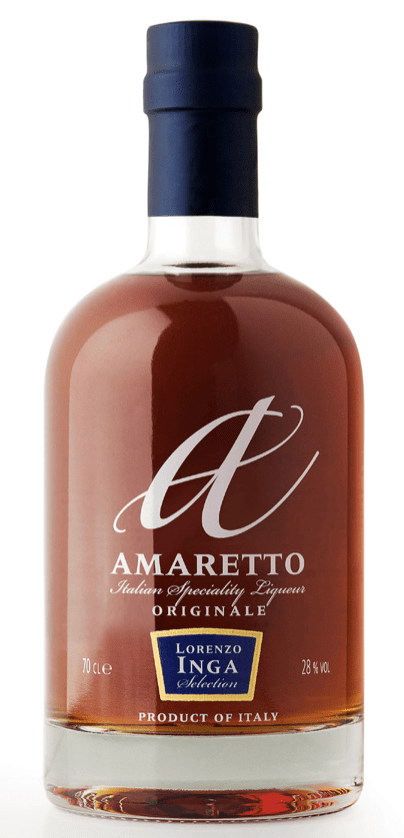
Unfortunately, most amaretto’s taste nasty and artificial. We decided to spend a bit more money and bought a bottle of amaretto produced by Lorenzo Inga. The distillery is located near Gavi, a city known for its amaretti cookies. They produce grappa, bitters and liqueurs such as sambuca and limoncello. Their amaretto is all about almonds. It has a soft structure with a sweet and full mouth feeling. We added it to our Tiramisù and the result was delicious.

Leftovers

The next day we noticed that we had some leftover ladyfingers and also some coffee-amaretto mixture. Why not combine them with whipped double cream and perhaps some vanilla sugar? Would that work? We followed the same approach and stored it in the refrigerator for half a day. We were pleasantly surprised!

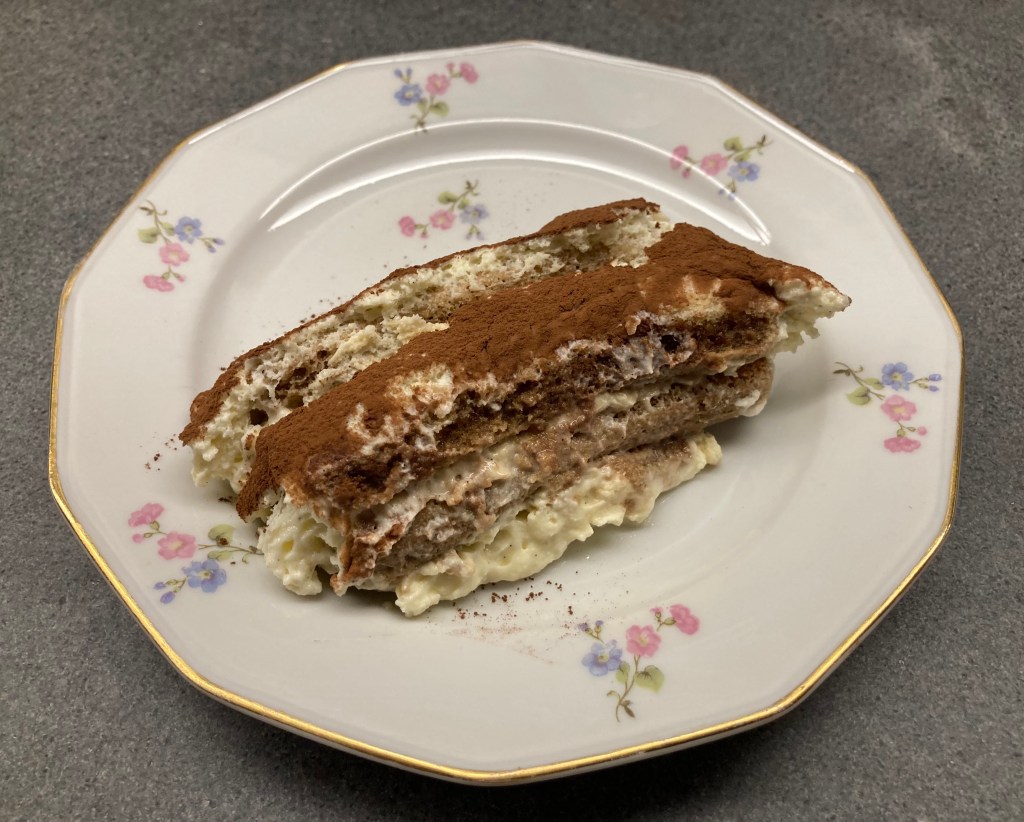
  • Tiramisù ©cadwu
  • Amaretto Originale Lorenzo Inga
  • Cees Holtkamp

Mushroom Fricassee

A few weeks ago, we wrote about History on Our Plate (2019) written by food historian and award-winning author Peter G. Rose. She writes about America’s Dutch past and the influence of the Dutch settlers on today’s American food. She explains how the founders of New Netherland (1609 – 1664, currently the states of New York, Delaware, Connecticut and New Jersey) brought Dutch recipes, tools, herbs and fruit to the US. Most recipes are based on publications like Een Notabel Boecxken van Cokeryen (a Notable Little Book of Cookery, 1514) and the 13thcentury publication Le Viandier de Taillevent. Peter Rose includes both the original and a modern version, allowing you to recreate food from the 17th century. 

Two Recipes

We were intrigued by a recipe for Mushroom Quiche without a Crust that made us think of a savoury clafoutis. We were also intrigued by another mushroom recipe, called Mushroom Fricassee, partly because of the unusual combination of eggs, mushrooms, onion, marjoram, thyme, orange juice, sherry, nutmeg and (optional) beef juice. The recipe is included in a manuscript written by Anne Stevenson Van Cortlandt (1774- 1821). She was married to Pierre Van Cortlandt, a well-known influential family with Dutch origins. Anne Stevenson was born in Albany, a city linked to Dutch settlers until the British took over in 1664.
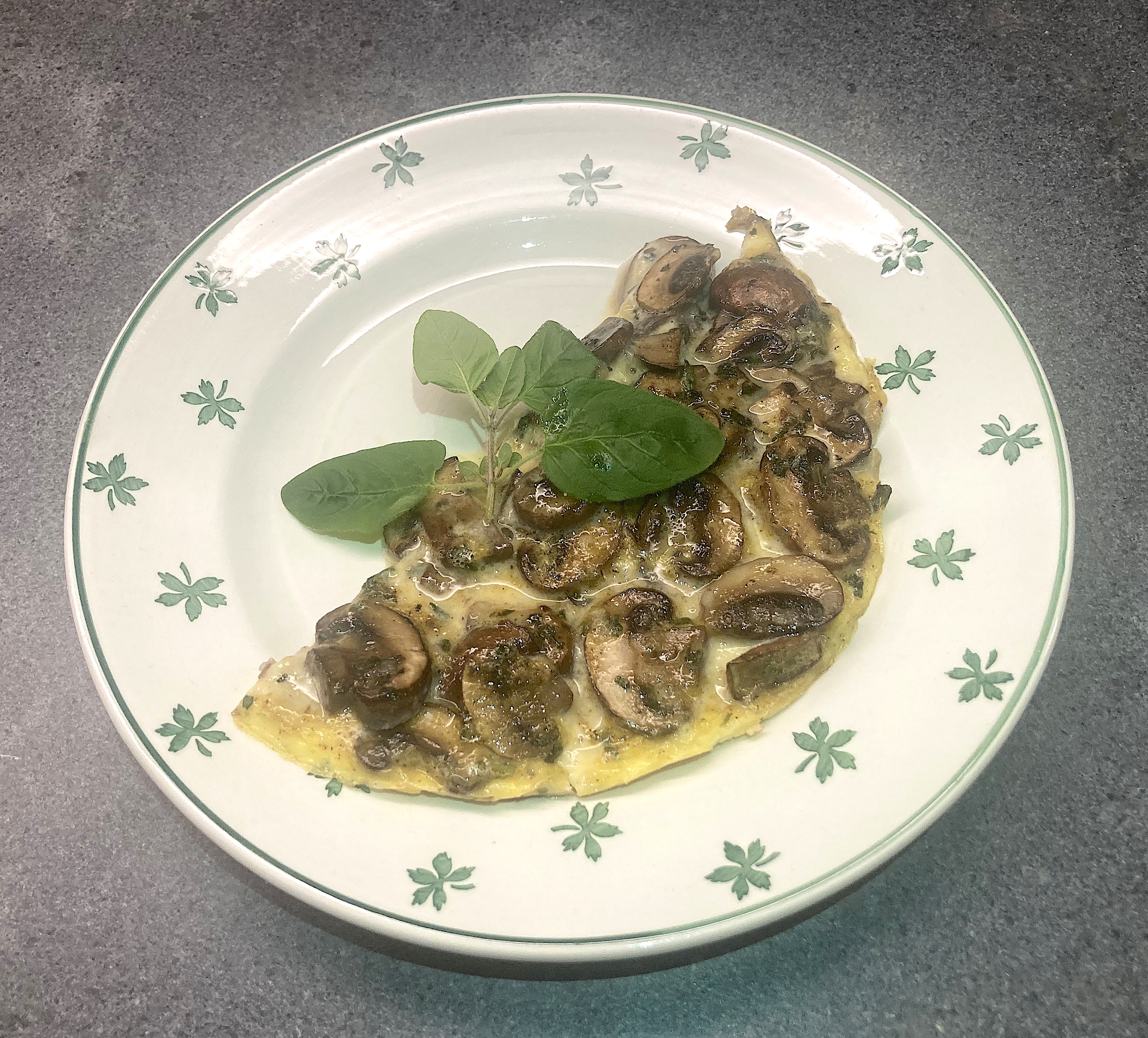
We tried this imaginative combination of ingredients and prepared an omelette. The result was tasty and beautifully balanced, with a nice twist thanks to the herbs, sherry and orange juice. Peter Rose suggests preparing it like scrambled eggs, which is probably a better idea. Turning the mixture into an omelette was a bit of a challenge.
You’ll find a detailed recipe in History on Our Plate.

Wine Pairing

We enjoyed our Mushroom Fricassee with a glass of Conde Valdemar Tempranillo Blanco Rioja DOCa 2020, produced by Bodegas Valdemar. Its colour is slightly yellow with greenish tones. The wine has notes of tropical fruit (pineapple) and its taste is fresh and pleasantly persistent. A beautiful, unoaked white Rioja made with 100% tempranillo blanco grapes.
In general, you’re looking for a lean, dry, slightly fruity white wine with notes of lemon, melon and/or pineapple, preferably with a long finish.

Buy The Book

History on Our Plate is available via the well-known channels and your local bookstore for approximately 15 euro or 10 US$.

History on Our Plate

A few years ago, we had the pleasure of attending a lecture by food historian and award winning author Peter G. Rose. She talked about America’s Dutch past and the influence of the Dutch settlers on today’s American food. She explained how the founders of New Netherland (currently the states of New York, Delaware, Connecticut and New Jersey) brought Dutch recipes, tools, herbs and fruit to the US. And she showed how the Dutch influence is still present in today’s food in the USA.

Recipes

In her book History on Our Plate (2019) she writes in more detail about this topic, also by providing various food and drink recipes from New Netherland (1609 – 1664). The recipes are based on publications like Een Notabel Boecxken van Cokeryen (a Notable Little Book of Cookery, 1514) and the 13th century publication Le Viandier de Taillevent. The recipes include both the original and a modern version, allowing you to recreate food from the 17th century. Fried cod with mace, waffles, mushroom fricassee, artichokes with a bread, cinnamon and wine sauce: they all sound amazing.

In her introduction she describes the joy of baking bread in a hearth, the fun (and challenges) of preparing food in her home fireplace and the candlelight dinners that follow. When reading the well written recipes, you sense that she (and her husband who is in charge of the fire) aims to let her readers enjoy the cooking and eating as much as they did.

Quiche or Clafoutis?

We were intrigued by a recipe for Mushroom Quiche without a Crust. It made us think of clafoutis. Replace the cherries by mushrooms, change the seasoning and you have a delicious vegetarian starter or main course. The recipe was first published in 1668 by Franciscus van Sterbeeck  in his book Tractaet van de Kampernoeljes, Genaamd Duivelsbrood (or Treatise of Mushrooms, named Devils’s Bread).
You’ll find a detailed recipe in History on Our Plate.

We enjoyed our Mushroom Quiche without a Crust (or should we say, Flaugnarde with Mushrooms?) with a glass of Rioja d’Oliva Gran Reserva, Altos d’Oliva, 2013. A full bodied, red wine with lots of character that worked really well with the mushrooms, the oregano, and the Gouda cheese.

Buy the Book!

History on Our Plate is available via the well-known channels and your local bookstore for approximately 15 euro or 10 US$.

Classic Cèpes

What better way to start the mushroom season than serving Classic Cèpes? The recipe is very simple and the result is about cèpes and cèpes alone. The stems a bit firm, the caps moist, the flavours intense and the taste rich and earthy, with a touch of freshness from the parsley. It’s a classic in Germany (Steinpilze auf klassische Art), France (similar to Cèpes a la Bordelaise), Italy and many other countries. 

Wine Pairing

If you want to enjoy the cèpes with a glass of white wine, then we suggest drinking one that is fresh, fruity, round and balanced, for instance of a glass of Bodegas Mocén Selección Especial made from verdejo grapes. A glass of rosé with similar flavours is also a good idea. The idea is to support the cèpes by adding fruitiness and freshness to the dish.

When you decide to drink a glass of red wine, then we suggest a full-bodied red wine with gently fruit and present tannins. 

What You Need

  • 200 gram Cèpes
  • Butter
  • One small Shallot
  • Parsley
  • Black Pepper

What You Do

Clean the mushrooms and slice lengthwise. Finely chop the shallot and the parsley. Add butter to a relatively hot heavy iron skillet. Reduce the heat and fry the cèpes for a few minutes. Add the shallot. Cook on medium heat for 2 minutes. Add chopped parsley, add more butter, black pepper and stir. Serve on a warm plate.

Mushroom Season

Hurray! The mushroom season has started! Last Saturday we bought delicious cèpes and chanterelles. Such a treat. It does of course mean that summer is over, which makes us a bit sad, but it also means the joy of eating wonderful dishes such as Cèpes à la Bordelaise or Salad with Mushrooms and smoked Duck (see below). Last year we prepared a Pâté with bay boletes, which was both beautiful and delicious. Will we be able to buy them this year? Or perhaps the intriguing Japanese Matsutake? It’s been some time since we last saw them on the market, and we would really love to make Matsutake with Spinach and Ginger again. How about Caesar’s mushroom with Udon?

Books

If you’re looking for useful mushroom recipes, then we suggest Antonio Carluccio’s The Quiet Hunt or Mushroom by Johnny Acton and Nick Sadler. Or look at our list of mushroom recipes.

Wine Pairing

Combining wine and salad is never obvious. In the case of a salad with mushrooms and duck we need to consider umami (mushrooms, duck), a touch of sweetness (smoked or cured meat) and the acidity of the dressing. We choose Domaine de Rimauresq Côtes de Provence Cru Classé rosé. A classic wine from the French Provence with grapes such as grenache noirmourvèdreugni blanc and rolle. The wine comes with delicate fruity, fresh flavours and aromas. It is very well balanced, dry and mouth filling and it combines beautifully with all aspects of the salad.
In general you’re looking for a white or rosé wine that has complexity and length, without being overpowering.

What You Need

  • 150 grams of Mushrooms (Cèpes preferred but also great with Oyster Mushrooms or a mix of Champignon de Paris, Shiitake and others)
  • Mesclun
  • Dried or Smoked Breast of Duck
  • Olive Oil
  • Vinegar (Red Wine, Jerez or Raspberry)

What You Do

Clean and slice the mushrooms. Heat a heavy iron skillet and fry the mushrooms in olive oil. Make a dressing of oil and vinegar. Toss the mesclun and the dressing. Transfer the salad to a plate, add mushrooms and finish with 3 or 5 slices of duck.