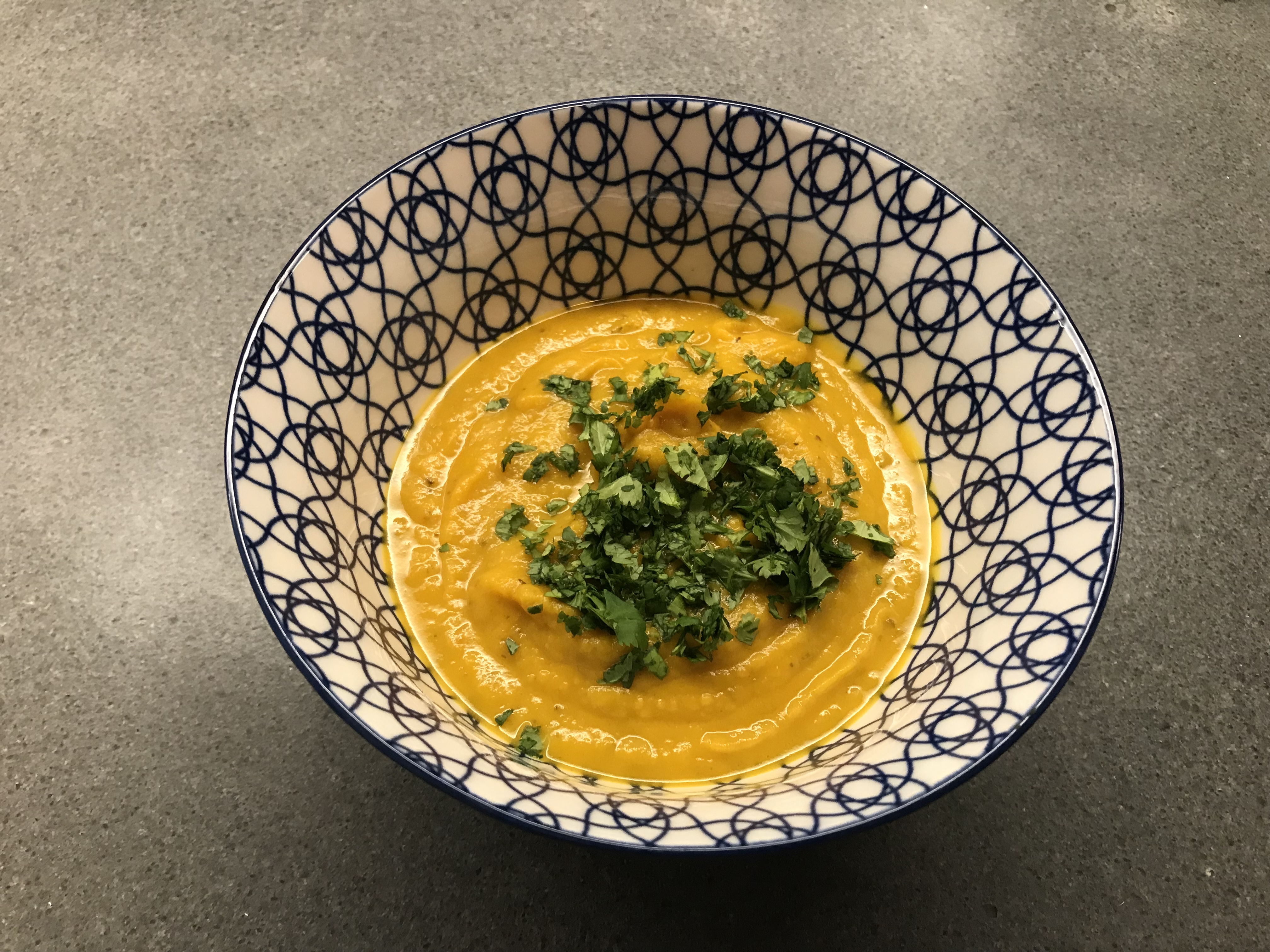
Pumpkin Soup

Pumpkin

Such a simple, tasty, inexpensive and vegetarian soup! What more can you ask for? A bit of jus de truffe maybe?
Make sure to buy organic pumpkins. This allows you to use the skin; so two benefits: there is no need to peel the pumpkin and the soup will be better tasting.
Red lentils will become completely soft when cooked for 30 minutes; very different from green or black lentils. We add the lentils not only because of their taste, but also because they improve the texture of the soup.
Give the soup a finishing touch by adding pumpkin seed oil, jus de truffe or truffle flavoured olive oil (for instance produced by Moulins de la Brague).

Here is what you need

  • Small Pumpkin
  • Red Onion
  • Two Garlic Gloves
  • 6 cm Fresh Ginger
  • 2 Chilli Peppers
  • Tablespoon or more Red Lentils
  • Water
  • Olive oil
  • Pumpkin Seed Oil, Jus de Truffe or Truffle Flavoured Olive Oil
  • Cilantro

Chop de red onion in smaller but equal sized bits and put in a pan with olive oil. Put on moderate heat and give it some 5 to 10 minutes. Now add the chopped and seeded chilli pepper, the garlic and stir. Continue for 5 minutes on moderate heat. Add the chopped pumpkin and the lentils and stir for another 5 minutes. Peel the ginger, cut in cubes and put on a small wooden stick. This way you can easily remove the ginger later on. Now add boiling water and leave for 30 minutes to simmer or until the pumpkin is very, very soft.
When done remove the ginger. Taste the ginger and decide how much ginger you want to add to the soup. We just love fresh ginger so we would add most of it. Blender the remainder into a smooth soup. You could pass it through a sieve to make sure it’s like a lovely velouté. Cool and transfer to the refrigerator for the next day.
Warm the soup and add a splash of truffle flavoured olive oil or pumpkin seed oil and lots of cilantro before serving.
You can also make a milder version by reducing the amount of chilli and ginger. Then add jus de truffe, a bit of olive oil and maybe some pepper before serving.

Pumpkin Soup © cadwu

Monkfish with Tomato Olive Sauce

Not the kind of fish you want to meet when swimming in the sea, but definitely one you want to meet when shopping at the fishmonger. Make sure you bring some money because monkfish tends to be expensive. Great meat, delicate yet distinctive taste and not difficult to prepare as long as you’re not in a hurry.
The sauce has to be made a day in advance. It needs time to cook and time to integrate.
You will need to remove the skin of the monkfish. There seem to be several layers of skin and one is (when cooked) really rubbery and inedible. So take you knife, start at the tail end and move forwards, thus removing the membrane. You will find useful videos on the Internet. Unfortunately these videos suggest removing the main bone of the fish, which is a mistake for three reasons. You lose taste and meat plus you lose a natural indicator of the cuisson of the fish.

Monkfish is an essential ingredient of Zarzuela because of its texture and taste. In this recipe we combine the obvious: monkfish and tomato. We add a bouquet garni consisting of rosemary, thyme and bay leaf. The black olives give the required twist to the sauce and the dish as a whole.

Wine Pairing

We suggest a glass of Chardonnay to accompany the monkfish, provided the wine is not too woody; a light touch of oak will be best. Soave could also be a good combination.

What You Need
  • one Shallot
  • one Garlic Glove
  • Olive Oil
  • two Tomatoes
  • Pitted Black Olives
  • Bay Leaf
  • Thyme
  • Rosemary
  • Monkfish (200 gram per person, bone included)
  • Black Pepper
What You Do
  1. Start by making the sauce
  2. Gently fry the chopped shallot in a splash of olive oil
  3. After a few minutes add the chopped garlic
  4. Add the chopped tomatoes and the pitted black olives (depending on their taste we suggest between 10 and 15)
  5. Add the bouquet garni and allow to cook on low heat for a number of hours
  6. Make sure to check on a regular basis
  7. When ready, remove the bouquet garni and transfer the sauce to a blender
  8. Pass the mixture through a sieve. The sauce should be as smooth as possible
  9. Transfer to the refrigerator and use the next day.
  10. Clean the fish
  11. Use a heavy iron skillet to fry the monkfish in olive oil
  12. When nicely coloured, reduce the heat and start adding the sauce
  13. Since the sauce is cold, you need to do it spoon by spoon
  14. Coat the fish with warm sauce, again, and again
  15. Use your knife to try separating the meat from the bone. When this is possible without applying too much pressure, the fish is nearly perfect
  16. Remove the bone, turn the fish on the side that was connected to the bone and cook for one or two minutes
  17. Taste the sauce; maybe you want to add some fresh black pepper.
  18. Serve on a warm plate with some crusted bread.

Pissaladière

Pissaladière is a very tasty combination of onions, local French herbs, anchovies and black olives. It originates from the South of France (Côte d’Azur) and many a local boulangerie will offer their home-made, original pissaladière. We compared many recipes, enjoyed lots of slices of Pissaladière when in France and are pleased to present our version. It does not include tomatoes, milk, almonds, sugar, coconut oil and is not made with puff pastry.

Best is to make your own pastry (especially because it’s very simple) and use fresh yeast. Since it’s more and more difficult to buy, we use dried yeast. Key to making pissaladière is time. The onions need an hour, they need to cool and the dough needs to proof twice. But we’re not in a hurry!

We combined our pissaladière with French charcuterie; think Paté en Croûte (recipe to follow), Rossette (from Lyon), Rillettes d´Oie, Jambon persillé and cornichons. You could also combine pissaladière with a nice simple green salad.

We enjoyed our Pissaladière with a glass of Cô­tes de Pro­ven­ce ro­sé made of Cinsault, Grenache and Shiraz grapes. Dry, with a touch of grapefruit and wonderfully pale pink.

Here is what you need

  • 600 grams of White Onions (or a combination of White Onions and Shallots)
  • Olive Oil
  • Butter
  • Bay Leaf
  • Anchovies
  • Halved Black Olives
  • Pastry
    • 125 grams of Flour
    • 2 grams of Yeast (depending on the yeast you use)
    • 75 ml of Water
    • Dash of Salt
    • Some Olive Oil
    • Herbes de Provences (or thyme)

Start by caramelizing the onions. Peel the onions, cut in 4 and slice. Not too thin, the onions will shrink. Fry gently in olive oil and butter. When starting to color reduce the heat, add the bay leaf and allow to simmer for one hour, stirring every 15 minutes or so. Check the taste, the bay leaf can be overpowering. Let cool and set aside (for instance until the next day).
Mix flour, yeast, salt and herbes de Provences. Add water and olive oil and knead for 10 minutes. Let proof for 2 hours. Transfer to kitchen top and create a thin rectangular pastry. Coat a baking plate with oil and transfer the pastry to the plate. With a fork make small holes in the pastry (not in the edge). This is important given the fact that the onions are cold and moist. Now add the onions and make a nice pattern with the anchovies and the halved olives. Bake in a hot oven (top half, 220˚ Celsius or 430˚ Fahrenheit) for 15 minutes. Serve warm (or cold) but not hot.

Caesar’s Mushrooms with Udon

Caesar’s mushroom (or Amanita Caesarea) is a true delicacy, especially when eaten very young. And raw. Since the young ones have the shape of an egg, they are called ovoli in Italian. It is not recommended to pick these young ones yourself, unless you’re an expert. The young Caesar’s mushroom looks very similar to young Fly Agaric, Death Cap or Destroying Angels. Ones we would not like to see on (y)our plate. The mature Caesar’s mushroom looks very distinct from these very dangerous mushrooms, so fewer risks involved.
When you’re in North America, you will probably be able to buy Amanita Jacksonii or Amanita Arkansana, which seem to be very similar, but not completely. As far as we know eating cooked Amanita Caesarea and Arkansana is not a problem; eating them raw could be.

The classic recipe for ovoli is to include them in a salad, with shaved white truffle, parsley, olive oil and parmesan cheese. Another option is to add them to your risotto.

In this recipe we combine the delicate flavour of the Caesar’s mushroom with lots of thyme, rosemary, bay leaf, a touch of garlic, Parmesan cheese and olive oil. Best would be to use Calamintha Nepeta, but using thyme will also do the trick. A garlic glove must be added because the garlic will turn black if your mushrooms are poisonous (not a story to rely on).

Ideally served with Japanese udon because the noodles will be nicely coated with the cooking juices, but feel free to use good pasta as an alternative. One of the benefits of udon is that it is really white, allowing for the yellow of the mushroom to be more present.

We enjoyed our Caesar’s mushrooms with a glass of traditional Burgundy wine from France (100% pinot noir). The wine should have delicate fruit aromas (black cherries, plum) and some earthiness. The wine should be medium bodied and have a crisp acidity. Not too much oak, because oak will overpower the mushrooms. The pinot noir should also be relatively light, allowing for herbal and floral tones.
Pinot Noir wines from the new world are in general rounder and higher in alcohol, making these wines more like Syrah or Malbec. We don’t recommend these wines, however tasty, in combination with the dish.
A glass of Chardonnay is also an option provided it’s fresh with just a touch of oak and butter.

Here is what you need

  • 200 grams of Caesar’s mushrooms
  • Olive Oil
  • Thyme
  • Rosemary
  • Bay Leaf
  • Garlic glove
  • Parmesan cheese
  • Japanese Udon (for instance from Hakubaku)

Clean the Caesar’s mushrooms and remove the white veil (or volva). Make a bouquet garni with lots of thyme, rosemary and a bay leaf. Start by making flavoured olive oil by warming the olive oil in a large skillet and adding the herbs and the garlic glove. Not too hot, you only want the flavours and essential oils to be added to the olive oil. After 15 minutes or so remove the garlic and the bouquet. Now add the sliced Ceasar’s mushrooms and very gently fry them. Just cooked is perfect. In parallel cook the udon. When ready (12 minutes in our case, you don’t want the udon to be al dente), drain the udon but keep some of the cooking liquid. If there is too much starch on the pasta, then think Japan and wash your pasta with cold water. This will remove the starch and allow for a better result. Remove the Caesar’s mushrooms from the pan and keep warm. Add the pasta to the pan, stir and make sure the pasta is fully coated. Add a spoonful or two of the cooking liquid to the pan. Add some grated Parmesan cheese and black pepper. Transfer the Caesar’s mushroom back to the pan and stir very gently, making it into one yellow, tasty mixture. Just before serving sprinkle with extra Parmesan cheese.

Fried Large Prawns

Enjoying the Sea

Shrimps and Prawns, delicacies from the sea, just like lobsters, scampi and crabs. Popular food in many countries, just think shrimp cocktail, paella, salad with shrimps, pasta with seafood, stuffed eggs with shrimps, curry with prawns and of course, fried shrimps with garlic and lemon.

We think shrimps and prawns are as subtle, delicate and tasty as lobster. The prawn should be at the center, not just another ingredient of your fish soup. Not hidden by loads of garlic and lemon. Or even worse, wrapped in bacon (whoever came up with the idea of wrapping prawns and oysters (angels on horseback) in bacon is not a seafood lover).

We will use the shell, the legs and the so-called swimmerets of the prawns to create a sauce; a bisque like sauce.

Wine Pairing

We enjoyed our fried large prawns with a glass of rose. This Italian rose (from Garofoli) is made from 100% Montepulciano. It comes with beautiful scent of cherries and peaches. The flavor is full, velvety, present and balanced. A great companion for seafood. Other options are Chablis and Soave. A Viognier will probably be too fruity.

What You Need

  • Two large Prawns, either wild or organic
  • One small Shallot
  • Chili Pepper
  • Butter
  • Olive oil
  • Armagnac or Cognac
  • Garlic
  • One Cherry Tomato
  • One Saffron Thread
  • Water
  • Bouquet Garni (Thyme, Parsley)
  • Black Pepper
  • Crusted Bread

What You Do

We start by making a bisque-like sauce, using the shell of the prawns.
Chop the shallot and a bit of chili pepper and glaze gently for 10 minutes in butter and olive oil. In parallel use scissors to cut the shell of the prawn. Start behind the head and cut towards the tail. Just before the tail turn 90 degrees and make a cut around the prawn. This allows you to remove the shell and the legs of the body but keep the head and the tail on the prawn. Remove the black vein (the prawn’s intestines) and the slurry in the head (if any). Since you serve the prawn with the head (and tail) it is essential that the prawn is clean. You could gently rinse the prawn if you want to be absolutely sure about this. Transfer the prawns to the refrigerator.
Break the shell into smaller chunks. Add these to the pan and fry for a few minutes until red. Add a small splash of Cognac or Armagnac and flambé. Never do this when using the exhaust or range hood. Add one garlic glove, water, the quartered cherry tomato, the bouquet garni and the saffron. Stir well, cover the pan and let rest on low heat for 30 minutes.
Remove the bouquet and the shells from the pan and using a spoon and a sieve squeeze the juices from the bouquet and the shells, then discard. Blender the mixture and pass through a sieve. Taste the mixture, add pepper if so required. Leave for another 30 minutes on very low heat, allowing for the flavors to integrate and for the liquid to reduce.
Dry the prawns and fry them in a skillet in oil (depending on the size maximum 4 minutes in total) on both sides and on the back. Use warm plates, and serve the prawn on top of the sauce. Touch of black pepper on the prawn is fine. Enjoy with crusted bread.

Tellines with Parsley

This Week’s Special

Many, far too many years ago we were walking along the Mediterranean coast, enjoying the sea, the sun and the company of a dear friend. She asked us if we would like to eat tellines for dinner. Of course, we replied, but what are tellines? She smiled and said I’ll show you. She walked to the sea and kneeled down, just where the sand and the sea meet. All you needed to do was move your fingers through the sand, just under the surface and feel. She harvested a few tellines, opened them with her fingers, washed them in the sea and that’s how we enjoyed our very first tellines, fresh from the sea. So simple, to tasty, so good.
We harvested many more and went back to her house where we cooked the tellines in a hot skillet and enjoyed them with a beautiful local ro­sé.

Harvesting tellines (or in France tenilles) is simple; knowing where you can do this is the challenge. Fortunately you can (occasionally) find them on the market.

It’s possible to use other small clams, but the fun of tellines is that they open quickly when in the pan, making sure they remain juicy.

Here is what you need:

  • 300 grams of tellines
  • one Shallot
  • one Garlic glove
  • Olive Oil
  • Parsley
  • White Wine
  • Black Pepper

Wash the tellines, preferably using salted water. Discard ones with a small hole and ones that are broken. Chop the shallot (you probably need half of it) and the garlic very fine. Heat the skillet, add the oil, the shallot, the garlic and the tellines and cook until the tellines are open. You probably want to add a splash of white wine during the cooking process. Serve the tellines on a warm plate with black pepper. Sprinkle with chopped parsley. Enjoy with a glass of Cô­tes de Pro­ven­ce ro­sé, for instance an Estandon from the Var region. No cutlery needed!

White asparagus with Egg, Ham, Parsley and Butter

A Classic

White asparagus is such a great vegetable! In this recipe we describe the classic way of serving asparagus: A la Flamande. This way you will be able to taste the slight bitterness and sweetness of the asparagus. The butter and egg bring a feeling of velvet to your palate, which is ideal to taste the asparagus. The parsley and white pepper give a touch of sharpness to the dish.

Wine Pairing

Serve the white asparagus with a dry Muscat from the Elzas. The delicate, slightly sweet but dry taste, the hint of bitterness and the rich aromas work very well with white asparagus. Muscat to us means the smell of fresh fruit. When drinking it is if you’re tasting the original grape. Wonderful wine and wonderful combination.
We recently combined the asparagus with a Riesling (2015, Trocken, Meulenhof) from the German Mosel region. Worked very well.

What You Need

  • 3 or 5 White Asparagus per person
  • 2 Eggs
  • 100 gram Ham
  • Parsley
  • Butter
  • White Pepper

What You Do

Steam the white asparagus and cook or steam the eggs medium, making sure the yolk is not set but also not running. Peel the egg and cut in four. Chop the parsley. Serve the asparagus and eggs warm on a plate. Dress the plate with ham (please make sure it has a bit of fat) and butter; sprinkle the parsley over the plate. Add some white pepper.
As an alternative warm the butter and pour it gently over the asparagus.

White Asparagus with Egg, Ham and Parsley

Grilled Asparagus with Parmesan Cheese

We enjoyed this dish as a starter when in Milan, on a beautiful evening, eating al fresco and enjoying the wonderful combination of the sweetness and bitterness of the asparagus, the slightly caramelised sugars as a result of grilling the asparagus and the salty and sweet cheese. A glass of Pinot Grigio was all we wanted. In Milan they served us green asparagus, but it works even better with white asparagus.
This is typically a dish you would make when the asparagus season is at its high and outside temperatures feel like summer. You could drink a Pinot Grigio, a Muscat from the Alsace region or a Rose with character. Remember the wine needs to combine with a range of very diverse flavours in the dish.

Here is what you need:

  • 2 Asparagus per person
  • Olive Oil
  • Parmesan Cheese
  • Black Pepper

Peel the asparagus and cook or steam until slightly tender. Depending on the size we would say 10-15 minutes in the Russel Hobss steamer. Leave and let cool. Take a plate, add some oil to the plate and use it to cover the asparagus in oil. Heat the pan and grill the asparagus for 4*1 minute, making sure you have a lovely brown (not too dark) pattern. Serve on a plate, add some grated Parmesan cheese and pepper. Add a generous drizzle of very good olive oil.


White Asparagus with Summer Truffle

From Spring to Summer

Time to celebrate! Summer has just begun and the Asparagus season has come to a close. So let’s bring the two together in this slightly extravagant dish. It is earthy, slightly bitter and sweet, velvety and complete.
The Summer Truffle (Tuber Aestivum) is not as intense and overwhelming as the Winter Truffle. It should be used immediately and preferably grated. It loses its taste when heated, so don’t use it for your Tournedos Rossini. This dish should be luke warm, so an excellent environment for a Summer Truffle. Take your time to appreciate the delicate combination in your plate.

Wine Pairing

We drank a glass of Italian Gewürztraminer with our Asparagus with Summer Truffle. This wine has a distinctive fruity flavour with hints of aromatic herbs. The area where the grapes are grown (Alto Adige) is relatively cool and sunny. As a result of this the Gewürztraminer grapes ripe well without losing their freshness. So the wine brings fruit, freshness, warmth and aromatic herbs, which works well with the earthy, aromatic truffle and the sweetness and bitterness of the asparagus. Parsley is essential because it brings freshness to the dish; nicely balanced with the velvety taste of the egg and butter. And butter is the ideal bridge between egg, asparagus and truffle.
In general a glass of Gewürztraminer is ideal with this dish, provided it has a touch of sweetness only. Sometimes Gewürztraminer is simply too sweet. This will not only ruin the hints of aromatic herbs in the wine; it will also ruin the delicate combination of asparagus with truffle.

What You Need

  • 4 Asparagus
  • 2 Eggs
  • 25 grams of Butter
  • 25 grams of Summer Truffle
  • Parsley
  • Black Pepper

What You Do

Cook or steam the asparagus. Make sure they are just done. Cook the eggs for 8-9 minutes. The yolk should not be completely firm. Cool the eggs in cold water, peel and mash with a fork. Add the finely chopped parsley and some black pepper. Taste. Melt the butter.
Put two asparagus per person on the plate, pour the warm butter over the asparagus, making sure they are fully covered, add the egg and finish by sprinkling the grated truffle. Poor a glass of excellent Gewürztraminer and enjoy the start of summer by eating the very last of this years asparagus.


Omelet with Black (Winter) Truffle

Omelet with Black (Winter) Truffle with a glass of Kuentz-Bas Alsa­ce Pi­not Blanc

It’s mid March so still some time left to enjoy tasty winter food. Treat yourself to Choucroute with pork, sausage and Confit of Duck. Or pumpkin soup with ginger and jus de truffes.
Talking about truffles, black truffles are harvested from November to March, so be extravagant and buy one before the season closes. The one we bought was 17.6 grams, so you could imagine how happy we were to find it. When buying truffle, please ask if it’s okay to smell them, because the aroma will tell you everything you need to know about the quality.
Black truffle combines really well with warm purée of potatoes, risotto and egg.
Hint: if you need to store a black truffle for a day or so, please store it in a small box with some rice and an egg. The rice will prevent the truffle of becoming too wet and the egg will embrace the aromas of the truffle and become a treat in its own right.
We used our truffle to make one of the simplest and tastiest truffle dishes ever: an omelet with truffle and Parmesan cheese.

A white wine goes very well with this omelet, best would be a classic Pinot Blanc or Riesling from the Alsace region (for instance Kuentz-Bas AOC Alsa­ce Pi­not Blanc Tra­di­ti­on). Think fruity aromas, floral characteristics, minerality and a touch of sweetness. If you want to drink a red wine, then go for a blend like Feteasca Neagra with Syrah as produced by Radacini from Moldavia. Sounds a bit exotic, so if you can’t find it go for a fruity (ripe cherry, plum), spicy red wine with a velvety structure; serve it slightly cooled.

Here is what you need

  • 2 Eggs
  • Butter
  • Parmesan Cheese
  • 10 grams or (budget permitting) more Black Truffle
  • White Pepper

Clean the truffle if necessary. Take a fairly small iron skillet and make sure the pan is warm through and through but not hot. Using a fork (a spoon is even better) whisk the two eggs together. Add butter to the pan and wait until it is melted. It should not change colour or sizzle. An omelet should not be fried; the bottom must remain yellow. Add the whisked egg to the pan and wait until the egg is beginning to set. Check the consistency with your fingers. There is no alternative to baveuse! Take your time.
Serve the omelet on warm dishes with some freshly grated Parmesan cheese, white pepper and grated black truffle.