Langoustine

Such a delicious starter! Perhaps it makes you think of Italy or France. A Plateau de Fruit de Mer, with oysters, shrimps, lobster, clams, periwinkles and langoustines.  The name sounds French, so perhaps the langoustine is local to the Mediterranean Sea? Not really.
Its Latin name (Nephrops norvegicus) is a nice indication of its habitat. Langoustines live in the North-Eastern Atlantic Ocean and the North Sea from Norway to Portugal. The langoustine-catch is very important for the Scottish fishing industry.

So why is it that so few people in countries around the North Sea enjoy langoustines? Difficult to prepare? Difficult to eat?

Let’s start with how to eat a langoustine. You begin by pulling away the head and claws, then you squeeze the belly to crack the shell. Start from the belly side and peel away the shell. Then de-vein by running a sharp knife along the back and remove the black vein (the intestinal tract). With a lobster cracker and a lobster curette you remove the meat from the claws. A bit of extra work, but it’s truly delicious.

So they’re easy to eat and, see below, very easy to prepare.

Wine pairing

We enjoyed a glass of Château Pajzos Tokaj Furmint 2019. This dry, white wine made from the well-known Hungarian Furmint grape is fresh, clean and slightly floral. It supports the langoustine beautifully.
In general we would suggest a white, clean, dry wine. It could be a German Riesling, a Sauvignon Blanc (a French Sancerre for instance) or an unoaked Chardonnay.

What You Need

  • 6 Langoustines (preferably fresh)
  • Mixed Salad
  • Olive Oil and Vinegar
  • (home-made) Mayonnaise

What You Do

Bring a large pan of water to the boil. Some chefs add salt or lemon. No need for this. Add the langoustines and cook for 3 to 4 minutes. Make sure you don’t overcook them. Smaller ones (like the ones we bought) require no more than 3 minutes. Remove from the pan and use a colander to drain them. We like to cool them quickly with a splash of cold water, to stop the cooking process. The meat must be moist and soft, not firm and rubbery. Leave the langoustines on a plate with kitchen paper while making a simple dressing. Toss some salad with the dressing.  Serve the warm langoustines with the salad and a generous helping of mayonnaise.

Langoustine ©cadwu
Langoustine ©cadwu

Omelet with Winter Truffle

Black truffles are harvested from November to March, so be extravagant and buy one before the season ends. When buying a truffle, please ask if it’s okay to smell them, because the aroma will tell you everything you need to know about the quality.
Black truffles combine really well with a warm purée of potatoes, with scallops, risotto and everything eggs. We used our truffle to make one of the simplest and tastiest truffle dishes ever: an omelet with truffle and Parmesan cheese.
If you store a black truffle for a day or so, then please store it in a small box with some rice and an egg. The rice will prevent the truffle of becoming wet and the egg will embrace the aromas of the truffle and become a treat in its own right.

Wine Pairing

A not too complex white wine goes very well with this omelet, best would be a classic Pinot Blanc or Riesling from the Alsace region (for instance produced by Kuentz-Bas). Think fruity aromas, floral characteristics, minerality and a touch of acidity and sweetness.

What You Need

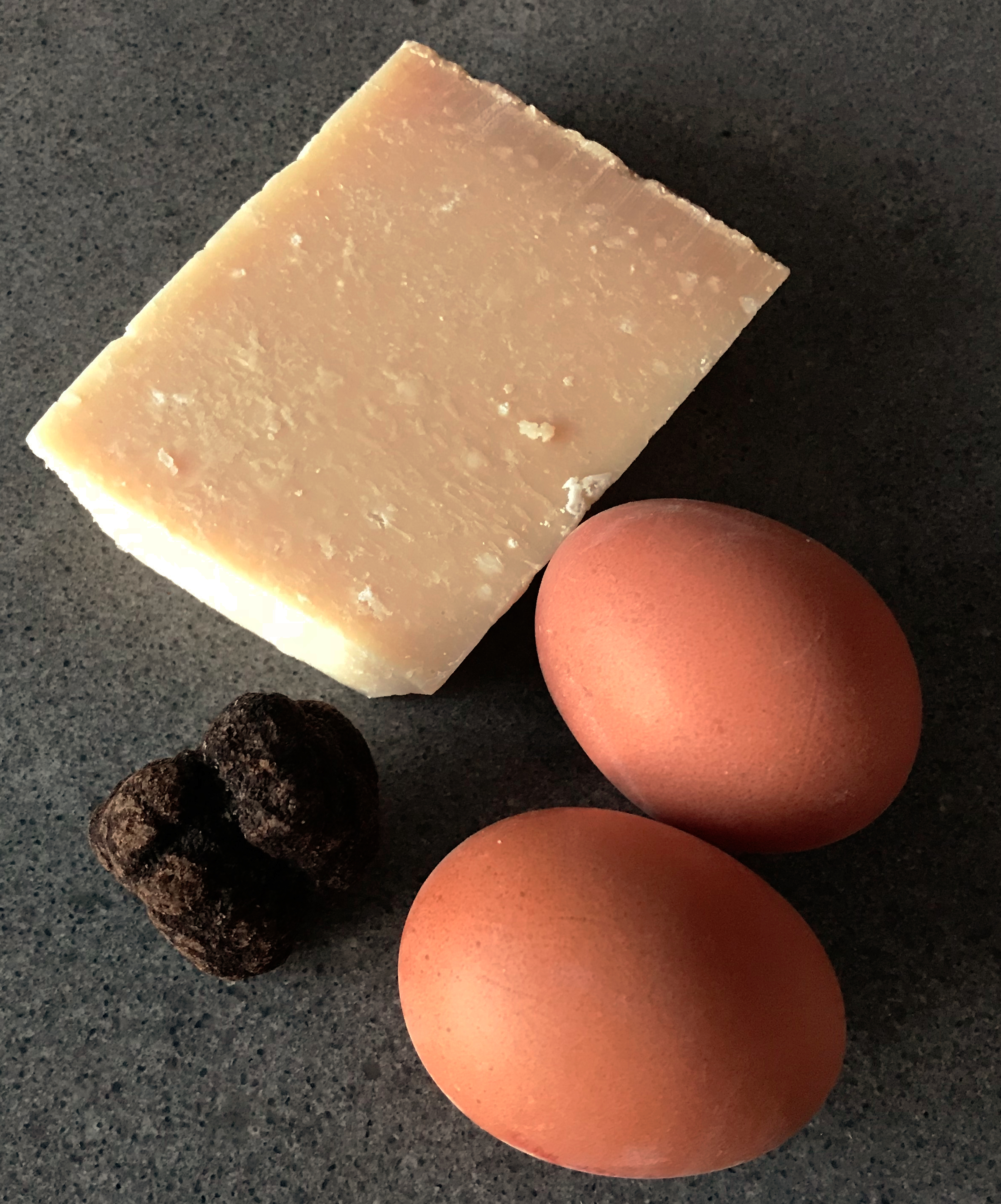
  • 2 Eggs
  • Butter
  • Parmesan Cheese
  • 10 grams or (budget permitting) more Black Truffle
  • White Pepper

What You Do

Clean the truffle if necessary. Take a fairly small iron skillet and make sure the pan is warm through and through but not hot. Using a fork (a spoon is even better) whisk the two eggs together. Add butter to the pan and wait until it is melted. It should not change colour or sizzle. An omelet should not be fried; the bottom must remain yellow. Add the whisked egg to the pan and wait until the egg is beginning to set. Check the consistency with your fingers. There is no alternative to baveuse! Take your time.
Serve the omelet on a warm dish with some freshly grated Parmesan cheese, white pepper and grated black truffle.

White Asparagus with Summer Truffle

Spring and Summer

Time to celebrate! Summer has just begun and the Asparagus season has come to a close. So let’s bring the two together in this slightly extravagant dish. It is earthy, slightly bitter and sweet, velvety and complete.
The Summer Truffle (Tuber Aestivum) is not as intense and overwhelming as the Winter Truffle. It should be used immediately and preferably grated. It loses its taste when heated, so don’t use it for your Tournedos Rossini. This dish should be luke warm, so an excellent environment for a Summer Truffle. Take your time to appreciate the delicate combination in your plate.

Wine Pairing

We drank a glass of Pinot Blanc made by Bott Frères (Ribeauvillé, France) with our Asparagus with Summer Truffle. This dry, fresh wine has a bouquet of well-ripened fruit. It comes with just a touch of sweetness.
A glass of Gewürztraminer is also a good choice with this dish, provided it has a touch of sweetness only.
Parsley is essential because it brings freshness to the dish; nicely balanced with the velvety taste of the egg and butter. And butter is the ideal bridge between egg, asparagus and truffle. So your wine needs to have a certain suppleness.

What You Need

  • 4 Asparagus
  • 2 Eggs
  • 25 grams of Butter
  • 20 grams of Summer Truffle
  • Parsley
  • Black Pepper

What You Do

Cook or steam the asparagus. Make sure they are just done. Cook the eggs for 8-9 minutes. The yolk should not be completely firm. Cool the eggs in cold water, peel and mash with a fork. Add the finely chopped parsley and some black pepper. Taste. Melt the butter.
Put two asparagus per person on the plate, pour the warm butter over the asparagus, making sure they are fully covered, add the egg and finish by sprinkling the grated truffle. Poor a glass of excellent Pinot Blanc and enjoy the start of summer by eating the very last of this years asparagus.

The Art of Sauces: Gribiche

Sauce Gribiche is a classic French sauce, made with boiled egg yolks, oil, various herbs (chives, chervil, parsley, tarragon), cornichons and capers. Sauce Gribiche is ideal with cold meat and fish. It’s a great combination of flavours and textures, also thanks to the chopped egg white.
As with mayonnaise the oil you use is an important ingredient. The range of flavours in Sauce Gribiche allows you to use a combination of oils, depending on the dish it should accompany. For instance olive oil when you’re looking for a more powerful sauce or arachis (peanut) oil when the sauce should be more delicate.
In this case we use chives only because especially tarragon would be too much for the asparagus. Chives give it a touch of onion, which is exactly what the sauce needs.

Wine Pairing

We enjoyed our Asparagus with sauce Gribiche with a glass of Macon (Louis Jadot Mâcon Villages Grange Magnien). The wine (100% chardonnay) comes with some gentle acidity and minerality, which is great with the acidity of the Sauce Gribiche. It’s fruity with a floral scent.

What You Need

  • Sauce Gribiche
    • Two Eggs
    • Dijon Mustard (1 teaspoon)
    • Olive Oil (100 ml)
    • (White Wine) Vinegar (1 tablespoon)
    • Black Pepper
    • Chives
    • Cornichon
    • Capers (in brine)
  • Asparagus

What You Do

Start by boiling the eggs, making sure the yolk is completely set. Depending on the size add them to boiling water and leave them in simmering water for 12 minutes. We steamed them for 15 minutes. Cool quickly, peel and separate the white from the yolk.
Once cool cut the white in very small bits and store. Push the egg yolk through a sieve. It should be a powder-like substance. Add the mustard and stir well until it’s a smooth paste. Continue stirring and very slowly add the olive oil, as if making a mayonnaise. Which is basically what you’re doing anyway! Main difference is that cooked yolk is less powerful when it comes to emulsifying. So the amount of olive oil you can add is limited and the process is more challenging.
Once you’ve added the olive oil, add white wine vinegar, whisk, taste and decide if more mustard, vinegar or pepper is needed.
Now add the chopped egg white, the finely chopped chives, the drained and chopped capers and the thinly sliced cornichon.
The sauce should be ‘stable’ so feel free to store in the refrigerator.
Steam or cook the white asparagus and enjoy!
PS It’s actually a very tricky sauce, one that splits easily. If it does, no worries, just add a tea spoon of (home made) mayonnaise and the problem is solved.

Tisane of Rosemary

Pruning is perhaps not the easiest thing to do, but with thyme, lavender and rosemary it’s not too difficult. They only downside is that after having pruned the plants you have a huge bundle of (in our case) rosemary. What to do? You could dry the rosemary and make flavoured oil or vinegar. But how to make use of lots of fresh rosemary?
This tisane of rosemary is a very delicate and powerful yet light and vibrant infusion. The tisane combines the aromatic flavours of the fresh rosemary with the stock. It’s all about rosemary, but in a surprisingly complex way. The edible flowers add an extra dimension to the tisane.
It’s best served in a small cup, size double espresso. It goes well between two more substantial dishes because it works as a palate cleaner. You could also serve it between two very different dishes.

The fun in preparing is that you need to find the right balance between the strength of the stock and the rosemary. Timing is also important. It simply requires some trial-and-error.

What You Need
  • Strong chicken or vegetable stock, preferably home made
  • Fresh Rosemary
What You Do

Heat the stock to 80° Celsius or 175° Fahrenheit. Warmer will make the tisane bitter. Now use the leaves (needles) of the rosemary and find out how many you need for let’s say 100 millilitre. Take 4 gram and set your alarm to 2 minutes. Remove the rosemary and taste. Too bitter: try again and set the alarm to 80 seconds. Not strong enough: increase the number of needles. Not intense enough: try 140 seconds. Keep testing until you have the perfect result!
Decorate with one or two rosemary flowers; their sweetness and colour adds value.


Farfalle with Wild Garlic (or Ramson) and Parmesan Cheese

In a number of countries ramson is a protected plant, so we don’t suggest you run out of the door and start picking it. But if it’s not protected, feel free to start running!
Ramson is much-loved in Germany, Austria (Bärlauch) and other parts of Europe. Its taste is like a combination of onion and garlic, but much greener, more intense, longer lasting and with a touch of bitterness at the end. Works very well as a pesto, but equally nice with potatoes or gnocchi. Once we made ramson soup, but that was not the best idea ever.
The flowers may have (if you’re lucky) a touch of sweetness because of the nectar in the flower. Always taste the leaves and the flowers before using and feel free to adjust quantities.

Wine Pairing

We would suggest a Soave to go with the dish. The Garganega grape combines very well with the specific taste of the ramson, given the wine is fresh with a subtle bitterness.

What You Need

  • 20 or so leaves of Ramson
  • Olive Oil
  • Parmesan Cheese
  • Farfalle
  • Lemon Juice

What You Do

Cut the leaves in smaller bits and blitz the leaves with grated Parmesan cheese. If you want to soften the taste, now is the moment to add some toasted almonds or pine nuts. Slowly add the olive oil until blended and smooth. Maybe you want to add a bit of lemon juice.
Cook the farfalle and serve with the pesto and some grated Parmesan cheese.
You can store the pesto for a week or so in the refrigerator if you add some extra olive oil to the jar, covering the pesto.

Oysters à la Antonio Carluccio

When It’s Spring

Combining ingredients and creating something new and tasty is difficult. On the one hand we have known combinations (tomatoes and basil, duck and thyme, macaroni with ham and cheese), on the other hand we want to be surprised by new combinations. Unfortunately many chefs don’t really have the required creative talent but they serve their unlikely combinations (gnocchi with kale, piccalilli, smoked oyster and black pudding) anyway.

Antonio Carluccio‘s combination of fresh oysters with a white wine sabayon and white truffle is spectacular. The combination of the distinct aroma of the white truffle with the oyster is intriguing. The sabayon brings everything together in terms of taste, consistency and structure. And just to show you how clever Carluccio’s combination is: the sabayon in itself is not pleasant.

Carluccio uses white truffles in his recipe, but given the costs we decided to go for the more affordable bianchetto. This truffle is available from mid January to the end of April, that’s why it is also called March truffle (marzuolo). Maybe less subtle, but the result is nevertheless wonderful.

The recipe (Ostriche con zabaglione e tartufo bianco) can be found in his Complete Mushroom Book. Best to use oysters with a mineral flavour and a mild brininess. Definitely not creamy oysters, given the richness of the sabayon.

Wine Pairing

With such a great dish you many want to drink a glass of Chablis or Champagne. We enjoyed a glass of Crémant de Bourgogne, produced by Vitteaut-Alberti. A refined wine, soft and with delicate fruit. The bubbles are small and pleasant.

Oysters a la Carluccio © cadwu
Oysters à la Carluccio © cadwu

Stuffed Courgette or Zucchini Flowers

A Tempting Flower

Such a pleasure to see courgette flowers in your garden or at the greengrocers. The young courgette is firm and tasty; the flowers a beautiful yellow. Simply stuff the flowers, fry in a pan or cook in the oven and you have a great side dish or starter. And then you start wondering: ‘Stuff with what? Cheese? Salmon? Tomatoes? Egg? And how to make a filling that remains inside the flower and isn’t too firm?‘.
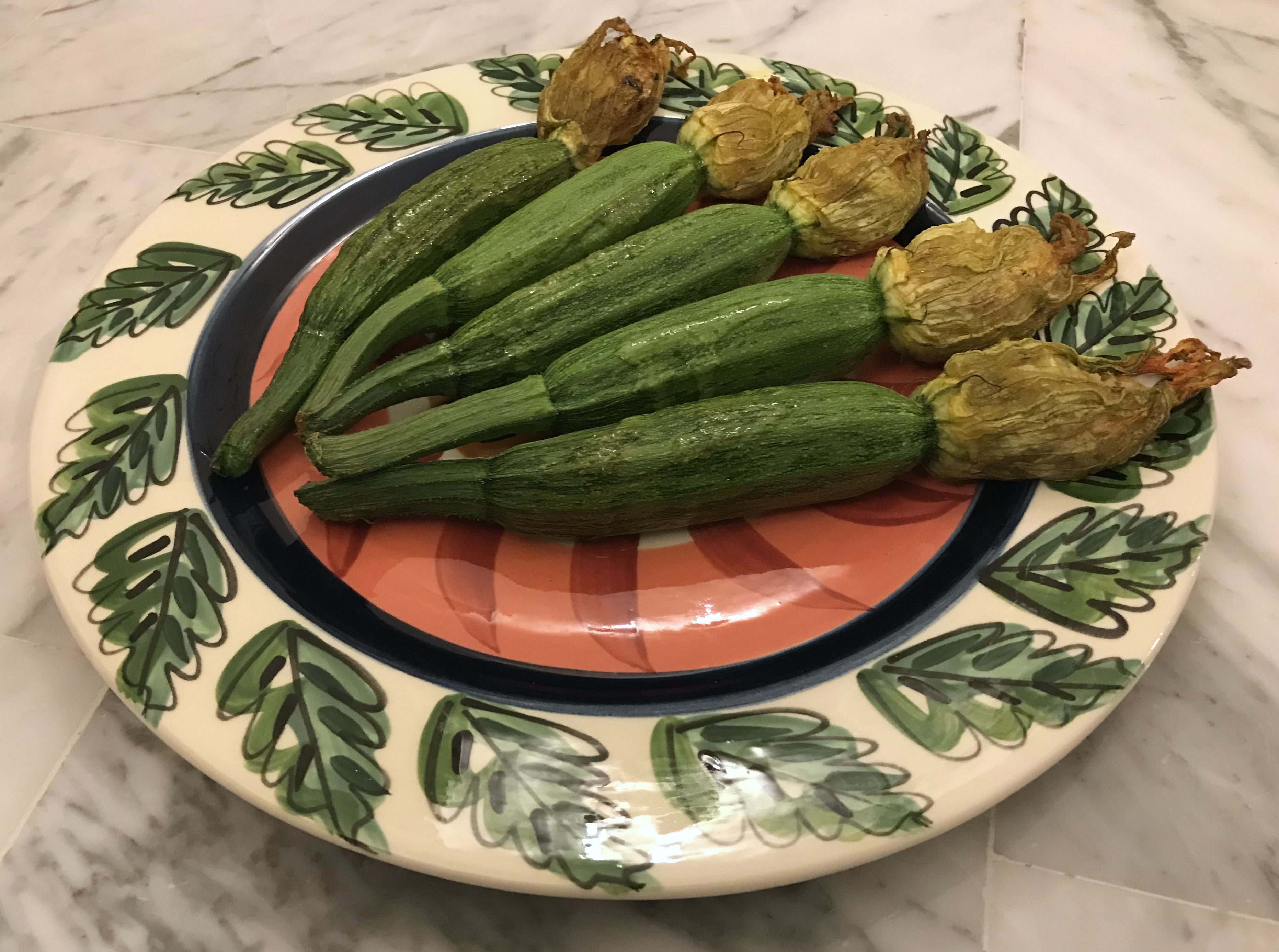
We prefer a simple approach: stuff the flowers with a perfect combination: courgette, thyme, shallot, garlic and Parmesan cheese. Firm, tasty and all about zucchini. Enjoy as a starter or combine the stuffed flowers with grilled lamb or chicken.

What You Need

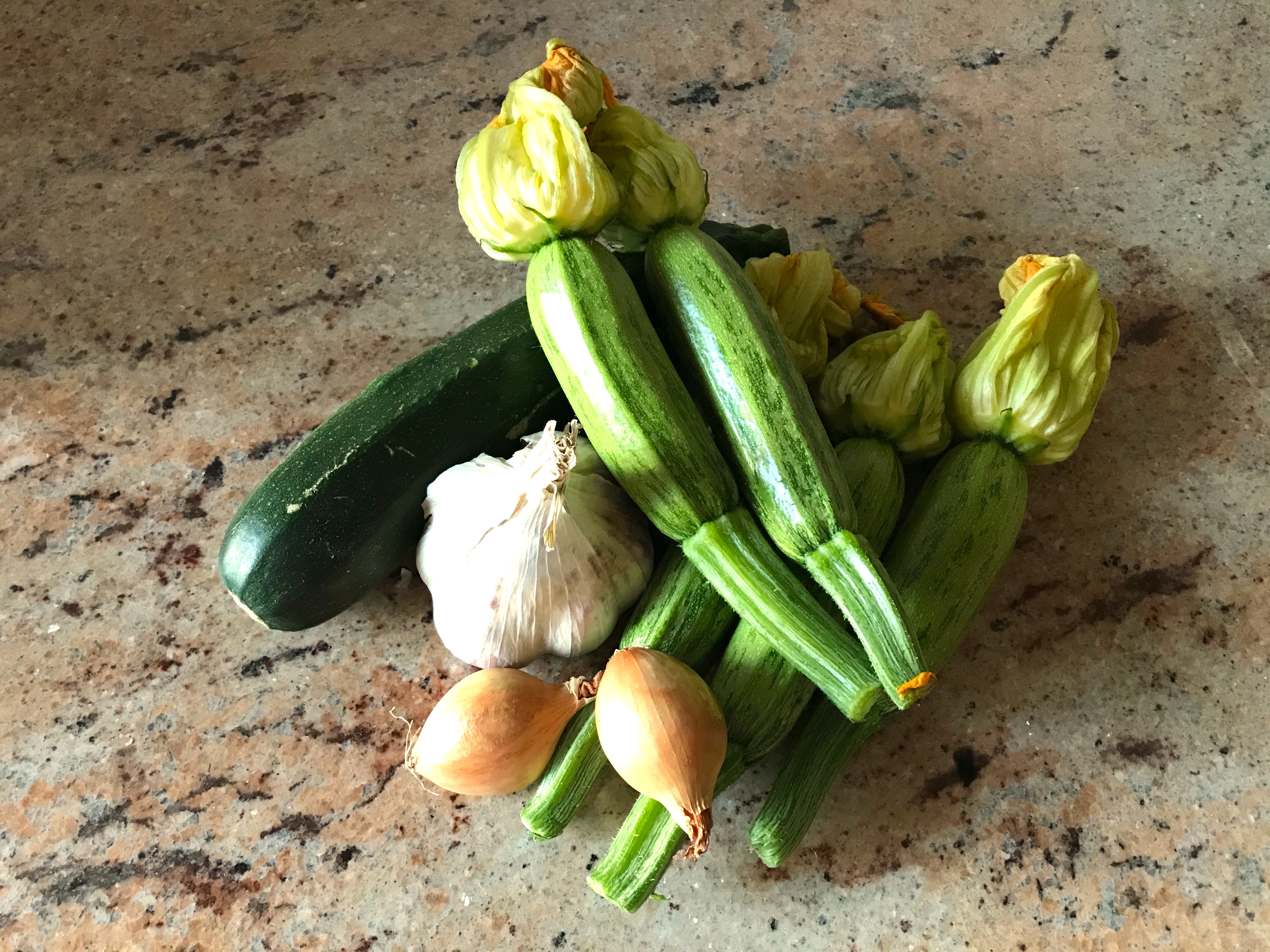
  • Small Courgettes with their flower
  • One Courgette (small and firm; you need 1 small courgette to stuff 4 flowers)
  • One Shallot
  • One Garlic Clove
  • Olive Oil
  • Parmesan Cheese
  • Thyme or Herbes de Provence
  • Black Pepper

What You Do

Remove the stamens from the flowers. Peel the additional courgette, slice the shallot and the garlic very thinly. Warm a heavy iron pan and gently glaze the shallot. After a few minutes add the garlic. Remove the seeds from the courgette and grate coarsely. When the shallot and the garlic are sufficiently glazed, add the grated courgette and the thyme or Herbes de Provence. Mix and warm for 15-20 minutes, making sure the liquid evaporates. Try to keep the structure of the coarsely grated courgette. Add finely grated Parmesan cheese, mix and taste. Adjust with cheese, black pepper and thyme or Herbes de Provence. Set aside and let cool.
Heat your oven to 180° Celsius or 360° Fahrenheit. Stuff the flowers, close them and transfer to the oven, sprinkle with olive oil and cook for 15 – 20 minutes. Depending on your oven you may need to use ‘traditional’ or a combination with a small grill. You want the flowers to become crisp. Allow them to cool for a few minutes before serving.
PS In case the grated courgette looses its structure and the mixture becomes too dense, then beat an egg white until very firm and gently spoon this through the cold mixture before stuffing the flowers.


White Asparagus with Sauce Gribiche

This tends to be a combination we like to serve towards the end of the asparagus season. The combination of asparagus with capers, cornichons and chives is unusual but it works really well with both green and white asparagus.

In most countries the season for asparagus is well-defined. It starts around April 23rd (St.George’s Day) and finishes on June 24th (the nativity of Saint John the Baptist). Green asparagus tend to be available all year round, however we recommend being careful. It’s a bit silly to buy the very skinny ones grown in darkest Peru. Nothing wrong with Peru, we love Paddington, it’s just that following the season and focusing on local, organic products is our preferred approach, but not in a dogmatic way.

Sauce Gribiche

This sauce is made with chives, chervil, parsley and tarragon. In this case we use chives only because especially the tarragon would be too much for the asparagus. Chives give it a touch of onion, which is exactly what the sauce needs.
Two notes regarding the oil: when you want to make a true sauce Gribiche (so with chervil, parsley and tarragon plus more vinegar) you would add more oil to give it volume and smoothness. In this case you want a very rich sauces with clear presence of all ingredients. And (second note) because we use less oil we use excellent olive oil only. Otherwise you would use a combination of olive or grapeseed oil with a more neutral oil like sunflower or arachis (peanut) oil.

Wine Pairing

We enjoyed our Asparagus with sauce Gribiche with a glass of Macon (Louis Jadot Mâcon Villages Grange Magnien). The wine (100% chardonnay) comes with some gentle acidity and minerality, which is great with the acidity of the Sauce Gribiche. It’s fruity with a floral scent.

You can also combine the dish with wine made from Sauvignon Blanc grapes. We very much liked the combination with a glass of Menetou-Salon from the house of Clement Chatenoy. A remarkable Sauvignon with citrus and passion fruit, freshness and an exceptional length in the mouth. The wine has flavours and complexity very similar to the sauce and to the asparagus, making it a harmonious pairing of food and wine.

What You Need

  • Two Eggs
  • Dijon Mustard (1 tea spoon)
  • (White Wine) Vinegar (1 small tablespoon)
  • Olive Oil
  • Lemon Juice
  • Pepper
  • Chives
  • Cornichon
  • Capers (in brine)
  • Asparagus

What You Do

Start by boiling the eggs, making sure the yolk is completely set. Depending on the size add them to boiling water and leave them in the simmering water for 10-12 minutes. We steamed them for 12 minutes. Remove and let cool.
Once cold, peel the eggs, separate the white from the yolk. Cut the white in very small bits and store. Push the egg yolk through a sieve. It should be a powder-like substance. Add the mustard and stir well. Continue stirring and slowly add the olive oil, as if making a mayonnaise. Which is basically what you’re doing anyway! Main difference is that cooked yolk is less powerful when it comes to emulsifying. So the amount of olive oil you can add is (more) limited.
Once you’ve added the olive oil, add white wine vinegar, taste and decide if more mustard, vinegar or pepper is needed.
Now add the chopped egg white, the finely chopped chives, the drained and chopped capers and the thinly sliced cornichon.
The sauce should be ‘stable’ so feel free to store in the refrigerator.
Steam or cook the white or green asparagus and enjoy!

PS

It’s actually a rather tricky sauce, one that splits easily. No reason to panic, just add a teaspoon of (homemade) mayonnaise, whisk and the sauce is saved.

White Asparagus with Scrambled Eggs and Shrimps

Salmon

For some reason smoked salmon and white asparagus are seen as a match made in heaven. Some even refer to this combination as being ‘classic’ or ‘Flemish’. The combination is complemented with dill, sauce Gribiche, parsley, tarragon or even sugar.

Smoked salmon can either be hot-smoked or cold-smoked, but in both cases it must be eaten cold or at room temperature. When warmed (for instance by wrapping it around hot asparagus) you get this iffy, fatty flavour and a palate that can’t be hidden by lots of dill or tarragon. The warmth turns the fat of the salmon (especially the cold-smoked salmon) into something nasty with train oil taste. We could imagine poached salmon with warm asparagus or a salad of smoked salmon with cold white asparagus. But honestly, close your eyes, smell and taste. Match made in heaven? Really?

White asparagus and eggs, that’s a match made in heaven. For instance à la Flamande (with boiled egg, clarified butter, parsley and optional ham) or with scrambled eggs, chives and shrimps.

Shrimps?

Indeed, with small excellent shrimps, preferably freshly peeled; not used as an ingredient but as an element of flavour. The first time we had this combination we were surprised by the role of the shrimps. The salty, intense taste in balance with the very rich eggs and the sweet-bitter asparagus is a very clever idea. The chives in the scrambled eggs lift the dish to a higher level.
Unfortunately we don’t know who created it, so we offer the recipe with a caveat.

Scrambled eggs, it seems obvious and simple, but actually we are looking for a version that is more like a sauce. Gordon Ramsey’s instructive and hilarious movie shows you how to make scrambled eggs, so no need for us to explain. You need to stop a bit earlier, given it needs to have a sauce-like consistency.

Wine Pairing

We decided to drink a glass of Rivaner from the house Gales in Luxembourg. The aroma made us think of grapefruit, ripe melon and apple. The taste is elegant with a touch of sweetness, acidity and minerality. Ideal with our dish! The sweetness with the asparagus, the acidity in combination with the scrambled eggs and chives, the minerality with the shrimps. And the taste is surprisingly long lasting, which is perfect with such a rich dish.

What You Need

  • 6 White Asparagus
  • 2 Eggs
  • Butter
  • Chives
  • Crème Fraiche
  • White Pepper
  • A Few Small (unpeeled) Shrimps

What You Do

Peel the asparagus and steam for 20 minutes or so. They should have a bite. Prepare scrambled eggs à la Ramsay. Serve the asparagus with the scrambled eggs and just a few shrimps. Done!