Daube Provençale

On a warm summer’s evening, sitting on your terrace, relaxing and sipping rosé, you wonder what to eat. Perhaps something that will make you think of the beautiful Cote d’Azur, with the chirping of cicadas and aromas of pine trees? A Salade Niçoise or something more substantial?
That’s the moment to dive into your freezer and look for that last portion of Daube Provençale. Excellent beef, stewed in red wine and packed with flavours, olives and mushrooms.

Fortunately preparing Daube Provençale is not too much work (and it keeps well in the freezer). You can also be fairly flexible with the recipe. Well known chef Hélène Barale (La Cuisine Niçoise, Mes 106 Recettes) uses beef, veal and pork with tomatoes and dried mushrooms, Hilaire Walden (French Provincial Cooking) suggests marinating the beef in red wine and also adds orange peel and olives whereas the classic La Cuisinière Provençale published in 1897 and written by Jean-Baptiste Reboul suggests adding vinegar to the marinade but doesn’t use tomatoes, mushrooms or olives.

Wine Pairing

We prepared our daube with red wine from France, made from Cabernet Franc grapes and produced by La Tour Beaumont. In general you need a full bodied, fruity red wine, with a good structure. You could of course enjoy the daube with the same red wine, but the daube is flexible. Just remember that the flavours and aromas are intense. 

What You Need (for 4)
  • 750 grams of Excellent Marbled Beef (Blade Steak for instance)
  • ½ Carrot
  • Shallot
  • 3 Garlic Gloves
  • 250 grams of Mushrooms
  • 50 grams of Black Olives (Kalamata or Taggiasca)
  • Olive Oil
  • Bouquet Garni (Bay Leaf, Thyme, Oregano, Rosemary, Parsley, Chives and/or Sage)
  • 500 ml Red Wine
What You Do
  1. Slice the meat into nice, big cubes
  2. Heat a heavy large pot through and through, add olive oil and fry the meat until brown
  3. Probably you need to do this in two or more batches
  4. Set the meat aside
  5. Fry the chopped shallot, the carrot and the garlic until smooth
  6. Transfer the meat to the pot, stir well, add the red wine, the (halved) olives and the bouquet garni
  7. Keep on low heat for 2 hours
  8. Clean the mushrooms and add these to the pan
  9. Keep on low heat for another two hours
  10. Check if the meat is soft and tender
  11. Quickly cool the pot and transfer the content to the refrigerator
  12. The next day label off some of the fat (we prefer not to do this, but feel free to do so)
  13. You could divide the daube in two portions. One for the freezer, the other one to enjoy today
  14. Warm the daube
  15. Option 1: remove some of the bigger mushrooms and four tablespoons of cooking liquid. Blender the liquid and mushrooms very fine and transfer back to the pan. This mixture will thicken the cooking liquid
  16. Option 2: combine 15 grams of flour with 15 grams of butter until it’s a smooth paste. Add this to the daube, making sure it’s fully dissollved. This way of thickening is called Beurre Manié
  17. Leave the daube to gently simmer for an hour.
  18. If the sauce has not yet reached the right consistency, then transfer cooking liquid to a separate pan and reduce on medium to high heat. Transfer back to the main pan and combine.
  19. Serve with red bell pepper salad, pasta, polenta or boiled potatoes.
  • Daube Provençale ©cadwu
  • Ingredients of Daube Provençale ©cadwu
  • Daube Provençale ready to be stewed ©cadwu

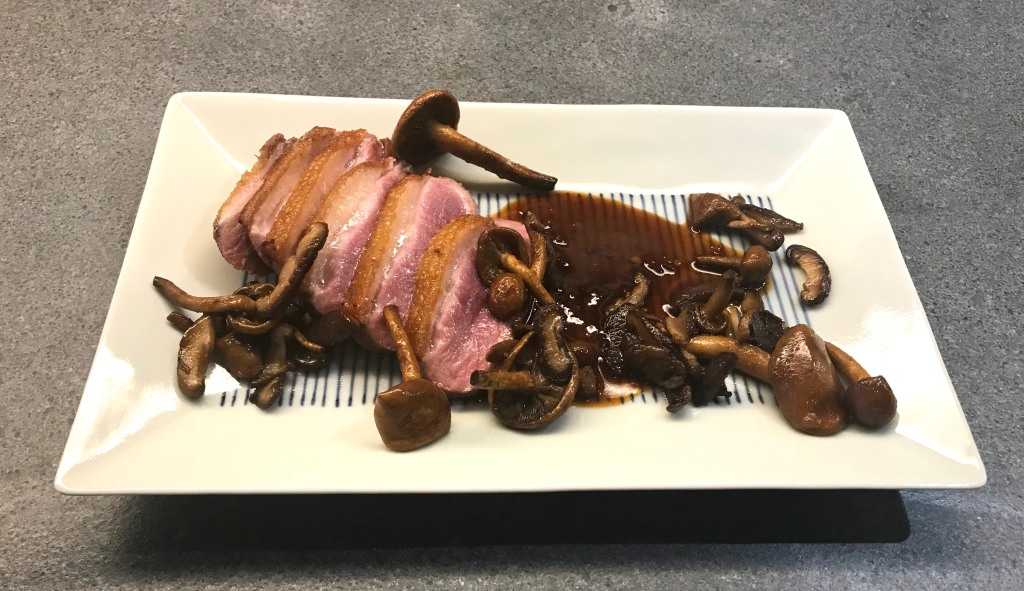
Duck with Soy Sauce and Mushrooms

eIn his book Yamazato, Kaiseki Recipes: Secrets of the Japanese Cuisine, author and Michelin Award winning chef Akira Oshima includes a recipe for breast of duck, marinated in a soy-based sauce, served with Belgian endive (chicory) and karashi (Japanese mustard). A mouth-watering dish. The book contains some 20 recipes that are technically challenging (at least, we think so) and well written.

In general the combination of duck and soy sauce works really well. It’s all about sweetness and umami. The Japanese mushrooms (shiitake, enoki, nameko and/or shimeji) add nuttiness and texture to the dish.
We use soy sauce and tentsuyu: a mix of soy sauce, mirin and dashi, the clasic tempura dip.

Wine Pairing

We enjoyed our duck with a glass of gewurztraminer (full bodied and long lasting with aromas of lychees and roses) but there are many options in this case. Perhaps a nice rosé or a sake with a touch of sweetness?

What You Need
  • Breast of Duck
  • Japanese Mushrooms
  • Soy Sauce (preferably with less salt)
  • Tentsuyu
  • Chicken Stock
  • (Olive) Oil
  • Mirin
  • (optional) Sake
What You Do
  1. Start by cleaning the breast of duck
  2. Heat a non-stick pan
  3. Fry the duck, straight from the fridge, for 12 minutes on the skin-side and 2 minutes on the meat-side in a non-stick pan
  4. Wrap in foil, making sure the skin is not covered.
  5. Clean the pan with kitchen paper and fry the sliced mushrooms for 5 minutes or so in oil until ready
  6. Set aside and keep warm
  7. Add soy sauce, tentsuyu and chicken stock to the pan and reduce
  8. Add a splash of sake and some mirin
  9. Add liquid of the duck
  10. Let simmer for a few minutes, add the mushrooms and make sure they are coated with the sauce
  11. Let simmer for 5 minutes
  12. Slice the duck, add liquid to the sauce, stir and serve.
Duck with Soy Sauce and Mushrooms ©cadwu

Fairy Ring Mushroom with Pork Chops

Spring brings us several edible or even delicious mushrooms, such as the Fairy Ring Mushroom, Morels and the Mushroom of Saint George.

The Fairy Ring Mushroom is a very common mushroom in many countries. The name is not very helpful since many mushrooms grow in the pattern of a ring. The German and Dutch names (Rasen-Schwindling and Weidekringzwam) are more helpful; these refer to the fact that they grow in meadows and lawns.

In France the Mushroom of Saint George is called mousseron and the Fairy Ring Mushroom faux mousseron. But because of the limited availability of the Mushroom of Saint George the faux (false) is dropped in the second name and the Fairy Ring Mushroom is often referred to and sold as mousseron.

It’s a small, very edible mushroom, available from early spring until late autumn. Its taste is a bit sweet and perhaps that’s why some people suggest using them to make sweet cookies. Hm, we think you can do better than that!

We combine the Fairy Ring Mushroom with excellent organic pork (also a touch of sweetness), cream, white wine, fresh sage and a splash of cognac to give the dish a nutty component.

Wine Pairing

We enjoyed our Fairy Ring Mushrooms and pork with a glass of Austrian Zweigelt, produced by Weingut Prechtl. This red wine is fruity and elegant with notes of blackberry and cherry. The tannins are well structured but not overly present. In general you’re looking for a full bodied red wine with fruit and not too much acidity.

What You Need

  • 2 Organic Pork Chops with lots of nice fat (Sirloin or Shoulder)
  • 100 gram of Fairy Ring Mushroom
  • Half a glass of Dry White Wine
  • Fresh Sage
  • Chicken Stock
  • Crème Fraîche
  • Splash of Cognac
  • Olive Oil

What You Do

Start by cleaning the mushrooms with kitchen paper. Remove the stems. Fry the caps in olive oil. When the liquid has evaporated, add some dry white wine and two finely chopped leaves of sage. Allow to simmer for 5 minutes or so. Add some crème fraîche and a few moments later a splash of cognac. Stir and leave to simmer for another 5 minutes. In parallel fry the pork chops until brown and leave to rest in aluminium foil. Remove the pork fat from the pan and deglaze with chicken stock. Reduce. Now add the liquid from the pan to the mushrooms, add more finely chopped sage and some black pepper.

  • Fairy Ring Mushrooms with Pork ©cadwu
  • Fairy Ring Mushrooms ©cadwu
  • Zweigelt made by Weingut Prechtl

White Asparagus with Sauce Périgueux à la Kimizu

The French Périgord is the truffle heart of France. The region is also known for its culinary products, such as Confit de Canard, wines from Bergerac and Monbazillac, Foie Gras and Sauce Périgueux. This sauce is a classic in the French kitchen. Its basis is a white sauce made with shallot, a reduction of white wine, (goose) fat, stock and lots of truffle. The ‘original’ recipe of this truffle sauce can be found in La Bonne Cuisine du Périgord written in 1929 by La Mazille. The sauce works beautifully with Tournedos and Magret de Canard. And since white asparagus love truffles, why not combine them with Sauce Périgueux?

We don’t think a roux-based sauce will go very well with asparagus, so we combined two recipes: the flavors of Sauce Périgueux with the lightness and consistency of Japanese Kimizu.

Wine Pairing

We enjoyed our asparagus with a glass of Riesling, produced by Bott Geyl in the French Alsace. This fresh, aromatic, dry white wine with a hint of sweetness and high acidity combines very well with the sweetness of the asparagus and the intense, rich flavor of the sauce. The wine supports the dish perfectly.

What You Need

  • 6 White Asparagus
  • 1 Small Truffle
  • For the Sauce
    • 1 Shallot
    • 1 Glass of Dry White Wine
    • 3 Black Peppercorns
    • ½ tablespoon Simple White Vinegar
    • Two Cubes of Jus de Truffe*
    • 2 egg yolks
  • White Pepper

What You Do

  1. Chop the shallot, crush the peppercorns coarsely, add to a pan and add a glass of white wine
  2. Leave to simmer for 20 minutes
  3. Add a splash of white vinegar
  4. Leave to simmer for 10 minutes
  5. Add two cubes of jus de truffe and leave to simmer for another 10 minutes
  6. Pass through a sieve
  7. If all is well you should have 4 tablespoons of liquid. If necessary reduce
  8. Set aside and leave to cool
  9. Peel the asparagus and steam for 20 minutes, depending on the size
  10. When there is still 10 minutes on the clock, start working on the sauce
  11. Whisk the two egg yolks well, add the 4 tablespoons of liquid, mix and heat in the microwave on 30% power
  12. Start with one interval of 10 seconds, stir, followed by an interval of 5 seconds, stir and continue with intervals of 5 seconds until you have the right consistency
  13. Total time in the microwave will be approximately 60 seconds
  14. Allow to cool for a minute or two
  15. In the meantime grate the truffle
  16. Serve the sauce over the asparagus, add some white pepper and sprinkle the truffle over the sauce and the asparagus.

* Best to buy a can of jus de truffe and freeze the content in an ice cube bag.

  • White Asparagus with Sauce Périgueux à la Kimizu ©cadwu
  • White Asparagus and Truffle ©cadwu
  • Bott Geyl Riesling ©cadwu
  • Jus de Truffes (Chabert-Guillot) ©cadwu

Guineafowl with Morels and Gnocchi

Preparing guineafowl can be a bit of a challenge because it’s easily overcooked. Guineafowl requires some liquid (oil, butter, wine, stock) when cooking it, but not too much. It’s actually not at all like chicken; just compare the meat and notice the difference. Guineafowl is structured, meaty, dense. Cooking guineafowl as coq au vin doesn’t work. Grilled guineafowl? Not a good idea either.

In The River Cafe Classic Italian Cookbook (written by Rose Gray and Ruth Rogers) you will find a great recipe of guineafowl with grappa, junipers, sage, white wine and pancetta. The combination of grappa and junipers is amazing and the idea to have these two support the guineafowl is simply stunning. The combination emphasises the wild and nutty taste of the guinegowl. Buy the book and start cooking!

Spring is the best season to prepare this dish, because morels are a spring mushroom. You could use dried morels; they can be as tasty as fresh ones. Other dried mushrooms are expensive, not very tasty and not even close to the real thing. Dried morels are the exception to the rule.

Wine Pairing

We enjoyed our guineafowl with a glass of an elegant, medium-bodied red wine, with aromas and flavours of red fruit. A wine made from gamay grapes will be a good choice, for instance Domaine La Tour Beaumont Val de Loire.

What You Need

  • 2 legs of Guineafowl
  • 50 gram of fresh Morels or 10 gram of dried Morels
  • Butter
  • Olive Oil
  • Chicken Stock
  • Mustard
  • Crème Fraîche
  • Black Pepper
  • Gnocchi

What You Do

Pre-heat the oven to 180˚Celsius or 355˚ Fahrenheit. Add the two legs of guineafowl to a shallow dish with butter and olive oil. Cook for 10 minutes. If using dried morels: soak in hot water for 15 minutes. Otherwise clean the morels with some kitchen paper. Turn the legs upside down after 10 minutes. Cook for another 10 minutes. Turn them a second time, skin up. Add the morels to the dish, leaving the skin free. The legs should be ready after in total 30 minutes. Transfer the guineafowl and the morels to a plate and keep warm. Add chicken stock to the cooking liquid. Add crème fraîche, mustard and pepper to the sauce, stir well and allow to warm through and through for 5 minutes. Taste the sauce and if necessary add more mustard.
Serve with gnocchi. (Yes of course, we will be happy to explain how to make gnocchi in the near future.)

  • Guineafowl with Morels and Gnocchi © cadwu
  • Soaked Morels © cadwu
  • Guineafowl © cadwu

Chicken with Fresh Oregano

Thyme, Oregano, Basil, Rosemary, Saffron, Sage: all powerful Mediterranean herbs. Oregano, or Wild Marjoram, is an interesting one. Probably best known as the herbal ingredient of pizza. A dried herb, one to store in a jar, forget about and then use beyond its ‘use-by date’ and be disappointed.
Such a pity because fresh oregano is aromatic, slightly bitter, pungent and perhaps chemical, depending on the variety, of course. Great to combine with lamb, a tomato salad, grilled fish and of course chicken. It’s also great to flavour olive oil with oregano. So ask your supermarket or local greengrocer for fresh oregano!

Wine Pairing

We enjoyed our chicken and oregano with a glass of Rioja Paternina Reserva 2015 produced by Marques de la Concordia. Reserva means that the wine ages for a minimum of 3 years, with at least 1 year in oak barrels. The grapes are tempranillo, mazuelo and garnacha; very typical for Rioja. It’s a powerful, full-bodied red wine with aromas of black cherries and touch of vanilla and various spices. The wine goes very well with the velvety chicken and the very present flavours of the oregano.

What You Need

  • Chicken Thighs
  • Olive Oil
  • Black Pepper
  • Chicken Stock
  • Lots of Fresh Oregano

What You Do

Halve the thighs, heat a heavy iron skillet, add olive oil and quickly fry the meat on all sides. Reduce the heat and add two third of the chopped oregano. Keep on low to medium heat for 10 minutes or so. Add some chicken stock, just to deglaze the pan. You will notice that the juices becomes green thanks to the oregano, so please coat the meat with the cooking liquid. Just before serving add the remaining oregano, some freshly ground black pepper and mix.
Serve with green beans, cooked in water with fresh garlic, wrapped in pancetta (after having grated some nutmeg over the beans) and then fried for 5 minutes in some olive oil.

  • Chicken with Fresh Oregano ©cadwu
  • Federico Paternina Rioja Reserva 2015 ©cadwu
  • Fresh Oregano ©cadwu


White Asparagus with Chervil

A salad can be an excellent starter of your lunch or dinner, provided it’s one with lots of flavour and gentle acidity. For instance a Salade Ni­çoi­se, a Salade Caprese or a salad of White Asparagus and Chervil.

Chervil is a very delicate herb. It tastes like anise, but it is much more refined. Chervil looses its taste almost immediately when heated. The salad needs to be prepared well in advance, allowing for the flavours to be well integrated.

Honey can easily ruin a salad (and sugar will always ruin a salad). In this case we use only a touch of honey to create an environment for the sweetness of the white asparagus. The honey should act as a trigger.

The salad is a great example of the complexity of white asparagus: you will taste the sweetness and the freshness of the asparagus. The mouth feel of the salad is very nice, because the asparagus will be both juicy and crispy, with the chervil, honey and vinegar in a supporting role.

After having mixed the salad you will notice that the asparagus and chervil absorb the dressing. During the time in the refrigerator the asparagus will loose some juices, which is actually the beginning of a great dressing.

Wine Pairing

Combining salad and wine is not straightforward. Especially the acidity of the dressing creates a challenge. One solution is to use verjuice and not vinegar. Verjuice is made by pressing unripe grapes. The idea is that verjuice links to wine, whereas classic vinegar or lemon juice would compete with wine. In this case we choose a wine that reflects the flavours of the salad: a hint of anise, a touch of sweetness and florality. Typical notes you will find in a wine from the Alsace region, for instance a Pinot Blanc or a Pinot Gris.

What You Need

  • 2 White Asparagus per person
  • Excellent Olive Oil
  • White Wine Vinegar or Verjuice
  • Lots of Chervil
  • Touch of Honey
  • White Pepper

What You Do

Steam the asparagus for 10 minutes. Let cool. Dry with kitchen paper if needed. Prepare a dressing with the olive oil and vinegar. Chop the chervil and add to the dressing. Add a touch of honey and stir well. Add some white pepper. Taste the dressing: it should be a balance, meaning that none of the ingredients is overly present. Now slice the asparagus in nice chunks, let’s say 3 centimetres long. Mix, cover and transfer to the refrigerator for 6 hours. Mix the salad every two hours. Check the taste after 4 hours, you may want to adjust. Mix the dressing just before serving.

Cod with Bleu d’Auvergne

Bleu d’Auvergne is amongst our favourite cheeses. It’s creamy, semi-hard, moist, powerful, pungent and not too salty. It was created around 1850 in France when a farmer combined cow milk curd with the mould of rye bread. He also noticed that the cheese benefits from increased aeration using needles (similar to the process used when making Stilton cheese). Nowadays Bleu d’Auvergne is a Protected Designation of Origin (PDO), just like the other excellent cheeses from that region (for example Saint-Nectaire and Cantal).
For some reason Bleu d’Auvergne combines extremely well with cod. We tried other combinations, experimented with adding butter, cream or crème fraîche but we always return to this one. It’s a tribute to both the fish and the cheese.

Wine Pairing

The combination may be very specific; wine pairing is not too difficult. In general a fairly present, white wine will be great choice. Could be a Verdejo from Spain, a mildly oaked Chardonnay or a glass of your favourite white wine. No reason to open a bottle of Chablis; the flavours are too bold for a really elegant wine.

What You Need

  • Skinless Cod Loin
  • Bleu d’Auvergne (preferable mature)
  • Olive Oil

What You Do

Heat a heavy cast iron skillet through and through, add olive oil, dry the cod with kitchen paper and fry on the firm side (where the skin used to be) until it’s nice and golden. Flip the fish, reduce the heat and start adding chunks of cheese. It will melt, but make sure you still have these blue bits in there. Baste the fish with the melting cheese. Check the cuisson of the cod (the fish must be opaque and flaky) and serve on a warm plate.

  • Cod with Bleu d’Auvergne ©cadwu
  • Blue d'Auvergne ©cadwu

Chicken with Morels and Very Classic Béchamel Sauce

One of the most delicious aspects of spring: fresh morels. They combine really well with asparagus, calves’ kidneys and chicken.
Jane Grigson offers two recipes for morels and chicken in her classic The Mushroom Feast, but her recipe for Flan with Morels à la Crème genuinely inspired us. It combines pastry with Mornay sauce and morels.
Mornay sauce is a béchamel sauce with grated, hard cheese (preferably Gruyère). Very old fashioned of course and a modern chef will not touch it. Which is a pity, because béchamel sauce is worth exploring.
One of the more intriguing stories is that the sauce was created by Marquis Louis de Béchameil who served at the court of Louis XIV at Versailles. It’s probably more realistic to think that chef François Pierre de la Varenne created it in the 17th century. He would have made a white stock (veal or chicken and lots of herbs) and used egg yolks and flower to get the right consistency. Many years later Antonin Carême described the use of a roux and added not only egg yolks but also cream. It was Auguste Escoffier who changed the recipe and created the béchamel sauce as we know it today.
The béchamel sauce as it was made by Antonin Carême is rich, velvety and full of flavours. Let’s pay tribute to the great Carême and cook his version of this sauce! 

Wine Pairing

The wine needs to accompany the subtle sweetness in the sauce and the nuttiness, umami, pancake-like taste of the morels. We suggest a fruity, well balanced, red wine, for instance a French Merlot, a Spanish Bobal, a Zinfandel or a Gamay.

What You Need

  • Chicken Breast with the skin on
  • Sauce
    • Carrot
    • Onion
    • Stems of the Morels
    • Butter
    • Flour
    • Egg yolk
    • Cream
  • Morels
  • Butter
  • Olive Oil
  • White Pepper

What You Do

Chop 5 centimetre of carrot, one small shallot and the stems of the morels. Melt butter in a pan and let the ingredients become tender. Add flour (same quantity as the butter), combine and warm well, without colouring the mixture; let’s say 5 minutes. Add the chicken stock, bit by bit and create the interim sauce (the velouté). Keep it warm for at least 15 minutes because this will improve the taste and the consistency. Half an hour is better.
In parallel clean the morels and slice lengthwise in 2 or 4. Add to a pan with butter and warm for 10 minutes or more.
Also in parallel fry the chicken in olive oil. This may take 15-20 minutes.
When the chicken is nearly ready, put the morels on a sheet of kitchen paper and keep warm in the oven. Feel free to add some of the cooking liquid to the sauce. Pass the interim sauce through a sieve. In a glass bowl whisk together a tablespoon of cream and the egg yolk until smooth. Slowly add the warm sauce into the mixture of egg and cream, whisking constantly. When this is done, transfer the sauce back to a clean pan and warm the sauce until it starts to thicken. Be careful because otherwise the sauce will curdle. Taste the sauce and add white pepper. Warm it through and through. Slice the chicken.
Serve the chicken with the sauce and the morels on a hot plate.

  • Chicken with Morels and Béchamel Sauce ©cadwu
  • Fresh Morels ©cadwu

Lentils with Cod and Cilantro

Lentils are healthy, easy to work with, not expensive, nutritious and high in fiber, protein and iron. Lentils have been around for a long time, so you would expect lentils to be popular, but for some reason they are not. Lentils can be used to prepare soups, salads, dahl, burgers, curry, biscuits (sablés) and so much more.
The three basic types are Green or Brown lentils, Red lentils and Black or Beluga lentils. Red lentils are often dehusked and then split, making them perfect for cooking soup.

In most cases we prefer Du Puy lentil from Sabarot because of their great taste and the fact that they hold their beautiful shape, even when cooked. Sabarot also produces lentil flour; ideal for biscuits, pancakes and waffles.

Beware of fake Du Puy lentils! They have names like ‘Le Puy lentils’ or ‘Dupuis lentils’. All nasty marketing. The real Du Puy lentils come with an Appellation d’Origine Controlee (Protected Designation of Origin).

Wine Pairing

We very much enjoyed a glass of Spanish Verdejo. In our case a bottle of Monteabellón Rueda 2019. In general wines made from the Verdejo grape combine very well with fish. The wine comes with the right acidity, giving freshness to the wine. It has floral aromas typical for the Verdejo grape. You may also recognize the aromas of banana and exotic fruit.

What You Need

  • Shallot
  • Olive Oil
  • Cilantro Seeds
  • Green, Du Puy or Beluga Lentils
  • Mild Fish Stock
  • Cod
  • Butter
  • Fresh Cilantro
  • White Pepper

What You Do

Chop the shallot (seize lentil) and glaze gently in olive oil. In the mean time check the lentils for small pebbles; wash them. Once the shallot is glazed, add the lentils and the crushed cilantro seeds. Heat for a few minutes, as you would do with risotto rice. Add the mild fish stock and leave to simmer on low heat for approximately 20 minutes, depending on the size (and your preference of course). In parallel fry the cod in butter in a non-stick pan. Just before the lentils are ready, add half of the finely cut cilantro to the lentils and mix.
Timing is all. The lentils should be cooked, all liquid evaporated and absorbed and the cod just done. Meaning the cod is opaque and the flakes can be separated easily. And overcooked meaning you can see those nasty small white bits of egg white and the fish becomes dry.
Serve the cod on top of the lentils and sprinkle some cilantro over the lentils and cod. Maybe add a touch of white pepper.

PS In case you think cilantro tastes like soap, feel free to replace the fresh cilantro with parsley. Cilantro seeds do not trigger the soap-like taste.