Artichoke à la Barigoule

It’s the time of year to enjoy artichokes: steamed, as a salad, in a pie or perhaps à la Barigoule. This is a rather intriguing recipe from the French Provence region. There are lots of variations, so we looked in books like La Cuisinière Provençale and La Cuisine Niçoise d’Hélène Barale to find the ‘original’ recipe.

Obviously you want to know what ‘barigoule’ means. According to Hélène Barale ‘barigoule’ means thyme, which is odd because she doesn’t add thyme to her Artichoke à la Barigoule. Is it perhaps derived from the Latin word mauruculai (meaning morel according to some and saffron milk cap to others) as the Larousse suggests? But what is the link between artichokes and mushrooms?

Three Versions

We found three different ways of preparing Artichoke à la Barigoule: cooked with onions, white wine and carrot, stuffed and preserved with lots of citrus. The stuffed one is probably the original version because the artichoke is stuffed with a mixture of mushrooms, thyme and garlic. Which makes the Larousse explanation more likely.

Preparing Artichokes a la Barigoule is quite a bit of work and the result, we must admit, looks like an old fashioned underbaked meatball. We could imagine you serve the artichoke halfway the recipe. If you do, best is to use smaller artichokes.

Wine Pairing

It’s not straightforward to pair artichokes with wine. According to various researchers this is due to cynarin, a chemical especially found in the leaves of the artichoke. When the wine and the cynarin meet in your mouth, the natural sweetness of the wine is enhanced, making it taste too sweet. So you have to pair artichokes with a bone-dry, crisp, unoaked white wine with clear, present acidity. For instance Sauvignon Blanc, Grüner Veltliner or Albariño. 

What You Need

  • Artichokes
  • Cooking liquid
    • Shallot
    • Carrot
    • Olive oil
    • White wine
    • Water
    • Thyme
  • Filling
    • Mushrooms
    • Egg yolk
    • Garlic
    • Shallot
    • 2 Strips of Bacon
    • Thyme
    • Black Pepper
  • Excellent Olive Oil

What You do

Remove outer leaves and stem of the artichokes. Add oil to a large pan, gently fry the chopped shallot and the chopped carrot. After 10 minutes or so add white wine, thyme and some water. Leave to simmer for 10 minutes. Add the artichokes to the liquid, close the pan and allow to cook and steam on low heat for 45-60 minutes or until nearly done. You could decide to stop here and serve the artichoke with the (reduced) sauce.
Let the artichokes cool, remove the leaves and the centre choke (the hairy part).  Use a spoon to remove the ‘meat’ from the leaves (bracts) of the artichokes. Set aside. In a small skillet heat some oil, add chopped shallot, glaze, add sliced bacon, mushrooms, garlic and thyme. Leave for 10 minutes until done. Add the artichoke meat from the leaves, stir, add the egg yolk and mix. Add freshly grounded black pepper. Use a food processor to make the mixture smoother, but not too smooth. Fill the artichokes with the mixture. It should look like an oversized golf ball on top of the bottom of the artichoke. You will probably have too much filling, which is fine. Gently transfer the artichokes to the pan with cooking liquid and allow to steam and warm for 30 minutes. Now transfer the artichokes to a warm oven (60 ˚C or 140 ˚F).  Add the reaming mixture to the liquid, use a powerful blender to create a sauce. Pass through a sieve and blender some more. Set the blender to low speed and add excellent olive oil. Taste and adjust. Serve the filled artichokes on a small plate with the sauce.

Lemon Curd

A Lemon Meringue Pie, a Tarte au Citron or Scones with Lemon Curd: tasty, refreshing, bitter, sour, a bit sharp and sweet. We love it! Provided of course that the lemon is more than just juicy and sour.

This has been a bit of an issue over the past years. Similar to the German consumers who complained about the watery and flavourless Dutch tomatoes they bought around 1990, we think that most lemons lack aroma and taste. We tried limes, bought more expensive lemons, added a bit of yuzu, but in the end, we still missed the true taste and aroma of an old-fashioned lemon.

Until one day we bought a Bergamot lemon. Its aroma is intense, floral and long. The juice is sour, deeply citrusy, refreshing and bright. Exactly what we were looking for! We went home and prepared a lovely curd.

Recently we had a similar experience when we visited a dear friend. She grows a Makrut (or Thai) Lime tree, also known as Makrut Lime, in her garden mainly because she wants to use the fresh leaves in Thai and Indonesian dishes such as Tom Yum, Soto Ayam and various curries. The leaves have a complex citrus flavour with floral notes. We talked about the lovely yellow fruit and how you could use its very aromatic zest as well.
The fruit contains little juice, so when preparing a curd with Makrut limes, you need to add lime, Bergamot or lemon juice.

What You Need

  • 65 ml of Lemon, Lime, Bergamot and/or Makrut Lime Juice
  • 65 grams of Butter
  • 100 grams of Sugar
  • One Egg
  • Zest

What You Do

  1. Beat the egg, melt the butter and combine all ingredients
  2. Make sure the sugar is fully dissolved
  3. Cook Au Bain Marie until you have the right consistency. Or transfer to your microwave, put it on 50% or 70% power and heat with intervals of 20-30 seconds. Mix between the intervals. This is a very precise way of heating the mixture and it gives you full control over the process. Towards the end of the process you may want to reduce the power or shorten the intervals. The percentage and the duration of the intervals depend on your microwave and the bowl you use. We use a microwave saucepan (£1,29 only) and it works perfectly. The material doesn’t absorb warmth, so the mixture doesn’t get extra heated when you stop the microwave
  4. Pass through a sieve (you don’t want the zest in the curd)
  5. Cool in a water bassin
  6. Store in a jar.
  7. The curd keeps for a week in the refrigerator .

PS

Around 1992 a German television program characterised Dutch tomatoes as watery and tasteless, and called them ‘wasserbombe’. The short-term impact was enormous: Dutch tomatoes went from 50% market share in Germany to something close to zero. Longer term the impact was very different: Dutch producers invested in their product, making their tomatoes tastier, richer and more diverse.

Clam Chowder

We have fond memories of the food we enjoyed when in New England: local oysters, lobster, Boston cream pie and of course clam chowder. Ah, yes, fond memories indeed.
Since then, clam chowder has become one of our favourite starters. Unfortunately, most restaurants (even in New England!) turn the clam chowder into a potato soup and even worse: they used canned clams. Help! 

The main ingredients of New England clam chowder should of course be lots of fresh clams plus vegetables, bacon, cream and potato. The soup must be about clams, with all the other ingredients in a supporting role.

We’re not from New England, so our clam chowder is far from original. But being Dutch we love our seafood and most certainly do we love our kokkels, also known as the common cockle. You can find a probably more original Manhatten version (meaning: without cream) in The Silver Palate Cookbook.

Finding the right potato is a bit of a struggle, also because some recipes suggest using waxy potatoes, so potatoes that remain firm. Not a good idea because it means that the potato doesn’t thicken the soup and the potato is far too present. We prefer using a starchy potato, one you would use for a purée, mash or mousseline. If you can find one with a golden colour, that’s even better. If you’re familiar with vichyssoise, then use the same potato.

What You Need

  • 500 grams of Clams, preferably washed
  • Chopped Carrot, Celeriac, Onion and Leek
  • Bouquet Garni (Parsley, Bay Leaf, some Thyme)
  • 4 strips of Bacon
  • White Wine
  • Water
  • 200 grams of Starchy Potato
  • 50 ml Cream
  • Olive Oil
  • White pepper

What You Do

Check the clams: discard broken ones or ones that will not close. Add a little olive oil to a pan and then chopped carrot, celeriac, onion and leek. Leave for 20 minutes until soft and sweet. Add the chopped bacon, fry for a few minutes until slightly crispy. Now add white wine, water and the bouquet garni. Leave for another 20 minutes. Turn up the heat, add the clams quickly and certainly not too long. If you heat them too long, then they will become rubbery when heated for the second time. Use a slotted spoon to remove the ingredients from the stock. Keep the bacon, the clams (without the shells) and the bouquet garni. Discard all other ingredients: onions, leek, celeriac, carrot and shells. Transfer the bacon and the bouquet garni back to the liquid. Add the chopped potato. Let simmer until the potato has broken down. Use a fork to thicken the soup. Add cream. Feel free to add a bit more, it’s all about taste and consistency at this stage. If you’re not happy with it, then you could add some potato starch. Keep the soup warm for 10 minutes or so, turn up the heat, add the clams and quickly heat them. Add some freshly grounded white pepper. Serve immediately.

Clam Chowder ©cadwu
Clam Chowder ©cadwu

Halibut with Morels

Seasonal eating is such a great idee. Simply buy (locally produced) seasonal fruit, vegetables and mushrooms, enjoy fresher and better tasting ingredients, reduce your carbon footprint and support your local community. And it creates lots of tasty opportunities: celebrate the beginning of the truffle season, the start of the asparagus season, the first red wine from the Beaujolais region – all good fun.

Part of the concept (at least, we think so) is commemorating the end of a season. In the Netherlands the morel-season ends early May. This year was a particularly good year for morels, we had some beautiful, tasty ones, for a reasonable price. But now it’s time to prepare the last morel dish of the season. And the last one with Ramson! A very tasty dish, one that requires a bit of work, but the result is absolutely yummy!

Wine Pairing

The richness of the dish requires a full-bodied white wine, for instance a glass of Chardonnay; one that has a touch of oak and vanilla plus a lightly buttery finish. Our choice would be the Chardonnay of La Cour des Dames

What You Need

  • Halibut
    • Halibut (slice with skin and bone preferred)
    • Olive Oil
  • Morels
    • 50 grams of Morels
    • Olive Oil
  • Sauce
    • Shallot
    • Olive Oil
    • Fish Stock
    • Noilly Prat
    • Crème Fraîche
    • Butter
    • White Pepper
  • Ramson (Wild Garlic)

What You Do

Clean and half the morels. Fry these gently in a heavy iron skillet for at least 10 minutes.
In parallel heat a small heavy iron skillet, gently fry the chopped shallot. When soft, add the garlic and one or two ice cubes of fish stock. Add a splash of Noilly Prat. When warm, blender the mixture, pass through a sieve and return to the pan. Add some crème fraiche. Warm through and through.
In parallel fry the halibut in a separate (non-stick) pan. First on the skin side, then turn the fish, remove the skin and turn again. The result should be golden. Whilst still in the pan, remove the bone. This gives you two portions of fish per person.
Slice a few leaves of ramson lengthwise, removing the vein.
When the fish is opaque, it’s time to add a bit of butter to the sauce and a touch of white pepper.
Serve the fish on top of the sauce, add the morels and the leaves.

PS

We served the halibut with morels on plates designed by Walter Gropius and produced by Rosenthal; a classic plate in Bauhaus Style.

Halibut with Morels ©cadwu

Mushroom Caponata

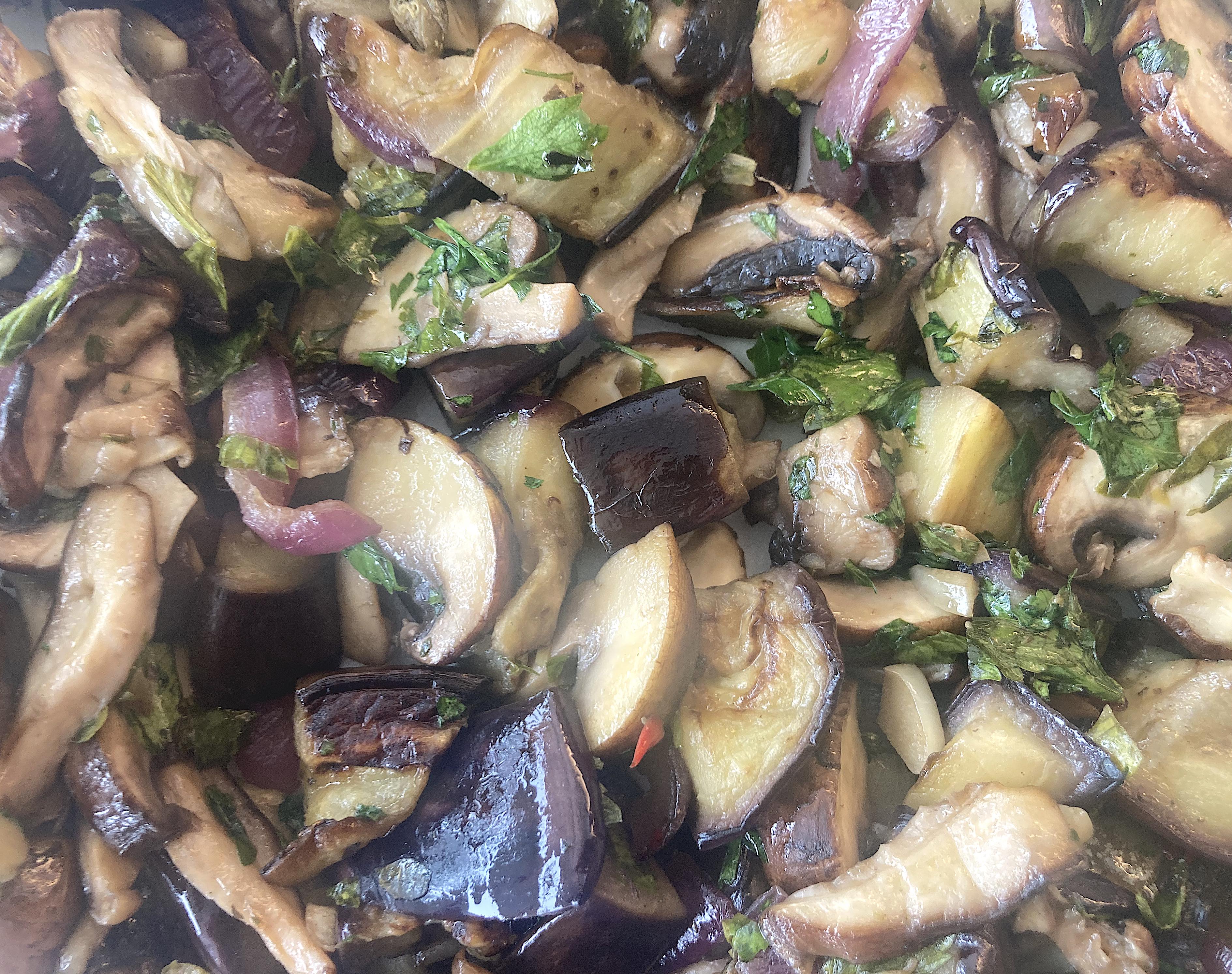
There must be hundreds of recipes for Caponata. The dish originates from Sicily and should contain (at least, we think so) eggplant (aubergine), celery and vinegar. Sugar is often added to enhance the sweetness and intensity. Nowadays it’s often a combination with tomatoes, shallot, capers, olives and perhaps raisins, pine nuts, oregano and basil.
The flavour of caponata should be slightly bitter (the eggplant) with a touch of sweetness (sugar, onion), acidity and saltiness (celery). The texture should be moist, but not sauce-like.
We love to enhance the flavours by adding mushrooms. And since we’re not keen on using sugar, we make sure the onions bring sufficient sweetness.

Enjoy your caponata as an appetizer, for instance with some crusted bread or bruschetta. A nice glass of white wine or rosé will be perfect with it. It’s also great as a side dish, with fish or even merguez.

Whatever the combination, caponata must be made one day ahead.

What You Need

  • 1 Aubergine
  • 200 grams of Mushrooms (preferably a mix with Shiitake)
  • 1 Red Onion
  • 1 Garlic Clove
  • 1 cm Red Chilli Pepper
  • Parsley
  • Celery
  • 2 tablespoons of White Wine Vinegar
  • Olive Oil
  • Fine Salt

What You Do

Wash the eggplant and slice. We slice the eggplant lengthwise in 8 and then we slice these strips. Salt them generously, transfer to a sieve and allow to drain for one or two hours. The more liquid they lose, the better! Rinse the eggplant with cold water and dry them with a kitchen cloth. Fry the aubergine in a heavy iron skillet until nicely golden brown. Set aside. Slice the red onion, clean and chop the mushrooms. Chop the garlic and the chilli pepper finely. Add some olive oil to the pan and fry the onion. Remove and set aside. Now fry the mushrooms. After 5 minutes or so add the garlic and the chilli pepper. After a few minutes add the mushrooms and the eggplant to the pan. Add chopped parsley and celery. Mix well. Add two spoons of white wine vinegar and leave on low heat for 10 minutes. Add black pepper to taste. Transfer to a plate and let cool. Keep in the refrigerator for the next day.

Chicken with Almonds and Ginger

Reading (very) old recipes allows you to discover new combinations, techniques and flavors, or better said, discover forgotten combinations, techniques and flavors.

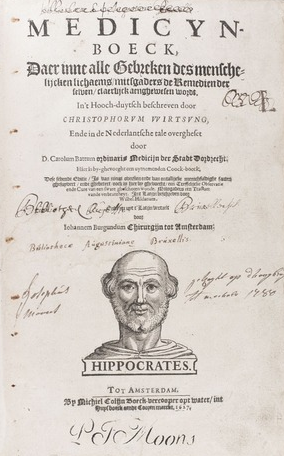
The University of Amsterdam is home to the Special Collections, the material heritage of the University. One of the collections is related to recipes, cookbooks, books on etiquette, nutrition, food et cetera. The oldest cookbook is Eenen seer schoonen ende excelenten Cocboeck, inhoudende alderley wel geexperimenteerde cokagien, van ghebraet, ghesoden, Pasteyen, Taerten, toerten, Vlaeijen, Saussen, Soppen, ende dier-gelijckeOock diversche Confeyturen ende Drancken, etc. by medical doctor Carel Baten (Carolus Battus) and was published in 1593. The book contains some 300 recipes for stews, roasts, poached food, pies, cakes, sauces and soup. It was published as an annex to his Medecijn Boec (medicine book). 

Luilekkerland

In 2018 Onno and Charlotte Kleyn published Luilekkerland (named after the painting by Pieter Bruegel de Oude). It’s a great book on 400 years of cooking in the Netherlands. They must have spent months at the Special Collections going through various cookbooks and manuscripts with recipes. They created ‘a magical mystery tour’ through the kitchens of the past.
In the book they describe one of the recipes of Carolus Battus: een sause op eenen gesoden capoen. Or in English: poached Capon with sauce. 

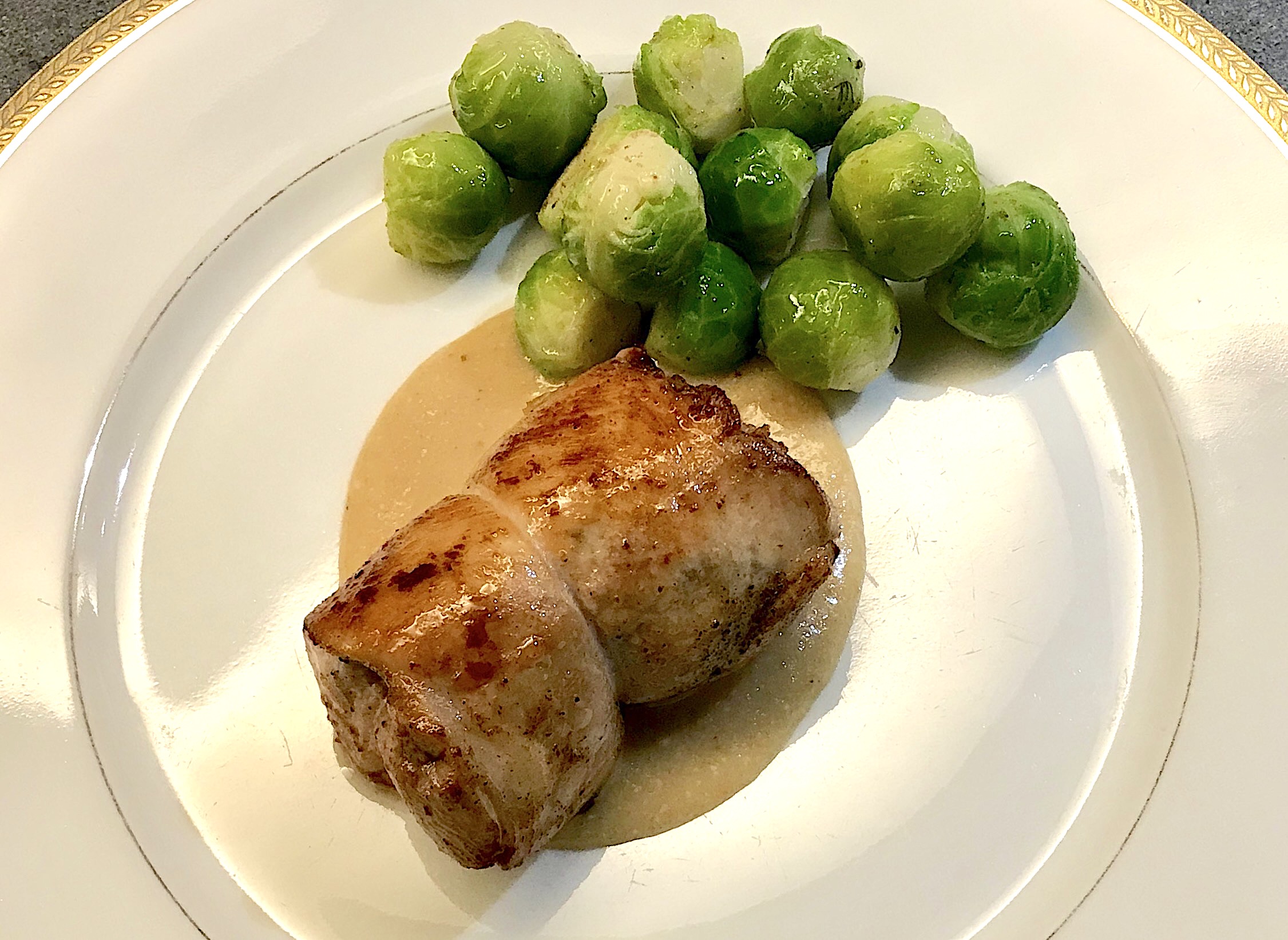
Capon is very expensive, so like Onno and Charlotte we go for chicken. Our recipe is for 2 chicken thighs, but we could also imagine making a roulade and then serving a slice of chicken roulade with the sauce.
The surprise is in the sauce: the combination of bread, ginger and almonds is tasty and complex. The sauce may appear to be filming and fat, but actually it’s not. The texture of the sauce is interesting as well: the bread will make the sauce a bit porridge-like and the crushed almonds prevent the sauce from being smooth.
Our version is a bit closer to today: we’re not the biggest fans of poaching and we don’t see the need for sugar in the sauce.

Wine Pairing

Best is to go for a white wine with a touch of sweetness, for instance a Gewürztraminer. This will combine very well with the somewhat unusual flavors in the dish.  If you go for a glass of red wine, then we would suggest a pinot noir, nice and earthy.

What You Need
  • 2 Organic Chicken Thighs
  • Stock
    • Chicken Stock
    • Leek
    • Carrot
    • Celeriac
    • Onion
  • Olive Oil
  • Butter
  • 15 grams of White Almonds
  • 1 – 2 cm of Fresh Ginger
  • 100 ml of Dry White Wine
  • Slice of Toasted Bread
What You Do
  1. Add the vegetables to the chicken stock and allow to simmer for 30 minutes
  2. Pass the stock through a sieve, capture all the flavours of the vegetables
  3. We turned the chicken thighs into small roulades
  4. In a small skillet heat the butter and olive oil
  5. Fry the chicken until nearly done
  6. In parallel blender the almonds and the toasted bread
  7. Grate the ginger
  8. Add the white wine and the ginger to the mixture and blender
  9. Add some stock and blender for a few seconds
  10. Transfer the mixture to a pan and warm over medium heat
  11. It requires attention, so keep an eye on the sauce and stir every minute or so
  12. The sauce will thicken so you will probably need to add more stock
  13. Transfer the chicken to a warm oven and let rest
  14. Deglaze the pan with some stock and add this liquid to the sauce
  15. Stir well
  16. Now it’s time to taste and adjust; remember the taste is new, so take your time
  17. Serve the chicken with the sauce. 
  18. We enjoyed the chicken as a main course with some Brussels sprouts, olive oil and nutmeg.

The Queen’s Soup

Actually, this post should be called Potage à la Reine, or even better Koninginnensoep. Before looking at the details, let’s first talk about Dutch Royalty.

The first Dutch Queen (Koningin) was Wilhelmina who reigned from 1898 until 1948. She was succeeded by Queen Juliana and later Queen Beatrix. Their birthdays were always a reason for festivities with lots of food (and lots of beer nowadays). One of the favourite dishes was a soup called Koninginnensoep: a rich, creamy chicken soup with carrots and garden peas. Not very refined, but perfect for the occasion.

The recipe of this soup goes back to France, to chef François Pierre de La Varenne (1618-1678). He is probably the first chef who documented and prepared Potage à la Reine. The soup is made with two kinds of stock (one made with almonds, the other one with partridge or capon), bread, lemon and it is garnished with pomegranate and pistachios. It was prepared in the honour of Queen Marguerite de Navarre.

The Dutch Koninginnensoep is a simplified version of the Potage à la Reine. Some recipes suggest replacing the bread with rice; most suggest making a roux and adding eggs and cream to thicken the soup. The pomegranate is replaced by carrot and the pistachios by garden peas. A practical cheap, Dutch approach…

Enough details, let’s start preparing our version of this traditional soup. After all, today, April 27th, we’re celebrating the King’s birthday! Hurray!

What You Need
  • For the stock
    • Organic Chicken (bones and meat)
    • Carrot
    • Leek
    • Onion
    • Bouquet Garni (Thyme, Parsley, Bay Leaf)
    • Mace (small piece)
    • Olive Oil
  • Flour
  • Almond Flour
  • Butter
  • One Egg Yolk
  • Cream
  • White Pepper
  • Carrot
  • Green peas
What You Do
  1. Gently fry the sliced leek, the chopped carrot and the chopped onion in olive oil
  2. After a few minutes add the chicken
  3. Leave for a few minutes
  4. Add cold water, the bouquet garni, the mace and a piece of carrot
  5. Leave to simmer for one or two hours
  6. Pass through a sieve
  7. Cool the stock and remove the fat. You could do this the day before
  8. Remove the skin and bones from the meat and make cubes the size of garden peas
  9. Same for the carrot
  10. Set aside. 
  11. Combine 30 grams of flour with 10 grams of almond flour and 30 grams of butter (depending on the amount of stock, these quantities are for one liter)
  12. Make a roux and thicken the soup
  13. Leave on low heat for 60 minutes.
  14. Beat the egg yolk, add cream, mix some more
  15. Add the warm soup to the liquid, one spoon at a time
  16. This is known as marrying the soup and the eggs
  17. When done, add the chicken and leave on low heat for 10 minutes
  18. Stir gently
  19. Add white pepper
  20. In parallel quickly cook the garden peas (one minute will be fine) and warm the carrot cubes.
  21. Garnish the soup with peas and carrot

Garnish the soup with carrot and garden peas.

The Queen's Soup ©cadwu
The Queen’s Soup ©cadwu

Takes 5

You can’t have enough cookbooks. Some make you think back of a holiday, others are written by chefs you admire, and some are technical or about specific ingredients. There is always room for just one extra cookbook.

Once in a while, when you’re looking for inspiration, you browse through a number of books, look at the pictures, read recipes and you think: ‘far too many ingredients, far too complicated’ for a not very inspired evening.

James Tanner

Fortunately, you remember one very special cookbook: James Tanner Takes 5: Delicious Dishes Using Just 5 Ingredients with over 90 recipes, ranging from Roasted Red Bell Peppers with Anchovies to Scones. Short shopping lists, easy recipes and tasty results: what more can you ask for! Isn’t it great, Chocolate MousseFigs with Honey or Toad-in-the-hole

James Tanner (1976) is a British chef and author. Together with his brother Chris he runs a restaurant in Kent, The Kentish Hare. He appeared as a tv-chef on shows like Ready Steady Cook (remember The Quickie BagGreen Pepper and Red Tomato?).

Favourite

Our personal favourite is a small chicken (preferably a coquelet, a young rooster) with a paste made of red peppers, pure creamed coconut (santan), lime and cilantro. It’s easy to make and the result is very tasty. Serve it with some bok choy in oyster sauce and you have a lovely meal. He enjoys it with a cold beer, we prefer a glass of rosé, for instance Chiaretto di Bardolino DOC made by Monte del Frà from Italy. A pale, pink wine with floral and fruity aromas. Dry with medium acidity, limited tannins and delicate flavours. Excellent with the chicken and the coconut.

Takes 5: Delicious Dishes Using Just 5 Ingredients was published in 2010 and is available (probably second hand) via the well-known channels for something like 20 US dollar or Euro.

Asparagus à la Flamande

One of the classic ways of serving asparagus is à la Flamande (Op Vlaamse wijze) with melted butter, boiled eggs, parsley and nutmeg. The nutmeg is an essential element of the dish. It enhances the flavour of the asparagus, and it’s a bridge between the egg mixture and the asparagus.
There are two main variations: the first one is to serve the asparagus with small potatoes. Not a great idea, unless you’re hungry, because the potatoes soften, weaken the flavour of the asparagus. The dish is about enjoying asparagus, so why would you add potatoes?
The second variation is to add lemon to the butter and egg mixture. This makes the dish a bit lighter and fresher. If you want to do so, be careful with the wine you serve. You need to balance the acidity in the wine and the food.

Wine Pairing

Serve the asparagus à la Flamande with a dry, white wine. We enjoyed a glass of Silvaner produced by the German Winery Thörle. The wine comes with freshness, some acidity, minerality and fruit (pear, green apples). Excellent with our asparagus.

What You Need

  • 4 Asparagus per person
  • 3 Eggs
  • Parsley
  • Butter
  • Nutmeg
  • White Pepper

What You Do

  1. We use our Russel and Hobbs food steamer to prepare this classic dish. An essential kitchen aid for only 50 euro or US dollar
  2. Clean and peel the asparagus
  3. Steam them for 10+5+5 minutes
  4. After 10 minutes add the eggs to the steamer basket
  5. After 5 minutes, turn the eggs upside down
  6. Another 5 minutes later the asparagus and the eggs are ready
  7. If you like your asparagus softer, then steam for 12-15 minutes.
  8. The eggs should be hard. Depending on the size you may need to steam them a bit longer
  9. In parallel heat a very generous amount of butter
  10. Chop the parsley
  11. Peel the egg and mash with a fork, creating a ‘mimosa’ of egg
  12. Combine mimosa and parsley
  13. Add some white pepper and freshly grated nutmeg
  14. Add the mixture to the butter and combine
  15. Spoon the egg mixture on top of the asparagus
Asparagus a la Flamande ©cadwu

Pasta with Mushrooms and Bell Pepper

Udon is such a wonderful noodle. What better comfort food than a warm soup made with dashi, vegetables, tofu, udon and thinly sliced spring onions? Perhaps some tempura on top of the soup? Or would you prefer a very simple dish, called Mori Udon? The cold udon is served with a sauce of mirin, dashi and soy sauce on the side.
Udon is also a great alternative to Italian pasta, for instance with Caesar’s Mushrooms.

In this recipe we combine udon with roasted bell pepper and Trompettes de la Mort. We’re not sure why, but this combination works really well. Is it because of the smokey aroma of the roasted bell pepper mixed with the aromas of the mushroom? The crispy pancetta in combination with the soft textures of the other ingredients, including the udon? The overall richness and umami thanks to the Trompettes de la Mort?

Wine Pairing

We enjoyed our pasta with a glass of Bianco di Custoza, made by Monte del Frà from Italy. It is a well-balanced, dry white wine, with a fruity nose. Its colour is straw yellow, with pale green highlights. A glass of Soave, made from the Garganega grape, will also be an excellent choice. In general you’re looking for a fresh, aromatic dry white wine. 

What You Need

  • 1 Red Bell Pepper
  • 1 Bunch of Udon
  • 100 grams of Trompettes de la Mort
  • 1 Glove of cooked Garlic
  • 4 slices of Pancetta
  • Black pepper
  • Olive Oil

What You Do

Clean the bell pepper and cut in 4. Transfer to the oven and grill or roast for 10 minutes or until well charred. When still hot, put the bell pepper in a plastic container and close it. After one hour it’s easy to remove the skin of the bell pepper. Slice lengthwise to make nice strips. Set aside.
Slice the mushrooms in two and clean them with a soft brush. Check carefully for grit and other things you don’t like to eat.
Fill a large pan with water (no salt!) and bring to a boil. Add the udon and cook it according to the instruction. When nearly done, add some cooking liquid to a cup and set aside. Drain the udon.
In parallel heat a large heavy iron skillet, add olive oil and fry the mushrooms. Once they become a bit dryer, add the sliced bell pepper. Add the cooked garlic, crush it with a fork and mix. Now add the udon and continue mixing. Add cooking liquid until the pasta is sufficiently moist.
Also in parallel: grill the strips of pancetta (perhaps 5 minutes).
Add some black pepper to the pasta and serve with the grilled pancetta.

Pasta with Mushrooms and Bell Pepper ©cadwu