Mushroom Cream Sauce from 1790

This recipe for a rich and tasty sauce is included in Het Receptenboek van mevrouw Marselis (the recipe book of Mrs. Marselis), published in the Netherlands in 1790. The combination of mushrooms, cream and nutmeg works remarkably well. One to prepare more often!

Mrs. Marselis doesn’t mention what the sauce is supposed to accompany. In this case we decided to combine it with pasta, making it a nice vegetarian dish, but we could also imagine combining it with veal or chicken. 

Wine Pairing

We suggest drinking an excellent rosé with the sauce, one with flavour, fruit, depth and refreshing acidity. For instance Monte del Frà Bardolino Chiaretto. This is a very affordable, tasty rosé with just the right balance between serious flavours, freshness and fruitiness.

What You Need

  • Mushrooms
  • Nutmeg
  • Flour
  • Chicken Stock
  • Cream
  • One egg
  • Butter
  • Lemon
  • Spaghetti

What You Do

We used yellow chanterelles, but you could also use Champignons de Paris. Clean and chop the mushrooms (we didn’t peel them, sorry Mrs. Marselis) and glaze them in butter. When glazed, sprinkle some flour over the mushrooms and stir. After a few minutes, slowly start adding chicken stock to make the beginning of a sauce. Add cream to the pan and some freshly grated nutmeg. Leave on low heat for at least 10 minutes. Beat one egg yolk. Slowly add the mixture from the pan to the egg yolk (marrying the sauce). Then add the egg yolk and cream mixture back to the pan. Warm carefully, otherwise it will split, or you just cooked an omelette. Taste and add a drop of lemon to make the sauce a touch fresher and lighter. No need for pepper or parsley.

We served the sauce with spaghetti and used the cooking liquid to give the sauce the right consistency.

Gazpacho

Simple, tasty, refreshing and quick: what more could you ask for on a summer’s evening? We love a cold soup, for instance Ajo Blanco or Avocado and Cucumber Soup.

Gazpacho, another Spanish classic, is not just a mixture of tomatoes, bell pepper, chili, garlic and white onion. It absolutely needs Jerez vinegar and excellent olive oil. The olive oil will give that velvety, rich feeling in your mouth and the vinegar with the chili gives the gazpacho that typical, sharp freshness.
You will need the very best of vegetables: ripe, tasty and with a firm structure.
The bell pepper should, according to some recipes, be a green Cubanelle pepper. Hard to find for us, so we’re happy to use a green bell pepper.

Prepare the Gazpacho 8 hours in advance and serve in cold bowls. 

What you need

  • 4 large, meaty, tasty red Tomatoes
  • ½ white (Spanish) Onion
  • 1 Green Bell Pepper
  • 2 Fresh Garlic Gloves
  • ½ Red Chili
  • 1 small Cucumber (optional in our view)
  • 3 tablespoons Olive Oil
  • 2 tablespoons Jerez Vinegar
  • Pinch of Salt

What You Do

Cut the tomatoes in 4 and remove the seeds. Transfer to a sieve and use the back of a spoon to squeeze out the liquid. Discard the seeds. Chop the tomato chunks, onion, bell pepper, gloves and chili. Use a blender to mix tomato chunks, tomato juice, onion, bell pepper, gloves and chili until you have a fairly smooth soup. Add olive oil and Jerez vinegar and pulse. Taste, add pinch of salt and more olive oil or vinegar if needed. Transfer to refrigerator to let cool. You could decorate with green bell pepper or chopped tomato (provided it’s peeled and seeded).

PS

Most recipes mention passing the mixture through a sieve. This way you will get a smoother, but also thinner soup. That’s probably why these recipes suggest adding white bread to the mixture.

Gazpacho ©cadwu
Gazpacho ©cadwu

Escargots à la Bordelaise

For some reason we had booked a hotel in Coutras, some 65 kilometres from Bordeaux. A nice enough city, on the borders of the river Dronne, but not as interesting as nearby city Libourne with its castles, parcs and rivers (the Dordogne and the Isle). In all fairness, we could easily have forgotten our stay at Coutras, if it wasn’t for the dinner at La Table Du Buffet. It was a warm welcome, a nice plat du jour made with lots of local products and served with very nice local wine, obviously.
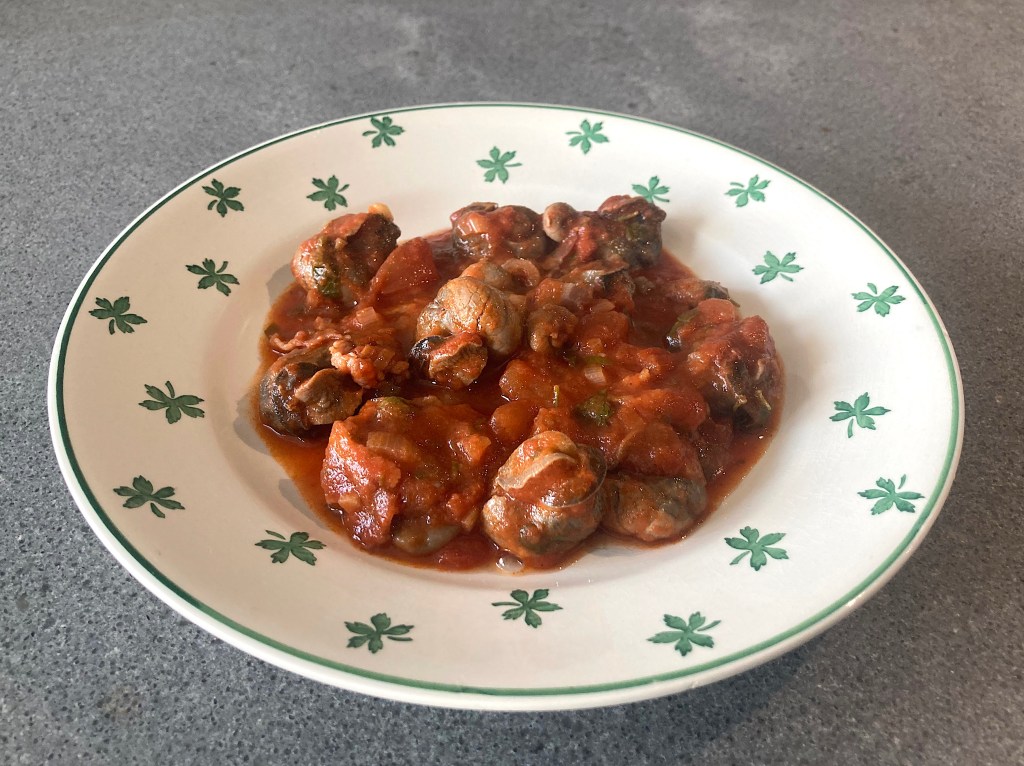
One of the dishes was Escargots à la Bordelaise, made with small snails. The taste was great although we think the snails could have been cleaner, but that’s a minor detail. The dish was a revelation: not the standard combination of snails, butter, garlic and parsley, but a rich tomato and wine sauce that supported the snails perfectly. Delicious with some crusted bread. We decided to prepare the dish as soon as we were back home.

Snails

Buying the right snails is not simple at all. The snail used for the classic Escargots de Bourgogne is called Helix Pomatia. Excellent taste, expensive and hard to find.
There are three alternatives: Helix Aspera (either the small one called Petit Gris or the large one called Gros Gris) and Helix Lucorum. The last one is considered to be less tasty than the other three, but when prepared well, it’s a very nice, affordable alternative.

Sometimes it simply says ‘Escargots’ and ‘Gros’ on the tin. Sounds good, doesn’t it? In most cases these ‘escargots’ are cooked and chopped large (sea) snails. The term ‘Gros’ is supposed to make you think of the Gros Gris. Don’t be fooled: these ‘escargots’ are rubbery, tasteless and a waste of money (and snail).

Fast Snails

And now for the sad part: as you know snails are slow. Very slow. And during winter they are even slower. They simply sleep 3 to 5 months before becoming active again. Some (most?) farmers are not that patient, so they turn up the light and the heat, pushing the snails towards a faster life, forcing them to skip hibernation and become fast snails.
Even the poor snails are turned into manageable products.
Let’s focus on the honest exception: some farms allow the snails to be slow, to sleep through winter, to be their natural self. Hurray!

Wine Pairing

Given the name of the dish (and the flavours of course) we suggest a red Bordeaux wine. Not too complex, not too expensive. We enjoyed a Côtes de Bordeaux produced by Château Cap Saint Martin in Blaye. In general you’re looking for a red wine with grapes such as Merlot, Cabernet Sauvignon, Cabernet Franc and Malbec. Rich in fruit, limited in tannins and acidity.

What You Need
  • 12-18 Snails
  • 50 grams of Pancetta (bacon is also fine)
  • 1 Shallot
  • 1 Garlic Clove
  • Parsley
  • Tomato Sauce
  • Red Wine
  • Olive oil
  • Black pepper
  • Crusted Bread
What You Do
  1. Chop the shallot, the garlic and the parsley
  2. Slice the pancetta
  3. Warm a heavy iron skillet
  4. Gently fry the shallot
  5. After a few minutes add the garlic
  6. Add the pancetta and fry for a few minutes
  7. Add the tomato sauce, some red wine, the chopped parsley
  8. Allow to reduce, thicken and integrate, let’s say 15 minutes. Longer is fine; the consistency of the sauce is important
  9. Add snails and cook for 10 minutes on a very low heat
  10. Serve immediately with crusted bread
Escargots à la Bordelaise ©cadwu

Cooking Soup

We simply love soup! A traditional soup like Londonderry or Queen’s Soup, a rich Tomato Soup, Clam Chowder, perhaps a more challenging soup like Lettuce Soup or a refreshing Ajo Blanco.
If you would look at our shelfs with cookbooks you would expect books like The Ultimate SoupbookThe Essential Soupbook or Soup of the Day. No doubt these are excellent books with great recipes, but we have only one book specific on soup: Cooking Soups for Dummies by Jenna Holst.

Why? Well, to be honest, it is one of these few cookbooks that is truly about ingredients, methods and recipes, with the aim to cook a tasty soup.
Most cookbooks are a collection of recipes. Not this one. The first chapter of the book is about tools and utensils, basically explaining what equipment you need to make a soup. The second chapter is about the ingredients (spices, herbs, basic items) you need and where and how you should store them. Fun to read, good to know, especially because it’s very well written, comprehensive and clear. The third and fourth chapter are about basic techniques, and the fifth chapter explains how to make a broth (chicken, beef, vegetarian, fish, clam). Chapter six is about storing soup (again well written and very helpful) and then we move towards making fresh soup from the garden (Tomato Soup, Sweet Potato Bisque etcetera).

You could skip the background information and only look at the index of recipes. You’ll find lots of interesting recipes, ranging from Mulligatawny Soup to Cantaloupe-Orange Soup, but also less exotic ones like Creamy Potato Leek Soup and Split Pea Soup.

We bought the book many years ago and have always found it helpful and inspiring. What better way to start dinner, or lunch, than with soup? Let’s buy some fresh beets and cook Herbed Beet Soup. Yummy!

Cooking Soups for Dummies is available via your local bookstore or via the well-known channels for approximately US$ 30,00 or € 20,00. You’ll find specific recipes on Dummies.

Fish Cakes

They are so tempting! The crunchy crust, the flaky texture and the flavour, especially when combined with mayonnaise and lemon. When we see them at the supermarket or at the fishmonger, we can’t always resist buying them. But we should resist the temptation because most fish cakes should be called salty potato cakes. Hardly any fish, limited herbs, the structure of mashed potato and lots of salt to disguise the lack of real flavour.

It’s not a lot of work to prepare your own fish cakes, so be brave and ignore the factory-made ones. The recipe is very flexible, you could make a Thai version (Tod Mun Pla) with lemon grass, red curry, onions and garlic, a traditional version with stockfish, or cakes with salmon, with shrimps etcetera. To be served with Tartar sauce, sweet chili sauce, dill sauce or perhaps hoisin. We prefer Jean Beddington‘s fish cakes (served with a beetroot chutney) or a more traditional version that focuses on the fish, with herbs and black pepper in a supporting role, breaded with our home-made breadcrumbs.

Wine Pairing

Let’s be flexible, a nice glass of beer or a not too complex white wine, it’s all fine. The salad, its dressing and the lemon will be rather present. Perhaps a Verdejo, Pinot Blanc or a Picpoul de Pinet?

What You Need

  • For the Cakes
    • 225 grams of Haddock
    • 100 grams of Potato
    • 1 egg yolk
    • Parsley
    • Chives
    • Black Pepper
    • Butter
  • 1 Egg
  • Breadcrumbs
  • Olive Oil and Butter
  • Salad with a dressing made of Olive Oil and White Wine Vinegar
  • Mayonnaise
  • Lemon

What You Do

It’s best to make the mixture one day ahead. This allows for the flavours to integrate.
Gently fry the haddock in butter. You’re looking for a light golden color, just to give it some extra flavour. When nearly done, transfer to a plate and let cool. Cook the potato until soft. Let cool. Use a fish knive to make fish flakes. Use a fork to mash the potato. Chop lots of parsley and chives. Combine fish (and its juices), potato, egg yolk, herbs and a generous amount of black pepper. Let cool and store in the refrigerator until the next day.
Beat the egg, add a few drops of lemon to the mayonnaise and heat a heavy iron skillet or a non-stick pan. Make 4 fish cakes. Coat them with egg, then cover with breadcrumbs and fry in butter and/or olive oil on all sides. In total 6-10 minutes. Serve with a salad, mayonnaise and a wedge of lemon.

PS

Making your own breadcrumbs is simple and worthwhile. The breadcrumbs at the supermarket are made of cardboard; yet another product you shouldn’t buy. Toast slices of old bread and let cool. Cut in smaller bits and then use a cutter or blender to make the crumbs. Done. They keep very well in the freezer.

Asparagus!

Only a few days left before the end of the asparagus season on June 24th! So dash off to your greengrocer and buy some lovely asparagus, white, green, purple, it’s all fine and great, as long as they are locally farmed and fresh.

The classic way of preparing asparagus is to cook (or better: steam) them. You can pair the steamed asparagus with kimizu (the beautiful, light, golden Japanese sauce made with egg yolks and rice vinegar) Hollandaise, morels or scrambled eggs with shrimps. Classic way to serve them is à la Flamande (mimosa of egg, butter, parsley and nutmeg). You could add boiled eggs, ham and new potatoes to have a nice dinner. Or if you want to spent more money, then you serve them with summer truffle or with Sauce Périgueux.

Grilling the asparagus is also possible, simply serve them with excellent olive oil and grated Parmesan cheese.

Parhaps as a salad on a summers evening? Of course, with a delicious dressing made of white wine vinegar, olive oil, a touch of honey and lots of chervil.

A more exotic way of is to fry the asparagus with black olives and basil. Goes very well with lamb.

Wine Pairing

The obvious choice is a glass of Pinot Blanc, although we actually prefer a dry Muscat in combination with a classic preparation such as à la Flamande. Depending on the dish it could also be a Verdicchio, an Albariño or perhaps even a Portuguese Vinho Verde. Feel free to experiment; yesterday we enjoyed our asparagus with a glass of wine made of muscat and picpoul grapes. Delicious combination! The wine comes from the Pont Du Gard region (near Nimes, France) and is produced by Château Mourgues du Grès.
A more serious rosé is a perfect choice when you grill the asparagus, for instance a glass of Domaine Vico Corse Le Bois du Cerf Rosé 2021. This exceptional rosé from Corsica is made of grenache and sciacarello grapes. It is medium bodied and fresh with aromas of red fruit with a complex, long and fruity taste.
A pinot noir or grenache based wine is great when you fry the asparagus, depending on the preparation of the meat.

Asparagus ©cadwu
Asparagus ©cadwu

Artichoke à la Barigoule

It’s the time of year to enjoy artichokes: steamed, as a salad, in a pie or perhaps à la Barigoule. This is a rather intriguing recipe from the French Provence region. There are lots of variations, so we looked in books like La Cuisinière Provençale and La Cuisine Niçoise d’Hélène Barale to find the ‘original’ recipe.

Obviously you want to know what ‘barigoule’ means. According to Hélène Barale ‘barigoule’ means thyme, which is odd because she doesn’t add thyme to her Artichoke à la Barigoule. Is it perhaps derived from the Latin word mauruculai (meaning morel according to some and saffron milk cap to others) as the Larousse suggests? But what is the link between artichokes and mushrooms?

Three Versions

We found three different ways of preparing Artichoke à la Barigoule: cooked with onions, white wine and carrot, stuffed and preserved with lots of citrus. The stuffed one is probably the original version because the artichoke is stuffed with a mixture of mushrooms, thyme and garlic. Which makes the Larousse explanation more likely.

Preparing Artichokes a la Barigoule is quite a bit of work and the result, we must admit, looks like an old fashioned underbaked meatball. We could imagine you serve the artichoke halfway the recipe. If you do, best is to use smaller artichokes.

Wine Pairing

It’s not straightforward to pair artichokes with wine. According to various researchers this is due to cynarin, a chemical especially found in the leaves of the artichoke. When the wine and the cynarin meet in your mouth, the natural sweetness of the wine is enhanced, making it taste too sweet. So you have to pair artichokes with a bone-dry, crisp, unoaked white wine with clear, present acidity. For instance Sauvignon Blanc, Grüner Veltliner or Albariño. 

What You Need

  • Artichokes
  • Cooking liquid
    • Shallot
    • Carrot
    • Olive oil
    • White wine
    • Water
    • Thyme
  • Filling
    • Mushrooms
    • Egg yolk
    • Garlic
    • Shallot
    • 2 Strips of Bacon
    • Thyme
    • Black Pepper
  • Excellent Olive Oil

What You do

Remove outer leaves and stem of the artichokes. Add oil to a large pan, gently fry the chopped shallot and the chopped carrot. After 10 minutes or so add white wine, thyme and some water. Leave to simmer for 10 minutes. Add the artichokes to the liquid, close the pan and allow to cook and steam on low heat for 45-60 minutes or until nearly done. You could decide to stop here and serve the artichoke with the (reduced) sauce.
Let the artichokes cool, remove the leaves and the centre choke (the hairy part).  Use a spoon to remove the ‘meat’ from the leaves (bracts) of the artichokes. Set aside. In a small skillet heat some oil, add chopped shallot, glaze, add sliced bacon, mushrooms, garlic and thyme. Leave for 10 minutes until done. Add the artichoke meat from the leaves, stir, add the egg yolk and mix. Add freshly grounded black pepper. Use a food processor to make the mixture smoother, but not too smooth. Fill the artichokes with the mixture. It should look like an oversized golf ball on top of the bottom of the artichoke. You will probably have too much filling, which is fine. Gently transfer the artichokes to the pan with cooking liquid and allow to steam and warm for 30 minutes. Now transfer the artichokes to a warm oven (60 ˚C or 140 ˚F).  Add the reaming mixture to the liquid, use a powerful blender to create a sauce. Pass through a sieve and blender some more. Set the blender to low speed and add excellent olive oil. Taste and adjust. Serve the filled artichokes on a small plate with the sauce.

Lemon Curd

A Lemon Meringue Pie, a Tarte au Citron or Scones with Lemon Curd: tasty, refreshing, bitter, sour, a bit sharp and sweet. We love it! Provided of course that the lemon is more than just juicy and sour.

This has been a bit of an issue over the past years. Similar to the German consumers who complained about the watery and flavourless Dutch tomatoes they bought around 1990, we think that most lemons lack aroma and taste. We tried limes, bought more expensive lemons, added a bit of yuzu, but in the end, we still missed the true taste and aroma of an old-fashioned lemon.

Until one day we bought a Bergamot lemon. Its aroma is intense, floral and long. The juice is sour, deeply citrusy, refreshing and bright. Exactly what we were looking for! We went home and prepared a lovely curd.

Recently we had a similar experience when we visited a dear friend. She grows a Makrut (or Thai) Lime tree, also known as Makrut Lime, in her garden mainly because she wants to use the fresh leaves in Thai and Indonesian dishes such as Tom Yum, Soto Ayam and various curries. The leaves have a complex citrus flavour with floral notes. We talked about the lovely yellow fruit and how you could use its very aromatic zest as well.
The fruit contains little juice, so when preparing a curd with Makrut limes, you need to add lime, Bergamot or lemon juice.

What You Need

  • 65 ml of Lemon, Lime, Bergamot and/or Makrut Lime Juice
  • 65 grams of Butter
  • 100 grams of Sugar
  • One Egg
  • Zest

What You Do

  1. Beat the egg, melt the butter and combine all ingredients
  2. Make sure the sugar is fully dissolved
  3. Cook Au Bain Marie until you have the right consistency. Or transfer to your microwave, put it on 50% or 70% power and heat with intervals of 20-30 seconds. Mix between the intervals. This is a very precise way of heating the mixture and it gives you full control over the process. Towards the end of the process you may want to reduce the power or shorten the intervals. The percentage and the duration of the intervals depend on your microwave and the bowl you use. We use a microwave saucepan (£1,29 only) and it works perfectly. The material doesn’t absorb warmth, so the mixture doesn’t get extra heated when you stop the microwave
  4. Pass through a sieve (you don’t want the zest in the curd)
  5. Cool in a water bassin
  6. Store in a jar.
  7. The curd keeps for a week in the refrigerator .

PS

Around 1992 a German television program characterised Dutch tomatoes as watery and tasteless, and called them ‘wasserbombe’. The short-term impact was enormous: Dutch tomatoes went from 50% market share in Germany to something close to zero. Longer term the impact was very different: Dutch producers invested in their product, making their tomatoes tastier, richer and more diverse.

Clam Chowder

We have fond memories of the food we enjoyed when in New England: local oysters, lobster, Boston cream pie and of course clam chowder. Ah, yes, fond memories indeed.
Since then, clam chowder has become one of our favourite starters. Unfortunately, most restaurants (even in New England!) turn the clam chowder into a potato soup and even worse: they used canned clams. Help! 

The main ingredients of New England clam chowder should of course be lots of fresh clams plus vegetables, bacon, cream and potato. The soup must be about clams, with all the other ingredients in a supporting role.

We’re not from New England, so our clam chowder is far from original. But being Dutch we love our seafood and most certainly do we love our kokkels, also known as the common cockle. You can find a probably more original Manhatten version (meaning: without cream) in The Silver Palate Cookbook.

Finding the right potato is a bit of a struggle, also because some recipes suggest using waxy potatoes, so potatoes that remain firm. Not a good idea because it means that the potato doesn’t thicken the soup and the potato is far too present. We prefer using a starchy potato, one you would use for a purée, mash or mousseline. If you can find one with a golden colour, that’s even better. If you’re familiar with vichyssoise, then use the same potato.

What You Need

  • 500 grams of Clams, preferably washed
  • Chopped Carrot, Celeriac, Onion and Leek
  • Bouquet Garni (Parsley, Bay Leaf, some Thyme)
  • 4 strips of Bacon
  • White Wine
  • Water
  • 200 grams of Starchy Potato
  • 50 ml Cream
  • Olive Oil
  • White pepper

What You Do

Check the clams: discard broken ones or ones that will not close. Add a little olive oil to a pan and then chopped carrot, celeriac, onion and leek. Leave for 20 minutes until soft and sweet. Add the chopped bacon, fry for a few minutes until slightly crispy. Now add white wine, water and the bouquet garni. Leave for another 20 minutes. Turn up the heat, add the clams quickly and certainly not too long. If you heat them too long, then they will become rubbery when heated for the second time. Use a slotted spoon to remove the ingredients from the stock. Keep the bacon, the clams (without the shells) and the bouquet garni. Discard all other ingredients: onions, leek, celeriac, carrot and shells. Transfer the bacon and the bouquet garni back to the liquid. Add the chopped potato. Let simmer until the potato has broken down. Use a fork to thicken the soup. Add cream. Feel free to add a bit more, it’s all about taste and consistency at this stage. If you’re not happy with it, then you could add some potato starch. Keep the soup warm for 10 minutes or so, turn up the heat, add the clams and quickly heat them. Add some freshly grounded white pepper. Serve immediately.

Clam Chowder ©cadwu
Clam Chowder ©cadwu

Halibut with Morels

Seasonal eating is such a great idee. Simply buy (locally produced) seasonal fruit, vegetables and mushrooms, enjoy fresher and better tasting ingredients, reduce your carbon footprint and support your local community. And it creates lots of tasty opportunities: celebrate the beginning of the truffle season, the start of the asparagus season, the first red wine from the Beaujolais region – all good fun.

Part of the concept (at least, we think so) is commemorating the end of a season. In the Netherlands the morel-season ends early May. This year was a particularly good year for morels, we had some beautiful, tasty ones, for a reasonable price. But now it’s time to prepare the last morel dish of the season. And the last one with Ramson! A very tasty dish, one that requires a bit of work, but the result is absolutely yummy!

Wine Pairing

The richness of the dish requires a full-bodied white wine, for instance a glass of Chardonnay; one that has a touch of oak and vanilla plus a lightly buttery finish. Our choice would be the Chardonnay of La Cour des Dames

What You Need

  • Halibut
    • Halibut (slice with skin and bone preferred)
    • Olive Oil
  • Morels
    • 50 grams of Morels
    • Olive Oil
  • Sauce
    • Shallot
    • Olive Oil
    • Fish Stock
    • Noilly Prat
    • Crème Fraîche
    • Butter
    • White Pepper
  • Ramson (Wild Garlic)

What You Do

Clean and half the morels. Fry these gently in a heavy iron skillet for at least 10 minutes.
In parallel heat a small heavy iron skillet, gently fry the chopped shallot. When soft, add the garlic and one or two ice cubes of fish stock. Add a splash of Noilly Prat. When warm, blender the mixture, pass through a sieve and return to the pan. Add some crème fraiche. Warm through and through.
In parallel fry the halibut in a separate (non-stick) pan. First on the skin side, then turn the fish, remove the skin and turn again. The result should be golden. Whilst still in the pan, remove the bone. This gives you two portions of fish per person.
Slice a few leaves of ramson lengthwise, removing the vein.
When the fish is opaque, it’s time to add a bit of butter to the sauce and a touch of white pepper.
Serve the fish on top of the sauce, add the morels and the leaves.

PS

We served the halibut with morels on plates designed by Walter Gropius and produced by Rosenthal; a classic plate in Bauhaus Style.

Halibut with Morels ©cadwu