Potato, Mushroom and Dill Omelette

Last week we bought some St. George’s Mushrooms, a very tasty spring mushroom. In Germany it’s called maipilz because they grow in May only. The English name obviously refers to St George’s Day, April 23rd, by which date it can be found in the UK.

Its aroma is very specific. In an earlier post we described it as overripe zucchini or even gee that is a bit offish. Not very attractive, but fortunately the aroma disappears when you heat the mushroom. Its taste is also specific and will remind you of autumn with a hint of earthiness. Intense but not overwhelming. 

We combined the St. George’s Mushrooms with a light, airy omelette with a potato bottom. It tasted delicious and the combination of the three ingredients worked very well.

Given the short season and the limited availability we thought about an alternative with button mushrooms.

Wine Pairing

We enjoyed our Omelette with a glass of Verdejo-Sauvignon Blanc made by the Spanish Bodegas Piqueras. This is a fresh, aromatic, dry wine, one that works very well with the earthy flavours in the dish and the dill.

What You Need

  • Waxy Potatoes
  • Button Mushrooms or Champignon de Paris
  • Eggs
  • Fresh Dill
  • Black Pepper
  • Olive Oil

What You Do

Start by cooking or steaming the unpeeled potatoes until nearly done. Let cool. Clean the mushrooms with kitchen paper. Heat a small non-stick pan with olive oil. Slice the mushroom and fry for a few minutes. Remove the mushrooms from the pan. Slice the potatoes and cover the bottom of the pan with one layer of potatoes. Add the mushrooms and spread evenly. Add a generous amount of fresh dill. Add some fresh black pepper. Beat the eggs until just a bit fluffy. Add the eggs on top of the mushrooms and dill and allow to become baveuse (perhaps 10 minutes) on low/medium heat. The idea is to fry the potatoes very gently, but not brown the omelette.

Pork with Clams

A delicious classic dish from the Portuguese Alentejo region. A region known for its long coastal line, its beautiful nature and very small villages. Loved by sun seeking holiday makers and those who want to escape from busy metropolitan areas. A region not known for its culinary tradition except for Porco Alentejana, a very tasty combination of pork and clams, supported by red bell pepper paste, white wine and onion. Forget about those unlikely surf and turf combinations and enjoy Porco Alentejana!

Wine Pairing

Combining clams (and shellfish in general) with red wine is not the best idea. The tannins in the red wine can cause a metal-like taste, which is not very pleasant. Best is a full-bodied white wine with some acidity. We opened a bottle of Chateau Mourgues Du Gres Rosé. A wine with an intense pink colour, aromas that made us think of strawberries and lemon and with a fruity, long taste with a hint of pepper. The wine is made from syrah, grenache en mourvèdre grapes.

What You Need (for 4 persons)

  • 800 grams of Organic Pork with lots of lovely Fat (Tenderloin or Sirloin)
  • 1 Large White Onion
  • Red Bell Pepper Paste
  • White Wine
  • 2 Bay Leaves
  • 2 Garlic Cloves
  • 800 grams of Clams or Vongole
  • Cilantro
  • Olive Oil

What You Do

Cut the pork into 2-centimetre cubes. Finely chop the garlic. In a bowl combine the garlic, four tablespoons of red bell pepper paste, white wine, bay leaf and pork. Cover and transfer to the refrigerator for 24 hours. Gently mix every 2 – 4 hours.
The next day coarsely chop the onion. Use a slotted spoon to remove the meat from the marinade. Heat olive oil in a large pan and fry the meat until nicely brown. Remove the meat and add the chopped onion to the pan. Glaze.  Return the meat to the pan, add the marinade and leave to simmer for two or three hours, depending on the meat. Taste and perhaps add more red bell pepper paste. When the meat is ready, check the clams, discard broken ones and ones that remain open. Take a large pan, add some water and a tablespoon of red bell pepper paste. When the water is boiling, add the clams to the pan, close the lid and cook until the clams are open, perhaps 2 minutes. Use a slotted spoon to transfer the clams to the other pan. Use a large spoon to add some of the cooking liquid of the clams to the stew. Taste carefully; the liquid could be very salty and you don’t want to ruin the stew by adding too much. Decorate with cilantro and serve with crusted bread. We enjoyed a carrot salad with fennel seeds as a side dish.

Pork with Clams ©cadwu

Guineafowl with Morels

Finally, it’s spring! The time of year to buy fresh Morels and White Asparagus. One of our local greengrocers charged 34 euro per 100 grams for the Morels and 29 euro per kilo for the White Asparagus. That’s clearly too much for our budget! Let’s wait for a few weeks and hope for more reasonable prices. In the meantime we will enjoy dried morels. In general dried mushrooms are expensive and not very tasty. Fortunately dried morels are the exception to the rule: they are as tasty as fresh ones. 

Preparing guineafowl can be a bit of a challenge.  Cooking guineafowl requires some liquid (oil, butter, wine, stock) but not too much. Don’t try making Pintade au Vin and don’t spit roast it. Guineafowl is easily overcooked. You must watch the cooking process carefully. 

This dish is about a full and rich taste, with the guineafowl at the heart of it supported by morels, cream and potato.

Wine Pairing

We enjoyed our guineafowl with a glass of Bergerac, Château De La Vaure. This is a full bodied red wine with some oak, dark fruit and great flavours overall. Made from Merlot, Cabernet Franc and Cabernet Sauvignon. In general you’re looking for a full bodied red wine with flavours of ripe fruit and oak and with a lasting taste

What You Need

  • 2 legs of Guineafowl
  • 10 grams of Dried Morels
  • Butter
  • Olive Oil
  • Chicken Stock
  • Mustard
  • Cream
  • Black Pepper
  • Gnocchi

What You Do

Pre-heat the oven to 180 ˚C or 355 ˚F. Add the two legs of guinea fowl to a shallow dish with butter and olive oil. Cook for 10 minutes. In the mean time add the morels to hot water. Soak for 15 minutes. Turn the legs upside down after 10 minutes. Cook for another 10 minutes. Turn them a second time, skin up. Add the morels to the dish, leaving the skin free. In parallel start preparing the sauce using chicken stock and some morel water, but not too much. Taste the water before adding. The legs should be ready after 30 minutes. Add the cooking juices to the sauce, grill the legs quickly if the skin is not yet nicely coloured and keep the morels warm. Add mustard and pepper to the sauce, stir well, add some cream and allow to heat through and through for 5 minutes. Taste the sauce and if necessary add more mustard or morel water. 
Serve with gnocchi.

Classic Beef Stew

Wintery weather, sunny and cold, the best time of year to enjoy a beef stew. We decided to cook an old-fashioned version, with red wine, bay leaf, mustard and black pepper. And patience of course, because it will take hours.

Regardless if you want to cook a Flemish Stew, Bœuf Bourguignon, Daube à la Provençale or this beef stew, you must use fatty, structured meat. The idea to use lean meat because fat is unhealthy or altogether wrong is one to forget quickly. Fat, structured meat is the key to a delicious stew. In general you’re looking for meat from the neck or the shoulder (beef chuck roast, sucadepaleron). When in doubt, ask your butcher.

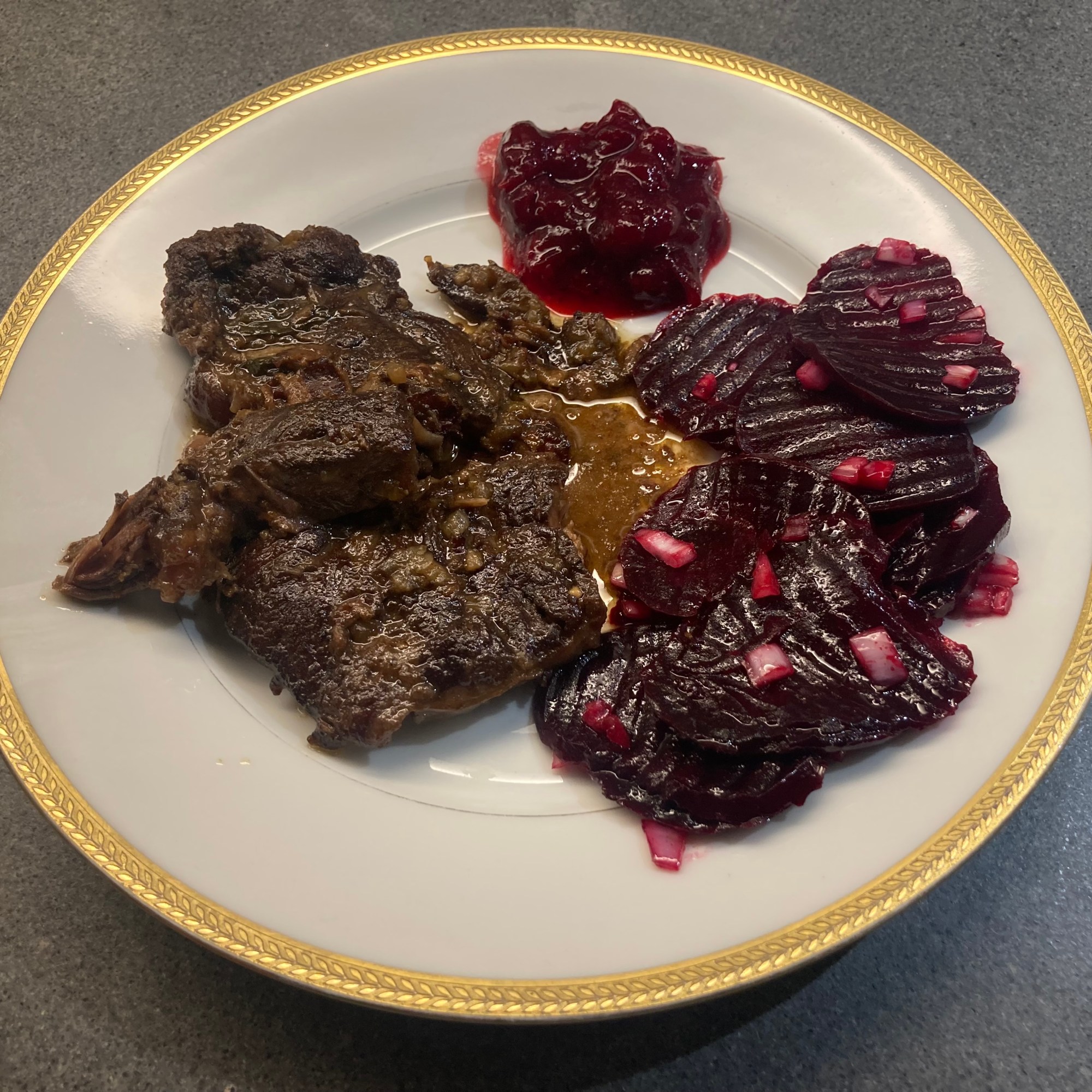
Most recipes suggest dicing the meat. We didn’t want to do that. When cutting the meat before serving, we followed the structure of the meat, which gives the plate a rustic feel.

We served the beef stew with a beet root salad and cranberry compote.

Drink Pairing

A rich beer or a full-bodied red wine will be a great accompaniment with the stew. The dish comes with some sweetness (the stew, the salad and the compote, obviously) so the wine should have some acidity and tannins. A robust wine with aromas of dark fruit (plums, blackberries, cherries), a touch of oak and a long taste will be perfect. 

What You Need

  • 400 grams of excellent Fat, Structured Beef
  • 50 grams of organic Bacon
  • Butter
  • Shallot
  • Mustard
  • Red Wine
  • 2 Bay Leaves
  • Bouquet Garni (Thyme, Parsley, Sage)
  • Black Pepper
  • Water

What You Do

Heat a heavy iron skillet, pat the meat dry with kitchen paper, add butter to the pan and fry until golden-brown. Reduce the heat and remove the meat from the pan. Add the sliced bacon and fry until golden. Add the shallot and glaze. Return the meat to the pan, add red wine, some water, mustard, bay leaves, bouquet garni and crushed black pepper. Allow to simmer for 6+ hours. You could close the pan with a lid. We prefer to cook it without a lid. The meat will take longer to become tender and soft. Our impression is that a stew prepared in a skillet without a lid is more moist. In all cases check the pan every 30 minutes, turn the meat and add water if required.
You could reduce the jus or turn it into a sauce, but you could also keep it as is.

What You Need – Beet Root Salad

  • One Beet Root
  • Excellent Olive Oil
  • White Wine Vinegar
  • Shallot
  • Black Pepper

What You Do – Beet Root Salad

The day before wash the beetroot and wrap in aluminium foil. Leave in the oven on 180° Celsius or 355° Fahrenheit for 45 – 60 minutes depending on the size. Cool and store in the refrigerator.
The next day peel the beet root and use a vegetable slicer (or mandoline) to make ridges. This will not only make the dish look more inviting, it will also enhance the taste given there is more coated surface and more air when chewing it. Make a simply, relatively acidic dressing with olive oil and vinegar. Finely chop the shallot and add to the dressing. Test a small slice of beet with the dressing and adjust when necessary. Perhaps some fresh black pepper? If you’re happy with the combination, toss the slices with the dressing making sure everything is nicely coated.

Choucroute

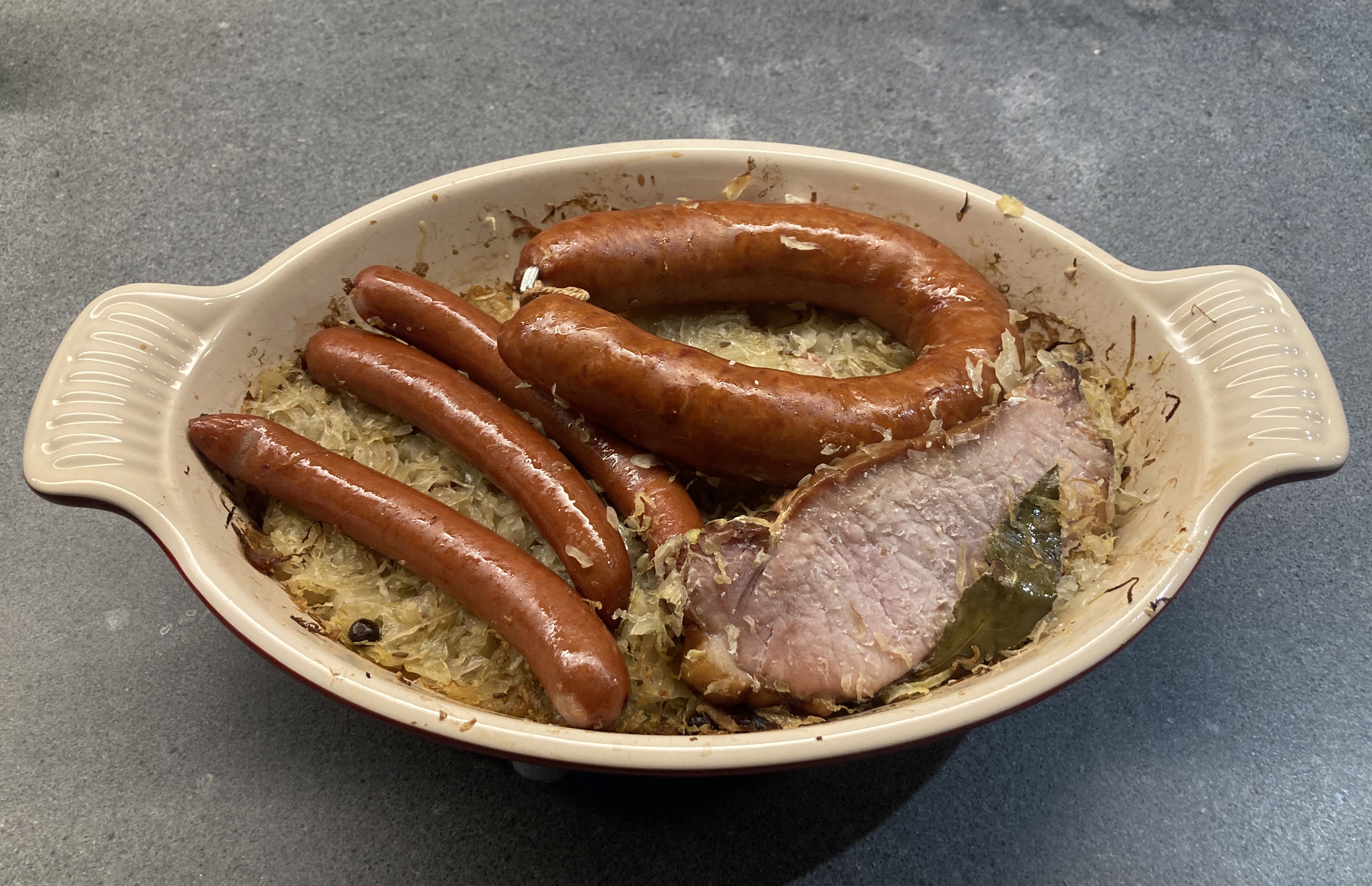
A classic choucroute is a tribute to winter food. You could go for a rich version with confit de canard or pheasant (Choucroute d’Alsa­ce) or for an unexpected combination with fish (Choucroute de la Mer). We decided to make a simple but very tasty version with pork sausages, bacon and pork meat.
The choucroute is moist and soft, the meat comes with some nice fat and a light smoky aroma, the juniper berries are full of flavours. Ah, it makes you love winter.
Preparing choucroute can be done in various ways, including cooking in water. We prefer the slow approach in an oven at 80° Celsius or 175° Fahrenheit during four to six hours.

Some add goose fat to the choucroute to enhance the taste, but that’s too much for us. We actually prefer a light version of the vegetable, allowing the meat to bring fat to the dish and a velvety mouthfeel.

Wine Pairing

The obvious choice is probably a white wine from the Alsace region in France. Which is exactly what we did. We were looking for a refreshing, round white wine and decided to drink a glass of Pinot Gris as produced by Cave de Beblenheim. Perfect with the present flavours of the choucroute.

What You Need

  • 400 grams of Sauerkraut
  • One Shallot
  • Juniper Berries
  • Caraway seed
  • 4 strips of Bacon or Pancetta
  • Dry White Wine
  • Olive Oil
  • Two Bay Leaves
  • Various Sausages and Pork Meat (all organic)
  • Dijon Mustard
  • Optional: a mash made with Parsnip and Parsley Root

What You Do

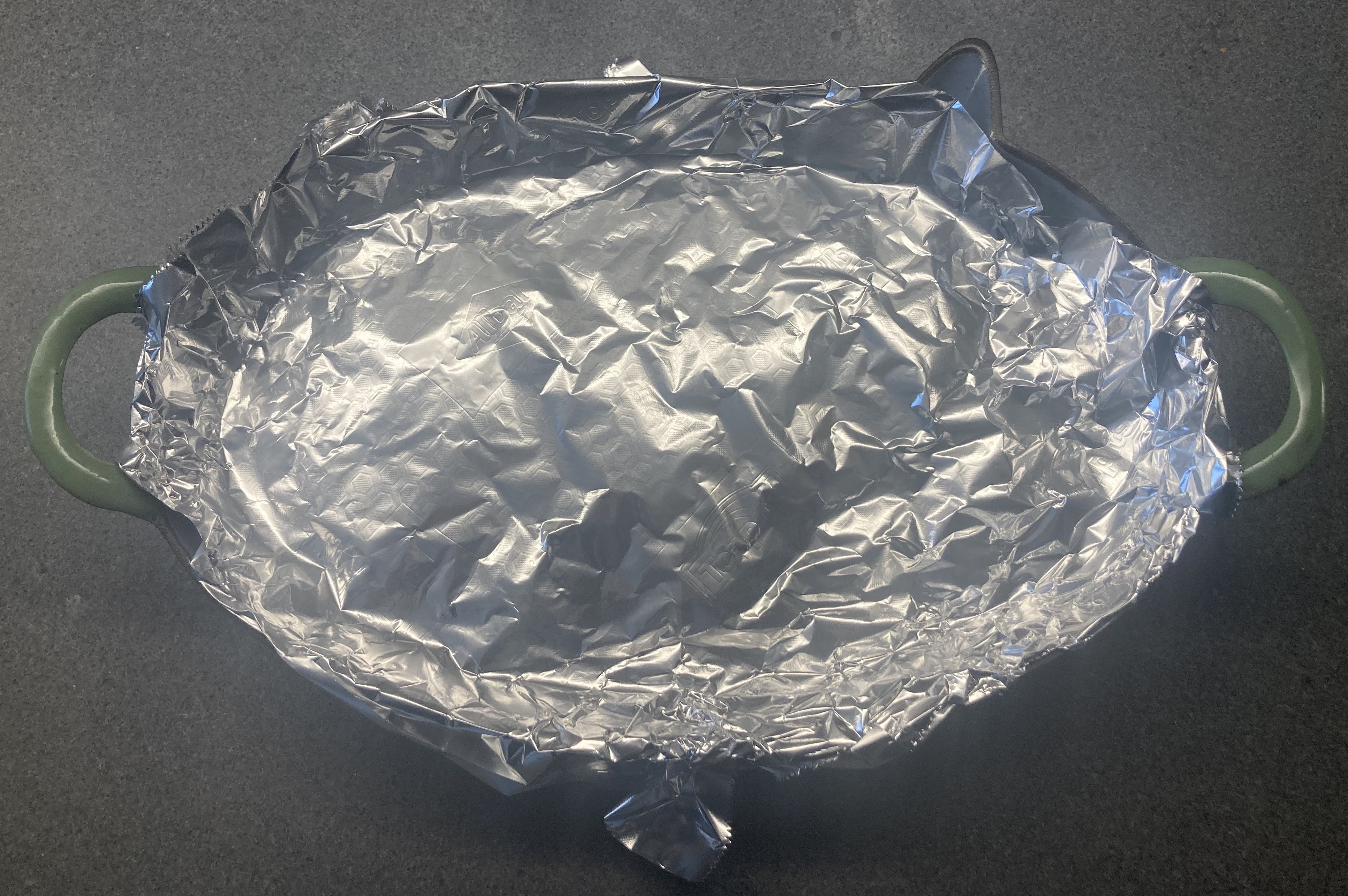
Taste the sauerkraut. If too much acidity, then squeeze and remove some of the liquid. Peel and slice the shallot. Crush the juniper berries and the caraway seed lightly. Slice the strips of bacon or pancetta in 6 or 8. Combine the sauerkraut with the shallot, the caraway seed, the berries and the bacon. Add some white wine, a splash of olive oil and two bay leaves. Transfer the mix to a heavy (iron) oven dish. Put some aluminium foil on top of it, making sure you press it on the sauerkraut (as if it’s a cartouche). Leave for 4 – 6 hours in the oven on 80° Celsius or 175° Fahrenheit. Check the choucroute every hour to make sure it’s sufficiently moist. Also move the slightly browned choucroute at the edge to the centre of the dish. One or two hours before serving add the meat to the dish. Serve with some Dijon mustard.

And The Winner Is…

The 2022 Johannes van Dam prize will be awarded to Belgian Chef Jeroen Meus during the Amsterdam Symposium on the History of Food on February 11th. Jeroen Meus is well known for his inspiring daily TV program Dagelijkse Kost (Daily Food). In this 15 minutes program he shares the fun of preparing food, for instance crumble pie with pears and raisins, monkfish with a mustard crust or penne with chorizo and red bell pepper. His aim is not to cook on Michelin Star level, his aim is to help everyone prepare tasty, good food, every day of the week. His books and website (in Dutch only) support this goal in a very helpful way.

He is a true TV-chef in the sense that he is in contact with his viewers. He is entertaining, professional, funny and never arrogant. He balances traditional Belgian food with changes in our culture (more focus on vegetables, more variation, different cultures). His food reflects these changes and inspires us to follow his friendly culinary adventures.

The prize is named after culinary writer and critic Johannes van Dam who was not only known for his reviews of restaurants but also for his massive collection of books on food and drinks. The prize is awarded to individuals who have made an outstanding contribution to the dissemination of the knowledge on international gastronomy. Jeroen Meus, through his tv programs, books and website, has clearly done so. His cooking brings people together and broadens our culinary scope.

Previous winners of this prestigious prize include Yotam Ottolenghi, John Halvemaan, Carlo Petrini, Alice Waters, Claudia Roden, Harold McGee and Alain Passard.

Jeroen Meeus Atribution: Arne Aelterman, CC BY-SA 4.0 , via Wikimedia Commons
Jeroen Meus – attribution: Arne Aelterman, CC BY-SA 4.0 , via Wikimedia Commons

Culinary Trends

Suppose we would publish a recipe that would include instructions such as “Coat cubes of pork meat with curry and microwave these for 2 minutes”, and “Combine oil, chilli, garlic and onion, heat for 1 minute on 100% power, add chicken stock, soy sauce and corn starch, stir and heat for 2 minutes on 50%”, you would of course think you are back in the 1980’s.

It’s fascinating that what we buy, the way we prepare it, and even how we serve and eat it, is constantly changing. Just look at the pictures in a 1950’s cookbook and try not to smile. Impossible.

Knowing that our culinary habits are constantly changing is one thing, understanding why they change is much more complex. 

Influence

A great example of a supplier influencing their customers is a magazine called Allerhande, published by leading Dutch supermarket Albert Heijn. The magazine, first published in 1954, is not your ordinary flyer with an overview of discounted articles, it’s a reflection of culinary trends (linked of course to what’s available in the supermarket) and trends in society with a focus on the individual.

Dutch author Klaartje Scheepers was brave enough to read all issues since 1954 and in her excellent book Van Aardappel tot Avocado (available in Dutch only) she describes how closely food is linked to our daily life and the world we live in. She writes about the 1950’s housewife struggling to keep her family happy and well-fed, about the introduction of the tv-dinner, about nutrition, the need to have a refrigerator, a blender, a microwave, an electric tin opener, about how we started to embrace dishes from other countries, including something odd called pizza, about diets and of course, about how supermarkets are closely monitoring these developments.
Reading Van Aardappel tot Avocado is a pleasure, not only because of the interesting insights, but also because it helps you recognize today’s trends. And of course it’s also a fun trip down memory lane. Highly recommended!

Your Menu

Why not sit back, take a sip of wine and wonder how your Seasonal menu is influenced by your local supermarket, by well-known chefs, culinary influencers and blogs. What made you decide? Availability? Recipe on the internet? Price? Friends? As seen on Youtube?
Interesting, isn’t it?

Klaartje Scheepers - Van Aardappel tot Avocado
Klaartje Scheepers – Van Aardappel tot Avocado

Symposium on the History of Food

Next year on February 11th and 12th, the 7th Amsterdam Symposium on the History of Food will take place in Amsterdam. You can also join online, for € 40,00 only. Lunch not included of course. This year’s theme is Food and the Environment: The Dynamic Relationship Between Food Practices and Nature

Program

The key note will be delivered by Ewout Frankema, Professor of Rural and Environmental History at the Dutch Wageningen University and research fellow of the UK Centre for Economic Policy Research (CEPR). Amongst the speaker are Christian Reynolds on The evolution of “sustainable” and vegetarian recipes from manuscripts and cookbooks to online and Amber Striekwold on The Dutch Alternative Food Movement.

Ceremony

On Friday 11th the program will close with the Prize-giving ceremony of the 2022 Johannes van Dam Prize and the 2022 Joop Witteveen Prize. Previous winners of the prestigious Johannes van Dam Prize include Yotam Ottolenghi, John Halvemaan, Carlo Petrini, Alice Waters, Claudia Roden and Alain Passard (see picture).

Join the Symposium

Additional information and the registration form are available on the website of the symposium.

Alain Passard speeches after having received the Johannes van Dam Prize 2019 © cadwu

Veal with Mai Take and a Madeira jus

The Dancing Mushroom

In Japan and China Mai Take (or Hen of the Woods) is a much-loved culinary mushroom. Legend has it that Mai Take got its name because foragers danced with happiness when finding it. Mai Take can be wild or cultivated but in both cases its taste is powerful, intense and nutty. Make sure you cook Mai Take through and through, otherwise you may upset your stomach (and other parts of your body).
Mai Take combines very well with beef and thyme. It is also great when combined with shrimps, crab, coquilles St Jacques, coriander, dill and parsley; a salad created by Antonio Carluccio and published in 2003 in the Complete Mushroom Book. The book has a wealth of wonderful, simple recipes.

In this case we combine beautiful veal rib eye with Mai Take, using a Madeira jus to bring the flavours together. The fried Mai Take comes with a lovely crunch. We love the way the taste of the combination develops in the mouth. We use rib eye because it is the most tender and delicate part of the veal. It is nicely marbled making it an excellent choice to grill or fry.

Don’t be tempted to buy so called ‘cooking Madeira’. This is some horrible, sweet liquid that is not even close to Madeira. One for the bin. We bought a bottle of medium dry Madeira (Santa Maria). It is perfectly suited for this recipe.

Wine Pairing

A Rioja Crianza is a good choice. In general a Rioja Crianza is a high-quality, affordable wine. It’s not too rich, but with Tempranillo’s natural high tannin it has quite a bit of body. The wines are commonly aged for one year in used oak casks, so the oak flavours are not too strong. The wine will show notes of sweet spice, vanilla, black and red fruit.

What You Need

  • Veal Rib Eye (let’s say 300 grams)
  • Veal stock
  • 75 gram Mai Take
  • Olive Oil
  • Butter
  • Madeira
  • Black Pepper

What You Do

The veal must be at room temperature. So take it out of the refrigerator let’s say 2 hours in advance. Heat a heavy iron skillet, add olive oil and butter. Fry and cook to perfection (pink is the colour you’re looking for). You could also transfer it to the oven for an internal core temperature of 60° Celsius or 140° Fahrenheit. When ready wrap in foil and allow to rest for 15 minutes. Add some veal stock and Madeira to the pan and warm. Add the liquid from the veal on a regular basis.
Remove the base of the Mai Take and then slice in 2 of 4 parts and fry for a few minutes. Apply some pressure, you want the Mai Take to look like a fan, perhaps the suggestion of coral.
Slice the veal and serve with the Mai Take, a generous amount of jus and some black pepper.
PS In case you have too much meat, simply store it in the refrigerator for the next day and serve as Vitello Tonato.

Roulade of Chicken with Rosemary and Pancetta

A Kitchen Puzzle

Roulade sounds terribly old-fashioned. And if not old-fashioned it will probably make you think of meat in a net, seasoned with something like ‘chicken herbs and spices’. Yuk! You have two options: ask your butcher to make one for you or the much-preferred option: Do It Yourself.
The key to a roulade is to buy smaller bits of meat. In this case we used 4 chicken thighs. This is the very tasty, boneless half of a chicken leg. To create a roulade you need fairly thin slices of meat that will be the outside of the roulade. For the inner part of the roulade you can use smaller, chunkier bits. Take your time to solve the puzzle. It may seem easier to buy one thin slice of meat and simply roll it up, and that could work very well with beef, but building a roulade with smaller bits of pork, veal or chicken is very rewarding. Use plenty of kitchen string to make the roulade.
After having tied the last knot, leave the roulade in the refrigerator for a few hours. This will help the roulade to become firm, which is helpful when frying it. It will also help the flavours to integrate.

Wine Pairing

We enjoyed our Roulade with a glass of excellent Austrian Zweigelt. This red wine is fruity and elegant which combines really well with the powerful rosemary and the full-bodied chicken roulade.

What You Need

  • 300 grams of Chicken Thigh
  • 3 sprigs of Rosemary
  • 2 slices of Pancetta
  • Butter
  • Olive Oil
  • Thyme
  • Chicken stock
  • Cream

What You Do

When you’ve solved the puzzle, simply add two slices of pancetta and the two sprigs of rosemary. Tie the roulade together with kitchen string. Cool for a few hours in the refrigerator. Heat some butter and olive oil in a skillet. Fry the roulade making sure you fry the seam first. A few minutes should be sufficient. Transfer the roulade to the oven, let’s say 160 °C. A higher temperature will shorten the cooking time and enhance the color, but you risk an overdone roulade. That’s why we prefer 160 °C or lower. When your roulade is bigger, feel free to turn it every 10 minutes.
Remove the roulade when the temperature in the centre is 70 °C. Wrap in foil and leave to rest for at least 15 minutes.
Start building the sauce by adding chicken stock, the third sprig of rosemary (leaves only) and some thyme. Cook gently for 5 – 10 minutes. Use a blender to make a smooth mixture and pass through a sieve. Transfer back to the skillet and add some cream. Remember to add the juices of the roulade as well. The juices should be clear. If not, the roulade needs to rest longer.
When the sauce is ready to be served, transfer the roulade from the foil, carefully remove the string and slice the roulade with a very sharp kitchen knife. Serve with the sauce on a hot plate.