No-Knead Bread

Two or three times per week we enjoy the taste of fresh home-made bread. The crust, the flavours, the aromas! And how about the singing of the bread when it’s just out of the oven? Baking your own bread is such a pleasure.

Our recipe is based on a recipe published by Jim Lahey, owner of Sullivan Street Bakery, New York. It was published in the New York Times in 2006 and can also be found in his excellent book My Bread. The process is time consuming (it’s 24 hours from start to finish) but not labour intensive. It’s simple and straightforward with a great result. We truly love it.

The recipe is based on slow-rise fermentation. With only 1 gram of instant yeast in combination with 19+3 hours of rest the yeast will do a wonderful job. The dough will be perfect. And kneading, as you would expect, is not required.

Origin

In 1764 Elizabeth Moxon describes a no kneading bread recipe as shown in this nice instructive video.
Her recipe: To half a peck of flour, put a full jill of new yeast, and a little salt, make it with new milk (warmer than from the cow) first put the flour and barm together, then pour in the milk, make it a little stiffer than a seed-cake, dust it and your hands well with flour, pull it in little pieces, and mould it with flour very quick; put it in the dishes, and cover them with a warm cloth (if the weather requires it) and let them rise till they are half up, then set them in the oven, (not in the dishes, but turn them with tops down upon the peel;) when baked rasp them.
Interesting that she rasps the bread: she is not interested in the crust!

Jim Lahey

My Bread is such a wonderful book. The first chapters describe the background, the process and the basic recipe. In the next chapters you will find recipes for special bread, such as Fresh Corn Bread and Banana Leaf Rolls plus inspired recipes for Pizza Fungi and Focaccia.

My Bread is available via your local bookshop and the usual channels for something between 20 and 30 euro or US dollar.

What You Need

  • 200 grams of Whole Grain Flour
  • 230 grams of Plain White Flour
  • 1 gram Instant Yeast
  • 25 grams Blue Poppy Seed
  • 30 grams Brown Linseed
  • 4 grams Salt (this is less than usual, most recipes for bread would say 8 grams)
  • 350 grams Water
  • Additional Flour
  • Bran

What You Do

Simplest is to buy My Bread or look at the recipe and movie as provided by the New York Times.

Mix flour, yeast, seeds and salt. Add water and create one mixture. Let rest in a covered bowl for 18 hours. Remove from bowl, fold 4 times, dust with additional flour and let rest on a towel dusted with flour and bran for 3 hours. Check that the pot (and the handles!) can be used in a really hot oven. Transfer the pot to the oven and heat your oven to 235˚ Celsius or 450˚ Fahrenheit. Put the dough, seam side up, in the pot, close it and bake for 30 minutes. Remove the lid and bake for 15 minutes or until it is nicely browned. Let cool on a wire rack for at least an hour before slicing it. Listen to your bread signing!

Chez Panisse

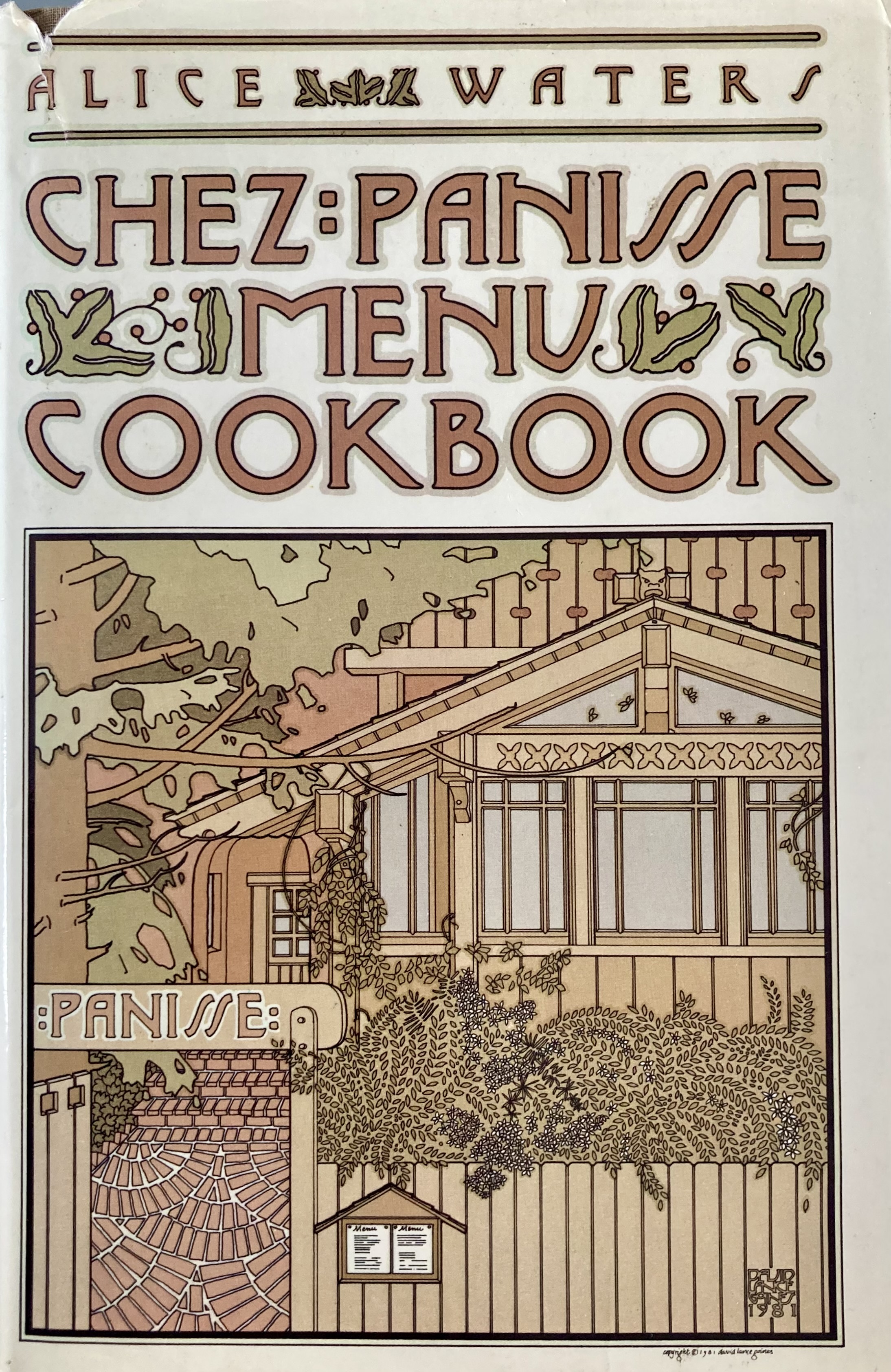
Alice Waters’ restaurant is called Chez Panisse, which is also the title of her Menu Cookbook, published in 1982. The book is centred around menu’s, emphasising the importance of combing dishes to create a balanced dinner or lunch.
In the introduction she describes how as a child she wanted fresh green beans and charcoal-grilled steaks every birthday dinner. And how she would sit out in the strawberry patch, happily eating fresh berries. In 1963 at the age of 19 she went to France for a year, to eat. Back in Berkeley her love for food transformed in opening her restaurant Chez Panisse in 1971.

Activist 

In the chapter What I Believe About Cooking she writes as American chef and activist. She discusses how the US as a nation is removed from any real involvement with food and how the US people (and probably many more) are alienated by frozen and hygienically sealed food. She writes: ”Food should be experienced through the senses.” And also: “… we have been indoctrinated into believing that by making food preparation easier and less time-consuming, we’re gaining valuable free time. No mention is ever made of what we lose by this whittling away at our direct contact with food or what better things we might do with the time thus gained.”
We couldn’t agree more! There is so much fun and love in buying, cooking and enjoying food. Sit down, take your time, and talk about food, wine and life.

Favourite

One of our favourites from Chez Panisse is her eggplant soup with dots of red bell pepper. Not difficult to prepare and a joy to eat and serve. The taste is rich yet light, fresh and uplifting. The combination of egg plant, garlic and red onions plus bell pepper works very well, probably because both are charred. Use vegetable stock and you will have a great vegetarian starter. 

Other titles by Alice Waters include We Are What We Eat (A Slow Food Manifesto) published in 2021, The Art Of Simple Food (I and II) and My Pantry (2015). (Audio) Books are available via your local bookstore, the well known channels and Chez Panisse.

More mushrooms!

Mushroom is one of the first books by Johnny Acton, Nick Sadler and Jonathan Lovekin (photographs), published in 2001. The book offers some 70 recipes plus very interesting background information on the history of mushrooms and their hallucinating, psychedelic and culinary aspects. The book comes with many beautiful drawings and photographs. It has specific sections on cèpes, morels, chanterelles and truffles. It is very well written, fun to read and the recipes are accurate.

They have also written books on Soup, Preserves and one called The Complete Guide to Making, Cooking & Eating Sausages.

Recipes

One of the benefits of the book is that the recipes range from relatively easy to make (pasta with cèpes or clear soup with enoki for instance) to exotic and mouth-watering dishes (lobster and cauliflower fungus ravioli with saffron butter). The book is a great addition to more classic books on mushrooms such as The Mushroom Book by Michael McLaughlin, The Mushroom Feast by Jane Grigson or Antonio Carluccio’s Complete Mushroom Book.

In most cases it’s not too difficult to buy the required mushroom. Shopping at your local Asian toko will also help, for instance if you need shiitake, enoki or wood ear (they offer a recipe for a very nice Chinese chicken soup with ginger, pak choi and dried wood ear).

Our favourite? Perhaps their salad with shiitake, watercress and tofu. A modern, light dish with lots of flavours (cilantro, ginger, sesame oil, lemon).

Mushroom is available (in most cases second hand) via channels such as Amazon and e-Bay for between 10 and 25 euro.

Mushroom

The Quiet Hunt

Antonio Carluccio’s The Complete Mushroom book is more than a cookbook. The first part of the book discusses foraging and collecting mushrooms, with clear descriptions of each mushroom and poisonous look-alikes. It’s a pleasure to read, but we’re not brave enough to start our own quiet hunt.

Fortunately, mushrooms are becoming more popular and greengrocers and supermarkets have started selling chestnut mushrooms, button mushrooms and shiitake. Asian supermarkets in most cases sell (king) oyster mushrooms, shiitake, enoki and shimeji.
Don’t be tempted to buy dried mushrooms: expensive, no aroma, nasty taste and not even close to a fresh mushroom.

Recipes

The second part of the book includes some 150 mushroom recipes, ranging from classic Italian dishes to culinary treats. Carluccio’s recipes are well written and informative. You’ll get the feeling that he lets you in on some of his secrets. And given he started foraging mushrooms as a young child, there are a lot of secrets to share!

One of our favourites is a salad made with maitake, fresh scallops, crab and shrimps. It’s an amazing result, with lots of pleasant flavours, also thanks to the cilantro, dill and parsley. Part of the fun is that the scallops are not seared but prepared like ceviche. Maitake is also available as a cultivated mushroom.

Caponata

More favourites? Of course! How about Mushroom Caponata or Tagliolini with black truffle? The caponata is a combination of mushrooms, egg plant and various herbs, so if you can buy button mushrooms and for instance shiitake, you’re ready to go.

Our all-time favourite from this book is the combination of fresh oysters with white truffle (bianchetti). A starter we prepare once or twice a year, depending on the availability of the truffle. Always a pleasure…

The Mushroom Book – the Quiet Hunt was published in 2001. It’s available (in most cases second hand) via channels such as Amazon and e-Bay for prices between 25 and 50 euro.

One of the very best books on mushrooms, written by a true expert.

PS

Later we found an earlier book by Antonio Carlucci called A Passion for Mushrooms, published in 1989. Very little overlap in recipes. A must-have for mushroom lovers!

Earthly Delights

The Mushroom Book by Michael McLaughlin and Dorothy Reinhardt (Illustrator) is a lovely, small book with some 35 recipes and 60 very delightful full-colour wood-cut illustrations. Just look at the cover! It’s the kind of book that we bought because it looks good. A book you simply want to have.

Only later did we find out that it discusses the history and other interesting back ground information of various mushrooms, including information on choosing, storing and preparing them. The book offers an introduction to the joy of cooking with mushrooms such as button mushrooms, morels, oyster mushroom, truffle, trompette de la mort, chanterelle, shiitake, cèpes and huitlacoche, a Mexican mushroom that grows on corn.
Michael McLaughlin is also known as co-author of The Silver Palate Cookbook with recipes from Manhattan’s celebrated gourmet food shop.

Amongst our favourite recipes are Mushroom Tapenade and Raw Mushroom, Fennel and Provolone Salad.

The Mushroom Book was published in 1994. It’s available (in most cases second hand) via channels such as Amazon and e-Bay for something like 15 euro. Ii is an ideal and friendly introduction to the world of earthly delights. 

The Mushroom Book
The Mushroom Book

The Mushroom Feast

Yes, it’s a bit early, but we can start thinking about enjoying the first mushrooms of this season, such as the Mushroom of Saint GeorgeMorels, Bianchetti and the Fairy Ring Mushroom. Let’s be prepared for the season and think about books, recipes, web sites and food-wine pairing.

A classic book on mushrooms was written by chef and author Jane GrigsonThe Mushroom Feast, originally published in 1975. The book Is beautifully illustrated by Yvonne Skargon.
Jane Grigson is known for many other classics such as The Fruit Book and The Vegetable Book.

The Mushroom Feast includes a chapter on the best edible mushrooms and ways to preserve mushrooms. Other chapters describe how to combine mushrooms with fish, meat, poultry and game. One chapter discusses mushrooms in the Japanese and Chinese kitchen.
Jane Grigson also provides interesting background information, like Colette’s view on truffles. Worth reading, with or without truffles.

It isn’t a handbook for foragers, but no book ever is.

The Mushroom Feast covers a wide range of mushroom recipes: soups, salads, pies, sauces and intriguing combinations like creamed cucumbers with mushrooms and classics like mushroom soufflé. The recipes are clear and well-written.

You may perhaps think the recipes are a bit old fashioned, but that shouldn’t stop you from reading them. Be inspired by one of Britain’s finest writers on recipes and food.

Hilaire Walden

Some chefs love the limelight, some prefer to stay in the background, focusing on cooking and writing. Hilaire Walden is clearly one of them. 

She is author of some 40 books and she has written for prestigious magazines and newspapers about food, cooking and restaurants. She wrote The Great Big Cookie Book, The Book of Tapas and Spanish Cooking, the Book of French Provincial Cooking, The Singapore CookbookQuick After Work Summer Vegetarian CookbookThe Book of Fish and Shellfish and more recently I Love My Barbecue. Indeed, a broad culinary spectrum!

The Loire

One of our favourites is Loire Gastronomique. In this book she follows the course of the French river and describes the various regions, local products, local recipes and of course the wines that go with it. Cheese, cookies, pies, everything. The Loire region is known as the Garden of France. In this garden you’ll find wonderful castles (Azay-le-RideauChambordChinon), great wine (MuscadetSancerrePouilly-Fumé) and beautiful food (asparagus, lots of fruit, artichokes and of course Lentille Verte du Puy). The book is inspiring and it will make you dream of a walk along the Loire, with a view on Amboise and a glass Crémant de Loire in your hand.

Recipes

One of the benefits of Hilaire Walden’s recipes is that they are always correct. Sounds odd, but as we all know, unfortunately, often recipes are simply not complete or correct.
If you prepare a dish for the first time, simply follow her instructions and you’re fine.

She started publishing books around 1980, so perhaps your favourite book will be second hand, but don’t worry, it will not be outdated.

Fish Cakes by Jean Beddington

Jean Beddington: a culinary, passionate creative! She was chef at five restaurants, owned her own successful restaurant, and still is an inspiration to many. One of her motto’s is ‘seemingly simple’, not with the intention to impress but with the intention to surprise and enhance the sensation when enjoying her food and the way it is presented.

Background

In her book Absolutely Jean Beddington she writes about her background, her youth in England, her eagerness to cook, the holidays with her father when they would stay at budget hotels and eat at Michelin Star restaurants, her travels, her years in Japan and her education (she studied Arts and Chemistry). When she moved to the Netherlands, she decided to become a chef, which is the obvious choice for someone with such a talent. She was one of the first to bring new ingredients to the classic French cuisine. For instance, she began using cilantro and yuzu. She was also inspired by the Japanese way of presenting food: beautifully designed and served on a variety of plates. She began doing this when most guests still expected bread and garlic butter at the beginning of their lunch or dinner.

Books

She published several books. One is dedicated to stock: the basis of soups, sauces and dishes. She explains how to make stock and how to create delicious food, for instance green vegetables in stock with couscous, yogurt and harissa sauce. 

Her book Absolutely Jean Beddington is very dear to us. It has three main chapters: the first one is called Glossy with beautifully presented food, the second one is called Real Time with food as you could expect to eat at her restaurant (which is closed, unfortunately) and our favourite chapter is called Daily. Indeed, recipes that are easy to follow and help prepare tasty, wonderful food, every day.

Fish Cakes

We prepared her fish cakes with a beetroot, ginger, apple and onion chutney. The fish cakes are intriguing and the chutney is the perfect accompaniment. Yummy!

The 2022 Johannes van Dam Prize

Today the program of the 7th Amsterdam Symposium on the History of Food closed with the Prize-giving ceremony of the 2022 Johannes van Dam Prize and the 2022 Joop Witteveen Prize. Previous winners of the prestigious Johannes van Dam Prize include Yotam Ottolenghi, John Halvemaan, Carlo Petrini, Alice Waters, Claudia Roden and Alain Passard.

Joop Witteveen Prize

The Joop Witteveen prize was awarded to Marleen Willebrands, Christianne Muusers and Alexandra van Dongen, authors of Het Excellente Kookboek van doctor Carolus Battus. This book focus on the culinary world of doctor Battus, who lived from 1539 until 1619. His cookbook was published in 1593.

Two publications were shortlisted: Dirk-Jan Verdonk, Dierloos: Een geschiedenis van vegetariërs en veganisten in Nederland and Ingrid de Zwarte, Hongerwinter.

Marleen Willebrands and Christianne Muusers

Johannes van Dam prize

The 2022 Johannes van Dam prize was awarded to Belgian Chef Jeroen Meus. He is well known for his inspiring daily TV program Dagelijkse Kost (Daily Food). In this 15 minutes program he shares the fun of preparing food, for instance crumble pie with pears and raisinsmonkfish with a mustard crust or penne with chorizo and red bell pepper. His aim is not to cook on Michelin Star level, his aim is to help everyone prepare tasty, good food, every day of the week. His books and website (in Dutch only) support this goal in a very helpful way.

Professor Louise O. Fresco, President of the Executive Board of Wageningen University & Research and chair of the jury, emphasised that Jeroen has a true talent to bring food and people together. She also highlighted his passion to prepare good food, and the fact that he shares that passion not only through cookbooks, but also via social media and a daily show on television. She mentioned he is an inspiration to all of us who love to cook and enjoy food.

Jeroen thanked the jury and all those who supported him over the years. He mentioned that he shared the love for meatballs with potato mash and endive (Chicorium endivia) with culinary journalist and food expert Johannes van Dam. He promised to prepare this dish next week on television, as a tribute to good food and to the prize.

The Chef of Kings

Just a few years before the height of the French revolution, Antonin Carême was born in the poorest area of Paris. He was abandoned by his parents and at the age of 10 he started his career by sweeping floors of a chophouse. It turned out to be the career of a celebrity. He was not only King of Chefs, he was also Chef of Kings: amongst them Napoleon, the Prince Regent (later George IV) and Tsar Alexander I.

365 Menu’s

At the age of 21 the influential politician Talleyrand asked him to become chef at the Château de Valençay. On instruction from Napoleon, Talleyrand would entertain 4 times per week for at least 36 (foreign) guests. Carême was asked to create a menu for every day of the year, without repetition. And since meals were served a la Française (a variety of dishes served simultaneously) this meant Carême had to create many dishes. Fortunately, he kept note of what he served and how he prepared it.

In his inspiring book Cooking For Kings, the live of Antonin Carême, The First Celebrity Chef, author Ian Kelly introduces us to the world of Antonin Carême. In a very easy to read, inviting way he describes the menus and food as created by Carême.  For instance, on page 76 he includes the menu as served on June 8th, 1806 at the Château: two soups, followed by twelve dishes and four desserts, including intriguing dishes such as Young Turkey in Watercress and Flan Milan. All menus and recipes from his days at the Château are included in his book Le Maitre d’Hotel Français (Paris, 1822).

Potage

Soups were important to Carême and since he served at least two soups per menu, the number of soups he created is more than impressive. Some seem a bit outdated (Potages d’anguille de Seine au pêcheur (with eel from the Seine)), others would be perfect in today’s kitchen (Potage de purée de d’oseille et du cerfeuil (with sorrel and chervil)).

At the end of his career Carême was asked by James Mayer and Betty de Rothschild to become their chef. Carême, who basically had already retired because of his very poor health, was tempted by a more than generous budget and accepted. The couple also supported his writing. De Rothschilds, very much nouveau riche, intended to achieve a position in the Parisian high society by hosting gala’s, lunches, dinners and receptions.  Of course, with Carême leading, they were very successful. Amongst their regular guests were Heinrich Heine, Frédéric Chopin, Victor Hugo and Gioacchino Rossini. They also regularly invited the press enhancing the celebrity status of Carême even more. And in his slipstream, they became more important.

Last Years

During his last years (he died aged 48 probably due to inhaling toxic fumes of the coal burning stoves) Carême wrote L’Art de la cuisine française au dix-neuvième siècle. Traité élémentaire et pratique. Five volumes, nearly 1700 pages with menus, recipes and drawings. A clear legacy of a Chef who is still remembered for his Charlotte Russe, the Tournedos Rossini, his systemisation of the kitchen and the four mother sauces.

Cooking For Kings, the live of Antonin Carême is a tribute to a devoted, extremely talented chef. The book includes several very interesting recipes, for instance Gelee de Verjus and Petits Croustades de Cailles. Perhaps old school, but nevertheless worth trying!