Pasta with Mushrooms and Bell Pepper

Udon is such a wonderful noodle. What better comfort food than a warm soup made with dashi, vegetables, tofu, udon and thinly sliced spring onions? Perhaps some tempura on top of the soup? Or would you prefer a very simple dish, called Mori Udon? The cold udon is served with a sauce of mirin, dashi and soy sauce on the side.
Udon is also a great alternative to Italian pasta, for instance with Caesar’s Mushrooms.

In this recipe we combine udon with roasted bell pepper and Trompettes de la Mort. We’re not sure why, but this combination works really well. Is it because of the smokey aroma of the roasted bell pepper mixed with the aromas of the mushroom? The crispy pancetta in combination with the soft textures of the other ingredients, including the udon? The overall richness and umami thanks to the Trompettes de la Mort?

Wine Pairing

We enjoyed our pasta with a glass of Bianco di Custoza, made by Monte del Frà from Italy. It is a well-balanced, dry white wine, with a fruity nose. Its colour is straw yellow, with pale green highlights. A glass of Soave, made from the Garganega grape, will also be an excellent choice. In general you’re looking for a fresh, aromatic dry white wine. 

What You Need

  • 1 Red Bell Pepper
  • 1 Bunch of Udon
  • 100 grams of Trompettes de la Mort
  • 1 Glove of cooked Garlic
  • 4 slices of Pancetta
  • Black pepper
  • Olive Oil

What You Do

Clean the bell pepper and cut in 4. Transfer to the oven and grill or roast for 10 minutes or until well charred. When still hot, put the bell pepper in a plastic container and close it. After one hour it’s easy to remove the skin of the bell pepper. Slice lengthwise to make nice strips. Set aside.
Slice the mushrooms in two and clean them with a soft brush. Check carefully for grit and other things you don’t like to eat.
Fill a large pan with water (no salt!) and bring to a boil. Add the udon and cook it according to the instruction. When nearly done, add some cooking liquid to a cup and set aside. Drain the udon.
In parallel heat a large heavy iron skillet, add olive oil and fry the mushrooms. Once they become a bit dryer, add the sliced bell pepper. Add the cooked garlic, crush it with a fork and mix. Now add the udon and continue mixing. Add cooking liquid until the pasta is sufficiently moist.
Also in parallel: grill the strips of pancetta (perhaps 5 minutes).
Add some black pepper to the pasta and serve with the grilled pancetta.

Pasta with Mushrooms and Bell Pepper ©cadwu

Chez Panisse

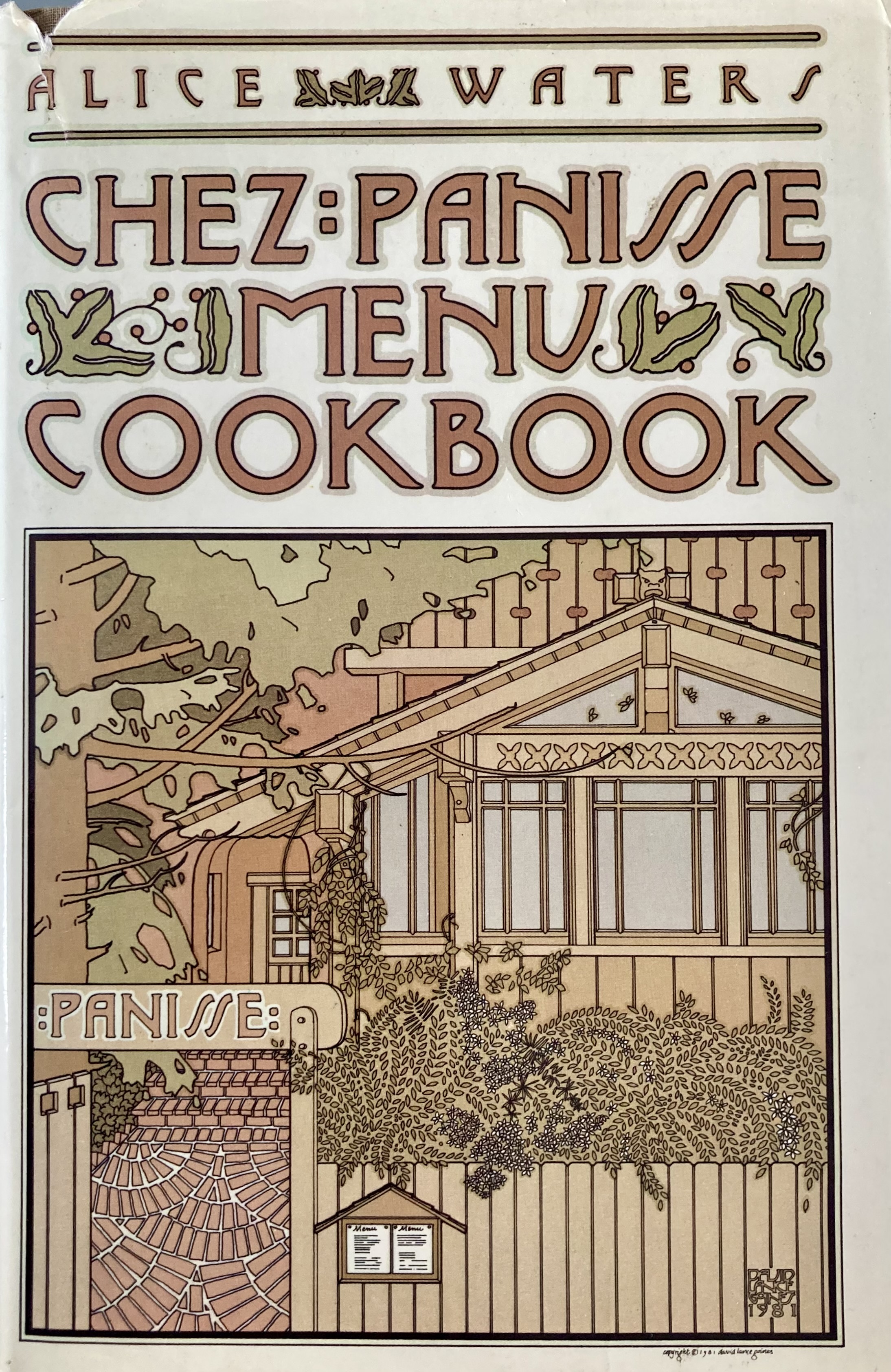
Alice Waters’ restaurant is called Chez Panisse, which is also the title of her Menu Cookbook, published in 1982. The book is centred around menu’s, emphasising the importance of combing dishes to create a balanced dinner or lunch.
In the introduction she describes how as a child she wanted fresh green beans and charcoal-grilled steaks every birthday dinner. And how she would sit out in the strawberry patch, happily eating fresh berries. In 1963 at the age of 19 she went to France for a year, to eat. Back in Berkeley her love for food transformed in opening her restaurant Chez Panisse in 1971.

Activist 

In the chapter What I Believe About Cooking she writes as American chef and activist. She discusses how the US as a nation is removed from any real involvement with food and how the US people (and probably many more) are alienated by frozen and hygienically sealed food. She writes: ”Food should be experienced through the senses.” And also: “… we have been indoctrinated into believing that by making food preparation easier and less time-consuming, we’re gaining valuable free time. No mention is ever made of what we lose by this whittling away at our direct contact with food or what better things we might do with the time thus gained.”
We couldn’t agree more! There is so much fun and love in buying, cooking and enjoying food. Sit down, take your time, and talk about food, wine and life.

Favourite

One of our favourites from Chez Panisse is her eggplant soup with dots of red bell pepper. Not difficult to prepare and a joy to eat and serve. The taste is rich yet light, fresh and uplifting. The combination of egg plant, garlic and red onions plus bell pepper works very well, probably because both are charred. Use vegetable stock and you will have a great vegetarian starter. 

Other titles by Alice Waters include We Are What We Eat (A Slow Food Manifesto) published in 2021, The Art Of Simple Food (I and II) and My Pantry (2015). (Audio) Books are available via your local bookstore, the well known channels and Chez Panisse.

More mushrooms!

Mushroom is one of the first books by Johnny Acton, Nick Sadler and Jonathan Lovekin (photographs), published in 2001. The book offers some 70 recipes plus very interesting background information on the history of mushrooms and their hallucinating, psychedelic and culinary aspects. The book comes with many beautiful drawings and photographs. It has specific sections on cèpes, morels, chanterelles and truffles. It is very well written, fun to read and the recipes are accurate.

They have also written books on Soup, Preserves and one called The Complete Guide to Making, Cooking & Eating Sausages.

Recipes

One of the benefits of the book is that the recipes range from relatively easy to make (pasta with cèpes or clear soup with enoki for instance) to exotic and mouth-watering dishes (lobster and cauliflower fungus ravioli with saffron butter). The book is a great addition to more classic books on mushrooms such as The Mushroom Book by Michael McLaughlin, The Mushroom Feast by Jane Grigson or Antonio Carluccio’s Complete Mushroom Book.

In most cases it’s not too difficult to buy the required mushroom. Shopping at your local Asian toko will also help, for instance if you need shiitake, enoki or wood ear (they offer a recipe for a very nice Chinese chicken soup with ginger, pak choi and dried wood ear).

Our favourite? Perhaps their salad with shiitake, watercress and tofu. A modern, light dish with lots of flavours (cilantro, ginger, sesame oil, lemon).

Mushroom is available (in most cases second hand) via channels such as Amazon and e-Bay for between 10 and 25 euro.

Mushroom

Maitake

Legend has it that maitake got its nickname The Dancing Mushroom because foragers danced with happiness when finding it. It still is a much loved culinary mushroom, with a very specific aroma, interesting texture and intense flavours.
Nowadays maitake can be wild or cultivated. Both are fine; we actually prefer the cultivated one because it’s milder. Make sure you cook maitake through and through, otherwise you may upset your stomach (and other parts of your body). 

Maitake combines very well with beef and thyme. It is also great when combined with shrimps, crab, scallops, coriander, dill and parsley; a salad created by Antonio Carluccio and published in 2003 in the Complete Mushroom Book. Our Maitake soup, made with dashi, ginger and rice, is a gentle soup, with some umami and bitterness. 

In this case we combine fried maitake with various other ingredients to create a well-balanced (vegetarian) meal.

Wine Pairing

A flavourful dish! Sweetness in the tomatoes, umami in the maitake, freshness in the mash et cetera. Wine wise you have lots of options. We preferred a not too complex pinot noir, because it’s supportive and combines very well with the various flavours.

What You Need

  • 200 grams of Maitake and Olive Oil
  • Parsley Root, Jerusalem Artichoke, Crème Fraîche, White Pepper and Nutmeg
  • Small Ripe Tomatoes, Thyme, Rosemary, Garlic and Olive Oil
  • Lentils, Shallot, Parsley, Vegetable Stock and Black Pepper
  • Celeriac, Butter, Caraway Seed, Fennel Seed and Black Pepper

What You Do

For the lentils: slice the shallot and gently fry it in olive oil. After a few minutes, add the washed lentils (check for pebbles!), coat them with oil, add vegetable stock and cook until ready. Perhaps 20 minutes. Drain but keep some of the liquid, add chopped parsley and black pepper.
For the tomato confit, see an earlier post.
For the mash: clean and chop 2 parsley roots and 1 Jerusalem artichoke. Cook for 10 minutes or so in water until nearly done. Drain. Add a generous spoonful of crème fraîche and warm on low heat for 10-20 minutes. The idea is for the vegetables to absorb some of the crème fraîche. Blender the mixture, pass through a sieve and serve with white pepper. A touch of freshly grated nutmeg will be great. If you like more color on your plate, then add some chopped parsley to the mash.
The celeriac is cooked in the oven with a coating of fennel and careway seed. The recipe from Dutch chef Yvette van Boven is available via YouTube. She combines it with a home-made citrus marmalade, but that’s not necessary for this dish. Use the YouTube settings if you want to have subtitles in your own language.
Slice the maitake and fry in olive oil until done and slightly crunchy.
Serve on a colourful plate.

The Quiet Hunt

Antonio Carluccio’s The Complete Mushroom book is more than a cookbook. The first part of the book discusses foraging and collecting mushrooms, with clear descriptions of each mushroom and poisonous look-alikes. It’s a pleasure to read, but we’re not brave enough to start our own quiet hunt.

Fortunately, mushrooms are becoming more popular and greengrocers and supermarkets have started selling chestnut mushrooms, button mushrooms and shiitake. Asian supermarkets in most cases sell (king) oyster mushrooms, shiitake, enoki and shimeji.
Don’t be tempted to buy dried mushrooms: expensive, no aroma, nasty taste and not even close to a fresh mushroom.

Recipes

The second part of the book includes some 150 mushroom recipes, ranging from classic Italian dishes to culinary treats. Carluccio’s recipes are well written and informative. You’ll get the feeling that he lets you in on some of his secrets. And given he started foraging mushrooms as a young child, there are a lot of secrets to share!

One of our favourites is a salad made with maitake, fresh scallops, crab and shrimps. It’s an amazing result, with lots of pleasant flavours, also thanks to the cilantro, dill and parsley. Part of the fun is that the scallops are not seared but prepared like ceviche. Maitake is also available as a cultivated mushroom.

Caponata

More favourites? Of course! How about Mushroom Caponata or Tagliolini with black truffle? The caponata is a combination of mushrooms, egg plant and various herbs, so if you can buy button mushrooms and for instance shiitake, you’re ready to go.

Our all-time favourite from this book is the combination of fresh oysters with white truffle (bianchetti). A starter we prepare once or twice a year, depending on the availability of the truffle. Always a pleasure…

The Mushroom Book – the Quiet Hunt was published in 2001. It’s available (in most cases second hand) via channels such as Amazon and e-Bay for prices between 25 and 50 euro.

One of the very best books on mushrooms, written by a true expert.

PS

Later we found an earlier book by Antonio Carlucci called A Passion for Mushrooms, published in 1989. Very little overlap in recipes. A must-have for mushroom lovers!

Mushroom Tapenade

Years ago our favourite green grocer was the shop of Joop and Trudi Petersen, close to Amsterdam’s China Town. Not only did they sell the tastiest vegetables, fruit and mushrooms, but they also sold homemade mash (the one made with potatoes and rapini (or broccoli rabe) was wonderful), desserts, ravioli with pumpkin and Trudi’s mushroom tapenade. When Joop turned 65 in 2008 they retired and closed the shop. Obviously, we asked for the tapenade recipe, but alas, all we got was a nice, friendly smile.

In our post about the Mushroom Book by Michael McLaughlin and Dorothy Reinhardt (Illustrator) we mentioned that the recipe for Mushroom Tapenade is amongst our favourites. His tapenade is a combination of mushrooms, garlic, various herbs, red wine, anchovies, black olives and capers. Very nice, tasty and powerful, but not as delicious as Trudi’s version.

Mushroom tapenade comes with lots of umami, thanks to the mushrooms and the olives. Thinking back of Trudi’s tapenade, we’re pretty sure she enhanced the umami flavor, probably by adding some oyster sauce from the toko next door. We think that the recipe below is very close to what she created.

What You Need

  • Fresh Button Mushrooms and Shiitake (ratio 2:1)
  • 2 Garlic Cloves
  • Olive Oil
  • Thyme and Rosemary
  • White Wine
  • Black Olives
  • Excellent Olive Oil
  • Black Pepper
  • Half a teaspoon of (Thai) Oyster Sauce

What You Do

Don’t use dried mushrooms. In general they have a nasty, bitter taste, not even close to the flavor, aromas and textures of fresh mushrooms.

  1. Clean and chop the mushrooms.
  2. Finely chop the rosemary, the thyme and the garlic.
  3. Fry the mushroom in olive oil in a heavy iron skillet.
  4. Reduce heat, add herbs and garlic.
  5. After 10 minutes add a splash of white wine.
  6. Continue on low heat and wait until the wine and juices have evaporated. No rush.
  7. Transfer the mushroom mix to a plate, let cool
  8. Chop a few black olives and add these to the mix.
  9. Transfer to a kitchen aid and on low-speed start adding excellent olive oil. The result should be a tapenade, so not smooth and not oily.
  10. Add black pepper to taste.
  11. Add a small amount (1/4 teaspoon to begin with) of (Thai) Oyster Sauce. Be very careful, it should only enhance the umami.
  12. Store in the refrigerator for at least one day before using.

Earthly Delights

The Mushroom Book by Michael McLaughlin and Dorothy Reinhardt (Illustrator) is a lovely, small book with some 35 recipes and 60 very delightful full-colour wood-cut illustrations. Just look at the cover! It’s the kind of book that we bought because it looks good. A book you simply want to have.

Only later did we find out that it discusses the history and other interesting back ground information of various mushrooms, including information on choosing, storing and preparing them. The book offers an introduction to the joy of cooking with mushrooms such as button mushrooms, morels, oyster mushroom, truffle, trompette de la mort, chanterelle, shiitake, cèpes and huitlacoche, a Mexican mushroom that grows on corn.
Michael McLaughlin is also known as co-author of The Silver Palate Cookbook with recipes from Manhattan’s celebrated gourmet food shop.

Amongst our favourite recipes are Mushroom Tapenade and Raw Mushroom, Fennel and Provolone Salad.

The Mushroom Book was published in 1994. It’s available (in most cases second hand) via channels such as Amazon and e-Bay for something like 15 euro. Ii is an ideal and friendly introduction to the world of earthly delights. 

The Mushroom Book
The Mushroom Book

The Mushroom Feast

Yes, it’s a bit early, but we can start thinking about enjoying the first mushrooms of this season, such as the Mushroom of Saint GeorgeMorels, Bianchetti and the Fairy Ring Mushroom. Let’s be prepared for the season and think about books, recipes, web sites and food-wine pairing.

A classic book on mushrooms was written by chef and author Jane GrigsonThe Mushroom Feast, originally published in 1975. The book Is beautifully illustrated by Yvonne Skargon.
Jane Grigson is known for many other classics such as The Fruit Book and The Vegetable Book.

The Mushroom Feast includes a chapter on the best edible mushrooms and ways to preserve mushrooms. Other chapters describe how to combine mushrooms with fish, meat, poultry and game. One chapter discusses mushrooms in the Japanese and Chinese kitchen.
Jane Grigson also provides interesting background information, like Colette’s view on truffles. Worth reading, with or without truffles.

It isn’t a handbook for foragers, but no book ever is.

The Mushroom Feast covers a wide range of mushroom recipes: soups, salads, pies, sauces and intriguing combinations like creamed cucumbers with mushrooms and classics like mushroom soufflé. The recipes are clear and well-written.

You may perhaps think the recipes are a bit old fashioned, but that shouldn’t stop you from reading them. Be inspired by one of Britain’s finest writers on recipes and food.

Confit of Duck: a home made alternative

The traditional way of making Confit of Duck is not complex. It’s a bit time consuming and it requires some planning, that’s all. The principle is to cure the meat in salt with various herbs (thyme, cumin, rosemary) and garlic. After 24 hours or so the duck is washed with water, patted dry and then slow cooked in goose or duck fat for several hours. When ready cool and store in fat.

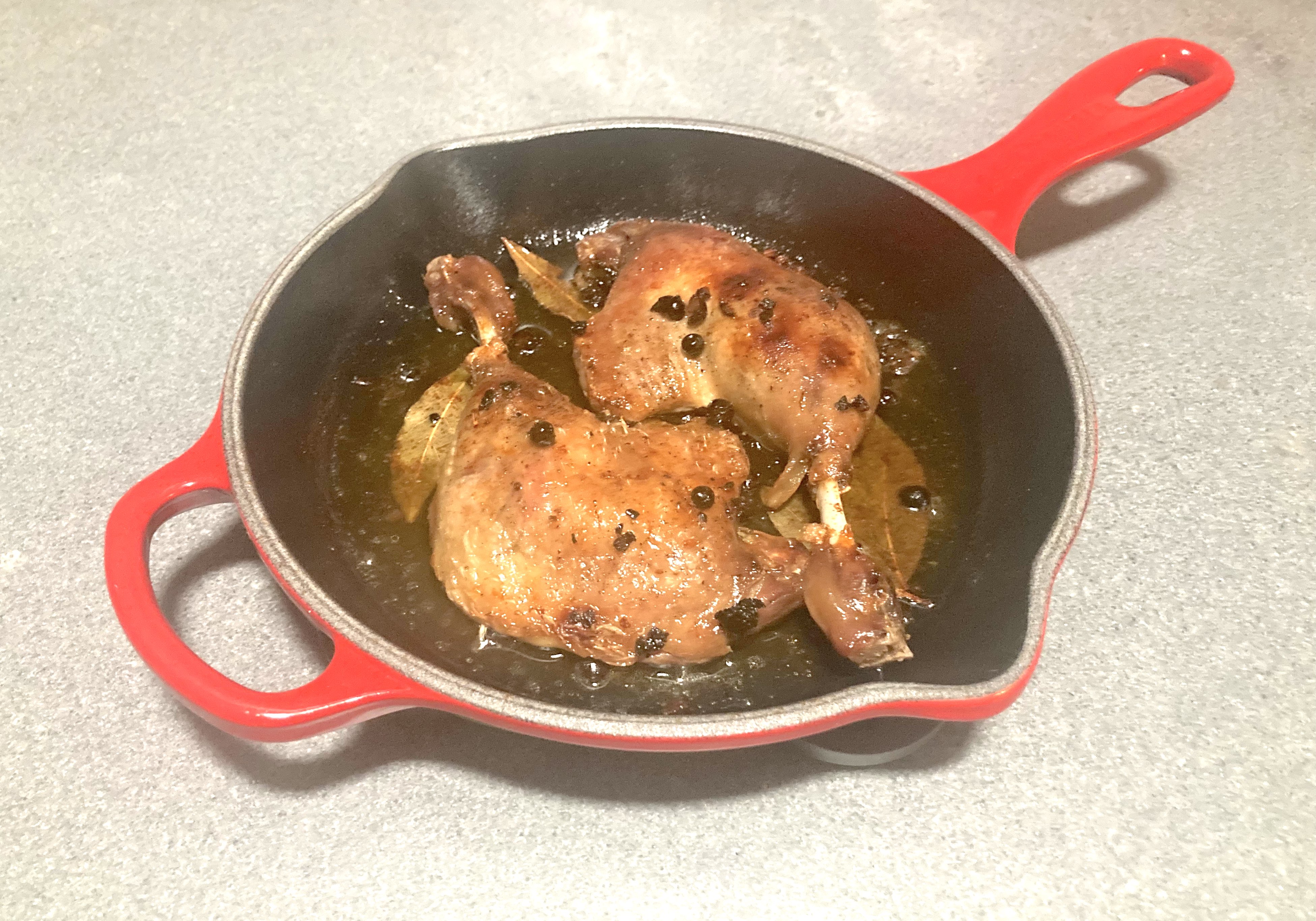
We take a different approach by slow cooking the duck legs in olive oil. The result is remarkable: juicy, full of flavours and aromas, provided you use first class duck (label rouge for instance). If not, the meat can become dry and tough. Another benefit: we don’t cure the meat so it’s not salty at all.
We serve the confit with celeriac mash. It’s light, nutty and refreshing compared to a mash made with potatoes.

Wine Pairing

Best choice is a full bodied, red wine with ripe fruit and smoothness. We decided to open a bottle of Herdade de São Miguel Colheita Seleccionada 2020 as produced by Casa Relvas. Such a pleasure! Its colour is deep ruby and the aromas made us think of ripe black fruit and dark cherries with some spiciness. The wine is well balanced with a nice structure and smooth tannins. Works very well with the juicy duck and the mash with its creamy texture and lemonish, celery flavours.

What You Need

  • For the Confit
    • 2 Duck Legs
    • Juniper berries
    • 4 Bay Leaves
    • Olive Oil
    • (optional) Garlic
  • For the Celeriac Mash
    • 1 Celeriac
    • Slice of Lemon
    • Cream
    • White Pepper
    • Nutmeg

Confit

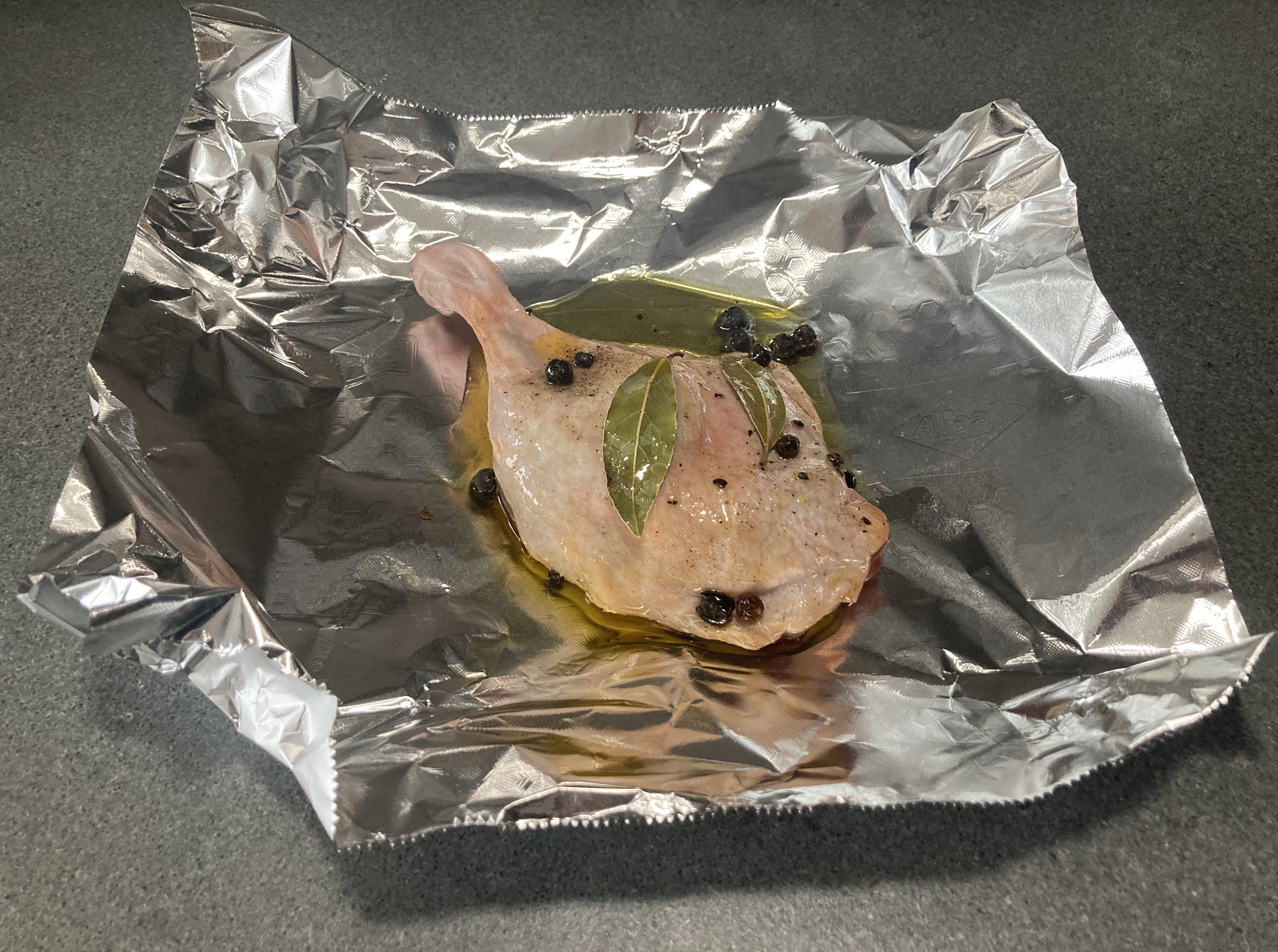
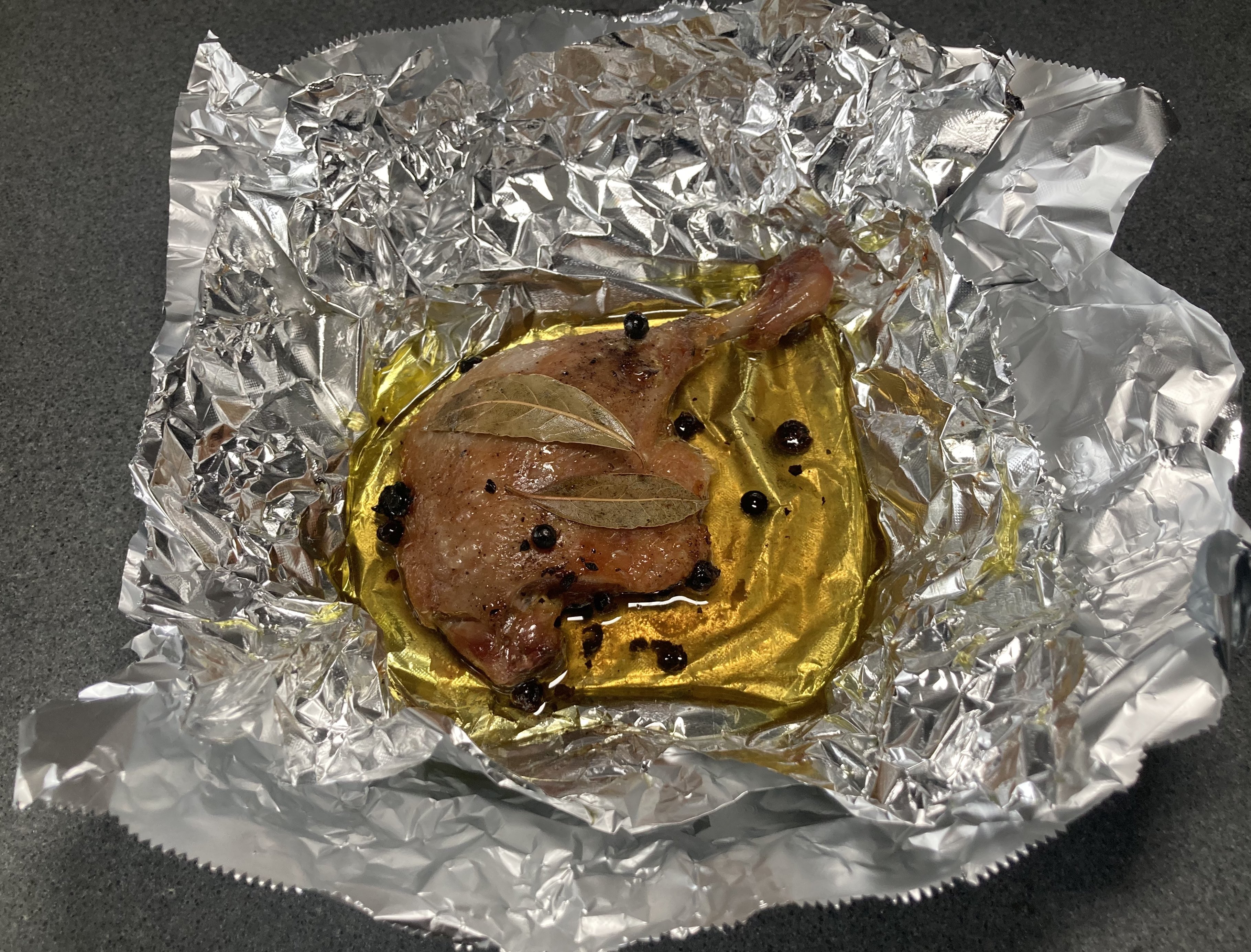
Take a sheet of aluminium foil and place the leg in the middle. Add lightly crushed juniper berries and two bay leaves. Perhaps some crushed garlic. Add a generous amount of olive oil and make sure everything is covered. Wrap foil around the duck. Take a second sheet of foil and wrap it around the package, making sure it’s closed. Repeat with the second leg. Transfer both packages to an oven at 120 °C or 240 °F. After one hour reduce the heat to 100 °C or 210 °F. After in total 4 to 5 hours, depending on the size of the legs, remove the legs from the oven, open the package and let cool. Then transfer to the refrigerator for use later on.

Heat the oven to 200 °C or 390 °F. Put the legs in an iron skillet, transfer to the oven and 15-20 minutes later the legs are ready. If the skin is not yet crispy, use the grill for 2 or 3 minutes.
Another idea is to pull the meat and use it to top a salad.

Mash

The Celeriac Mash: clean and dice the celeriac. Cook in minimum water with a nice slice of lemon until nearly done. Remove the lemon and drain. Add cream. Put on low heat for a few minutes; the celeriac should absorb the cream. When the celeriac is done, use a blender to create the puree. Pass through a sieve. Perhaps add extra lemon or cream. Just before serving add white pepper. Serve with freshly grated nutmeg.

Hilaire Walden

Some chefs love the limelight, some prefer to stay in the background, focusing on cooking and writing. Hilaire Walden is clearly one of them. 

She is author of some 40 books and she has written for prestigious magazines and newspapers about food, cooking and restaurants. She wrote The Great Big Cookie Book, The Book of Tapas and Spanish Cooking, the Book of French Provincial Cooking, The Singapore CookbookQuick After Work Summer Vegetarian CookbookThe Book of Fish and Shellfish and more recently I Love My Barbecue. Indeed, a broad culinary spectrum!

The Loire

One of our favourites is Loire Gastronomique. In this book she follows the course of the French river and describes the various regions, local products, local recipes and of course the wines that go with it. Cheese, cookies, pies, everything. The Loire region is known as the Garden of France. In this garden you’ll find wonderful castles (Azay-le-RideauChambordChinon), great wine (MuscadetSancerrePouilly-Fumé) and beautiful food (asparagus, lots of fruit, artichokes and of course Lentille Verte du Puy). The book is inspiring and it will make you dream of a walk along the Loire, with a view on Amboise and a glass Crémant de Loire in your hand.

Recipes

One of the benefits of Hilaire Walden’s recipes is that they are always correct. Sounds odd, but as we all know, unfortunately, often recipes are simply not complete or correct.
If you prepare a dish for the first time, simply follow her instructions and you’re fine.

She started publishing books around 1980, so perhaps your favourite book will be second hand, but don’t worry, it will not be outdated.