Leek with Truffle

This winter truffles are even more expensive than usual, due to a warm and dry season in the Italian and French truffle regions. The number of truffles is limited and the ones that are harvested are small. Bad news for the truffle-lover.

The first to talk to us about truffles were Fred and Yolanda de Leeuw. Not only did they run a very special butcher in Amsterdam, they also imported truffles and truffle related products. 
Their shop was the only place in Amsterdam where you could buy Wagyu beef before it became popular, foie gras, quails, Spanish veal, bread from Paris, oysters with wasabi sabayon, capon, home-made pastrami and black pudding. Expensive, delicious and always of the highest quality.

Fred and Yolanda contributed to various cookbooks with recipes for truffle-based dishes. In 1999 chef Alain Caron and author Lars Hamer published a book about the shop, the meat, the patés, the sausages, the salads and the dishes they prepared. One of these recipes is for a leek salad with summer truffle and Jus de Truffe. The truffle juice is obtained after maceration of the truffles for six months to one year in the juice of the first cooking process for conserved truffles. Jus de Truffe has the deep earthy aromas and flavour of fresh truffle.

We prepared the leek salad as a tribute to two people who were genuinely passionate about what they did, what they sold and what they prepared.

Wine Pairing

The dish comes with a range of flavours: the leek is buttery with a hint of onion and the vinaigrette earthy and fresh with a touch of bitterness. Wine wise we suggest a Soave, a white wine made with garganega grapes, because it goes very well with the citrus and the aromatic leek flavour. 

What You Need

  • Young Thin Leek
  • Lemon
  • Olive Oil
  • Jus de Truffe
  • Mustard

What You Do

Clean and wash the leek. Slice in three, making sure all slices have the same length. Cook in hot water for 20-30 minutes until they have a soft, creamy texture. Cool quickly and set aside. Make a dressing by adding jus de truffe to a bowl. Add half a teaspoon of mustard, a few drops of lemon juice and half a teaspoon of excellent olive oil. Now it’s a matter of adjusting. It all depends on the intensity of the jus de truffe, the tartness of the lemon and flavour of the olive oil. Dry the leek carefully, whisk the dressing and serve. And if you can afford it, add some freshly grated truffle.

Artichokes Roasted In the Oven

We love artichokes, as a salad, stuffed, with pasta, always a treat. We saw young, small, purple artichokes on the market and decided to take a different approach. Let’s roast them in the oven with lots of fresh thyme, rosemary and bay leaf.
The bitter, nutty taste of the artichokes was clearly present, and it was delicious in combination with the mouthfeel (the olive oil) and the aromatic herbs. Compared to steamed artichokes the roasted ones come with stronger but not too strong flavours.

The artichokes were clearly young because there was no centre choke (the hairy part), which meant that we could eat most of the artichoke, including the stem.

Wine Pairing

Normally pairing artichokes and wine is a real challenge. According to various researchers this is due to cynarin, a chemical especially found in the leaves of the artichoke. When the wine and the cynarin meet in your mouth, the natural sweetness of the wine is enhanced, making it taste too sweet. Meaning you must pair artichokes with a bone-dry, crisp, unoaked white wine with clear, present acidity. Roasting the artichokes in the oven seems to reduce the impact of the cynarin. We suggest serving the artichokes with a medium bodied, dry red wine, not too complex. Could be Merlot, perhaps Malbec or Carménère.

What You Need

  • Young, Small Artichokes
  • One Garlic Clove
  • Fresh Thyme, Rosemary and Bay Leaf
  • One Lemon
  • Olive Oil

What You Do

Heat your oven to 150 °C or 300 °F. Press the lemon and add the juice to a bowl of cold water. Slice the artichokes lengthwise in two. Add them to the water. Check if they have a centre choke. If so, try to remove. Let the artichokes soak for a few minutes. In the meantime peel the garlic and chop, coarsely. Add a generous amount of olive oil to your baking dish, dry the artichokes somewhat, add them to the dish, add the garlic, the sprigs of thyme and rosemary, the bay leaf. Mix. Sprinkle with more olive oil. Cover with aluminium foil and transfer to the oven for 15 minutes. After 15 minutes increase the temperature to 180 °C or 355 °F. Leave for 30 minutes. Check if the artichokes are ready. The trick is simple. If you can remove a leave without too much trouble, they are ready, if not, give them 5 more minutes. You could also check the stem, it should be soft. Remove the foil and leave in the oven for another 5-10 minutes. In parallel fry some merguez sausages.

PS

Artichokes require eating with your hands. Given the olive oil you may need an extra napkin or two.

Scallops with Roe

Where you are in the world influences how you enjoy your scallops: with or without the roe? That’s probably why we are used to discarding the roe, even if we buy our scallops in the shell.
We were talking to our fish monger, and he completely disagreed with us. He feels the roe is a tasty bonus, perhaps a bit more intense than the white of the scallop (the muscle). The texture of the roe gives a very pleasant mouthfeel, he told us.
We bought six scallops and promised him to eat both the muscle and the roe.
The flavours are very similar and the combination is a real treat. As our fish monger mentioned, it is a tasty bonus. We served the scallops with a potato purée. It creates a nice balance in the dish and it allows you to taste the scallops even better.

Wine Pairing

We enjoyed our Scallops with a glass of Muscadet Sèvre et Maine sur Lie produced by Château de la Noë. This is an aromatic wine with fruity aromas, minerality and a long finish, which goes very well with the taste of the scallops and the purée.
The term ‘sur lie’ indicates that during a few months the wine stays in contact with the dead yeast cells left over after fermentation. This technique makes the wine more complex.
In general you’re looking for an elegant, fresh, light wine with clear acidity.

What You Need

  • For the Seared Scallops
    • 6 fresh Scallops (best if in their shell)
    • Olive Oil
    • Black Pepper
  • For the Potato Purée
    • One Potato
    • Butter
    • Cream
    • Nutmeg
    • Black Pepper

What You Do

  1. Clean and steam (or cook) the potato until done.
  2. Use a fork to mash the potato (we love a bit chunky purée in this combination; therefore we suggest using a potato that’s also suitable for making fries)
  3. Add butter, mash some more, add cream
  4. Taste and add more butter and/or cream
  5. Just before serving add freshy grated nutmeg and black pepper
  6. Clean the scallops
  7. Heat a non-stick pan, add some olive oil to the pan and fry the muscle and the roe quickly
  8. When on the plate, add some black pepper.

Cod Cheeks

Cod has been a popular fish for hundreds of years. Much appreciated for its taste and structure. Its popularity unfortunately also means it has been heavily overfished. During the nineties the population dropped significantly. Thanks to various restrictions, cod is slowly on its way back to recovery, especially in the Northeast Atlantic Ocean, although it is still on the red list in many countries. Sea Food Watch provides a very helpful buying guide.

When you buy cod, in most cases you buy cod fillets. But what happens to the remainder, what happens for instance to the head? You could roast it in the oven, you could use it to make stock (don’t forget to remove the skewers), in some countries dried cod heads are appreciated as a delicacy, but in reality, most fish heads seem to end up in animal food or biofuel.

Recently our fish monger surprised us by selling cod cheeks, an absolute delicacy. They are moist with a firm structure and have a delicate taste. Great to combine with parsley, capers and lemon. Or make a batter with beer, flower and egg, coat the cheeks and fry them in oil at 180 °C or 360 °F.

Wine Pairing

A medium bodied white wine will do very well in combination with the Cod Cheeks, for instance an unoaked Chardonnay or Chenin Blanc. We enjoyed a glass of Clin d’Oeil, Saumur Blanc from the Loire region in France produced by Les Vignobles Edonis. It’s a dry wine with clear acidity, fruit, green apples, some minerality and length.

What You Need

  • 200 grams of Cod Cheeks
  • All Purpose Flower
  • Egg
  • Bread Crumbs
  • Butter
  • Pepper
  • Tartar Sauce

What You Do

  1. Carefully remove the skin and white membranes of the cod cheeks
  2. Separate the egg, whisk the egg yolk
  3. Heat a pan and add butter
  4. Dry the cod cheeks with kitchen paper, dust with flower, then dip in the egg yolk and coat with bread crumbs
  5. Fry until golden
  6. Add some black pepper and serve on a warm plate
  7. A dish to share!
PS
  • Make your own bread-crumbs by using old, stale but originally very tasty bread. Obviously, we use our home-made bread.
    Toast the bread and let cool. Cut in smaller bits and then use a cutter or blender to make the crumbs. They keep very well in the freezer, so best to make in advance, when you have some left over bread.
  • Make your own tartar sauce by combining mayonnaise, pickles, lemon juice, capers, dill and Dijon mustard.
Cod Cheeks ©cadwu
Cod Cheeks ©cadwu

Sand Carrots

We were chatting to our favourite greengrocer. Anything special this week? Yes, absolutely, we’ve got Carottes des Sables, also known as sand carrots. The carrots grow in sand in the French Normandy region. The sand has been fertilized with seaweed for many years. The carrots grow slowly and don’t develop a fibrous core, as other carrots do. Furthermore, they are not stored in cool warehouses. Immediately after the harvest they are transported to the greengrocer or the kitchen, covered with sand, to keep them fresh and aromatic. A culinary treat, appreciated by Michelin star chefs.

The carrots are simply delicious and look wonderful. The colour is vibrant orange. We tasted carrot as carrot should taste, crunchy, a touch sweet and fresh.

You could braise the carrots in stock with star anise and finish with butter. We decided to keep it simple and give all credits to the carrot. We served them with a pork medallion with apricots and prunes. A combination that worked very well.

Wine Pairing

The sweetness of the carrots is leading. We opened a bottle of St. Amour, one of the ten crus of the Beaujolais, produced by Maison Jean Loron. An elegant red wine with aromas of strawberries, cassis and chocolate. The tannins are soft and pleasant. The taste is a wonderful balance of strawberries, raspberries and blueberries.

In general you’re looking for a light or medium bodied wine, with character and fruity aromas. Could be a Malbec, perhaps a blend of Syrah and Grenache?

What You Need

  • Sand Carrots
  • Butter

What You Do

Wash the carrots carefully, slice, add to a pan with a bit of water and butter. Cook until you’re happy with the firmness of the carrot. By then the water should have evaporated. You could serve them with fresh parsley, cilantro, cinnamon or black pepper. We were perfectly happy with this simple preparation.

Eton Mess

For some reason we were talking about summer, about typical summer food, about strawberries, green peas, melon, okra, peaches, spinach and new potatoes. Of course, most of these are available all year round, but we like to enjoy the season. Today was different, we really wanted to eat strawberries and we decided to make Eton Mess.
According to Hilaire Walden in her excellent Book of Traditional English Cookery the strawberry dessert is eaten on June 4th in Eton during a picnic for pupils and parents of Eton College, as part of the annual prize giving ceremony. Others say it was first served during the annual cricket match between pupils of Harrow School and Eton College.
One anecdote is that a chef planned to make Pavlova but it collapsed, the other anecdote is that the Pavlova was perfect but a dog sat on it, making a mess, an Eton Mess.

Mascarpone is sometimes added to the cream, but that’s a bit over the top. No need to add sugar to the cream because the meringue is sufficiently sweet. Hilaire Walden suggests soaking the strawberries for two hours or longer in kirsch, an idea we liked. She also suggests using ready-made meringues, which make it even easier to make Eton Mess.

What You Need

  • Strawberries
  • Raspberries (optional)
  • Kirsch (or Brandy)
  • Cream
  • Merengue
  • Lemon Zest

What You Do

Clean the fruit, chop, place in a bowl and sprinkle with kirsch or brandy (one or two small tablespoons per portion). Leave in the refrigerator for at least two hours. Whip the cream. Add some lemon zest, mix. Start assembling the Eton Mess: first a layer of merengue crumbles, then fruit, then whipped cream, then a second layer, same order but make sure you can see some of the red fruit. Serve immediately.

PS

In case you want to make your own (French) meringues: you need 2 egg whites and 100 grams of (finely granulated) sugar. The weight ratio should be 1:2, egg white to sugar. Set your oven to 90 °C or 190 °F. Whip the egg whites until somewhat stiff. Start slowly adding the sugar and continue whipping until the egg white mixture shows stiff peaks. Pipe the mixture on a baking sheet, transfer to the oven for 2 hours. The shape of the meringues is not important because you will need crumble for the Eton Mess

  • Eton Mess ©cadwu
  • Book of Traditional English Cookery - Hilaire Walden

Fried Large Prawns

Prawns and shrimps are very popular, just think shrimp cocktail, paella, salad with shrimps, pasta with seafood, stuffed eggs with shrimps, curry with shrimps and fried shrimps with garlic and lemon. Most of these prawns and shrimps are cultivated, frozen and then shipped. For this recipe you need really large, fresh, wild or organic prawns because the dish is all about the prawn, its flavour and aromas. The result fully depends on the quality of the prawn.
We use the shell, the legs and the so-called swimmerets of the prawns to create a sauce; a bisque like sauce. 

Wine Pairing

We enjoyed our Prawns with a glass of Picpoul de Pinet produced by Gérard Bertrand. A dry white wine, with a pale straw yellow color. It has aromas of citrus and gooseberries. The wine is full and round with minerality which is typical for a Picpoul de Pinet.
You could also combine the prawns with a glass of Chablis, Verdejo or Soave.

What You Need

  • Two large Prawns, fresh, either wild or organic
  • For the Bisque
    • One small Shallot
    • Chili Pepper
    • Olive oil
    • Armagnac or Cognac
    • Garlic
    • Tomato Paste
    • One Saffron Thread
    • Water
    • Bouquet Garni (Thyme, Parsley)
  • For the Tomato
    • One excellent dark Tomato
    • Olive Oil
    • Vinegar
  • Olive Oil
  • Black Pepper
  • Crusted Bread

What You Do

We start by making a bisque-like sauce, using the shell of the prawns.
Chop the shallot and a bit of chili pepper and glaze gently for 10 minutes in olive oil. In parallel use scissors to cut the shell of the prawn. Start behind the head and cut towards the tail. Just before the tail turn 90 degrees and make a cut around the prawn. This allows you to remove the shell and the legs of the body but keep the head and the tail on the prawn. Remove the black vein (the prawn’s intestines) and the slurry in the head (if any). Since you serve the prawn with the head (and tail) it is essential that the prawn is clean. You could gently rinse the prawn if you want to be absolutely sure about this. Transfer the prawns to the refrigerator.

Break the shell into smaller chunks. Add these to the pan and fry for a few minutes until red. Add a small splash of Cognac or Armagnac and flambé. Never do this when using the exhaust or range hood. Add one garlic glove, water, a teaspoon of tomato paste, the bouquet garni and the saffron. Stir well, cover the pan and let rest on low heat for 30 minutes.
Remove the bouquet and the shells from the pan. Use a spoon and a sieve to squeeze the juices from the bouquet and the shells, then discard. Blender the mixture and pass through a sieve. Taste the mixture, add pepper if so required. Leave for another 30 minutes on very low heat, allowing for the flavors to integrate and for the liquid to reduce.

Make a dressing by combining olive oil and vinegar. Wash and slice the tomato. Coat the slices with the dressing. Dry the prawns and fry them in a skillet in oil (depending on the size maximum 4 minutes in total) on both sides and on the back. Use warm plates, and serve the prawn on top of the sauce. Touch of black pepper on the prawn is fine. Enjoy with crusted bread.

PS

A few years ago we made a video showing you in detail how to prepare this dish.

Fried Large Prawn ©cadwu

Golden Turnips

A forgotten vegetable, ridiculed by Baldrick in the British series Blackadder (remember the Turnip Surprise that he prepared for Blackadder? It contained, obviously, turnip and the surprise? There was nothing else in it except turnip) and it still not very popular.
To be called a golden turnip and remain forgotten is of course a bit sad.

Let’s give credit to the turnip: it has been around for many years (according to some sources as early as 2000 BC), it is used in many cuisines, from America to Japan, the leaves are also edible and it was once an important vegetable in the four-year-crop-rotation system. Next time you see turnips, just buy them, look for a recipe and enjoy.

The golden turnip has indeed a beautiful yellow colour, its taste is sweet and delicate, the structure smooth. Great to turn into a mash (with butter and perhaps nutmeg). They can be eaten raw (crunchy and the taste is peppery, radish-like). You could also mix them with other vegetables such as Jerusalem artichoke and parsnip (fry in the oven). 

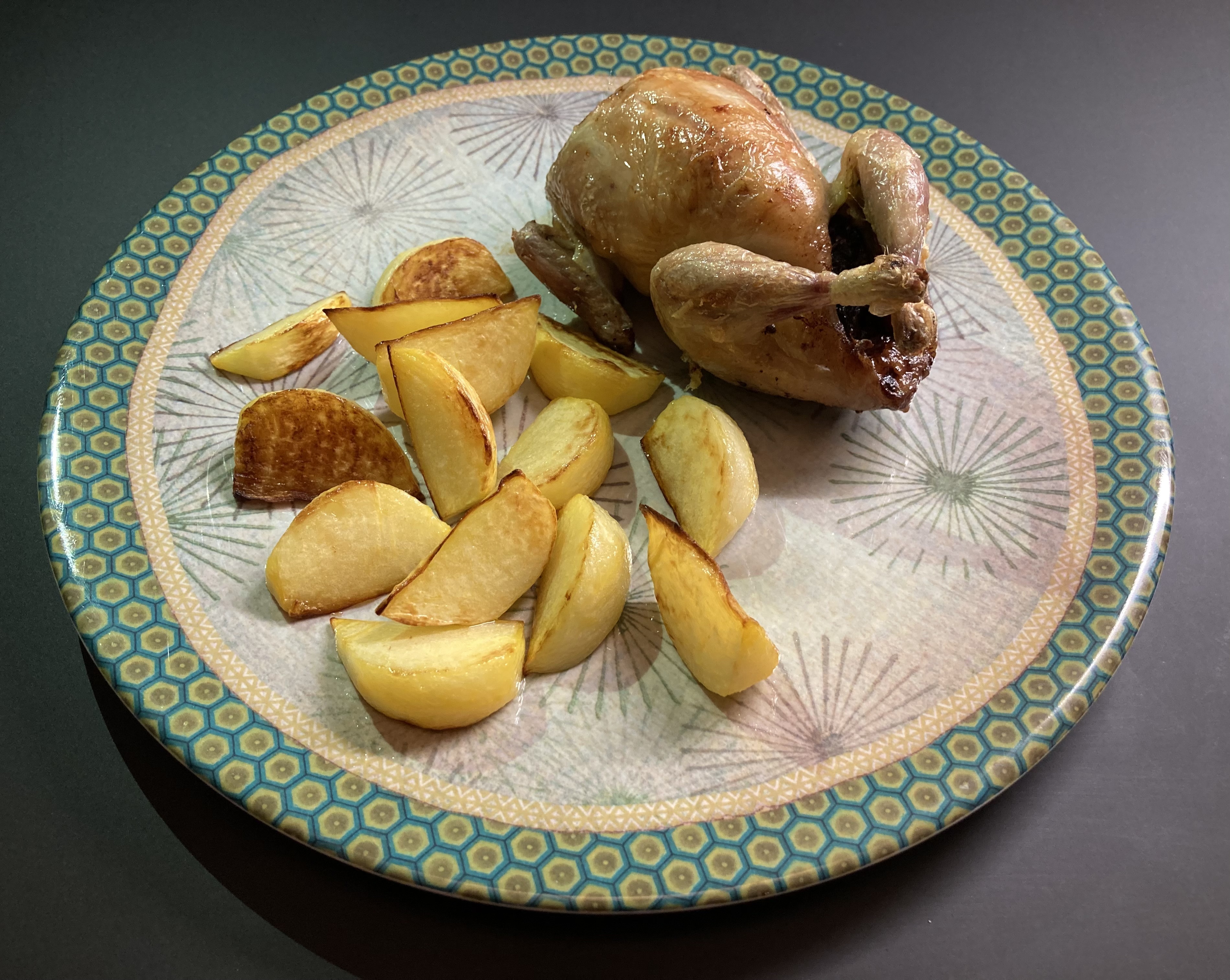
We combined the turnip with a very tasty quail, stuffed with prunes, pancetta and bay leaf.

Wine Pairing

The turnip was cheap, the quail expensive so we decided to spend even more money and bought a bottle of Château de Crémat from the Bellet region near Nice. The wine is made with 75% folle noir and 25% grenache. Folle noir is a grape typical for the Provence region. Once very popular, this grape is now hardly used.
The wine is very balanced with flavours like prune and blackberries, a touch of oak and an aroma that made us think of flowers and dark fruit. In general you’re looking for a full bodied red wine, one that matches the quail and the presence of the bay leaf and the herbs in the pancetta.

What You Need
  • 4 Golden Turnips
  • Black Pepper
  • Nutmeg
  • Olive Oil
What You Do
  1. For the quail see our earlier post
  2. For the turnips: peel these as thinly as possible
  3. Cook or steam for perhaps 5 minutes and let cool
  4. Slice in eight
  5. Heat a pan, add olive oil and colour the turnips quickly
  6. The idea is to add some colour and taste to the turnip and keep its golden colour
  7. Serve with some black pepper and nutmeg.
PS

Use the remainder of the quails to make a very tasty stock. Put in ice cube bags, freeze and use when making sauces.

Dorade

The Gilt-Head (Sea) Bream, better known as Daurade, Dorade (Royale) or Orata is a popular fish in France, Greece, Italy, Spain and many other Mediterranean countries. Delicious when stuffed with herbs such as thyme, rosemary or marjoram, grilled and served with a slice of lemon. The firm, juicy meat is aromatic and a culinary treat.
Serving a whole fish can be a bit uncomfortable. You must remove the head, dissect the fish and look carefully for hidden bones. Serving a fillet makes enjoying fish much easier. The downside is that a fillet is less tasty and perhaps a touch dry. When you buy a fillet, make sure it’s fresh and enjoy it the same day.
We combine the Dorade with typical Mediterranean ingredients. A combination that is both light and tasty.

Wine Pairing

The dish is full of flavours, so we would suggest a glass of Spanish Verdejo or Italian Custoza. In general you’re looking for a full, fragrant dry white wine with a fruity aroma and a round, long, full and dry taste.

What You Need

  • 200 grams of Dorade Fillet
  • 2 ripe Tomatoes
  • 1 Garlic Clove
  • Capers (in brine)
  • Basil
  • Black Pepper
  • Olive Oil

What You Do

Remove the pits from the tomato and dice. Chop the garlic. Coarsely slice the capers. Add olive oil to the pan, heat the garlic for a few seconds, add tomatoes. Leave for a few minutes, add the capers. Taste and adjust. One minute before serving add half of the basil. Add black pepper.
In parallel fry the dorade until golden. Serve on a hot plate and add the remaining basil.
PS When you use salted capers, wash these thoroughly to remove the salt. You need lemon juice to get the right acidity.

Dorade ©cadwu
Dorade ©cadwu

Tomate aux Crevettes

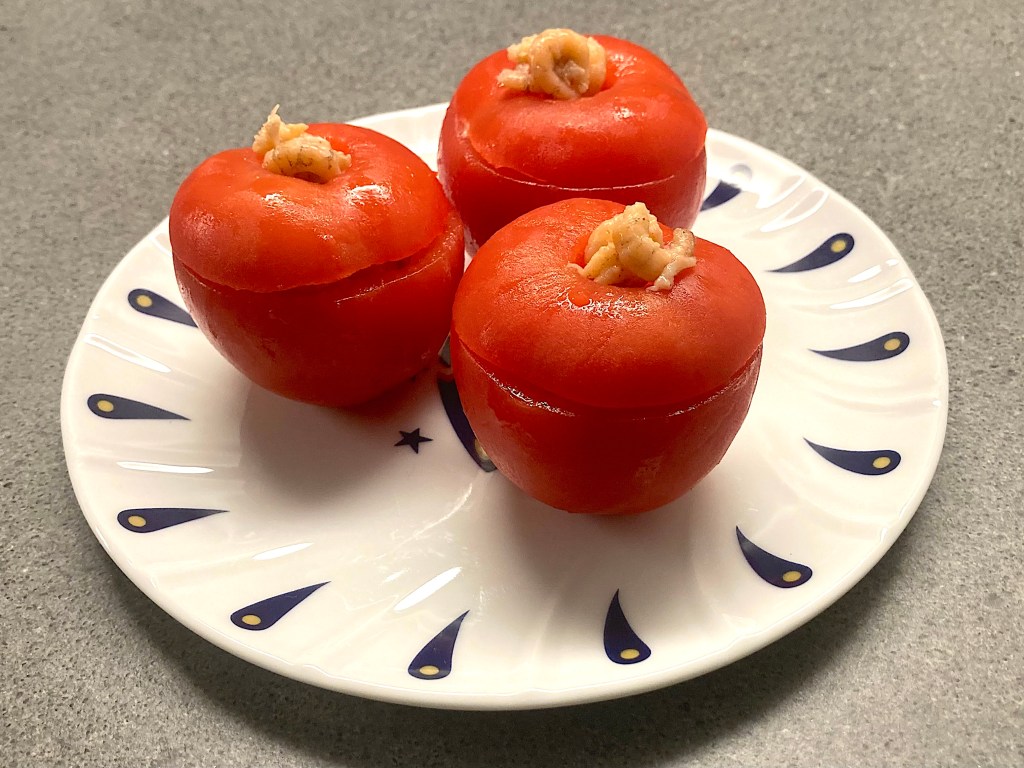
This simple and delicious starter is served in Belgium on special occasions. There are three key ingredients: tomatoes, small (grey) shrimps and mayonnaise. The tomato brings sweetness, umami and some acidity, the mayonnaise richness and a velvety mouthfeel and the shrimps saltiness and sweetness. Ideal combination.
We prefer to peel the tomatoes, because it makes it easier to enjoy the dish.
We thought it would be nice to tweak the recipe slightly. These ingredients are listed as optional.

Wine Pairing

We enjoyed our Tomate aux Crevettes with a glass of Muscadet Sevre et Maine sur Lie produced by Domaine Raphael Luneau. This is a very aromatic wine with a strong flavour and a long finish, which goes very well with the taste of the shrimps and the mayonnaise. The term ‘sur lie’ indicates that during a few months the wine stays in contact with the dead yeast cells left over after fermentation. This technique makes the wine more complex.
In general you’re looking for a fresh, light wine with a clear acidity. 

What You Need

  • 6 excellent ripe Tomatoes
  • 100 grams of (grey) small Shrimps
  • Mayonnaise
  • Black Pepper
  • Chervil
  • Optional
    • Ketchup
    • Worcestershire Sauce
    • Lemon Juice
    • Mustard

What You Do

  1. Peel the tomatoes
  2. Cut of the top and remove the green centre,
  3. Remove the inside of the tomato and discard
  4. Dry the inside of the tomatoes
  5. Dry the shrimps
  6. Add some black pepper to the shrimps and mix
  7. Chop the chervil
  8. Classic version: start with a layer of shrimps, then some mayonnaise and chervil, followed by a second layer of shrimps and finish with mayonnaise and chervil
  9. Alternative version: mix the mayonnaise with a squeeze of ketchup, Worcestershire sauce, lemon juice and mustard. Taste and adjust. Follow step 8
  10. Put the top back on the tomato and decorate with a few shrimps and chervil
Tomate aux Crevettes ©cadwu