Blanquette de Veau

Hard to say what the original way of preparing Blanquette de Veau is. In all cases the veal is added to a cold liquid (preferably a combination of water, wine and stock) and then cooked slowly. The sauce must be made using egg yolk.
Make sure the veal has some nice layers of fat. This will add falvour to the dish and it will help make the meat moist.
We use mace to add additional flavour to the Blanquette. Mace is the outer skin of a nutmeg seed. It is removed by hand and then dried. It is sold in whole pieces or ground. Given its strong flavour, using mace comes with a risk. Use a small piece and taste well after 30 minutes or so. Remove the mace from the stew before it becomes overwhelming.
Don’t underestimate Blanquette de Veau. You need time and patience.

Wine Pairing

We enjoyed our Blanquette de Veau with a Pinot Noir from Austria. A red Burgundy would also work. If you prefer a new world Pinot Noir, make sure it’s not too woody. The vanilla that comes with the wood is too strong for the delicate taste of the Blanquette.

  • 300 gram of Veal
  • 1 Shallot
  • Little bit of Mace
  • Cup of White Wine
  • Cup of Veal or Chicken Stock
  • Water
  • 100 gram white Champignons de Paris
  • Butter
  • One or two Egg Yolk(s)
  • Cream
What You Do – Day 1
  1. Cut the veal into cubes. Not too small because during the cooking process they will become smaller
  2. Take a pan, add wine, stock, veal, peeled (but not chopped) shallot, mace and water, making sure the veal is covered
  3. Put on a medium heat and wait until you see a brownish froth
  4. Carefully remove this  with a slotted spoon
  5. Transfer the pan back and leave for 30 minutes on low heat
  6. Taste and check if you’re okay mace-wise
  7. Remove the mace when you think it is becoming too present
  8. Check again after 30 minutes
  9. Cook in total for 3-4 hours on low heat
  10. Clean the mushrooms and fry very gently in a skillet with butter for 15 minutes on low heat
  11. Remove the shallot and mash with a fork.
  12. Decide if you want to reduce the liquid, depending on taste and volume
  13. If you decide to reduce, store the meat on a plate for the duration of the proces
  14. Transfer the mushrooms to the stew and leave for 15 minutes
  15. Make sure you get all the juices form the skillet
  16. Cool the Blanquette and put in the refrigerator for the next day.
What You Do – Day 2
  1. Warm the stew gently
  2. Combine one egg yolk (or two, depending on the volume) with the cream
  3. Mix well
  4. Now add a spoonful of the very warm liquid
  5. This is what is called ‘marrying’
  6. Add more liquid, one spoonful at the time
  7. Keep stirring
  8. Once your mixture is of a similar temperature, add the liquid to the stew and keep stirring until it starts to thicken
  9. Make sure the stew is (very) warm but not cooking. If it becomes too warm you will ruin the marriage.
  10. Taste, check if you want to add some white pepper
  11. Serve on a warm plate with rice or with green beans with a splash of olive and grated nutmeg (!) and crusted bread.
PS

A very tasty alternative is to use Girolles. Agreed, the blanquette will become a bit yellow, but the taste of the Girolle goes very well with the mace and the sauce. It’s a more intense, powerful blanquette.

Cod with Lentils and Cilantro

Plat du Jour

Think France, think a nice small bistro in a small street, off centre, nothing posh, no Michelin star in sight. It’s 12.30, time for a quick lunch. You enter the restaurant, take a seat and order today’s dish, the plat du jour. It turns out to be a generous helping of brown lentils, two fried sausages and mustard. A beer works beautifully with it. After having enjoyed your lunch, you think about the joy of good food, French mustard and the beauty of lentils. Time for coffee. And maybe a glass of Calvados?

Lentils

Let’s talk about lentils. Not expensive at all, very healthy and a pack of essential vitamins and nutrients. Lentils are used in many kitchens and grown in many countries (India, Canada, Australia and also Europe, North Africa and the USA). Lentils have been around for a long time, possible 10.000 years. So you would expect lentils to be popular, but for some reason you don’t see them too much, unless in restaurants serving organic food or as soup. A pity, because a simple dish of rice and lentils with a dash of chutney is healthy, cheap and tasty.

The red lentil (key element to Indian Dhal) is well-known. We use it in our pumpkin soup. It is a split lentil and it will cook very soft.
The Beluga lentil is black, as the name suggests. We could have used Beluga lentils in this recipe because of the colour combines nicely with the white fish.
Most lentils are green or brown. The Du Puy green lentil is special, not only because of its Appellation d’origine contrôlée but very much because of their great taste and the fact that they keep a beautiful shape, even when cooked. Beware of fake Du Puy lentils! All Du Puy lentils are green and from France, but not all green lentils from France are Du Puy lentils. They have names like ‘Le Puy lentils’ or ‘Dupuis lentils’. All nasty marketing. If you want real Lentille Verte du Puy then look for the A.O.P and A.O.C. We prefer the ones from Sabarot (Happy 200th Birthday!)
The recipe for the plat du jour is relatively straight forward (make sure the meat in the sausage is not too finely minced) and we have enjoyed it many times.
Lentil soup combines really well with fresh cilantro, so we use the same combination in this case, although using fresh parsley is also a good idea. Key elements in this dish are excellent fresh cod, a mild fish stock and cilantro leaves and seeds.

Wine Pairing

We very much enjoyed a glass of Spanish Verdejo with this dish. In our case a bottle of Monteabellon Rueda. In general wines made from the Verdejo grape combine very well with fish. The wine comes with the right acidity, giving freshness to the wine. It has floral aromas typical for the Verdejo grape. You may recognise the aromas of banana and exotic fruit.

What You Need

  • Shallot
  • Butter
  • Cilantro Seeds
  • Green, Du Puy or Beluga Lentils
  • Mild Fish Stock
  • Cod
  • Butter
  • Fresh Cilantro (or Parsley)
  • White Pepper

What You Do

Cut the shallot in small bits and glaze gently in butter. In the mean time check the lentils for small pebbles; wash them. Once the shallot is glazed, add the lentils and heat them for a few minutes, as you would do with risotto rice. Gently crush the cilantro seeds a bit and add to the pan. Add the mild fish stock and leave to simmer on low heat. In parallel pan-fry the cod in butter in a non-stick pan. Just before the lentils are ready add half of the finely cut cilantro or parsley to the lentils and mix.
Timing is all. The lentils should be cooked, all liquid evaporated and absorbed and the cod just done. Meaning the cod is opaque and the flakes can be separated easily. And overcooked meaning you can see those small white bits and the fish becomes dry.
Serve the cod on top of the lentils and sprinkle some cilantro or parsley over the lentils and cod. Maybe add a touch of white pepper.


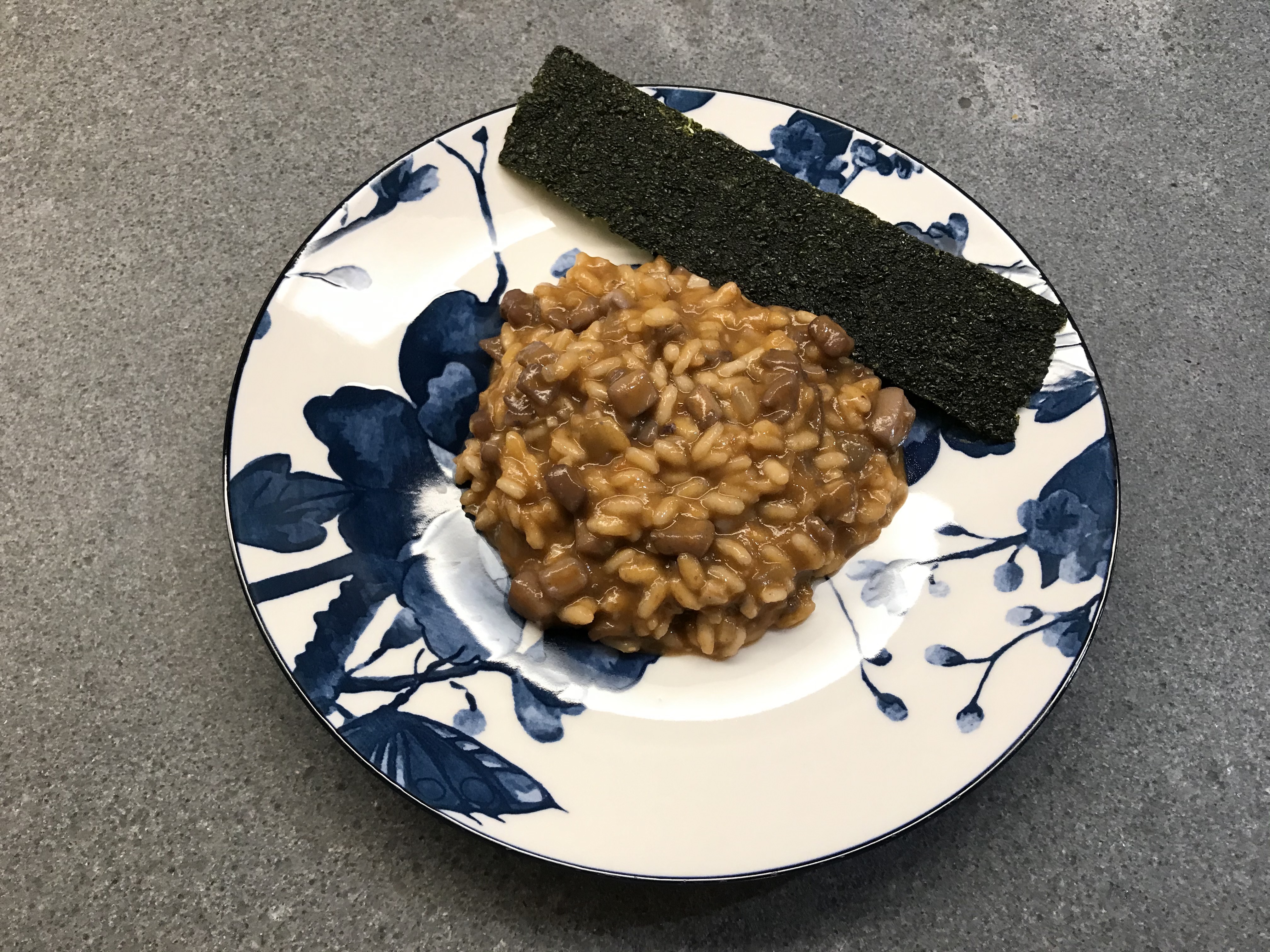
Risotto with Mushrooms

And on the 8th day he remembered he had forgotten to create food. So he quickly created something so simple, so tasty, so fulfilling that he knew people would still enjoy it, many, many years later. He called it Risotto.

Five Challenges When Making Risotto
  1. We’re always too busy! We are tempted to buy risotto rice that cooks quickly and can be served in under 10 minutes. Never rush a risotto!
    And by the way, what is so important that you don’t have 34 minutes to cook your own lovely, genuine, risotto? Why would quick be more important than tasty?
  2. And since we are too busy: why look for fresh cèpes if you can buy a pack of risotto rice with cèpes. Second mistake. You will not taste cèpes but a series of nasty E numbers and salt. Just look at the package! It will probably contain 0,01% of cèpes.
  3. We think risotto is too basic, so we’ve decided to prepare a luxurious version. Let’s add tomatoes, or salmon, or spinach and pumpkin, or chicken, or saffron, shrimps and peas. Please don’t. It will only ruin the lovely combination of rice, butter, stock and Parmesan cheese.
  4. Risotto is too heavy, too rich. Let’s use crème fraîche or Mozzarella and not Parmesan and not butter, let’s simply skip the butter. Fourth mistake: butter and Parmesan cheese are essential, for the taste, the mouthfeel and the consistency.
  5. Buy risotto-rice without checking if it’s the right rice. We use beautiful Carnaroli rice, superfine quality, produced by Acquerello. It doesn’t come cheap (we pay € 11,95 per kilo) but why would you not treat yourself to the best risotto rice? It has all the right qualities and the taste is outstanding.
Wine Pairing

We enjoyed our Risotto with a glass of Soave. Some acidity, touch of bitterness, nicely balanced with the butter and the cheese. It’s light and fruity; it elevates the risotto.

What You Need
  • 70 grams of Acquerello rice
  • 1 Shallot
  • Butter
  • Olive Oil
  • 100 gram of Shiitake
  • 200 gram of mushrooms, for instance Chestnut Mushrooms
  • optional: 100 gram of Cèpes
  • Chicken Stock
  • Parmesan Cheese
What You Do
  1. Peel and chop the shallot
  2. Add butter and olive oil to the pan and glaze the shallot
  3. In parallel clean and slice the various mushrooms. Feel free to use other mushrooms as well. We think the Shiitake is an important one because it adds depth to the taste
  4. Bring the stock to a boil
  5. After 5 minutes add the mushrooms to the pan and fry gently for 5 minutes
  6. Add the rice to the pan and coat the rice for 2 minutes
  7. Start adding the stock, spoon by spoon and stir the rice frequently
  8. When using Acquerello rice it takes 18 minutes
  9. Check the rice
  10. When okay, transfer the pan to the kitchen counter top and leave to rest for 2 minutes.
  11. Add chunks of butter, stir, add a bit more butter and the grated Parmesan cheese
  12. Stir, a bit of black pepper, add more butter or Parmesan cheese if so required
  13. Serve immediately.

Amuse-Gueule

Something on a Spoon

A glass of white wine, perhaps a glass of Crémant d’Alsace or maybe even a glass of Champagne; such a great way to start dinner (or lunch when you feel like treating yourself). You enjoy some bread with homemade Tapenade, or a few nice olives. All good. And then suddenly the chef presents you her or his Amuse-Bouche. Something very special and an indication of the chef’s talent. But in most cases it’s something on a spoon and not very special.

A bit of background: amuse-bouche is actually not a French term. Restaurateurs made it up because they think amuse-gueule (the correct term) is a bit harsh. ‘Gueule’ can refer to both humans and animals. And ‘ferme ta gueule’ is far from polite. So restaurateurs started using ‘bouche’, to eliminate the impression that they think their guests have a snout.

So the correct French term is amuse-gueule. Some say the concept of the amuse was invented by the Nouvelle Cuisine in the 1960s. Not really. In 1946 Francis Ambrière, in his book Les Grandes vacances, writes … Une côtelette à midi. Quelques amuse-gueule à l’heure du goûter. Et le soir, ô splendeur, un gigot bien saignant, le premier gigot depuis l’an 40!

Today’s amuse-gueule is a dish in its own right that amuses the mouth, fools your appetite and makes you want to start on the first course. Small, tasty, full of flavours and maybe a bit out of the ordinary.

We use a traditional coddler for this amuse-gueule, but you could also use a small ramequin. No spoon, please.

Wine Pairing

Typically the amuse-gueule is combined with your aperitif. We combined this amuse gueule with a glass of German Sekt, to be more precise with a glass of Reichsrat von Buhl – Pfalz – Sekt – Spätburgunder Brut rosé 2016, which is a superb pale pink wine, made from 100% Pinot Noir and produced by one of the leading wineries in Germany. Think red berries, brioche, a delicate texture with a nice mousse, fresh acidity and a long-lasting aftertaste.

What You Need (for 4)

  • One Egg
  • Four Medium Sized Raw Prawns
  • 75 grams Spinach
  • ½ Shallot
  • A Generous Tablespoon of Crème Fraiche
  • Dill
  • Blue Cheese
  • Chives
  • 4 Edible flowers

What You Do

Start by cleaning the prawns, removing the head, the shell and the vein. We used Argentine red shrimps. The meat is fairly soft and they become beautifully red when cooked. Fry the shrimps is some olive oil for 3 minutes. Remove the shrimps from the pan, set aside and let cool. Gently fry the shallot in the same pan for 10 minutes until glazed. Remove from the pan and let cool. In a different pan quickly cook the (dry and clean) spinach in some olive oil. Keep stirring! Drain if so required, set aside and let cool.
Cut the prawns in smaller bits. Chop the spinach using a large knife. Whisk the egg until completely smooth. Now add the (cool) bits of prawn, the spinach and the shallot. Whisk with a spoon. Add the Crème Fraiche. Add some chopped dill (depending on your taste), a bit of blue cheese (not too much, just to add a dimension to the dish) and a generous amount of chives. Mix. Coat the coddlers or ramequins with butter. Add the mixture to the coddlers or ramequins. Heat your oven to 170° Celsius (or 340° Fahrenheit). Place the coddlers or ramequins in a shallow dish. Add boiling water up to 2/3 of the height of the coddler or ramequin. Close the oven and reduce the temperature to 120° Celsius (or 250° Fahrenheit). After 30 minutes au bain marie your amuse-gueule should be ready. Test with a needle. Let cool.
If using a coddler, remove and dry the lid, add the flower and close.

Amuse-Gueule © cadwu


Skate with Capers

When you Google for skate with capers you will find many recipes with capers and brown butter. We think you can do better!
The trick in this recipe is to clarify butter and then deep-fry the capers in the clarified butter. The result is a crunchy and salty caper with clear acidity from the brine. This works brilliantly with the meaty, fatty skate.

Clarification

Butter is an emulsion of butterfat, water and proteins. The process of clarification means breaking down the emulsion. The goal is to have pure butterfat, which will not burn and which allows for deep-frying.
The water will simply go when you warm the butter.
How to remove the proteins? Option one is to start by melting the butter and to wait until you see white foam and until the water is gone. Now pour the fat into a jar or cup, carefully keeping the foam in the pan.
Option two is to continue warming the butter until the white foam becomes brown. Be careful not to burn it, this will ruin your butter. The now brown foam will sink to the bottom, which makes it easier to pour the butterfat in a jar or cup. If you want to be even more sure of the quality, use a cheesecloth when pouring. The idea is that using the second option will give the clarified butter a more nutty taste.

Wine Pairing

Skate goes really well with a glass of classic Chardonnay with a touch of oak. The chardonnay comes with a velvety taste which is great with the skate and its consistency. The touch of oak combines very well with the fried capers.

What You Need

  • Skate Wing (let’s say 200 grams for 2 persons)
  • Butter
  • Olive Oil
  • Black Pepper
  • Capers (in brine)
  • 75 grams of Butter (to be clarified)

What You Do

Clarify the butter and set aside. Fry the skate in a non-sticky pan for 5-10 minutes or so, depending on the size and shape. Please notice that there is more meat on one side then on the other side, so it’s not 10=5+5. Transfer the skate to a warm plate. Heat the clarified butter to frying temperature and in parallel wash the capers and dry them with kitchen paper. Fry the capers until crispy. Serve the skate with some black pepper and sprinkle the capers on top of the skate.

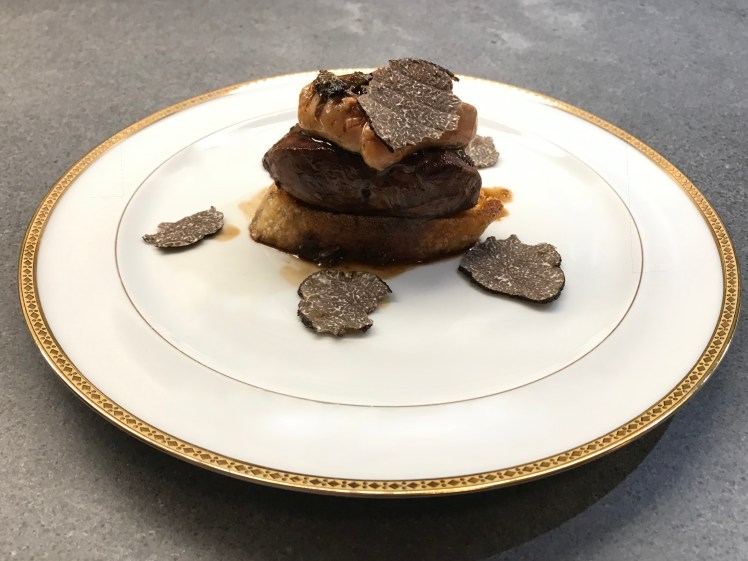
Sweetbread with Madeira and Truffle

A Starter to Remember

A culinary treat that is delicate, balanced and overwhelming yet subtle. In a restaurant you will probably get Sweetbread (Ris de Veau, Kalfszwezerik, Kalbsbries, Molleja de Ternera, Animelle di Vitello) dusted with flour (okayish) or breaded (awful idea, it’s not a Wiener Schnitzel). In some countries Sweetbread is grilled, which is an interesting idea. We stick to a very traditional approach that works extremely well because it’s all about the taste of the Sweetbread in combination with Madeira and Truffle.
Sweetbread should of course be hot and soft on the inside and golden and crispy on the outside. Use your non-sticky skillet and a bit of butter for a beautiful result.
Sweetbread should be between rosé and well done. It requires a bit of attention, but it’s hard to overcook Sweetbread. Although some restaurants are very capable of creating rubber.
It is essential to clean Sweetbread. For some the process of removing the membrane from Sweetbread is intimidating, but don’t be put off. Just watch the video!

Wine Pairing

First the Madeira: don’t be tempted to buy so called ‘cooking Madeira’. This is some horrible, sweet liquid that is not even close to Madeira. One for the bin. We bought a bottle of Santa Maria Fine, Medium Dry, Vinho Madeira. It is perfectly suited for this recipe. The story behind Madeira is complex so if you get the chance to buy one that is 10 or 15 years old, please give it a try. Just sip and enjoy.

We’re looking for a wine that will be supporting the delicate taste and the sweetness, earthiness and the slight nuttiness of the sauce. If you want to drink a glass of white wine, then it should be a full-bodied Chardonnay, although not too oaky. Chablis will be a good choice. If you go for red, then we recommend a Beaujolais Cru (St. Amour or Fleurie) or a Bourgogne. It’s about soft tannins, aromas like dark cherries and licorice and on the palate a lean texture and dry.

What You Need

  • 200 grams of Sweetbread
  • Two leaves of Bay Leaf
  • Crushed black pepper
  • Butter
  • Shallot
  • Veal Stock
  • Madeira
  • Preserved Truffle (preferably without additional flavours)
  • Jus de Truffes

What You Do

Start by filling a big pan with water. Add the crunched pepper and the bay leaf. Bring to a boil. Now add the sweetbread and make sure the water remains close to boiling. Blanch the sweetbread for let’s say 5 minutes, depending on the size and shape of the sweetbread.
Transfer the sweetbread to a large bowl with ice-cold water and cool the meat as quickly as possible.
Now it’s time to clean the sweetbread. Remove the bits of fat, the fleeces, any membrane, the veins and anything else you don’t like. Best way to do this is with your hands and a very sharp small knife. Once your sweetbread is clean, you will be able to see how to slice it later on. But first put it on a flat plate, seal it with plastic foil, put a similar flat plate on top of it and put something heavy on top of the plate. Transfer to the fridge and leave it for a few hours. The idea is twofold: on the one hand the sweetbread will be firm and easy to partition. And it will lose some liquid because of the weight.
With the sweetbread in the refrigerator it’s time to think about your sauce. Cut the shallot in small bits and glaze in butter. Aftre a few minutes add the veal stock and the Madeira. Mix and reduce. Add one preserved truffle. Blender the liquid after five minutes. Pass through a small sieve and warm what is the beginning of your sauce. Add Jus de Truffes. This is an essential ingredient because it brings volume and depth to the sauce. It’s not to be confused with Truffle Oil, which in most cases is some kind of horrendous chemical invention. Taste and perhaps add some more Madeira or stock. A pinch of pepper may also be helpful. Keep warm for 5 minutes, stirring regularly. You will notice that the sauce becomes more intense and mature, which is exactly what you want.
In parallel cut 2-3 cm thick slices of sweetbread. Fry them for 5 minutes or so in a very warm (but not hot), non-sticky skillet with butter. It’s simple: when the sweetbread is golden and beautiful they are ready to be served. If in doubt: there is bound to be a small slice, one that you can use to test. Remember it’s offal, so you don’t want to take a risk.
Take two warm plates, add sauce and carefully put the slices of sweetbread on the plate. You could add slices of (fresh) truffle on top.

Video


Vitello Tonnato

Fish and Meat

Who came up with the idea to combine veal, tuna, anchovy, mayonnaise and capers?
The story goes that in the 19th century veal was prepared as if it was tuna. Sounds a bit far fetched, but tuna wasn’t eaten raw (at least not in Europe) but cooked in water with various herbs and then stored in brine or oil. Tha approach to prepare veal as if it is tuna was described in 1836 by the French Monsieur Burnet in his recipe Manière de donner au veau l’apparence et le goût du thon mariné.
In 1862 (according to Luca Cesari) a medical doctor from Milan was the first to combine tuna and veal.

Anchovy

Not a remarkable ingredient at all!
(Salted) anchovy has been used as a flavour booster in meat dishes and sauces for many centuries. For instance in the combination of leg of lamb with anchovy and garlic it will bring depths, umami and saltiness. When making a remoulade sauce you should not forget to add anchovy. And why not prepare a wonderful French Anchoiade? Or dip your vegetables in Bagna Cauda? And let’s not forget the joy of crusted bread with Tapénade (black olives, capers, garlic, anchovy and olive oil). What would a classic Caesar salad or a salade Niçoise taste like without the anchovies in the dressing? Such a useful fish!

Wine Pairing

The obvious choice is to drink a glass of Italian white or rosé wine with the vitello tonnato. A fresh wine, with a touch of acidity and not too complex, for instance a Bardolino Chiaretto or a Soave.

What You Do (Classic approach)

Given the origin of Vitello Tonnato the meat should be cooked in water with carrots, onion, leek, clove, bay leaf, thyme and pepper. The trick is not to cook it too long; you want a touch of pink in the meat when it is served. Keep some of the cooking juices to add to the sauce later on.
Create the mayonnaise by mixing egg yolks, lemon and a neutral oil (peanut or grape seed oil).

What You Need

  • 150 gram of Veal (top side or silver side)
  • Butter
  • Olive Oil
  • Mayonnaise
  • 75 gram of canned Tuna (in brine)
  • 1 Anchovy fillet (or 2 depending on your preference)
  • Lemon
  • Capers (in brine)

What You Do

We prefer to fry the meat, even if it’s historically and culinary incorrect. We think frying is quicker and gives you more control over the cuisson. Plus we feel that cooking the meat means losing flavours.
Fry the meat in a heavy iron skillet in some butter and olive oil. Not too hot! Sear the meat, lower the temperature and fry the meat until nicely rosé. Transfer the meat to a sheet of aluminium foil and let rest until lukewarm or cool. Wrap the foil around the meat, let cool and transfer to the refrigerator.
Just before serving, blender the tuna, the anchovy, a few capers, the juices from the meat (in the foil) and some lemon juice until completely smooth. Add some mayonnaise to a bowl, add a spoonful of the mixture and taste. Continue until you have the right balance. Thinly slice the veal, serve on a plate and top with the sauce. Make sure some of the meat is still visible. Decorate with the capers.

Vitello Tonnato © cadwu

Insalata Caprese

Tomatoes

In 2013 the German culinary press characterised Dutch tomatoes as ‘wasserbomben’, let’s say ‘water balloons’. And they were right. Even more so, many tomatoes were, and still are, tasteless and watery. And since the Netherlands are in the top 3 of tomato exporting countries, you run the risk of buying a red balloon. Which is of course not what you want to do. So if you plan to make one of the simplest and tastiest starters ever, you have to find the best tomatoes ever. Or grow your own of course.

Mozzarella

Meaning Buffalo mozzarella, made from the milk of the Italian buffalo. Since 1993 it’s a DOP (Denominazione di Origine Protetta) and protected under EU law. It’s a young, moist, tasty cheese with a lovely soft, elastic but not chewy texture and it comes with a skin as a result of the shaping and pickling. The taste is more robust than mozzarella made from cow milk and it’s ideal for a salad. The cow version is best used for cooking. The smoked version should be ignored.

Basil

Someone should write ‘The Case of the Dying Basil’. A whodunit in which a clever detective will reveal why the basil plant you buy from the green grocer or supermarket will very likely die within 3 days, regardless what you do. And since they always die on us, we buy ‘fresh’ leaves.
The most used variety of basil is sweet or Genovese basil. Others are Thai basil (slightly spicy with a hint of anise) and red (or purple) basil (similar to sweet basil but more powerful). Alain Passard’s book Collages et Recettes includes a recipe for purple carrots with purple basil and cinnamon. Wonderful colours and a delicate taste.

Insalata Caprese

This salad stands or falls on the quality of the ingredients. And it requires the talent to keep things simple, so you have to stick to the 5 (five!) ingredients, meaning tomatoes, mozzarella, basil, olive oil and pepper. The salad does not come with balsamic vinegar, lettuce, pineapple nuts, salt, honey, croutons, oregano, mustard or a vinaigrette. Five ingredients. That’s it.
You wonder why? Because this way the Insalata Caprese is at its best. Tasty, sweet, rich, moist, fresh and a reflection of Italy and of summer. Adding an ingredient will worsen the concept of the salad and reduce its taste.

Wine Pairing

We suggest an excellent rosé, one with flavour and depth. For instance Monte del Frà Bardolino Chiaretto 2018. You’re looking for a wine with delicate scents of berries accompanied by light and refreshing hints of green apples and subtle spicy tones. On the palate the wine should reveal juicy sensations of red berries along with an appealing and refreshing acidity.

What You Need

  • Two Excellent Ripe Tomatoes, chilled
  • One Ball (125 gram) of Excellent Buffalo Mozzarella
  • Fresh Basil
  • Excellent Olive Oil
  • Fresh ground Black Pepper

What You Do

Slice the (chilled) tomatoes, slice the mozzarella and create the ‘tricolore’. Add fresh black pepper and drizzle generously with olive oil.

Insalata Caprese © cadwu

Pimientos de Padrón

Lovely and Simple Starter

Pimientos de Padrón are mild, sweet tasting and small green peppers, originally from the Galicia region in Spain, but now widely available in Spain and Portugal. Story has it that one in a hundred (or more?) is actually very spicy, but rest assured, we have eaten many more and never encountered a spicy one. Ask your greengrocer for these lovely peppers because we’re sure you will enjoy them.

Wine Pairing

We would suggest drinking a Vinho Verde with the Pimientos de Padrón. Vinho Verde is a wine from the most northern part of Portugal, between the Douro and Minho rivers. Verde refers to the fact that the grapes are harvested very early in the year. This implies that the grapes contain a fairly small amount of sugar. As a result of this the wine (in most cases) has a fairly low percentage of alcohol (think 10%). But don’t be surprised if you find one with a higher percentage.

About Vinho Verde

In general we feel Vinho Verde is undervalued. It’s a great, very taste wine; one that is not just wonderful on a summers evening.
Vinho Verde is not a wine to store, so make sure you buy one from the most recent harvest.
Most Vinho Verde wines are white. They tend to have a very subtle bubble. The taste is light, floral and the wine comes with some clear acidity.
We also found a rosé and a red Vinho Verde. Seldom have we seen a wine with such an intense colour! To balance the acidity of the red Vinho Verde you must be combined with fat meat or rich sauces. We combined it with grilled Secreto of Iberico pork, which is a treat in its own right. Secreto is a thin, juicy cut from acorn fed, free range Iberico pigs.

Secreto

As an extra: for two people buy 300 grams of Secreto. In a way the structure of the secreto resembles skate. One side of the secreto will look nice, fat and meaty, the other may look like if you have to remove extra fat. Which is exactly what you need to do! After having done that, heat a heavy grill pan (or the barbeque) and grill the meat for 4 times one minute, creating a nice pattern. The cuisson should be rosé. It’s not a problem if the thinner parts of the secreto are well done because the meat will be very juicy anyway, thanks to the fat. Serve with a sautéed courgette. The bitterness and the sweetness of the courgette combines really well with the juicy secreto. The red Vinho Verde will balance the fat and will turn the combination of secreto and courgette into an intriguing dish.

What You Need

  • Pimientos de Padrón
  • Olive Oil
  • Sea Salt

What You Do

Clean the Pimientos de Padrón and dry the peppers. Heat a heavy skillet, add olive oil and fry the peppers for a few minutes. Make sure they are fried but not cooked. Sprinkle some sea salt over the Pimientos de Padrón, fry for a few seconds making sure the salt is somewhat adsorbed in the olive oil. Serve immediately.

White Asparagus with Sauce Gribiche

This tends to be a combination we like to serve towards the end of the asparagus season. The combination of asparagus with capers, cornichons and chives is unusual but it works really well with both green and white asparagus.

In most countries the season for asparagus is well-defined. It starts around April 23rd (St.George’s Day) and finishes on June 24th (the nativity of Saint John the Baptist). Green asparagus tend to be available all year round, however we recommend being careful. It’s a bit silly to buy the very skinny ones grown in darkest Peru. Nothing wrong with Peru, we love Paddington, it’s just that following the season and focusing on local, organic products is our preferred approach, but not in a dogmatic way.

Sauce Gribiche

This sauce is made with chives, chervil, parsley and tarragon. In this case we use chives only because especially the tarragon would be too much for the asparagus. Chives give it a touch of onion, which is exactly what the sauce needs.
Two notes regarding the oil: when you want to make a true sauce Gribiche (so with chervil, parsley and tarragon plus more vinegar) you would add more oil to give it volume and smoothness. In this case you want a very rich sauces with clear presence of all ingredients. And (second note) because we use less oil we use excellent olive oil only. Otherwise you would use a combination of olive or grapeseed oil with a more neutral oil like sunflower or arachis (peanut) oil.

Wine Pairing

We enjoyed our Asparagus with sauce Gribiche with a glass of Macon (Louis Jadot Mâcon Villages Grange Magnien). The wine (100% chardonnay) comes with some gentle acidity and minerality, which is great with the acidity of the Sauce Gribiche. It’s fruity with a floral scent.

You can also combine the dish with wine made from Sauvignon Blanc grapes. We very much liked the combination with a glass of Menetou-Salon from the house of Clement Chatenoy. A remarkable Sauvignon with citrus and passion fruit, freshness and an exceptional length in the mouth. The wine has flavours and complexity very similar to the sauce and to the asparagus, making it a harmonious pairing of food and wine.

What You Need

  • Two Eggs
  • Dijon Mustard (1 tea spoon)
  • (White Wine) Vinegar (1 small tablespoon)
  • Olive Oil
  • Lemon Juice
  • Pepper
  • Chives
  • Cornichon
  • Capers (in brine)
  • Asparagus

What You Do

Start by boiling the eggs, making sure the yolk is completely set. Depending on the size add them to boiling water and leave them in the simmering water for 10-12 minutes. We steamed them for 12 minutes. Remove and let cool.
Once cold, peel the eggs, separate the white from the yolk. Cut the white in very small bits and store. Push the egg yolk through a sieve. It should be a powder-like substance. Add the mustard and stir well. Continue stirring and slowly add the olive oil, as if making a mayonnaise. Which is basically what you’re doing anyway! Main difference is that cooked yolk is less powerful when it comes to emulsifying. So the amount of olive oil you can add is (more) limited.
Once you’ve added the olive oil, add white wine vinegar, taste and decide if more mustard, vinegar or pepper is needed.
Now add the chopped egg white, the finely chopped chives, the drained and chopped capers and the thinly sliced cornichon.
The sauce should be ‘stable’ so feel free to store in the refrigerator.
Steam or cook the white or green asparagus and enjoy!

PS

It’s actually a rather tricky sauce, one that splits easily. No reason to panic, just add a teaspoon of (homemade) mayonnaise, whisk and the sauce is saved.