Sharing our love for good food and excellent wine with you: mushrooms, sauces, forgotten vegetables, pies and tartelettes. Join us and Cook and Drink with us!
A few years ago we created an overview of recipes per season, simply because it’s such a good idea to enjoy what is available in the season. Nice to eat strawberries in Winter, but isn’t it a much better idea to enjoy seasonal slow cooked pears?
We then introduced overviews per course, ranging from side dish to lunch. The categories didn’t always make sense, so we added a few more, making our admin more complicated, especially when we updated a recipe or a picture.
The obvious thing happened: we lost track of recipes, noticed some links were broken and the overviews became incomplete.
So how to organise this blog?
After much debate and intense workshops (not really) we’re pleased to present to you an old fashioned, up to date and very easy to use (and maintain) index of All Our Recipes For You!
End of June means end-of-season for asparagus, morels and ramson (wild garlic). But let’s not be sad! It’s also the beginning of Summer; time to dine al fresco and serve vibrant, light flavours. We combine the very last white asparagus with green asparagus, black olives and basil. Feel free to use green asparagus only. The dish will lose some of its bitterness and complexity but it’s still a great combination of flavours and aromas.
Wine Pairing
Best to enjoy with a full bodied and elegant red wine. Flavour-wise you’re looking for lots of fruit, mild tannins and a touch of wood. We enjoyed our asparagus with a glass of Cantine Due Palme Salento Il Passo Nero 2019. This wine from Puglia (Italy) is made from late harvested negroamaro grapes. Dark berry fruit, medium full tannins and a beautiful deep colour.
What You Need
Asparagus
Equal Amount of White and Green Asparagus
Basil
Black Olives (preferably Cailletier or Taggiasca)
Olive oil
Lamb Chops
Olive Oil
Thyme
Garlic
Black Pepper
What You Do
Peel the white asparagus and cut of the end. Wash the green asparagus and cut of the end. Slice the asparagus in nice chunks (4 centimetres or so). Combine the asparagus with olive oil and a nice amount of black olives. Transfer to the refrigerator. When ready for your al fresco dinner, heat your oven to 190˚- 200˚ Celsius (or 375˚- 390˚ Fahrenheit). Mix after 10 minutes and again after 20 minutes. The asparagus should now be ready (if not, another 10 minutes should do the trick). Add half of the basil leaves.
If you serve the asparagus with lamb chops: leave the chops to marinate in olive oil, crushed garlic and thyme for 24 hours in the refrigerator. Remove thyme. Heat a heavy iron skillet and fry the chops in olive oil (4 minutes depending on the size). When ready keep the chops warm in aluminium foil. Fry the thyme in the remaining oil. In parallel add more basil leaves to the asparagus and mix.
On a warm summer’s evening, sitting on your terrace, relaxing and sipping rosé, you wonder what to eat. Perhaps something that will make you think of the beautiful Cote d’Azur, with the chirping of cicadas and aromas of pine trees? A Salade Niçoise or something more substantial? That’s the moment to dive into your freezer and look for that last portion of Daube Provençale. Excellent beef, stewed in red wine and packed with flavours, olives and mushrooms.
Fortunately preparing Daube Provençale is not too much work (and it keeps well in the freezer). You can also be fairly flexible with the recipe. Well known chef Hélène Barale (La Cuisine Niçoise, Mes 106 Recettes) uses beef, veal and pork with tomatoes and dried mushrooms, Hilaire Walden (French Provincial Cooking) suggests marinating the beef in red wine and also adds orange peel and olives whereas the classic La Cuisinière Provençale published in 1897 and written by Jean-Baptiste Reboul suggests adding vinegar to the marinade but doesn’t use tomatoes, mushrooms or olives.
Wine Pairing
We prepared our daube with red wine from France, made from Cabernet Franc grapes and produced by La Tour Beaumont. In general you need a full bodied, fruity red wine, with a good structure. You could of course enjoy the daube with the same red wine, but the daube is flexible. Just remember that the flavours and aromas are intense.
What You Need (for 4)
750 grams of Excellent Marbled Beef (Blade Steak for instance)
Heat a heavy large pot through and through, add olive oil and fry the meat until brown
Probably you need to do this in two or more batches
Set the meat aside
Fry the chopped shallot, the carrot and the garlic until smooth
Transfer the meat to the pot, stir well, add the red wine, the (halved) olives and the bouquet garni
Keep on low heat for 2 hours
Clean the mushrooms and add these to the pan
Keep on low heat for another two hours
Check if the meat is soft and tender
Quickly cool the pot and transfer the content to the refrigerator
The next day label off some of the fat (we prefer not to do this, but feel free to do so)
You could divide the daube in two portions. One for the freezer, the other one to enjoy today
Warm the daube
Option 1: remove some of the bigger mushrooms and four tablespoons of cooking liquid. Blender the liquid and mushrooms very fine and transfer back to the pan. This mixture will thicken the cooking liquid
Option 2: combine 15 grams of flour with 15 grams of butter until it’s a smooth paste. Add this to the daube, making sure it’s fully dissollved. This way of thickening is called Beurre Manié
Leave the daube to gently simmer for an hour.
If the sauce has not yet reached the right consistency, then transfer cooking liquid to a separate pan and reduce on medium to high heat. Transfer back to the main pan and combine.
Serve with red bell pepper salad, pasta, polenta or boiled potatoes.
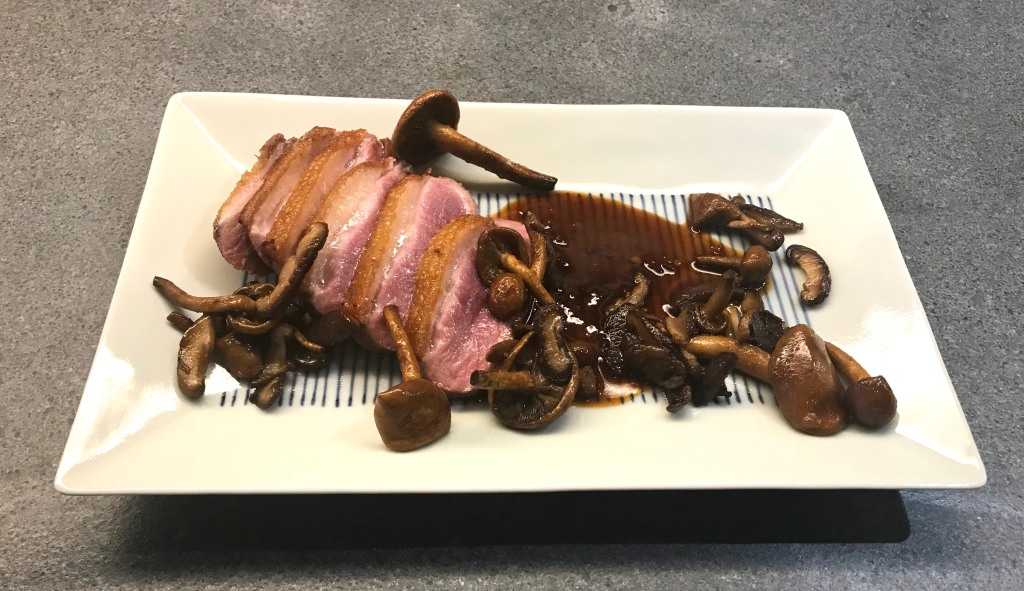
eIn his book Yamazato, Kaiseki Recipes: Secrets of the Japanese Cuisine, author and Michelin Award winning chef Akira Oshima includes a recipe for breast of duck, marinated in a soy-based sauce, served with Belgian endive (chicory) and karashi (Japanese mustard). A mouth-watering dish. The book contains some 20 recipes that are technically challenging (at least, we think so) and well written.
In general the combination of duck and soy sauce works really well. It’s all about sweetness and umami. The Japanese mushrooms (shiitake, enoki, nameko and/or shimeji) add nuttiness and texture to the dish. We use soy sauce and tentsuyu: a mix of soy sauce, mirin and dashi, the clasic tempura dip.
Wine Pairing
We enjoyed our duck with a glass of gewurztraminer (full bodied and long lasting with aromas of lychees and roses) but there are many options in this case. Perhaps a nice rosé or a sake with a touch of sweetness?
We enjoyed this dish as a starter when in Milan, on a beautiful evening, eating al fresco and enjoying the wonderful combination of the sweetness and bitterness of the asparagus, the slightly caramelised sugars as a result of grilling the asparagus and the salty and sweet cheese. A glass of Pinot Grigio was all we wanted. In Milan we enjoyed grilled green asparagus, but it works equally well with white asparagus. This is typically a dish to prepare when the asparagus season is at its high and outside temperatures feel like summer.
Wine Pairing
Serve with a glass of Pinot Grigio, a Muscat or Pinot Gris from the Alsace region or a rosé with character. The wine needs to combine with a range of very diverse flavors so it should be a bit complex.
What You Need
3 Asparagus per person
Olive Oil
Parmesan Cheese
Black Pepper
What You Do
Peel the asparagus and cook or steam until slightly tender
The Fairy Ring Mushroom is a very common mushroom in many countries. The name is not very helpful since many mushrooms grow in the pattern of a ring. The German and Dutch names (Rasen-Schwindling and Weidekringzwam) are more helpful; these refer to the fact that they grow in meadows and lawns.
In France the Mushroom of Saint George is called mousseron and the Fairy Ring Mushroom faux mousseron. But becauseof the limited availability of the Mushroom of Saint George the faux (false) is dropped in the second name and the Fairy Ring Mushroom is often referred to and sold as mousseron.
It’s a small, very edible mushroom, available from early spring until late autumn. Its taste is a bit sweet and perhaps that’s why some people suggest using them to make sweet cookies. Hm, we think you can do better than that!
We combine the Fairy Ring Mushroom with excellent organic pork (also a touch of sweetness), cream, white wine, fresh sage and a splash of cognac to give the dish a nutty component.
Wine Pairing
We enjoyed our Fairy Ring Mushrooms and pork with a glass of Austrian Zweigelt, produced by Weingut Prechtl. This red wine is fruity and elegant with notes of blackberry and cherry. The tannins are well structured but not overly present. In general you’re looking for a full bodied red wine with fruit and not too much acidity.
What You Need
2 Organic Pork Chops with lots of nice fat (Sirloin or Shoulder)
Start by cleaning the mushrooms with kitchen paper. Remove the stems. Fry the caps in olive oil. When the liquid has evaporated, add some dry white wine and two finely chopped leaves of sage. Allow to simmer for 5 minutes or so. Add some crème fraîche and a few moments later a splash of cognac. Stir and leave to simmer for another 5 minutes. In parallel fry the pork chops until brown and leave to rest in aluminium foil. Remove the pork fat from the pan and deglaze with chicken stock. Reduce. Now add the liquid from the pan to the mushrooms, add more finely chopped sage and some black pepper.
Asparagus and eggs, it’s a match made in heaven. For instance à la Flamande(with boiled egg, butter, parsley and ham) or more exotic with Kimizu or with scrambled eggs, chives and shrimps.
Shrimps?
Indeed, with small excellent shrimps, preferably freshly peeled; not used as an ingredient but as an element of flavour. The first time we tasted this combination we were surprised by the role of the shrimps. The salty, intense taste, balanced with the very rich eggs and the sweet-bitter asparagus is a very clever idea. The chives in the scrambled eggs lift the dish to a higher level. Unfortunately we don’t know who created it, so we offer the recipe with a caveat.
Scrambled eggs?
Preparing scrambled eggs, it seems obvious and simple, but actually we are looking for a version that is more like a sauce. Gordon Ramsey’s instructive and hilarious video shows you how to make scrambled eggs, so no need for us to explain. You need to stop a bit earlier, given it needs to have a sauce-like consistency.
Wine Pairing
We decided to drink a glass of Rivaner from the house Gales in Luxembourg. The aroma made us think of grapefruit, ripe melon and apple. The taste is elegant with a touch of sweetness, acidity and minerality. Ideal with our dish! The sweetness with the asparagus, the acidity in combination with the scrambled eggs and chives, the minerality with the shrimps. And the taste is surprisingly long lasting, which is perfect with such a rich dish.
What You Need
6 White Asparagus
2 Eggs
Butter
Chives
Crème Fraiche
White Pepper
A Few Small (unpeeled) Shrimps
What You Do
Peel the asparagus and steam for 20 minutes or so. They should have a bite. Prepare scrambled eggs à la Ramsay. Serve the asparagus with the scrambled eggs and just a few shrimps. Done!
Spring brings us several edible or even delicious mushrooms, such as the Mushroom of Saint George, Morels and the Fairy Ring Mushroom.
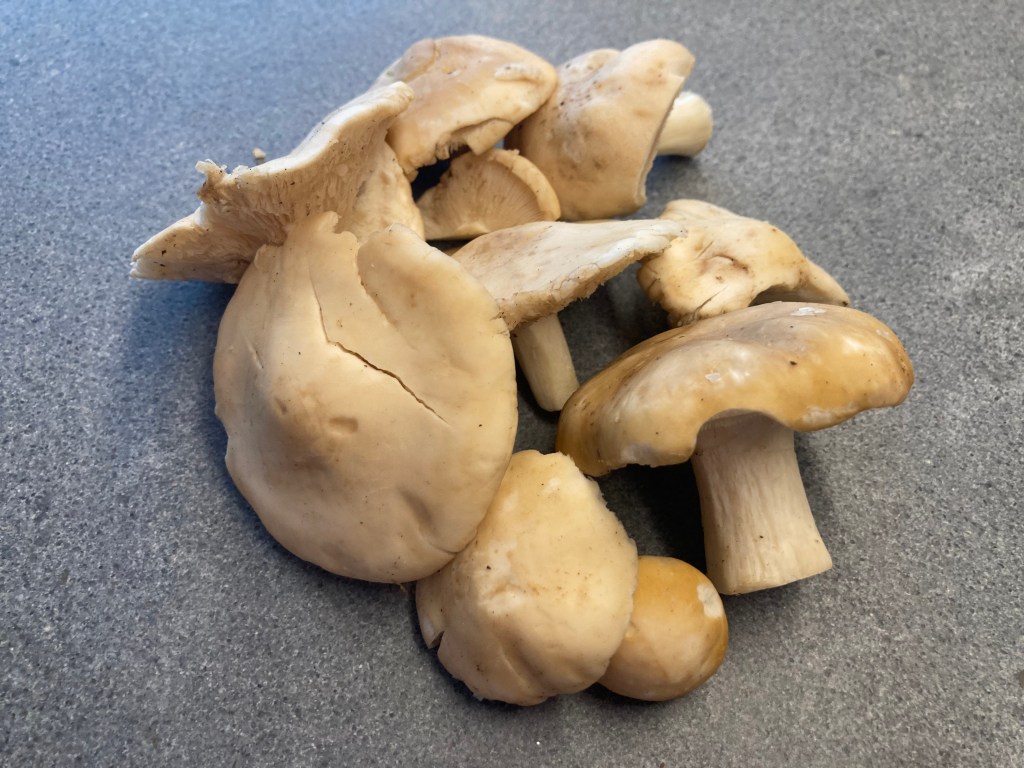
The mushroom of Saint George (Calocybe gambosa) is usually the first edible mushroom to appear. Its name derives from St George’s Day, 23rd April, by which date it can be found in the UK. Its French and Italian name (for instance Tricholome de la Saint-Georges in France) also refer to this day. Its Dutch name (Voorjaarspronkridder) and its Swedish name (Vårmusseron meaning spring mushroom) refer to the fact that the mushroom is available for a short period only.
Famous chef and author Jane Grigson isn’t a fan of the mushroom. In her classic book The Mushroom Feast she writes “I have omitted one or two which our mushroom books follow each other in praising too highly. One of these is the Saint George’s Mushroom.”
Perhaps because the smell is so rare? Some say the mushroom smells of cucumber; others say melon rind or refer to a mealy scent. We think it’s more like overripe zucchini or even ghee that is a bit offish. In all cases, a not-very-pleasant-smell to remember. The good news is that the smell disappears as soon as you heat the mushrooms.
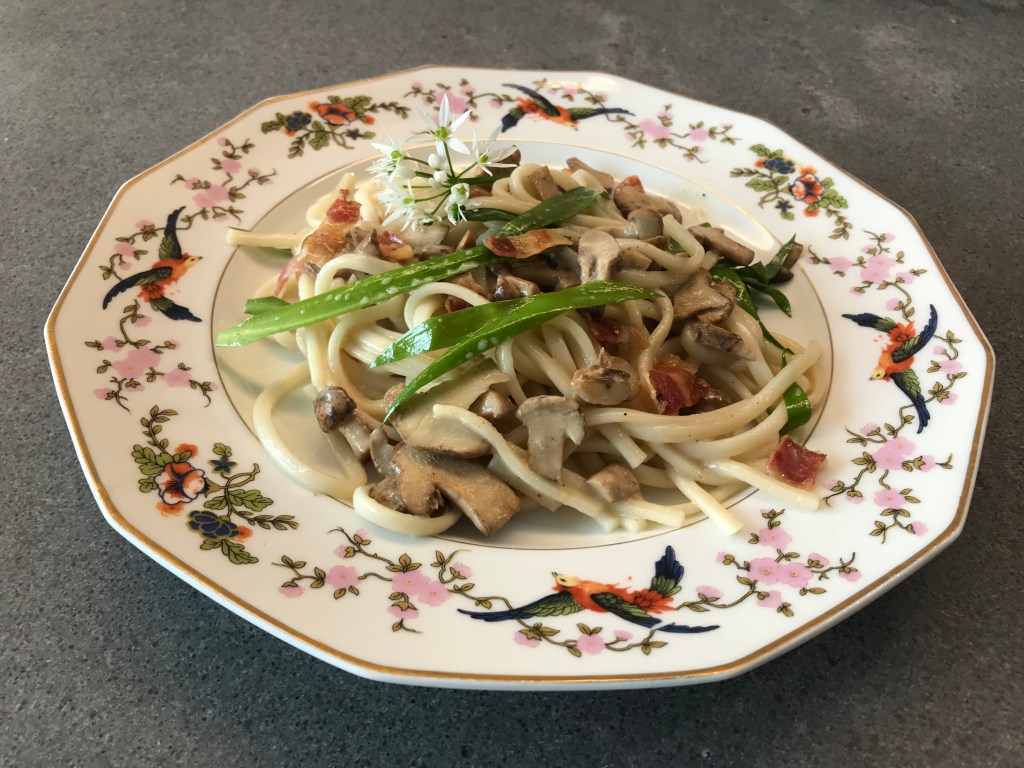
The mushroom of Saint George is clearly a spring-mushroom, but we think that you will have some reminiscence of autumn when eating this dish. A hint of earthiness. Intense but not overwhelming. However, the combination of ramson (wild garlic) and Saint George’s mushroom is 100% spring.
Confused? Perhaps that’s part of the fun of eating Saint George’s mushroom.
Wine Pairing
We suggest an oaked chardonnay, for instance Domaine De La Prade from the Languedoc region in France. The wine has a pale, yellow colour, aromas of ripe tropical fruit and its taste is intense, buttery and comes with a touch of oak. The wine has a long lasting taste.
Feel free to go for a US or Australian Chardonnay. A full-bodied, gently oaked chardonnay will go very well with the mushroom and the udon.
What You Need
1 bunch of Udon
150 grams of Saint George’s Mushroom
Fresh Ramson (or Wild Garlic, 5 Leaves and Flowers)
The French Périgord is the truffle heart of France. The region is also known for its culinary products, such as Confit de Canard, wines from Bergerac and Monbazillac, Foie Gras and Sauce Périgueux. This sauce is a classic in the French kitchen. Its basis is a white sauce made with shallot, a reduction of white wine, (goose) fat, stock and lots of truffle. The ‘original’ recipe of this truffle sauce can be found in La Bonne Cuisine du Périgord written in 1929 by La Mazille. The sauce works beautifully with Tournedos and Magret de Canard. And since white asparagus love truffles, why not combine them with Sauce Périgueux?
We don’t think a roux-based sauce will go very well with asparagus, so we combined two recipes: the flavors of Sauce Périgueux with the lightness and consistency of Japanese Kimizu.
Wine Pairing
We enjoyed our asparagus with a glass of Riesling, produced by Bott Geyl in the French Alsace. This fresh, aromatic, dry white wine with a hint of sweetness and high acidity combines very well with the sweetness of the asparagus and the intense, rich flavor of the sauce. The wine supports the dish perfectly.
What You Need
6 White Asparagus
1 Small Truffle
For the Sauce
1 Shallot
1 Glass of Dry White Wine
3 Black Peppercorns
½ tablespoon Simple White Vinegar
Two Cubes of Jus de Truffe*
2 egg yolks
White Pepper
What You Do
Chop the shallot, crush the peppercorns coarsely, add to a pan and add a glass of white wine
Leave to simmer for 20 minutes
Add a splash of white vinegar
Leave to simmer for 10 minutes
Add two cubes of jus de truffe and leave to simmer for another 10 minutes
Pass through a sieve
If all is well you should have 4 tablespoons of liquid. If necessary reduce
Set aside and leave to cool
Peel the asparagus and steam for 20 minutes, depending on the size
When there is still 10 minutes on the clock, start working on the sauce
Whisk the two egg yolks well, add the 4 tablespoons of liquid, mix and heat in the microwave on 30% power
Start with one interval of 10 seconds, stir, followed by an interval of 5 seconds, stir and continue with intervals of 5 seconds until you have the right consistency
Total time in the microwave will be approximately 60 seconds
Allow to cool for a minute or two
In the meantime grate the truffle
Serve the sauce over the asparagus, add some white pepper and sprinkle the truffle over the sauce and the asparagus.
* Best to buy a can of jus de truffe and freeze the content in an ice cube bag.
Preparing guineafowl can be a bit of a challenge because it’s easily overcooked. Guineafowl requires some liquid (oil, butter, wine, stock) when cooking it, but not too much. It’s actually not at all like chicken; just compare the meat and notice the difference. Guineafowl is structured, meaty, dense. Cooking guineafowl as coq au vin doesn’t work. Grilled guineafowl? Not a good idea either.
In The River Cafe Classic Italian Cookbook (written by Rose Gray and Ruth Rogers) you will find a great recipe of guineafowl with grappa, junipers, sage, white wine and pancetta. The combination of grappa and junipers is amazing and the idea to have these two support the guineafowl is simply stunning. The combination emphasises the wild and nutty taste of the guinegowl. Buy the book and start cooking!
Spring is the best season to prepare this dish, because morels are a spring mushroom. You could use dried morels; they can be as tasty as fresh ones. Other dried mushrooms are expensive, not very tasty and not even close to the real thing. Dried morels are the exception to the rule.
Wine Pairing
We enjoyed our guineafowl with a glass of an elegant, medium-bodied red wine, with aromas and flavours of red fruit. A wine made from gamay grapes will be a good choice, for instance Domaine La Tour Beaumont Val de Loire.
What You Need
2 legs of Guineafowl
50 gram of fresh Morels or 10 gram of dried Morels
Pre-heat the oven to 180˚Celsius or 355˚ Fahrenheit. Add the two legs of guineafowl to a shallow dish with butter and olive oil. Cook for 10 minutes. If using dried morels: soak in hot water for 15 minutes. Otherwise clean the morels with some kitchen paper. Turn the legs upside down after 10 minutes. Cook for another 10 minutes. Turn them a second time, skin up. Add the morels to the dish, leaving the skin free. The legs should be ready after in total 30 minutes. Transfer the guineafowl and the morels to a plate and keep warm. Add chicken stock to the cooking liquid. Add crème fraîche, mustard and pepper to the sauce, stir well and allow to warm through and through for 5 minutes. Taste the sauce and if necessary add more mustard. Serve with gnocchi. (Yes of course, we will be happy to explain how to make gnocchi in the near future.)