Asparagus with Scrambled Eggs and Shrimps

Asparagus and eggs, it’s a match made in heaven. For instance à la Flamande (with boiled egg, butter, parsley and ham) or more exotic with Kimizu or with scrambled eggs, chives and shrimps.

Shrimps?

Indeed, with small excellent shrimps, preferably freshly peeled; not used as an ingredient but as an element of flavour. The first time we tasted this combination we were surprised by the role of the shrimps. The salty, intense taste, balanced with the very rich eggs and the sweet-bitter asparagus is a very clever idea. The chives in the scrambled eggs lift the dish to a higher level.
Unfortunately we don’t know who created it, so we offer the recipe with a caveat.

Scrambled eggs?

Preparing scrambled eggs, it seems obvious and simple, but actually we are looking for a version that is more like a sauce. Gordon Ramsey’s instructive and hilarious video shows you how to make scrambled eggs, so no need for us to explain. You need to stop a bit earlier, given it needs to have a sauce-like consistency.

Wine Pairing

We decided to drink a glass of Rivaner from the house Gales in Luxembourg. The aroma made us think of grapefruit, ripe melon and apple. The taste is elegant with a touch of sweetness, acidity and minerality. Ideal with our dish! The sweetness with the asparagus, the acidity in combination with the scrambled eggs and chives, the minerality with the shrimps. And the taste is surprisingly long lasting, which is perfect with such a rich dish.

What You Need

  • 6 White Asparagus
  • 2 Eggs
  • Butter
  • Chives
  • Crème Fraiche
  • White Pepper
  • A Few Small (unpeeled) Shrimps

What You Do

Peel the asparagus and steam for 20 minutes or so. They should have a bite. Prepare scrambled eggs à la Ramsay. Serve the asparagus with the scrambled eggs and just a few shrimps. Done!

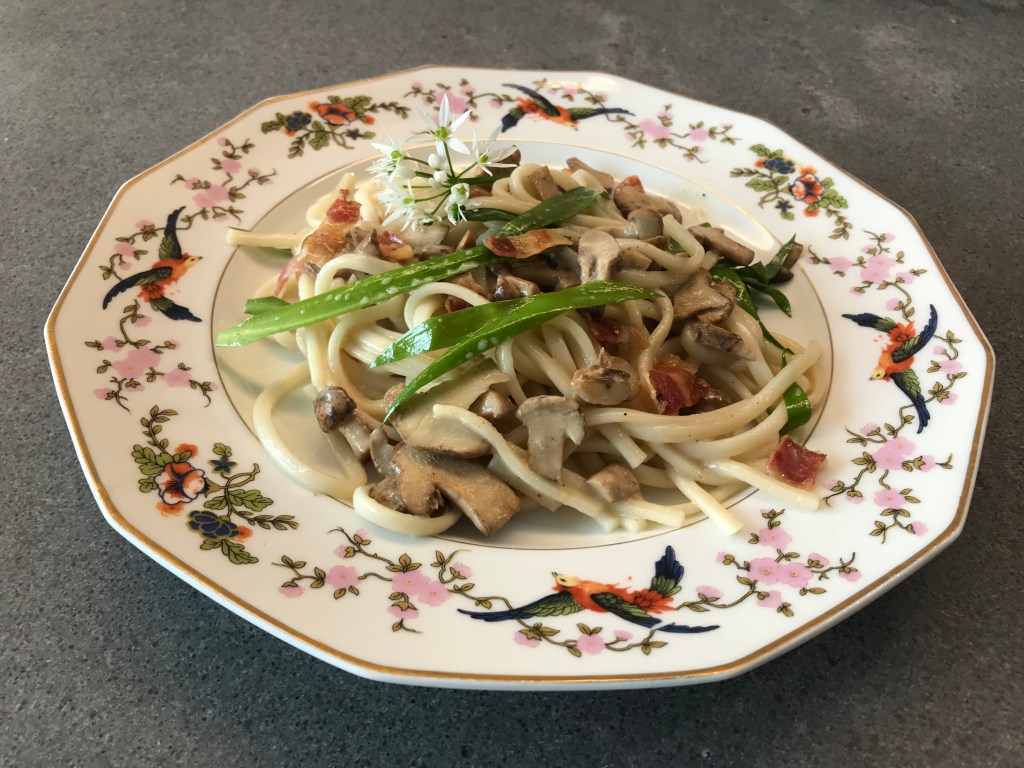
Saint George’s Mushroom with Pasta

Spring brings us several edible or even delicious mushrooms, such as the Mushroom of Saint GeorgeMorels and the Fairy Ring Mushroom.

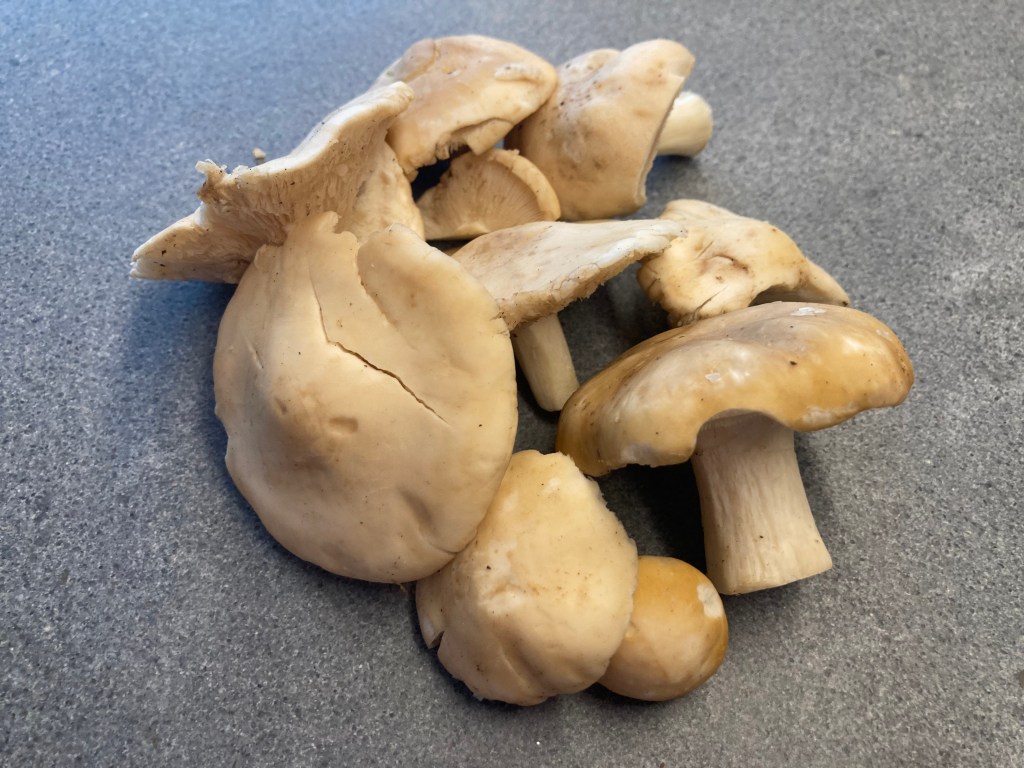
The mushroom of Saint George (Calocybe gambosa) is usually the first edible mushroom to appear. Its name derives from St George’s Day, 23rd April, by which date it can be found in the UK. Its French and Italian name (for instance Tricholome de la Saint-Georges in France) also refer to this day. Its Dutch name (Voorjaarspronkridder) and its Swedish name (Vårmusseron meaning spring mushroom) refer to the fact that the mushroom is available for a short period only.

Famous chef and author Jane Grigson isn’t a fan of the mushroom. In her classic book The Mushroom Feast she writes “I have omitted one or two which our mushroom books follow each other in praising too highly. One of these is the Saint George’s Mushroom.” 

Perhaps because the smell is so rare? Some say the mushroom smells of cucumber; others say melon rind or refer to a mealy scent. We think it’s more like overripe zucchini or even ghee that is a bit offish. In all cases, a not-very-pleasant-smell to remember. The good news is that the smell disappears as soon as you heat the mushrooms.

The mushroom of Saint George is clearly a spring-mushroom, but we think that you will have some reminiscence of autumn when eating this dish. A hint of earthiness. Intense but not overwhelming. However, the combination of ramson (wild garlic) and Saint George’s mushroom is 100% spring.

Confused? Perhaps that’s part of the fun of eating Saint George’s mushroom.

Wine Pairing

We suggest an oaked chardonnay, for instance Domaine De La Prade from the Languedoc region in France. The wine has a pale, yellow colour, aromas of ripe tropical fruit and its taste is intense, buttery and comes with a touch of oak. The wine has a long lasting taste. 

Feel free to go for a US or Australian Chardonnay. A full-bodied, gently oaked chardonnay will go very well with the mushroom and the udon.

What You Need
  • 1 bunch of Udon
  • 150 grams of Saint George’s Mushroom
  • Fresh Ramson (or Wild Garlic, 5 Leaves and Flowers)
  • Chicken Stock
  • Black Pepper
  • Crème Fraîche
  • 4 Slices of Excellent Pancetta
  • Olive Oil
What You Do
  1. Clean the mushrooms with kitchen paper and if necessary clean the stems with a sharp knife.
  2. Slice the pancetta in small slices.
  3. Heat a heavy iron skillet, add olive oil and quickly fry the pancetta.
  4. Transfer to a plate with kitchen paper and keep in the oven on 60° Celsius or 140° Fahrenheit.
  5. Slice the mushrooms, fry them gently in the pan and reduce the heat.
  6. Add chicken stock.
  7. Add some crème fraiche.
  8. In parallel cook the udon for 10 minutes.
  9. Drain the udon and keep some of the cooking liquid.
  10. Add the udon to the mushrooms in the pan, add black pepper and stir gently, making sure all pasta is covered.
  11. Add some cooking liquid to make sure it’s nice and moist.
  12. Add the pancetta and the sliced leaves (lengthwise, remove the vein) of ramson, mix and serve immediately.
  13. Decorate with a ramson flower.
  • Saint George's Mushroom with Pasta ©cadwu
  • Saint George's Mushroom with Pasta - Ingredients ©cadwu
  • Saint George's Mushroom ©cadwu
  • Domaine La Prade Chardonnay ©cadwu

White Asparagus with Sauce Périgueux à la Kimizu

The French Périgord is the truffle heart of France. The region is also known for its culinary products, such as Confit de Canard, wines from Bergerac and MonbazillacFoie Gras and Sauce Périgueux. This sauce is a classic in the French kitchen. Its basis is a white sauce made with shallot, a reduction of white wine, (goose) fat, stock and lots of truffle. The ‘original’ recipe of this truffle sauce can be found in La Bonne Cuisine du Périgord written in 1929 by La Mazille. The sauce works beautifully with Tournedos and Magret de Canard. And since white asparagus love truffles, why not combine them with Sauce Périgueux?

We don’t think a roux-based sauce will go very well with asparagus, so we combined two recipes: the flavors of Sauce Périgueux with the lightness and consistency of Japanese Kimizu.

Wine Pairing

We enjoyed our asparagus with a glass of Riesling, produced by Bott Geyl in the French Alsace. This fresh, aromatic, dry white wine with a hint of sweetness and high acidity combines very well with the sweetness of the asparagus and the intense, rich flavor of the sauce. The wine supports the dish perfectly.

What You Need

  • 6 White Asparagus
  • 1 Small Truffle
  • For the Sauce
    • 1 Shallot
    • 1 Glass of Dry White Wine
    • 3 Black Peppercorns
    • ½ tablespoon Simple White Vinegar
    • Two Cubes of Jus de Truffe*
    • 2 egg yolks
  • White Pepper

What You Do

  1. Chop the shallot, crush the peppercorns coarsely, add to a pan and add a glass of white wine
  2. Leave to simmer for 20 minutes
  3. Add a splash of white vinegar
  4. Leave to simmer for 10 minutes
  5. Add two cubes of jus de truffe and leave to simmer for another 10 minutes
  6. Pass through a sieve
  7. If all is well you should have 4 tablespoons of liquid. If necessary reduce
  8. Set aside and leave to cool
  9. Peel the asparagus and steam for 20 minutes, depending on the size
  10. When there is still 10 minutes on the clock, start working on the sauce
  11. Whisk the two egg yolks well, add the 4 tablespoons of liquid, mix and heat in the microwave on 30% power
  12. Start with one interval of 10 seconds, stir, followed by an interval of 5 seconds, stir and continue with intervals of 5 seconds until you have the right consistency
  13. Total time in the microwave will be approximately 60 seconds
  14. Allow to cool for a minute or two
  15. In the meantime grate the truffle
  16. Serve the sauce over the asparagus, add some white pepper and sprinkle the truffle over the sauce and the asparagus.

* Best to buy a can of jus de truffe and freeze the content in an ice cube bag.

  • White Asparagus with Sauce Périgueux à la Kimizu ©cadwu
  • White Asparagus and Truffle ©cadwu
  • Bott Geyl Riesling ©cadwu
  • Jus de Truffes (Chabert-Guillot) ©cadwu

Guineafowl with Morels and Gnocchi

Preparing guineafowl can be a bit of a challenge because it’s easily overcooked. Guineafowl requires some liquid (oil, butter, wine, stock) when cooking it, but not too much. It’s actually not at all like chicken; just compare the meat and notice the difference. Guineafowl is structured, meaty, dense. Cooking guineafowl as coq au vin doesn’t work. Grilled guineafowl? Not a good idea either.

In The River Cafe Classic Italian Cookbook (written by Rose Gray and Ruth Rogers) you will find a great recipe of guineafowl with grappa, junipers, sage, white wine and pancetta. The combination of grappa and junipers is amazing and the idea to have these two support the guineafowl is simply stunning. The combination emphasises the wild and nutty taste of the guinegowl. Buy the book and start cooking!

Spring is the best season to prepare this dish, because morels are a spring mushroom. You could use dried morels; they can be as tasty as fresh ones. Other dried mushrooms are expensive, not very tasty and not even close to the real thing. Dried morels are the exception to the rule.

Wine Pairing

We enjoyed our guineafowl with a glass of an elegant, medium-bodied red wine, with aromas and flavours of red fruit. A wine made from gamay grapes will be a good choice, for instance Domaine La Tour Beaumont Val de Loire.

What You Need

  • 2 legs of Guineafowl
  • 50 gram of fresh Morels or 10 gram of dried Morels
  • Butter
  • Olive Oil
  • Chicken Stock
  • Mustard
  • Crème Fraîche
  • Black Pepper
  • Gnocchi

What You Do

Pre-heat the oven to 180˚Celsius or 355˚ Fahrenheit. Add the two legs of guineafowl to a shallow dish with butter and olive oil. Cook for 10 minutes. If using dried morels: soak in hot water for 15 minutes. Otherwise clean the morels with some kitchen paper. Turn the legs upside down after 10 minutes. Cook for another 10 minutes. Turn them a second time, skin up. Add the morels to the dish, leaving the skin free. The legs should be ready after in total 30 minutes. Transfer the guineafowl and the morels to a plate and keep warm. Add chicken stock to the cooking liquid. Add crème fraîche, mustard and pepper to the sauce, stir well and allow to warm through and through for 5 minutes. Taste the sauce and if necessary add more mustard.
Serve with gnocchi. (Yes of course, we will be happy to explain how to make gnocchi in the near future.)

  • Guineafowl with Morels and Gnocchi © cadwu
  • Soaked Morels © cadwu
  • Guineafowl © cadwu

Chicken with Fresh Oregano

Thyme, Oregano, Basil, Rosemary, Saffron, Sage: all powerful Mediterranean herbs. Oregano, or Wild Marjoram, is an interesting one. Probably best known as the herbal ingredient of pizza. A dried herb, one to store in a jar, forget about and then use beyond its ‘use-by date’ and be disappointed.
Such a pity because fresh oregano is aromatic, slightly bitter, pungent and perhaps chemical, depending on the variety, of course. Great to combine with lamb, a tomato salad, grilled fish and of course chicken. It’s also great to flavour olive oil with oregano. So ask your supermarket or local greengrocer for fresh oregano!

Wine Pairing

We enjoyed our chicken and oregano with a glass of Rioja Paternina Reserva 2015 produced by Marques de la Concordia. Reserva means that the wine ages for a minimum of 3 years, with at least 1 year in oak barrels. The grapes are tempranillo, mazuelo and garnacha; very typical for Rioja. It’s a powerful, full-bodied red wine with aromas of black cherries and touch of vanilla and various spices. The wine goes very well with the velvety chicken and the very present flavours of the oregano.

What You Need

  • Chicken Thighs
  • Olive Oil
  • Black Pepper
  • Chicken Stock
  • Lots of Fresh Oregano

What You Do

Halve the thighs, heat a heavy iron skillet, add olive oil and quickly fry the meat on all sides. Reduce the heat and add two third of the chopped oregano. Keep on low to medium heat for 10 minutes or so. Add some chicken stock, just to deglaze the pan. You will notice that the juices becomes green thanks to the oregano, so please coat the meat with the cooking liquid. Just before serving add the remaining oregano, some freshly ground black pepper and mix.
Serve with green beans, cooked in water with fresh garlic, wrapped in pancetta (after having grated some nutmeg over the beans) and then fried for 5 minutes in some olive oil.

  • Chicken with Fresh Oregano ©cadwu
  • Federico Paternina Rioja Reserva 2015 ©cadwu
  • Fresh Oregano ©cadwu


White Asparagus with Chervil

A salad can be an excellent starter of your lunch or dinner, provided it’s one with lots of flavour and gentle acidity. For instance a Salade Ni­çoi­se, a Salade Caprese or a salad of White Asparagus and Chervil.

Chervil is a very delicate herb. It tastes like anise, but it is much more refined. Chervil looses its taste almost immediately when heated. The salad needs to be prepared well in advance, allowing for the flavours to be well integrated.

Honey can easily ruin a salad (and sugar will always ruin a salad). In this case we use only a touch of honey to create an environment for the sweetness of the white asparagus. The honey should act as a trigger.

The salad is a great example of the complexity of white asparagus: you will taste the sweetness and the freshness of the asparagus. The mouth feel of the salad is very nice, because the asparagus will be both juicy and crispy, with the chervil, honey and vinegar in a supporting role.

After having mixed the salad you will notice that the asparagus and chervil absorb the dressing. During the time in the refrigerator the asparagus will loose some juices, which is actually the beginning of a great dressing.

Wine Pairing

Combining salad and wine is not straightforward. Especially the acidity of the dressing creates a challenge. One solution is to use verjuice and not vinegar. Verjuice is made by pressing unripe grapes. The idea is that verjuice links to wine, whereas classic vinegar or lemon juice would compete with wine. In this case we choose a wine that reflects the flavours of the salad: a hint of anise, a touch of sweetness and florality. Typical notes you will find in a wine from the Alsace region, for instance a Pinot Blanc or a Pinot Gris.

What You Need

  • 2 White Asparagus per person
  • Excellent Olive Oil
  • White Wine Vinegar or Verjuice
  • Lots of Chervil
  • Touch of Honey
  • White Pepper

What You Do

Steam the asparagus for 10 minutes. Let cool. Dry with kitchen paper if needed. Prepare a dressing with the olive oil and vinegar. Chop the chervil and add to the dressing. Add a touch of honey and stir well. Add some white pepper. Taste the dressing: it should be a balance, meaning that none of the ingredients is overly present. Now slice the asparagus in nice chunks, let’s say 3 centimetres long. Mix, cover and transfer to the refrigerator for 6 hours. Mix the salad every two hours. Check the taste after 4 hours, you may want to adjust. Mix the dressing just before serving.

White Asparagus with Ham, Egg, Potatoes and Parsley

Finally, it’s spring. The season of white asparagus, morels and many more primeurs. This dish brings together white asparagus with eggs, excellent ham, butter, small potatoes and parsley. Taste the slight bitterness and sweetness of the asparagus, the umami of the potato and enjoy the velvety feeling on your palate as a result of the butter and the egg.
Don’t be tempted to boil white asparagus in water with butter, lemon, sugar or salt. Steaming is by far the best way to prepare them. We love our Russel Hobbs food steamer! Simple, straightforward and the result is a tribute to spring.

Wine Pairing

Ideally we would serve a dry Muscat from the Elzas with our asparagus. The delicate, slightly sweet but dry taste, the hint of bitterness and the rich aromas work very well with white asparagus. Muscat to us means the smell of fresh fruit. As if you taste the original grape. A wonderful wine and a wonderful combination.
Fortunately asparagus are fairly flexible when it comes to wine: a Pinot Blanc or Pinot Gris will also be fine.

We opened a bottle of Vinho Verde from Portugal. A light and vibrant wine with clear notes of citrus and floral aromas that combined rather well with the flavours of the asparagus. Not the most exquisite combination, but it worked for us.

What You Need

  • 6 or 10 White Asparagus
  • 2 Eggs
  • 100 gram Excellent, Organic Ham
  • Small Firm Potatoes
  • Parsley
  • Butter
  • White Pepper

What You Do

Peel the asparagus and steam them for 20 minutes. Steam the eggs medium (10 minutes), making sure the yolk is firm but not dry. Wash the potatoes and steam them for 15 minutes. Timing depends on the size. Melt the butter. Peel the egg and cut in four. Chop the parsley. Serve the asparagus and eggs on a plate. Coat the potatoes with butter and parsley. Dress the plate with ham (please make sure it has a bit of fat) and potatoes. Poor the remaining melted butter over the asparagus. Sprinkle the parsley over the egg. Add some white pepper.

White Asparagus with Ham, Egg, Potatoes and Parsley ©cadwu

Caudle, Eggnog, Ajerkoniak and Advocaat

In the old days new mothers and their visitors were served Caudle, a combination of white wine, eggs, sugar, cloves, raisins, nutmeg and cinnamon. The idea was to strengthen the new mother and of course to celebrate the occasion. Dutch master Jan Steen painted De Kandeelmakers (The Caudle Makers) around 1665. Note the nutmeg grater!

The ingredients are not too dissimilar to those of Eggnog. Basically this is custard infused with various spices, such as vanilla, nutmeg, cinnamon and cloves. The custard is enriched with whole cream, rum/brandy/whisky/cognac and whipped egg white. Our Eggnog was very tasty, creamy and soft with the right push from the cognac. The spices worked really well, especially the nutmeg. We suggest not adding cream because it actually doesn’t bring much other than a fatty feeling in your mouth.

A less complex version is Ajerkoniak from Poland. It combines egg yolks with non-sweetened condensed milk, sugar and vodka (or plain alcohol). The result is a strong, smooth and sweet drink. The vodka worked very well with the eggs but we thought the condensed milk was a bit too present.

Making Caudle, Ajerkoniak or Eggnog begins with whisking sugar and egg yolks until it’s smooth, pale and creamy. This is called whisking the eggs ruban and may take 10 minutes. Interestingly the result is a dish in its own right called Kogel Mogel.

We also prepared Advocaat from the Netherlands. It is a combination of eggs, alcohol and sugar (so no milk, cream or spices). It can be enjoyed as a drink (but our grandmother used a small spoon, probably because she didn’t want to be heard slurping). Our version is a bit thicker, making it ideal as a dessert.

What You Need

  • 2 Egg Yolks
  • 25 grams of Sugar
  • 50 ml of Brandy, Gin or Vodka
  • Whole Cream

What You Do

  1. Mix the egg yolks and the sugar well. It doesn’t need to become ruban but some increase in volume is needed
  2. Now gently add brandy, gin or vodka
  3. Transfer to the microwave and very gently heat the mixture. We used one interval of 10 seconds to start with and continued with intervals of 5 seconds. In total only 55 seconds on 30% power
  4. Stir well after every interval until it becomes thick
  5. The consistency must be similar to a thick pastry cream (crème pâtissière)
  6. Cool quickly and store in the refrigerator
  7. Serve with some whipped cream

PS Obviously you need fresh eggs when making Ajerkoniak, Eggnog, Kogel Mogel, Advocaat, Mayonnaise, Sabayon, Béarnaise, Kimizu et cetera. We don’t think eating fresh, organic eggs is a problem. Eating all kinds of additives, chemicals such as E102 – Tartrazine to make commercial Advocaat look as yellow as real Advocaat, unclear syrops, modified milk ingredients, guar gum, monoglycerides etcetera, that’s a problem.

  • Advocaat ©cadwu
  • Eggnog ©cadwu
  • Ajerkoniak ©cadwu

Spicy Grilled Octopus

We have all experienced chewy, fibrous and tasteless octopus, so how to make sure your octopus is juicy, tender and full of flavours?

Since octopuses don’t have bones, they have very tough connective tissue (collagen) between the muscles. When heating the octopus for a few hours, the collagen will break down into soft gelatine and the meat will become tender and juicy, just as you would like it to be.

‘How to speed up the process’, you wonder?
You could add vinegar to the cooking liquid, you could prepare the octopus by storing it in brine for a few hours, you could beat and pound the flesh, you could freeze the octopus for a few days, you could try adding a wine cork to the cooking liquid (hilarious!).
Unfortunately none of these short cuts make a significant difference.

The best method is to stew the octopus in a large pot or in the oven. This may take 4 hours or more. Octopuses contain a fair amount of juices and you want to capture these and their lovely flavours, which is exactly what you do when stewing an octopus.
Cooking an octopus in water for hours means losing these flavours; not something you want to do.

There is only one alternative to slow cooking: buy (frozen) baby octopuses. Marinate them for a few hours, grill them for 2 minutes and enjoy with a glass of wine or a nice cold beer.

What You Need

  • 6 Baby Octopuses
  • For the Marinade
    • Neutral Oil
    • Soy Sauce
    • Sweet Soy Sauce (Kecap Manis)
    • Fresh Ginger
    • One Garlic Glove
    • Teaspoon of Cumin
    • Tablespoon of Chilli Bean Sauce (Toban Djan)
    • Water (optional)
  • Chinese or Japanese pickles

What You Do

Clean the octopuses and remove the beak. Grate the ginger, chop the garlic and combine with the other ingredients. You’re looking for a powerful marinade with lots of chilli and (sweet) soy sauce. Allow the octopuses to marinate for a few hours.
Heat your grill, dry the octopus and grill for 2*1 minute. We prefer using a non-stick contact grill. Cut of the mantle and slice the tentacles in two. Serve on a warm plate with pickles and share.

Cod with Bleu d’Auvergne

Bleu d’Auvergne is amongst our favourite cheeses. It’s creamy, semi-hard, moist, powerful, pungent and not too salty. It was created around 1850 in France when a farmer combined cow milk curd with the mould of rye bread. He also noticed that the cheese benefits from increased aeration using needles (similar to the process used when making Stilton cheese). Nowadays Bleu d’Auvergne is a Protected Designation of Origin (PDO), just like the other excellent cheeses from that region (for example Saint-Nectaire and Cantal).
For some reason Bleu d’Auvergne combines extremely well with cod. We tried other combinations, experimented with adding butter, cream or crème fraîche but we always return to this one. It’s a tribute to both the fish and the cheese.

Wine Pairing

The combination may be very specific; wine pairing is not too difficult. In general a fairly present, white wine will be great choice. Could be a Verdejo from Spain, a mildly oaked Chardonnay or a glass of your favourite white wine. No reason to open a bottle of Chablis; the flavours are too bold for a really elegant wine.

What You Need

  • Skinless Cod Loin
  • Bleu d’Auvergne (preferable mature)
  • Olive Oil

What You Do

Heat a heavy cast iron skillet through and through, add olive oil, dry the cod with kitchen paper and fry on the firm side (where the skin used to be) until it’s nice and golden. Flip the fish, reduce the heat and start adding chunks of cheese. It will melt, but make sure you still have these blue bits in there. Baste the fish with the melting cheese. Check the cuisson of the cod (the fish must be opaque and flaky) and serve on a warm plate.

  • Cod with Bleu d’Auvergne ©cadwu
  • Blue d'Auvergne ©cadwu