Asparagus with Kimizu

The combination of white asparagus and Hollandaise is classic. The sweetness and bitterness of the asparagus together with the velvety, rich flavours of the sauce is just perfect.

A few years ago we enjoyed Kimizu-Ae (white asparagus with Kimizu) at Yamazato in Amsterdam. We were immediately intrigued by this combination. The Kimizu is a rich and light sauce; it comes with a velvety feeling, a touch of sweetness, a bright yellow colour and perfect acidity. So yes, the next day we prepared our own Kimizu.

Kimizu is based on two main ingredients: egg yolk and rice vinegar. You could add some mirin and a pinch of salt. Kimizu does not contain butter (the egg yolk being the only source of fat) so Kimizu, although it seems similar to Hollandaise, is lighter, easier to digest and fresher.
Many recipes for Kimizu include starch, probably because the cook has trouble making a warm, emulgated sauce. Our advice: never use starch or beurre manié. The consistency is an essential element of the sauce and must be the result of carefully heating the mixture of egg yolk, vinegar, mirin and water.

Using a microwave oven to make Kimizu is a great idea (see our recipe for Hollandaise), although it does require more whipping and more attention compared to making Hollandaise.

Wine Pairing

We enjoyed our Asparagus and Kimizu with a glass of Sancerre, Domaine Merlin Cherrier. This classic wine reflects the chalky terroir of Sancerre beautifully. The combination of Sauvignon Blanc (citrus, minerals) and Kimizu (touch of sweetness, present but not overpowering acidity) works really well. A wine of true class and complexity with a long finish.

What You Need

  • Two Egg Yolks
  • 1,5 tablespoon of Rice Vinegar (depending on the size of the egg yolks and the acidity of the vinegar)
  • 3 tablespoons of Water
  • Teaspoon of Mirin (optional)
  • Pinch of salt (very optional)
  • 6 Asparagus

What You Do

The amount of water you’ll need depends on the acidity of the rice vinegar and the size of the egg yolks. Whisk the two egg yolks, add the rice vinegar, the mirin, the water and whisk some more. Now transfer to the microwave and give it let’s say 10 seconds on 30% power. Remove from oven and whisk well. Repeat. You will now feel the consistency changing. If not, don’t worry, just repeat the step. After 2*10 or 3*10, move to steps of 5 seconds on 30% power. Whisk, whisk again and feel free to find your own way. When the Kimizu is ready, take it out of the oven, continue whisking gently and perhaps cool slightly in a water bath.
In parallel steam the asparagus (depending on the size 20 or 25 minutes; they should be well done for this dish).
Serve the asparagus with a generous helping of Kimizu.
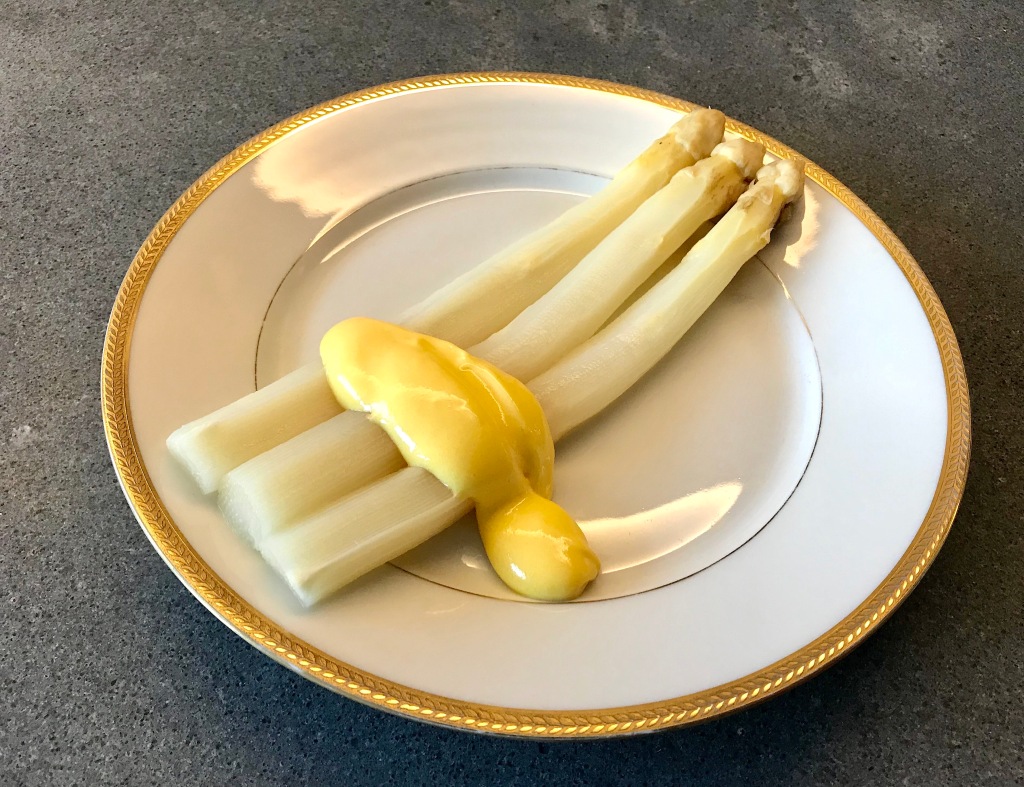
White Asparagus with Kimizu ©cadwu

Takes 5

You can’t have enough cookbooks. Some make you think back of a holiday, others are written by chefs you admire, and some are technical or about specific ingredients. There is always room for just one extra cookbook.

Once in a while, when you’re looking for inspiration, you browse through a number of books, look at the pictures, read recipes and you think: ‘far too many ingredients, far too complicated’ for a not very inspired evening.

James Tanner

Fortunately, you remember one very special cookbook: James Tanner Takes 5: Delicious Dishes Using Just 5 Ingredients with over 90 recipes, ranging from Roasted Red Bell Peppers with Anchovies to Scones. Short shopping lists, easy recipes and tasty results: what more can you ask for! Isn’t it great, Chocolate MousseFigs with Honey or Toad-in-the-hole

James Tanner (1976) is a British chef and author. Together with his brother Chris he runs a restaurant in Kent, The Kentish Hare. He appeared as a tv-chef on shows like Ready Steady Cook (remember The Quickie BagGreen Pepper and Red Tomato?).

Favourite

Our personal favourite is a small chicken (preferably a coquelet, a young rooster) with a paste made of red peppers, pure creamed coconut (santan), lime and cilantro. It’s easy to make and the result is very tasty. Serve it with some bok choy in oyster sauce and you have a lovely meal. He enjoys it with a cold beer, we prefer a glass of rosé, for instance Chiaretto di Bardolino DOC made by Monte del Frà from Italy. A pale, pink wine with floral and fruity aromas. Dry with medium acidity, limited tannins and delicate flavours. Excellent with the chicken and the coconut.

Takes 5: Delicious Dishes Using Just 5 Ingredients was published in 2010 and is available (probably second hand) via the well-known channels for something like 20 US dollar or Euro.

Asparagus à la Flamande

One of the classic ways of serving asparagus is à la Flamande (Op Vlaamse wijze) with melted butter, boiled eggs, parsley and nutmeg. The nutmeg is an essential element of the dish. It enhances the flavour of the asparagus, and it’s a bridge between the egg mixture and the asparagus.
There are two main variations: the first one is to serve the asparagus with small potatoes. Not a great idea, unless you’re hungry, because the potatoes soften, weaken the flavour of the asparagus. The dish is about enjoying asparagus, so why would you add potatoes?
The second variation is to add lemon to the butter and egg mixture. This makes the dish a bit lighter and fresher. If you want to do so, be careful with the wine you serve. You need to balance the acidity in the wine and the food.

Wine Pairing

Serve the asparagus à la Flamande with a dry, white wine. We enjoyed a glass of Silvaner produced by the German Winery Thörle. The wine comes with freshness, some acidity, minerality and fruit (pear, green apples). Excellent with our asparagus.

What You Need

  • 4 Asparagus per person
  • 3 Eggs
  • Parsley
  • Butter
  • Nutmeg
  • White Pepper

What You Do

  1. We use our Russel and Hobbs food steamer to prepare this classic dish. An essential kitchen aid for only 50 euro or US dollar
  2. Clean and peel the asparagus
  3. Steam them for 10+5+5 minutes
  4. After 10 minutes add the eggs to the steamer basket
  5. After 5 minutes, turn the eggs upside down
  6. Another 5 minutes later the asparagus and the eggs are ready
  7. If you like your asparagus softer, then steam for 12-15 minutes.
  8. The eggs should be hard. Depending on the size you may need to steam them a bit longer
  9. In parallel heat a very generous amount of butter
  10. Chop the parsley
  11. Peel the egg and mash with a fork, creating a ‘mimosa’ of egg
  12. Combine mimosa and parsley
  13. Add some white pepper and freshly grated nutmeg
  14. Add the mixture to the butter and combine
  15. Spoon the egg mixture on top of the asparagus
Asparagus a la Flamande ©cadwu

No-Knead Bread

Two or three times per week we enjoy the taste of fresh home-made bread. The crust, the flavours, the aromas! And how about the singing of the bread when it’s just out of the oven? Baking your own bread is such a pleasure.

Our recipe is based on a recipe published by Jim Lahey, owner of Sullivan Street Bakery, New York. It was published in the New York Times in 2006 and can also be found in his excellent book My Bread. The process is time consuming (it’s 24 hours from start to finish) but not labour intensive. It’s simple and straightforward with a great result. We truly love it.

The recipe is based on slow-rise fermentation. With only 1 gram of instant yeast in combination with 19+3 hours of rest the yeast will do a wonderful job. The dough will be perfect. And kneading, as you would expect, is not required.

Origin

In 1764 Elizabeth Moxon describes a no kneading bread recipe as shown in this nice instructive video.
Her recipe: To half a peck of flour, put a full jill of new yeast, and a little salt, make it with new milk (warmer than from the cow) first put the flour and barm together, then pour in the milk, make it a little stiffer than a seed-cake, dust it and your hands well with flour, pull it in little pieces, and mould it with flour very quick; put it in the dishes, and cover them with a warm cloth (if the weather requires it) and let them rise till they are half up, then set them in the oven, (not in the dishes, but turn them with tops down upon the peel;) when baked rasp them.
Interesting that she rasps the bread: she is not interested in the crust!

Jim Lahey

My Bread is such a wonderful book. The first chapters describe the background, the process and the basic recipe. In the next chapters you will find recipes for special bread, such as Fresh Corn Bread and Banana Leaf Rolls plus inspired recipes for Pizza Fungi and Focaccia.

My Bread is available via your local bookshop and the usual channels for something between 20 and 30 euro or US dollar.

What You Need

  • 200 grams of Whole Grain Flour
  • 230 grams of Plain White Flour
  • 1 gram Instant Yeast
  • 25 grams Blue Poppy Seed
  • 30 grams Brown Linseed
  • 4 grams Salt (this is less than usual, most recipes for bread would say 8 grams)
  • 350 grams Water
  • Additional Flour
  • Bran

What You Do

Simplest is to buy My Bread or look at the recipe and movie as provided by the New York Times.

Mix flour, yeast, seeds and salt. Add water and create one mixture. Let rest in a covered bowl for 18 hours. Remove from bowl, fold 4 times, dust with additional flour and let rest on a towel dusted with flour and bran for 3 hours. Check that the pot (and the handles!) can be used in a really hot oven. Transfer the pot to the oven and heat your oven to 235˚ Celsius or 450˚ Fahrenheit. Put the dough, seam side up, in the pot, close it and bake for 30 minutes. Remove the lid and bake for 15 minutes or until it is nicely browned. Let cool on a wire rack for at least an hour before slicing it. Listen to your bread signing!

Pasta with Mushrooms and Bell Pepper

Udon is such a wonderful noodle. What better comfort food than a warm soup made with dashi, vegetables, tofu, udon and thinly sliced spring onions? Perhaps some tempura on top of the soup? Or would you prefer a very simple dish, called Mori Udon? The cold udon is served with a sauce of mirin, dashi and soy sauce on the side.
Udon is also a great alternative to Italian pasta, for instance with Caesar’s Mushrooms.

In this recipe we combine udon with roasted bell pepper and Trompettes de la Mort. We’re not sure why, but this combination works really well. Is it because of the smokey aroma of the roasted bell pepper mixed with the aromas of the mushroom? The crispy pancetta in combination with the soft textures of the other ingredients, including the udon? The overall richness and umami thanks to the Trompettes de la Mort?

Wine Pairing

We enjoyed our pasta with a glass of Bianco di Custoza, made by Monte del Frà from Italy. It is a well-balanced, dry white wine, with a fruity nose. Its colour is straw yellow, with pale green highlights. A glass of Soave, made from the Garganega grape, will also be an excellent choice. In general you’re looking for a fresh, aromatic dry white wine. 

What You Need

  • 1 Red Bell Pepper
  • 1 Bunch of Udon
  • 100 grams of Trompettes de la Mort
  • 1 Glove of cooked Garlic
  • 4 slices of Pancetta
  • Black pepper
  • Olive Oil

What You Do

Clean the bell pepper and cut in 4. Transfer to the oven and grill or roast for 10 minutes or until well charred. When still hot, put the bell pepper in a plastic container and close it. After one hour it’s easy to remove the skin of the bell pepper. Slice lengthwise to make nice strips. Set aside.
Slice the mushrooms in two and clean them with a soft brush. Check carefully for grit and other things you don’t like to eat.
Fill a large pan with water (no salt!) and bring to a boil. Add the udon and cook it according to the instruction. When nearly done, add some cooking liquid to a cup and set aside. Drain the udon.
In parallel heat a large heavy iron skillet, add olive oil and fry the mushrooms. Once they become a bit dryer, add the sliced bell pepper. Add the cooked garlic, crush it with a fork and mix. Now add the udon and continue mixing. Add cooking liquid until the pasta is sufficiently moist.
Also in parallel: grill the strips of pancetta (perhaps 5 minutes).
Add some black pepper to the pasta and serve with the grilled pancetta.

Pasta with Mushrooms and Bell Pepper ©cadwu

Chez Panisse

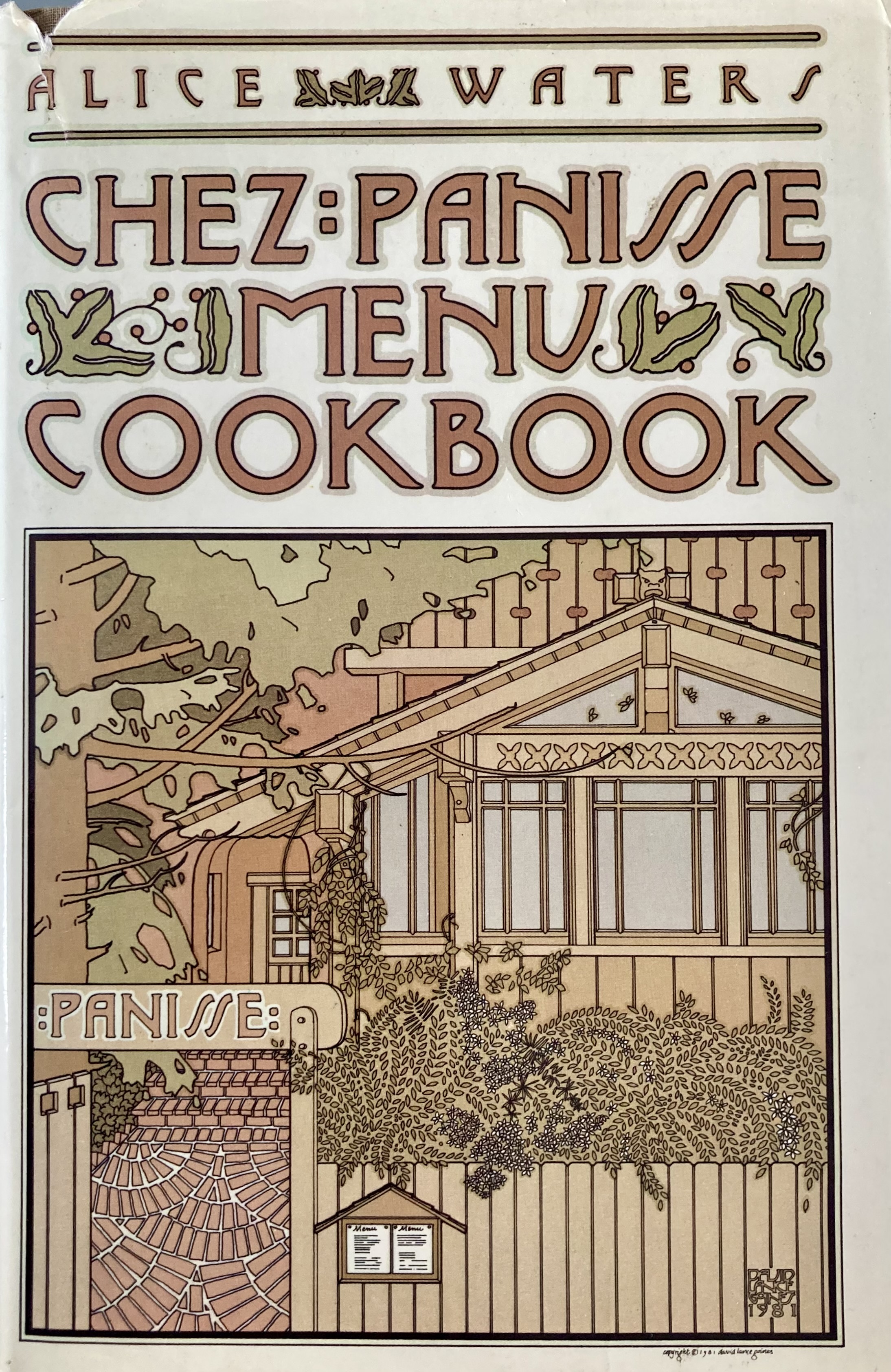
Alice Waters’ restaurant is called Chez Panisse, which is also the title of her Menu Cookbook, published in 1982. The book is centred around menu’s, emphasising the importance of combing dishes to create a balanced dinner or lunch.
In the introduction she describes how as a child she wanted fresh green beans and charcoal-grilled steaks every birthday dinner. And how she would sit out in the strawberry patch, happily eating fresh berries. In 1963 at the age of 19 she went to France for a year, to eat. Back in Berkeley her love for food transformed in opening her restaurant Chez Panisse in 1971.

Activist 

In the chapter What I Believe About Cooking she writes as American chef and activist. She discusses how the US as a nation is removed from any real involvement with food and how the US people (and probably many more) are alienated by frozen and hygienically sealed food. She writes: ”Food should be experienced through the senses.” And also: “… we have been indoctrinated into believing that by making food preparation easier and less time-consuming, we’re gaining valuable free time. No mention is ever made of what we lose by this whittling away at our direct contact with food or what better things we might do with the time thus gained.”
We couldn’t agree more! There is so much fun and love in buying, cooking and enjoying food. Sit down, take your time, and talk about food, wine and life.

Favourite

One of our favourites from Chez Panisse is her eggplant soup with dots of red bell pepper. Not difficult to prepare and a joy to eat and serve. The taste is rich yet light, fresh and uplifting. The combination of egg plant, garlic and red onions plus bell pepper works very well, probably because both are charred. Use vegetable stock and you will have a great vegetarian starter. 

Other titles by Alice Waters include We Are What We Eat (A Slow Food Manifesto) published in 2021, The Art Of Simple Food (I and II) and My Pantry (2015). (Audio) Books are available via your local bookstore, the well known channels and Chez Panisse.

Classic White Asparagus

One of the classic ways of serving white asparagus is with melted butter, boiled eggs, ham and parsley. Preparing the asparagus this way, will allow you to taste the slight bitterness and sweetness of the asparagus. The butter and egg bring a velvety feeling to your palate, and the parsley and white pepper give a touch of sharpness to the dish. A great way to celebrate spring!

We use our Russel and Hobbs food steamer to prepare this classic dish. An essential kitchen aid for only 50 euro or US dollar. In this case the steamer cooks the asparagus, boils the eggs and heats the butter. Amazing!

A few years ago we enjoyed white asparagus with béarnaise and a small veal schnitzel accompanied by a glass of Silvaner at Café Heider in Potsdam, Germany. When we ordered we were asked how we would like our asparagus. Al dente, of course! If you like them more cooked, then steam them for an extra 5 minutes. 

Wine Pairing

Preferably serve the white asparagus with a dry Muscat from the Elzas. The delicate, slightly sweet but dry taste, the hint of bitterness and the rich aromas work very well with the asparagus. Muscat to us means the smell of fresh fruit. When drinking it is if you’re tasting the original grape. Wonderful wine and wonderful combination.
Or a glass of Silvaner of course. Just make sure the white wine has a touch of sweetness and is aromatic.

What You Need

  • 3 or 5 white asparagus per person
  • 2 Eggs
  • 100 grams Organic Cooked Ham
  • Parsley
  • Butter
  • White Pepper

What You Do

Clean and peel the asparagus. Steam them for 10+5+5 minutes. After 10 minutes add the eggs to the steamer basket. After 5 minutes, turn the eggs upside down and add a cup with cold butter. Another 5 minutes later everything is ready. The eggs will be medium: the yolk is not set but also not running. Peel the egg and cut in four. Chop the parsley. Serve the asparagus and eggs on a plate. Pour the warm butter over the asparagus. Dress the plate with ham (please make sure it has a bit of fat), perhaps some extra butter and sprinkle the parsley over the plate. Add some white pepper. 

Classic white Asparagus ©cadwu

More mushrooms!

Mushroom is one of the first books by Johnny Acton, Nick Sadler and Jonathan Lovekin (photographs), published in 2001. The book offers some 70 recipes plus very interesting background information on the history of mushrooms and their hallucinating, psychedelic and culinary aspects. The book comes with many beautiful drawings and photographs. It has specific sections on cèpes, morels, chanterelles and truffles. It is very well written, fun to read and the recipes are accurate.

They have also written books on Soup, Preserves and one called The Complete Guide to Making, Cooking & Eating Sausages.

Recipes

One of the benefits of the book is that the recipes range from relatively easy to make (pasta with cèpes or clear soup with enoki for instance) to exotic and mouth-watering dishes (lobster and cauliflower fungus ravioli with saffron butter). The book is a great addition to more classic books on mushrooms such as The Mushroom Book by Michael McLaughlin, The Mushroom Feast by Jane Grigson or Antonio Carluccio’s Complete Mushroom Book.

In most cases it’s not too difficult to buy the required mushroom. Shopping at your local Asian toko will also help, for instance if you need shiitake, enoki or wood ear (they offer a recipe for a very nice Chinese chicken soup with ginger, pak choi and dried wood ear).

Our favourite? Perhaps their salad with shiitake, watercress and tofu. A modern, light dish with lots of flavours (cilantro, ginger, sesame oil, lemon).

Mushroom is available (in most cases second hand) via channels such as Amazon and e-Bay for between 10 and 25 euro.

Mushroom

Maitake

Legend has it that maitake got its nickname The Dancing Mushroom because foragers danced with happiness when finding it. It still is a much loved culinary mushroom, with a very specific aroma, interesting texture and intense flavours.
Nowadays maitake can be wild or cultivated. Both are fine; we actually prefer the cultivated one because it’s milder. Make sure you cook maitake through and through, otherwise you may upset your stomach (and other parts of your body). 

Maitake combines very well with beef and thyme. It is also great when combined with shrimps, crab, scallops, coriander, dill and parsley; a salad created by Antonio Carluccio and published in 2003 in the Complete Mushroom Book. Our Maitake soup, made with dashi, ginger and rice, is a gentle soup, with some umami and bitterness. 

In this case we combine fried maitake with various other ingredients to create a well-balanced (vegetarian) meal.

Wine Pairing

A flavourful dish! Sweetness in the tomatoes, umami in the maitake, freshness in the mash et cetera. Wine wise you have lots of options. We preferred a not too complex pinot noir, because it’s supportive and combines very well with the various flavours.

What You Need

  • 200 grams of Maitake and Olive Oil
  • Parsley Root, Jerusalem Artichoke, Crème Fraîche, White Pepper and Nutmeg
  • Small Ripe Tomatoes, Thyme, Rosemary, Garlic and Olive Oil
  • Lentils, Shallot, Parsley, Vegetable Stock and Black Pepper
  • Celeriac, Butter, Caraway Seed, Fennel Seed and Black Pepper

What You Do

For the lentils: slice the shallot and gently fry it in olive oil. After a few minutes, add the washed lentils (check for pebbles!), coat them with oil, add vegetable stock and cook until ready. Perhaps 20 minutes. Drain but keep some of the liquid, add chopped parsley and black pepper.
For the tomato confit, see an earlier post.
For the mash: clean and chop 2 parsley roots and 1 Jerusalem artichoke. Cook for 10 minutes or so in water until nearly done. Drain. Add a generous spoonful of crème fraîche and warm on low heat for 10-20 minutes. The idea is for the vegetables to absorb some of the crème fraîche. Blender the mixture, pass through a sieve and serve with white pepper. A touch of freshly grated nutmeg will be great. If you like more color on your plate, then add some chopped parsley to the mash.
The celeriac is cooked in the oven with a coating of fennel and careway seed. The recipe from Dutch chef Yvette van Boven is available via YouTube. She combines it with a home-made citrus marmalade, but that’s not necessary for this dish. Use the YouTube settings if you want to have subtitles in your own language.
Slice the maitake and fry in olive oil until done and slightly crunchy.
Serve on a colourful plate.

The Quiet Hunt

Antonio Carluccio’s The Complete Mushroom book is more than a cookbook. The first part of the book discusses foraging and collecting mushrooms, with clear descriptions of each mushroom and poisonous look-alikes. It’s a pleasure to read, but we’re not brave enough to start our own quiet hunt.

Fortunately, mushrooms are becoming more popular and greengrocers and supermarkets have started selling chestnut mushrooms, button mushrooms and shiitake. Asian supermarkets in most cases sell (king) oyster mushrooms, shiitake, enoki and shimeji.
Don’t be tempted to buy dried mushrooms: expensive, no aroma, nasty taste and not even close to a fresh mushroom.

Recipes

The second part of the book includes some 150 mushroom recipes, ranging from classic Italian dishes to culinary treats. Carluccio’s recipes are well written and informative. You’ll get the feeling that he lets you in on some of his secrets. And given he started foraging mushrooms as a young child, there are a lot of secrets to share!

One of our favourites is a salad made with maitake, fresh scallops, crab and shrimps. It’s an amazing result, with lots of pleasant flavours, also thanks to the cilantro, dill and parsley. Part of the fun is that the scallops are not seared but prepared like ceviche. Maitake is also available as a cultivated mushroom.

Caponata

More favourites? Of course! How about Mushroom Caponata or Tagliolini with black truffle? The caponata is a combination of mushrooms, egg plant and various herbs, so if you can buy button mushrooms and for instance shiitake, you’re ready to go.

Our all-time favourite from this book is the combination of fresh oysters with white truffle (bianchetti). A starter we prepare once or twice a year, depending on the availability of the truffle. Always a pleasure…

The Mushroom Book – the Quiet Hunt was published in 2001. It’s available (in most cases second hand) via channels such as Amazon and e-Bay for prices between 25 and 50 euro.

One of the very best books on mushrooms, written by a true expert.

PS

Later we found an earlier book by Antonio Carlucci called A Passion for Mushrooms, published in 1989. Very little overlap in recipes. A must-have for mushroom lovers!