Ragù Napoletano

Ragù Napoletano is all about beef and tomatoes. Combining these two creates umami, one of the five tastes, because the tomatoes contain amino acid glutamate and the beef inosinate
Whereas Ragù Bolognese is made with finely chopped meat, Ragù Napoletano is prepared with whole cuts of beef, seasoned and rolled up. Best is to use Blade Steak (or Top Blade), Rump Cap or Top Rump. Our butcher suggested using Knuckle Side Roast (or Knuckle Plate Muscle) which is rather lean so a touch dry after simmering for many hours. On the other hand, it kept its structure and flavours very well. Best is to ask your butcher for advice.
Many recipes suggest adding pork ribs to the dish, but we wanted to focus on the combination of beef and tomato. We did however add a bit of fatty bacon.
Tomato-wise you need lots of tomatoes: fresh ones, passata, puree and/or canned.
Best to prepare one day ahead.

Wine Pairing

A red, full bodied wine from Italy made with Sangiovese grapes will be a great accompaniment for both the starter and the main dish. We opened a bottle of Les Petits Rigolos, a red wine from the Tolosan region in south western France made with Merlot and Cabernet Sauvignon. A round wine with notes of strawberry and blackcurrant. A touch spicy, which worked very well with the rich flavours of the Ragù Napoletano.

What You Need
  • For the Beef
    • 2 slices of Beef
    • Parmesan Cheese
    • Raisins
    • Fresh Parsley
    • Fresh Oregano
    • 1 small Garlic Clove
    • Optional: Pine Nuts
    • Olive Oil
  • For the Sauce
    • Small Onion or Shallot
    • Olive Oil
    • Bacon (or better: Lardo)
    • 250 ml of White Wine
    • Fresh Tomatoes
    • Tomato puree
    • ½ can of Tomatoes
    • Passata
  • For the Starter
    • Rigatoni
    • Parmesan Cheese
  • For the Main Course
    • Vegetables
What You Do
  1. Soak the raisins in water for an hour
  2. Drain
  3. Chop parsley, oregano, raisins and garlic
  4. In a bowl, combine raisins, garlic, oregano, parsley and freshly grated cheese
  5. Flatten the meat if it’s difficult to roll up
  6. Scatter the mixture over the meat, roll the meat up and tie with two strings of kitchen twine.
  7. If using fresh tomatoes, peel and seed them. Chop coarsely
  8. Chop the onion and slice the bacon
  9. Heat a large saucepan, add olive oil, add onion and bacon
  10. Leave on low heat for some 10 minutes or until the onion is glazed
  11. Add the two rolls and fry them on all sides until evenly golden brown
  12. Take you time to do this
  13. Add the wine, let the alcohol evaporate and reduce
  14. Add the tomatoes, the passata and the puree
  15. Leave the stew on low heat and turn the meat occasionally. This stage is about stewing the meat as gently as possible and reducing the sauce. If you feel it’s going too fast, then put a lid on the pan, but only partially.
  16. Once the meat is ready (this may take 4+ hours) remove the meat from the sauce, keep it warm (an oven at 50 °C or 120 °F will be perfect) and allow the sauce to reduce even more, as slowly as possible.
  17. Wait for the sauce to become dark and shiny
  18. For the first course: serve the sauce with pasta and freshly grated Parmesan cheese (we used Rigatoni because of the ridges)
  19. For the second course: warm the meat in the remaining sauce, slice it and serve with sauce and vegetables.

PS

We would probably be kicked out of Naples (and Italy) with our version of Ragù Napoletano (oregano? French wine?). It is, however, a very tasty two course meal with lots of umami, as expected.

Umami

Sweet, sour, bitter, salty and umami are the five basic tastes. The term umami originates in Japan; it’s probably close to savoury. Recognizing sweet or bitter is something we learn as a child, recognizing umami is not something we have learned and that’s perhaps why some people in the past argued that umami is not a taste in its own right. It’s now clear that we have taste receptors that respond to the components that make umami.

Science

Danish professor emeritus in biophysics at the University of Southern Denmark, Ole G. Mouritsen, writes about the gastronomical, historical, scientific and cultural aspects of umami in his book Umami: Unlocking the Secrets of the Fifth Taste (available via your local bookstore or the well-known channels for approximately 40 US$). He also published cookbooks, for instance about seaweeds. Several scientific studies were conducted, trying to unravel the secrets of umami. One of the findings is that umami is the result of two components: glutamate and nucleotide. Bringing them together creates synergy and the umami taste is amplified.

Three Examples

Classic Japanese dashi is a combination of kombu (seaweed) and katsuobushi (bonito flakes). Kombu contains amino acid glutamate and Katsuobushi contains nucleotides inosinate and guanylate. Together they create a synergy, and the result is the clear taste of umami in dashi.
Same story for oysters and champagne. The oysters contain both glutamate and nucleotides (meaning that they are full of umami) and the champagne, due to the way it’s produced, contains glutamate, making oysters and champagne into a very tasty, umami rich combination.
Also the same story for tomatoes (amino acid glutamate) and beef (inosinate). Combining them should create the beautiful synergy of umami.

Ragù

Enough chemistry for one day. We decided to prepare Ragù Napoletano. It is one of the great dishes of Italy, or to be more precise of Campania. It is a combination of rolled up well marbled beef (rump cap, rump tail), an intense tomato sauce and hours of careful slow cooking and reducing. 
The result is a two-course meal: the sauce is served with pasta as a starter and the sliced meat with some sauce and vegetables as a main. 
Will you able to taste the umami? The answer is yes, absolutely, especially when you prepare the dish one or two days ahead.

Recipe for Ragù Napoletano in our next post.

Mushroom Fricassee

A few weeks ago, we wrote about History on Our Plate (2019) written by food historian and award-winning author Peter G. Rose. She writes about America’s Dutch past and the influence of the Dutch settlers on today’s American food. She explains how the founders of New Netherland (1609 – 1664, currently the states of New York, Delaware, Connecticut and New Jersey) brought Dutch recipes, tools, herbs and fruit to the US. Most recipes are based on publications like Een Notabel Boecxken van Cokeryen (a Notable Little Book of Cookery, 1514) and the 13thcentury publication Le Viandier de Taillevent. Peter Rose includes both the original and a modern version, allowing you to recreate food from the 17th century. 

Two Recipes

We were intrigued by a recipe for Mushroom Quiche without a Crust that made us think of a savoury clafoutis. We were also intrigued by another mushroom recipe, called Mushroom Fricassee, partly because of the unusual combination of eggs, mushrooms, onion, marjoram, thyme, orange juice, sherry, nutmeg and (optional) beef juice. The recipe is included in a manuscript written by Anne Stevenson Van Cortlandt (1774- 1821). She was married to Pierre Van Cortlandt, a well-known influential family with Dutch origins. Anne Stevenson was born in Albany, a city linked to Dutch settlers until the British took over in 1664.
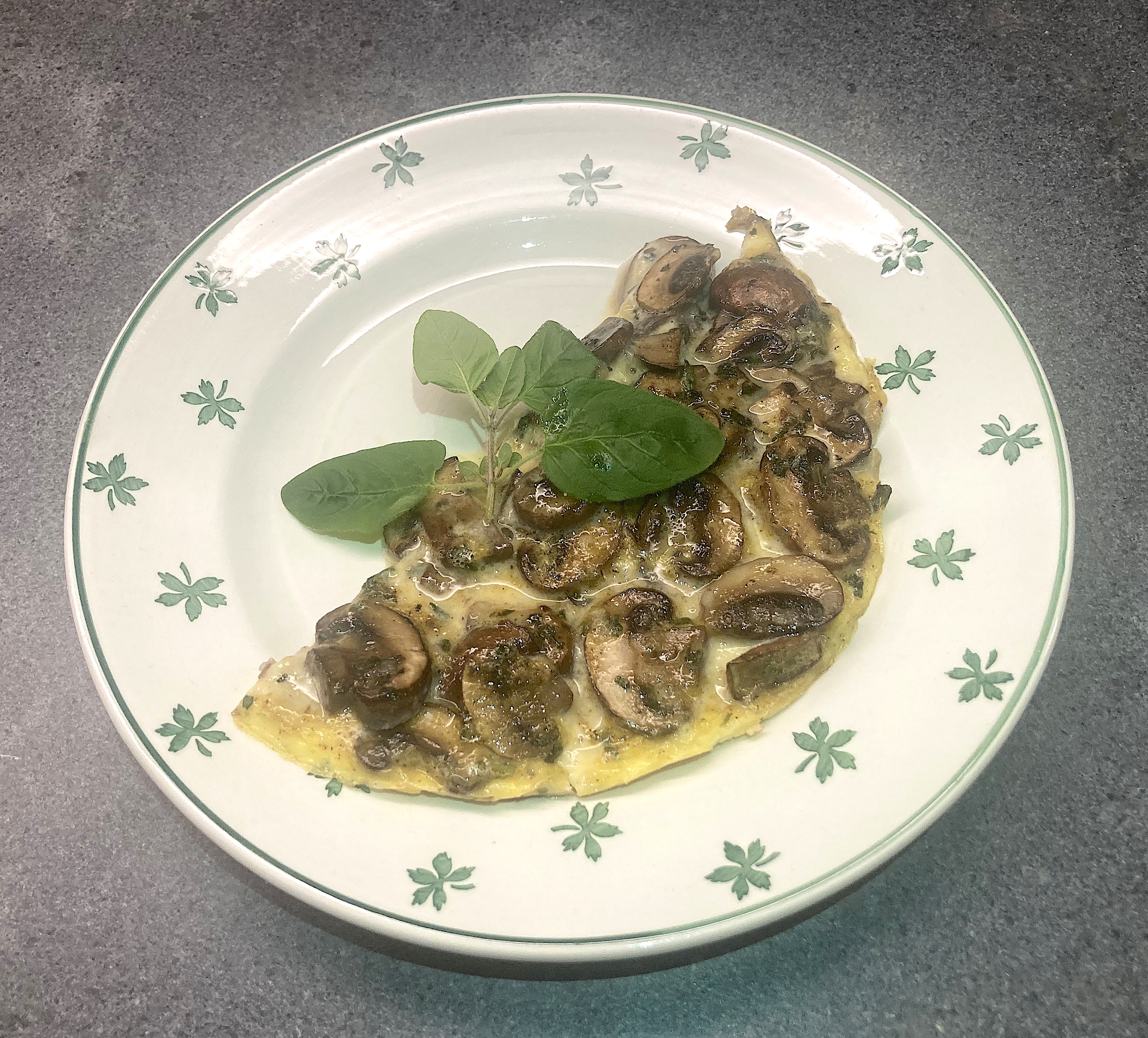
We tried this imaginative combination of ingredients and prepared an omelette. The result was tasty and beautifully balanced, with a nice twist thanks to the herbs, sherry and orange juice. Peter Rose suggests preparing it like scrambled eggs, which is probably a better idea. Turning the mixture into an omelette was a bit of a challenge.
You’ll find a detailed recipe in History on Our Plate.

Wine Pairing

We enjoyed our Mushroom Fricassee with a glass of Conde Valdemar Tempranillo Blanco Rioja DOCa 2020, produced by Bodegas Valdemar. Its colour is slightly yellow with greenish tones. The wine has notes of tropical fruit (pineapple) and its taste is fresh and pleasantly persistent. A beautiful, unoaked white Rioja made with 100% tempranillo blanco grapes.
In general, you’re looking for a lean, dry, slightly fruity white wine with notes of lemon, melon and/or pineapple, preferably with a long finish.

Buy The Book

History on Our Plate is available via the well-known channels and your local bookstore for approximately 15 euro or 10 US$.

Guacamole

It’s very tempting to buy ready-made tapenade, guacamole, mayonnaise or fish paté. It’s easier, much quicker and you don’t need to worry about ingredients and recipes. Very true. On the other hand, we also know that most of these ready-made products contain far too much salt plus additives that shouldn’t be in there. For instance, we found a trout paté with rapeseed oil, vinegar, egg, salt, lemon juice, sugar and paprika. The ingredients in a jar with guacamole included mascarpone, cellulose gum, sugar (again) and coconut oil.

The good news is that making your own guacamole is very simple. The only challenge is to buy ripe and tasty avocados. When in doubt, ask your greengrocer.
Guacamole combines very well with nachos, chips and toast, but also with baked potatoes, fried fish and smoked salmon. We like to enjoy it with our beloved (Flemish) grey small shrimps.

Wine Pairing

If you serve guacamole with small shrimps as a starter, then we suggest a refreshing white wine, for instance a glass of Viognier. You could also serve a glass of dry rosé.

What You Need

  • 2 Ripe Avocados
  • Small Red Onion or Shallot
  • Small Garlic Clove
  • Red Chili Pepper
  • Lemon
  • Soy Sauce
  • 100 grams Small (Grey) Shrimps
  • Black Pepper
  • Cilantro (optional)

What You Do

Peel both avocados, remove the seeds and chop coarsely. Finely chop the shallot, the garlic clove and some red chilli pepper. How much you use depends on the spiciness of the pepper and your preference. Add one avocado to the beaker of your blender. Add the shallot, garlic and chili pepper. Add a small splash (start with half a teaspoon) of soy sauce and a bigger splash of lemon juice. Add the remaining avocado and blender until smooth. Taste and decide if you want to add more lemon juice or soy sauce. Transfer to the refrigerator.
Serve with small shrimps, black pepper and cilantro.

PS

We know, we start by mentioning that ready-made guacamole contains odd ingredients like mascarpone and then we suggest adding soy sauce to this typical Mexican dish. Inconsistent to say the least. Well, guacamole needs a pinch of salt. You could (of course) add regular salt, but by adding a drop of fish sauce or soy sauce, you also add some umami, which seems to work well with the avocado and the shrimps. 

Guacemole ©cadwu
Guacamole ©cadwu

Guineafowl and Bay Bolete

It seems to be a great year for the Bay Bolete! Earlier we wrote about this delicious mushroom and its name. The Bay Bolete is a fairly common mushroom and its flavour can be compared to that of the more expensive Cèpes or Porcini. It’s a bit more intense and especially when served with meat it is a culinary treat. We combined the Bay Bolete with guineafowl, rosemary, thyme, garlic and pancetta. Lots of flavours and aromas. An intense and great way to celebrate autumn.

Guineafowl meat is leaner, somewhat darker and more flavourful compared to chicken. It is not difficult to prepare, but due to the low-fat content you must be careful not to overcook. In this recipe we use guineafowl supreme (the breast fillet with the skin on plus the wing bone) which is perhaps the tastiest part of the guineafowl. 

Wine Pairing

We opened a bottle of Chiroubles, a cru from the Beaujolais, produced by Domaine Montangeron. The wine has floral notes and aromas of cherries and strawberries. Its colour is pale ruby. Rich, elegant and long. It brings freshness and fruitiness to the dish and is sufficiently complex to remain present when enjoying the guineafowl and the Bay Bolete.
In general you’re looking for a red wine with freshness, fruity aromas and complexity. Perhaps a Pinot Noir?

What You Need

  • 2 Guineafowl Supremes
  • Pancetta
  • Rosemary
  • Thyme
  • Olive Oil
  • 150 grams of Bay Bolete
  • One Garlic Clove

What You Do

Pre-heat your oven to 180 °C or 355 °F. Clean the mushrooms with kitchen paper. Put a sprig of thyme and rosemary on the meat side of the fillet and close it with two strings of red/white kitchen twine. Add some olive oil to an iron oven dish, add the guineafowl, meat side up, and cover with strips of pancetta (or bacon). Leave in the oven for 10-15 minutes depending on the size. Transfer the pancetta to the side of the pan, turn the meat and leave for another 10-15 minutes until done (and golden). The temperature of the meat should be minimum 70 °C or 160 °F. When the guineafowl is done, transfer from the oven, remove the kitchen twine and allow to rest for 10 minutes. Halve or quarter the mushrooms, chop the garlic very fine, fry the mushrooms in olive oil and add the garlic seconds before the mushrooms are ready. Add the mushroom mixture to the sizzling guineafowl juices in the pan and stir. Serve the guineafowl with the bay bolete on a warm plate.

History on Our Plate

A few years ago, we had the pleasure of attending a lecture by food historian and award winning author Peter G. Rose. She talked about America’s Dutch past and the influence of the Dutch settlers on today’s American food. She explained how the founders of New Netherland (currently the states of New York, Delaware, Connecticut and New Jersey) brought Dutch recipes, tools, herbs and fruit to the US. And she showed how the Dutch influence is still present in today’s food in the USA.

Recipes

In her book History on Our Plate (2019) she writes in more detail about this topic, also by providing various food and drink recipes from New Netherland (1609 – 1664). The recipes are based on publications like Een Notabel Boecxken van Cokeryen (a Notable Little Book of Cookery, 1514) and the 13th century publication Le Viandier de Taillevent. The recipes include both the original and a modern version, allowing you to recreate food from the 17th century. Fried cod with mace, waffles, mushroom fricassee, artichokes with a bread, cinnamon and wine sauce: they all sound amazing.

In her introduction she describes the joy of baking bread in a hearth, the fun (and challenges) of preparing food in her home fireplace and the candlelight dinners that follow. When reading the well written recipes, you sense that she (and her husband who is in charge of the fire) aims to let her readers enjoy the cooking and eating as much as they did.

Quiche or Clafoutis?

We were intrigued by a recipe for Mushroom Quiche without a Crust. It made us think of clafoutis. Replace the cherries by mushrooms, change the seasoning and you have a delicious vegetarian starter or main course. The recipe was first published in 1668 by Franciscus van Sterbeeck  in his book Tractaet van de Kampernoeljes, Genaamd Duivelsbrood (or Treatise of Mushrooms, named Devils’s Bread).
You’ll find a detailed recipe in History on Our Plate.

We enjoyed our Mushroom Quiche without a Crust (or should we say, Flaugnarde with Mushrooms?) with a glass of Rioja d’Oliva Gran Reserva, Altos d’Oliva, 2013. A full bodied, red wine with lots of character that worked really well with the mushrooms, the oregano, and the Gouda cheese.

Buy the Book!

History on Our Plate is available via the well-known channels and your local bookstore for approximately 15 euro or 10 US$.

Classic Cèpes

What better way to start the mushroom season than serving Classic Cèpes? The recipe is very simple and the result is about cèpes and cèpes alone. The stems a bit firm, the caps moist, the flavours intense and the taste rich and earthy, with a touch of freshness from the parsley. It’s a classic in Germany (Steinpilze auf klassische Art), France (similar to Cèpes a la Bordelaise), Italy and many other countries. 

Wine Pairing

If you want to enjoy the cèpes with a glass of white wine, then we suggest drinking one that is fresh, fruity, round and balanced, for instance of a glass of Bodegas Mocén Selección Especial made from verdejo grapes. A glass of rosé with similar flavours is also a good idea. The idea is to support the cèpes by adding fruitiness and freshness to the dish.

When you decide to drink a glass of red wine, then we suggest a full-bodied red wine with gently fruit and present tannins. 

What You Need

  • 200 gram Cèpes
  • Butter
  • One small Shallot
  • Parsley
  • Black Pepper

What You Do

Clean the mushrooms and slice lengthwise. Finely chop the shallot and the parsley. Add butter to a relatively hot heavy iron skillet. Reduce the heat and fry the cèpes for a few minutes. Add the shallot. Cook on medium heat for 2 minutes. Add chopped parsley, add more butter, black pepper and stir. Serve on a warm plate.

Warm Tapenade

On one of the last, warm, long evenings of this summer we wanted to enjoy something with lots of flavours and depth, but we didn’t want to spend too much time in the kitchen. Then we remembered a tapenade like mixture that worked nicely with monkfish. Why not combine it with excellent beef? The result was what we hoped for: lots of flavours and we only needed 15 minutes to prepare it.

Wine Pairing

Enjoy with a glass of full-bodied red wine, for instance Syrah, Cabernet Sauvignon or Malbec. The tannins of such a wine will combine very well with the depth and richness of the tapenade and the beef.

We enjoyed a glass of Les Terrasses Occitanes Fitou produced by Mont Tauch from the Languedoc region in France, made with Grenache, Carignan and Syrah grapes. A not too complex, full bodied dry wine with aromas of red fruit and a lasting taste.

What You Need

  • 150 grams of Excellent Beef (Sirloin, Bavette)
  • For the Tapenade:
    • Shallot
    • Garlic
    • Black Olives
    • Capers
    • Thyme
    • Rosemary (optional)
    • Anchovies
    • Olive Oil

What You Do

Let the beef rest on a plate until it reaches room temperature. This could take an hour. Chop the shallot and the garlic, halve the black olives and remove the thyme leaves from the stalk. If using fresh rosemary, make sure to chop the leaves. Dry the capers with kitchen paper. Mash the anchovies with a fork until you have a paste-like substance. Warm a pan, add some olive oil and glaze the onions. After a few minutes add the garlic. Add the olives, the thyme, the capers and the anchovies. The result should be a rather chunky, rich tapenade.
Add olive oil to a hot skillet and quickly fry the beef. Leave to rest for a few minutes before serving with the warm tapenade. Add some black pepper.

PS

Not using anchovies is not an option. They bring umami and saltiness to the tapenade. One fillet is enough to have the right result.

Beef with Warm Tapenade ©cadwu

Mushroom Season

Hurray! The mushroom season has started! Last Saturday we bought delicious cèpes and chanterelles. Such a treat. It does of course mean that summer is over, which makes us a bit sad, but it also means the joy of eating wonderful dishes such as Cèpes à la Bordelaise or Salad with Mushrooms and smoked Duck (see below). Last year we prepared a Pâté with bay boletes, which was both beautiful and delicious. Will we be able to buy them this year? Or perhaps the intriguing Japanese Matsutake? It’s been some time since we last saw them on the market, and we would really love to make Matsutake with Spinach and Ginger again. How about Caesar’s mushroom with Udon?

Books

If you’re looking for useful mushroom recipes, then we suggest Antonio Carluccio’s The Quiet Hunt or Mushroom by Johnny Acton and Nick Sadler. Or look at our list of mushroom recipes.

Wine Pairing

Combining wine and salad is never obvious. In the case of a salad with mushrooms and duck we need to consider umami (mushrooms, duck), a touch of sweetness (smoked or cured meat) and the acidity of the dressing. We choose Domaine de Rimauresq Côtes de Provence Cru Classé rosé. A classic wine from the French Provence with grapes such as grenache noirmourvèdreugni blanc and rolle. The wine comes with delicate fruity, fresh flavours and aromas. It is very well balanced, dry and mouth filling and it combines beautifully with all aspects of the salad.
In general you’re looking for a white or rosé wine that has complexity and length, without being overpowering.

What You Need

  • 150 grams of Mushrooms (Cèpes preferred but also great with Oyster Mushrooms or a mix of Champignon de Paris, Shiitake and others)
  • Mesclun
  • Dried or Smoked Breast of Duck
  • Olive Oil
  • Vinegar (Red Wine, Jerez or Raspberry)

What You Do

Clean and slice the mushrooms. Heat a heavy iron skillet and fry the mushrooms in olive oil. Make a dressing of oil and vinegar. Toss the mesclun and the dressing. Transfer the salad to a plate, add mushrooms and finish with 3 or 5 slices of duck.

Fromage de Fribourg

When reading La Cuisine Niçoise d’Hélène Barale: Mes 106 recettes, we noticed that she uses only one kind of cheese in her recipes. Not Parmesan, not Pecorino, but Fromage de Fribourg. She adds it to her fish soup, to her ravioli, to her tourte de blette and to various other dishes. But what is Fromage de Fribourg?

It’s also known as Vacherin Fribourgeois and it originates from the region around the Swiss city Fribourg. It’s a semi-hard, creamy cheese made with raw cow milk. It matures for at least 6 weeks in a damp cellar. Its taste is aromatic, floral, full-bodied and lasting, with a touch of sweetness, bitterness and umami. It is used in a fondue called moitié-moitié (50% Gruyère and 50% Fribourg). It’s also possible to make a fondue with Fribourgeois only, using three ingredients: water, cheese and garlic.

Obviously we wanted to taste this cheese and we assumed that in the home town of Hélène Barale we would be able to buy it. We found a great cheese shop and bought a nice slice of this complex cheese. At home we decided to make an omelet with spinach, following a recipe from Hélène Barale for Omelette aux Blettes.

Omelet

For this omelet you need spinach, shallot, garlic, bay leaf, egg and freshly grated Vacherin Fribourgeois. No thyme, black pepper or salt. We were much surprised by the perfectly balanced flavours of spinach, cheese and eggs. Wonderful omelet.
You’ll find all the details you need in La cuisine niçoise d’Hélène Barale: Mes 106 recettes.

Wine Pairing

We enjoyed our omelet with a nice glass of Côtes de Provence Rosé. You could also enjoy it with an unoaked Chardonnay.
If you decide to eat the cheese as dessert, then we suggest a glass of full bodied red wine (Bordeaux, Côtes du Rhône etcetera).

PS

From a culinary point of view we think we understand why Madame Barale favored Fromage de Fribourg. If it’s her personal choice, something typical for the Niçoise cuisine, a culinary trend or perhaps because she was fond of Fribourg, that remains a mystery to us.