Bay Boletes with Veal and Sage

We continue celebrating the season: we create a rich sauce with Bay Bolete, Mustard, Sage and Crème Fraîche and combine it with excellent veal. The sweetness of both the sauce and the veal makes for an delicious combination. The aromatic sage brings length and depth to the dish.

It’s not always clear what umami is, but trust us, when you taste this dish, you will taste it. Meaty, deep and savoury. A very powerful and intense dish.

The taste of the Bay Bolete (Imleria badia, Bolet Bai, Kastanjeboleet, Maronen-RöhrlingBoleto Bayo) is similar to that of the Cèpes or Penny Bun. Perhaps the taste is more intense? In most cases you must discard the stem of the bay bolete because it’s not soft (and it will remain chewy when cooked), different from the stem of the cèpes. The colour of the cap is dark brown, like a chestnut.

Wine Pairing

A fruity, slightly chilled red wine will be great with the dish. We opened a bottle of German Spätburgunder from the Pfalz area. Some dark fruit, strawberries, touch of earthiness, not too complex. One that supported the flavours and aromas of the dish very well.

What You Need

  • 100 grams Bay Boletes
  • Butter
  • Olive Oil
  • 4 Sage leaves
  • Stock (Chicken or Vegetable)
  • Black Pepper
  • Mustard
  • Crème Fraîche
  • 200 grams of excellent organic Veal Ribeye

What You do

Make sure the meat is at room temperature. Add some butter and oil to a heavy iron skillet and fry the meat until golden brown and pink. Transfer to the oven at 50 °C or 125 °F. Cover with aluminium foil. In parallel remove the dry stems of the mushrooms. Clean the remaining mushrooms with kitchen paper. Chop half of the mushrooms. Slice the other half. Start by frying the halves in the pan. When ready transfer to the oven. Add some butter and oil to the pan and fry the chopped mushrooms. Add chopped sage leaves and allow to simmer. Use mustard, stock and crème fraiche to make the sauce. Leave on low heat for 5 minutes or so. Add more stock if so required. Add some extra sage and black pepper. Add the meat juices to the sauce. Slice the meat, plate up with sauce, meat and sliced bay bolete.

Other Recipes with Bay Boletes

You may also enjoy them with Brussels Sprouts, Jerusalem Artichoke or with Guineafowl.

Vitello Tonnato

Fish and Meat

Who came up with the idea to combine veal, tuna, anchovy, mayonnaise and capers?
The story goes that in the 19th century veal was prepared as if it was tuna. Sounds a bit far fetched, but tuna wasn’t eaten raw (at least not in Europe) but cooked in water with various herbs and then stored in brine or oil. Tha approach to prepare veal as if it is tuna was described in 1836 by the French Monsieur Burnet in his recipe Manière de donner au veau l’apparence et le goût du thon mariné.
In 1862 (according to Luca Cesari) a medical doctor from Milan was the first to combine tuna and veal.

Anchovy

Not a remarkable ingredient at all!
(Salted) anchovy has been used as a flavour booster in meat dishes and sauces for many centuries. For instance in the combination of leg of lamb with anchovy and garlic it will bring depths, umami and saltiness. When making a remoulade sauce you should not forget to add anchovy. And why not prepare a wonderful French Anchoiade? Or dip your vegetables in Bagna Cauda? And let’s not forget the joy of crusted bread with Tapénade (black olives, capers, garlic, anchovy and olive oil). What would a classic Caesar salad or a salade Niçoise taste like without the anchovies in the dressing? Such a useful fish!

Wine Pairing

The obvious choice is to drink a glass of Italian white or rosé wine with the vitello tonnato. A fresh wine, with a touch of acidity and not too complex, for instance a Bardolino Chiaretto or a Soave.

What You Do (Classic approach)

Given the origin of Vitello Tonnato the meat should be cooked in water with carrots, onion, leek, clove, bay leaf, thyme and pepper. The trick is not to cook it too long; you want a touch of pink in the meat when it is served. Keep some of the cooking juices to add to the sauce later on.
Create the mayonnaise by mixing egg yolks, lemon and a neutral oil (peanut or grape seed oil).

What You Need

  • 150 gram of Veal (top side or silver side)
  • Butter
  • Olive Oil
  • Mayonnaise
  • 75 gram of canned Tuna (in brine)
  • 1 Anchovy fillet (or 2 depending on your preference)
  • Lemon
  • Capers (in brine)

What You Do

We prefer to fry the meat, even if it’s historically and culinary incorrect. We think frying is quicker and gives you more control over the cuisson. Plus we feel that cooking the meat means losing flavours.
Fry the meat in a heavy iron skillet in some butter and olive oil. Not too hot! Sear the meat, lower the temperature and fry the meat until nicely rosé. Transfer the meat to a sheet of aluminium foil and let rest until lukewarm or cool. Wrap the foil around the meat, let cool and transfer to the refrigerator.
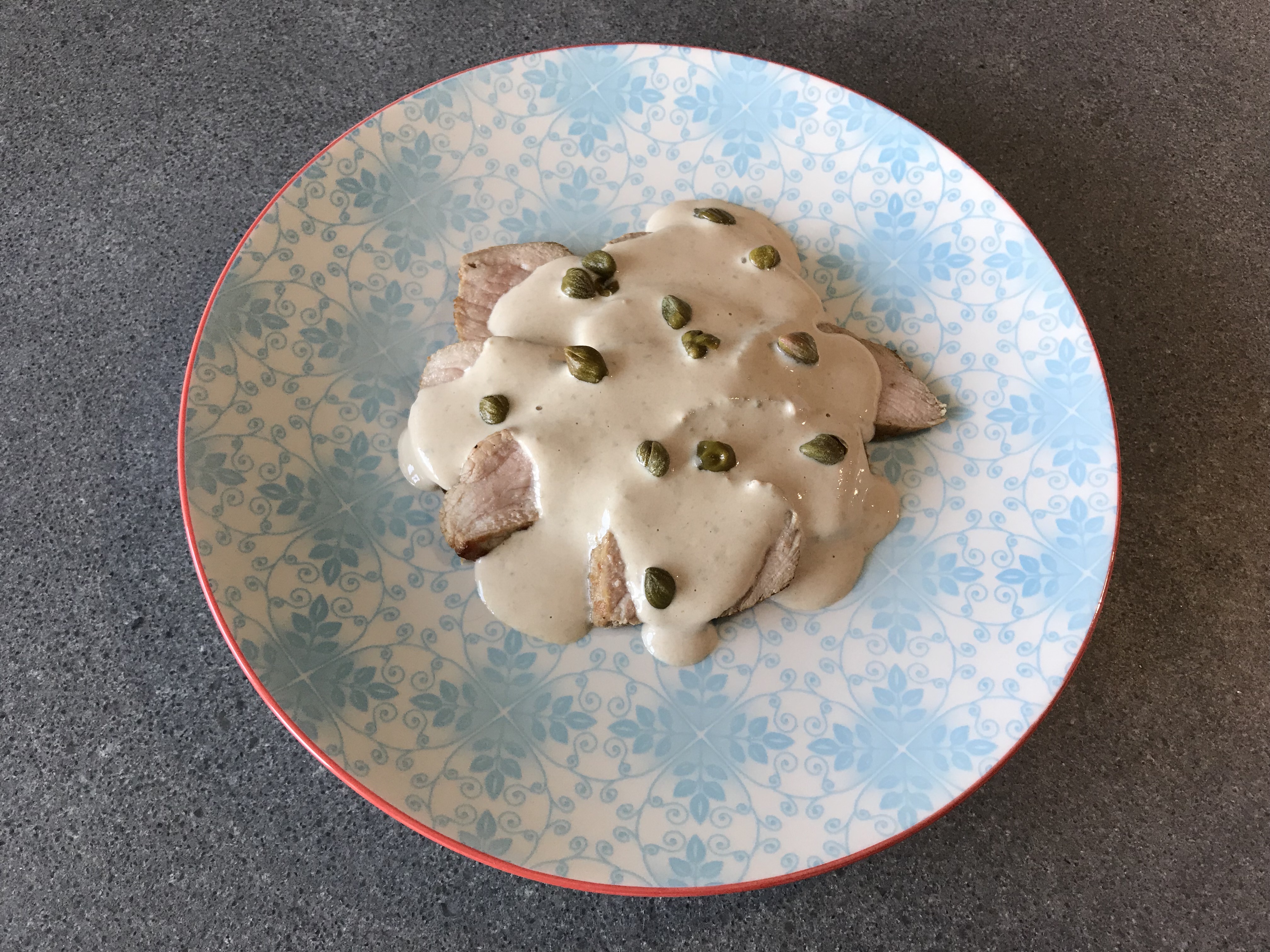
Just before serving, blender the tuna, the anchovy, a few capers, the juices from the meat (in the foil) and some lemon juice until completely smooth. Add some mayonnaise to a bowl, add a spoonful of the mixture and taste. Continue until you have the right balance. Thinly slice the veal, serve on a plate and top with the sauce. Make sure some of the meat is still visible. Decorate with the capers.

Vitello Tonnato © cadwu

Veal Rib Eye with Morels

Morels or Not?

In January 2019 one person died and over 30 people became ill after having eaten at Riff, the one Michelin star restaurant in Valencia. Media were quick in their analysis and decided that it was caused by the morels in one of the dishes. Today (April 4th) it’s not yet clear what caused the catastrophe.

Most sources mention that Morels contain some kind of toxin, one that can be destroyed by heating the morels. So lesson one with morels is not to eat them raw; they must be sautéed for a few minutes. Luckily the taste improves when sautéing them a bit longer, let’s say 10 minutes, so the toxin should be gone by then. However… some people report an upset stomach after having eaten morels and drinking alcohol. If you’re not used to eating morels, it could be wise to eat just a few and see how you react.

Look-A-Likes

A clear risk with morels is the fact that some other mushrooms are true look-a-likes. For example the highly toxic early morel or wrinkled thimble-cap and other ‘false’ morels. So picking them yourself is not a good idea unless you are an experienced morel-hunter. If you buy them (like we do), then buy them fresh or dried from a reliable source.

China

Some media mentioned that the morels used at Riff were brought in from China. Is that a problem? Yes from a sustainability point of view and No from a morel point of view. Morels are found in abundance in North America, Australia, China, Poland, France, India, Pakistan and many other countries, so why distrust them when they originate from China?

Back to Riff

Our humble view is that morels are in the mushroom top three together with Cèpes and Truffle. We are perfectly happy to eat them, for instance combined with Veal. And we look forward to having dinner at Riff when we are in Valencia later this year.

Wine Pairing

We prefer a full-bodied red wine, for instance a Nero d’Avola. We enjoyed a glass of Vanitá Nero d’Avola Organico Terre Siciliane I.G.T. 2016. It goes very well with the rich flavours of the veal and the morels. The wine comes with raspberries, red fruits and just a touch of vanilla. It has medium sweetness and a hint of herbs and spices, almost cinnamon. A long aftertaste and light tannins.

What You Need

  • Rib Eye of Veal
  • Butter
  • Olive Oil
  • Morels
  • Veal stock
  • Spinach

What You Do

Fry the Rib Eye in a heavy iron skillet for a few minutes until (very) pink. Wrap in aluminium foil and allow to rest. Reduce the heat and if necessary add some extra butter to the pan. Add the cleaned and halved morels and sauté gently. Add some veal stock and juices from the rib eye. In a small pan heat some olive oil, add the dry spinach and stir constantly. Serve the rib eye with the sauce, the morels and the spinach. Spring on your plate!

Veal Cheeks with Pak Choi (Bok Choy)

Joue de Veau

You may have spotted this in a French Boucherie or Supermarket. Probably close to the Ris de Veau, the Collier D’Agneau and the Abats de Porc. Not the most obvious choices, but in reality the Joue de Veau (Veal Cheek) is a true delicacy. The meat requires a few hours to become tender, but it’s worth the wait. When you serve it you will pleasantly surprised: the meat is extremely tender, juicy and a touch of pink on the inside. Which makes it a great idea to serve it sliced, especially because the outside of the meat is deep dark brown.
The Joue or Cheek requires cleaning. Best is to ask your butcher to do this or use a very sharp knife.
We use a classic combination carrot, onion, leek and celeriac plus red wine and a bouquet garni. Don’t make the bouquet too powerful; the idea is to support the meat, nothing else.
No need to use an expensive wine for the stew. A simple, red wine is fine. Some people will argue that the wine you use for cooking must be the one you serve with the food. Nonsense. Feel free to drink a Baralo (like we did) with the Veal Cheeks, but don’t waste half a bottle of it by using it as a cooking liquid.
The Pak Choi works really well with the Veal Cheeks. It brings the bitterness of cabbage, balancing the sweetness of the meat and the deep taste of the sauce. Plus the fried Pak Choi is a bit crispy, both the leaves and the stem, which is great in combination with the moist, tender meat.

Wine Pairing

A full-bodied red wine with clear tannins, a delicate smell and red fruit aromas will be an excellent choice. Velvety and smooth. As the Veal Cheeks: simple yet complex. We drank a glass of Barolo San Silvestro, Serra Dei Turchi, 2014. A perfect match with the braised veal, the sauce and the cabbage.

What You Need

  • 2 Veal Cheeks (one per person)
  • Carrot
  • Celeriac
  • Onion
  • Leek
  • Olive Oil
  • Bouquet Garni
    • Bay Leaf
    • Thyme
    • Parsley
  • Red Wine
  • Cognac
  • (baby) Pak Choi (Bok Choy)

What You Do

Start by adding oil to the pan. Fry the Veal Cheeks until they have a nice, golden colour. Transfer to a plate. Add more oil and fry the chopped vegetables. Be careful not to add too much carrot or celeriac. Stir for a few minutes and then add the meat. Add wine and the bouquet garni. Leave on a low heat for 4-6 hours until tender. Make sure to turn the meat every hour or so. Cool the stew and transfer to the refrigerator. The next day remove the fat (if any) and warm the stew. When warm, transfer the meat to a plate and keep warm (for instance in an oven of 70 C, the ideal temperature for your plates as well). Remove the vegetables and the bouquet. Reduce the liquid with one-third or more. Taste the sauce. Add a splash of cognac. Black Pepper? Cook a few minutes longer allowing for the alcohol to evaporate.
In a non-sticky pan heat some oil and fry the Pak Choi for 2 times 2 minutes, maximum. In parallel fry the meat in a non-sticky pan, one or two minutes in total. This will give the meat a crispy touch and an even deeper dark brown colour. Serve the Joue de Veau with the sauce, crusty bread and the Pak Choi.