Tataki

Over the years tataki has become increasingly popular: beef, tuna, salmon, trout and even veal and deer tataki. But what is tataki actually? And what is tataki sauce?

Tataki originates from the Kōchi prefecture in Japan. The original dish is called katsuo-no-tataki. Katsuo (also known as Oceanic Bonito or Skipjack Tuna) is an important ingredient in the Japanese kitchen, for instance raw as sashimi and dried as katsuobushi (the flakes you need when making dashi).

The fish is seared very briefly in a huge rice straw fire. This way the fish becomes nicely coloured, the centre remains raw, and the flavour will be enhanced with smokiness. It is then sliced and served with a garlic, lemon (ponzu), soy and onion sauce, making Katsuo-no-tataki very different from other sashimi.

Unfortunately, most of us don’t have a straw fire at home, so you need a very hot pan to sear the fish. Bonito is not widely available where we live, but tuna is a great alternative. Beef is a good idea, salmon is a possibility, veal and trout are definitely not good alternatives.

What You Need

  • Bonito (or Tuna or Beef Tenderloin)
  • Light Soy Sauce (Tsuyu)
  • Mirin
  • Rice Vinegar
  • Lemon
  • ½ Garlic Clove
  • Sesame Seeds
  • Spring Onion
  • Olive Oil

What You Do

We added lightly roasted sesame seeds to the dish. There are not included in the original katsuo-no-tataki so feel free to leave them out.
Combine light soy sauce, mirin and rice vinegar (ratio 3:1:1), add some lemon juice and the grated garlic. The garlic must be grated; it should nearly dissolve in the sauce. Quickly sear the bonito (tuna, beef) in a hot non-stick pan with just a touch of oil. When ready transfer to an ice bath. Wait for a minute or so. Remove from the water and use kitchen paper to dry the fish. Slice, serve on a plate, drizzle with the dressing, then add thinly sliced white spring onion, then sesame seeds (if using) and finish with some dressing.

PS

And the answers are: tataki is a method to sear katsuo (or in general fish or beef) in a straw fire (or over a grill or in a hot pan). Tataki Sauce doesn’t actually exist; it may refer to the sauce that is served with katsuo-no-tataki.

Tataki (Tuna) ©cadwu


Tuna Tartare

A starter that is tasty, appetizing and easy to make, one that will always put a smile on your face. The only challenge is to buy excellent, fresh tuna. Since most tuna species are overfished or at the risk of becoming overfished, make sure the tuna you buy is from sustainable fishing practices, for instance if it’s certified by MSC (Marine Stewardship Council). Whatever you do, look for skipjack or albacore and don’t buy bluefin (or yellowfin).

Wine Pairing

In general, enjoy the tartare with a white wine, for instance a Picpoul de Pinet or a Muscadet-Sèvre-et-Maine with aromas such as apple and peach. Flavour wise the wine must be dry with a mild citrussy flavour and some minerality.
We happily opened a bottle of Château de Crémat Blanc 2021. A wine with a light-yellow colour, with complex aroma’s (toast, floral, grapefruit) and a long finish.

What You Need

  • 150 grams of Tuna
  • Capers
  • Organic Lemon (Zest and Juice)
  • Chives
  • Black Pepper

What You Do

Make sure you have all ingredients ready before you combine it with the tuna. If you mix too often, the tartare will become soggy.
Wash the lemon, make a teaspoon or so of zest, squeeze the lemon. If using salted capers, make sure to wash them carefully (and long); a salty taste will ruin the tartare. Better to use capers in brine. Dry the capers and chop. Take 5 or 10 sprigs of chives, cut in small bits using scissors. Dice the tuna. Add tuna, chopped capers, zest, chives and some black pepper to a bowl. Add a drizzle of lemon juice. Combine, taste and adjust. Cover with cling foil and transfer to the refrigerator for one or two hours. Decorate with mayonnaise and two sprigs of chives.

Tuna Tartare ©cadwu
Tuna Tartare ©cadwu

Salade Niçoise

Pan Bagnat

The origin of the Salade Niçoise goes back to the days that life on the French Côte d’Azur was harsh. It was a remote and poor region and people tried making a living trough fishing, harvesting flowers for the perfume manufacturers and growing olives. Not a tourist in sight and no fancy lunches. Bread would be baked once every fortnight and people would soak the stale, day-old bread with water, olive oil or ripe tomatoes. Over the years this developed into what is known today as Pan Bagnat: bathed bread. Interestingly enough the stuffing became a dish in its own right: the Salade Niçoise.

Today’s Salade Niçoise is of course much more than water, olive oil and tomatoes. According to the founders of the label Nissarde Cuisine the Salade Niçoise is a combination of tomatoes, boiled eggs, salted anchovy, tuna in oil, spring onion, small black Niçoise olives, basil and olive oil. Optional ingredients are artichoke, broad beans, green pepper, garlic and radish.
And now I can hear you think: but how about the haricots verts and the potatoes? And haven’t you forgotten the vinegar?

Let’s start with the vinegar: a few drops are allowed but the idea goes back to the Pan Bagnat. So little or no vinegar and certainly no balsamic vinegar, mustard or mayonnaise. 

It was Auguste Escoffier who introduced the haricots verts and the potatoes as ingredients of the Salade Niçoise. For the guardians of the Nissarde Cuisine this is clearly a ‘no go’ (also because Escoffier was not from Nice). We were brave and did a small experiment by preparing both variations.

We expected the Escoffier version to be the winner of our small competition, but the stars clearly go to the Nissarde version: elegant, light, full of flavours and a tribute to the ingredients. Forget about haricots verts, potatoes, vinegar and grilled fresh tuna!

What You Need

  • Tomatoes
  • Salted Anchovy
  • Tuna in Oil
  • Spring Onion
  • 2 Boiled Eggs
  • Small Black (Niçoise) Olives
  • Basil
  • Olive oil
  • Optional
    • Artichoke
    • Broad Beans
    • Green Pepper
    • Garlic
    • Radish
  • Version Escoffier
    • Haricots Verts
    • Potatoes
    • Mesclun
    • Vinegar
    • Black Pepper

What You Do

For the Nissarde Cuisine version: cook the eggs until nearly set, clean the vegetables, wash and slice the anchovy. Then combine quartered tomatoes, sliced spring onion, tuna, anchovy, olives and basil. Drizzle with excellent olive oil and garnish with eggs. Toss briefly to make sure all ingredients are coated with oil.
For the Escoffier version: briefly cook the haricots verts and cool in cold water. Cook the potatoes until done. Cook the eggs until nearly set. Wash and slice the anchovy. Clean the vegetables. Combine quartered tomatoes, sliced spring onion, tuna, anchovy, olives, cubed potatoes, haricots verts and basil. Mix olive oil and vinegar. Drizzle with the dressing and garnish with eggs. Toss briefly to make sure all ingredients are coated with the dressing.
For a more luxurious version replace the canned tuna with grilled tuna.

Vitello Tonnato

Fish and Meat

Who came up with the idea to combine veal, tuna, anchovy, mayonnaise and capers?
The story goes that in the 19th century veal was prepared as if it was tuna. Sounds a bit far fetched, but tuna wasn’t eaten raw (at least not in Europe) but cooked in water with various herbs and then stored in brine or oil. Tha approach to prepare veal as if it is tuna was described in 1836 by the French Monsieur Burnet in his recipe Manière de donner au veau l’apparence et le goût du thon mariné.
In 1862 (according to Luca Cesari) a medical doctor from Milan was the first to combine tuna and veal.

Anchovy

Not a remarkable ingredient at all!
(Salted) anchovy has been used as a flavour booster in meat dishes and sauces for many centuries. For instance in the combination of leg of lamb with anchovy and garlic it will bring depths, umami and saltiness. When making a remoulade sauce you should not forget to add anchovy. And why not prepare a wonderful French Anchoiade? Or dip your vegetables in Bagna Cauda? And let’s not forget the joy of crusted bread with Tapénade (black olives, capers, garlic, anchovy and olive oil). What would a classic Caesar salad or a salade Niçoise taste like without the anchovies in the dressing? Such a useful fish!

Wine Pairing

The obvious choice is to drink a glass of Italian white or rosé wine with the vitello tonnato. A fresh wine, with a touch of acidity and not too complex, for instance a Bardolino Chiaretto or a Soave.

What You Do (Classic approach)

Given the origin of Vitello Tonnato the meat should be cooked in water with carrots, onion, leek, clove, bay leaf, thyme and pepper. The trick is not to cook it too long; you want a touch of pink in the meat when it is served. Keep some of the cooking juices to add to the sauce later on.
Create the mayonnaise by mixing egg yolks, lemon and a neutral oil (peanut or grape seed oil).

What You Need

  • 150 gram of Veal (top side or silver side)
  • Butter
  • Olive Oil
  • Mayonnaise
  • 75 gram of canned Tuna (in brine)
  • 1 Anchovy fillet (or 2 depending on your preference)
  • Lemon
  • Capers (in brine)

What You Do

We prefer to fry the meat, even if it’s historically and culinary incorrect. We think frying is quicker and gives you more control over the cuisson. Plus we feel that cooking the meat means losing flavours.
Fry the meat in a heavy iron skillet in some butter and olive oil. Not too hot! Sear the meat, lower the temperature and fry the meat until nicely rosé. Transfer the meat to a sheet of aluminium foil and let rest until lukewarm or cool. Wrap the foil around the meat, let cool and transfer to the refrigerator.
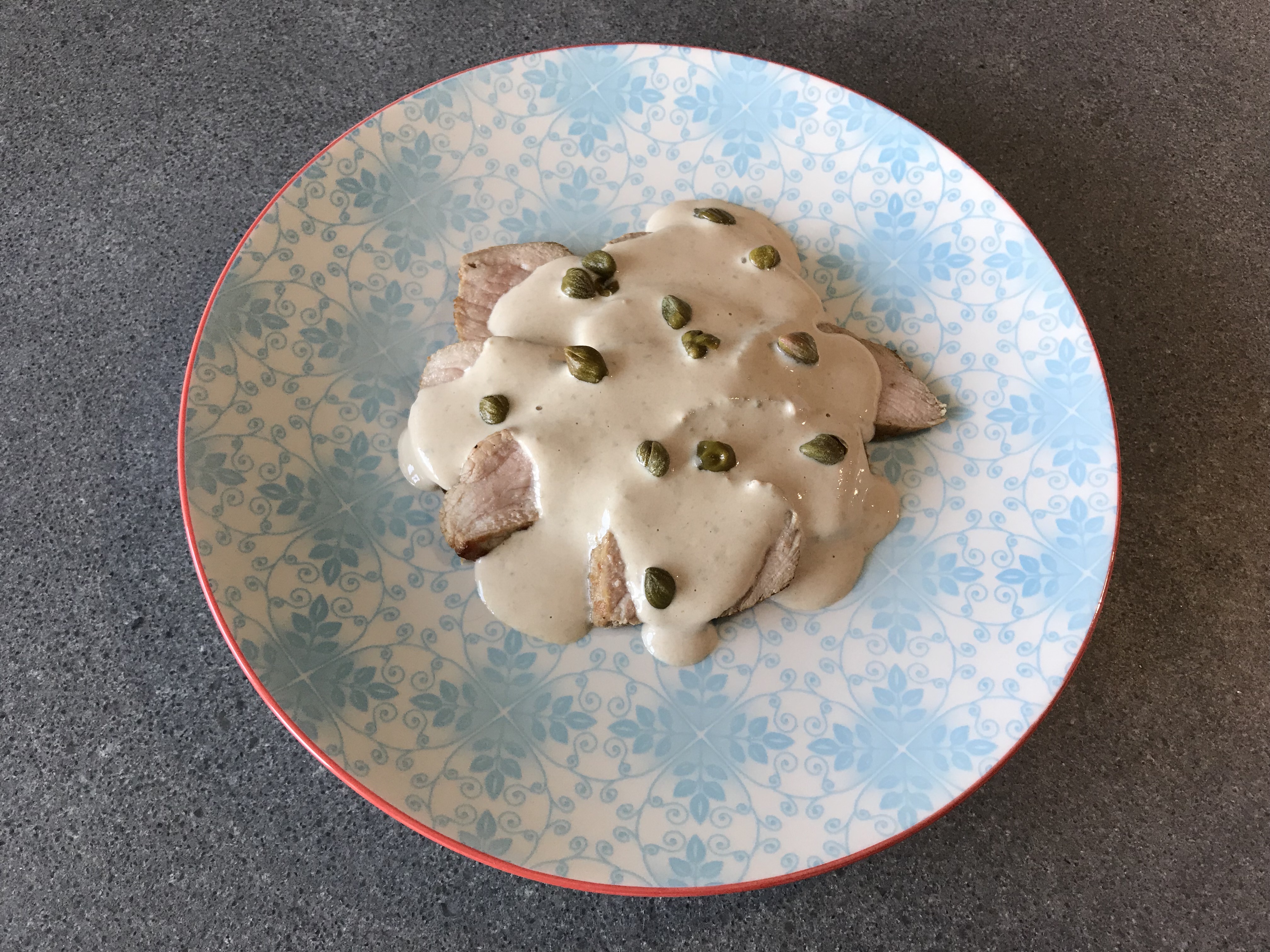
Just before serving, blender the tuna, the anchovy, a few capers, the juices from the meat (in the foil) and some lemon juice until completely smooth. Add some mayonnaise to a bowl, add a spoonful of the mixture and taste. Continue until you have the right balance. Thinly slice the veal, serve on a plate and top with the sauce. Make sure some of the meat is still visible. Decorate with the capers.

Vitello Tonnato © cadwu