Confit of Wild Duck

Making confit of duck begins with curing the meat in salt with various herbs and spices (thyme, cumin, rosemary). After 24 hours or so the duck is washed with water, patted dry and then slow cooked in goose or duck fat for several hours. When ready it is cooled and stored in fat.

We take a different approach by slow cooking legs of wild duck in olive oil. Wild duck is bold in terms of flavour and aroma. It is gamey with a strong, earthy taste. Slow cooking softens the flavour. We added star anise to balance the intense flavour and aroma. It also brings sweetness, which is great with the slightly spicy sweet potato mash.

Wine Pairing

Best choice is a full bodied, red wine with ripe fruit and smoothness. We decided to open a bottle of Herdade de São Miguel Colheita Seleccionada as produced by Casa Relvas. Such a pleasure! Its colour is deep ruby and the aromas made us think of ripe black fruit and dark cherries with some spiciness. The wine is well balanced with a nice structure and smooth tannins. Works very well with the flavourful duck and the mash with its spicy character.

What You Need
  • For the Confit
    • 6 Legs of Wild Duck (or 4 depending on the size)
    • 6 Star Anise
    • 12 Juniper Berries
    • Black Pepper
    • Olive Oil
  • For the Sweet Potato Mash
    • 1 Sweet Potato
    • ½ Kashmiri Pepper
    • Milk
    • Crème Fraîche
    • Mustard
    • Black Pepper
    • Pinch of Salt
What You Do
  1. Take a sheet of aluminium foil and place a leg in the middle
  2. Add two lightly crushed juniper berries and one star anise
  3. Add black pepper and a generous amount of olive oil
  4. Wrap the foil around the leg
  5. Take a second sheet of aluminium foil and wrap it around the package, making sure it’s closed
  6. Repeat
  7. Transfer packages to an oven at 120 °C or 240 °F
  8. After one hour reduce the heat to 90 °C or 195 °F
  9. After in total 3 hours, remove the legs from the oven, open the package and let cool (may take two hours)
  10. Close the packages and transfer to the refrigerator for use the next day
  11. Peel the sweet potato and cube
  12. Crumble the pepper
  13. Add potato cubes and pepper to a pan with some water and cook until the potato is soft, 10 – 15 minutes
  14. Discard cooking liquid
  15. Leave the potatoes on a plate for 5 minutes
  16. Return to the pan and mash with a fork
  17. Add warm milk, crème fraîche, mustard, black pepper, a pinch of salt and a dash of olive oil
  18. Just before serving add extra mustard, the mash must be a bit spicy
  19. Discard the liquid from the duck
  20. Pat the legs dry with kitchen paper
  21. Fry the legs in a medium heavy iron skillet, meat side first
  22. Increase the heat and fry the skin of the legs for 1 or 2 minutes
  23. Serve immediately with the mash on a warm plate
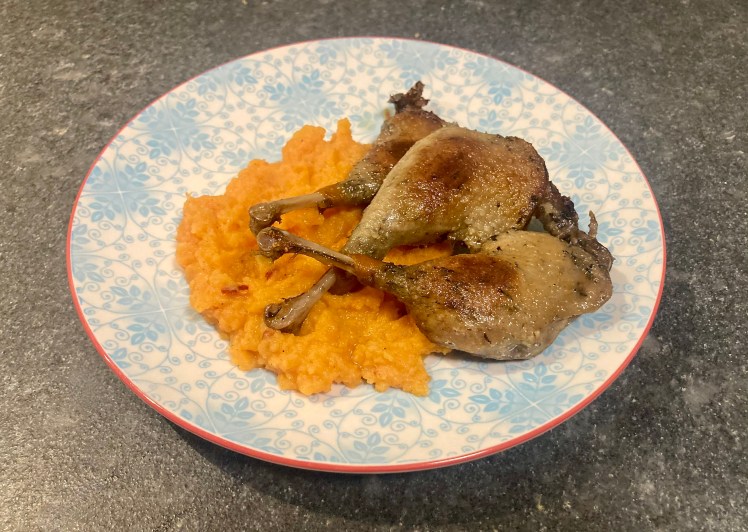
Confit of Wild Duck ©cadwu with star anise and juniper berries
Confit of Wild Duck ©cadwu

Guineafowl with Ras el Hanout

Preparing guineafowl can be a bit of a challenge: easily overcooked and quickly dry. Guineafowl has more structure and less fat compared to chicken plus it’s much firmer. The good news is that guineafowl has lots of flavour, perhaps a bit gamey, but not overpowering. So great to combine with nice ingredients such as morels or with grappa, junipers, sage, white wine and pancetta (as included in The River Cafe Classic Italian Cookbook, written by Rose Gray and Ruth Rogers).

Ras el Hanout is a mix of some twenty plus spices such as coriander, cumin, cinnamon, nutmeg, fenugreek, fennel, cardamom, turmeric and many more. Ras el Hanout is complex, layered, warm, a touch sweet and bitter. It works beautifully with the guineafowl and the various vegetables. 

Wine Pairing

Enjoy your guineafowl with a not too complex, medium bodied, fruity red wine. Grapes such as Grenache, Carménère, Carignan. We enjoyed a glass of Merlot, produced by Les Ormes de Cambras from the French Pays d’Oc region. A round, fruity wine with aromas of berries and subtle tannins. Also available as Bag in Box!

What You Need

  • Guineafowl
    • Guineafowl (Supreme preferred, but Leg is also fine)
    • Teaspoon of Ras el Hanout
    • 2 Garlic Gloves
    • Olive Oil
    • White Onion or Shallot
  • Vegetables
    • 1 Sweet Potato
    • 1 Carrot
    • Cinnamon
    • Olive oil
    • Teaspoon of Soy Sauce
  • Ratatouille

What You Do

Crush the two garlic gloves and mix with some olive oil and ras el hanout. Rub the meat with the mixture and leave to marinate in the refrigerator for a few hours.
Pre-heat the oven to 180 ˚C or 355 ˚F. Add the two legs of guineafowl to a shallow dish with generous olive oil and chopped onion. Cook for 10 minutes. Turn the legs upside down and cook for another 10 minutes. Turn them a second time, skin up, for 10 more minutes. If you want a bit more colour, then set the oven to 200 ˚C or 390 ˚F.
In parallel peel the potato and the carrot. Dice and slice. Cook separately (the carrot needs more time) until tender but firm. Combine the vegetables, add olive oil, a teaspoon of grated cinnamon and a teaspoon of soy sauce. Mix well, making sure the vegetables are nicely coated. Leave on very low heat for 10 minutes. This will help integrate the flavours. (You wonder why we add soy sauce? Its umami will bring the flavours of the potato and the carrot together plus the saltiness will give the dish the required push. And because it’s one teaspoon only, you will not be able to recognise it).
The ratatouille is optional. Make it the day before, with relatively small slices and cubes of vegetables, add some tomato puree, making it nearly paste like.

Guineafowl with Ras el Hanout ©cadwu