Caponata

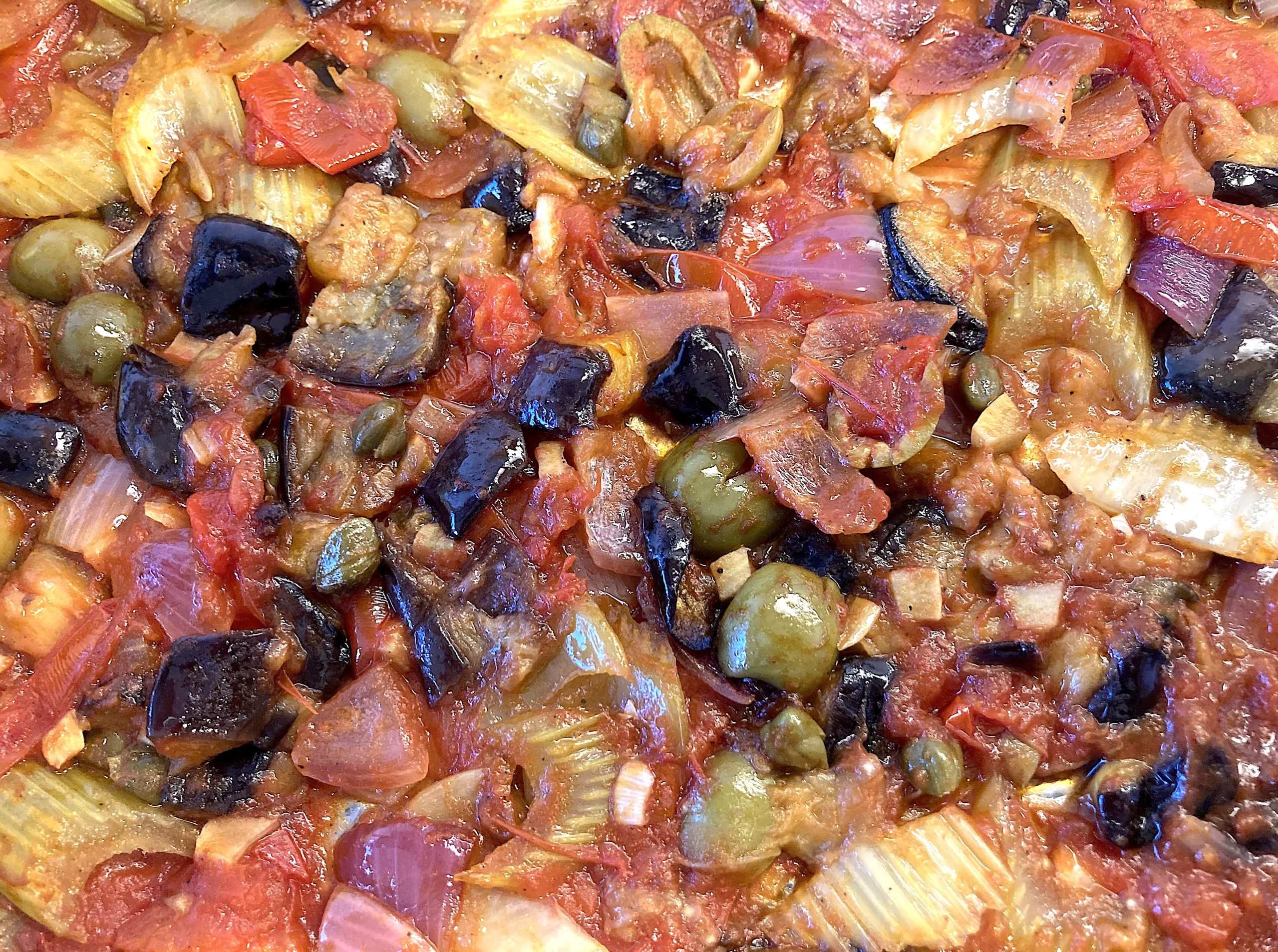
This very tasty dish originates from Sicily and is a mixture of chopped and fried vegetables. Eggplant (Aubergine), Tomatoes, Celery, rRed Onion and Green Olives are the main ingredients. The vegetables are prepared and served in an agrodolce sauce, so sweet and sour. Although we’re not keen on using sugar in a salad, in this case the combination of sugar and vinegar is perfect.
Perhaps the ingredients make you think of Ratatouille. Caponata and Ratatouille are very different dishes. Capanota is about fried vegetables, about crunchy celery, about sweet and sour.

Food and Wine Pairing

We served our Caponata with a roulade of pork with sage, rosemary, pancetta, black olives and black garlic. A dish we enjoyed with a glass of Barbera del Monferrato 2022, produced by Livio Pavese. In general, we suggest a full-bodied red wine with perhaps a touch of oak. Some acidity to balance the caponata and dark fruit (plums, blueberries).

The next day we served the Caponata with a roulade of chicken with pancetta, Parmesan Cheese and sage. A dish we enjoyed with a glass of Spätburgunder from the Pfalz area in Germany. In general, we suggest a medium bodied red wine with aromas of red fruit. Medium tannins and balanced acidity. Its taste dry, aromatic, fruity, juicy with a touch of strawberry.

You could also add some canned tuna (in olive oil) and serve the Caponata with crusted bread as a starter, perhaps accompanied with charcuterie and a glass of Crémant or Prosecco.

What you Need (recipe for 4)
  • 2 Aubergines
  • 400 grams excellent ripe Tomatoes
  • 10 Green Olives
  • Capers
  • 30 grams Tomato Puree
  • 4 cloves of Garlic
  • 4 small Red Onions
  • 3 stalks Celery
  • Tablespoon of Caster Sugar
  • Tablespoon of White Wine Vinegar
  • Black Pepper.
What You Do

Best to prepare Caponata one day ahead.

  1. Wash the vegetables.
  2. Slice the eggplant lengthwise in 8 and then in chunks. Drizzle with salt and mix. Put the chunks in a sieve and let rest above a bowl for one or two hours.
  3. Coarsely chop the onion.
  4. Quarter the tomatoes. Remove the internal hard bits and the pits and put these aside. Slice the outer part of the tomato lengthwise in three.
  5. Roughly cut the remainder of the tomatoes, add to a sieve and use the back of a spoon to capture the juices.
  6. Coarsely chop the garlic.
  7. Halve the olives.
  8. Use a knife to peel the back of the celery stalks, or ribs. Slice.
  9. Combine the tomato puree, black pepper, the caster sugar, the vinegar and the tomato juice.
  10. Set your oven to 140 °C or 285 °F.
  11. Discard the liquid of the eggplants, wash of the salt, dry with kitchen paper and fry the chunks in a generous amount of olive oil until golden.
  12. Transfer to a baking tray in your oven.
  13. Fry the onions and the celery until somewhat translucent. Add these to the baking tray.
  14. Now add the olives, the capers, the garlic, the tomato mixture and the tomatoes. Mix. Perhaps add a splash of water.
  15. Cover the baking tray with aluminium foil.
  16. After 20 minutes it’s time to mix the vegetables. Check if you need to add extra water.
  17. After another 20 minutes, remove and discard the foil, mix and increase the temperature to 160 °C or320 °F.
  18. Now you need to keep an eye on the mixture. It may take 10 to 20 minutes for the liquid to somewhat evaporate, but you don’t want the dish to become dry.
  19. When ready, let cool and transfer to the refrigerator.

Your Favourites in 2023

Happy New Year! Let’s begin the new year with the 2023 highlights. Your favorite post was No-Knead Bread, We have been baking our own bread for several years, based on the method of no-knead bread (see Jim Lahey’s book My Bread for more detail) and using the ingredients (Blue Poppy Seeds, Linseed) of the French Talmière. The result is delicious!

Another very popular post is the one showing you how to make Kimizu. This is a classic, golden sauce from Japan, made with Egg Yolks, Rice Vinegar, Water and Mirin. We also have a version with Tarragon, let’s say the Béarnaise version of Kimizu. The recipes for Kimizu and Kimizu with Tarragon continue to be very popular. Although this is a classic sauce, we use a microwave to prepare it. An easy and very effective way of managing temperature and consistency.

We love mushrooms. Cultivated ones, like Shiitake, Oyster Mushrooms, Enoki and Champignons de Paris and seasonal ones, such as Morels, St. George’s mushroom, and Caesar’s Mushroom. One of the most popular posts is about Cèpes à la Bordelaise. You can also use more available mushrooms for this great combination. Always a pleasure to serve, with eggs, with meat, with more present fish.
Last year we had lots of Bay Boletes, which was such a pleasure. It’s a fairly common mushroom, as tasty as Cèpes, but much more affordable.

And finally The Queen’s Soup. We didn’t expect too much of this post, but the soup turns out to be very popular.

We were of course very pleased and honored to receive an award for our Pear and Almond pie in the Great Bloggers’ Bake Off.

Let’s start cooking!

Your Favourites in 2023 ©cadwu

Pork with Enoki

It’s nearly the end of the mushroom season in Europe. It’s hard to find chanterelle (girolle), and nearly impossible to buy fresh cèpes. The black winter truffle (Tuber melanosporum) is an exception. It’s available until March, but the price may be prohibitive. Better to focus on cultivated mushrooms, such as enoki, available at your local Asian supermarket. A delicious mushroom with a pleasant texture and aroma. Its flavour is mild, a bit sweet and fruity. You can use it raw in a salad, in a soup or combine it with soba noodles. A few weeks ago, we wrote about an omelette with enoki and a light soy sauce. The result is a lovely sweet, rich and intriguing dish.
Combining enoki with pork is also a great idea. Feel free to adjust the recipe and make the sauce spicier or sweeter or thicker. The result will be tasty given all three elements in the dish bring some kind of sweetness.

Wine Pairing

You could emphasize the Asian influence by serving a glass of Pinot Gris, Riesling, Chenin Blanc or perhaps Soave. In general you’re looking for a light or medium bodied, unoaked, dry white wine with nice acidity. Benefits are minerality and florality. A glass of Côtes de Provence rosé will also be a good choice.
If you want to focus on the flavours of the pork, we suggest a glass of Beaujolais or a glass of wine made with Grenache (France) or Garnacha (Spain) grapes.

What You Need

  • Organic Pork Tenderloin
  • 100 grams of (Golden) Enoki
  • Soy Sauce
  • Light Soy Sauce (we used Tentsuyu)
  • Stock
  • Oyster Sauce
  • Black Bean Sauce (optional)
  • Red Chili Paste (optional)
  • Olive Oil

What You Do

Fry the pork in olive oil until pink. Turn on a regular basis. Remove the stem (bottom) of the enoki. Fry in olive oil for maximum one minute. Add some (vegetable stock), soy sauce, oyster sauce, black bean sauce and red chili paste and create a not overly sweet, intense sauce. We like some spiciness, hence the chili paste. Serve the meat on top of the enoki mixture.

Tomato and Halloumi Salad

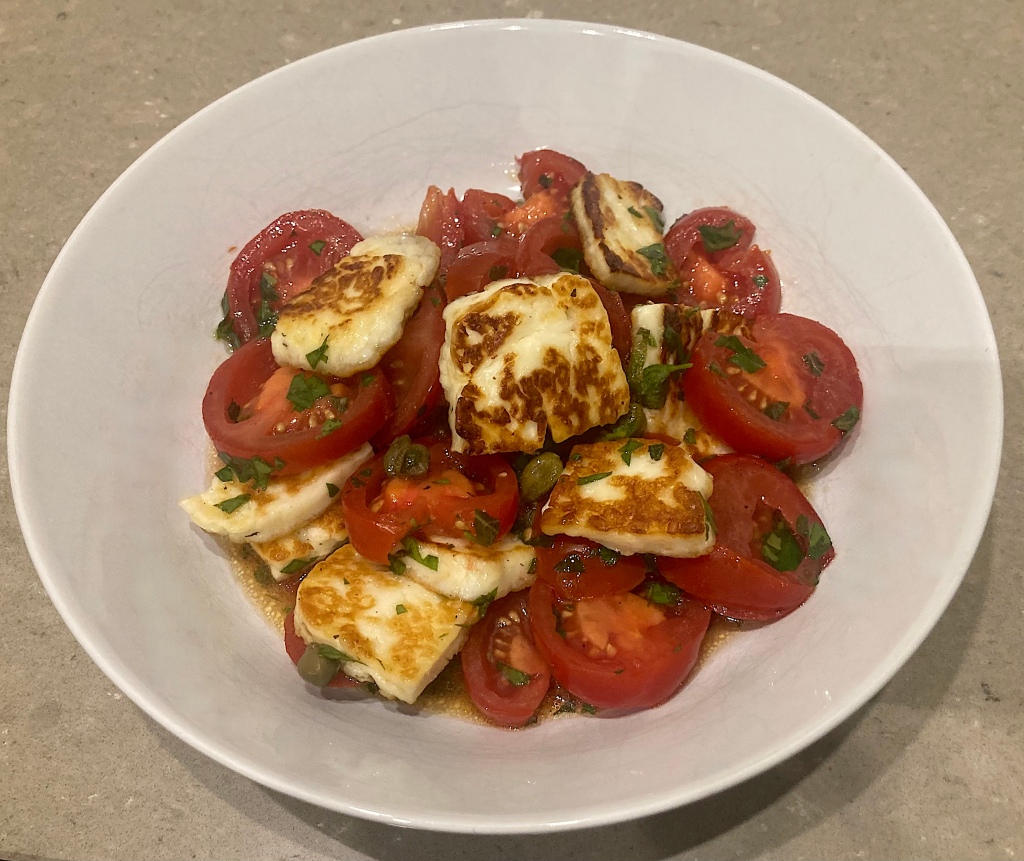
A simple and lovely salad, one that works very well as a starter with some crusted bread. Tomatoes, a touch of mint, parsley and warm halloumi. One of the first times we made this we used homegrown, ripe and tasty tomatoes. We also prepared the dish using tomatoes that were rather bland. That wasn’t much of a success.
The history of halloumi goes back centuries. Nowadays it’s a cheese made of goat’s and sheep’s milk. Sometimes cow’s milk is added to the mixture. In the EU it’s a protected product and must be produced in Cyprus. Because of its high melting point it’s ideal to grill or fry, although it can remain a bit firm and chewy. During the final phase of the production process the cheese is salted and sprinkled with chopped spearmint leaves.
Mint is also an essential ingredient of the salad. We tend to use it only occasionally because mint can be overpowering. It works very well in combination with the cheese and the tomatoes. It gives a boost to the flavours without being overly present.

Wine Pairing

A glass of rosé, a simple unoaked white wine or a beer will be great with the salad. When looking for a wine to go with a salad, make sure to think about the acidity. In general a more acidic salad requires a more acidic wine. The combination will make the wine fruiter and the salad softer. In this case the tomatoes, the dressing and the capers bring acidity. However, marinating the tomatoes makes the salad softer and emphasises the sweetness of the tomatoes. 

What You Need

  • Six excellent, tasty, ripe Tomatoes
  • 6 leaves of Mint
  • Parsley
  • Olive Oil
  • Vinegar
  • Teaspoon of Capers (in brine)
  • Black Pepper
  • Halloumi

What you Do

Core and slice the tomatoes. Chop the parsley and the mint. Combine oil and vinegar, add tomatoes, mix and add the herbs. Transfer to the refrigerator for a few hours. Mix every hour.
Slice the halloumi and fry on medium heat in olive oil. Turn regularly. Add the capers to the salad, mix, top with the fried halloumi and serve immediately with crusted bread.

Tomato and Halloumi Salad ©cadwu

Farfalle with Fennel and Zucchini

It was our last evening in Paris and we wondered what to do? Book a table at a nice local restaurant? Or enjoy drinks and dinner in our lovely apartment? Obviously, we decided to stay in. We looked in our refrigerator, did some shopping and sat down with a nice glass of Pinot Blanc and some shrimps. The plan was to make a rich, creamy pasta dish with fennel, zucchini and pancetta.
Thanks to the mild aniseed flavour of the fennel, the dish has a surprisingly uplifting taste. The (peeled) zucchini also benefits from the aniseed flavour and remains tasty and present.

Wine Pairing

Being in France we opened a bottle of Côtes du Rhône produced by Maison M. Chapoutier. This is a red wine made with Grenache, Mourvèdre and Syrah grapes. The wine has some fruit, a touch of pepper and mild tannins. A traditional French red wine.

If you prefer an Italian wine with the pasta, then we would suggest a glass of Bardolino, for instance the one produced by Monte del Frà. The wine has a beautiful deep red colour, and the aromas made us think of red fruit and perhaps pepper. The wine is medium bodied with some acidity. It will combine very well with both the lightness in the dish and the creaminess.
In general, you’re looking for a fruity red wine with a touch of acidity, for example Chianti Classico, Montepulciano or Barbera.

What You Need

  • 1 small Fennel
  • 1 small Zucchini (Courgette)
  • 1 Shallot
  • 80 grams of organic Pancetta
  • 1 Garlic Clove
  • 1 Bay Leaf
  • Piment Doux
  • Cream
  • Parmesan Cheese
  • Black Pepper
  • Olive Oil
  • Farfalle

What You Do

Finely chop the shallot and the fennel. Add olive oil to a warm skillet and gently fry the shallot and the fennel. Peel the zucchini, slice and quarter. Dice the pancetta. Chop the garlic. Now add the zucchini and the pancetta to the pan. Increase the heat and fry for one or two minutes, just to add colour. Reduce the heat, add the garlic, the bay leaf and the piment doux. Add the farfalle to the boiling water and cook according to the instruction on the package. Leave the pan on low heat for a few minutes. Now add the cream and the Parmesan cheese. Stir and taste. When the farfalle is ready, add it to the pan. Combine and add some cooking liquid to the sauce if needed. Remove the bay leaf, add some fresh black pepper and serve. We decorated the dish with a slice of grilled pancetta.

Farfalle with Fennel and Zucchini ©cadwu

Pike Perch with Shrimps and Dill

Pike Perch (zandersnoekbaarssandre) is one of the tastiest, flavour-packed freshwater fish. The flesh is white, firm and lean and the taste is delicate, mild and perhaps a touch sweet. It combines very well, for instance with this delicious shrimp-based sauce with dill. It seems to be a bit of work, but when you prepare the bisque-like sauce in advance, then it’s actually a very quick recipe.

Wine Pairing

We opened a bottle of Domaine Font-Mars Picpoul de Pinet 2022. This is a white wine from the South of France between Narbonne and Montpellier. The terroir (think calcareous soil, clay, quartz) is influenced by the sea, which is reflected in the mineral taste of the wine.
If you feel like spending more money, then we suggest a glass of Chablis. In general you’re looking for a refreshing, unoaked white wine with minerality and fresh acidity.

What You Need

  • Pike Perch fillets
  • Butter
  • For the Bisque
    • 300 grams of unpeeled small Grey Shrimps
    • Tomato Paste
    • 1 Shallot
    • 1 Garlic Clove
    • Dill
    • Olive oil
    • Saffron
    • Cognac
    • Salt
    • Butter

What You Do

Start by peeling the shrimps. It’s a very simple, mindfulness exercise. Remove the heads and discard. Use the shells for the bisque and transfer the bodies of the shrimps to the refrigerator. Chop the shallot and the garlic. Gently glaze the shallot for 10 minutes or so in olive oil. Add the shells and the garlic. Increase the heat for a few seconds.  Add some water. Stir. Add tomato paste, dill and saffron. Add a splash of cognac and a pinch of salt. Allow to simmer for 20 minutes. Pass the liquid through a fine sieve. Make sure you get all the lovely juices. Reduce the liquid until it’s powerful. Cool and set aside.
Transfer the shrimps from the refrigerator. In a non-stick pan heat some butter and fry the pike-perch. In parallel warm the bisque. Use ice cold butter to make the sauce thicker and richer. Plate up by creating a pool of sauce. Place the fried fish somewhat in the middle of the sauce. Add the shrimps and finish with some fresh dill.

Pike Perch with Shrimps and Dill ©cadwu

Herring Salad

In 1910 Mrs. Wannée published her Amsterdams Kookboek. A book dedicated to nutritious, easy to prepare and inexpensive food. She was teacher and director of the Amsterdam Huishoudschool, which was a school for domestic skills, aimed at training future maids and housewives. The book is currently in its 32nd edition and has sold over one million copies. It continues to be a popular cookbook because every new edition reflects the current culinary trends. We own a copy of the 14th edition (published around 1955?) and it clearly reflects the post second world war Dutch cuisine: very limited use of spices and herbs combined with cooking vegetables and meat for hours. We prepared Leek à la Wannée and decided it was perhaps edible in 1955 but certainly not today.

Recently we were reading the 7th edition of the book, published around 1935. The recipes are interesting and showcase a very different Dutch cuisine. We decided to prepare a Herring Salad inspired by the 1935 recipe of Mrs. Wannée.

Wine Pairing

A nice cold beer will be great with the salad. You could also go for a white wine from the Alsace or Mosel region. Nice acidity, perhaps a touch sweet, floral and aromatic.

What You Need

  • 1 Dutch Herring
  • ½ Apple
  • ½ Cooked Beetroot
  • 1 Boiled Egg
  • Small Pickled Onions
  • Cornichons
  • (Olive) Oil
  • Vinegar
  • Mayonnaise
  • Chives
  • Black Pepper
  • Corn Salad (Lamb Lettuce, Mâche)

What You Do

Peel the apple and the beet root. Chop herring, apple, beetroot, onions, cornichons and a generous amount of chives. Chop the white of the egg, crumble the yolk. Quickly combine the ingredients, add a teaspoon of mayonnaise, black pepper, small tablespoon of vinegar and the same quantity of olive oil, mix and serve immediately on top of the lettuce. Decorate with chives.

PS

Being Dutch we love our herring. Sometimes Dutch herring is called ‘raw’ because it’s not cooked. Actually, it’s placed in lightly salted brine for 5 days so it’s fermented and not raw at all. Herring is not to be compared with sashimi.

Tataki

Over the years tataki has become increasingly popular: beef, tuna, salmon, trout and even veal and deer tataki. But what is tataki actually? And what is tataki sauce?

Tataki originates from the Kōchi prefecture in Japan. The original dish is called katsuo-no-tataki. Katsuo (also known as Oceanic Bonito or Skipjack Tuna) is an important ingredient in the Japanese kitchen, for instance raw as sashimi and dried as katsuobushi (the flakes you need when making dashi).

The fish is seared very briefly in a huge rice straw fire. This way the fish becomes nicely coloured, the centre remains raw, and the flavour will be enhanced with smokiness. It is then sliced and served with a garlic, lemon (ponzu), soy and onion sauce, making Katsuo-no-tataki very different from other sashimi.

Unfortunately, most of us don’t have a straw fire at home, so you need a very hot pan to sear the fish. Bonito is not widely available where we live, but tuna is a great alternative. Beef is a good idea, salmon is a possibility, veal and trout are definitely not good alternatives.

What You Need

  • Bonito (or Tuna or Beef Tenderloin)
  • Light Soy Sauce (Tsuyu)
  • Mirin
  • Rice Vinegar
  • Lemon
  • ½ Garlic Clove
  • Sesame Seeds
  • Spring Onion
  • Olive Oil

What You Do

We added lightly roasted sesame seeds to the dish. There are not included in the original katsuo-no-tataki so feel free to leave them out.
Combine light soy sauce, mirin and rice vinegar (ratio 3:1:1), add some lemon juice and the grated garlic. The garlic must be grated; it should nearly dissolve in the sauce. Quickly sear the bonito (tuna, beef) in a hot non-stick pan with just a touch of oil. When ready transfer to an ice bath. Wait for a minute or so. Remove from the water and use kitchen paper to dry the fish. Slice, serve on a plate, drizzle with the dressing, then add thinly sliced white spring onion, then sesame seeds (if using) and finish with some dressing.

PS

And the answers are: tataki is a method to sear katsuo (or in general fish or beef) in a straw fire (or over a grill or in a hot pan). Tataki Sauce doesn’t actually exist; it may refer to the sauce that is served with katsuo-no-tataki.

Tataki (Tuna) ©cadwu


Pasta with Tomato Balls

Recently we reviewed Oh She Glows for Dinner by Angela Liddon as part of the great cookbook review project by Bernadette. Angela Liddons aim is to create tasty, colourful, nutritious, vegan, simple, healthy, easy to make food that you can prepare in just a few minutes. Unfortunately, her book shows that this is nearly impossible. Nevertheless, we liked her idea for a burger with tomato-based patties. We changed the recipe and turned the dish into Pasta with Tomato Balls. It’s certainly a tasty, healthy and colourful dish, but not one you can make in a few minutes.

Wine Pairing

Tomatoes come with acidity, an aspect to keep in mind when choosing your wine. Cooking the tomatoes reduces the acidity and enhances the sweetness and depth of the tomatoes. In this case you could go for a non-oaky white wine (Pinot Grigio, Soave Classico) or for a red wine with soft tannins (Chianti, Sangiovese). A glass of crisp rosé will also be fine, so the choice is yours, as long it’s not an oaky chardonnay or a tannic red wine.

What You Need

  • Tomato Balls
    • 30 grams Brown Lentils
    • Vegetarian Stock
    • Bouquet Garni (Thyme, Parsley, Bay Leaf, Chives)
    • 1 small Red Onion
    • 1 Garlic Clove
    • 40 grams of roasted Cashews
    • 40 grams of roasted Hazelnuts
    • 5 grams (or more) of dried Oregano
    • 25 grams Sun Dried Tomatoes
    • Teaspoon Tomato Paste 
    • Teaspoon Lemon Juice
    • Red Pepper Flakes (to taste)
    • Salt
    • Black Pepper
    • Breadcrumbs
    • Olive Oil
  • Tomato Sauce
  • Orecchiette or Farfalle
  • Parmesan Cheese
  • Basil Leaves

What You Do

Start by washing the lentils. Cook in vegetarian stock with a bouquet garni. Set aside and let cool. Prepare the dried tomatoes: if they are salted, then wash them thoroughly. If they are oil-packed, drain them. Chop the red onion, the garlic clove and the dried tomatoes coarsely. Glaze the onion and the garlic in olive oil. Use a food processor to make a coarse mixture of the cashews, hazelnuts and oregano. Add the chopped tomatoes, the onion, the garlic, the tomato paste, the lentils, the lemon juice and the red pepper flakes (if using). Pulse a few times. Taste and decide if you want to add salt, pepper or lemon juice. Now it’s time to check the consistency. Is it possible to turn the mixture into balls? A bit soggy probably? Add breadcrumbs. Leave the mixture for 15 minutes. Divide the mixture in smaller portions and make balls, using your hands. Bake for a few minutes in a non-stick pan with some olive oil.
In parallel cook the orecchiette or farfalle according to the instruction on the package. Warm a tomato sauce. When all components are ready, add the pasta straight from the pan to the sauce. Add the balls and mix gently.  Finish by adding some freshly grated Parmesan cheese and basil.

Pasta with Tomato Balls ©cadwu

Asparagus Soup (Blended)

Earlier we wrote about the traditional way of making asparagus soup. It starts by using the skin and woody ends of the asparagus with leek or shallot to make a stock. Then extra flavour is added (the tips of the asparagus, cream or salmon and dill) and the consistency of the soup improved, for instance by making a roux. This way you will get a nice, thickened soup with a velvety mouthfeel. It’s still a bit one dimensional so if you want a more complex soup, you need to replace the water by chicken or vegetable stock.

Another way of thickening the soup is by blending the asparagus. Unfortunately, this doesn’t help a lot since asparagus do not contain starch, so yes, the soup is tastier, a touch more structured but its consistence remains watery. What to do? Egg yolk? Corn starch? A potato? Cream? More white asparagus? A roux after all?

What You Need

  • 300 grams of White Asparagus
  • 1 small Shallot
  • Butter
  • 350 ml Chicken or Vegetable Stock
  • Bouquet Garni (Parsley, Bay Leaf, Chives)
  • Cream
  • White Pepper

What You Do

First decide how you want to thicken the soup. A roux is not preferred because it will flatten, reduce the flavour plus we want a try a different approach. You could use a small starchy potato (not preferred because it will bring the typical potato flavour to the soup which is great in combination with leek but not with the subtle bitterness of asparagus), corn starch (great thickener but one that reduces flavours), egg yolk (classic, but we haven’t tried it yet with this soup) or potato starch (flavourless, simple, no impact flavour wise, only colour wise).

Peel the asparagus and cut of the woody ends. Peel and slice the shallot. Add butter to a pan, glaze the shallot. Now add the skin and woody ends of the asparagus, coat with the shallot and butter mixture and add the stock. Allow to simmer for 30 – 45 minutes. If you cook the stock too long, then it will become bitter. Pass the liquid through a sieve. Squeeze to capture all the lovely asparagus juices. Keep on low heat. Chop the asparagus, add the slices to the soup and keep the tips. After 20 minutes blender the soup. Add some cream, slice the tips lengthwise and add these to the soup. 10 more minutes later the soup is ready.

And The Winner Is…

We prefer the blended version to the roux version. The stock and the other ingredients support the asparagus flavour, making it into a tasty, light yet rich soup.

Asparagus Soup (Blended) ©cadwu