Baba Ghanoush

Eggplant

Baba Ghanoush is tasteful and easy to make. Combine it with olives, pickles and flat bread (naan) to create a delicious starter to share. Don’t be tempted to buy Baba Ganoush at the supermarket. Most of these products lack the typical taste as a result of charring the eggplant.
Sumac is an ingredient from the Levantine cuisine. Basically sumac powder is the result of crunching dried berries of the sumac plant. The taste vaguely resembles cranberries with a touch of lemon. In this case it adds fruitiness to the dish. The sweetness of the berries combines well with the garlic.

Wine Pairing

Enjoy Baba Ganoush with a glass of white Lebanese wine, but since that’s hard to find a nice glass of Cava is also a good choice.

What You Need

  • 1 Eggplant
  • 1 Garlic glove
  • 1 Tablespoon of Tahini
  • Olive Oil
  • Greek or Turkish yoghurt
  • Lemon Juice
  • Sumac
  • Pomegranate

What You Do

Start by grilling the eggplant (in the oven in our case) to the point of charring. Ideal would be a char coal grill, but an oven grill also does the trick. Then leave the eggplant in the hot oven until very soft; maybe 30-45 minutes in total, depending on the seize of the eggplant. Some suggest rubbing the eggplant with olive before grilling it that’s not necessary.
Transfer the eggplant to a plate and let cool. Now cut in half and use a spoon to separate the flesh from the skin. Use a kitchen knife to cut the flesh very thinly. Put the mixture in a sieve and reduce the amount of liquid in the mixture. Add the garlic and mix well.  Add tahini and while stirring slowly add olive oil to create a thick mixture. Add yoghurt and some lemon juice. Taste well and adjust by adding more tahini, yoghurt or lemon juice. Allow to integrate for at least 15 minutes before serving.
Spread the baba ghanoush on a small plate, add a splash of excellent olive oil and sprinkle some pomegranate seeds and sumac to finish.


Farfalle with Wild Garlic (or Ramson) and Parmesan Cheese

In a number of countries ramson is a protected plant, so we don’t suggest you run out of the door and start picking it. But if it’s not protected, feel free to start running!
Ramson is much-loved in Germany, Austria (Bärlauch) and other parts of Europe. Its taste is like a combination of onion and garlic, but much greener, more intense, longer lasting and with a touch of bitterness at the end. Works very well as a pesto, but equally nice with potatoes or gnocchi. Once we made ramson soup, but that was not the best idea ever.
The flowers may have (if you’re lucky) a touch of sweetness because of the nectar in the flower. Always taste the leaves and the flowers before using and feel free to adjust quantities.

Wine Pairing

We would suggest a Soave to go with the dish. The Garganega grape combines very well with the specific taste of the ramson, given the wine is fresh with a subtle bitterness.

What You Need

  • 20 or so leaves of Ramson
  • Olive Oil
  • Parmesan Cheese
  • Farfalle
  • Lemon Juice

What You Do

Cut the leaves in smaller bits and blitz the leaves with grated Parmesan cheese. If you want to soften the taste, now is the moment to add some toasted almonds or pine nuts. Slowly add the olive oil until blended and smooth. Maybe you want to add a bit of lemon juice.
Cook the farfalle and serve with the pesto and some grated Parmesan cheese.
You can store the pesto for a week or so in the refrigerator if you add some extra olive oil to the jar, covering the pesto.

Haddock with White Beech Mushrooms

Popular Fish

When you mention Haddock, Cod is never far away. Two of the world’s most popular fish. Many recipes and foodies describe the two as being very similar in terms of taste and preparation. We humbly disagree. We think Haddock is more flavourful and present compared to the mild taste of Cod. The structures differ as well, although both require your constant attention; they easily overcook.

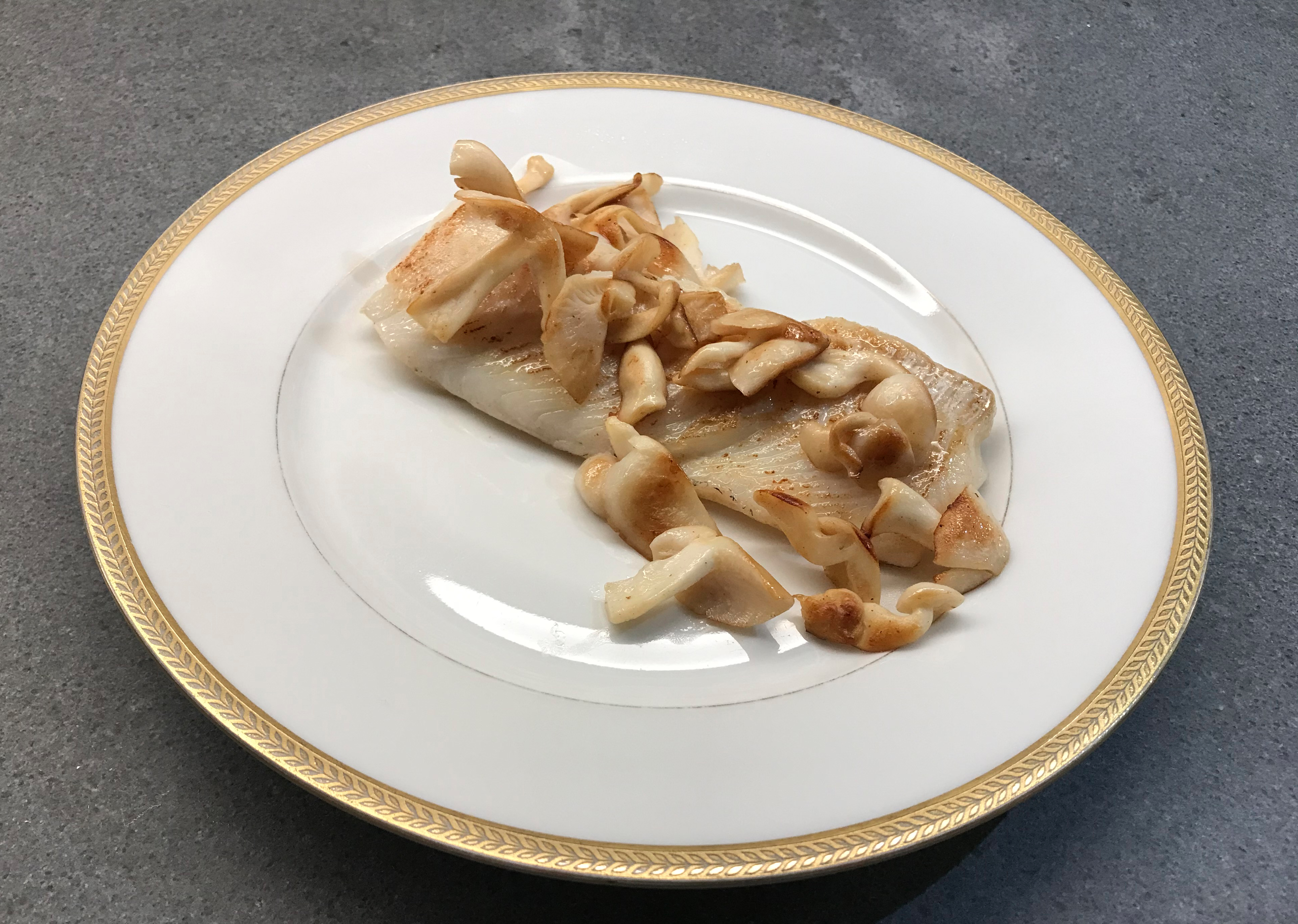
Beech Mushrooms are more and more widely available, which is great. The slightly nutty  taste in combination with their texture makes them ideal for this dish. And the golden colour of the fried white beech mushrooms is perfect with the golden colour of the fried haddock.

Wine Pairing

Our choice was a bottle of Pinot Grigio made by MezzaCorona. This is a dry and crispy white wine with a beautiful deep yellow colour. It’s an elegant wine with just the right acidity to relate to both the fish and the mushrooms.

What You Need

  • 200 grams of Haddock (without the skin)
  • 100 gram of Beech Mushrooms
  • Butter
  • White Pepper

What You Do

Clean the beech mushroom with kitchen paper and half. Check the fish for bits you don’t want to eat. Fry the fish in butter. Both sides should be beautiful golden brown. In parallel gently fry the beech mushrooms in butter.
Serve the beech mushrooms on top of fish. Perhaps a touch of white pepper.

Haddock with white Beech Mushrooms © cadwu

Salade Niçoise

Pan Bagnat

The origin of the Salade Niçoise goes back to the days that life on the French Côte d’Azur was harsh. It was a remote and poor region and people tried making a living trough fishing, harvesting flowers for the perfume manufacturers and growing olives. Not a tourist in sight and no fancy lunches. Bread would be baked once every fortnight and people would soak the stale, day-old bread with water, olive oil or ripe tomatoes. Over the years this developed into what is known today as Pan Bagnat: bathed bread. Interestingly enough the stuffing became a dish in its own right: the Salade Niçoise.

Today’s Salade Niçoise is of course much more than water, olive oil and tomatoes. According to the founders of the label Nissarde Cuisine the Salade Niçoise is a combination of tomatoes, boiled eggs, salted anchovy, tuna in oil, spring onion, small black Niçoise olives, basil and olive oil. Optional ingredients are artichoke, broad beans, green pepper, garlic and radish.
And now I can hear you think: but how about the haricots verts and the potatoes? And haven’t you forgotten the vinegar?

Let’s start with the vinegar: a few drops are allowed but the idea goes back to the Pan Bagnat. So little or no vinegar and certainly no balsamic vinegar, mustard or mayonnaise. 

It was Auguste Escoffier who introduced the haricots verts and the potatoes as ingredients of the Salade Niçoise. For the guardians of the Nissarde Cuisine this is clearly a ‘no go’ (also because Escoffier was not from Nice). We were brave and did a small experiment by preparing both variations.

We expected the Escoffier version to be the winner of our small competition, but the stars clearly go to the Nissarde version: elegant, light, full of flavours and a tribute to the ingredients. Forget about haricots verts, potatoes, vinegar and grilled fresh tuna!

What You Need

  • Tomatoes
  • Salted Anchovy
  • Tuna in Oil
  • Spring Onion
  • 2 Boiled Eggs
  • Small Black (Niçoise) Olives
  • Basil
  • Olive oil
  • Optional
    • Artichoke
    • Broad Beans
    • Green Pepper
    • Garlic
    • Radish
  • Version Escoffier
    • Haricots Verts
    • Potatoes
    • Mesclun
    • Vinegar
    • Black Pepper

What You Do

For the Nissarde Cuisine version: cook the eggs until nearly set, clean the vegetables, wash and slice the anchovy. Then combine quartered tomatoes, sliced spring onion, tuna, anchovy, olives and basil. Drizzle with excellent olive oil and garnish with eggs. Toss briefly to make sure all ingredients are coated with oil.
For the Escoffier version: briefly cook the haricots verts and cool in cold water. Cook the potatoes until done. Cook the eggs until nearly set. Wash and slice the anchovy. Clean the vegetables. Combine quartered tomatoes, sliced spring onion, tuna, anchovy, olives, cubed potatoes, haricots verts and basil. Mix olive oil and vinegar. Drizzle with the dressing and garnish with eggs. Toss briefly to make sure all ingredients are coated with the dressing.
For a more luxurious version replace the canned tuna with grilled tuna.

Salad with Various Beans and Swordfish

When in Valencia

The Mercat Central in Valencia is one of the largest markets in Europe. Its architecture is amazing, but even more stunning are the products: fruit, vegetables, mushrooms, wines, fresh meat, sausages, hams, herbs, spices, fish, bread, chickens, pickles, snails, weeds, offal, rice, nuts, beans: anything and everything you can dream of.
Albufera is a fresh water area not far from Valencia used for growing rice. It is of course the ideal rice for paella. If an original recipe of paella would exist, it would include rice, olive oil, rabbit, saffron and various beans such as broad beans, roget and garrofón.
Inspired by the classic Salade Niçoise we bought a slice of excellent swordfish, sweet onions, potatoes, eggs and of course: lots of beans. Shall we call it Salade Valençoise?

Wine Pairing

We served the salad as a main dish. Combining wine and salad is not straightforward because acidity is an important aspect of a dressing and therefore of a salad. In this case we have a range of flavours and textures so we would suggest a wine with a very present floral bouquet. The taste should be smooth and fruity. We enjoyed it with a glass of Albariño Rias Baixas 2018 produced by Bodegas Bouza do Rei, made from 100% Albariño grapes.
Another excellent choice would be Sericis, 2018 from the house of Murviedro. A wine from Utiel-Requena, so from the Valencia region. A wine made from 100% Merseguera grapes. Full bodied yet light, elegant and surprisingly low in its alcohol with only 12%. Well balanced acidity which is great when combining it with a salad.

What You Need

  • Mixed Salad
  • White Sweet Onion
  • Flat Beans (we also used the local red variety Roget)
  • Green Peas
  • Broad Beans
  • Garrofón (Lima Beans or Butter Beans)
  • Sword Fish
  • 2 Eggs
  • 2 Small (New) Potatoes
  • Olive Oil
  • Vinegar
  • Mustard
  • Black Pepper

What You Do

Start by pealing the broad beans, the green peas, the flat beans, the garrofón beans and the potatoes. Cook all five ingredients separately until al dente. Cook the eggs until just done. Let cool. Peel the broad beans and the garrofón beans again. Make a dressing by combining olive oil, vinegar and mustard. Slice the flat beans, the onion and the potatoes. Cut the egg in four. Fry the swordfish until just done. In parallel mix the salad with the onion, the flat beans, the green peas, the potatoes and the broad beans. Add the dressing and toss. Slice the swordfish and decorate the salad with egg, garrofón and swordfish. A touch of black pepper to finish.

Fried Oyster Mushrooms

Cotoletta alla Milanese and Wiener Schnitzel are based on a similar concept: breaded and pan fried thin slices of veal or pork, served with a slice of lemon. The most obvious variation is Pollo alla Milanese which is made with chicken. A very special variation is Cotoletta di vitella di latte alla Milanese, as described in 1891 by Pelligrino Artusi (1820-1911) in his book La Scienza in Cucina e l’Arte di Mangiar Bene (The Science in the Kitchen and the Art of Eating Well). The book is a must have for every serious food lover, so buy the book! It is very well written and contains over 700 recipes from Italy. Before breading the meat Mr. Artusi coats one side of the veal with a mixture of finely chopped fat ham, parsley, grated Parmesan cheese and truffle. Delicious no doubt!

The variation we prefer is made with Oyster Mushrooms, so Cotolette di Funghi Pleurotus alla Milanese. It is very tasty and the juicy and meaty structure of the oyster mushroom in combination with the crispy crust makes it into a much-loved starter. No need to deep fry: a hot pan with olive oil and butter is all you need.

The key to an excellent Alla Milanese are the breadcrumbs. Make your own breadcrumbs with yesterday’s bread and compare the result with the cardboard crumbs you can buy. Flavour! Texture!

Wine Pairing

A fresh, not too complex white wine will be great with the fried oyster mushrooms. Soave, Burgundy, Loire: all good.

What You Need
  • 150 grams of Oyster Mushrooms
  • One Egg
  • Three Slices of Yesterday’s Bread
  • Olive Oil
  • Butter
  • Black Pepper
  • Lemon Juice
  • Parsley (optional)
What You Do

We begin by making the breadcrumbs. Toast the slices of bread and let cool. Cut in smaller bits and then using a cutter or blender make the crumbs. Whisk the egg. Feel free to add some water if you need more volume. Remove the stems from the mushrooms. Make sure your pan is hot, add the oil, the butter and start breading (coat the mushroom with egg, then with breadcrumbs) and frying. When nearly ready remove the pan from the heat, add some lemon juice and move the mushrooms in the pan. The idea is to add a touch of lemon to the taste and to keep the mushrooms crispy. Add black pepper and serve immediately on a warm plate. We don’t serve with additional lemon because adding lemon juice later on will make the wonderful crunchy crust of the soft oyster mushrooms soggy. Sprinkle with chopped parsley (optional)

Dashi with Matsutake and Shrimps

Celebrate Autumn

This year seems to be an exceptionally good year for Matsutake. Antonio Carluccio once described it is a much-overrated mushroom but we dare to disagree. Just smell it! Pine, pine, pine. A unique mushroom. We tried making this soup with shiitake, but the result is not as refined, delicate and well-balanced. The key elements are of course the (home-made) dashi, the matsutake and the shrimps. Kamaboko (made from processed seafood) and Mitsuba (Japanese parsley) add colour (and some extra flavour) to the dish.

What You Need

  • Dashi
    • 0,5 l of Water
    • 10 gram of Konbu
    • 10 gram of Katsuobushi
  • 75 gram of Matsutake
  • 2 Shrimps
  • Taru Sake
  • Light Soy Sauce
  • Yuzu
  • Kamaboko
  • (Mitsuba)

Sake Pairing

If you want to serve a drink with the soup, then serve taru sake. This is a dry sake characterized by its refreshing taste and the wooden aroma of Yoshino cedar. A wonderful link to the matsutake. And if you bought a bottle of taru sake, then please use this sake for marinating the shrimps.

What You Do

With a damp cloth clean the matsutake. Be careful not to remove the skin. The root should be cut like a pencil. Clean the shrimps and cut lengthwise in two. Let marinade in two tablespoons of sake and transfer to the refrigerator for an hour. Gently warm the dashi, add a small tablespoon of sake and a similar quantity (or less) of soy sauce. Cut the matsutake in 8 similar slices and add to the soup. After a few minutes (depending on the size of the matsutake) add four slices of kamaboko and the shrimps. Taste and add some more soy sauce and or yuzu if needed. Serve immediately when the shrimps are ready. If available add some mitsuba.

Grilled Octopus Tentacles

Portugal

The Portuguese kitchen is not known for its subtleness or refinement. But that should not stop you from enjoying it! Portuguese cuisine comes with powerful flavours, lots of fish of course, bacalhau, Caldo Verde, octopus, cuttlefish, and the well known chicken piri-piri and pastel de nata. Same for Portuguese wine: perhaps not the most subtle wine (apart from Madeiras and Port wines), but how about an excellent Vinho Verde, a red wine from the Dão region made with Touriga Nacional or a red wine from Alentejo? We love flavors and we very much enjoy the bold dishes from Portugal.

Recently when in Brussels we booked a table at Chez Luis, a Portuguese Bar à vin and Restaurant. Tasty dishes like Pasteis de bacalhau, Cassolette de palourdes and Polvo lagareiro. Served with Portuguese wine, of course. And Chez Luis has an excellent choice! So we drank a vibrant espumante and a refreshing Vinho Verde (Longos Vales Alvarinho 2016). The Polvo made us think of one of our favorites: Octopus with summer vegetables. And since one octopus is way too much for two people, we simply bought two cooked tentacles. Feel free to buy a whole octopus, clean it, cook it, braise it and then follow the recipe below.

Wine Pairing

A Portuguese white wine will be a excellent choice, for instance a Vinho Verde like we enjoyed at Chez Luis. You could also go for a Spanish Verdejo from Rueda. Look for characteristics like fresh, fruity, clear acidity, subtle bitterness and full bodied.

What You Need

  • 2 Octopus Tentacles (cooked)
  • 1 Tomato
  • 1 Red Bell Pepper
  • 2 gloves of fresh Garlic
  • 1 Spring Onion
  • Jerez Vinegar
  • Black pepper
  • (Optional) Parsley
  • Lemon
  • Olive oil

What You do

Clean the red bell pepper and slice in 4 to 6 chunks. Grill it in your oven until nicely burned. Transfer to a plastic container and close the lid. Wait a few hours before peeling the bell pepper. Slice it into cubes (not too small). Remove the pits from the tomato. Slice in similar cubes. Slice the garlic (again, not too small). Slice the spring onion. Mix the vegetables and fry gently in a hot pan with olive oil. Set to low heat. In parallel heat your grill pan. Remove the gelatinous substance from the tentacles, dry them, coat with olive oil and grill for 4*2 minutes, creating a nice brown criss-cross pattern. It will not be very visible, but it will be crunchy. Just before serving the dish, add some Jerez vinegar to the vegetables, turning it into something like a salsa. Perhaps some parsley and black pepper. Serve the hot tentacle on the vegetables and add a slice of lemon.

grilled octopus tentacles

Skate with Capers

When you Google for skate with capers you will find many recipes with capers and brown butter. We think you can do better!
The trick in this recipe is to clarify butter and then deep-fry the capers in the clarified butter. The result is a crunchy and salty caper with clear acidity from the brine. This works brilliantly with the meaty, fatty skate.

Clarification

Butter is an emulsion of butterfat, water and proteins. The process of clarification means breaking down the emulsion. The goal is to have pure butterfat, which will not burn and which allows for deep-frying.
The water will simply go when you warm the butter.
How to remove the proteins? Option one is to start by melting the butter and to wait until you see white foam and until the water is gone. Now pour the fat into a jar or cup, carefully keeping the foam in the pan.
Option two is to continue warming the butter until the white foam becomes brown. Be careful not to burn it, this will ruin your butter. The now brown foam will sink to the bottom, which makes it easier to pour the butterfat in a jar or cup. If you want to be even more sure of the quality, use a cheesecloth when pouring. The idea is that using the second option will give the clarified butter a more nutty taste.

Wine Pairing

Skate goes really well with a glass of classic Chardonnay with a touch of oak. The chardonnay comes with a velvety taste which is great with the skate and its consistency. The touch of oak combines very well with the fried capers.

What You Need

  • Skate Wing (let’s say 200 grams for 2 persons)
  • Butter
  • Olive Oil
  • Black Pepper
  • Capers (in brine)
  • 75 grams of Butter (to be clarified)

What You Do

Clarify the butter and set aside. Fry the skate in a non-sticky pan for 5-10 minutes or so, depending on the size and shape. Please notice that there is more meat on one side then on the other side, so it’s not 10=5+5. Transfer the skate to a warm plate. Heat the clarified butter to frying temperature and in parallel wash the capers and dry them with kitchen paper. Fry the capers until crispy. Serve the skate with some black pepper and sprinkle the capers on top of the skate.

Sweetbread with Madeira and Truffle

A Starter to Remember

A culinary treat that is delicate, balanced and overwhelming yet subtle. In a restaurant you will probably get Sweetbread (Ris de Veau, Kalfszwezerik, Kalbsbries, Molleja de Ternera, Animelle di Vitello) dusted with flour (okayish) or breaded (awful idea, it’s not a Wiener Schnitzel). In some countries Sweetbread is grilled, which is an interesting idea. We stick to a very traditional approach that works extremely well because it’s all about the taste of the Sweetbread in combination with Madeira and Truffle.
Sweetbread should of course be hot and soft on the inside and golden and crispy on the outside. Use your non-sticky skillet and a bit of butter for a beautiful result.
Sweetbread should be between rosé and well done. It requires a bit of attention, but it’s hard to overcook Sweetbread. Although some restaurants are very capable of creating rubber.
It is essential to clean Sweetbread. For some the process of removing the membrane from Sweetbread is intimidating, but don’t be put off. Just watch the video!

Wine Pairing

First the Madeira: don’t be tempted to buy so called ‘cooking Madeira’. This is some horrible, sweet liquid that is not even close to Madeira. One for the bin. We bought a bottle of Santa Maria Fine, Medium Dry, Vinho Madeira. It is perfectly suited for this recipe. The story behind Madeira is complex so if you get the chance to buy one that is 10 or 15 years old, please give it a try. Just sip and enjoy.

We’re looking for a wine that will be supporting the delicate taste and the sweetness, earthiness and the slight nuttiness of the sauce. If you want to drink a glass of white wine, then it should be a full-bodied Chardonnay, although not too oaky. Chablis will be a good choice. If you go for red, then we recommend a Beaujolais Cru (St. Amour or Fleurie) or a Bourgogne. It’s about soft tannins, aromas like dark cherries and licorice and on the palate a lean texture and dry.

What You Need

  • 200 grams of Sweetbread
  • Two leaves of Bay Leaf
  • Crushed black pepper
  • Butter
  • Shallot
  • Veal Stock
  • Madeira
  • Preserved Truffle (preferably without additional flavours)
  • Jus de Truffes

What You Do

Start by filling a big pan with water. Add the crunched pepper and the bay leaf. Bring to a boil. Now add the sweetbread and make sure the water remains close to boiling. Blanch the sweetbread for let’s say 5 minutes, depending on the size and shape of the sweetbread.
Transfer the sweetbread to a large bowl with ice-cold water and cool the meat as quickly as possible.
Now it’s time to clean the sweetbread. Remove the bits of fat, the fleeces, any membrane, the veins and anything else you don’t like. Best way to do this is with your hands and a very sharp small knife. Once your sweetbread is clean, you will be able to see how to slice it later on. But first put it on a flat plate, seal it with plastic foil, put a similar flat plate on top of it and put something heavy on top of the plate. Transfer to the fridge and leave it for a few hours. The idea is twofold: on the one hand the sweetbread will be firm and easy to partition. And it will lose some liquid because of the weight.
With the sweetbread in the refrigerator it’s time to think about your sauce. Cut the shallot in small bits and glaze in butter. Aftre a few minutes add the veal stock and the Madeira. Mix and reduce. Add one preserved truffle. Blender the liquid after five minutes. Pass through a small sieve and warm what is the beginning of your sauce. Add Jus de Truffes. This is an essential ingredient because it brings volume and depth to the sauce. It’s not to be confused with Truffle Oil, which in most cases is some kind of horrendous chemical invention. Taste and perhaps add some more Madeira or stock. A pinch of pepper may also be helpful. Keep warm for 5 minutes, stirring regularly. You will notice that the sauce becomes more intense and mature, which is exactly what you want.
In parallel cut 2-3 cm thick slices of sweetbread. Fry them for 5 minutes or so in a very warm (but not hot), non-sticky skillet with butter. It’s simple: when the sweetbread is golden and beautiful they are ready to be served. If in doubt: there is bound to be a small slice, one that you can use to test. Remember it’s offal, so you don’t want to take a risk.
Take two warm plates, add sauce and carefully put the slices of sweetbread on the plate. You could add slices of (fresh) truffle on top.

Video