Fried Prawns with Garlic and Samphire

Shrimps and prawns are subtle, delicate and tasty. Popular food in many countries, just think shrimp cocktail, stuffed eggs with shrimps and of course, fried prawns with garlic and lemon.
For this recipe you need large, wild or organic prawns. We strongly suggest using ones that are not yet cleaned. It’s not difficult to clean shrimps and they taste much better than factory cleaned shrimps.
We serve the prawns with samphire. It’s a crunchy and salty vegetable that brings lots of colour and flavour to the plate. It can be eaten raw but it’s better to cook or steam it for a minute or two. The history of samphire goes back to the 14thcentury when the ashes of the marsh samphire (rich on sodium carbonate) were used to make glass. 

Wine Pairing

We enjoyed our Prawns with a glass of Picpoul de Pinet produced by Gérard Bertrand. A dry white wine, with a pale straw yellow color. It has aromas of citrus and gooseberries. The wine is full and round with minerality which is typical for a Picpoul de Pinet.
Recently we combined the prawns with a white wine made by Casa Relvas in Portugal. The wine is made with antão vaz and viognier grapes. Subtle aromas, gentle acidity and a nice finish.
You could also combine the prawns with a glass of Chablis, Verdejo or Soave.

What You Need
  • Six large Prawns
  • Garlic
  • Olive Oil
  • Black Pepper
  • 50 grams of Samphire
  • Crusted Bread
  • Lemon (optional)
What You Do
  1. Use scissors to cut the shell of the prawn. Start behind the head and cut towards the tail. Just before the tail turn 90 degrees and make a cut around the prawn
  2. Remove the head, the shell and the legs of the body. Keep the tail on the prawn.
  3. Remove the black vein (the prawn’s intestines) and the slurry (if any)
  4. Wipe clean with kitchen paper
  5. Transfer the prawns to the refrigerator
  6. Wash the samphire
  7. Coarsely slice the garlic
  8. Heat a pan with water
  9. Dry the prawns and fry them in a skillet in olive oil (depending on the size maximum 4 minutes in total) on both sides and on the back.
  10. When the prawns begin to colour, add the garlic and reduce the heat
  11. Coat the prawns with the oil and the garlic in the pan
  12. Cook the samphire for one minute maximum (or steam for two minutes)
  13. Drain the samphire
  14. Serve on warm plates with some black pepper and lemon (if using)
  15. Enjoy with crusted bread
Fried prawns with Garlic and Samphire ©cadwu

Pike Perch with Shrimps and Dill

Pike Perch (zandersnoekbaarssandre) is one of the tastiest, flavour-packed freshwater fish. The flesh is white, firm and lean and the taste is delicate, mild and perhaps a touch sweet. It combines very well, for instance with this delicious shrimp-based sauce with dill. It seems to be a bit of work, but when you prepare the bisque-like sauce in advance, then it’s actually a very quick recipe.

Wine Pairing

We opened a bottle of Domaine Font-Mars Picpoul de Pinet 2022. This is a white wine from the South of France between Narbonne and Montpellier. The terroir (think calcareous soil, clay, quartz) is influenced by the sea, which is reflected in the mineral taste of the wine.
If you feel like spending more money, then we suggest a glass of Chablis. In general you’re looking for a refreshing, unoaked white wine with minerality and fresh acidity.

What You Need

  • Pike Perch fillets
  • Butter
  • For the Bisque
    • 300 grams of unpeeled small Grey Shrimps
    • Tomato Paste
    • 1 Shallot
    • 1 Garlic Clove
    • Dill
    • Olive oil
    • Saffron
    • Cognac
    • Salt
    • Butter

What You Do

Start by peeling the shrimps. It’s a very simple, mindfulness exercise. Remove the heads and discard. Use the shells for the bisque and transfer the bodies of the shrimps to the refrigerator. Chop the shallot and the garlic. Gently glaze the shallot for 10 minutes or so in olive oil. Add the shells and the garlic. Increase the heat for a few seconds.  Add some water. Stir. Add tomato paste, dill and saffron. Add a splash of cognac and a pinch of salt. Allow to simmer for 20 minutes. Pass the liquid through a fine sieve. Make sure you get all the lovely juices. Reduce the liquid until it’s powerful. Cool and set aside.
Transfer the shrimps from the refrigerator. In a non-stick pan heat some butter and fry the pike-perch. In parallel warm the bisque. Use ice cold butter to make the sauce thicker and richer. Plate up by creating a pool of sauce. Place the fried fish somewhat in the middle of the sauce. Add the shrimps and finish with some fresh dill.

Pike Perch with Shrimps and Dill ©cadwu

Fried Large Prawns

Prawns and shrimps are very popular, just think shrimp cocktail, paella, salad with shrimps, pasta with seafood, stuffed eggs with shrimps, curry with shrimps and fried shrimps with garlic and lemon. Most of these prawns and shrimps are cultivated, frozen and then shipped. For this recipe you need really large, fresh, wild or organic prawns because the dish is all about the prawn, its flavour and aromas. The result fully depends on the quality of the prawn.
We use the shell, the legs and the so-called swimmerets of the prawns to create a sauce; a bisque like sauce. 

Wine Pairing

We enjoyed our Prawns with a glass of Picpoul de Pinet produced by Gérard Bertrand. A dry white wine, with a pale straw yellow color. It has aromas of citrus and gooseberries. The wine is full and round with minerality which is typical for a Picpoul de Pinet.
You could also combine the prawns with a glass of Chablis, Verdejo or Soave.

What You Need

  • Two large Prawns, fresh, either wild or organic
  • For the Bisque
    • One small Shallot
    • Chili Pepper
    • Olive oil
    • Armagnac or Cognac
    • Garlic
    • Tomato Paste
    • One Saffron Thread
    • Water
    • Bouquet Garni (Thyme, Parsley)
  • For the Tomato
    • One excellent dark Tomato
    • Olive Oil
    • Vinegar
  • Olive Oil
  • Black Pepper
  • Crusted Bread

What You Do

We start by making a bisque-like sauce, using the shell of the prawns.
Chop the shallot and a bit of chili pepper and glaze gently for 10 minutes in olive oil. In parallel use scissors to cut the shell of the prawn. Start behind the head and cut towards the tail. Just before the tail turn 90 degrees and make a cut around the prawn. This allows you to remove the shell and the legs of the body but keep the head and the tail on the prawn. Remove the black vein (the prawn’s intestines) and the slurry in the head (if any). Since you serve the prawn with the head (and tail) it is essential that the prawn is clean. You could gently rinse the prawn if you want to be absolutely sure about this. Transfer the prawns to the refrigerator.

Break the shell into smaller chunks. Add these to the pan and fry for a few minutes until red. Add a small splash of Cognac or Armagnac and flambé. Never do this when using the exhaust or range hood. Add one garlic glove, water, a teaspoon of tomato paste, the bouquet garni and the saffron. Stir well, cover the pan and let rest on low heat for 30 minutes.
Remove the bouquet and the shells from the pan. Use a spoon and a sieve to squeeze the juices from the bouquet and the shells, then discard. Blender the mixture and pass through a sieve. Taste the mixture, add pepper if so required. Leave for another 30 minutes on very low heat, allowing for the flavors to integrate and for the liquid to reduce.

Make a dressing by combining olive oil and vinegar. Wash and slice the tomato. Coat the slices with the dressing. Dry the prawns and fry them in a skillet in oil (depending on the size maximum 4 minutes in total) on both sides and on the back. Use warm plates, and serve the prawn on top of the sauce. Touch of black pepper on the prawn is fine. Enjoy with crusted bread.

PS

A few years ago we made a video showing you in detail how to prepare this dish.

Fried Large Prawn ©cadwu

Tomate aux Crevettes

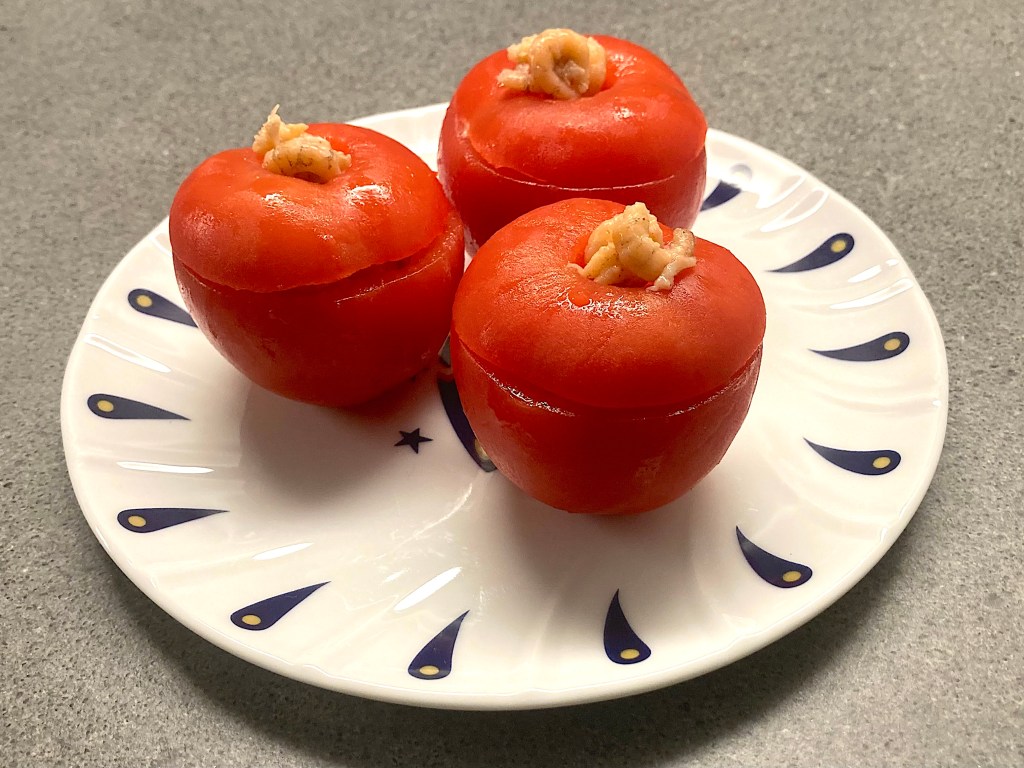
This simple and delicious starter is normally served in Belgium on special occasions. There are three key ingredients: tomatoes, small (grey) shrimps and mayonnaise. The tomato brings sweetness, umami and some acidity, the mayonnaise richness and a velvety mouthfeel and the shrimps saltiness and sweetness. Ideal combination.
We prefer to peel the tomatoes, because it makes it easier to enjoy the dish.
We thought it would be nice to tweak the recipe slightly. These ingredients are listed as optional.

Wine Pairing

We enjoyed our Tomate aux Crevettes with a glass of Muscadet Sevre et Maine sur Lie produced by Domaine Raphael Luneau. This is a very aromatic wine with a strong flavour and a long finish, which goes very well with the taste of the shrimps and the mayonnaise. The term ‘sur lie’ indicates that during a few months the wine stays in contact with the dead yeast cells left over after fermentation. This technique makes the wine more complex.
In general you’re looking for a fresh, light wine with a clear acidity. 

What You Need

  • 6 excellent ripe Tomatoes
  • 100 grams of (grey) small Shrimps
  • Mayonnaise
  • Black Pepper
  • Chervil
  • Optional
    • Ketchup
    • Worcestershire Sauce
    • Lemon
    • Mustard

What You Do

  1. Peel the tomatoes
  2. Cut of the top and remove the green centre,
  3. Remove the inside of the tomato and discard
  4. Dry the inside of the tomatoes
  5. Dry the shrimps
  6. Add some black pepper to the shrimps and mix
  7. Chop the chervil
  8. Classic version: start with a layer of shrimps, then some mayonnaise and chervil, followed by a second layer of shrimps and finish with mayonnaise and chervil
  9. Alternative version: mix the mayonnaise with a squeeze of ketchup, Worcestershire sauce, lemon and mustard. Taste and adjust. Follow step 8
  10. Put the top back on the tomato and decorate with a few shrimps and chervil
Tomate aux Crevettes ©cadwu

Guacamole

It’s very tempting to buy ready-made tapenade, guacamole, mayonnaise or fish paté. It’s easier, much quicker and you don’t need to worry about ingredients and recipes. Very true. On the other hand, we also know that most of these ready-made products contain far too much salt plus additives that shouldn’t be in there. For instance, we found a trout paté with rapeseed oil, vinegar, egg, salt, lemon juice, sugar and paprika. The ingredients in a jar with guacamole included mascarpone, cellulose gum, sugar (again) and coconut oil.

The good news is that making your own guacamole is very simple. The only challenge is to buy ripe and tasty avocados. When in doubt, ask your greengrocer.
Guacamole combines very well with nachos, chips and toast, but also with baked potatoes, fried fish and smoked salmon. We like to enjoy it with our beloved (Flemish) grey small shrimps.

Wine Pairing

If you serve guacamole with small shrimps as a starter, then we suggest a refreshing white wine, for instance a glass of Viognier. You could also serve a glass of dry rosé.

What You Need

  • 2 Ripe Avocados
  • Small Red Onion or Shallot
  • Small Garlic Clove
  • Red Chili Pepper
  • Lemon
  • Soy Sauce
  • 100 grams Small (Grey) Shrimps
  • Black Pepper
  • Cilantro (optional)

What You Do

Peel both avocados, remove the seeds and chop coarsely. Finely chop the shallot, the garlic clove and some red chilli pepper. How much you use depends on the spiciness of the pepper and your preference. Add one avocado to the beaker of your blender. Add the shallot, garlic and chili pepper. Add a small splash (start with half a teaspoon) of soy sauce and a bigger splash of lemon juice. Add the remaining avocado and blender until smooth. Taste and decide if you want to add more lemon juice or soy sauce. Transfer to the refrigerator.
Serve with small shrimps, black pepper and cilantro.

PS

We know, we start by mentioning that ready-made guacamole contains odd ingredients like mascarpone and then we suggest adding soy sauce to this typical Mexican dish. Inconsistent to say the least. Well, guacamole needs a pinch of salt. You could (of course) add regular salt, but by adding a drop of fish sauce or soy sauce, you also add some umami, which seems to work well with the avocado and the shrimps. 

Guacemole ©cadwu
Guacamole ©cadwu

Japanese Pumpkin with Shrimps

The traditional Japanese way of preparing Kabocha (Japanese Pumpkin) requires a bit of work but is not overly complex. The result is a combination of delicate, fresh pumpkin flavours with clear umami as a result of simmering the pumpkin in a dashi-based stock. You could replace the Japanese Pumpkin with a more common winter squash or with a red Hokkaido pumpkin.

Combining shrimps and pumpkin seems a bit odd, but it’s actually very nice. The combination is colourful and the various flavours come together nicely, also thanks to the dashi.
The first time we enjoyed this combination was when we prepared Takiawase, following the recipe from author and Michelin Award winning chef Akira Oshima. The recipe is included in his book Yamazato, Kaiseki Recipes: Secrets of the Japanese Cuisine. It’s a mouth-watering dish but unfortunately fairly difficult to prepare. Typically, Takiawase is a combination of vegetables and fish. Every ingredient requires its own preparation and is simmered in its own dashi-based stock. Indeed: four different kinds of homemade stock. The recipe of Akira Oshima combines kabocha, eggplant, okra and shrimp.

Drink Pairing

We prefer a glass of sake with our Kabocha with Shrimps, for instance a Junmai sake with fresh aromas and good acidity. The sake must be dry and well-balanced with a clean finish. You could enjoy a glass of white wine with the dish, provided it’s dry and mineral. Or a more adventurous choice: a glass of Manzanilla or Fino sherry. Manzanilla is a dry sherry with a flowery bouquet, a delicate palate and subtle acidity. It works beautifully with the dashi and the sweetness of both the kabocha and the shrimps.

What You Need                                                                         

  • For the Dashi
    • 10 grams of Kelp
    • 10 grams of Katsuobushi
  • For the Kabocha
    • Mirin
    • Light Soy Sauce (Usukuchi)
    • Sake
  • For the Shrimps
    • Sake
    • (Olive) Oil
    • Mirin
    • Light Soy Sauce (Usukuchi)
  • Pickled Cucumber

What You Do

Start by preparing 500 ml of dashi.
Peel and devein the six shrimps. We prefer to leave the tail on. Transfer the shrimps to a bowl, add some sake and transfer to the refrigerator for a few hours.
Peel the Kabocha, remove the seeds. Halve and then slice in 6 equal parts. Combine 400 ml of dashi with 25 ml of mirin, 25 ml of light soy sauce and a tablespoon of sake. Add the slices of kabocha and let is simmer for some 10 minutes or until nearly done.
In parallel heat a heavy iron skillet, add oil, dry the shrimps with kitchen paper and then fry them quickly, let’s say 4 minutes. Transfer to a warm oven. Remove the oil from the pan with kitchen paper. Reduce the heat to low. Mix 50 ml of dashi with 25 ml of mirin and a small spoon of light soy sauce. Deglaze the pan and let the mixture reduce. Transfer the shrimps back the pan and coat them quickly with the mixture. Serve the slices of kabocha with the fried, coated shrimps and the pickled cucumber.

Prawn Cocktail

Back in the 1960’s a Prawn Cocktail was a very popular hors d’œuvre. Simple and tasteful, always a pleasure. Today it’s not just unfashionable, it’s close to being hilarious (as far as food can be hilarious). A chef serving a Prawn Cocktail? You must be kidding me!

The two essential elements of a Prawn Cocktail are Prawns and Cocktail Sauce. Yes, indeed, another invention from the 1960’s: Cocktail Sauce. In most cases something in a jar or mayonnaise mixed with powder. But don’t underestimate Cocktail Sauce. It works really well with (cooked) seafood.

Prawns in this case must be grey shrimps, crevette grise, grijze garnalen, Nordseegarnele, quisquilla gris, the common shrimp also known as Crangon Crangon. Preferably home cooked and peeled, but home peeled is also fine. The peeled once have travelled half the world (because they were peeled in a low-wage-country), were twice frozen and treated with food preservatives leading to a loss of quality.

Basically there are two ways of serving the dish: serve the cocktail sauce in a champagne coupe with the prawns hanging on the rim of the glass or as a cocktail, so with multiple layers in the glass.

Wine Pairing

We enjoyed our Prawn Cocktail with a glass of Muscadet Sèvre et Maine sur Lie produced by Domaine Raphael Luneau. This is a very aromatic wine with a strong flavour and a long finish, which goes really well with the taste of the shrimps and the velvety sauce. The term ‘sur lie’ indicates that during a few months the wine stayed in contact with the dead yeast cells left over after fermentation. This technique makes the wine more complex.
In general a fresh, light wine with a clear acidity, such as a Muscadet Sèvre et Maine, will go very well with seafood.

What You Need

  • 200 gram of unpeeled (and uncooked) Grey Shrimps
  • Black Pepper
  • Common Corn Salad
  • Walnuts
  • For the Cocktail Sauce
    • (Home made) Mayonnaise
    • Ketchup
    • Worcestershire Sauce
    • Horseradish (preferably fresh)
    • Lemon
    • Vinegar
    • Mustard
    • Tabasco Sauce

What You Do

Cook the shrimps for 2 or 3 minutes in water with a pinch of salt. Let cool. Peel the shrimps. This is time consuming! Feel free to keep the outer shell and the tails; they will make for excellent stock.
Combine two tablespoons of mayonnaise with three or four teaspoons of ketchup, two teaspoons of Worcestershire sauce, one teaspoon of grated horseradish, one teaspoon of vinegar and one teaspoon of mustard. Now it’s a matter of tasting and adjusting. Feel free to add some lemon juice. The cocktail sauce needs a bit of a punch, so add a few drops of Tabasco sauce. The cocktail sauce can be stored in the refrigerator for up to two days.
Coarsely crush two or three walnuts. Mix the shrimps with some black pepper.
Add some leaves of the common corn salad to the glass, sprinkle some walnut over the leaves, then a generous helping of cocktail sauce and finish with the peeled shrimps. Don’t forget to play some nice music from the 1960’s, for instance Helen Shapiro’s Walkin’ Back to Happiness.

Prawn Cocktail ©cadwu

Dashi with Nameko and Shrimps

Nameko (or Pholiota Nameko) is a very popular, cultivated mushroom in Japan. It’s used in stir-fries and miso soup. The taste is nutty, the color amber brown and the texture is firm, also after cooking. The flavor combines very well with (home-made) dashi and shrimps.  The kamaboko (made from processed seafood) and the mitsuba (Japanese parsley) add colour and extra flavour to the dish. Light, delicate and refreshing: a memorable starter.

Sake Pairing

If you want to serve a drink with the soup, then serve taru sake. This dry sake is characterized by its refreshing taste and the aroma of Yoshino cedar. The sake was stored in a barrel (taru) made of cedar. Taru sake is about skills, history, dedication and refinement. Yes, you guessed right, we simply love it. Our choice? The one made by Kiku-Masamune.

What You Need

  • For the Dashi
    • 500 ml Water
    • 10 gram Konbu
    • 10 gram Katsuobushi
  • 100 gram Nameko
  • 2 large Shrimps
  • Sake
  • Light Soy Sauce
  • Yuzu
  • Kamaboko
  • Mitsuba

What You Do

Clean the shrimps and cut lengthwise in two. Let the shrimps marinade in two tablespoons of sake and transfer to the refrigerator for an hour. Clean the mushrooms with kitchen paper if necessary. Prepare the dashi; add a small tablespoon of sake and a similar quantity (or less) of soy sauce. Add the mushrooms to the soup. After a few minutes (depending on the size of the mushrooms) add four slices of kamaboko and the shrimps.  Taste and add some more soy sauce and or perhaps yuzu if necessary. Serve immediately when the shrimps are ready. If possible add some mitsuba.

Dashi with Nameko and Shrimps ©cadwu

Choucroute de la Mer with Riesling

Bofinger

The traditional Choucroute Garnie or d’Alsa­ce comes with various sausages, smoked pork belly, confit de canard, steamed potatoes and Dijon mustard. Combine it with a glass of Riesling and you will have a great dinner. Perhaps a bit heavy on the stomach, but the sauerkraut itself will make things lighter.
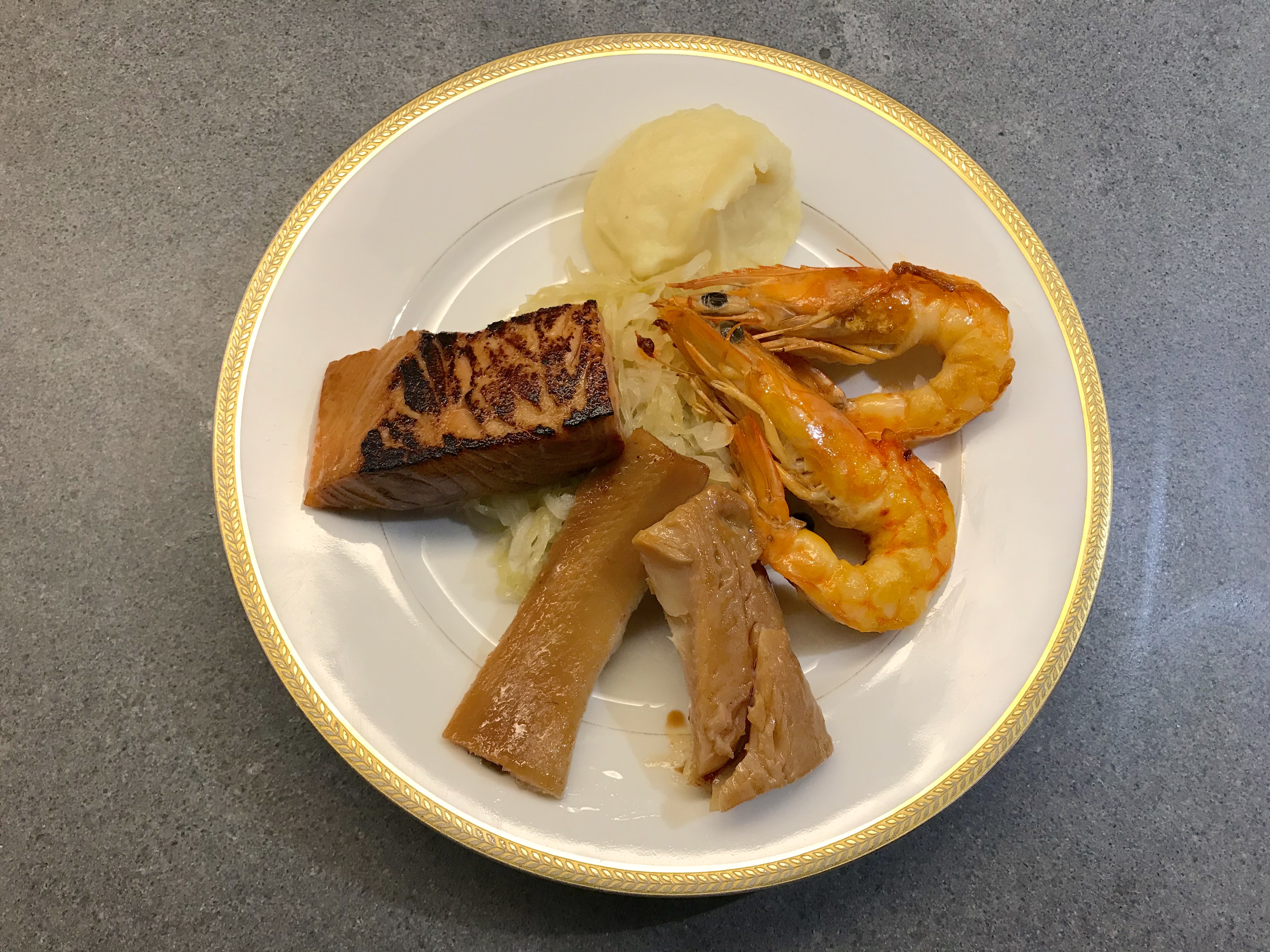
A very interesting variation is called Choucroute de la Mer. We have fond memories of restaurant Bofinger in Paris. They serve an excellent Choucroute de la Mer with haddock, salmon, sea bass, king prawns, boiled potatoes and horseradish butter. The haddock is actually smoked haddock, which works really well with the choucroute. The sharp horseradish is an excellent alternative for the Dijon mustard. When in Paris, go to Bofinger and order Choucroute de la Mer!

For some reason it’s hard to find smoked haddock where we live, so we tried smoked herring (kippers). Worked very well. And because we wanted to give the fish a deeper, fermented flavour (after all, the choucroute is fermented white cabbage) we marinated the fish in miso before frying it. Excellent result, deep and intense flavours and not to heavy on your stomach.

Wine Pairing

We very much enjoyed a glass of Riesling with our Choucroute de la Mer. We decided to buy a bottle of 2017 Riesling Kalkmergel, produced by Weingut Rings. It’s a classic, organic Riesling from the Pfalz in Germany. It is juicy and fresh with balanced acidity. Great combination with the sauerkraut, the fish and the umami from the miso.

What You Need

  • For the Marinated Fish
    • Salmon
    • Haddock
    • Miso
  • For the Choucroute
    • One Shallot
    • 500 grams of Sauerkraut
    • 10 – 20 Juniper Berries
    • Dry White Wine
    • Olive Oil
    • Bay Leaf
    • Butter
  • For the Horseradish Butter
    • Horseradish
    • Soft Butter
  • For the Mash
    • Parsnip
    • Jerusalem Artichoke
    • Parsley Root
    • Or a combination of these
    • White Pepper
    • Crème Fraiche
    • Olive Oil
  • 4 Large Shrimps
  • Kippers

What You Do

This recipe requires a bit of planning!
The fish needs to be marinated for five days. Use a shallow bowl, cover the bottom with miso and place the fish on top of it. Now cover the fish with miso, making sure it’s completely coated. It requires a bit of patience. Cover the bowl with foil and transfer to the refrigerator for 5 days. Check every day and if necessary add some miso. We use miso with less salt (and more flavours). After five days the salmon will have a deep red colour and the white haddock will be also have an beautiful red/brown colour. The miso marinate will also change the structure of the fish, so carefully monitor when frying. We have the best results with thinner pieces of fish.
Four days later (so one day before your want to serve the choucroute de la mer): taste the sauerkraut. If too much acidity, then squeeze and remove some of the liquid. Cut and slice a shallot. Crush the juniper berries (feel free to add a few more, we just love them). Now combine the sauerkraut with the shallot and the berries. Mix. Add white wine, a generous splash of olive oil and a bay leaf. Coat a heavy (iron) oven dish with butter and add the mix. Put aluminium foil on top of it, making sure you press it on the sauerkraut (as if it’s a cartouche). Leave for 4-6 hours in the oven on 80° Celsius or 175° Fahrenheit. Cool and store in the refrigirator for the next day.
Warm the dish in the oven (same temperature, let’s say one hour) and in parallel make the mash. Finish with some crème fraiche, a dash of excellent olive oil and white pepper. Keep warm.
Combine the soft butter with the grated horseradish. Taste and adjust. Set aside.
Clean the prawns without removing the head
Make sure you have three nice, warm pans. One heavy iron skillet for the prawns, two non-sticky ones for the salmon and the haddock.
Wash and dry the salmon and the haddock. Decide on the order of frying. We started with the salmon. We like to have a bit of caramelisation on the salmon.
In parallel (planning!) remove the skin from the kippers. Transfer to the the oven and grill two minutes on the former skin side. Turn, drizzle with some olive oil and grill for another three minutes.
Make sure salmon, haddock, shrimps and kippers are ready to be served at the same time.
Serve the sauerkraut on a warm plate and decorate with salmon, kippers, haddock and shrimps. Add the mash. And don’t forget the horseradish butter!

Choucroute de la Mer © cadwu

Dashi with Matsutake and Shrimps

Celebrate Autumn

This year seems to be an exceptionally good year for Matsutake. Antonio Carluccio once described it is a much-overrated mushroom but we dare to disagree. Just smell it! Pine, pine, pine. A unique mushroom. We tried making this soup with shiitake, but the result is not as refined, delicate and well-balanced. The key elements are of course the (home-made) dashi, the matsutake and the shrimps. Kamaboko (made from processed seafood) and Mitsuba (Japanese parsley) add colour (and some extra flavour) to the dish.

What You Need

  • Dashi
    • 0,5 l of Water
    • 10 gram of Konbu
    • 10 gram of Katsuobushi
  • 75 gram of Matsutake
  • 2 Shrimps
  • Taru Sake
  • Light Soy Sauce
  • Yuzu
  • Kamaboko
  • (Mitsuba)

Sake Pairing

If you want to serve a drink with the soup, then serve taru sake. This is a dry sake characterized by its refreshing taste and the wooden aroma of Yoshino cedar. A wonderful link to the matsutake. And if you bought a bottle of taru sake, then please use this sake for marinating the shrimps.

What You Do

With a damp cloth clean the matsutake. Be careful not to remove the skin. The root should be cut like a pencil. Clean the shrimps and cut lengthwise in two. Let marinade in two tablespoons of sake and transfer to the refrigerator for an hour. Gently warm the dashi, add a small tablespoon of sake and a similar quantity (or less) of soy sauce. Cut the matsutake in 8 similar slices and add to the soup. After a few minutes (depending on the size of the matsutake) add four slices of kamaboko and the shrimps. Taste and add some more soy sauce and or yuzu if needed. Serve immediately when the shrimps are ready. If available add some mitsuba.