
Scallops and Morels

Combining seafood with mushrooms can be magic. We prepared Cod with Horn of Plenty and Beech Mushrooms with Haddock. Both are delicious combinations.
We went shopping on the market, looking for fresh or dried morels. After having bought them, we saw great looking scallops. Why not combine these two complimentary products?
At home we searched for Coquilles Saint Jacques aux Morilles, assuming we would find lots of suggestions in French. Which we did. It turns out to be a ‘recipe from (grand-) mother’, although we don’t know why because it’s such a refined dish. The scallops are delicate; the sauce rich and the morels have a unique taste. Adding finely chopped morels to the sauce helps bringing the two main ingredients together. 

Wine Pairing

We decided to enjoy a glass of lightly oaked chardonnay with our Scallops with Morels, produced by Doudet-Naudin. The wine is fresh with some acidity. Its aromas are floral with some nuttiness. The freshness is nice with the sauce, and the nuttiness is great with the aroma of the fried morels. In general, we suggest a nicely balanced, pleasant white wine with some oak, fruitiness and freshness.

What You Need
  • 10 grams of dried Morels (or 50 grams of fresh Morels)
  • 6 Scallops
  • 1 small Shallot
  • Parsley
  • Cream
  • Stock (vegetable or chicken)
  • Mustard
  • Black Pepper
  • Butter
  • Olive oil
What You Do
  1. If using dried morels, then soak the morels in warm water, wait for 30 minutes, remove morels from water, check for dirt and pass the morel-water through a fine sieve if necessary
  2. If using fresh morels: check for dirt
  3. Clean the scallops
  4. Warm 2 skillets
  5. Finely chop shallot
  6. Remove the white stem of the morels
  7. Halve 2/3 of the morels lengthwise
  8. Finely chop 1/3 of the morels
  9. Chop the parsley
  10. Gently fry the sliced morels in butter in one skillet, for a few minutes or until a touch golden
  11. Wrap the fried morels in aluminium foil and transfer morels to the oven on 50 °C or 120 °F
  12. Glaze shallot in the same skillet
  13. After a few minutes add chopped morels
  14. After 5 minutes add some chicken stock, some morel-water, cream and black pepper
  15. Add ½ teaspoon of mustard. The mustard will add flavour and help thicken the sauce
  16. Reduce and taste
  17. Have morel-water and/or stock on stand-by in case you need to be thinning the sauce
  18. Add some chopped parsley
  19. Taste the sauce and adjust
  20. Quickly fry the scallops in olive oil until opaque
  21. Time to assemble: the sauce, the scallops and the halved morels on top. Sprinkle with parsley  
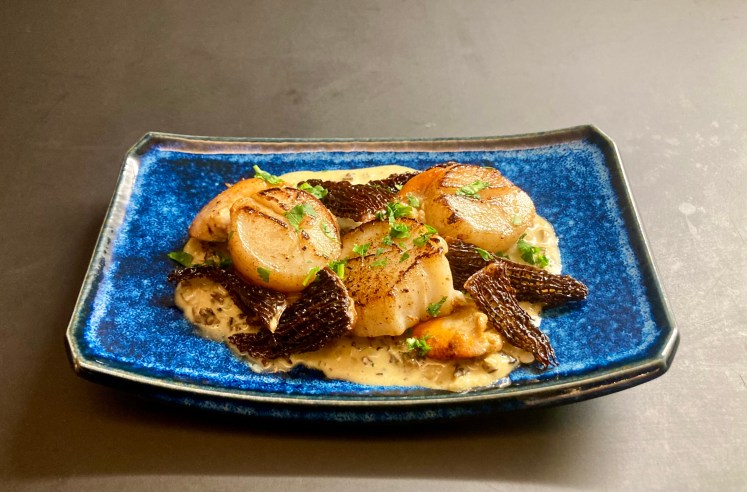
Scallops and Morels ©cadwu with a rich creamy morel sauce with chopped shallots, stock, mustard and chopped parsley
Scallops and Morels ©cadwu

Langoustine

Such a delicious starter! Perhaps it makes you think of Italy or France. A Plateau de Fruit de Mer, with oysters, shrimps, lobster, clams, periwinkles and langoustines.  The name sounds French, so perhaps the langoustine is local to the Mediterranean Sea? Not really.
Its Latin name (Nephrops norvegicus) is a nice indication of its habitat. Langoustines live in the North-Eastern Atlantic Ocean and the North Sea from Norway to Portugal. The langoustine-catch is very important for the Scottish fishing industry.

So why is it that so few people in countries around the North Sea enjoy langoustines? Difficult to prepare? Difficult to eat?

Let’s start with how to eat a langoustine. You begin by pulling away the head and claws, then you squeeze the belly to crack the shell. Start from the belly side and peel away the shell. Then de-vein by running a sharp knife along the back and remove the black vein (the intestinal tract). With a lobster cracker and a lobster curette you remove the meat from the claws. A bit of extra work, but it’s truly delicious.

So they’re easy to eat and, see below, very easy to prepare.

Wine pairing

We enjoyed a glass of Château Pajzos Tokaj Furmint 2019. This dry, white wine made from the well-known Hungarian Furmint grape is fresh, clean and slightly floral. It supports the langoustine beautifully.
In general we would suggest a white, clean, dry wine. It could be a German Riesling, a Sauvignon Blanc (a French Sancerre for instance) or an unoaked Chardonnay.

What You Need

  • 6 Langoustines (preferably fresh)
  • Mixed Salad
  • Olive Oil and Vinegar
  • (home-made) Mayonnaise

What You Do

Bring a large pan of water to the boil. Some chefs add salt or lemon. No need for this. Add the langoustines and cook for 3 to 4 minutes. Make sure you don’t overcook them. Smaller ones (like the ones we bought) require no more than 3 minutes. Remove from the pan and use a colander to drain them. We like to cool them quickly with a splash of cold water, to stop the cooking process. The meat must be moist and soft, not firm and rubbery. Leave the langoustines on a plate with kitchen paper while making a simple dressing. Toss some salad with the dressing.  Serve the warm langoustines with the salad and a generous helping of mayonnaise.

Langoustine ©cadwu
Langoustine ©cadwu

Tellines with Parsley

This Week’s Special

Many, far too many years ago we were walking along the Mediterranean coast, enjoying the sea, the sun and the company of a dear friend. She asked us if we would like to eat tellines for dinner. Of course, we replied, but what are tellines? She smiled and said I’ll show you. She walked to the sea and kneeled down, just where the sand and the sea meet. All you needed to do was move your fingers through the sand, just under the surface and feel. She harvested a few tellines, opened them with her fingers, washed them in the sea and that’s how we enjoyed our very first tellines, fresh from the sea. So simple, to tasty, so good.
We harvested many more and went back to her house where we cooked the tellines in a hot skillet and enjoyed them with a beautiful local ro­sé.

Harvesting tellines (or in France tenilles) is simple; knowing where you can do this is the challenge. Fortunately you can (occasionally) find them on the market.

It’s possible to use other small clams, but the fun of tellines is that they open quickly when in the pan, making sure they remain juicy.

Here is what you need:

  • 300 grams of tellines
  • one Shallot
  • one Garlic glove
  • Olive Oil
  • Parsley
  • White Wine
  • Black Pepper

Wash the tellines, preferably using salted water. Discard ones with a small hole and ones that are broken. Chop the shallot (you probably need half of it) and the garlic very fine. Heat the skillet, add the oil, the shallot, the garlic and the tellines and cook until the tellines are open. You probably want to add a splash of white wine during the cooking process. Serve the tellines on a warm plate with black pepper. Sprinkle with chopped parsley. Enjoy with a glass of Cô­tes de Pro­ven­ce ro­sé, for instance an Estandon from the Var region. No cutlery needed!