
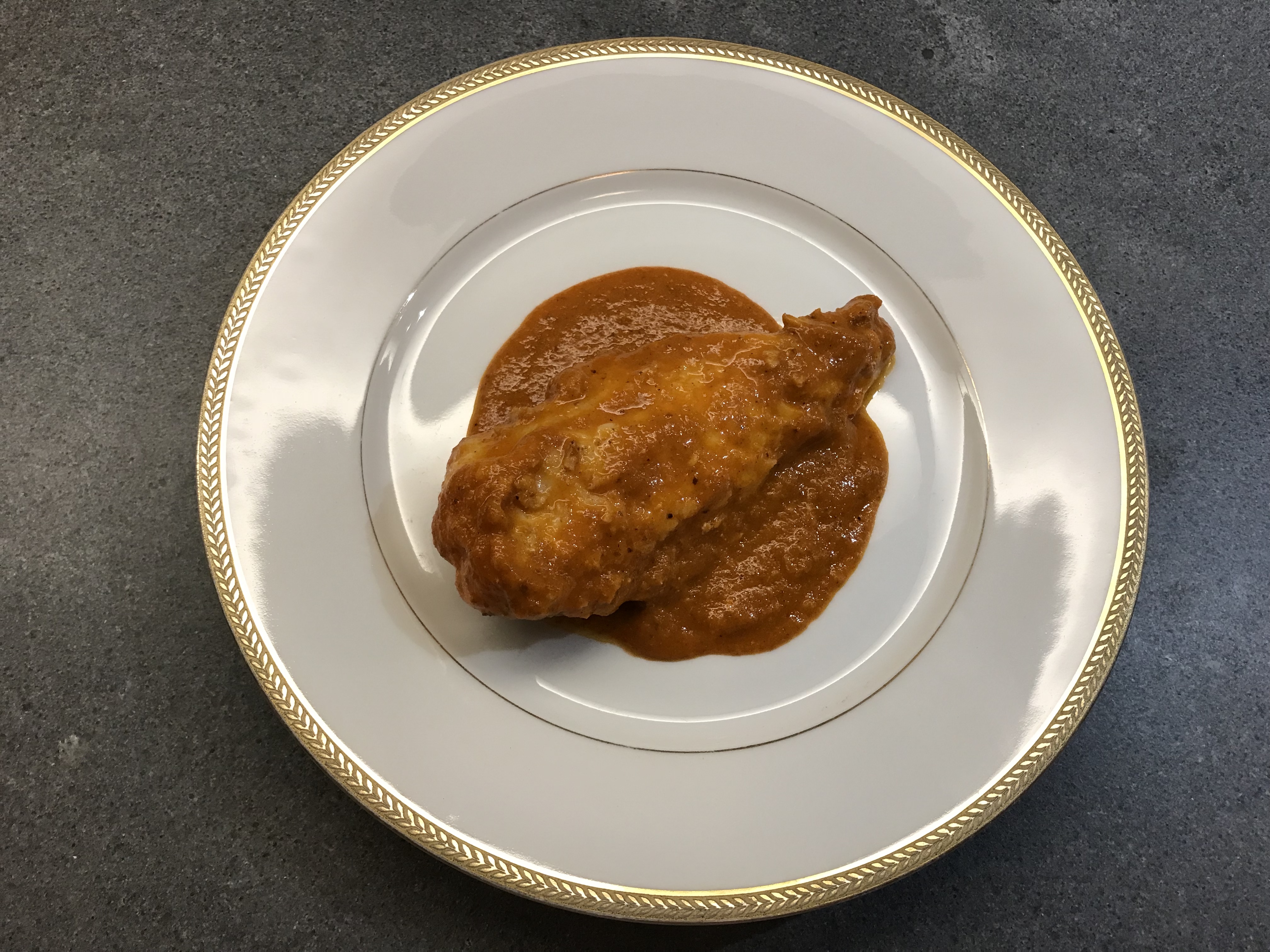
Monkfish with Tomato Olive Sauce

Not the kind of fish you want to meet when swimming in the sea, but definitely one you want to meet when shopping at the fishmonger. Make sure you bring some money because monkfish tends to be expensive. Great meat, delicate yet distinctive taste and not difficult to prepare as long as you’re not in a hurry.
The sauce has to be made a day in advance. It needs time to cook and time to integrate.
You will need to remove the skin of the monkfish. There seem to be several layers of skin and one is (when cooked) really rubbery and inedible. So take you knife, start at the tail end and move forwards, thus removing the membrane. You will find useful videos on the Internet. Unfortunately these videos suggest removing the main bone of the fish, which is a mistake for three reasons. You lose taste and meat plus you lose a natural indicator of the cuisson of the fish.

Monkfish is an essential ingredient of Zarzuela because of its texture and taste. In this recipe we combine the obvious: monkfish and tomato. We add a bouquet garni consisting of rosemary, thyme and bay leaf. The black olives give the required twist to the sauce and the dish as a whole.

Wine Pairing

We suggest a glass of Chardonnay to accompany the monkfish, provided the wine is not too woody; a light touch of oak will be best. Soave could also be a good combination.

What You Need
  • one Shallot
  • one Garlic Glove
  • Olive Oil
  • two Tomatoes
  • Pitted Black Olives
  • Bay Leaf
  • Thyme
  • Rosemary
  • Monkfish (200 gram per person, bone included)
  • Black Pepper
What You Do
  1. Start by making the sauce
  2. Gently fry the chopped shallot in a splash of olive oil
  3. After a few minutes add the chopped garlic
  4. Add the chopped tomatoes and the pitted black olives (depending on their taste we suggest between 10 and 15)
  5. Add the bouquet garni and allow to cook on low heat for a number of hours
  6. Make sure to check on a regular basis
  7. When ready, remove the bouquet garni and transfer the sauce to a blender
  8. Pass the mixture through a sieve. The sauce should be as smooth as possible
  9. Transfer to the refrigerator and use the next day.
  10. Clean the fish
  11. Use a heavy iron skillet to fry the monkfish in olive oil
  12. When nicely coloured, reduce the heat and start adding the sauce
  13. Since the sauce is cold, you need to do it spoon by spoon
  14. Coat the fish with warm sauce, again, and again
  15. Use your knife to try separating the meat from the bone. When this is possible without applying too much pressure, the fish is nearly perfect
  16. Remove the bone, turn the fish on the side that was connected to the bone and cook for one or two minutes
  17. Taste the sauce; maybe you want to add some fresh black pepper.
  18. Serve on a warm plate with some crusted bread.
Haddock with Shiitake

One of the Most Popular Fish

Well known of course as one of the most popular fish used for Fish and Chips. And when you mention Haddock, Cod is never far away. According to many recipes and foodies the two are very similar in terms of taste and way to prepare.
That’s where we disagree. We think Haddock has a much more delicate taste compared to Cod. Plus its structure is more compact. When frying Cod it’s not difficult to see and feel what the cuison is. The compact structure of Haddock implies that you have to test the cuison in a different way. Frying haddock requires your constant attention.

Shiitake is more and more widely available, which is great! The nutty taste with the firm structure makes them ideal for this dish. Powerful but not overwhelming. The classic White Mushroom (or the chestnut coloured variation) will not do the trick; too soft and not sufficiently intense. The Shiitake brings umami to the dish.

The white wine sauce is actually enriched with Classic Dry Noilly Prat, our favourite vermouth. Why favourite? Because Noilly Prat comes with a touch of bitterness, with umami, bringing the sauce and the Shiitake together. The vermouth is made with a number of botanicals, including chamomile. The white wine will bring acidity, but the dish also requires a hint of sweetness. The vermouth will enhance the natural sweetness of the Haddock. We use fish stock to create the sauce, obviously. Spend some money on buying a jar of excellent stock (or make your own).

So on your plate you have an intriguing combination of fish and mushrooms, with all five tastes represented. Nice isn’t it?

Wine Pairing

Our choice was a bottle of Pinot Grigio made by MezzaCorona. This is a dry and crispy wine with a beautiful deep yellow colour. It’s an elegant wine with just the right acidity to relate to both the fish and the sauce. The producer mentions hints of chamomile.

What You Need

  • 200 grams of Haddock (without the skin)
  • 100 gram of Shiitake
  • Shallot
  • Parsley
  • Butter
  • Olive Oil
  • Fish Stock
  • Noilly Prat
  • Dry White wine
  • White pepper

What You Do

Start by cutting the shallot. Fry gently in butter for a few minutes. Clean the Shiitake with kitchen paper and slice. Check the fish for bits you don’t want to eat. Add wine and Noilly Prat to the shallots and let the alcohol evaporate. Then add parsley and some fish stock. Leave for a few minutes and taste. Maybe add a bit more vermouth or fish stock. Be careful with the white wine. In parallel fry the fish in butter and olive oil. Both sides should be beautiful golden brown. Gently fry the shiitake in olive oil. When not yet completely ready (check the flexibility, feel how warm the fish is) transfer the fish to a sheet of aluminium foil. Don’t close it; you only want to keep it warm. Pass the sauce through a sieve and be ready to blender the sauce. Add all juices from the two pans and from the aluminium wrapping. Blend the liquid. You could add a small chunk of ice-cold butter to thicken the sauce. We didn’t.
Serve the fish on top of the sauce and add the shiitake. Perhaps a touch of white pepper.