King Oyster Mushrooms

The King Oyster Mushroom (Pleurotus Eryngii, also known as EryngiKing Trumpet MushroomPleurote de Panicaut and Seta de Cardo) is a very tasty, large oyster mushroom with a great meaty texture. 
One of its Dutch names is intriguing: Kruisdisteloesterzwam. The name consists of two parts: the second half is obvious, but why the reference to a plant called Kruisdistel? The King Oyster Mushroom is a parasite on the roots of plants, in general on herbaceous plants and especially on the roots of the Kruisdistel (Eryngium campestre) which brings us nicely back to the name Eryngi.
We often buy Eryngi at our local Asian Supermarket, so we assumed the mushroom is native to China or Japan. Much to our surprise it turns out to be a native to the Mediterranean, the Middle East, and North Africa. Its Italian name is Cardoncello and it’s common in regions such as Calabria and Puglia. Cardoncello is combined with tomatoes and served with orecchiette. Sounds like a delicious dish to us!
But it does raise the question why they’re often sold in Asian supermarkets and why so many recipes combine it with Asian ingredients. Anyone?
We decided to combine Eryngi with very different ingredients, including fried polenta and grilled pancetta. The result is a delicious combination with lots of textures and flavours.

Wine Pairing

We enjoyed the combination with a glass of Rosé, produced by Lionel Osmin, from the Fronton area just north of the French city of Toulouse. The grape used to make this wine was the négrette, a grape that has been used to produce red and rosé wines in the Fronton region since perhaps the 12th century. The wine was low in acidity and had aromas such as violet and strawberry. It was a supple, fruity, balanced wine. In general we would suggest a relatively easy wine, but the wine must have sufficient character, thinking of the different flavours in the dish.

What You Need
  • For the Mash
    • Green Peas
    • Parsley
    • Olive Oil
    • White Pepper
    • Pinch of Salt
  • For the Fried Polenta
    • Polenta
    • (optional) Parmesan Cheese
    • (optional) Vegetable Stock
  • For the Mushrooms
    • King Oyster Mushrooms
    • Olive Oil
    • Black Pepper
  • Pancetta or Speck
What You Do
  1. Cook the polenta (in vegetable stock) according to the package until ready. You could add Parmesan Cheese.
  2. Pour the polenta onto a plate and smooth it into an even layer (1,5 centimetres) with a spatula.
  3. Cool to room temperature.
  4. Cover with plastic foil and transfer to the refrigerator for use the next day.
  5. Cook the peas for one or two minutes in water or vegetable stock (preferred). They should have a bite.
  6. Chop the parsley and combine drained peas with parsley, white pepper and a pinch of salt.
  7. Blender. Add olive oil and mix. Taste and adjust. The mash can be prepared in advance.
  8. Turn out the polenta onto a cutting board.
  9. Cut it into a shape you like (strips, triangles, circles).
  10. Fry in a generous amount of relatively hot olive oil in a non-stick pan until golden, probably 2*3 minutes. 
  11. In parallel clean the mushroom and slice (not too thin). Some suggest slicing the mushroom horizontally, but then you lose its impressive shape.
  12. Fry in olive oil until golden brown, probably 2*5 minutes.
  13. Add just a hint of black pepper before serving.
  14. Warm the mash.
  15. Also in parallel: grill speck or pancetta for 3 minutes until crispy.
  16. Assemble and serve on a warm plate. 

Tourtes de Blettes Sucrée

A sweet pie with vegetables, Parmesan cheese and black pepper? It does sound a bit odd but actually the pie is very tasty and the savoury ingredients support the sweet character of the pie.
The pie is made with Blette, also known as Swiss ChardLeaf BeetSilver BeetSpinach BeetBietola (Italy), Bléa (France), Acelga (Spain), Krautsteil (Germany, Switzerland) and Snijbiet (the Netherlands). Once a popular vegetable, it can be hard to find or expensive. When preparing a savoury Tourte de Blettes we used Water Spinach (also known as Kang Koen or Ong Choy) which is a very popular vegetable in Asia. The leaves have lots of structure and the (hollow) stems are tasty and crunchy. 

As you would expect with a classic pie like this, recipes vary, Very often the tourte is made with sweet shortcrust pastry (butter, eggs, sugar and sometimes orange blossom water). The filling contains chard, Parmesan cheese, sugar, eau de vie, raisins, eggs, apples and pine nuts. We’re not keen on using pine nuts, so we didn’t add these to our filling. We thought it would be nice to add the orange blossom aroma to the filling, not to the pastry.

What You Need (Pastry)
  • 50 grams of White Caster Sugar
  • 100 grams of soft Unsalted Butter
  • ½ Egg (beaten)
  • 1 gram of Salt
  • 150 grams of All Purpose Flour
  • Cold Water (if the pastry is dry)
What You Do

Adding egg to the dough makes its flavour richer and easier to handle when lining the baking tin. Start by combining the sugar and the butter. Use a hand mixer with kneading hooks. When mixed, add halve of the beaten egg. Combine salt and flour. Pass through a sieve and add to the mixture. Use the kneading hooks to mix. When done, remove from the bowl and wrap in foil. Store in the refrigerator for at least two hours. The dough freezes well, so it’s a great idea to make a bit extra.

What You Need (Filling)
  • 500 grams of Chard
  • Handful of Raisins
  • 25 grams of Parmesan Cheese
  • 50 grams of Sugar
  • 1 or 2 teaspoons of Orange Blossom Water
  • Black Pepper
  • 1 Egg
  • Olive Oil
  • ½ Sour Apple (Bramley, Goudrenet)
What You Do
  1. Wash the chard, remove and discard the stems.
  2. Coarsely slice the leaves.
  3. Whisk the egg.
  4. Soak the raisins for 15 minutes in water (or rum). Pat dry.
  5. Peel and slice the apple into small cubes.
  6. Combine chard, raisins, grated cheese, sugar, orange blossom water, black pepper and a splash of olive oil. Be generous with the black pepper and the cheese. Mix.
  7. Add the beaten egg and mix.
  8. Divide the pastry in two.
  9. Line a baking tin with the pastry, prick holes in the pastry using a fork (docking).
  10. Add the filling, sprinkle with apple cubes, top with the remaining pastry and close.
  11. Prick holes in the pastry. Or apply the method of Cornish pasty, as we did.
  12. Bake in the oven at 180 °C or 355 °F for 30 minutes.
  13. Allow to rest on an oven rack.
  14. Best to be enjoyed the next day, so you must be a little patient.
  15. Dust with icing sugar.
PS

We must admit we took a short cut by using readymade Pâte Brisée. This is shortcrust pastry, without sugar. Perhaps it’s a good idea to reduce the amount of sugar in the pastry or skip it all together!

Scallop Gratin

Scallops (or Coquilles Saint-Jacques) are a seasonal product. In France they are available from October 1st until May 15th. In Nantucket the season runs from November 1st through March. Perhaps your fishmonger sells scallops all year round. Most likely they were frozen which massively impacts the flavour and texture. Scallops must be fresh. If possible, buy them in their shell (opening them is not difficult, cleaning them can be a bit messy, this video explains more) or ask your fishmonger to do so.

Recently John Rieber and Dorothy’s New Vintage Kitchen published great recipes with Nantucket Bay Scallops. We bought French scallops from the Normandy region and prepared three dishes, one following Dorothy’s recipe, one classic gratin and one modern gratin.

Earlier we wrote about Vacherin Fribourgeois. This cheese originates from the region around the Swiss city Fribourg. It’s a semi-hard, creamy cheese made with raw cow milk. It matures for some ten weeks in a damp cellar. Its taste is aromatic, floral, full-bodied and lasting, with a touch of sweetness, bitterness and umami. Unfortunately, it’s difficult to get hold of. It can be replaced by a combination of Gruyere and Appenzeller. Emmentaler is not an option because when you melt it, it gets stringy.

Wine Pairing

We enjoyed a glass of white Macon with our Gratin de Coquilles Saint-Jacques. In general you’re looking for a fresh, round white wine, with notes of citrus and pepper, minerality and a touch sweetness.

What You Need (Modern Gratin)
  • Scallops
  • Leek
  • Vacherin Fribourgeois
  • Olive Oil
  • Black Pepper
What You Do

This is our preferred version. The dish is an interesting combination of sweetness, richness, aromas and textures. It’s fun to serve in a shell, but it makes for challenging eating. Better to serve in ramekin, which also allows you to serve three scallops per person!

  1. Thinly slice the white of a leek and leave it for 30+ minutes in a pan with olive oil on very low heat.
  2. Taste the leek, it should have just a little bite and it should still have the distinct flavour and aroma of leek.
  3. Add some black pepper.
  4. Preheat the oven to 220 °C or 430 °F.
  5. Heat a small non-stick pan and quickly colour the scallops.
  6. Add some of the leek mixture to the shell.
  7. Place the scallops on top.
  8. Add grated cheese.
  9. Transfer to the oven and serve when the cheese has melted, probably after three minutes.
What You Need (Classic Gratin)
  • Scallops
  • Shallot
  • Double Cream
  • Breadcrumbs
  • Butter
  • White Wine
  • All Purpose Flour
  • Black Pepper
What You Do

The idea is to make a sauce, combine the sauce with the scallops, top with breadcrumbs and grill until golden. Alternative ingredients include fish fumet, parsley, cheese and mushrooms. If you coarsely chop the scallops, then the scallops are more evenly spread in the sauce. 

  1. Fry the scallops quickly in a hot pan with olive oil, just to give them extra flavour and colour.
  2. Set the scallops aside, reduce heat, add finely chopped shallot to the pan and glaze.
  3. Add some butter and flour to the pan; make a roux.
  4. Add white wine, let reduce a bit, add cream.
  5. If the sauce is too thick then add some liquid.
  6. Add some black pepper.
  7. Place the scallop(s) in a shell, add sauce and top with breadcrumbs.
  8. Grill for three minutes or until golden.
PS

Yes, we serve our scallops with roe. Why discard it? The roe is flavourful and brings another texture to the combination.
Other very tasty recipes: scallops with cauliflower or with potatoes and truffle.

Helianthus with Blue Cheese

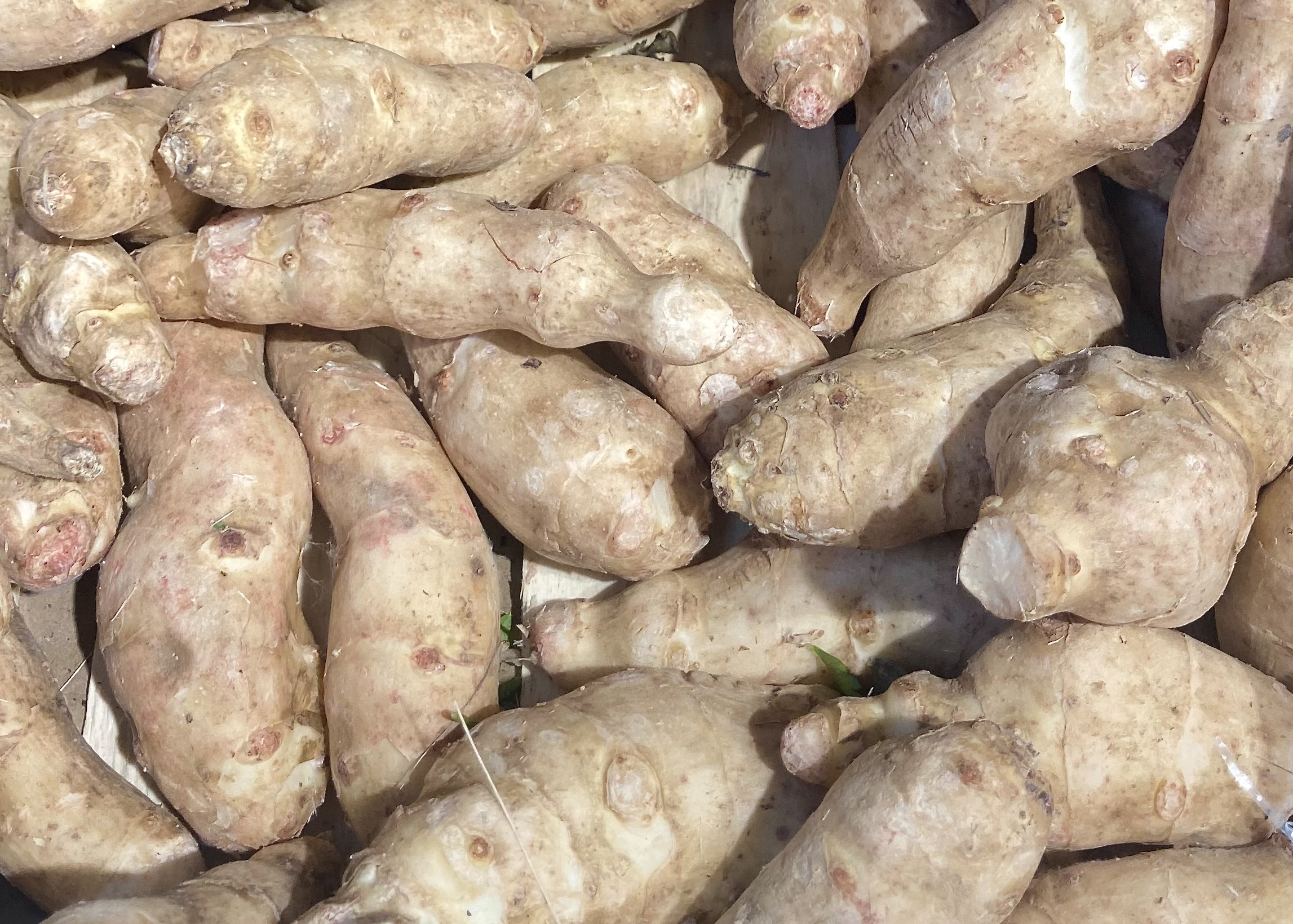
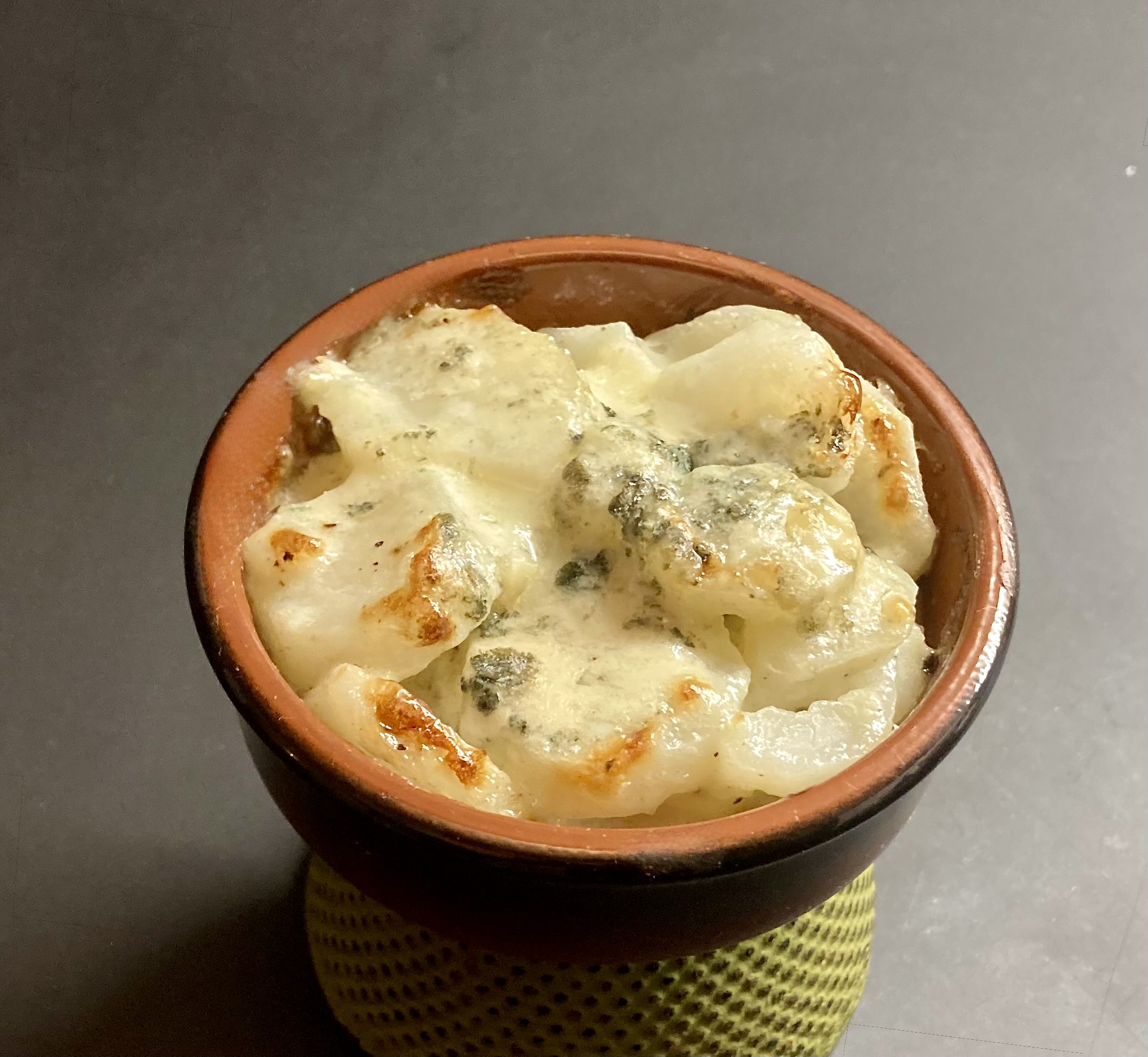
Always fun to shop at our organic supermarket and see what forgotten vegetables they have. This week they offered oca, Jerusalem artichoke (Helianthus Tuberoses), parsnip, black radish and helianthus, which was new to us. We bought a few of the helianthus roots and when at home we started thinking about ways to prepare them. Both Jerusalem artichoke and the helianthus roots are a touch sweet and nutty. A purée perhaps? We then noticed a recipe for a tartelette with blue cheese. Great idea, but not so sure about the combination with pastry. After a few minutes we came up with the recipe below. The helianthus roots are creamier than the Jerusalem artichokes and this worked very well in the combination with blue cheese and crème fraîche.The dish is rich with a touch of freshness.

Wine Pairing

In general, we suggest a full bodied, well balanced red wine, with aromas of black fruit, perhaps liquorice and with supple tannins. 

What You Need
  • Roots of the Helianthus Strumosus
  • Crème Fraîche
  • Roquefort
What You Do

Clean the roots and cook in boiling water for perhaps 5 minutes. They become soft very quickly. Drain and let cool. In parallel use a fork to combine equal parts of crème fraîche and Roquefort. Slice the roots and combine with the mixture. Place in ramekins and transfer to the oven at 200 °C or 390 °F for a few minutes, until hot and golden. You can also place them under the grill for a few minutes.

PS

Interested? Find out more about forgotten vegetables!

More PS

As Dorothy suggested (see below) it’s a great idea to fry or roast them with onions. We also added some garlic. Delicious!

Mushrooms and Miso

Shiitake is becoming more and more available. It has a unique flavour, savoury, meaty, earthy and it is rich in umami. The name is a combination of shii (a tree native to Japan and Korea, also known as the Japanese Chinquapin) and take (meaning mushroom, as in matsutake and maitake). The mushroom grows on decaying wood, not only on shii but also on other trees such as oaks and chestnuts. It’s fun to buy a shiitake log and grow your own mushrooms. 
In this dish we combine shiitake and oyster mushrooms. These two have very different structures, which adds value to the dish.

Wine Pairing

Enjoy your Mushrooms with Miso with a lightly oaked chardonnay. The oakiness of the wine will match well with the umami and miso flavours. The richness of the chardonnay will be very nice with the mushrooms.

What You Need
  • 100 grams Shiitake
  • 100 grams Oyster Mushrooms
  • Fresh Ginger
  • One Garlic Clove
  • One Scallion
  • Miso
  • Mirin
  • Soy Sauce (light)
  • Olive Oil
  • Black pepper
What You Do

Remove the stem of the shiitake, slice the caps and tear the oyster mushrooms. Fry in olive oil. Add thinly sliced white of the scallion. Add chopped garlic. Combine a teaspoon of miso with one tablespoon of mirin and one tablespoon of light soy sauce. If using thicker soy sauce, add some water. Mix and taste. It should be both salty and umami. Add some of the mixture to the mushroom. Coat the mushrooms with the miso mixture. Add more mixture if required. Be careful, you don’t want a sauce. When ready to serve add some black pepper, freshly grated ginger, the thinly sliced green of the scallion. Combine and serve. 

PS

Don’t throw the stems away! Simply add them to a pan with water, bring to a boil and leave to simmer for 30-60 minutes. Strain and store the broth. It freezes well.

Tuberous Chervil

Earlier we wrote about mashua and oca, two forgotten vegetables. This week we enjoyed tuberous chervil, another forgotten vegetable, also known as turnip chervil and bulbous chervil. Popular throughout continental Europe in the 19th century, but now hard to find. The tubers we bought had a length of approximately 4 cm and a thickness of 2 cm. They are white on the inside. The tuberous chervil is very tasty, easy to prepare, and its flavour will make you think of chestnuts, without a hint of bitterness.
As more often, these winter vegetables were replaced by potatoes: cheaper, easier to handle and easier to grow.
The ‘chervil’ in the name does not mean it’s the tuber of the chervil plant (like parsley and parsley root are related). It’s included because the leaves of tuberous chervil (see picture below) look like the leaves of chervil. The two are not at all related.
According to some sources tuberous chervil can be eaten raw. We tried it, of course, and yes, edible, but not great. We prefer to turn the tubers into a purée, with cream, butter and nutmeg. We combined the purée with lamb chops and with scallops. The second combination didn’t work, as if bringing the two together diminished the individual flavours. The first combination was delicious, the sweetness of the meat with the chestnut flavour, the freshness of the puree with the fatty lamb.

Wine Pairing

We enjoyed a glass of red wine from the Bordeaux region with our purée and lamb, produced by Château Picon. A very nice, affordable wine, with some dark fruit and acidity. In general, we suggest a not too complex red wine, made with for instance cabernet sauvignon and/or merlot grapes.

What You Need
  • 250 grams of Tuberous Chervil
  • Butter
  • Cream
  • Nutmeg
  • Black Pepper
What You Do

If the tuberous chervil are young and fresh, you don’t need to peel them. The ones we bought were a bit older, so we peeled them. Wash and cook for 5-10 minutes until soft. Drain. Mash using a fork, add butter and cream. Use a spoon to make the purée. The tubers love both, so you will probably need to add a bit more than expected. Keep warm on low heat, add black pepper and freshly grated nutmeg to taste. Quickly fry the lamb chops, add lots of herbes de Provence or a combination of thyme and oregano and serve with the purée.

Spicy Pumpkin Soup

It’s the time of year to enjoy simple, seasonal, rich and flavourful food, for instance spicy pumpkin soup. The trick in this case is in the coconut milk or cream. Coconut milk contains something like 15 grams of fat per 100ml. For this soup you need 25+ grams of fat per 100ml. The fat enhances the coconut flavour and it combines very well with the spicy and aromatic character of the soup (ginger, chili, djeroek poeroet).

What You Need (for 4)
  • Small Pumpkin
  • Large Shallot
  • 2 large Garlic Cloves
  • 4 cm Fresh Ginger
  • Chili Pepper
  • Olive Oil
  • 8 leaves of Djeroek Poeroet  
  • Coconut Cream
  • Cilantro
What You Do

Wash the pumpkin and chop. If the pumpkin is organic, then you don’t need to peel it. Peel and chop the shallot, garlic and the ginger. Ground dried chili pepper. Gently fry the shallot in olive oil. Add chilli pepper. Add ginger. Stir, mix and add pumpkin. Stir and add garlic. Now add the vegetable stock, the djeroek poeroet and allow to simmer for 30 minutes. If the pumpkin is soft, remove the djeroek poeroet and blender the mixture. Taste and adjust. Add 6 spoons of coconut cream, 1 by 1, mix and taste. When you’re happy with the flavours, leave the soup on low heat for 15 minutes. Serve with lots of chopped cilantro.

Spicy Pumpkin Soup ©cadwu

Your Favourites in 2024

Happy New Year!
Let’s begin the new year with the 2024 highlights. For the past two years your favorite post was No-Knead Bread, This year’s most popular post was an all time favorite: Kimizu. This classic, golden sauce from Japan, is made with Egg Yolks, Rice Vinegar, Water and Mirin. We also have a version with Tarragon, let’s say the Béarnaise version of Kimizu. Although it is a classic sauce, we use a microwave to prepare Kimizu and Kimizu with Tarragon. An easy and very effective way of controlling temperature and consistency.

This year’s runner up is Scallops with Roe, a recipe we published in January 2023. We were inspired by the great quality of the scallops on the market in Nice and we were not disappointed. The combination of scallops, roe and mashed potatoes is simple and delicious.

On August 19th 2024 Michel Guérard passed away. He was a French chef, author, one of the founders of the Nouvelle Cuisine and the inventor of La Cuisine Minceur. We wrote about his version of sauce vierge and combined it with sea bass and with skate. Very happy to see so many people interested in this post.

You’ve probably noticed we love mushrooms. Cultivated ones, like Shiitake, Oyster Mushrooms, Enoki and Champignons de Paris and seasonal ones, such as Morels, St. George’s mushroom and Caesar’s Mushroom. One of the most popular posts is Cèpes à la Bordelaise. Also very tasty when prepared with button mushrooms. Always a pleasure to serve, for instance with eggs, with meat, with more present fish. Last year we created a special page with an overview of our mushroom recipes.

We were very impressed by the exhibition Food For Thought by Kadir van Loohuizen in the Maritime Museum in Amsterdam. Let’s summarize it by quoting Ralph Dahlhaus, Chef of the National Maritime Museum: “Your choice of food does not need to be perfect, but it must be responsible.”

We continued our series of Sauces. One of your favorites is another classic sauce: Ravigote. We served the sauce with Pâté de Tête Persillé and crusted bread. The recipe we posted goes back to the more or less original version: the Ravigote is light, uplifting and flavorful.

This year we are looking forward to the Amsterdam Symposium on the History of Food on June 5th and 6th. This year’s topic is Food and the City. The symposium takes place in the 750th anniversary year of the city of Amsterdam. The symposium will be organized during an exhibition on the history of food culture in Amsterdam, from April 11th until September 7th 2025 in the Allard Pierson.

Let’s start cooking!

Smoked Salmon and Egg Salad

The joy of preparing food together, the joy of eating tasty and simple food, the joy of sharing. It’s one of the themes of Together: Our Community Kitchen, our suggestion for this year’s Christmas cookery book. It was written by a group of residents, gathering in the aftermath of the Grenfell Tower fire in London. They began cooking food for their families, friends and neighbours. Food that helped restore hope and provided a sense of home.

The recipe for this tasty salad is simple, quick and fun to make. It is rich, with warm flavours, a bold structure and of course lots of salmon. The egg yolks are set, but only just, adding to the great mouthfeel. Take some crusted bread, put the salad on top of it, perhaps a bit extra?, and enjoy!

Wine Pairing

A glass of dry sparkling wine will be great. A glass of Sauvignon Blanc or Chardonnay will also fine, as long as the wine is acidic enough to balance the fat from the fish and the egg. We enjoyed a glass of Sicilian white wine made by Baglio di Grìsi with the local grillo-grape. This full-bodied wine has the right level of acidity and minerality. Excellent with the salmon and the egg.

What you need
  • 2 Organic (or Demeter) Eggs
  • 100 grams organic Smoked Salmon
  • Chives
  • Mayonnaise
  • Crème Fraîche
  • Mustard
  • Lemon
  • Black pepper
What You Do

Boil the eggs until slightly set. Peel and let cool. Coarsely slice the salmon. Same with the eggs. Chop the chives. Combine one tablespoon of mayonnaise, 2 teaspoons of crème fraîche, 1 teaspoon of mustard, chives, a few drops of lemon and black pepper. Add the salmon and combine. Add the egg and gently combine. Now it’s a matter of tasting. Perhaps you want to add more mayonnaise, crème fraîche or lemon. Let cool and serve with crusted bread.

We wish you a wonderful 2025 with lots of culinary adventures!
Mr. Cook and Mr. Drink

Together: Our Community Cookbook

Food is much more than just food, it’s about culture, about being with friends, family, about learning from other cultures, about talking and sharing memories, about emotions, about special days and celebrations. It brings people together and enhances our understanding of others.

We take part in Jo Stacy’s BKD Cookbook Club and this month the focus is on Christmas recipes for us all to make and share. Our choice is a recipe for a Casserole from Together: Our Community Cookbook.

The book is written by a group of residents, gathering in the aftermath of the Grenfell Tower tragedy in London to cook food for their families, friends and neighbours. They began using the kitchen at the Al-Manaar Muslim Cultural Heritage Centre and used the kitchen for two days per week, preparing food and eating together. Gradually more local women began to join in, embracing the community and supporting their neighbours. This was the beginning of the Hubb Community Kitchen (‘hubb’ meaning ‘love’ in Arabic).
In 2018 the group published Together: Our Community Cookbook with 50 simple and tasty recipes from the Middle East, North Africa, Europe and other countries.
Food that brings people together, food you prepare for your loved ones.

The book features mouthwatering recipes including Shakshouka (Algeria), Potato Fritters with Cilantro (India), Spicy Peanut Dip (Uganda), Green Rice (Iraq), Fennel and Orange Salad (Italy) and many more.

Food that helped restore hope and provided a sense of home.

Casserole

We decided to prepare Tepsi Baytinijan. To quote Intlak Alsaiegh, the author of this recipe: “Tepsi translates as ‘casserole’ and this is a traditional Persian dish of meatballs in tomato sauce with eggplant. It’s quite rich. You could make it with less oil, I suppose, but then it wouldn’t be so traditional—or taste so good.”

The dish is indeed a rich, tasty combination of small meat balls (ground beef, garlic, curry powder), fried egg plant, fried potatoes, onion, green pepper, tomatoes, tomato paste and tamarind paste, served with basmati rice or crusted bread.
The detailed recipe can be found in Together: Our Community Cookbook or on Food52.

Together: Our Community Cookbook is dear to us, because it shows us that food can unite people. Preparing food from this book will bring you closer to the hope and strength of the Grenfell community.

The book is available via the usual channels and your local bookstore. A portion of the proceeds from the sales will help the Hubb Community Kitchen to strengthen lives and communities through cooking.

We wish you Happy Holidays and a Wonderful 2025!
Mr. Cook and Mr. Drink