Tellines with Parsley

This Week’s Special

Many, far too many years ago we were walking along the Mediterranean coast, enjoying the sea, the sun and the company of a dear friend. She asked us if we would like to eat tellines for dinner. Of course, we replied, but what are tellines? She smiled and said I’ll show you. She walked to the sea and kneeled down, just where the sand and the sea meet. All you needed to do was move your fingers through the sand, just under the surface and feel. She harvested a few tellines, opened them with her fingers, washed them in the sea and that’s how we enjoyed our very first tellines, fresh from the sea. So simple, to tasty, so good.
We harvested many more and went back to her house where we cooked the tellines in a hot skillet and enjoyed them with a beautiful local ro­sé.

Harvesting tellines (or in France tenilles) is simple; knowing where you can do this is the challenge. Fortunately you can (occasionally) find them on the market.

It’s possible to use other small clams, but the fun of tellines is that they open quickly when in the pan, making sure they remain juicy.

Here is what you need:

  • 300 grams of tellines
  • one Shallot
  • one Garlic glove
  • Olive Oil
  • Parsley
  • White Wine
  • Black Pepper

Wash the tellines, preferably using salted water. Discard ones with a small hole and ones that are broken. Chop the shallot (you probably need half of it) and the garlic very fine. Heat the skillet, add the oil, the shallot, the garlic and the tellines and cook until the tellines are open. You probably want to add a splash of white wine during the cooking process. Serve the tellines on a warm plate with black pepper. Sprinkle with chopped parsley. Enjoy with a glass of Cô­tes de Pro­ven­ce ro­sé, for instance an Estandon from the Var region. No cutlery needed!

Grilled Asparagus with Parmesan Cheese

We enjoyed this dish as a starter when in Milan, on a beautiful evening, eating al fresco and enjoying the wonderful combination of the sweetness and bitterness of the asparagus, the slightly caramelised sugars as a result of grilling the asparagus and the salty and sweet cheese. A glass of Pinot Grigio was all we wanted. In Milan they served us green asparagus, but it works even better with white asparagus.
This is typically a dish you would make when the asparagus season is at its high and outside temperatures feel like summer. You could drink a Pinot Grigio, a Muscat from the Alsace region or a Rose with character. Remember the wine needs to combine with a range of very diverse flavours in the dish.

Here is what you need:

  • 2 Asparagus per person
  • Olive Oil
  • Parmesan Cheese
  • Black Pepper

Peel the asparagus and cook or steam until slightly tender. Depending on the size we would say 10-15 minutes in the Russel Hobss steamer. Leave and let cool. Take a plate, add some oil to the plate and use it to cover the asparagus in oil. Heat the pan and grill the asparagus for 4*1 minute, making sure you have a lovely brown (not too dark) pattern. Serve on a plate, add some grated Parmesan cheese and pepper. Add a generous drizzle of very good olive oil.


Duck Breast with a Green Pepper Corn Sauce

Ignore The Obvious

Duck is often combined with a sweet ingredient. Think fruit (orange, clementine, apple and even peach), with honey, Port Wine or Marsala. All these combinations make sense because the idea is to relate to the taste of the duck. In this case we ignore the obvious and combine it with a green pepper corn sauce. The thyme is the bridge between the duck and the sauce. The garlic brings a touch of sweetness to the sauce. The combination works beautifully!
Green pepper corn is available dried and in brine. We prefer the brine version because it integrates better with the other ingredients of the sauce. The dried corns work well after leaving them in a nice vinegar for 24 – 48 hours.

Wine Pairing

A simple Bordeaux wine will work very well. But Syrah, with its hint of spiciness, will be the perfect wine with this dish. If available go for an Australian Syrah because of the full-bodied character.

What You Need

  • 2 small Breasts of Duck or 1 large one
  • Thyme
  • Chicken stock
  • Garlic
  • Single or Double Cream
  • Green Pepper Corn in Brine (slightly crunched)
  • Mustard

What You Do

Check the breast of duck for remainders of feathers. Remove the vein on the meat side of the breast (and the odd membrane you don’t like). Cut the skin (not the meat!) in a crosshatch pattern, let’s say 1-2 centimeter apart. Doing this helps the fat render and it will give a crispy result. Put thyme in the pattern. Put on a dish, cover and transfer to the fridge. Leave in the fridge for a few hours, making sure it’s nice, firm and cold.
Fry the duck in a hot, non-sticky skillet for 10-12 minutes on the skin side. Reduce the heat after a few minutes. You don’t need oil or butter, the duck fat will do the trick. Now fry for 2-3 minute on the meat side and remove. Cover with aluminum foil is such a way that the crispy skin is not covered. The foil should only cover meat.
Remove most of the fat from the pan, but not all. Add chicken stock, garlic and thyme. Stir and add the crunched green pepper. We like their taste so we tend to add quite a few. Now start building the sauce by adding juices from the duck. Maybe you want to add a bit of mustard. This will not only add complexity to the sauce, it will also make it thicker. Add the cream but please remember that cream needs a few minutes to integrate in the sauce. If you add cream last-minute, you will, indeed, taste cream.
After 10 – 15 minutes it’s time to carve the duck. Make sure to add all the juices to the sauce. Cut the duck in slices (we like fairly big slices, you may prefer thinner ones) and place these on top of the sauce when serving.
If you have a bit of extra time, pass the sauce through a sieve, removing the thyme and other bits, before adding the green pepper.

Omelet with Oyster Mushrooms and Nasturtium

Try This at Home

Oyster mushrooms were among the first mushrooms to be cultivated. They grow very well on straw so great to grow at home. See pictures!
The vast majority of oyster mushrooms are grey, but we have seen and tasted the yellow and sensational pink oyster mushroom. Since you can eat oyster mushrooms raw, the pink and yellow variety is great in a salad. Oyster mushrooms can be a bit watery, which impacts the taste. A pity because the taste is delicate and soft anyway. Not a mushroom to combine with more powerful mushrooms like shiitake. Oyster mushrooms cook quickly, so great to use in a stir-fry or a soup. You can try using them in a stew, but make sure your chunks are not too small.

Wine pairing

A crisp, floral white wine goes very well with this omelet. Best would be a Pinot Grigio or a combination of Chardonnay and Viognier.

What You Need

  • 250 grams Oyster mushroom
  • 3 Eggs
  • 1 Spring Onion
  • Butter
  • Olive Oil
  • Black Pepper
  • Chives
  • Nasturtium

What You Do

Harvest your oyster mushrooms or buy really fresh and tasty ones. Tear the mushroom into smaller but not too small chunks. Slice the spring onion in small rings. Fry the oyster mushrooms in olive oil and butter for 3 minutes or so until slightly cooked. Add the white of the spring onion. Perhaps you want to add some butter to the pan. Now make sure the pan is nice and hot. Whisk the eggs well, add the green of the spring onion and add to the pan. After a few seconds reduce the heat to very low and wait 5 to 10 minutes until the egg is nearly set. Take your time but keep an eye on the surface and the consistency. Check with your fingers if the omelet is beginning to set. A good omelet must be baveuse so Timing is All. There is no alternative to baveuse!
Serve the omelet on warm dishes with black pepper, chives and nasturtium (not just for fun, also for the peppery taste of the nasturtium leaves).

Guineafowl with Morels and Gnocchi

Guineafowl

Preparing guineafowl can be a bit of a challenge. Easily overcooked and easily prepared the wrong way. Given its size you could think it should be prepared like chicken but that’s not the case. Compare chicken with guineafowl and notice the difference: the meat of a guineafowl has much more structure, it’s fatter and firmer.
Cooking quineafowl requires some liquid (oil, butter, wine, stock) but not too much. Cooked like coq au vin it’s a disaster. Spit-roasted guineafowl? Not a good idea.

In The River Cafe Classic Italian Cookbook (written by Rose Gray and Ruth Rogers) you will find a great recipe of guineafowl with grappa, junipers, white wine and pancetta. The combination of grappa and junipers is amazing and the idea to have these two support the guinea fowl is simply stunning. The combination emphasises the wild and nutty taste of the guinegowl. Buy the book and start cooking!

Dried mushrooms: expensive and actually not very tasty. Not even close to the real thing. With the exception of dried morels: these are as tasty as fresh ones.
Also important: unlike most mushrooms, morels are to be found (and bought) in Spring. So the best season to cook this dish is in Spring, but given dried morels are equally tasty, it doesn’t really matter.

Wine Pairing

We enjoyed our guineafowl with a glass of Bergerac, La Vaure, 2015. This is a full-bodied wine with a hint of oak, red fruits and great flavours overall. Made from Merlot and Cabernet Sauvignon. A mature Bergerac with a lasting taste.

What You Need

  • 2 legs of Guineafowl
  • 10 gram of dried Morels
  • Butter
  • Olive Oil
  • Chicken Stock
  • Mustard
  • Cream
  • Black Pepper
  • Gnocchi

What You Do

Pre-heat the oven to 180 ˚Celsius. Add the two legs of guinea fowl to a shallow dish with butter and olive oil. Cook for 10 minutes. In the mean time add the morels to hot water. Soak for 15 minutes. Turn the legs upside down after 10 minutes. Cook for another 10 minutes. Turn them a second time, skin up. Add the morels to the dish, leaving the skin free. In parallel start preparing the sauce using chicken stock and some morel-water, but not too much. Taste the water before adding. The legs should be ready after 30 minutes. Add the cooking juices to the sauce, grill the legs quickly if the skin is not yet nicely coloured and keep the morels warm. Add mustard and pepper to the sauce, stir well, add some cream and allow to heat through and through for 5 minutes. Taste the sauce and if necessary add more mustard or morel-water.
Serve with gnocchi.


Salad of Oyster Mushrooms, Pancetta and Chives

The Challenges of Oyster Mushrooms

Finally! After weeks of patience you’ve just harvested your home grown Oyster Mushrooms. Or for those among us with less patience: you’ve just bought some A+ Oyster Mushrooms.
Let’s discuss some misunderstandings about oyster mushrooms.
First of all, yes, they can be eaten raw (especially the pink and yellow variety), but as always with mushrooms, some people simply don’t agree with them. Cooking is a way of removing the toxic element.
Second aspect, oyster mushrooms do have a taste of their own. It’s delicate and it combines really well with eggs, chives and pancetta, but mind the balance.
And finally, they are (indeed) a bit soggy. So don’t try to fry them and don’t use them in a sauce where you want a certain consistency. Use this aspect of the oyster mushroom, don’t fight it.

This recipe is clearly inspired by the wonderful salade paysanne, which is a combination of ingredients such as mesclun, egg, bacon, potatoes, oil and vinegar. (and never pine nuts, balsamic vinegar, tomatoes and mayonnaise).

Wine Pairing

You can serve the salad as a lunch with a glass of Pinot Grigio or a nice rosé from the Provence region, but why not be a bit bold and serve it with a red wine? Our suggestion would be a Pinot Noir or a Beaujolais Cru (so not nouveau or village).

What You Need

  • Oyster Mushrooms
  • Mesclun
  • Pancetta
  • Quail Eggs
  • Olive Oil
  • Butter
  • Chives
  • Black Pepper

What You Do

Tear the oyster mushrooms into smaller bits, following the lamellae. Don’t use a knife. Make sure the mesclun is ready to eat. Cut the pancetta into smaller bits. Don’t use bacon because the saltiness of the bacon will overpower the mushrooms.
In parallel gently fry the oyster mushrooms in olive oil and butter, just to give them warmth and allow for the taste to develop. Remove from the pan and set aside, preferable on a warm plate. In a second skillet fry the pancetta in olive oil. Add olive oil and white wine vinegar to the remaining juices of the oyster mushroom and create a warm vinaigrette. This way you capture the juices and taste of the mushrooms. In a third pan cook the quail eggs until just set. When using fresh chicken eggs cook them until runny or even better, poach the eggs. We prefer using quail eggs given the size of the salad and the more present taste of the quail eggs.
Create the salad by tossing the mesclun, pancetta, chives, black pepper and half of the mushrooms with the vinaigrette. Serve with the other half of the mushrooms on top of the salad, sprinkle some chives on top. Serve with crusted bread.


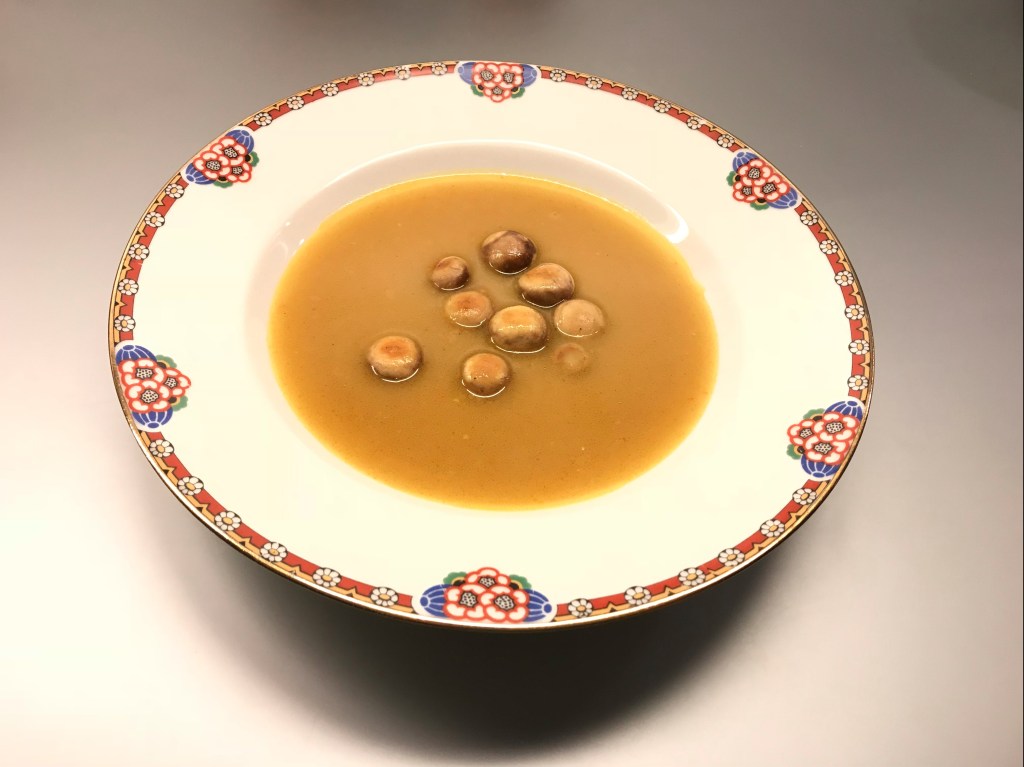
Londonderry Soup

Sunday afternoon, my mother in the kitchen, asking us what we would like to eat as a starter. Would we like vegetable soup with broken vermicelli or Londonderry soup? My favourite! Londonderry soup! Monday meant school but Sunday was all about Londonderry Soup!
My mother seemed less keen to prepare Londonderry soup because, depending on the chili and the curry, it could be too spicy to her taste. The vegetable soup was more predictable.
As always in life, things change. I moved to another city, she became less interested in cooking and so here we are today: I haven’t tasted the soup for years. Time to start cooking.
The Londonderry soup I tasted as a child seems to be a Dutch and Belgium phenomenon. And a rather undefined one. Some use veal stock, others chicken. Some add mushrooms, others rice. Also used are chili, sambal, cayenne pepper, parsley, egg, meat balls et cetera. And to make things even more confusing, in the UK it’s known as a pea soup. Which is not at all what my mother used to prepare. Plus no-one seems to know what the origin is of the name.
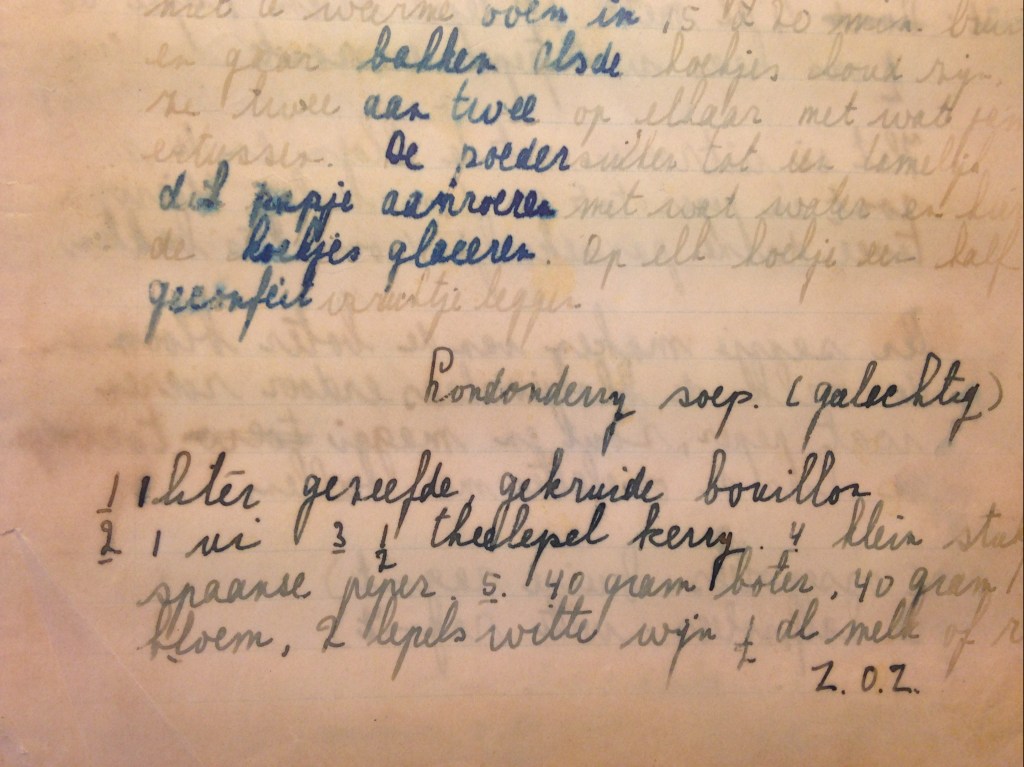
So we decided to follow the recipe my mother included in her ‘kookschrift’, which is a notebook with recipes she learned as a young woman.

What You Need

  • Light Stock (Veal or Chicken)
  • A Shallot
  • Curry Powder
  • Chili
  • Equal amount of Flower and Butter
  • Button Mushrooms
  • Single Cream

What You Do

  1. Start by glazing the chopped shallot in butter
  2. Add the chili (my mother used 4 small slices, but feel free to use more!) and the curry powder
  3. The curry powder should be spicy and powerful
  4. Make sure the curry is fried, allowing for the flavors to develop
  5. Add the flour and start making a roux
  6. Add the warm stock, step by step, take your time, and create the soup
  7. Leave it for 15 minutes to integrate
  8. In parallel gently fry the very small mushrooms (so called button mushrooms)
  9. Pass the soup through a sieve
  10. Use a spoon to capture all the flavors of the shallot and the chili
  11. The soup should be completely smooth
  12. Now things become unclear in my mother’s recipe. She suggests adding white wine just before serving (which will add acidity plus the taste of alcohol which is not great) or single milk or cream. Milk will only weaken the taste of the curry. Cream however will give a velvety mouthfeel when tasting the soup, which is great in combination with the spicy curry. So we added a touch of single cream
  13. Leave the soup for 5 minutes on low heat, allowing for the cream to cook
  14. Just before serving add the gently colored button mushrooms

Thanks Mum!

Consommé of Yellow Tomatoes

Clarification

A bit of magic in your kitchen! This soup requires ‘clarification’ in order to become a true consommé. Clarification is a simple and very effective way of making a liquid clear, regardless if it’s cold (wine) of warm. The goal of clarification is to remove all insoluble matter before serving (or bottling in case of wine). The ‘matter’ is in most cases too small to be removed using a filter. Hence clarification. In this case we use a mixture of tomatoes, basil and egg white, the so-called clarifique.
We use yellow tomatoes to create a bit of a surprise. When you use red tomatoes your guests will immediately guess it’s a consommé of tomatoes. Using yellow tomatoes will definitely surprise them. Plus we think the yellow ones are a bit more gently, fresher, more refined.
You could also use all of the tomatoes for the soup and add ravioli to the consommé: turning it into Ravioli in Brodo.
A quick comment before you start : it’s a bit of work and it requires a bit of patience as well. It’s not your ordinary soup!

What You Need

  • 6 Yellow Tomatoes
  • 2 Shallots
  • 1 Glove of Fresh Garlic
  • 1/2 Red Pepper
  • Thyme
  • Rosemary
  • Parsley
  • Bay Leaf
  • Black Pepper
  • Water
  • Butter
  • Olive oil
  • 2 Egg whites
  • Garlic
  • Basil

What You Do

Peel all 6 tomatoes by leaving them for 10-15 seconds in gently boiling water. Cool and peel, one by one. Keep the skin. Set 2 tomatoes aside. Chop the 4 tomatoes in smaller bits. Add butter and olive oil to the pan and gently glace the chopped shallot for 10 minutes. Add the garlic and the finely chopped red pepper and leave for 1 minute. Now add the tomatoes and the peel and fry for a minute or so. Then add thyme, rosemary, parsley, bay leaf and water. Bring to a boil and leave to simmer for 45 minutes. Taste and if so required add a touch of black pepper. If you do so, leave for an extra 5 minutes. Adding pepper later on is not a good idea because you want a completely clear soup. Pass through a sieve and cool to room temperature.
Remove seeds and the internal white from the two tomatoes, keeping the outside of the tomatoes only. Set the outside apart. Using a bowl create a mixture of tomato left overs, cooked garlic, lots of basil and the two egg whites. Mix with a spoon and then blender a few seconds. This is the clarifique.
Transfer the soup to a pan and add the clarifique. Stir with a spoon, making sure the mixture is homogenous. Start heating the mixture gently, until just below boiling. Some people will argue it’s should be 80º Celsius, exactly, which we think is not the case. You don’t want it to boil because that will destroy the funny looking cake on top of the mixture. Leave it for 30 minutes. No lid required.
Now use a slotted spoon to remove most of the cake. You can simply throw it away. Pour the liquid into a sieve lined with wet cheesecloth (or a clean cotton kitchen towel if you cannot find a cheesecloth, as long it’s odour free it will work; if not odour free soak in water for 24 hours). And Lo and Behold: you have a clear soup, a true consommé! Just taste it and be surprised! Herbs, even basil and of course tomato.
Cut the remains of the 2 tomatoes in small chunks and put them in a warm soup plate and transfer to the table. Pour the consommé around the tomato and enjoy!


Curry with Shrimps, Cardamom, Coriander and Ginger

A simple but very tasty main dish. Serve it with some rice and you will have a lovely and rich dish.

We enjoyed our curry with a glass of Spanish gewürztraminer. The white wine needs to be aromatic and herbal. The gewürztraminer should come with a touch of sweetness which links nicely to the coconut and the cardamom.

What You Need
  • 1 small Red Onion or a bigger Shallot
  • 1 Chilly Pepper (a quarter or a half, depending on the spiciness)
  • 1 Garlic Clove (both fresh and prepared)
  • 1 Cardamom
  • Coriander (seeds and fresh leaves)
  • Ginger (fresh, 5 centimetres)
  • Nutmeg
  • 1 or 2 Djeroek Poeroet leaves (these are the leaves of the Makrut or Thai Lime (Citrus Hystrix); if fresh use 1 leave
  • Curry Powder
  • 6 – 10 fresh Shrimps
  • Coconut Milk (150 ml)
  • Olive Oil
  • Black Pepper
What You Do
  1. Clean the shrimps and remove the parts you don’t want to eat, especially the dark vein. This is actually the shrimp’s gastrointestinal tract, so not something you want to eat
  2. Once cleaned, set aside
  3. Cut the onion in four and then slice
  4. Remove the seeds from the chilly pepper and cut the pepper in small bits
  5. Fry the onion gently in a skillet with olive oil
  6. Use a mortar to crush the coriander and cardamom seeds
  7. Add the curry powder, the cardamom, the coriander, the grated nutmeg and the chilly pepper to the pan
  8. Fry a bit more, making sure you get all the tastes
  9. Add one clove of fresh garlic, one prepared and the grated ginger
  10. Fry and stir
  11. Start adding the coconut milk and keep stirring
  12. Add the djeroek poeroet
  13. When the sauce starts to thicken, check if you have sufficient sauce for the shrimps.
  14. f not, add some more coconut milk
  15. When thickened, add the shrimps and let cook for 4 minutes, maximum, depending on size
  16. Chop the fresh coriander leaves
  17. Just before serving add three quarters of the fresh coriander leaves to the curry and mix
  18. Check if some black pepper is required
  19. Sprinkle some more fresh coriander just before serving the dish.
  20. Serve with rice, preferably Camargue red rice because it offers such a wealth of taste. Indian Basmati will also do the trick of course.