Baba Ghanoush

Eggplant

Baba Ghanoush is tasteful and easy to make. Combine it with olives, pickles and flat bread (naan) to create a delicious starter to share. Don’t be tempted to buy Baba Ganoush at the supermarket. Most of these products lack the typical taste as a result of charring the eggplant.
Sumac is an ingredient from the Levantine cuisine. Basically sumac powder is the result of crunching dried berries of the sumac plant. The taste vaguely resembles cranberries with a touch of lemon. In this case it adds fruitiness to the dish. The sweetness of the berries combines well with the garlic.

Wine Pairing

Enjoy Baba Ganoush with a glass of white Lebanese wine, but since that’s hard to find a nice glass of Cava is also a good choice.

What You Need

  • 1 Eggplant
  • 1 Garlic glove
  • 1 Tablespoon of Tahini
  • Olive Oil
  • Greek or Turkish yoghurt
  • Lemon Juice
  • Sumac
  • Pomegranate

What You Do

Start by grilling the eggplant (in the oven in our case) to the point of charring. Ideal would be a char coal grill, but an oven grill also does the trick. Then leave the eggplant in the hot oven until very soft; maybe 30-45 minutes in total, depending on the seize of the eggplant. Some suggest rubbing the eggplant with olive before grilling it that’s not necessary.
Transfer the eggplant to a plate and let cool. Now cut in half and use a spoon to separate the flesh from the skin. Use a kitchen knife to cut the flesh very thinly. Put the mixture in a sieve and reduce the amount of liquid in the mixture. Add the garlic and mix well.  Add tahini and while stirring slowly add olive oil to create a thick mixture. Add yoghurt and some lemon juice. Taste well and adjust by adding more tahini, yoghurt or lemon juice. Allow to integrate for at least 15 minutes before serving.
Spread the baba ghanoush on a small plate, add a splash of excellent olive oil and sprinkle some pomegranate seeds and sumac to finish.


Haddock with White Beech Mushrooms

Popular Fish

When you mention Haddock, Cod is never far away. Two of the world’s most popular fish. Many recipes and foodies describe the two as being very similar in terms of taste and preparation. We humbly disagree. We think Haddock is more flavourful and present compared to the mild taste of Cod. The structures differ as well, although both require your constant attention; they easily overcook.

Beech Mushrooms are more and more widely available, which is great. The slightly nutty  taste in combination with their texture makes them ideal for this dish. And the golden colour of the fried white beech mushrooms is perfect with the golden colour of the fried haddock.

Wine Pairing

Our choice was a bottle of Pinot Grigio made by MezzaCorona. This is a dry and crispy white wine with a beautiful deep yellow colour. It’s an elegant wine with just the right acidity to relate to both the fish and the mushrooms.

What You Need

  • 200 grams of Haddock (without the skin)
  • 100 gram of Beech Mushrooms
  • Butter
  • White Pepper

What You Do

Clean the beech mushroom with kitchen paper and half. Check the fish for bits you don’t want to eat. Fry the fish in butter. Both sides should be beautiful golden brown. In parallel gently fry the beech mushrooms in butter.
Serve the beech mushrooms on top of fish. Perhaps a touch of white pepper.

Haddock with white Beech Mushrooms © cadwu

Stuffed Courgette or Zucchini Flowers

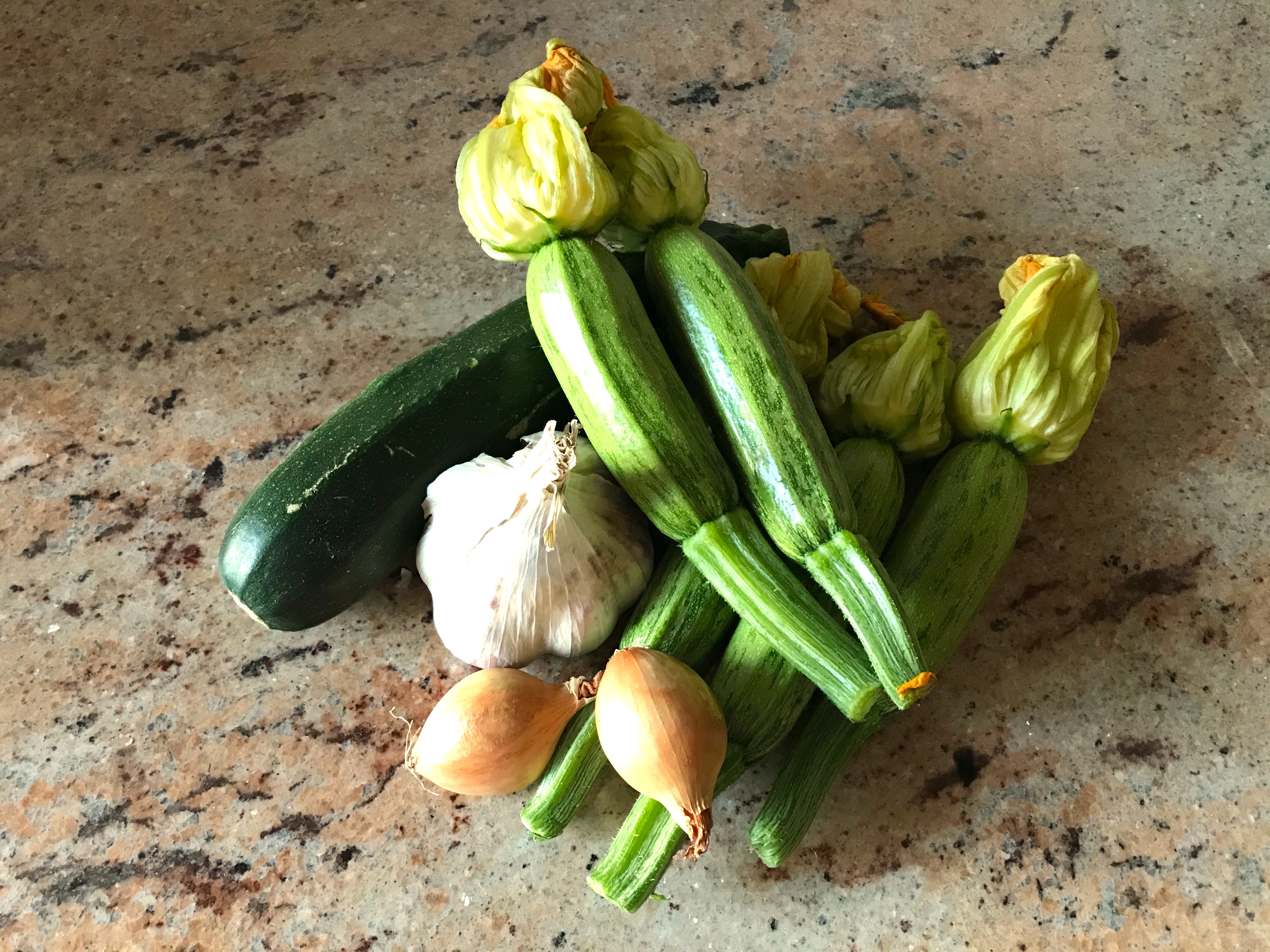
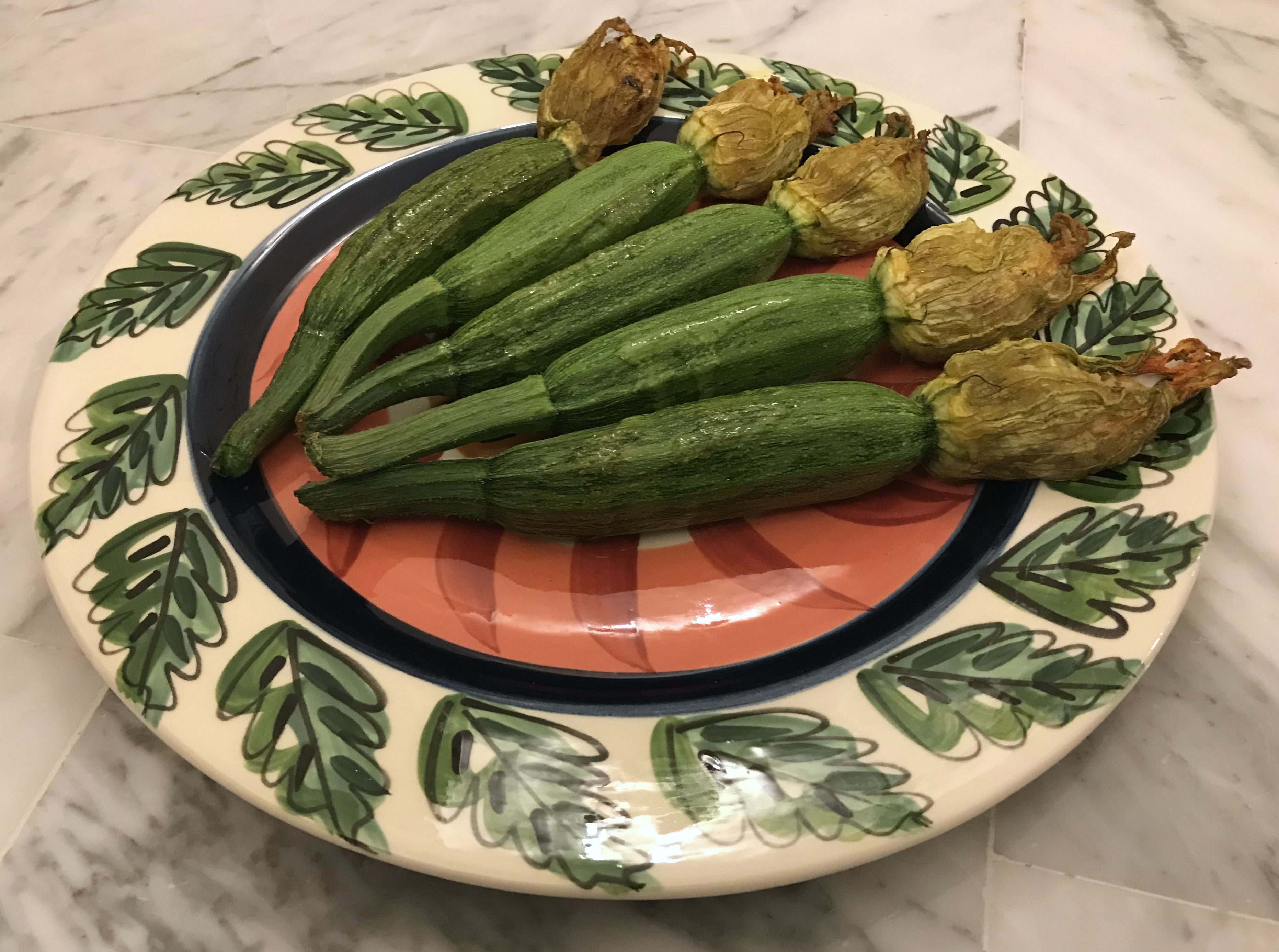
Such a pleasure to see courgette flowers in your garden or at the greengrocers. The young courgette is firm and tasty; the flowers a beautiful yellow. Simply stuff the flowers, fry in a pan or cook in the oven and you have a great side dish or starter. And then you start wondering: ‘Stuff with what? Cheese? Salmon? Tomatoes? Egg? And how to make a filling that remains inside the flower and isn’t too firm?‘.
We prefer a simple approach: stuff the flowers with a perfect combination: courgette, thyme, shallot, garlic and Parmesan cheese. Firm, tasty and all about zucchini. Enjoy as a starter or combine the stuffed flowers with grilled lamb or chicken.

What You Need
  • Small Courgettes with their flower
  • One Courgette (small and firm; you need 1 small courgette to stuff 4 flowers)
  • One Shallot
  • One Garlic Clove
  • Olive Oil
  • Parmesan Cheese
  • Thyme or Herbes de Provence
  • Black Pepper
What You Do
  1. Remove the stamens from the flowers
  2. Peel the additional courgette, slice the shallot and the garlic very thinly
  3. Warm a heavy iron pan and gently glaze the shallot
  4. After a few minutes add the garlic
  5. Remove the seeds from the courgette and grate coarsely
  6. When the shallot and the garlic are sufficiently glazed, add the grated courgette and the thyme or Herbes de Provence
  7. Mix and warm for 15-20 minutes, making sure the liquid evaporates.
  8. ry to keep the structure of the coarsely grated courgette
  9. Add finely grated Parmesan cheese, mix and taste
  10. Adjust with cheese, black pepper and thyme or Herbes de Provence
  11. Set aside and let cool.
  12. Heat your oven to 180° Celsius or 360° Fahrenheit
  13. Stuff the flowers, close them and sprinkle with olive oil
  14. Transfer to the oven and cook for 15 – 20 minutes
  15. Depending on your oven you may need to use ‘traditional’ or a combination with a small broiler. You want the flowers to become crisp
  16. Allow them to cool for a few minutes before serving.
PS

In case the grated courgette looses its structure and the mixture becomes too dense, then beat an egg white until very firm and gently spoon this through the cold mixture before stuffing the flowers.


Risotto With Squid

A Tasty Bonus

Combining rice with squid is an excellent idea. Just think about Arroz Negro, the black rice from Valencia. We combine rice (Acquerello, of course!) with fresh (or frozen) squid. Cleaning squid can be a bit intimidating, but it’s not difficult at all. The result is much better than the already cleaned frozen tubes you can buy plus you get the tentacles as a tasty bonus. Becky Selengut’s video is very helpful. This is how we do it:

  • Start by removing the head from the body. When you do this gently, you will also remove most of the internal organs of the squid. You may want to secure the ink for later use.
  • Just below the eyes, cut off the tentacles using a knife or scissors. Remove the beak (located at the base of the tentacles). Discard internal organs and beak. Transfer the tentacles to a bowl.
  • With your fingers remove the cartilage (this is the part that looks like it is made of plastic).
  • Now you have a choice: you could leave the skin on; it does add extra colour to the stew. But you could also remove the skin of the tube and fins. Best is to start in the middle and then gently pull the skin towards the top and bottom.
  • Remove the fins and transfer to the bowl.
  • Turn the tube inside out by pushing the top into the tube. This allows you to remove all internal organs and the membrane.
  • Turn the tube outside in by pushing the top into the tube. Transfer to the bowl.
  • Wash the tube, fins and tentacles with cold water.

Wine Pairing

Best is to combine this seafood risotto with a light, aromatic white wine. One that is fresh and dry. We enjoyed our risotto with a glass of Bianco di Custoza 2018, made by Monte del Frà in Italy. It is a well-balanced, dry white wine, with a fruity nose. Its colour is straw yellow, with pale green highlights. It is made from a variety of grapes: Garganega, Trebbiano Toscano, Trebbianello and Cortese. An excellent combination with the seafood risotto.

What You Need

  • For the Squid Stew
    • 500 grams of Squid (to be cleaned)
    • Olive Oil
    • Shallot
    • 2 Garlic Gloves
    • 200 grams of Tomatoes (peeled, seeded and cut in chunks)
    • 1 Red Chilli
    • Red Wine
    • Two Fresh Bay Leaves
  • For the Risotto
    • 100 gram of Risotto Rice (Acquerello)
    • Fish Stock
    • Shallot
    • Butter
    • Parmesan cheese
    • Black Pepper
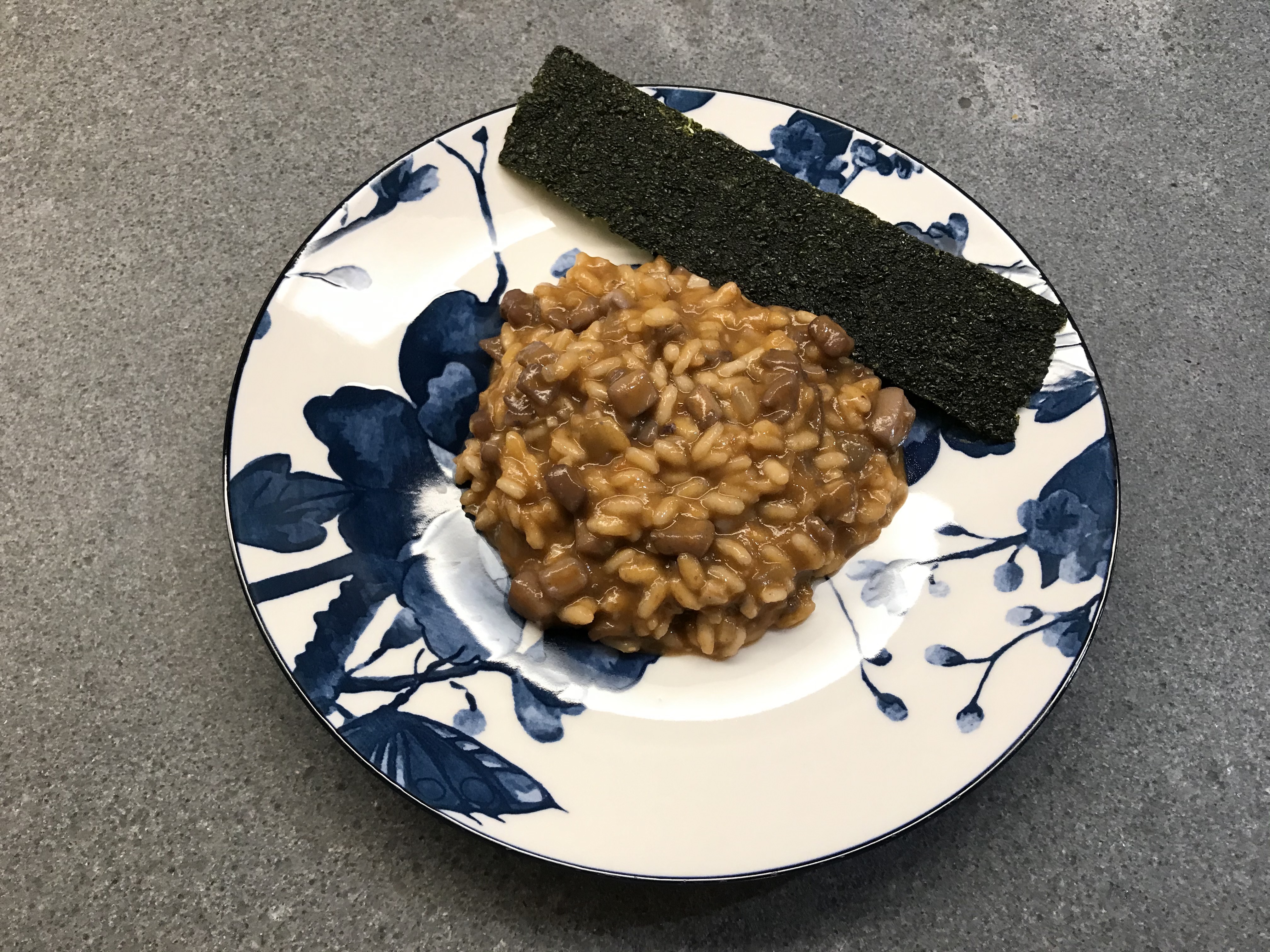
    • Crispy Japanese Seaweed

What You Do

A day before serving the risotto, prepare the stew: use a heavy, iron skillet. Cut the shallot in small bits and glaze gently in olive oil. Once the shallot is glazed add the garlic and the deseeded, chopped red chilli. After a few minutes add the squid (chopped tube and fins, tentacles ). Fry for a few minutes, add the tomatoes, a glass of red wine and the bay leaf. Allow to simmer for 4 hours. If necessary add a splash of water. Stir every 15 minutes. Remove the bay leaf, cool and store in the refrigerator.

The next day start by peeling and chopping the shallot. Add butter and olive oil to a pan and glaze the shallot. In another pan bring the light fish stock to a boil. After 5 minutes add the rice to the pan with the shallot and coat for 2 minutes. Add the squid stew and mix. Start adding the stock, spoon by spoon and stir the rice frequently. When using Acquerello rice it takes 18 minutes. Check the rice. When okay, transfer the pan to the kitchen counter top and leave to rest for 2 minutes. Add chunks of butter, stir, add a bit more butter and grated Parmesan cheese. Stir, a bit of black pepper, add more butter or Parmesan cheese if so required. Serve immediately with some crispy Japanese seaweed.

Risotto with Squid © cadwu

Salad with Various Beans and Swordfish

When in Valencia

The Mercat Central in Valencia is one of the largest markets in Europe. Its architecture is amazing, but even more stunning are the products: fruit, vegetables, mushrooms, wines, fresh meat, sausages, hams, herbs, spices, fish, bread, chickens, pickles, snails, weeds, offal, rice, nuts, beans: anything and everything you can dream of.
Albufera is a fresh water area not far from Valencia used for growing rice. It is of course the ideal rice for paella. If an original recipe of paella would exist, it would include rice, olive oil, rabbit, saffron and various beans such as broad beans, roget and garrofón.
Inspired by the classic Salade Niçoise we bought a slice of excellent swordfish, sweet onions, potatoes, eggs and of course: lots of beans. Shall we call it Salade Valençoise?

Wine Pairing

We served the salad as a main dish. Combining wine and salad is not straightforward because acidity is an important aspect of a dressing and therefore of a salad. In this case we have a range of flavours and textures so we would suggest a wine with a very present floral bouquet. The taste should be smooth and fruity. We enjoyed it with a glass of Albariño Rias Baixas 2018 produced by Bodegas Bouza do Rei, made from 100% Albariño grapes.
Another excellent choice would be Sericis, 2018 from the house of Murviedro. A wine from Utiel-Requena, so from the Valencia region. A wine made from 100% Merseguera grapes. Full bodied yet light, elegant and surprisingly low in its alcohol with only 12%. Well balanced acidity which is great when combining it with a salad.

What You Need

  • Mixed Salad
  • White Sweet Onion
  • Flat Beans (we also used the local red variety Roget)
  • Green Peas
  • Broad Beans
  • Garrofón (Lima Beans or Butter Beans)
  • Sword Fish
  • 2 Eggs
  • 2 Small (New) Potatoes
  • Olive Oil
  • Vinegar
  • Mustard
  • Black Pepper

What You Do

Start by pealing the broad beans, the green peas, the flat beans, the garrofón beans and the potatoes. Cook all five ingredients separately until al dente. Cook the eggs until just done. Let cool. Peel the broad beans and the garrofón beans again. Make a dressing by combining olive oil, vinegar and mustard. Slice the flat beans, the onion and the potatoes. Cut the egg in four. Fry the swordfish until just done. In parallel mix the salad with the onion, the flat beans, the green peas, the potatoes and the broad beans. Add the dressing and toss. Slice the swordfish and decorate the salad with egg, garrofón and swordfish. A touch of black pepper to finish.

Matsutake with Ginger and Spinach

A very special mushroom, to say the least. Well known throughout Japan, China and South Korea as a true delicacy.  Matsutake smells like a pine wood forest and its taste is intense, aromatic, lasting and unique. As if you could taste Autumn.
It’s an expensive mushroom (around 180 euro per kilo) with very limited availability. But if you happen to find it, be sure to buy it. Between 75 and 100 grams is fine for two.
The Matsutake makes this into an unforgettable dish. It will bring you back to earth in a split second. Smell it, taste it and feel how satisfying and relaxing it is.

Wine pairing

Best served with a dry sake. We prefer Junmai Taru Sake as produced by Kiku-Masamune. This fine sake is matured in barrels made of the finest Yoshino cedar. The aroma has indeed clear hints of cedar. The sake will clear your palate and allow for a more intense taste of the Matsutake.

What You Need
  • 75 – 100 gram of Matsutake
  • Some Spinach (preferably what is called the ‘wild’ version, cleaned and without the stem)
  • Ginger
  • Garlic
  • Scallion
  • Soy Sauce (reduced salt)
  • Olive Oil
  • Sesame Oil

What You Do

Clean the Matsutake and cut in small dices. The size you would like to eat them (Matsutake doesn’t shrink like many other mushrooms; it remains firm). Warm the soy sauce, add a touch of sesame oil and flavour with very small cubes of ginger. Fry the Matsutake gently in a skillet in some olive oil, no longer than 3 minutes. Add very finely or grated garlic. Add very thinly sliced scallion (white only). In parallel blanch the spinach in the liquid. Quickly drain the spinach and set aside. Reduce the liquid and taste. Add some excellent sesame oil and whisk. In parallel chop the spinach.
Put spinach on a plate, gently add some sauce and then sprinkle the Matsutake over the spinach..

Insalata Caprese

Tomatoes

In 2013 the German culinary press characterised Dutch tomatoes as ‘wasserbomben’, let’s say ‘water balloons’. And they were right. Even more so, many tomatoes were, and still are, tasteless and watery. And since the Netherlands are in the top 3 of tomato exporting countries, you run the risk of buying a red balloon. Which is of course not what you want to do. So if you plan to make one of the simplest and tastiest starters ever, you have to find the best tomatoes ever. Or grow your own of course.

Mozzarella

Meaning Buffalo mozzarella, made from the milk of the Italian buffalo. Since 1993 it’s a DOP (Denominazione di Origine Protetta) and protected under EU law. It’s a young, moist, tasty cheese with a lovely soft, elastic but not chewy texture and it comes with a skin as a result of the shaping and pickling. The taste is more robust than mozzarella made from cow milk and it’s ideal for a salad. The cow version is best used for cooking. The smoked version should be ignored.

Basil

Someone should write ‘The Case of the Dying Basil’. A whodunit in which a clever detective will reveal why the basil plant you buy from the green grocer or supermarket will very likely die within 3 days, regardless what you do. And since they always die on us, we buy ‘fresh’ leaves.
The most used variety of basil is sweet or Genovese basil. Others are Thai basil (slightly spicy with a hint of anise) and red (or purple) basil (similar to sweet basil but more powerful). Alain Passard’s book Collages et Recettes includes a recipe for purple carrots with purple basil and cinnamon. Wonderful colours and a delicate taste.

Insalata Caprese

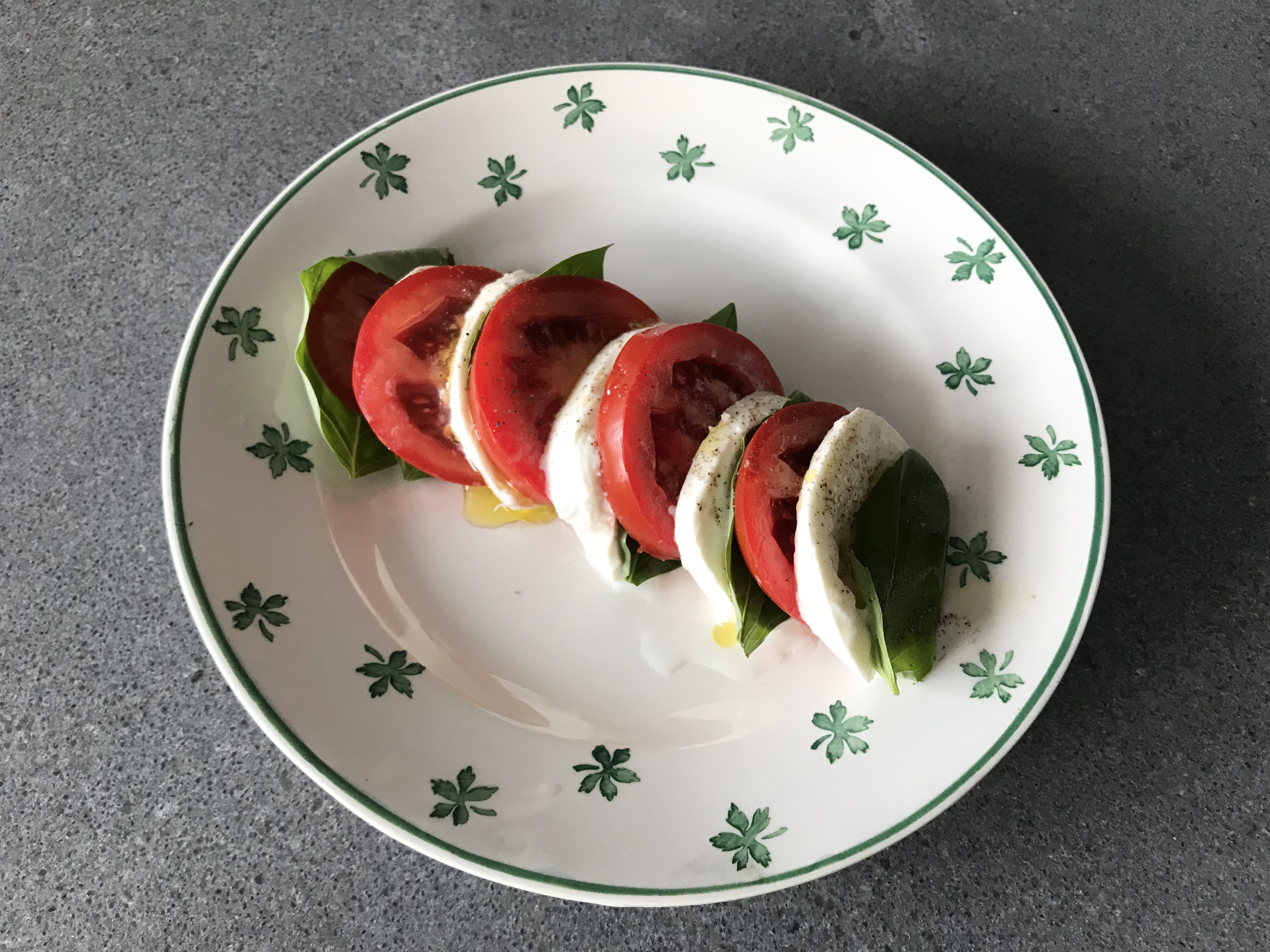
This salad stands or falls on the quality of the ingredients. And it requires the talent to keep things simple, so you have to stick to the 5 (five!) ingredients, meaning tomatoes, mozzarella, basil, olive oil and pepper. The salad does not come with balsamic vinegar, lettuce, pineapple nuts, salt, honey, croutons, oregano, mustard or a vinaigrette. Five ingredients. That’s it.
You wonder why? Because this way the Insalata Caprese is at its best. Tasty, sweet, rich, moist, fresh and a reflection of Italy and of summer. Adding an ingredient will worsen the concept of the salad and reduce its taste.

Wine Pairing

We suggest an excellent rosé, one with flavour and depth. For instance Monte del Frà Bardolino Chiaretto 2018. You’re looking for a wine with delicate scents of berries accompanied by light and refreshing hints of green apples and subtle spicy tones. On the palate the wine should reveal juicy sensations of red berries along with an appealing and refreshing acidity.

What You Need

  • Two Excellent Ripe Tomatoes, chilled
  • One Ball (125 gram) of Excellent Buffalo Mozzarella
  • Fresh Basil
  • Excellent Olive Oil
  • Fresh ground Black Pepper

What You Do

Slice the (chilled) tomatoes, slice the mozzarella and create the ‘tricolore’. Add fresh black pepper and drizzle generously with olive oil.

Insalata Caprese © cadwu

White Asparagus with Wild Garlic (Ramson) and Morels

Ramson, Wild Garlic, Daslook, Bear Leek, Ail des Ours, Bärlauch: so many names for this great plant: Allium ursinum is one of the highlights of spring. Powerful, pure and tasty. Some say you should only eat the leaves before the plant starts to bloom. But then you can’t combine the leaves and the tasty white flowers in your dish, so we suggest ignoring that idea. The flowers are (if you’re lucky) just a touch sweet because of the nectar. It can be harvested from the wild, but some garden centers also sell ramson.
The taste is a combination of onion and garlic, but much greener, longer lasting and with a touch of bitterness at the end. You can turn the leaves into a strong pesto, but better use it as herb with for instance potatoes or gnocchi. See our recipe for Farfalle with Ramson (or Wild Garlic) and Parmesan Cheese.

Johnny Acton and Nick Sandler included two recipes in their classic book Mushrooms (published by Kyle Books and still available via for instance Amazon and other channels). One is a combination of Cod, Trompette des Morts (Black Trumpet) and Ramson. The other one is an intriguing combination of white Asparagus, Morels and Ramson.

Wine pairing

We suggest a full-bodied white wine with a fine acidity. For instance Herdade São Miguel, Colheita Seleccionada. The wine comes with distinctive minerals, along with excellent harmony and a long and well-balanced finish. It works well with the slight bitterness and sweetness of the asparagus; the gently onion and garlic taste of the ramson and the pancake-like taste of the morels.

What You Need

  • 6 White Asparagus
  • Morels (but even dried porcini will work)
  • Ramson
  • Chicken Stock
  • Crème Fraîche
  • Garlic
  • Butter
  • Shallot
  • Mushrooms by Johnny Acton and Nick Sandler


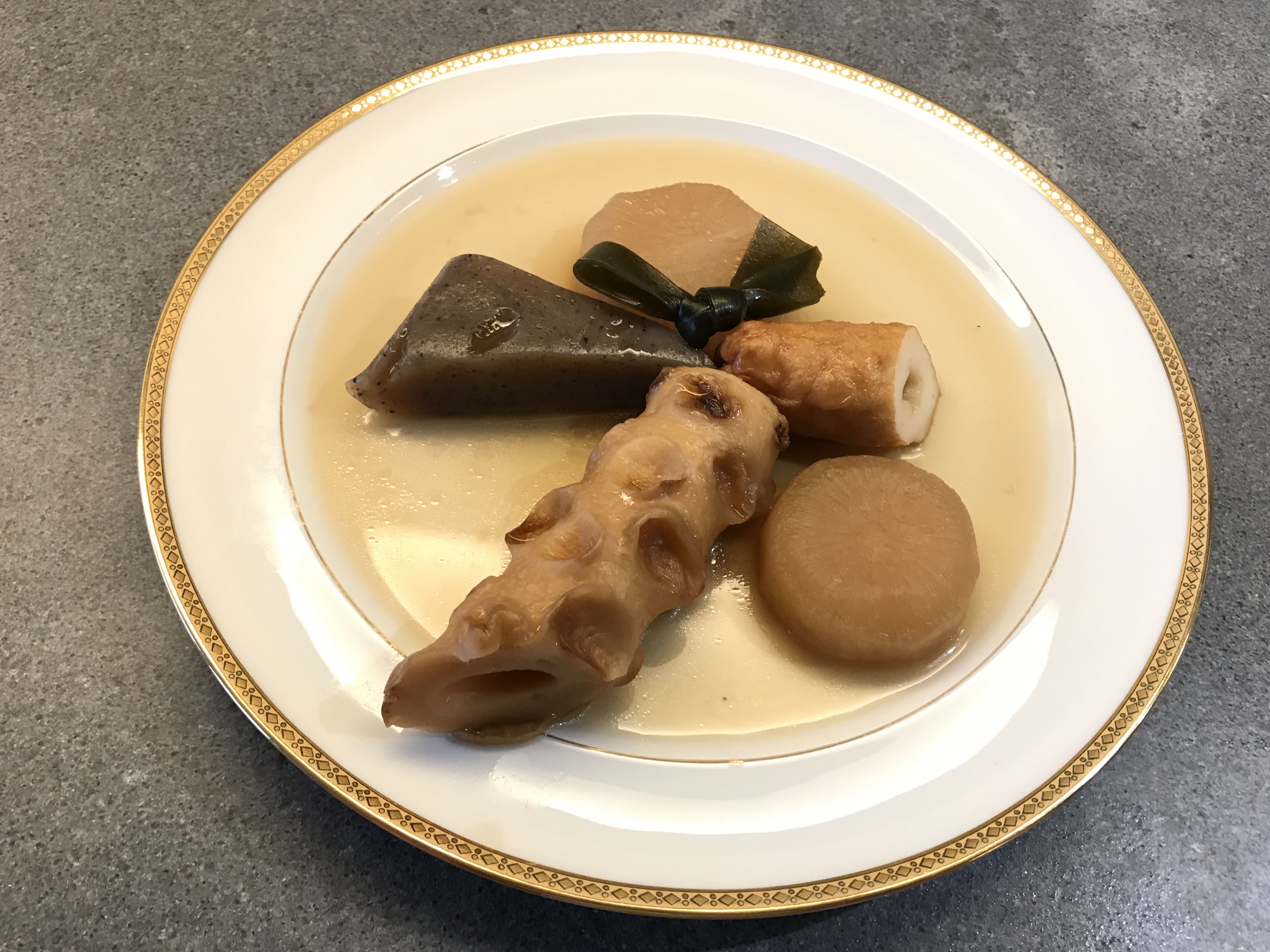
Oden

A Traditional Japanese Dish

If we say ‘Japanese food’, you will probably think ‘sushi’, ‘sashimi’, ‘yakitori’, perhaps ‘udon’. But Oden? Probably not. Such a shame because Oden is a really wonderful dish. Oden for lunch or as a course in a typical Japanese menu: tasty, light and full of surprises. Oden is a stew that requires a bit more work than you would expect and of course time. It also requires some shopping, given some of the ingredients are not easy to find.
We are not from Japan so we humbly present our version of this (wintery) classic. We hope it inspires you to cook Oden and enjoy it as much as we did.

Wine and Sake pairing

We preferred a glass of Chardonnay with the Oden during our dinner; others preferred a glass of cold sake. The stew is rich in flavours, umami of course, but not spicy, so we would not suggest a Gewurztraminer of a Sauvignon Blanc. A Chardonnay (with a touch of oak perhaps) will be a good choice.

What You Need

  • For the Dashi
    • 20 grams of Dashi Kombu (Rishiri Kombu)
    • 25 grams of Katsuobushi (Bonito Flakes)
  • For the Stew
    • One Daikon
    • Chikuwa Fish Cakes
    • One Pack Konnyaku
    • One Pack of Gobo Maki Burdockroot Fish Cakes
    • 1 sheet of Hayani Kombu
    • 2 boiled eggs
    • Abura Age Fried Tofu
    • Mochi (Sticky Rice Cake)
    • Soy Sauce (preferably one with less salt)
    • Mirin
  • Karashi

What You Do

Start by making one litre of dashi. This seems simple but requires precision. Clean the kombu with a wet cloth and put into one litre of cold water. Gently raise the temperature to 80° Celsius or 176° Fahrenheit. Remove and discard the kombu. Bring the liquid to a boil, add the katsuobushi, bring to a boil and immediately set heat to zero. Wait 5 minutes or so. The katsuobushi will sink to the bottom of the pan. Now very gently pass the liquid through a wet towel. Do not squeeze, just give it time. The result will be a great, clean dashi. Cool and set aside.
Next step is to peel the daikon and slice it (2 centimeters is best). Now use a sharp knife to plane of the edge of the daikon. This improves the presentation and it is supposed to stop the daikon from falling apart. Cook the daikon for one hour in water. Drain and set aside.
Step three is to cut the konnyaku in triangles and cook these in water for 15 minutes. Konnyaku is made from the konjac plant and is specific for the Japanese cuisine.
Step four is to cook the sheet of Hayani Kombu for 5 minutes. This is young kombu and edible, different for the one you used when preparing dashi. Let cool a bit, slice and knot ribbons. Not sure why, but is looks great when you serve it.
Now it’s time to add the dashi to the pan (should be a clay pot, but we stick to our Le Creuset), add one tablespoon of mirin, one (or two, depending on your taste) of soy sauce, add the daikon, the konnyaku and the fish cakes.
We served our oden as a course during dinner, so we limited the number of ingredients. If served for lunch add boiled eggs, fried tofu and mochi. The last two ingredients have to be combined by putting the mochi into the tofu.
Allow to simmer for at least 2 hours. Best is, as always, to serve it the next day.
Serve with some karashi (Japanese mustard, which is different from wasabi by the way).

Oden © cadwu
Oden © cadwu

Carbonade à la Flamande (Flemish Beef Stew)

This is a true classic, so many will claim to have the one and only original recipe. This dish is all about beef, onions and brown Belgian beer. Herbs like parsley and bay leaf, spices like nutmeg plus mustard and cider vinegar. Definitely not bacon, stock, prunes and garlic. Maybe some brown sugar if you prefer a sweet touch to the dish.
Given it’s a true classic many traditional restaurants in Belgium (or better said Flanders) will have this on the menu. Try it with some bread and a glass of brown Beer, preferably draught.

We serve the stew with two vegetables: celeriac and green beans. You could also go for mashed potatoes or fries, but balancing the rich stew with vegetables and bread is (we think) a much healthier idea.
And typical for a good stew: make it a day in advance.
Don’t worry if you made too much, the stew will keep for months in the freezer.

Wine Pairing

If you go for a glass of red wine, make sure it is full-bodied and rich, because the stew is really hearty. Bordeaux is a good choice. We drank a glass of Chateau Beaulieu, Cotes de Bourg. It is a wine with lots of dark fruit and a touch of oak. The wine is a blend of the traditional Merlot, Cabernet Sauvignon and Cabernet Franc plus 10% Malbec.

What You Need (for 4 persons)

  • 1 kilo of excellent, fat, marbled Beef
  • 4-6 large White Onions
  • Olive oil
  • Butter
  • 1 tablespoon of all purpose Flour
  • Nutmeg
  • 2 bottles (33 cl) of Belgian Brown Beer (we prefer Westmalle)
  • Bouquet garni, consisting of Thyme, Bay Leaf and Parsley
  • Cider Vinegar
  • Slice of Bread
  • Mustard

What To Do

  1. Start by slicing the meat. Don’t make the cubes too small; they will shrink during the cooking process
  2. Slice the onions, not too thin, they should be visible in the stew
  3. Heat butter and olive oil in a large pan
  4. Start frying the meat. You probably will have to do this in 2 or 3 batches
  5. Make sure the meat is nicely colored
  6. Add some more olive oil and caramelize the sliced onions
  7. Add the flour and coat the onions and the beef
  8. Add nutmeg, the beer, the cider vinegar and the bouquet
  9. Close the pan and keep on a low heat for 3 to 4 hours
  10. Check and stir every hour.
  11. Check the meat and add one slice of bread (not the crust)
  12. Add a nice spoon of French mustard
  13. Leave to simmer for another hour. By now the bread will be dissolved
  14. Stir and check the meat
  15. If okay, then remove the meat from the pan and reduce the sauce
  16. Discard the bouquet
  17. Transfer the meat back into the pan, reheat, then cool and transfer to the refrigerator until the next day.
  18. Reheat slowly and serve with Celeriac and Beans.

PS How to Prepare Celeriac?

Good question! Clean the celeriac and cut in cubes. Transfer to a pan with some water and one or two generous slices of lemon. One or two you ask? Well, the answer depends on the size of your celeriac and the acidity of the lemon. If in doubt, then go for one slice. Cook the celeriac until nearly done. Remove the water and the lemon. Now add (single) cream to the pan. Keep on a low heat for 10 minutes. The celeriac will absorb some of the cream. Transfer the mixture to the blender and create a smooth puree. Serve with nutmeg.

PS How to Cook Green Beans?

Short is the only answer. Serve with excellent olive oil. Normally we would add some nutmeg, but given it’s already on the celeriac and in the stew you may want to skip it. Olive oil is essential to coat the beans and make them nuttier. Butter will also coat them, but it is much more mouth filming and the butter will not emphasize the nuttiness of the beans.