Lemon Curd

A Lemon Meringue Pie, a Tarte au Citron or Scones with Lemon Curd: tasty, refreshing, bitter, sour, a bit sharp and sweet. We love it! Provided of course that the lemon is more than just juicy and sour.

This has been a bit of an issue over the past years. Similar to the German consumers who complained about the watery and flavourless Dutch tomatoes they bought around 1990, we think that most lemons lack aroma and taste. We tried limes, bought more expensive lemons, added a bit of yuzu, but in the end, we still missed the true taste and aroma of an old-fashioned lemon.

Until one day we bought a Bergamot lemon. Its aroma is intense, floral and long. The juice is sour, deeply citrusy, refreshing and bright. Exactly what we were looking for! We went home and prepared a lovely curd.

Recently we had a similar experience when we visited a dear friend. She grows a Makrut (or Thai) Lime tree, also known as Makrut Lime, in her garden mainly because she wants to use the fresh leaves in Thai and Indonesian dishes such as Tom Yum, Soto Ayam and various curries. The leaves have a complex citrus flavour with floral notes. We talked about the lovely yellow fruit and how you could use its very aromatic zest as well.
The fruit contains little juice, so when preparing a curd with Makrut limes, you need to add lime, Bergamot or lemon juice.

What You Need

  • 65 ml of Lemon, Lime, Bergamot and/or Makrut Lime Juice
  • 65 grams of Butter
  • 100 grams of Sugar
  • One Egg
  • Zest

What You Do

  1. Beat the egg, melt the butter and combine all ingredients
  2. Make sure the sugar is fully dissolved
  3. Cook Au Bain Marie until you have the right consistency. Or transfer to your microwave, put it on 50% or 70% power and heat with intervals of 20-30 seconds. Mix between the intervals. This is a very precise way of heating the mixture and it gives you full control over the process. Towards the end of the process you may want to reduce the power or shorten the intervals. The percentage and the duration of the intervals depend on your microwave and the bowl you use. We use a microwave saucepan (£1,29 only) and it works perfectly. The material doesn’t absorb warmth, so the mixture doesn’t get extra heated when you stop the microwave
  4. Pass through a sieve (you don’t want the zest in the curd)
  5. Cool in a water bassin
  6. Store in a jar.
  7. The curd keeps for a week in the refrigerator .

PS

Around 1992 a German television program characterised Dutch tomatoes as watery and tasteless, and called them ‘wasserbombe’. The short-term impact was enormous: Dutch tomatoes went from 50% market share in Germany to something close to zero. Longer term the impact was very different: Dutch producers invested in their product, making their tomatoes tastier, richer and more diverse.

Cooking Techniques

We all love reading recipes, trying to prepare something yummy, surprise our friends and create something great. A tasty strawberry jam that makes you think of summer, a choucroute as it could be served in the Alsace, a soup that warms you in winter or asparagus a la Flamande, all delicious.

Recipes basically have two components: the ingredients (what you need) and the actions (what you do). These actions may seem simple but can be challenging, for instance: ‘chop the onion’. Sounds simple, until you see how a chef chops an onion and you compare their result with your own. Another one: ‘poach the egg’.

Reference

When we’re not sure how to do something, we open our copy of Le Cordon Bleu Complete Cooking Techniques by Jenny Wright and Eric Treuille, first published in 1997. It’s such a great book! It describes over 700 cooking techniques and has more than 2,000 pictures to help you understand the techniques. The book includes 200+ recipes, an overview of kitchen aids and utensils plus detailed information about meat, fish, fruit, vegetables, game, nuts etcetera. If you wonder how to slice a pineapple, don’t know how to glace a pie, in doubt how to fry a pork chop, want to prepare your fish en papillotte, then you simply open the book and find the answer.

Institute

Le Cordon Bleu is an exceptional institute. It was founded in Paris in 1895 and today it is a network of culinary and hospitality schools in 20 countries. Le Cordon Bleu combines innovation and creativity with tradition through courses, workshop, educational programs and books. Currently they offer books about ChocolatePastry and Classic Recipes.

Le Cordon Bleu Complete Cooking Techniques is unfortunately a bit expensive (we saw a hardcover for over € 250,00), so you may want to visit a second-hand bookshop when you’re keen to buy it. Don’t be bothered if it looks a bit off, it just means it was often used, which is to be expected with such a helpful book.

Clam Chowder

We have fond memories of the food we enjoyed when in New England: local oysters, lobster, Boston cream pie and of course clam chowder. Ah, yes, fond memories indeed.
Since then, clam chowder has become one of our favourite starters. Unfortunately, most restaurants (even in New England!) turn the clam chowder into a potato soup and even worse: they used canned clams. Help! 

The main ingredients of New England clam chowder should of course be lots of fresh clams plus vegetables, bacon, cream and potato. The soup must be about clams, with all the other ingredients in a supporting role.

We’re not from New England, so our clam chowder is far from original. But being Dutch we love our seafood and most certainly do we love our kokkels, also known as the common cockle. You can find a probably more original Manhatten version (meaning: without cream) in The Silver Palate Cookbook.

Finding the right potato is a bit of a struggle, also because some recipes suggest using waxy potatoes, so potatoes that remain firm. Not a good idea because it means that the potato doesn’t thicken the soup and the potato is far too present. We prefer using a starchy potato, one you would use for a purée, mash or mousseline. If you can find one with a golden colour, that’s even better. If you’re familiar with vichyssoise, then use the same potato.

What You Need

  • 500 grams of Clams, preferably washed
  • Chopped Carrot, Celeriac, Onion and Leek
  • Bouquet Garni (Parsley, Bay Leaf, some Thyme)
  • 4 strips of Bacon
  • White Wine
  • Water
  • 200 grams of Starchy Potato
  • 50 ml Cream
  • Olive Oil
  • White pepper

What You Do

Check the clams: discard broken ones or ones that will not close. Add a little olive oil to a pan and then chopped carrot, celeriac, onion and leek. Leave for 20 minutes until soft and sweet. Add the chopped bacon, fry for a few minutes until slightly crispy. Now add white wine, water and the bouquet garni. Leave for another 20 minutes. Turn up the heat, add the clams quickly and certainly not too long. If you heat them too long, then they will become rubbery when heated for the second time. Use a slotted spoon to remove the ingredients from the stock. Keep the bacon, the clams (without the shells) and the bouquet garni. Discard all other ingredients: onions, leek, celeriac, carrot and shells. Transfer the bacon and the bouquet garni back to the liquid. Add the chopped potato. Let simmer until the potato has broken down. Use a fork to thicken the soup. Add cream. Feel free to add a bit more, it’s all about taste and consistency at this stage. If you’re not happy with it, then you could add some potato starch. Keep the soup warm for 10 minutes or so, turn up the heat, add the clams and quickly heat them. Add some freshly grounded white pepper. Serve immediately.

Clam Chowder ©cadwu
Clam Chowder ©cadwu

I Know How To Cook

We have all been there, you read a recipe, you decide to prepare the dish, only to find that some essential information is missing, that the ingredients are impossible to find or that the result is something completely different. For instance, we once decided to prepare a fairly complex dish. It consisted of four components, one being a popcorn-like version of saffron rice. The steps were not too challenging: cook sushi rice with saffron, dry for 2 days and then fry in oil on 180 °C or 355 °F for 10 minutes until the rice looks like popcorn. Sounds do-able, doesn’t it? Apart from the ‘like popcorn’. All rice turned out fat and golden-brown. Finally, we figured it out: we had to use a neutral oil with a very high smoking point, for instance refined sesame seed or avocado oil. But that information wasn’t provided in the recipe. Why not, we wonder, isn’t the goal of a recipe to help the reader prepare it? So why not provide all the necessary information?

(In case you wonder what the smoking point of oil is, it’s the temperature on which the oil breaks down. That’s when it may release unhealthy, damaging chemicals and nasty flavours. Olive oil has a relative low smoking point which is why you should pay careful attention to your pan when using it for frying.)

Je Sais Cuisinier

Ginnete Mathiot approach to recipes is clearly based on an ambition to educate, to transfer and share knowledge. She was born in 1907 in Paris and pursued a career as a teacher and inspector in home economics and as an author of many cookbooks. She didn’t own a restaurant, she never worked as a chef, she wasn’t a tv-celebrity. She was focused on sharing recipes and useful household and kitchen information. Millions of copies of her cookbooks were sold and many more benefitted from her knowledge and experience.

When she was 25 years old she published her classic Je Sais Cuisinier. Today the book is known as La Cuisine pour Tous. The English version is titled I Know How to Cook. It is a very useful cookbook with recipes that truly help you to prepare a dish. She also wrote excellent books on patisserie and preserves.

When you leave through I Know How to Cook you will notice helpful sections on spices, aromatic vegetables and flavourings, you’ll see a well written glossary of essential cooking terms, seasonal suggestions and many more aspects of food.

Given the time of year we looked for the artichoke-section of the book. Such a delicious vegetable! She includes a recipe for Artichoke Hearts Printanière (artichoke hearts with a filling of mushrooms, shallot, boiled egg, ham and artichoke, grilled in the oven) and for Artichokes à la Barigoule. This is a classic dish from the Provence region. The artichoke hearts are stuffed, wrapped in bacon, fried and then cooked in a sauce with carrots and onion. The artichoke is then served with the (strained) sauce. Next week we will publish our  vegetarian version of this classic.

Her books (in French, Italian and English) are available via your local bookstore and the usual channels.

I Know How To Cook
I Know How To Cook

Beet Greens Pie

Such a cheap and delicious vegetable: beets! Grilled, cooked, braised, combined with other vegetables or on its own, as a salad or straight from the oven. And so many varieties! Deep red, orange (chiogga), purple, golden and even white. All these beets have one thing in common: they come with leafs, with greens. Most retailers (and their customers) are not interested in the greens and therefore the leaves are discarded before the beets reach the shop. Which is a pity because they are as tasty as the beets. Use the greens in a salad, prepare them like you would prepare spinach or, even tastier, use the leaves as main ingredient of a pie.

Tourte de Blette

Some time ago we published the recipe for Tourte de Blette. When preparing it we were inspired by a dear friend who bases her Tourte on the Italian Torta Verde del Ponente Ligure. This is a very similar dish with zucchini, chard, basil, sage, rise, onion, Grana Padano or Parmesan and eggs. The dough of the Torta Verde is easy to work with and the result is both tasty and crunchy. It works really well for our Tourte de Blette so we decided to use it for this pie as well.

Wine Pairing

A not too complex white wine will be a great idea. You could also drink a glass of rosé with it, for instance a Côtes de Provence. Drinking a beer with your pie is also an excellent idea.

What You Need

  • For the Dough
    • 100 gram of Flour
    • 50 gram of Water
    • 10 gram of Olive Oil
    • 1 gram of Salt
  • For the Mixture
    • Greens of 3 or 4 Beets
    • One Shallot
    • Olive Oil
    • 50 grams of Cooked Rice
    • 1 or 2 Eggs
    • 50 gram Freshly Grated Parmesan Cheese
    • Black Pepper

What You Do

Cook the rice and leave to rest.  Combine flour, salt, water and olive oil. Make the dough, kneed for a minute or so and store in the refrigerator for at least 30 minutes.
Remove the leaves from the stem and chop the stems. Slice the leaves coarsely. Best is to have the stem slices the size of the cooked rice. Same for the shallot. Warm a large heavy skillet, gently fry the shallot. After 10 minutes add the chopped stems. Leave for 10 minutes and then add the leaves. Cook for a few minutes until done. Transfer to a plate and let cool.
Slice the mixture using a kitchen knife. Whisk the two eggs. Combine the vegetables, the egg, the rice and the freshly grated Parmesan cheese. Add black pepper.
Cut the dough in two, one part slightly bigger than the other. The bigger part will be the bottom, the smaller part the top. Roll out the bigger one with a rolling pin on a lightly floured surface. Coat a 15 cm or 6 inch round baking form with oil (or use a sheet of baking paper). Place the first disk in the baking form, add filling and close with the second disk of dough. Fold the edge of the top piece of dough over and under the edge of the bottom piece of dough, pressing together. Make holes in the top, allowing for the steam to escape. Transfer to the oven for 40 – 50 minutes on 180˚ – 200˚ Celsius or 355˚ – 390˚ Fahrenheit. Immediately after having removed the pie from the oven, brush the top with olive oil. This will intensify the colour of the crust. Let cool and enjoy luke warm.

La Cuisinière Provençale

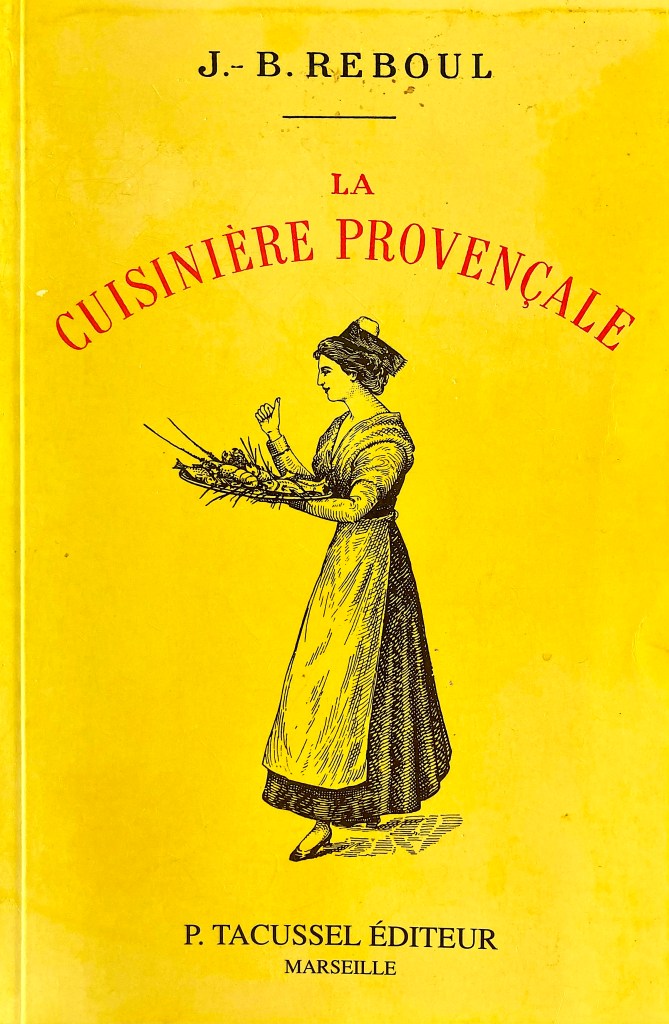
When we’re not completely sure about a sauce or a dish, we search for a recipe and inspiration in La Cuisinière Provençale. This comprehensive cookbook was first published in 1897 and was written by Jean-Baptiste Reboul. It includes 1119 recipes for an enormous variety of dishes and it provides background information on fish, meat and vegetables. It also gives traditional, seasonal, French suggestions for lunch and dinner for every day of the year. For instance for today, the third Monday of May, the two course lunch consists of moules farcies aux épinards et tendrons de veau bourgeoise. Or in English, mussels stuffed with spinach and veal tenderloins with carrots and onions.
You will find chapters about soups, hors d’œuvres, typical Provençal dishes, fish, sauces, mutton, veal, vegetables, eggs, jams and everything else you can think of.

This is one of the few cookbooks that uses the concept of formulas. For example: the recipe for Truite à la Meunière is very short: it simple states a few specific steps and then refers to formula 135, the one for Loup à la Meunière. We like this concept because it supports the idea that you can and should be flexible with ingredients. If for instance you can bake a pie with chard, then it’s probably a similar formula to bake a pie with wild spinach or beet leaves.

The recipes do not come with a separate list of ingredients, so you must make your own shopping list while reading the recipe. Not great, but we got used to it. The advantage is of course that the publisher could squeeze in even more recipes in the book.

Our Favourites

Daube Provençale is one of our favourites from this book. It is not too much work and you can also be fairly flexible with the recipe, as long as you use excellent, marbled beef. Well known chef Hélène Barale (La Cuisine Niçoise, Mes 106 Recettes) uses beef, veal and pork with tomatoes and dried mushrooms, Hilaire Walden (French Provincial Cooking) suggests marinating the beef in red wine and adds orange peel and olives whereas La Cuisinière Provençale suggests adding vinegar to the marinade but doesn’t use tomatoes, mushrooms or olives. We use carrots, shallot, garlic, mushrooms, black olives and red wine to make an intense, heart-warming stew.

La Cuisinière Provençale (in French only) is for sale via your local bookstore or the well known channels for 25 Euro or US dollar.

La Cuisinière Provençale

Halibut with Morels

Seasonal eating is such a great idee. Simply buy (locally produced) seasonal fruit, vegetables and mushrooms, enjoy fresher and better tasting ingredients, reduce your carbon footprint and support your local community. And it creates lots of tasty opportunities: celebrate the beginning of the truffle season, the start of the asparagus season, the first red wine from the Beaujolais region – all good fun.

Part of the concept (at least, we think so) is commemorating the end of a season. In the Netherlands the morel-season ends early May. This year was a particularly good year for morels, we had some beautiful, tasty ones, for a reasonable price. But now it’s time to prepare the last morel dish of the season. And the last one with Ramson! A very tasty dish, one that requires a bit of work, but the result is absolutely yummy!

Wine Pairing

The richness of the dish requires a full-bodied white wine, for instance a glass of Chardonnay; one that has a touch of oak and vanilla plus a lightly buttery finish. Our choice would be the Chardonnay of La Cour des Dames

What You Need

  • Halibut
    • Halibut (slice with skin and bone preferred)
    • Olive Oil
  • Morels
    • 50 grams of Morels
    • Olive Oil
  • Sauce
    • Shallot
    • Olive Oil
    • Fish Stock
    • Noilly Prat
    • Crème Fraîche
    • Butter
    • White Pepper
  • Ramson (Wild Garlic)

What You Do

Clean and half the morels. Fry these gently in a heavy iron skillet for at least 10 minutes.
In parallel heat a small heavy iron skillet, gently fry the chopped shallot. When soft, add the garlic and one or two ice cubes of fish stock. Add a splash of Noilly Prat. When warm, blender the mixture, pass through a sieve and return to the pan. Add some crème fraiche. Warm through and through.
In parallel fry the halibut in a separate (non-stick) pan. First on the skin side, then turn the fish, remove the skin and turn again. The result should be golden. Whilst still in the pan, remove the bone. This gives you two portions of fish per person.
Slice a few leaves of ramson lengthwise, removing the vein.
When the fish is opaque, it’s time to add a bit of butter to the sauce and a touch of white pepper.
Serve the fish on top of the sauce, add the morels and the leaves.

PS

We served the halibut with morels on plates designed by Walter Gropius and produced by Rosenthal; a classic plate in Bauhaus Style.

Halibut with Morels ©cadwu

The Silver Palate

Think about the US, think about food and you’ll end up thinking about fast food, pale fries, endless portions of meat and bagels and waffles, sweetened orange juice and blueberry muffins with too much sugar. Which is such a pity, because the US cuisine is so much more and diverse. Just think about, eh, well, yes, eh…

The Shop

Which is exactly the reason why we bought The Silver Palate Cookbook, written by Julee Rosso and Sheila Lukins, with Michael McLaughlin. It’s the story of two young, motivated people, Julee and Sheila, one from marketing with a passion for cooking and the other a graduate from Le Cordon Bleu in Paris. Both were trying and struggling to balance work, family, hobbies and interest. One day they came up with the idea of setting up a shop where people could buy great food, to take home and ‘graciously serve as their own’, solving one of the problems in their own life. And so, mid-July 1977, they opened their gourmet food shop in New York, selling Tarragon Chicken Salad, Nutted Wild Rice, Giant Chocolate Chip Cookies, Cheese Straws and on and on.

The Book

The shop was more than successful and in 1981 they were asked to write a cookbook. It was published in 1982 and not much later it was published in various languages. The Silver Palate Cookbook was a huge success, and still is.

The book includes a wealth of recipes, ranging from finger food, dazzlers, soups, pasta to game, stew pots, vegetables, sweets and brunch drinks. The book is very well designed, with beautiful drawings and pictures. Next to the recipes you’ll find interesting background information and tips. It’s a pleasure to read recipes for dishes such as Glazed Blueberry Chicken (with homemade blueberry vinegar and thyme, so not overly sweet at all!), Clam Chowder or Sorrel Soup.

The 25th Anniversary Edition of The Silver Palate cookbook is available via your local bookstore and the well-known channels for approximately US$ 17,00 or € 22,00.

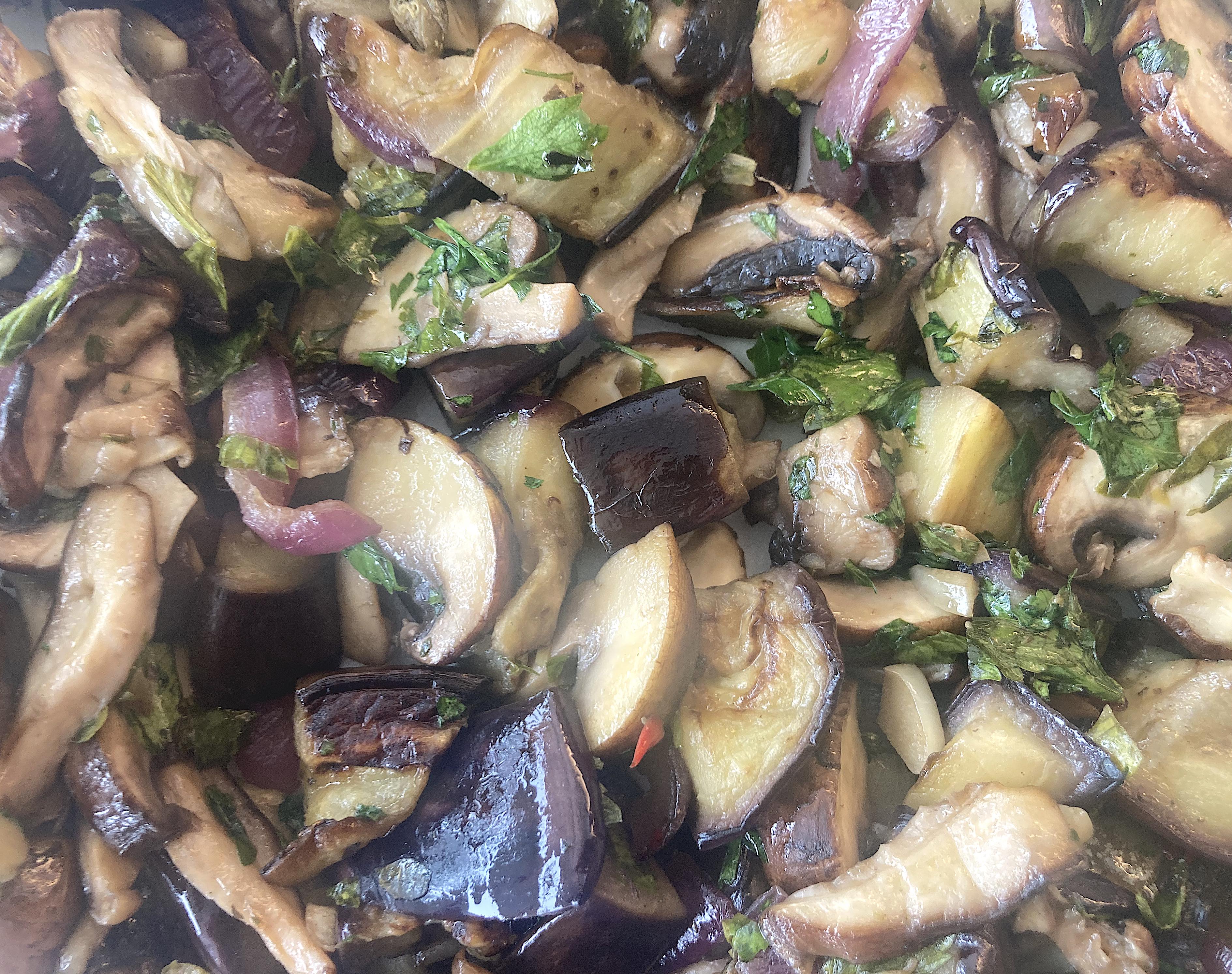
Mushroom Caponata

There must be hundreds of recipes for Caponata. The dish originates from Sicily and should contain (at least, we think so) eggplant (aubergine), celery and vinegar. Sugar is often added to enhance the sweetness and intensity. Nowadays it’s often a combination with tomatoes, shallot, capers, olives and perhaps raisins, pine nuts, oregano and basil.
The flavour of caponata should be slightly bitter (the eggplant) with a touch of sweetness (sugar, onion), acidity and saltiness (celery). The texture should be moist, but not sauce-like.
We love to enhance the flavours by adding mushrooms. And since we’re not keen on using sugar, we make sure the onions bring sufficient sweetness.

Enjoy your caponata as an appetizer, for instance with some crusted bread or bruschetta. A nice glass of white wine or rosé will be perfect with it. It’s also great as a side dish, with fish or even merguez.

Whatever the combination, caponata must be made one day ahead.

What You Need

  • 1 Aubergine
  • 200 grams of Mushrooms (preferably a mix with Shiitake)
  • 1 Red Onion
  • 1 Garlic Clove
  • 1 cm Red Chilli Pepper
  • Parsley
  • Celery
  • 2 tablespoons of White Wine Vinegar
  • Olive Oil
  • Fine Salt

What You Do

Wash the eggplant and slice. We slice the eggplant lengthwise in 8 and then we slice these strips. Salt them generously, transfer to a sieve and allow to drain for one or two hours. The more liquid they lose, the better! Rinse the eggplant with cold water and dry them with a kitchen cloth. Fry the aubergine in a heavy iron skillet until nicely golden brown. Set aside. Slice the red onion, clean and chop the mushrooms. Chop the garlic and the chilli pepper finely. Add some olive oil to the pan and fry the onion. Remove and set aside. Now fry the mushrooms. After 5 minutes or so add the garlic and the chilli pepper. After a few minutes add the mushrooms and the eggplant to the pan. Add chopped parsley and celery. Mix well. Add two spoons of white wine vinegar and leave on low heat for 10 minutes. Add black pepper to taste. Transfer to a plate and let cool. Keep in the refrigerator for the next day.

La Cuisine Minceur 

Michel Guérard (27 March 1933 – 19 August 2024) was probably one of the most influential French chefs. He was one of the founders of the Nouvelle Cuisine (basically the style of cooking with a minimum of butter, eggs and cream) and the inventor of the Cuisine Minceur: the slimming kitchen. Enjoy a three-course lunch or dinner without consuming too many calories.

In his restaurant Les Prés d’Eugénie in the southwest of France you can enjoy his slimming food. It’s a bit too expensive for our budget (the menus cost between € 275 and € 310 per person), so we were very happy to buy one of his books.

Sauce Vierge

Once upon a time, there was a simple sauce called Sauce Vierge. It wasn’t difficult to prepare, just beat butter until soft, then add lemon juice, salt and pepper and continue beating until fluffy. Serve with asparagus, leeks or other boiled vegetables. It was not the most exciting sauce ever and Sauce Vierge could easily have been forgotten.

The Nouvelle Cuisine changed the recipe by replacing the butter by olive oil. The new Sauce Vierge became a star. It was turned into a warm sauce and ingredients like garlic, tarragon, basil, parsley and chervil were added. Sauce Vierge became the ideal sauce to accompany fish.

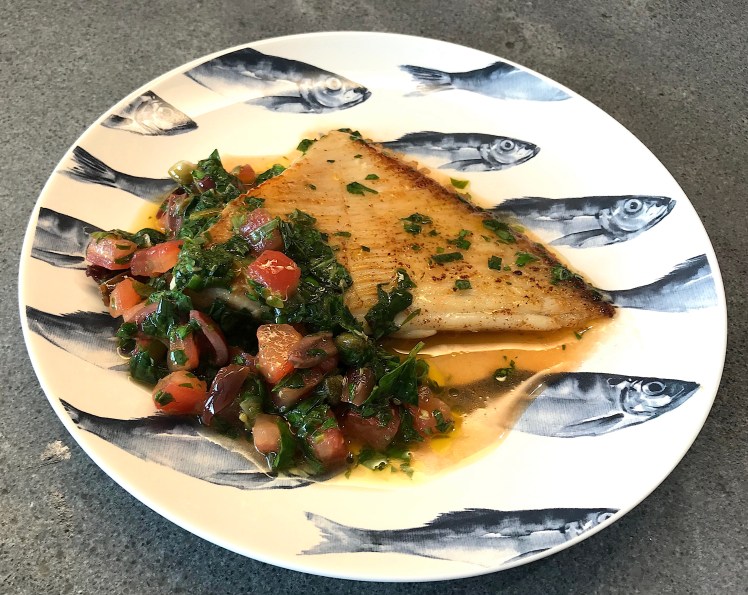
In 1977 Michel Guérard published his recipe of Sauce Vierge, including crushed coriander seeds and diced tomatoes. His suggestion is to serve it with sea bass and a puree of watercress. We serve the sauce with fried skate.

Sauce Vierge was a star, but the name wasn’t ideal. The term Antiboise became popular, especially outside of France. Antiboise is named after the city of Antibes in the south of France.

Books

La Cuisine Minceur was published in 1976, followed by Cuisine Gourmande in 1979 and many other books, including a Best Of (2015). His books are available via your local bookstore, the well-known channels (also second hand) and his webshop.

Wine Pairing

Given the powerful flavours (capers, olives, herbs, skate) we suggest a fresh white wine with lots of fruit and easy to drink. Our choice was a Verdejo produced by Mocen (Spain).
In general you’re looking for an easy to drink, white wine with intense aromas (tropical fruit). The flavours should be fresh, dry, fruity, round and balanced.

What You Need
  • Skate (or Sea Bass)
  • Olive Oil
  • Garlic
  • Lemon
  • Excellent Tomatoes
  • Basil
  • Parsley
  • Chives
  • Black Olives
  • Capers
  • Black Pepper
  • Butter
What You Do
  1. Heat some olive oil
  2. Add the crushed garlic glove
  3. Let it rest on low temperature until the oil is infused
  4. Peel and seed the tomatoes
  5. Chop in small cubes
  6. Cut the olives lengthwise in 8
  7. Cut the capers
  8. Roughly cut all the herbs
  9. Fry the skate in oil and/or butter until brown
  10. Remove the garlic
  11. Add lemon juice and tomatoes; mix
  12. Serve the skate on a plate, add the herbs, the olives, the capers and black pepper to the sauce, mix and serve the sauce on top of the fish. 
Skate with Sauce Vierge ©cadwu