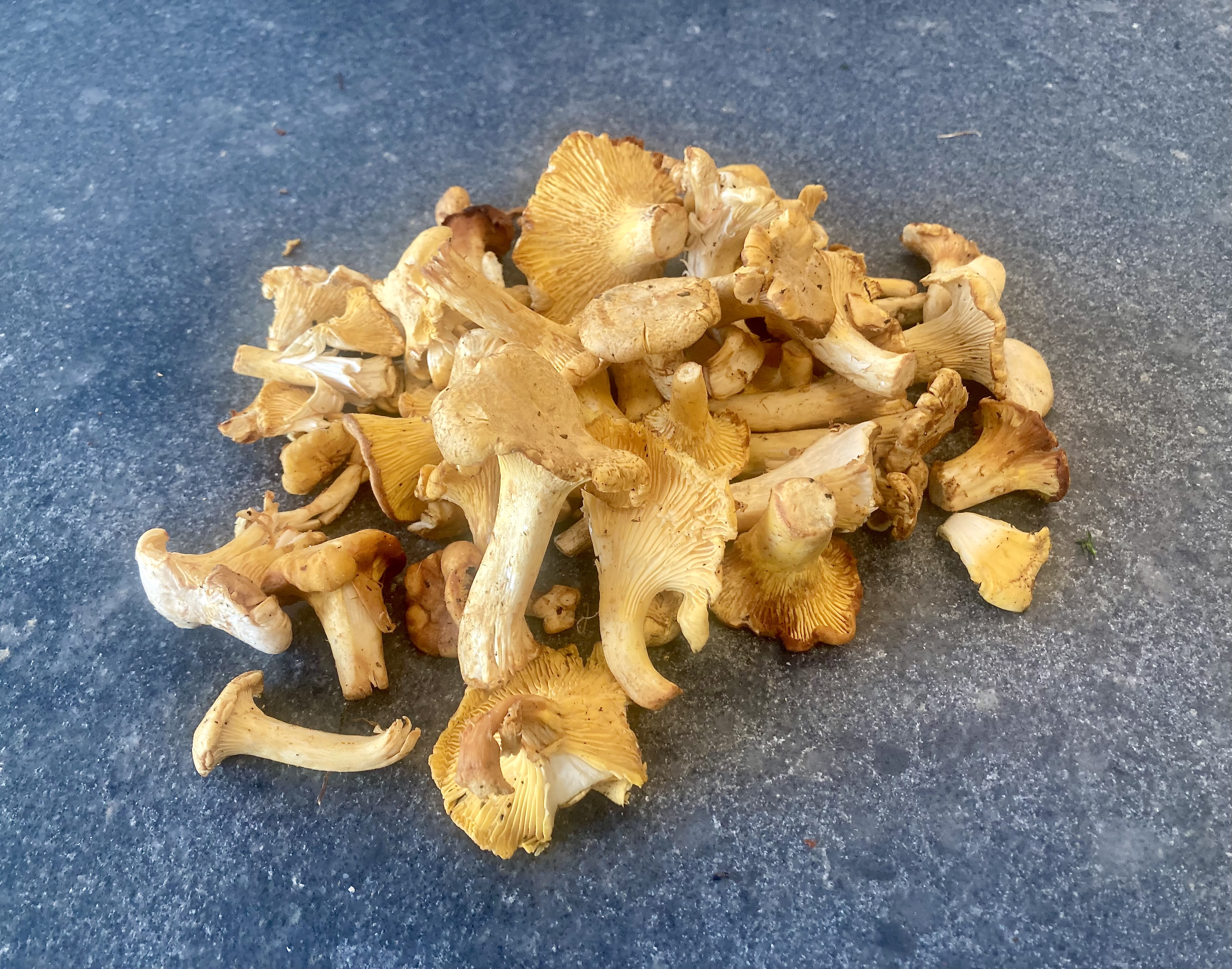
Summer Truffle and Golden Chanterelle

It’s always a great idea to combine seasonal ingredients: asparagus and morels, strawberries and rhubarb, summer truffle and golden chanterelle.
The season of the chanterelle runs from June to December. It’s a firm, bright yellow mushroom with subtle earthy, fruity flavour. It’s native to North America, Europe and Asia.
Summer truffles can be found between May and August. Their aroma and taste is very subtle. If slightly warmed, the flavour is more present (a bit nutty). If heated, the truffle loses its flavour.

The combination of chanterelle, truffle and cream is elegant and complex. The chanterelle gains depth from the truffle and vice versa. The pasta and the creamy sauce support the flavours beautifully.

Wine Pairing

We suggest a fruity, dry, red wine, with light tannins, for instance a Pinot Noir or perhaps a Gamay. We enjoyed a glass of Domaine Coudoulet Pinot Noir. This is a light, red wine from the Pays d’Oc in the south of France. It has a nice, light colour, aromas of strawberries, it’s refreshing and has a long finish. To be served somewhat chilled.

What You Need
  • 200 grams of Golden (Yellow) Chanterelle
  • 20 grams of Summer Truffle
  • 1 Garlic Clove
  • Stock (vegetable or chicken)
  • Cream
  • 1 teaspoon of Mustard
  • Parmesan Cheese
  • Spaghetti 
  • Olive Oil
  • Butter
  • Black Pepper
  • Salt
What You Do
  1. Add olive oil to a heavy iron skillet. Set on low heat
  2. Slice the garlic in 3 or 4 and add to the oil
  3. Leave the oil on very low heat for 10-15 minutes
  4. Clean the chanterelle with a brush. Take your time!
  5. Cut the chanterelle in 2 or 4, depending on the size
  6. Clean the truffle
  7. Grate a quarter of the truffle, slice the remainder
  8. Grate some Parmesan cheese, just to thicken and gently flavour the sauce
  9. Cook the spaghetti in boiling water with some salt until al dente, according to the instruction on the package
  10. Remove the garlic from the pan
  11. Add some butter to the pan and increase the heat
  12. Fry the chanterelle
  13. Reduce heat
  14. Add stock, mustard and cream. Combine
  15. Add Parmesan cheese. Combine
  16. Add the spaghetti to the pan
  17. Taste and adjust
  18. Just before serving add black pepper and grated truffle
  19. Combine and serve
  20. Decorate with the summer truffle slices 

Bouchée a la Reine au Poisson

Crispy, fluffy, flaky puff pastry and a rich, warm ragoût, what better way to turn leftovers into a tasty starter. Bouchée a la Reine: a classic in Belgium and France. Not modern at all, but such fun to serve (and eat). The Bouchée a la Reine goes back to the days of Queen Marie Leszcynska, wife of King Louis XV. The story is that she tried to win back the attention of her husband (who was more interested in Madame de Pompadour) with these delicious small pastries. She assumed they would work as an aphrodisiac. One of her chefs (Nicolas Stohrer, also founder of the oldest patisserie in Paris) is probably the creator of Bouchée a la Reine (and Baba au Rhum by the way).
Enough history: you could fill the pastry with fish, poultry, mushrooms, sweetbread, just about anything will go, as long as you use a rich roux as basis.
Our ragoût combines fish with (common) shrimps. We bought halibut, a fish with compact, firm meat and a delicate taste, one that goes very well with butter, herbs and lemon. 

Wine Pairing

It all depends on the filling of your Bouchée a la Reine. Could be a light red wine if you have some left over veal, if it’s sweetbread then a lightly oaked chardonnay is fine et cetera. In all cases keep in mind that the filling comes with a generous amount of butter. In this case we enjoyed a glass of Mâcon, produced by Thierry Drouin. The wine has aromas of green apples and citrus, with a touch of toast and some minerality. Great in combination with the rich ragoût and its flavours. Good value for money too!

What You Need
  • One small Shallot
  • 100 grams of firm, delicate Fish
  • 50 grams of small Shrimps
  • 15 grams of Butter
  • 10 grams of All Purpose Flour
  • Fish Stock
  • Chervil
  • White Pepper
  • 2 Bouchées
What You Do
  1. Dice the raw fish (bite size)
  2. Finely chop the shallot
  3. Chop the chervil
  4. Warm the fish stock
  5. Preheat your oven to 180 °C or 355 °F
  6. Gently heat butter in a skillet
  7. Add the shallot and glaze for 5 minutes or so
  8. Add the flour
  9. Softly fry the flour until you begin smelling that typical cookie aroma
  10. Start adding the warm stock, slowly at first, constantly whisking.
  11. When the ragoût is ready, transfer the bouchées to the oven and leave for 10 minutes
  12. After 5 minutes, add the fish and combine
  13. After a few minutes the fish will be cooked
  14. Remove the pan from the heat
  15. Add white pepper, shrimps and chervil
  16. Combine
  17. Transfer the bouchées to the plates
  18. Add ragoût, decorate with chervil and serve immediately
PS

Normally we make our own stock. In this case we bought fish fond produced by Jürgen Langbein. We added water (1:1) to get the right stock for the ragout.

Bouchée a la Reine au Poisson ©cadwu made with a béchamel, halibut, shrimps and chervil
Bouchée a la Reine au Poisson ©cadwu