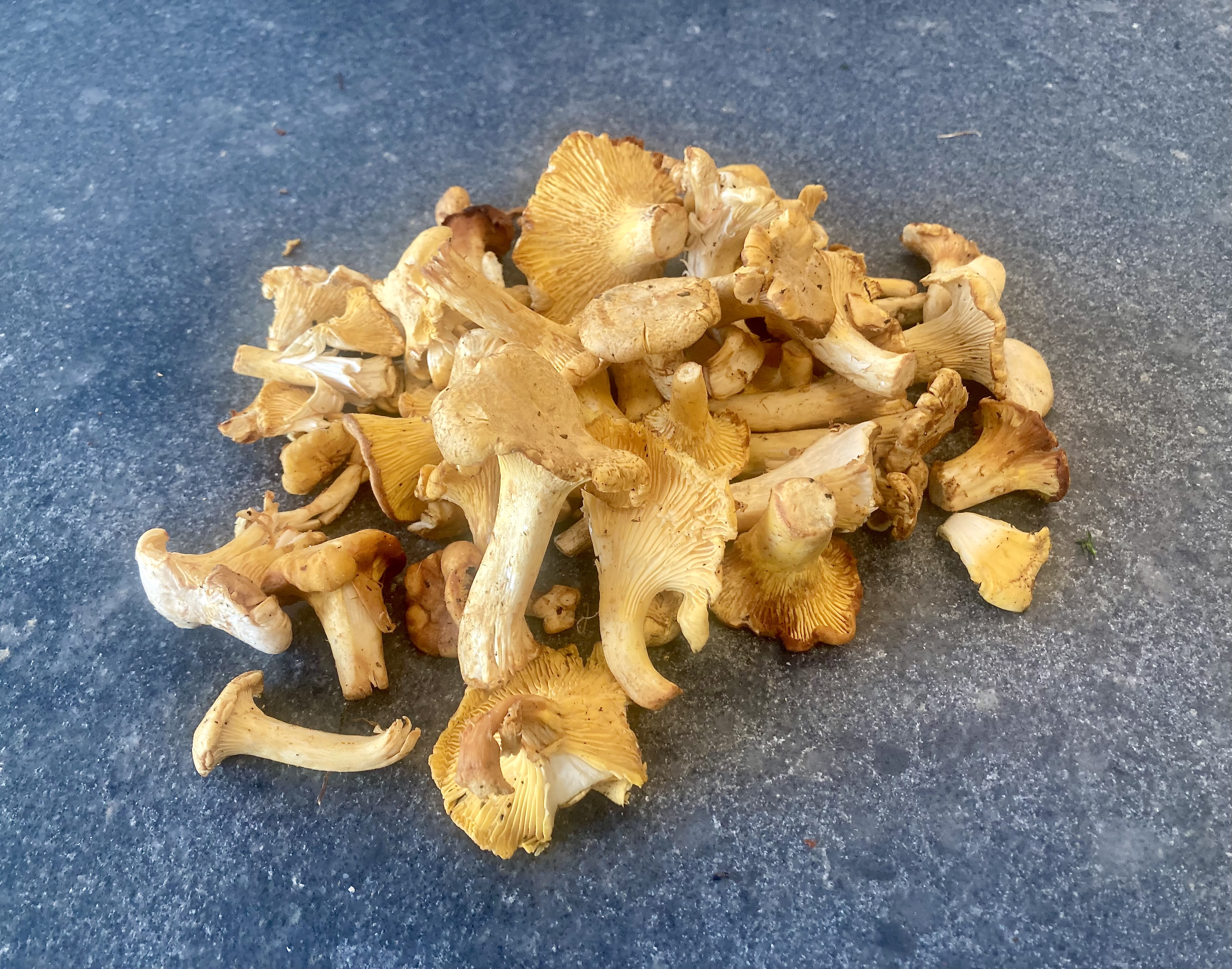
Summer Truffle and Golden Chanterelle

It’s always a great idea to combine seasonal ingredients: asparagus and morels, strawberries and rhubarb, summer truffle and golden chanterelle.
The season of the chanterelle runs from June to December. It’s a firm, bright yellow mushroom with subtle earthy, fruity flavour. It’s native to North America, Europe and Asia.
Summer truffles can be found between May and August. Their aroma and taste is very subtle. If slightly warmed, the flavour is more present (a bit nutty). If heated, the truffle loses its flavour.

The combination of chanterelle, truffle and cream is elegant and complex. The chanterelle gains depth from the truffle and vice versa. The pasta and the creamy sauce support the flavours beautifully.

Wine Pairing

We suggest a fruity, dry, red wine, with light tannins, for instance a Pinot Noir or perhaps a Gamay. We enjoyed a glass of Domaine Coudoulet Pinot Noir. This is a light, red wine from the Pays d’Oc in the south of France. It has a nice, light colour, aromas of strawberries, it’s refreshing and has a long finish. To be served somewhat chilled.

What You Need
  • 200 grams of Golden (Yellow) Chanterelle
  • 20 grams of Summer Truffle
  • 1 Garlic Clove
  • Stock (vegetable or chicken)
  • Cream
  • 1 teaspoon of Mustard
  • Parmesan Cheese
  • Spaghetti 
  • Olive Oil
  • Butter
  • Black Pepper
  • Salt
What You Do
  1. Add olive oil to a heavy iron skillet. Set on low heat
  2. Slice the garlic in 3 or 4 and add to the oil
  3. Leave the oil on very low heat for 10-15 minutes
  4. Clean the chanterelle with a brush. Take your time!
  5. Cut the chanterelle in 2 or 4, depending on the size
  6. Clean the truffle
  7. Grate a quarter of the truffle, slice the remainder
  8. Grate some Parmesan cheese, just to thicken and gently flavour the sauce
  9. Cook the spaghetti in boiling water with some salt until al dente, according to the instruction on the package
  10. Remove the garlic from the pan
  11. Add some butter to the pan and increase the heat
  12. Fry the chanterelle
  13. Reduce heat
  14. Add stock, mustard and cream. Combine
  15. Add Parmesan cheese. Combine
  16. Add the spaghetti to the pan
  17. Taste and adjust
  18. Just before serving add black pepper and grated truffle
  19. Combine and serve
  20. Decorate with the summer truffle slices 

Asparagus with Beurre Blanc

Nearly the end of the asparagus season in the Netherlands so we wanted to make a very special dish. One that combines the sweetness and the bitterness of the asparagus with freshness, the structure of the al dente asparagus with a velvety, rich mouthfeel. What better sauce to make than Beurre Blanc: a remarkable light French butter sauce.

The starting point of a Beurre Blanc is similar to that of Hollandaise and Béarnaise: a reduction made with shallot, vinegar, tarragon, black pepper and white wine. Inspired by Dutch chef Erik van Loo we added some Noilly Prat to the castric.

Wine Pairing

We enjoyed our Asparagus with a glass of white Rioja. The wine is made by Vivanco with three Spanish grapes: Viura, Tempranillo Blanco (a grape discovered in 1988) and Maturana Blanca (a local grape that goes back to 1622). The result is a bright, intense white wine with aromas of citrus fruit and green apples. Fresh, tasty and a great match with the flavours of the asparagus and Beurre Blanc.
In general, we suggest a non-oaked, fresh, dry white wine, with clear acidity. 

What You Need
  • For the Castric (25 ml)
    • 5 ml White Vinegar
    • 50 ml dry White Wine
    • 20 ml Noilly Prat
    • One coarsely crushed corn of Black Pepper
  • For the Beurre Blanc
    • 25 ml Castric
    • 60 grams of cold Butter
  • 6 Asparagus
What You Do
  1. Start by making the Castric
  2. Chop the shallot
  3. Combine all ingredients and leave to reduce by 2/3 on low heat
  4. Pass through a sieve; try to capture the juices of the shallot
  5. Set aside
  6. Peel the asparagus and remove one centimetre from the bottom
  7. Steam for 15 – 20 minutes
  8. Remove the asparagus from the steamer and allow to rest for 5 minutes
  9. Make the Beurre Blanc
    • Warm the Castric
    • Dice the butter
    • Add the butter, one by one, to the Castric
    • Whisk (either by hand or by using a hand blender)
    • Make sure the butter has completely dissolved before you add the next dice of butter
    • Whisk and repeat
  10. Serve the asparagus with the sauce on a luke warm plate
Asparagus with Beurre Blanc
Asparagus with Beurre Blanc ©cadwu

Authentic Dutch Pepernoten

Today, December 5th (actually December 6th), we celebrate the birthday (actually name day) of Sinterklaas or Sint Nicolas (270-343), patron saint of children (and Amsterdam), the Greek Bishop of Myra (now Demre), currently Turkey, but living in Madrid according to Dutch tradition and arriving end of November per steamboat. He rides a white horse over the rooftops at night and can be in different places at the same time. Very confusing but it makes perfect sense to children.

His assistants, (called Pieten), carry bags with sweets and presents. They used to be Zwarte Pieten (Black Pete) but thankfully that part of the tradition has now changed significantly making the Sinterklaas festivities more inclusive. Piet has become a Sooty Piet (they squeeze down and up sooty chimneys in order to deliver presents).

The celebration is not just about presents and sweets, it is about behaviour: Sinterklaas carries a big book with information about children: who has been good (sweets, presents) and who has been naughty (spanking with the birch rod that is used by Piet to sweep chimneys or being put in a now empty bag and taken back to Spain). Now you know why most Dutch and Belgian children become nervous and restless beginning of December!

Culinary

The culinary aspect of Sinterklaas is about sweets: chocolate letters (the first letter of your name), chocolate coins, marzipan figures, chocolate frogs (in a bathing suit, obviously) and mice (both stuffed with fondant), speculaas (spiced short crust), kruidnoten (as speculaas but slightly different) and pepernoten. Both kruidnoten en pepernoten were thrown through the room, for the children to look for.
The smaller sweets were part of a ritual: in the evening you would put a shoe in front of the fireplace (or a similar apparatus, as long as it was connected to a chimney, things became challenging with the introduction of central heating) and you would sing a traditional Sinterklaas song. If possible you would put a carrot in your shoe for Sinterklaas’ horse. The next morning the sweets would be waiting for you in your shoe. Wonderful memories!

Pepernoten

If you shop these days in the Netherlands, you will see lots and lots of pepernoten. One Dutch company specialises in pepernoten and produces them in over 50 flavours. These pepernoten are actually kruidnoten. In 1593 Carolus Battus mentions Peper-coecxkens. The recipe for the original pepernoot goes back to 1756 when Gerrit van den Brenk writes a book called Volmaakte onderrigtinge, ten dienste der koekbakkers of hunne leerlingen (which translates into something like Perfect lessons for cookie bakers and their pupils). The ingredients are honey, white rye flour, potash and grinded anise seed. Dutch pâtissier Cees Holtkamp modernized the recipe, enabling us to recreate pepernoten.

What You Need
  • 50 grams of Brown Caster Sugar
  • 75 grams of Honey
  • 150 grams of White Rye Flour
  • 2 grams of Salt
  • 20 grams of Water
  • 5 grams of Baking Powder
  • 6 grams of grinded Anise Seed
  • 10 grams of Water
  • Neutral Oil
  • No Pepper (despite the name!)
What You Do

Best option is to watch Cees Holtkamp preparing pepernoten with support from his granddaughter Stella. The video comes with English subtitles. An even better idea is to buy his book Dutch Pastry. It’s available via the usual channels or order it at your local bookstore. Price is approximately 20 – 25 euro or US dollar.
Combine sugar, honey and water in a pan. Heat the mixture without boiling. Remove from heat. Immediately add flour and salt. Use a kitchen aid with hooks to make the dough. It will be very sticky and odd. Allow to rest for a few hours.
Add baking powder, anise seed and water. Kneed, cover with plastic foil and allow to rest until the next day.
Preheat your oven to 180 °C or 355 °F traditional. Make small cubes and use your hands to turn these into balls. Generously coat a baking tin with oil. We used a spring baking tin, which is not what we should have done. It is better to use a seamless baking tin. Wet your hands with oil, coat every ball with oil and add to the tin. The tin must be completely filled, so the balls must touch each other. This way you get the typical rounded-cube-shape of pepernoten. If not, add some aluminium foil to the tin. Transfer to the oven and leave for 20 minutes. Detach the pepernoten as soon as possible.

PS

We could only find whole grain rye flour, which is not suitable for this recipe. Instead, we used all-purpose flour.

Recipes from 1790

Het Receptenboek van mevrouw Marselis (The Recipe Book of Mrs. Marselis) published in 1790 gives a wonderful insight in the household and kitchen of an upper middle-class family in the 18th century. Mrs. Marselis (the lady of the house) wrote down instructions for her cook. Mrs. Marselis enjoyed dinners and lunches when she was visiting friends and family, she read cookbooks and collected recipes. Back home she explained to her cook how to prepare the food that she wanted to be served to her family and guests. Unfortunately she doesn’t include menus, so it’s not clear how her meals looked. She probably served various dishes at once (Service à la Française) as was custom until the mid-19th century.

The cook and her staff (perhaps 4 people) worked many hours in the kitchen downstairs to prepare cakes, beef, fish, chicken, pies, cookies, veal, soups, ragouts etcetera. You won’t find many recipes for vegetables because these were considered to be phlegmatic (slimy, cold, wet) and perhaps even more important, vegetables were eaten by the lower classes.

500 Recipes

She does include a recipe for snow peas: these are cooked in butter and water. Adding chopped onion is optional. When the peas are soft, the cook adds some sweet cream and one or two beaten eggs. And one for spinach: it is cooked until really well done, then chopped and stewed with butter, nutmeg and stock.

Some of the recipes are intriguing, for instance: shrimps are cooked in water with vinegar, anchovies, peppers and mace. When done, the shrimps are combined with cold butter to be served with salmon. Others are very tempting, for instance ravioli with a filing made of veal, parsley, pepper, nutmeg, mace, Parmesan cheese and butter. Sounds yummy!

Mushrooms are also on the menu, so we decided to follow Mrs. Marselis instruction and prepare mushrooms cooked in cream. It’s a rich, tasty sauce that enveloped the pasta very nicely. The combination of mushrooms and nutmeg works remarkably well. One to prepare more often! Recipe this week on Thursday, July 14th.
The pasta was our own idea; Mrs. Marselis doesn’t mention what the sauce is supposed to accompany.

Het Receptenboek van mevrouw Marselis, in Dutch only, is out of print. A second-hand copy will cost approximately € 15,00.