
Garlic Soup

A few weeks ago John Rieber wrote about the miracle of garlic. He also explains the 10-minute rule and the way it creates additional benefits when using garlic. His post includes a recipe for a garlicky soup, a variation of Avgolemono.

The post made us think of ‘knofsoep’ (in English it would be ‘garsoup’) as described by author, poet and performer Johnny Van Doorn in 1988. He was known for his ecstatic performances, enabled by the use of various substances. His knofsoep, based on a recipe from Roman times, helped him through the day. The soup is uplifting, supports overall health and more specifically the liver. It is to be served with crusted bread and a glass of wine.
We adjusted the recipe slightly by using vegetable stock and adding some chives. The soup has a very mild, sweet garlic flavour (thanks to not roasting or frying the garlic) and complexity thanks to the herbs and the clove.

The original recipe (in Dutch) is available in his diary Door de Weken Heen, available for 5 euros, second hand only.

What You Need
  • 500 ml Vegetable Stock
  • 8 cloves of Garlic
  • 1 starchy Potato
  • Olive Oil
  • Bouquet Garni (Thyme, Sage, Rosemary, Parsley, Bay Leaf)
  • 1 Clove
  • 2 crushed Black Peppers
  • Parmesan Cheese
  • Chives
  • (optional) Black Pepper
  • (optional) Salt
What You Do
  1. Bring the stock to a boil
  2. Add garlic and potato
  3. Reduce the heat
  4. Add a small tablespoon of olive oil
  5. Add bouquet garni, clove and crushed black peppers
  6. After 40 minutes pass the soup through a sieve
  7. Use a spoon to capture all the flavours of the ingredients
  8. Reheat the soup
  9. Taste and adjust (salt, pepper)
  10. Garnish with Parmesan cheese and chives
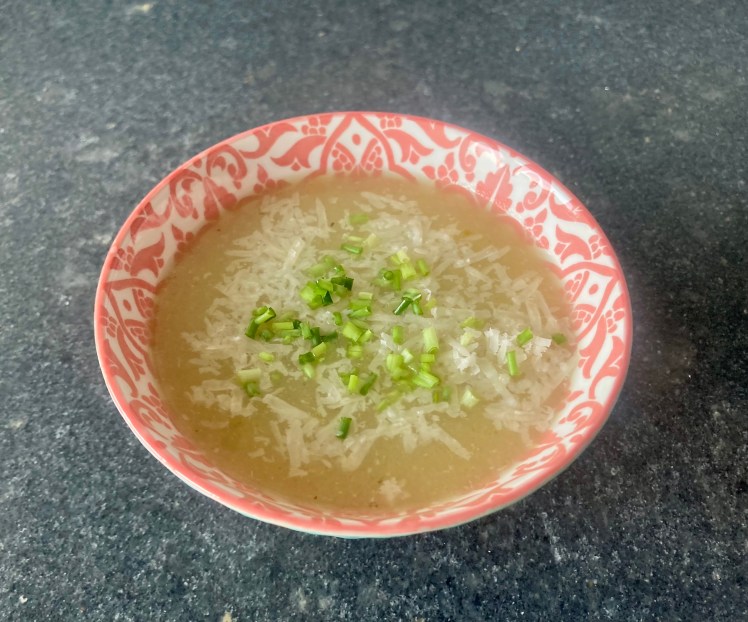
Garlic Soup ©cadwu made with garlic, potatoes, clove, bouquet garni, vegetable stock and decorated with parmesan cheese and chives
Garlic Soup ©cadwu

Bouchée a la Reine au Poisson

Crispy, fluffy, flaky puff pastry and a rich, warm ragoût, what better way to turn leftovers into a tasty starter. Bouchée a la Reine: a classic in Belgium and France. Not modern at all, but such fun to serve (and eat). The Bouchée a la Reine goes back to the days of Queen Marie Leszcynska, wife of King Louis XV. The story is that she tried to win back the attention of her husband (who was more interested in Madame de Pompadour) with these delicious small pastries. She assumed they would work as an aphrodisiac. One of her chefs (Nicolas Stohrer, also founder of the oldest patisserie in Paris) is probably the creator of Bouchée a la Reine (and Baba au Rhum by the way).
Enough history: you could fill the pastry with fish, poultry, mushrooms, sweetbread, just about anything will go, as long as you use a rich roux as basis.
Our ragoût combines fish with (common) shrimps. We bought halibut, a fish with compact, firm meat and a delicate taste, one that goes very well with butter, herbs and lemon. 

Wine Pairing

It all depends on the filling of your Bouchée a la Reine. Could be a light red wine if you have some left over veal, if it’s sweetbread then a lightly oaked chardonnay is fine et cetera. In all cases keep in mind that the filling comes with a generous amount of butter. In this case we enjoyed a glass of Mâcon, produced by Thierry Drouin. The wine has aromas of green apples and citrus, with a touch of toast and some minerality. Great in combination with the rich ragoût and its flavours. Good value for money too!

What You Need
  • One small Shallot
  • 100 grams of firm, delicate Fish
  • 50 grams of small Shrimps
  • 15 grams of Butter
  • 10 grams of All Purpose Flour
  • Fish Stock
  • Chervil
  • White Pepper
  • 2 Bouchées
What You Do
  1. Dice the raw fish (bite size)
  2. Finely chop the shallot
  3. Chop the chervil
  4. Warm the fish stock
  5. Preheat your oven to 180 °C or 355 °F
  6. Gently heat butter in a skillet
  7. Add the shallot and glaze for 5 minutes or so
  8. Add the flour
  9. Softly fry the flour until you begin smelling that typical cookie aroma
  10. Start adding the warm stock, slowly at first, constantly whisking.
  11. When the ragoût is ready, transfer the bouchées to the oven and leave for 10 minutes
  12. After 5 minutes, add the fish and combine
  13. After a few minutes the fish will be cooked
  14. Remove the pan from the heat
  15. Add white pepper, shrimps and chervil
  16. Combine
  17. Transfer the bouchées to the plates
  18. Add ragoût, decorate with chervil and serve immediately
PS

Normally we make our own stock. In this case we bought fish fond produced by Jürgen Langbein. We added water (1:1) to get the right stock for the ragout.

Bouchée a la Reine au Poisson ©cadwu made with a béchamel, halibut, shrimps and chervil
Bouchée a la Reine au Poisson ©cadwu

Asparagus with Beurre Blanc

Nearly the end of the asparagus season in the Netherlands so we wanted to make a very special dish. One that combines the sweetness and the bitterness of the asparagus with freshness, the structure of the al dente asparagus with a velvety, rich mouthfeel. What better sauce to make than Beurre Blanc: a remarkable light French butter sauce.

The starting point of a Beurre Blanc is similar to that of Hollandaise and Béarnaise: a reduction made with shallot, vinegar, tarragon, black pepper and white wine. Inspired by Dutch chef Erik van Loo we added some Noilly Prat to the castric.

Wine Pairing

We enjoyed our Asparagus with a glass of white Rioja. The wine is made by Vivanco with three Spanish grapes: Viura, Tempranillo Blanco (a grape discovered in 1988) and Maturana Blanca (a local grape that goes back to 1622). The result is a bright, intense white wine with aromas of citrus fruit and green apples. Fresh, tasty and a great match with the flavours of the asparagus and Beurre Blanc.
In general, we suggest a non-oaked, fresh, dry white wine, with clear acidity. 

What You Need
  • For the Castric (25 ml)
    • 5 ml White Vinegar
    • 50 ml dry White Wine
    • 20 ml Noilly Prat
    • One coarsely crushed corn of Black Pepper
  • For the Beurre Blanc
    • 25 ml Castric
    • 60 grams of cold Butter
  • 6 Asparagus
What You Do
  1. Start by making the Castric
  2. Chop the shallot
  3. Combine all ingredients and leave to reduce by 2/3 on low heat
  4. Pass through a sieve; try to capture the juices of the shallot
  5. Set aside
  6. Peel the asparagus and remove one centimetre from the bottom
  7. Steam for 15 – 20 minutes
  8. Remove the asparagus from the steamer and allow to rest for 5 minutes
  9. Make the Beurre Blanc
    • Warm the Castric
    • Dice the butter
    • Add the butter, one by one, to the Castric
    • Whisk (either by hand or by using a hand blender)
    • Make sure the butter has completely dissolved before you add the next dice of butter
    • Whisk and repeat
  10. Serve the asparagus with the sauce on a luke warm plate
Asparagus with Beurre Blanc
Asparagus with Beurre Blanc ©cadwu