Wild Garlic

From February to June, you can find Wild Garlic (Ramson(s) Daslook, Bear Leek, Ail des Ours, Bärlauch). It’s a shade-loving plant with beautiful white flowers that you can forage for in the woods or grow in your garden or on your balcony. If you decide to pick wild garlic, be careful not to pick its lookalike: the poisonous Lily of the Valley. Check if it’s wild garlic by grinding your fingers on the leaf. If you smell garlic and onion, you should be fine. If in doubt, don’t use it.
Wild garlic is much loved in Germany, Austria, France and other parts of Europe. The leaves and the flowers are edible (and so are the bulbs, but we haven’t tried these yet). Some sources mention that you should only eat the leaves before the plant starts flowering. But then you can’t combine the leaves and the tasty flowers in your dish, so we suggest ignoring that idea. The flowers are a touch sweet because of the honey. We suggest tasting the leaves and the flowers well before using. Adjust the quantities accordingly.
The taste is a bit like a combination of onion and garlic, but much greener, longer lasting and with a touch of bitterness at the end.  Works very well as a pesto, but equally nice with potatoes or gnocchi. You can also add the leaves and the flowers to a salad, but we feel the taste benefits from some warmth. Be very careful when cooking wild garlic because the flavour deteriorates quickly and at its best becomes unpleasant and onion-like. However, it’s possible to prepare a very tasty wild garlic soup.

We use wild garlic in four dishes. One is Farfalle with a wild garlic-based pesto, the second is a soup and the third is with white asparagus with morels and is published in the excellent book Mushrooms by Johnny Acton and Nick Sandler.

The cheese we use on our potato-wild-garlic-mash is Vacherin Fribourgeois. It originates from the region around the Swiss city Fribourg. It’s a semi-hard, creamy cheese made with raw cow milk. It matures for some 10 weeks in a damp cellar. Its taste is aromatic, floral, full-bodied and lasting, with a touch of sweetness, bitterness and umami. Ideal to combine with gnocchi or an omelette. Unfortunately, it’s not a widely available cheese. We bought it at one of our favourite cheese shops. You could replace it with Gruyère or perhaps Emmenthaler.

We combined out potato-wild-garlic-mash with a nice steak, but you could also serve it with an excellent organic sausage, perhaps one with sage?

Wine Pairing

The combination of the rich and flavourful mash and the red meat suggests a red wine with sufficient acidity, structure and tannins. We decided to enjoy a glass of Le Jardin de Queyron Pindefleurs 2018, Saint-Emilion, made from 78% merlot, 20% cabernet franc and 2% Cabernet Sauvignon grapes. It’s an elegant wine with aromas of dark fruit, liquorice and toast. The wine was a perfect balance with the various flavours in the dish.

What You Need
  • Floury (Starchy) Potatoes
  • Milk or Cream
  • Butter
  • Pinch of Salt
  • Cheese
  • Wild Garlic
What You Do
  1. Bring a pan of water with a pinch of salt to the boil
  2. Add the potatoes and cook until tender
  3. Transfer to a colander and drain
  4. Return to the pan (on low heat) and allow to dry
  5. Mash the potatoes using a fork or a potato masher
  6. Add hot milk, or cream and (melted) butter
  7. A few minutes before you serve the mash, coarsely chop the leaves and grate the cheese
  8. Quickly add the cheese, mix, taste, adjust, perhaps some more, perhaps some black pepper and then add the chopped leaves
  9. A few seconds later the mash is ready
PS

Watch this video (in English) about a communal garden in a park in Amsterdam, featuring Lynn and her beloved daslook.

Wild Garlic Soup

Only a few days to go before the end of the Wild Garlic season. The season starts early February when the first leaves appear. Mid-April the star shaped white flowers appear, beautiful and also edible. When the flowers go to seed it’s the end of the season and the leaves become bitter and chewy.

Wild Garlic can be used to make pesto, it can be added to a dish with white asparagus and morels and it’s delicious when combined with fennel and potato. Preparing Wild Garlic soup is also a good idea. The first time we tasted it, at Zum Fliegenden Holländer in Potsdam, Germany, we expected the soup to be a bit simple, probably we would taste onion, touch of garlic and potatoes. We were wrong, the soup was much more complicated and sophisticated than expected. The flavour was mild, we could clearly taste the Wild Garlic, but very gentle, with some sweetness. The overall taste was pleasant and lasting. Perhaps the potato was too present, but that was a minor detail. Bärlauchsuppe proofed to be delicious, refreshing and very much a tribute to spring.

What You Need

  • 150 grams of Wild Garlic Leaves
  • 500 ml of Stock
  • 1 Shallot
  • ½ Garlic Clove
  • Potato Starch
  • Cream
  • Olive Oil
  • Black Pepper
  • Nutmeg

What You Do

Wash and dry the leaves. Chop the shallot and the garlic. We were lucky, our bunch of leaves also contained a few flower buds. We chopped these as well. Warm a pan, add some olive oil and glaze the onions and the garlic (and the flower buds). After a few minutes add the stock. We used homemade quail stock, which brought additional sweetness to the soup. Leave to simmer for a few minutes. Coarsely chop the leaves, add these to the pan and leave for perhaps one minute. Be careful, you don’t want to discolour the leaves. Use a blender to make a smooth liquid. Pass the liquid through a sieve. Add one to two teaspoons of potato starch and mix very well. Add cream and leave for a few minutes. Just before serving add some excellent olive oil and black pepper, blender for 1 or 2 seconds and serve with some freshly grated nutmeg.

PS

We use potato starch to remain close to the basic idea of the Bärlauchsuppe in Potsdam. Potato Starch has a neutral taste and a high binding strength. If you use a (starchy) potato, then peel and cube it and add it to the stock. Remove the potato cubes when they are ready, add the chopped leaves, leave to simmer and then blender. Mash the potato cubes, combine with some of the liquid, add the mash to the soup and whisk well. If you blender the liquid with the potato, you risk ending up with a gluey, sticky soup.

Potato, Fennel and Wild Garlic

So many names for this great plant: Ramson(s), Wild Garlic, Bear Leek, DaslookAil des OursBärlauchRamsløgAglio Orsino, Allium ursinum, it is one of the highlights of spring. Powerful, pure and tasty. It can be harvested from the wild, but fortunately some green grocers also sell Wild Garlic. The taste is a combination of onion and garlic, but much greener, longer lasting and with a touch of bitterness at the end. You can turn the leaves into a strong pesto, but better use it as herb with for instance potatoes or gnocchi. It is also great when used in a dish with white asparagus and morels. The flowers are also edible and are a great decoration for savory dishes and salads.

We combine Wild Garlic with potatoes and fresh fennel. The anise-taste and the light crunchiness of the fennel go very well with this rich, lightly onion flavoured potato mash.

What You Need

  • Potato
  • Butter
  • Cream
  • Fennel
  • Wild Garlic
  • Black Pepper
  • Salt (optional)

What You Do

Dice the peeled potatoes and cook until ready to mash. Very finely dice some fennel, let’s say one tablespoon per one large potato. Add cream, butter and diced fennel to the mashed potato, mix and leave on very low heat. Remove the veins from the wild garlic leaves and tear the leaves, as you would do with basil. Add some of them to the mash, add black pepper and perhaps a pinch of salt. Leave for a few minutes, add more butter or cream if so required and more leaves. If you’re happy with the consistency and the taste, it’s time to add some more torn leaves to the mash. Serve immediately.

PS

Other elements on the plate are Saucisse de Morteau, Frankfurter and petit farci. More about the latter in one of our next posts!

Halibut with Morels

Seasonal eating is such a great idee. Simply buy (locally produced) seasonal fruit, vegetables and mushrooms, enjoy fresher and better tasting ingredients, reduce your carbon footprint and support your local community. And it creates lots of tasty opportunities: celebrate the beginning of the truffle season, the start of the asparagus season, the first red wine from the Beaujolais region – all good fun.

Part of the concept (at least, we think so) is commemorating the end of a season. In the Netherlands the morel-season ends early May. This year was a particularly good year for morels, we had some beautiful, tasty ones, for a reasonable price. But now it’s time to prepare the last morel dish of the season. And the last one with Ramson! A very tasty dish, one that requires a bit of work, but the result is absolutely yummy!

Wine Pairing

The richness of the dish requires a full-bodied white wine, for instance a glass of Chardonnay; one that has a touch of oak and vanilla plus a lightly buttery finish. Our choice would be the Chardonnay of La Cour des Dames

What You Need

  • Halibut
    • Halibut (slice with skin and bone preferred)
    • Olive Oil
  • Morels
    • 50 grams of Morels
    • Olive Oil
  • Sauce
    • Shallot
    • Olive Oil
    • Fish Stock
    • Noilly Prat
    • Crème Fraîche
    • Butter
    • White Pepper
  • Ramson (Wild Garlic)

What You Do

Clean and half the morels. Fry these gently in a heavy iron skillet for at least 10 minutes.
In parallel heat a small heavy iron skillet, gently fry the chopped shallot. When soft, add the garlic and one or two ice cubes of fish stock. Add a splash of Noilly Prat. When warm, blender the mixture, pass through a sieve and return to the pan. Add some crème fraiche. Warm through and through.
In parallel fry the halibut in a separate (non-stick) pan. First on the skin side, then turn the fish, remove the skin and turn again. The result should be golden. Whilst still in the pan, remove the bone. This gives you two portions of fish per person.
Slice a few leaves of ramson lengthwise, removing the vein.
When the fish is opaque, it’s time to add a bit of butter to the sauce and a touch of white pepper.
Serve the fish on top of the sauce, add the morels and the leaves.

PS

We served the halibut with morels on plates designed by Walter Gropius and produced by Rosenthal; a classic plate in Bauhaus Style.

Halibut with Morels ©cadwu

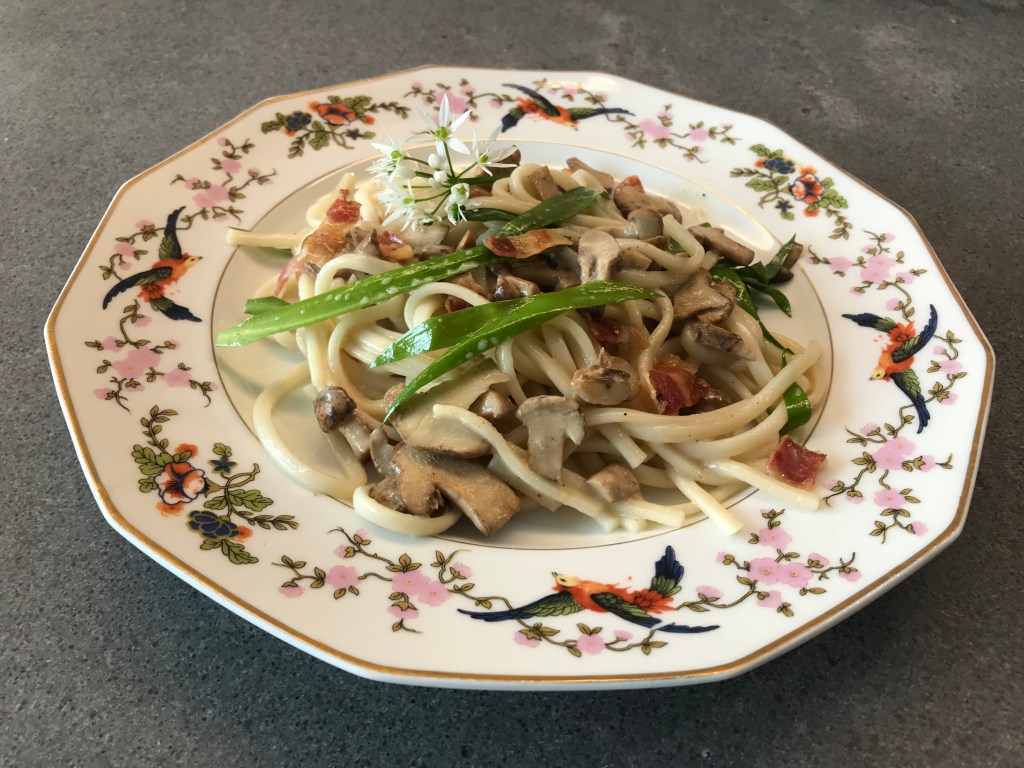
Saint George’s Mushroom with Pasta

Spring brings us several edible or even delicious mushrooms, such as the Mushroom of Saint GeorgeMorels and the Fairy Ring Mushroom.

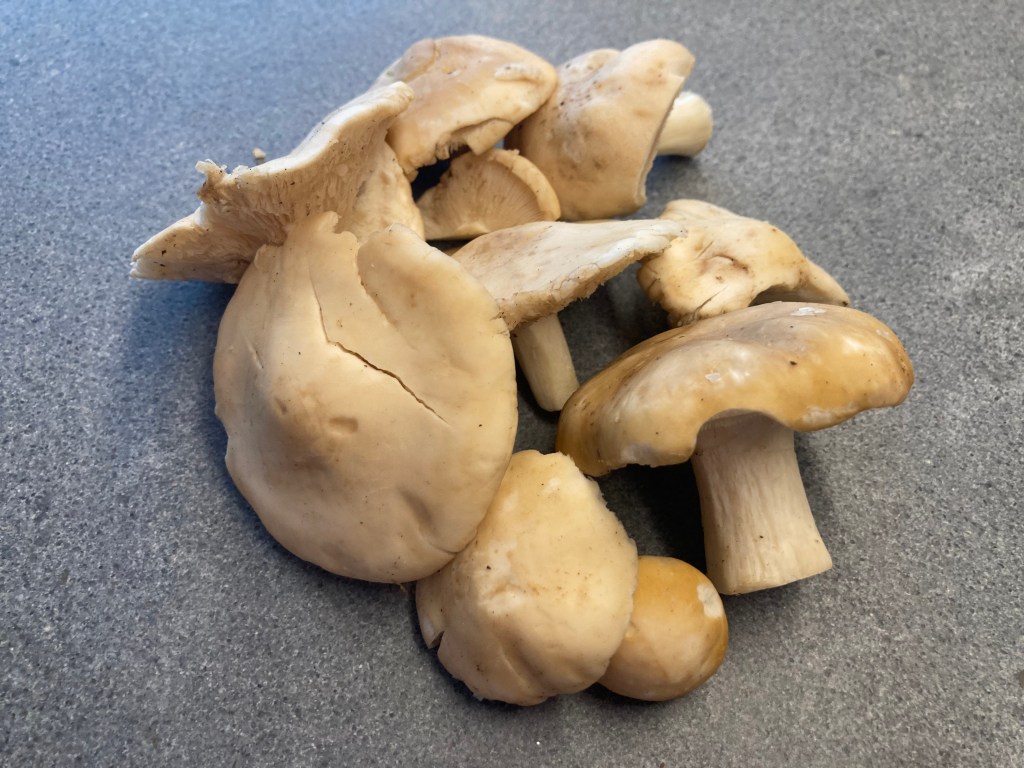
The mushroom of Saint George (Calocybe gambosa) is usually the first edible mushroom to appear. Its name derives from St George’s Day, 23rd April, by which date it can be found in the UK. Its French and Italian name (for instance Tricholome de la Saint-Georges in France) also refer to this day. Its Dutch name (Voorjaarspronkridder) and its Swedish name (Vårmusseron meaning spring mushroom) refer to the fact that the mushroom is available for a short period only.

Famous chef and author Jane Grigson isn’t a fan of the mushroom. In her classic book The Mushroom Feast she writes “I have omitted one or two which our mushroom books follow each other in praising too highly. One of these is the Saint George’s Mushroom.” 

Perhaps because the smell is so rare? Some say the mushroom smells of cucumber; others say melon rind or refer to a mealy scent. We think it’s more like overripe zucchini or even ghee that is a bit offish. In all cases, a not-very-pleasant-smell to remember. The good news is that the smell disappears as soon as you heat the mushrooms.

The mushroom of Saint George is clearly a spring-mushroom, but we think that you will have some reminiscence of autumn when eating this dish. A hint of earthiness. Intense but not overwhelming. However, the combination of ramson (wild garlic) and Saint George’s mushroom is 100% spring.

Confused? Perhaps that’s part of the fun of eating Saint George’s mushroom.

Wine Pairing

We suggest an oaked chardonnay, for instance Domaine De La Prade from the Languedoc region in France. The wine has a pale, yellow colour, aromas of ripe tropical fruit and its taste is intense, buttery and comes with a touch of oak. The wine has a long lasting taste. 

Feel free to go for a US or Australian Chardonnay. A full-bodied, gently oaked chardonnay will go very well with the mushroom and the udon.

What You Need

  • 1 bunch of Udon
  • 150 grams of Saint George’s Mushroom
  • Fresh Ramson (or Wild Garlic, 5 Leaves and Flowers)
  • Chicken Stock
  • Black Pepper
  • Crème Fraîche
  • 4 Slices of Excellent Pancetta
  • Olive Oil

What You Do

  1. Clean the mushrooms with kitchen paper and if necessary clean the stems with a sharp knife.
  2. Slice the pancetta in small slices.
  3. Heat a heavy iron skillet, add olive oil and quickly fry the pancetta.
  4. Transfer to a plate with kitchen paper and keep in the oven on 60° Celsius or 140° Fahrenheit.
  5. Slice the mushrooms, fry them gently in the pan and reduce the heat.
  6. Add chicken stock.
  7. Add some crème fraiche.
  8. In parallel cook the udon for 10 minutes.
  9. Drain the udon and keep some of the cooking liquid.
  10. Add the udon to the mushrooms in the pan, add black pepper and stir gently, making sure all pasta is covered.
  11. Add some cooking liquid to make sure it’s nice and moist.
  12. Add the pancetta and the sliced leaves (lengthwise, remove the vein) of ramson, mix and serve immediately.
  13. Decorate with a ramson flower.
  • Saint George's Mushroom with Pasta ©cadwu
  • Saint George's Mushroom with Pasta - Ingredients ©cadwu
  • Saint George's Mushroom ©cadwu
  • Domaine La Prade Chardonnay ©cadwu

Farfalle with Wild Garlic (or Ramson) and Parmesan Cheese

In a number of countries ramson is a protected plant, so we don’t suggest you run out of the door and start picking it. But if it’s not protected, feel free to start running!
Ramson is much-loved in Germany, Austria (Bärlauch) and other parts of Europe. Its taste is like a combination of onion and garlic, but much greener, more intense, longer lasting and with a touch of bitterness at the end. Works very well as a pesto, but equally nice with potatoes or gnocchi. Once we made ramson soup, but that was not the best idea ever.
The flowers may have (if you’re lucky) a touch of sweetness because of the nectar in the flower. Always taste the leaves and the flowers before using and feel free to adjust quantities.

Wine Pairing

We would suggest a Soave to go with the dish. The Garganega grape combines very well with the specific taste of the ramson, given the wine is fresh with a subtle bitterness.

What You Need

  • 20 or so leaves of Ramson
  • Olive Oil
  • Parmesan Cheese
  • Farfalle
  • Lemon Juice

What You Do

Cut the leaves in smaller bits and blitz the leaves with grated Parmesan cheese. If you want to soften the taste, now is the moment to add some toasted almonds or pine nuts. Slowly add the olive oil until blended and smooth. Maybe you want to add a bit of lemon juice.
Cook the farfalle and serve with the pesto and some grated Parmesan cheese.
You can store the pesto for a week or so in the refrigerator if you add some extra olive oil to the jar, covering the pesto.

White Asparagus with Wild Garlic (Ramson) and Morels

Ramson, Wild Garlic, Daslook, Bear Leek, Ail des Ours, Bärlauch: so many names for this great plant: Allium ursinum is one of the highlights of spring. Powerful, pure and tasty. Some say you should only eat the leaves before the plant starts to bloom. But then you can’t combine the leaves and the tasty white flowers in your dish, so we suggest ignoring that idea. The flowers are (if you’re lucky) just a touch sweet because of the nectar. It can be harvested from the wild, but some garden centers also sell ramson.
The taste is a combination of onion and garlic, but much greener, longer lasting and with a touch of bitterness at the end. You can turn the leaves into a strong pesto, but better use it as herb with for instance potatoes or gnocchi. See our recipe for Farfalle with Ramson (or Wild Garlic) and Parmesan Cheese.

Johnny Acton and Nick Sandler included two recipes in their classic book Mushrooms (published by Kyle Books and still available via for instance Amazon and other channels). One is a combination of Cod, Trompette des Morts (Black Trumpet) and Ramson. The other one is an intriguing combination of white Asparagus, Morels and Ramson.

Wine pairing

We suggest a full-bodied white wine with a fine acidity. For instance Herdade São Miguel, Colheita Seleccionada. The wine comes with distinctive minerals, along with excellent harmony and a long and well-balanced finish. It works well with the slight bitterness and sweetness of the asparagus; the gently onion and garlic taste of the ramson and the pancake-like taste of the morels.

What You Need

  • 6 White Asparagus
  • Morels (but even dried porcini will work)
  • Ramson
  • Chicken Stock
  • Crème Fraîche
  • Garlic
  • Butter
  • Shallot
  • Mushrooms by Johnny Acton and Nick Sandler