Salade Piémontaise
In the 1860’s Lucien Olivier was chef of the restaurant Hermitage in Moscow. The restaurant served a dish with luxurious ingredients, such as pheasant, caviar, lobster, tongue, potatoes, pickles and lettuce with a sauce, perhaps sauce Provençal. These ingredients were served separately on one plate. One evening some of the guests combined the ingredients into one dish, which was not the intention of chef Olivier, but when he tasted it, he found that the blend worked very well. He improved the sauce by adding one or more secret ingredients and the Olivier Salad was born!
It quickly became a very popular dish at the restaurant.
Sadly the recipe for the original Olivier Salad is not known. One of his sous chefs, Ivan Ivanov, wrote down what he thought was the recipe (without the secret ingredients, obviously), became head chef at another restaurant and sold the recipe to various publishers. It became known as Russian Salad. As more often, the popular version is made with less expensive ingredients, such as ham, chicken, carrots, green peas and mayonnaise.
In 1909 Tsar Nicholas II visited King Victor Emmanuel III in Racconigi, some 35 kilometres south of Turin. Russian chefs explained to their Italian colleagues how to prepare Russian salad. The Italian chefs used vegetables from the royal gardens such as carrots, peas, beans and potatoes (which we think is a bit odd given the luxurious ingredients of the original). The salad was decorated with cream to evoke the snow of the Russian steppes. It became very popular in the Savoy region, a region that included the Principality of Piedmont and the County of Nice, among others. In the south of France it is known as Salade Piémontaise.
The anecdote about the creation of the Olivier Salad seems credible, but is it? The second edition of The Modern Cook by Charles Elmé Francatelli (chef to Queen Victoria) was published in 1846. Recipe number 1215 is for…. Russian Salad! It is made with lobster, thunny (‘tuna’ we think), anchovies, crayfish, prawn tails, stuffed olives, capers and red mayonnaise (a combination of lobster coral, mayonnaise, cayenne pepper and mustard), to be served in a vegetable border (made with cauliflower, asparagus, beans, peas, potatoes, artichoke bottoms and aspic).
Two great chefs think alike?
We can’t recreate the Olivier Salad, but we can follow Francatelli’s instructions and make an original Russian salad.
Anyone?
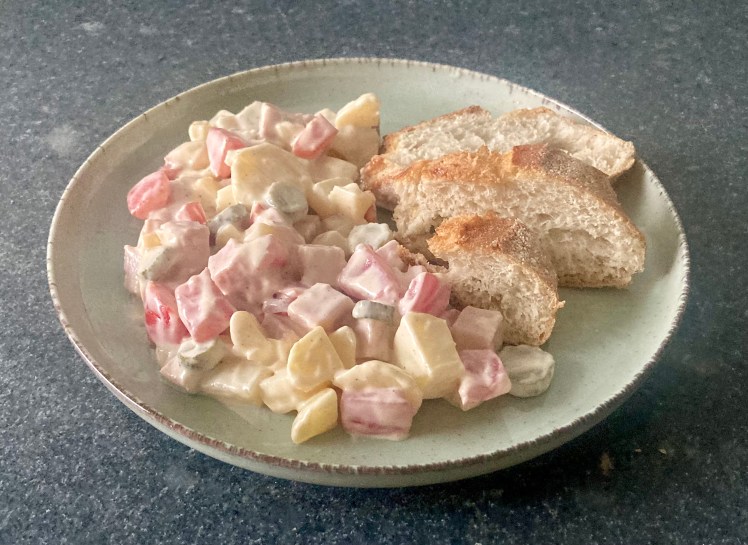
Our version of the Salade Piémontaise is based on the salad as sold by the Boucherie de France in Nice. It’s a surprisingly light dish that allows you to enjoy all ingredients, thanks to the lemon juice and the fairly neutral mayonnaise.
Wine Pairing
Piemonte is well known for its great wines, such as Barolo and Barbaresco, both made with Nebbiolo grapes. We decided to go for a more simple wine from the region, produced by Fontanafredda and made with 100% Barbera grapes. A wine that is fruity (black berries, plums) with low tannins and a relatively high acidity, which is very nice with the salad.
What You Need
- 250 grams of Potatoes
- 125 grams of Ham (one slice)
- 200 grams of ripe, excellent Tomatoes
- 1 organic Egg
- 10 Cornichons
- Black Pepper
- Lemon Juice
- Mayonnaise
What You Do
- Steam the potatoes, let cool, peel and dice
- Dice the ham
- De-seed the tomatoes and slice, same size as the potatoes and the ham
- Steam or boil the egg, let cool and dice
- Slice the cornichons
- Combine the ingredients
- Coat with mayonnaise and mix gently
- Add lemon juice, black pepper and adjust
- Leave in the refrigerator until cool
- Serve with crusted bread
PS
In 1852 Francatelli published A Plain Cookery Book for the Working Classes to help poorer members of society. The book contains 241 recipes with inexpensive ingredients. Not just royalty and exclusivity for him!