Beetroot Pie

Let’s enjoy the last fresh beetroots of this season by making a pie with lots of beetroot, cheese and thyme. The pie combines sweetness with savoury and slightly tangy flavours. Best to prepare a day in advance, allowing for the flavours to integrate. We top the pie with Chioggia beetroot because of their beautiful colour and pattern.

Wine Pairing

Caruso e Minini Terre Siciliane Bibbo Zibibbo, doesn’t that sound like a wonderful wine? The wine is produced by the Sicilian company Caruso e Minini, which explains the first part of the name. How about Bibbo Zibibbo? The grape used to make this wine is the Muscat of Alexandria, known as Zibibbo in Sicily. The wine is aromatic with fruity notes (think apricot, hints of almond and orange blossom). You will taste a gentle, dry wine with flavours of dried fruit. The wine has a long and present finish.
In general, we suggest a light, dry white wine with floral and fruity notes. It must have some sweetness to balance the taste of the beetroots.

What You Need
  • For the Dough
    • 100 grams of All Purpose Flour
    • 50 grams of Water
    • 10 grams of Olive Oil
    • 1 gram of Salt
  • For the Filling
    • One Red Beetroot
    • One Chioggia Beetroot
    • Firm Goat Cheese
    • One Red Onion
    • Thyme
    • Black Pepper
What You Do
  1. Clean the beetroots and wrap seperatly in aluminium foil
  2. Transfer to the oven at 180 ˚C or 355 ˚F and cook for 45-60 minutes, depending on the size
  3. Let cool
  4. Combine flour, salt, water and olive oil and make the dough
  5. Kneed for a minute or so and store in the refrigerator for at least 30 minutes
  6. Slice and quarter the onion
  7. Fry the onion on low heat in olive oil until soft
  8. Peel and slice the beetroots
  9. Roll out the dough using a rolling pin on a lightly floured surface. Coat a 15 cm or 6 inch round baking form with oil
  10. Cover the form with the dough
  11. Build the pie, first a layer of red beetroot, followed by grated cheese, onion, lots of thyme and black pepper
  12. Repeat
  13. Top with gioggia beetroot
  14. Brush the top with olive oil
  15. Transfer to the oven for 40-50 minutes on 180-200 ˚C or 355-390 ˚F
  16. Immediately after having removed the pie from the oven, brush the top with olive oil. This will intensify the colour of the crust
  17. Let cool and enjoy the next day; warm is best (preferably 65 ˚C or 150 ˚F)
PS

We didn’t explain Bibbo as part of name Caruso e Minini Terre Siciliane Bibbo Zibibbo . We believe it’s the pet name of Zibibbo.

Beetroot Pie ©cadwu made with fresh beetroots, goat cheese and lots of thyme
Beetroot Pie ©cadwu

Easy Mushroom Pie

Hurray! The mushroom season has started! Last Friday we bought beautiful golden chanterelles (girolles) and white beech mushrooms (shimeji). It’s the time of year to enjoy wonderful dishes such as Cèpes à la Bordelaise or Salad with Mushrooms and Smoked Duck. Will there be bay boletes this year? Or the intriguing Japanese Matsutake? It’s been some time since we last saw these on the market, and we would really love to make Matsutake with Spinach and Ginger again.
We decided to celebrate the start of the season by making an easy Mushroom Pie, packed with rich flavours, nuttiness and a touch of autumn.

Wine Pairing

We treated ourselves to a bottle of Pinot Noir from the Elzas region, made by Sophie Schaal. She produces wine in France and South Africa. The grapes are handpicked and then naturally fermented before ageing in French oak barrels for 10 months. The result is a wine with a deep ruby colour. The aromas suggest black fruit and a touch of vanilla. The taste is well balanced with soft tannins and length.
In general, you’re looking for a wine with red fruit and refined tannins. Some earthiness will match very well with the mushrooms and the taleggio.

What You Need
  • For the Pastry
    • 100 grams of Flour
    • 50 grams of Water
    • 10 grams of Olive Oil
    • 1 gram of Salt
  • For the Filling
    • 250 grams of firm Mushrooms (shiitake, golden chanterelles, beech mushrooms, button mushrooms)
    • 1 Organic Egg
    • 50 grams of Taleggio
    • 50 ml Double Cream
    • Thyme
    • 1 small Garlic Clove
    • Black Pepper
    • Olive Oil
    • 2 slices of Bacon (optional)
What You Do
  1. Combine flour, salt, water and olive oil
  2. Kneed for a minute and store in the refrigerator for at least 30 minutes.
  3. Clean the mushrooms and slice if necessary
  4. (Optional) Fry the bacon, let dry on kitchen paper and crumble. Add to the egg mixture (step 11)
  5. Lightly fry the mushrooms in a heavy iron skillet
  6. Transfer the mushrooms to a plate and let cool
  7. After 30 minutes: preheat the oven to 180 ˚ C or 355 ˚ F
  8. Combine the egg with the cream
  9. Add lots of thyme and black pepper
  10. Add grated garlic
  11. Add the mushrooms
  12. Slice small cubes of taleggio
  13. Add the cheese to the mixture
  14. Roll out the dough with a rolling pin on a lightly floured surface.
  15. Coat a 22 cm or 9-inch round baking tin with oil or butter
  16. Place the dough in the baking tin
  17. Add the mixture and distribute evenly
  18. Transfer to the oven for 35-40 minutes or until nice and golden
  19. Allow to cool for a few minutes
  20. Remove from the tin and let cool on a wire rack
  21. Serve lukewarm
PS

It tastes even better the next day!

An easy to make mushroom pie with rich flavours
Mushroom Pie ©cadwu

Pear Pie with Frangipane

Juicy, sweet ripe pears, frangipane and a crunchy crust, what more can you ask for! This very tasty pear pie is not difficult to make. The only challenge is finding ripe pears. The juicer the better!

Frangipane is a classic from the French pâtisserie and was first mentioned in 1652 by François Pierre (de) La Varenne. His recipe for Tourte de Franchipanne describes a crust made with puff pastry and a filling with what we would call crème pâtissière, enriched with crushed pistachios and almonds.
In her book Tarte TatinGinette Mathiot includes a recipe for Strawberry Frangipane. Same approach, but with crushed almonds only.

The current Larousse Gastronomique takes a different approach by beating sugar and butter until creamy (beurre pommade in French), then adding the eggs, one at a time, and the almond flour. No cooking required. Our approach is fairly similar, we combine soft butter, sugar and almond flour and then add the beaten egg.

Obviously, the recipe provided by Varenne is for a rich sauce whereas the second method is about making a paste, which is very suitable for a Pear Pie.

What You Need
  • For the Crust
    • 50 grams of White Caster Sugar
    • 100 grams of soft Unsalted Butter
    • ½ Egg (beaten)
    • 1 gram of Salt
    • 150 grams of All Purpose Flour
    • Cold Water (optinal)
  • For the Frangipane
    • 50 grams of Almond Flour
    • 40 grams of Sugar
    • 40 grams of Unsalted Butter (room temperature)
    • One Egg
    • Lemon Zest (optional)
  • For the Filling
    • 4 Ripe Pears (Williams, Bartlett, Conference)
  • For the Coating
    • Apricot Jam
    • Water
What You Do
  1. Start by making the dough
  2. Combine sugar and butter. Use a hand mixer with kneading hooks
  3. When mixed, add halve of the beaten egg
  4. Combine salt and flour
  5. Pass through a sieve and add to the mixture
  6. (optional) add some baking powder if you want a crispier crust)
  7. Use the kneading hooks to mix
  8. If the dough is too dry, add some cold water
  9. It’s ready when the pastry comes together in a ball that doesn’t stick to the surface
  10. When done, remove from the bowl and wrap in foil. Store in the refrigerator for at least two hours. The dough freezes well, so it’s a great idea to make a bit extra
  11. Now make the frangipane
  12. Combine almond flour, sugar and butter. Beat until fluffy
  13. Add the beaten egg
  14. Mix
  15. (optional) Add lemon zest
  16. Transfer to the refrigerator
  17. Preheat the oven to 180 °C or 355 °F
  18. Roll out the dough on a lightly floured surface and use it to line a 16 cm (6 in) tin. Best is 2 millimetres
  19. Transfer to the refrigerator and leave for 30 minutes
  20. Prick the pastry with a fork, to prevent air bubbles forming during baking
  21. Add the frangipane to the pastry case and spread evenly
  22. Peel and slice the pears, add on top of the frangipane
  23. Transfer to the oven for 30 – 40 minutes or until golden
  24. Use a fork to combine apricot jam and water, ratio 4:1
  25. Warm the apricot mixture
  26. When the pie is still warm, coat with the apricot mixture
PS
  • We made the crust with pâte sucrée, or sweet shortcrust pastry. The result is a flaky, crumbly crust. You could also use (ready-made) puff pastry or pate sablée. Adding a few grams of baking powder is an option when you want a lighter, crispier crust.
  • When we first saw a recipe for frangipane with pistachios, we wondered if that would be a good idea. Now that we have read the 1652 recipe, we will definitely give it a try.
Pear Pie ©cadwu
Pear Pie ©cadwu

Tarte Au Citron

The key to a tasty lemon pie is the quality of the lemon. Sounds obvious but unfortunately not every lemon is tart, aromatic and a touch sweet. Best are lemons used for limoncello: Sorrento (or Femminello), Eureka, Amalfi or Lisbon lemons. In all cases the lemons must be fresh, vibrant yellow, firm, untreated and organic.
The lemons we used needed a small aromatic push, that’s why we added one mandarin to the filling.
This recipe is for a classic tarte au citron or lemon pie. You could also make it with lemon curd, which we will do in a few weeks. 

What You Need 
  • Pâte Sucrée
    • 50 grams of Unsalted Butter
    • 40 grams of Caster Sugar
    • 125 grams of All Purpose Flour
    • 1 gram of Salt
    • 1 Organic Egg
    • Water (optional)
  • Filling
    • 2 Organic Eggs
    • Juice and Zest of 2 Organic Lemons
    • Juice and Zest of 1 Organic Mandarin
    • 50 – 70 grams of Caster Sugar (depending on the flavour of the Lemons)
What You Do
  1. Recipe for a 16 cm or 6 inch form or baking tin
  2. Combine sugar, flour and salt.
  3. Dice butter, add to the mixture and combine. Use a hand mixer with kneading hooks.
  4. Beat the egg and add.
  5. Use your hands to make the dough. It should not be sticky, so it must be easy to make a ball. If too dry, add just a bit of water. If too wet, add some flour.
  6. When done, remove from the bowl and wrap in kitchen foil. Store in the refrigerator for at least two hours. It can be stored for a few days.
  7. Flour your work surface and roll out the pastry to a circle larger than the top of the form. The dough should be approximately 4 mm thick.
  8. Coat the form with butter.
  9. Line the form with the pastry. Press the pastry well into the sides and bottom. Use a knife to remove the excess dough.
  10. Cover and let rest for 30 minutes in the refrigerator.
  11. Preheat the oven to 190 °C or 375 °F.
  12. Use a fork to prick small holes in the pastry.
  13. Line the pastry with greaseproof paper or aluminium foil, add baking beans and bake blind for 15 minutes.
  14. Remove the paper and the baking beans.
  15. Reduce the oven temperature to 160 °C or 320 °F.
  16. Transfer back to the oven for 5 minutes.
  17. Transfer to a wire rack and let cool.
  18. Mix eggs, sugar and zest.
  19. Add the mixture to the pastry case.
  20. Bake for 20 – 30 minutes or until set.
  21. Transfer to a wire rack, allow to cool. Remove from the tin and allow to cool completely.
Tarte Au Citron ©cadwu

Tourtes de Blettes Sucrée

A sweet pie with vegetables, Parmesan cheese and black pepper? It does sound a bit odd but actually the pie is very tasty and the savoury ingredients support the sweet character of the pie.
The pie is made with Blette, also known as Swiss ChardLeaf BeetSilver BeetSpinach BeetBietola (Italy), Bléa (France), Acelga (Spain), Krautsteil (Germany, Switzerland) and Snijbiet (the Netherlands). Once a popular vegetable, it can be hard to find or expensive. When preparing a savoury Tourte de Blettes we used Water Spinach (also known as Kang Koen or Ong Choy) which is a very popular vegetable in Asia. The leaves have lots of structure and the (hollow) stems are tasty and crunchy. 

As you would expect with a classic pie like this, recipes vary, Very often the tourte is made with sweet shortcrust pastry (butter, eggs, sugar and sometimes orange blossom water). The filling contains chard, Parmesan cheese, sugar, eau de vie, raisins, eggs, apples and pine nuts. We’re not keen on using pine nuts, so we didn’t add these to our filling. We thought it would be nice to add the orange blossom aroma to the filling, not to the pastry.

What You Need (Pastry)
  • 50 grams of White Caster Sugar
  • 100 grams of soft Unsalted Butter
  • ½ Egg (beaten)
  • 1 gram of Salt
  • 150 grams of All Purpose Flour
  • Cold Water (if the pastry is dry)
What You Do

Adding egg to the dough makes its flavour richer and easier to handle when lining the baking tin. Start by combining the sugar and the butter. Use a hand mixer with kneading hooks. When mixed, add halve of the beaten egg. Combine salt and flour. Pass through a sieve and add to the mixture. Use the kneading hooks to mix. When done, remove from the bowl and wrap in foil. Store in the refrigerator for at least two hours. The dough freezes well, so it’s a great idea to make a bit extra.

What You Need (Filling)
  • 500 grams of Chard
  • Handful of Raisins
  • 25 grams of Parmesan Cheese
  • 50 grams of Sugar
  • 1 or 2 teaspoons of Orange Blossom Water
  • Black Pepper
  • 1 Egg
  • Olive Oil
  • ½ Sour Apple (Bramley, Goudrenet)
What You Do
  1. Wash the chard, remove and discard the stems.
  2. Coarsely slice the leaves.
  3. Whisk the egg.
  4. Soak the raisins for 15 minutes in water (or rum). Pat dry.
  5. Peel and slice the apple into small cubes.
  6. Combine chard, raisins, grated cheese, sugar, orange blossom water, black pepper and a splash of olive oil. Be generous with the black pepper and the cheese. Mix.
  7. Add the beaten egg and mix.
  8. Divide the pastry in two.
  9. Line a baking tin with the pastry, prick holes in the pastry using a fork (docking).
  10. Add the filling, sprinkle with apple cubes, top with the remaining pastry and close.
  11. Prick holes in the pastry. Or apply the method of Cornish pasty, as we did.
  12. Bake in the oven at 180 °C or 355 °F for 30 minutes.
  13. Allow to rest on an oven rack.
  14. Best to be enjoyed the next day, so you must be a little patient.
  15. Dust with icing sugar.
PS

We must admit we took a short cut by using readymade Pâte Brisée. This is shortcrust pastry, without sugar. Perhaps it’s a good idea to reduce the amount of sugar in the pastry or skip it all together!

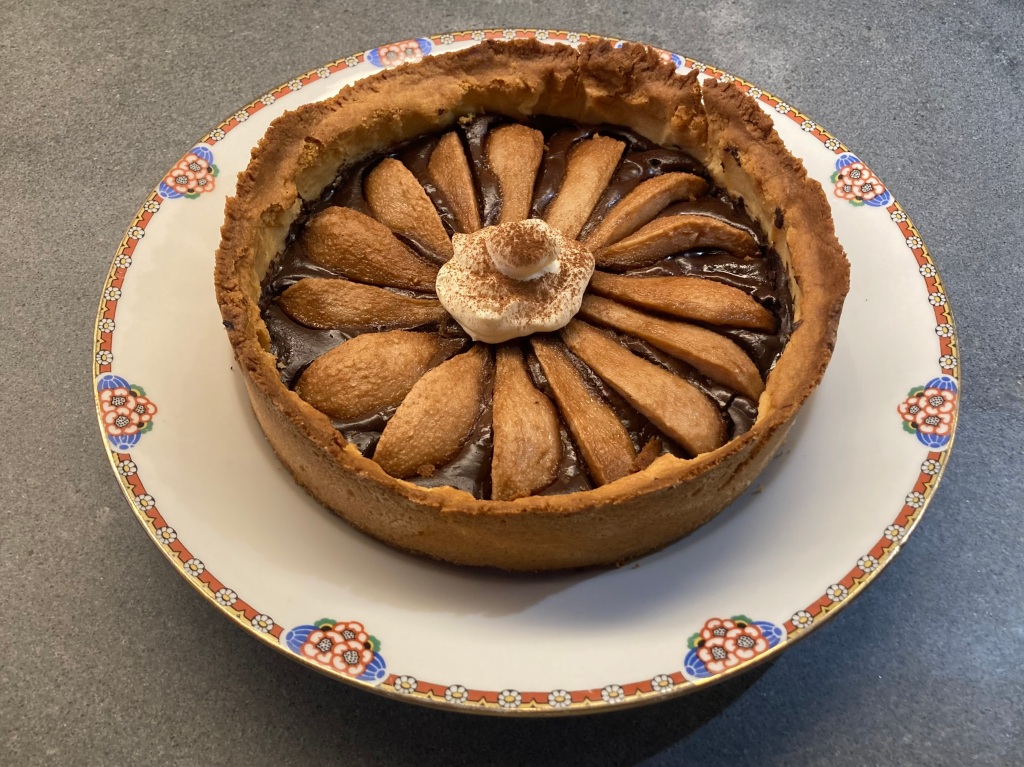
Pear and Chocolate Pie

A few weeks ago, we were very pleased to win the Great Bloggers Bake Off award in the pie-category with a Pear and Almond Pie. A delicious, uplifting combination that works very well thanks to the crème fraîche and the calvados. The Bake Off is organised by A Jeanne in the Kitchen.

Pear and chocolate is a match made in heaven, that’s why we decided to make a Pear and Chocolate Pie. The result is a rich, intense flavoured pie. A small slice with an espresso will make for a very nice dessert.

What You Need

  • Dough
    • 50 grams White Caster Sugar
    • 100 grams soft Butter
    • ½ teaspoon grated Lemon Peel
    • Pinch of Salt
    • ½ Egg
    • 3 grams Baking Powder
    • 150 grams All Purpose Flour
  • Almond Paste
    • 225 grams of White Caster Sugar
    • 250 grams of Almond Flour
    • One Egg
    • Lemon zest
  • Filling
    • 200 grams Chocolate
    • 50 grams Double Cream
    • 50 grams Sugar
    • 1 Egg
    • 1 Egg Yolk
    • Pears, preferably Doyenné du Comice (or Conference)
  • Decoration
    • Whipped Cream
    • Cinnamon Powder

    What You Do

    Start by making the Dough. Beat the egg. Combine sugar and butter until smooth. Add Lemon zest and salt. Mix. Add the egg. Mix. Combine baking powder and flour. Pass through a sieve and add to the mixture. Best is to use a kitchen mixer with kneading hooks. Wrap in foil and transfer to the refrigerator for at least two hours. The dough freezes well so not a problem if you’ve made too much.

    Now make the Almond Paste. Combine almond flour and sugar. Add one beaten egg and (optional) lemon zest. Mix until you have a paste. Keeps well in the refrigerator for a week and in the freezer for months. You could also use 250 grams of white almonds. Grind these and continue as if almond flour. In this case you need half the quantity (or less).

    Preheat the oven to 180 °C or 355 °F. Coat your pie tin with butter (we used a 15 cm, 6 inch tin). Roll out the dough, it should be 5 mm (0.20 inch). Line the tin with the dough. Don’t worry if the dough breaks; it’s easy to repair. Remove the excess dough. Line with aluminium foil or parchment paper, add baking beans and bake the pie blind for 15 minutes.

    When the pie is in the oven, it’s time to make the Filling. We used cooking chocolate, that makes life a lot easier. Add the broken chocolate to the cream and melt gently in the microwave (set to low power) or au bain-marie. Add sugar. Allow to cool. Lukewarm is fine. Beat the egg.

    Use almond paste to make a thin layer on the bottom of the pie. Take half of the chocolate mixture and (using a spatula) add a layer of chocolate on top of the almond paste. Add the egg to the remaining chocolate, mix well and make a third layer. Peel the pears, quarter and push the pears into the mixture. Bake in the oven for 20 minutes (depending on the pears and the mixture).
    Allow to cool and then remove from the tin.

    Pear and Chocolate Pie ©cadwu
    Pear and Chocolate Pie ©cadwu

    Lemon Curd

    A Lemon Meringue Pie, a Tarte au Citron or Scones with Lemon Curd: tasty, refreshing, bitter, sour, a bit sharp and sweet. We love it! Provided of course that the lemon is more than just juicy and sour.

    This has been a bit of an issue over the past years. Similar to the German consumers who complained about the watery and flavourless Dutch tomatoes they bought around 1990, we think that most lemons lack aroma and taste. We tried limes, bought more expensive lemons, added a bit of yuzu, but in the end, we still missed the true taste and aroma of an old-fashioned lemon.

    Until one day we bought a Bergamot lemon. Its aroma is intense, floral and long. The juice is sour, deeply citrusy, refreshing and bright. Exactly what we were looking for! We went home and prepared a lovely curd.

    Recently we had a similar experience when we visited a dear friend. She grows a Makrut (or Thai) Lime tree, also known as Makrut Lime, in her garden mainly because she wants to use the fresh leaves in Thai and Indonesian dishes such as Tom Yum, Soto Ayam and various curries. The leaves have a complex citrus flavour with floral notes. We talked about the lovely yellow fruit and how you could use its very aromatic zest as well.
    The fruit contains little juice, so when preparing a curd with Makrut limes, you need to add lime, Bergamot or lemon juice.

    What You Need

    • 65 ml of Lemon, Lime, Bergamot and/or Makrut Lime Juice
    • 65 grams of Butter
    • 100 grams of Sugar
    • One Egg
    • Zest

    What You Do

    Beat the egg, melt the butter and combine all ingredients. Make sure the sugar is dissolved. Cook Au Bain Marie until you have the right consistency. Or transfer to your microwave, put it on 50% or 70% power and heat with intervals of 20-30 seconds. Mix between the intervals. This is a very precise way of heating the mixture and it gives you full control over the process. Towards the end of the process you may want to reduce the power or shorten the intervals. The percentage and the duration of the intervals depend on your microwave and the bowl you use. We use a microwave saucepan (£1,29 only) and it works perfectly. The material doesn’t absorb warmth, so the mixture doesn’t get extra heated when you stop the microwave. Pass through a sieve (you don’t want the zest in the curd), cool in a water bassin and store in a jar.
    The curd keeps for a week in the refrigerator .

    PS

    Around 1992 a German television program characterised the Dutch tomatoes as watery and tasteless, and called them ‘wasserbombe’. The short-term impact was enormous: the Dutch tomato went from 50% market share in Germany to something close to zero. Longer term the impact was very different: Dutch producers invested in their product, making their tomatoes tastier, richer and more diverse.

    Beet Greens Pie

    Such a cheap and delicious vegetable: beets! Grilled, cooked, braised, combined with other vegetables or on its own, as a salad or straight from the oven. And so many varieties! Deep red, orange (chiogga), purple, golden and even white. All these beets have one thing in common: they come with leafs, with greens. Most retailers (and their customers) are not interested in the greens and therefore the leaves are discarded before the beets reach the shop. Which is a pity because they are as tasty as the beets. Use the greens in a salad, prepare them like you would prepare spinach or, even tastier, use the leaves as main ingredient of a pie.

    Tourte de Blette

    Some time ago we published the recipe for Tourte de Blette. When preparing it we were inspired by a dear friend who bases her Tourte on the Italian Torta Verde del Ponente Ligure. This is a very similar dish with zucchini, chard, basil, sage, rise, onion, Grana Padano or Parmesan and eggs. The dough of the Torta Verde is easy to work with and the result is both tasty and crunchy. It works really well for our Tourte de Blette so we decided to use it for this pie as well.

    Wine Pairing

    A not too complex white wine will be a great idea. You could also drink a glass of rosé with it, for instance a Côtes de Provence. Drinking a beer with your pie is also an excellent idea.

    What You Need

    • For the Dough
      • 100 gram of Flour
      • 50 gram of Water
      • 10 gram of Olive Oil
      • 1 gram of Salt
    • For the Mixture
      • Greens of 3 or 4 Beets
      • One Shallot
      • Olive Oil
      • 50 grams of Cooked Rice
      • 1 or 2 Eggs
      • 50 gram Freshly Grated Parmesan Cheese
      • Black Pepper

    What You Do

    Cook the rice and leave to rest.  Combine flour, salt, water and olive oil. Make the dough, kneed for a minute or so and store in the refrigerator for at least 30 minutes.
    Remove the leaves from the stem and chop the stems. Slice the leaves coarsely. Best is to have the stem slices the size of the cooked rice. Same for the shallot. Warm a large heavy skillet, gently fry the shallot. After 10 minutes add the chopped stems. Leave for 10 minutes and then add the leaves. Cook for a few minutes until done. Transfer to a plate and let cool.
    Slice the mixture using a kitchen knife. Whisk the two eggs. Combine the vegetables, the egg, the rice and the freshly grated Parmesan cheese. Add black pepper.
    Cut the dough in two, one part slightly bigger than the other. The bigger part will be the bottom, the smaller part the top. Roll out the bigger one with a rolling pin on a lightly floured surface. Coat a 15 cm or 6 inch round baking form with oil (or use a sheet of baking paper). Place the first disk in the baking form, add filling and close with the second disk of dough. Fold the edge of the top piece of dough over and under the edge of the bottom piece of dough, pressing together. Make holes in the top, allowing for the steam to escape. Transfer to the oven for 40 – 50 minutes on 180˚ – 200˚ Celsius or 355˚ – 390˚ Fahrenheit. Immediately after having removed the pie from the oven, brush the top with olive oil. This will intensify the colour of the crust. Let cool and enjoy luke warm.

    Artichoke Pie

    A few days after we published our recipe for Tourte de Blette a friend told us about the great taste of artichoke pie and how popular this dish is in Italy, especially in Liguria. Since we love artichokes, we dived into our cooking library, looking for recipes.
    Interestingly most recipes refer to canned or marinated artichokes. But wouldn’t it be much better to use fresh, young artichokes? Other ingredients are cheese (Prescinsêua, or a combination of Parmesan or Pecorino and Ricotta, perhaps some Crème fraîche or even Feta), herbs (parsley, thyme or oregano) and eggs.
    We like the combination of artichoke and thyme (as we did in our salad), but we could imagine oregano to be a good choice as well.
    We remained close to Tourte de Blette and prepared a rustic, open pie, but feel free to create one with pastry on top.

    Wine Pairing

    It’s not straightforward to pair artichokes with wine. According to various researchers this is due to cynarin, a chemical especially found in the leaves of the artichoke. When the wine and the cynarin meet in your mouth, the natural sweetness of the wine is amplified, making it taste too sweet. So you have to pair freshly cooked or steamed artichokes with a bone-dry, crisp, unoaked white wine with clear, present acidity. For instance Sauvignon Blanc, Grüner Veltliner or Albariño.
    We enjoyed our Artichoke Pie with a glass of Château Pajzos Tokaj “T” Furmint, a dry, bright, fresh wine with zesty, nutty and mineral flavours made from the Hungarian Furmint grape. A unique wine and perfect in combination with the artichokes.
    Cynarin and wine are not a match made in heaven but the good news is that cynarin seems to protect your liver and even helps it regenerate.

    What You Need

    • For the Dough
      • 100 gram of Flour
      • 50 gram of Water
      • 10 gram of Olive Oil
      • 1 gram of Salt
    • For the Mixture
      • 4-6 young Artichokes
      • One Shallot
      • Olive Oil
      • 30 grams of Rice
      • 2 Eggs
      • Fresh Thyme
      • 20 gram Freshly Grated Parmesan Cheese
      • Black Pepper

    What You Do

    Cook the rice and leave to rest.  Combine flour, salt, water and olive oil. Make the dough, kneed for a minute or so and store in the refrigerator for at least 30 minutes.
    Clean the artichokes, steam for 30-45 minutes depending on the size and let cool. Chop the shallot. Warm a heavy skillet, add olive oil and gently fry the shallot. Transfer to a plate and let cool. Using a spoon remove the ‘meat’ from the leaves (bracts) of the artichokes. Chop the hearts in four. You may need to remove the centre choke (the hairs). Strip a generous amount of thyme.
    Whisk two eggs and combine with the artichokes, the shallot, the rice, the thyme and the freshly grated Parmesan cheese. Add some black pepper.
    Roll out the dough with a rolling pin on a lightly floured surface. Coat a 15 cm or 6 inch round baking form with oil (or use a sheet of baking paper). Place the dough in the baking form and add the filling. Transfer to the oven for 40-50 minutes on 180˚-200˚ Celsius or 355˚-390˚ Fahrenheit. Immediately after having removed the pie from the oven, brush the outside with olive oil. This will intensify the colour of the pastry. Let cool and enjoy luke warm.