Three Winter Soups

A few weeks ago, we enjoyed a delicious vegan dinner at Lokaal, a small restaurant in the centre of Gent, Belgium. Friendly service, relaxed atmosphere and nice music. One of the specialties of Lokaal is fermentation, for instance homemade Tempeh from Bulgur. Lots of umami and length. We loved it!
Our dinner at Lokaal started with a nice winter soup made with kale and kohlrabi. We’re not the biggest fans of kale, but in this case it worked very well. The kohlrabi gave a nice, uplifting touch to the soup.

It made us think of other winter soups, like parsnip and Jerusalem artichoke soup, and parsley root soup. Ah, those forgotten vegetables! They bring us new flavours and combinations.

We used vegetable stock for all three soups. It is made with Carrot, Onion, Leek, Celery and Black Pepper (and optional a bouquet garni). Easy to make and lots of flavour. It freezes well, which makes it an even more important asset.

What You Need (Kale and Kohlrabi soup)
  • 500 ml Vegetable Stock
  • 200 grams of Kohlrabi
  • 50 grams of Kale
  • French Mustard
What You Do
  1. Clean the vegetables
  2. Devein the kale
  3. Peel the kohlrabi
  4. Coarsely chop the vegetables
  5. Warm the stock
  6. Add the kohlrabi
  7. Leave to simmer for 10 minutes
  8. Add the kale
  9. Leave to simmer for 10 minutes
  10. Use a blender to make a relatively smooth soup
  11. Add mustard to taste
  12. Serve
  13. PS The soup doesn’t keep well, so not one for the refrigerator
What You Need (Parsnip and Jerusalem Artichoke soup)
  • 500 ml Vegetable Stock
  • 200 grams Parsnip
  • 200 grams Jerusalem Artichokes
  • White Pepper (optional)
What You Do
  1. Clean, peel and coarsely chop the vegetables
  2. Warm the stock
  3. Add the vegetables
  4. Leave to simmer for 15 minutes or until the vegetables are done
  5. Use a blender to make a smooth and creamy soup
  6. Depending on the Jerusalem Artichokes the soup can become fairly thick. Add some stock if so required
  7. Taste (optional: add some white pepper)
  8. Serve
  9. PS You can also enjoy the soup the next day, it keeps well in the refrigerator
What You Need (Parsley Root soup)
  • 500 ml of Vegetable Stock
  • 200 grams Parsley Root
  • 1 small Shallot
  • ½ Leek (white only)
  • 1 small clove Garlic
  • Butter
  • Parsley
What You Do
  1. Warm butter in a pan
  2. Peel and coarsely chop parsley root
  3. Coarsely chop leek and onion
  4. Glaze onion and leek in butter
  5. Add parsley root
  6. Add garlic
  7. Leave on low heat for 5 minutes
  8. Add stock
  9. Simmer for 20-30 minutes or until the parsley root is soft
  10. Blender
  11. Pass through a sieve
  12. Simmer for 10 minutes
  13. Cool
  14. Serve the next day
  15. Decorate with chopped parsley leaves
Kale and Kohlrabi Soup made with vegetable stock. An intriguing combination. The kohlrabi gives this winter soup an uplifting flavour. ©cadwu
Kale and Kohlrabi Soup ©cadwu

Tomato and Halloumi Salad

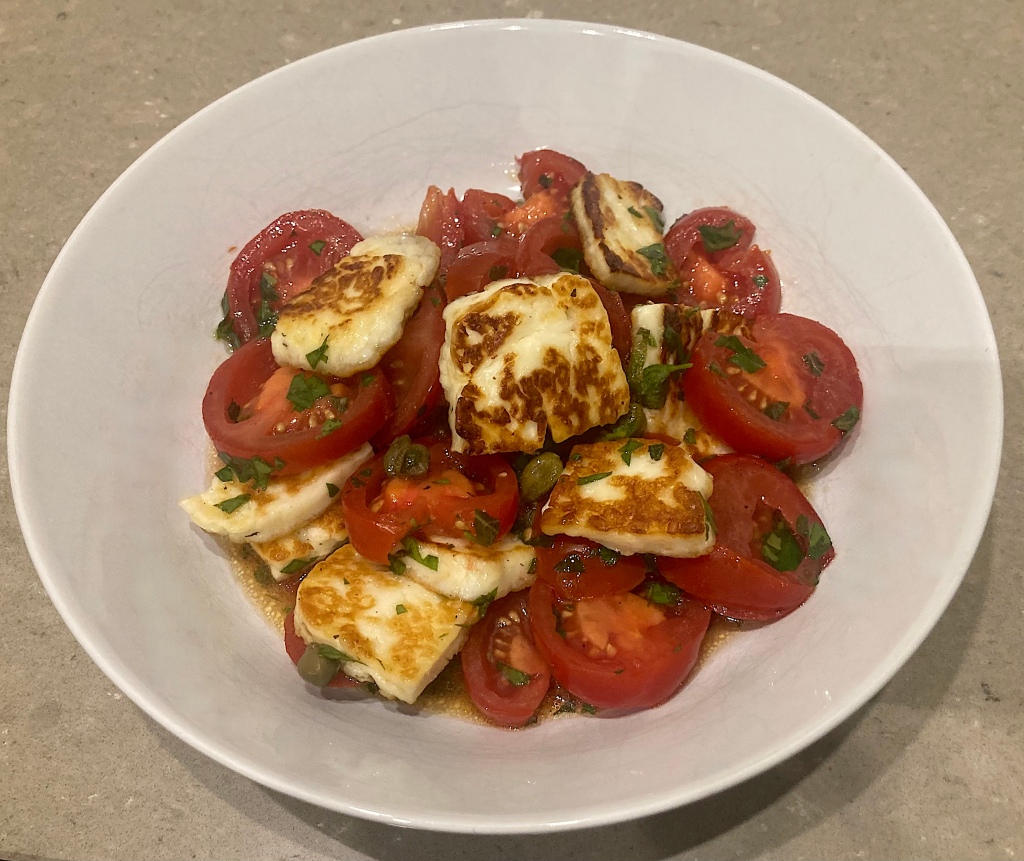
A simple and lovely salad, one that works very well as a starter with some crusted bread. Tomatoes, a touch of mint, parsley and warm halloumi. One of the first times we made this we used homegrown, ripe and tasty tomatoes. We also prepared the dish using tomatoes that were rather bland. That wasn’t much of a success.
The history of halloumi goes back centuries. Nowadays it’s a cheese made of goat’s and sheep’s milk. Sometimes cow’s milk is added to the mixture. In the EU it’s a protected product and must be produced in Cyprus. Because of its high melting point it’s ideal to grill or fry, although it can remain a bit firm and chewy. During the final phase of the production process the cheese is salted and sprinkled with chopped spearmint leaves.
Mint is also an essential ingredient of the salad. We tend to use it only occasionally because mint can be overpowering. It works very well in combination with the cheese and the tomatoes. It gives a boost to the flavours without being overly present.

Wine Pairing

A glass of rosé, a simple unoaked white wine or a beer will be great with the salad. When looking for a wine to go with a salad, make sure to think about the acidity. In general a more acidic salad requires a more acidic wine. The combination will make the wine fruiter and the salad softer. In this case the tomatoes, the dressing and the capers bring acidity. However, marinating the tomatoes makes the salad softer and emphasises the sweetness of the tomatoes. 

What You Need

  • Six excellent, tasty, ripe Tomatoes
  • 6 leaves of Mint
  • Parsley
  • Olive Oil
  • Vinegar
  • Teaspoon of Capers (in brine)
  • Black Pepper
  • Halloumi

What you Do

Core and slice the tomatoes. Chop the parsley and the mint. Combine oil and vinegar, add tomatoes, mix and add the herbs. Transfer to the refrigerator for a few hours. Mix every hour.
Slice the halloumi and fry on medium heat in olive oil. Turn regularly. Add the capers to the salad, mix, top with the fried halloumi and serve immediately with crusted bread.

Tomato and Halloumi Salad ©cadwu

Belgian Endive with Cheese Sauce and Ham

When asked for a typical Flemish dish, award winning chef Jeroen Meus immediately mentioned Belgian Endive with Cheese Sauce and Ham.
At home we found the recipe in my mother’s kookschrift, a notebook with recipes she learned as a young woman. She would cook the dish often, typically on a Sunday evening, and serve it with mashed potatoes. Her recipe is fairly straightforward: wash and clean the Belgian endive and cook it for 30 minutes (the recipe is from 1950!) in salted water. Then make a béchamel sauce, add cheese, wrap the endive in ham, spoon the sauce over the vegetables, add butter and breadcrumbs and transfer the combination to the oven for 15-20 minutes. Done!

Actually, her recipe is not very different from how Jeroen Meus prepares the dish. He doesn’t use breadcrumbs and he adds nutmeg and a splash of lemon to the sauce. He suggests steaming or braising the endive.

Most recipes mention removing the bitter core of the Belgian endive. Perhaps that was necessary in 1950, but today’s Belgian endive is not as bitter, so there is no need to do that. Belgian endive must have some bitterness.

Wine Pairing

Enjoy your Belgian Endive with a nice glass of red wine, one with a bite and not too complex. For instance a blend of Cabernet Sauvignon and Syrah from France, a Carmenère from Chili or a Spanish Rioja (Crianza or Joven). 

What You Need

  • For the Endive
    • 4 Belgian Endive
    • 4 slices of Excellent Organic Cooked Ham
    • For the Cheese Sauce
      • 20 grams of Flour
      • 20 grams of Butter
      • Milk
      • 75 grams of grated Cheese (preferably a combination of Gruyère and Emmentaler)
      • optional: one Egg Yolk
    • Nutmeg
    • White pepper
  • For the Mash
    • Root Parsley
    • Parsnip
    • Nutmeg
    • Fresh Parsley
    • White Pepper

What You Do

Chop the bottom of the base of the endive and remove the outer leaves if they don’t look great. Steam the endive or braise it in butter. We prefer braising in butter, which may take 30 minutes on low heat. This way you keep all the flavors and the texture. If steamed: make sure you squeeze the endives gently to get rid of the water excess.
Make the cheese sauce with flour, butter and milk, adding most of the grated cheese when the béchamel is ready. Add grated nutmeg and white pepper to taste. You could turn it into a classic Sauce Mornay by adding one egg yolk to the sauce.
Preheat the oven (200°C or 390 °F). Wrap a piece of ham around each endive and arrange in a shallow baking dish. You don’t want any space between the endive. Spoon sauce over the endive. Sprinkle remainder of the cheese over the sauce. Bake until golden brown on top, 15 to 25 minutes. We prefer using the grill.

For the Mash: clean and dice the root parsley and the parsnip (ratio 1:1). Cook quickly in a limited amount of water. When ready, drain and mash using a blender. Add nutmeg and white pepper. Just before serving add lots of finely chopped fresh parsley.

White Asparagus with Ham, Egg, Potatoes and Parsley

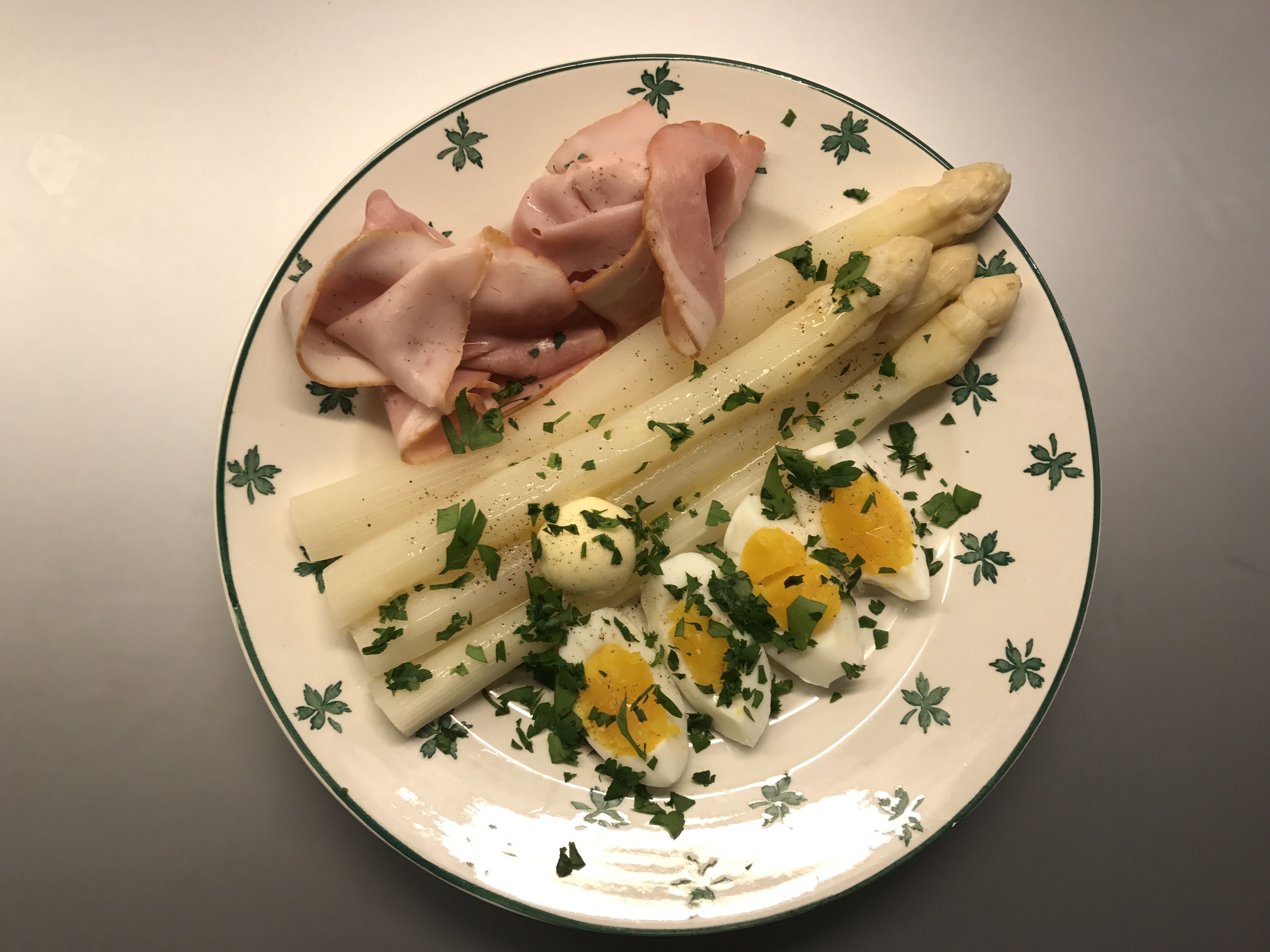
Finally, it’s spring. The season of white asparagus, morels and many more primeurs. This dish brings together white asparagus with eggs, excellent ham, butter, small potatoes and parsley. Taste the slight bitterness and sweetness of the asparagus, the umami of the potato and enjoy the velvety feeling on your palate as a result of the butter and the egg.
Don’t be tempted to boil white asparagus in water with butter, lemon, sugar or salt. Steaming is by far the best way to prepare them. We love our Russel Hobbs food steamer! Simple, straightforward and the result is a tribute to spring.

Wine Pairing

Ideally we would serve a dry Muscat from the Elzas with our asparagus. The delicate, slightly sweet but dry taste, the hint of bitterness and the rich aromas work very well with white asparagus. Muscat to us means the smell of fresh fruit. As if you taste the original grape. A wonderful wine and a wonderful combination.
Fortunately asparagus are fairly flexible when it comes to wine: a Pinot Blanc or Pinot Gris will also be fine.

We opened a bottle of Vinho Verde from Portugal. A light and vibrant wine with clear notes of citrus and floral aromas that combined rather well with the flavours of the asparagus. Not the most exquisite combination, but it worked for us.

What You Need

  • 6 or 10 White Asparagus
  • 2 Eggs
  • 100 gram Excellent, Organic Ham
  • Small Firm Potatoes
  • Parsley
  • Butter
  • White Pepper

What You Do

Peel the asparagus and steam them for 20 minutes. Steam the eggs medium (10 minutes), making sure the yolk is firm but not dry. Wash the potatoes and steam them for 15 minutes. Timing depends on the size. Melt the butter. Peel the egg and cut in four. Chop the parsley. Serve the asparagus and eggs on a plate. Coat the potatoes with butter and parsley. Dress the plate with ham (please make sure it has a bit of fat) and potatoes. Poor the remaining melted butter over the asparagus. Sprinkle the parsley over the egg. Add some white pepper.

White Asparagus with Ham, Egg, Potatoes and Parsley ©cadwu

Bay Boletes with Brussels Sprouts and Tenderloin

Bay Bolete

The Bay Bolete is a tasty, fairly common mushroom. Its cap is chestnut (bay) brown. They are easy to find under pines and other conifers in Europe and North America (but we’re not mushroom hunters) and unfortunately not so easy to find on the market. The main season for the Bay Bolete is late summer and autumn. Bay Boletes are rarely infested with maggots. They dry very well.
When comparing the taste of Bay Boletes and Cepes we think that Cepes have a more powerful and complex taste whereas Bay Boletes are nuttier.

We remember Brussels sprouts from our youth: over- cooked, greyish, soggy and oh-that-smell (it’s sulphur actually)! Once in a blue moon we take a trip down memory lane and cook them this way, but we prefer a more modern approach, for instance steamed and served with a drizzle of olive oil. Nutmeg is a must by the way.

Wine

We very much enjoyed a glass of Portuguese Segredos de São Miguel, a full-bodied, warm red wine, made from grapes such as Alicante Bouschet, Aragonez, Touriga Nacional and Trincadeira. You will taste lots of fruit and a touch of toast. A juicy wine with nice acidity and smooth tannins. Fresh and vigorous finish.

You could also go for a Malbec. Taste wise the mushrooms and the sprouts are very powerful, so you’re looking for a wine that will clearly support the beef and will also combine with the nuttiness of the mushrooms and the touch of bitterness of the sprouts.

Here is what you need

  • Boletes
    • 150 grams of Bay Boletes
    • Olive Oil
    • Butter
    • One glove of Fresh Garlic
    • Parsley
  • Brussels Sprouts
    • 200 grams of Brussels Sprouts
    • Butter
    • Nutmeg
  • 150 grams of excellent Beef (Tenderloin is best in this case)
  • Black Pepper

Let’s Start Cooking

We begin with the Brussels sprouts: clean them (don’t cut in half as so many do nowadays) and cook or steam them until they are nearly okay. Set aside and let cool. Clean the mushrooms with a brush and/or kitchen paper. Slice (not too thin). Heat a skillet, add olive oil and butter. Add the sliced mushrooms and fry gently over medium heat. In parallel warm a pan with some butter and add the sprouts. The idea is to coat them with butter and warm them, giving them just the cuisson you prefer. Heat a second skillet with olive oil and butter, fry the beef and let rest for 5 minutes or so in aluminum foil. Season the sprouts with some nutmeg. Back to the mushrooms: add chopped garlic to the pan. Wait a few minutes and then add chopped parsley. You could make a jus in the skillet you used for the beef. Serve on a hot plate with extra nutmeg and black pepper.

White asparagus with Egg, Ham, Parsley and Butter

A Classic

White asparagus is such a great vegetable! In this recipe we describe the classic way of serving asparagus: A la Flamande. This way you will be able to taste the slight bitterness and sweetness of the asparagus. The butter and egg bring a feeling of velvet to your palate, which is ideal to taste the asparagus. The parsley and white pepper give a touch of sharpness to the dish.

Wine Pairing

Serve the white asparagus with a dry Muscat from the Elzas. The delicate, slightly sweet but dry taste, the hint of bitterness and the rich aromas work very well with white asparagus. Muscat to us means the smell of fresh fruit. When drinking it is if you’re tasting the original grape. Wonderful wine and wonderful combination.
We recently combined the asparagus with a Riesling (2015, Trocken, Meulenhof) from the German Mosel region. Worked very well.

What You Need

  • 3 or 5 White Asparagus per person
  • 2 Eggs
  • 100 gram Ham
  • Parsley
  • Butter
  • White Pepper

What You Do

Steam the white asparagus and cook or steam the eggs medium, making sure the yolk is not set but also not running. Peel the egg and cut in four. Chop the parsley. Serve the asparagus and eggs warm on a plate. Dress the plate with ham (please make sure it has a bit of fat) and butter; sprinkle the parsley over the plate. Add some white pepper.
As an alternative warm the butter and pour it gently over the asparagus.

White Asparagus with Egg, Ham and Parsley

White Asparagus with Summer Truffle

From Spring to Summer

Time to celebrate! Summer has just begun and the Asparagus season has come to a close. So let’s bring the two together in this slightly extravagant dish. It is earthy, slightly bitter and sweet, velvety and complete.
The Summer Truffle (Tuber Aestivum) is not as intense and overwhelming as the Winter Truffle. It should be used immediately and preferably grated. It loses its taste when heated, so don’t use it for your Tournedos Rossini. This dish should be luke warm, so an excellent environment for a Summer Truffle. Take your time to appreciate the delicate combination in your plate.

Wine Pairing

We drank a glass of Italian Gewürztraminer with our Asparagus with Summer Truffle. This wine has a distinctive fruity flavour with hints of aromatic herbs. The area where the grapes are grown (Alto Adige) is relatively cool and sunny. As a result of this the Gewürztraminer grapes ripe well without losing their freshness. So the wine brings fruit, freshness, warmth and aromatic herbs, which works well with the earthy, aromatic truffle and the sweetness and bitterness of the asparagus. Parsley is essential because it brings freshness to the dish; nicely balanced with the velvety taste of the egg and butter. And butter is the ideal bridge between egg, asparagus and truffle.
In general a glass of Gewürztraminer is ideal with this dish, provided it has a touch of sweetness only. Sometimes Gewürztraminer is simply too sweet. This will not only ruin the hints of aromatic herbs in the wine; it will also ruin the delicate combination of asparagus with truffle.

What You Need

  • 4 Asparagus
  • 2 Eggs
  • 25 grams of Butter
  • 25 grams of Summer Truffle
  • Parsley
  • Black Pepper

What You Do

Cook or steam the asparagus. Make sure they are just done. Cook the eggs for 8-9 minutes. The yolk should not be completely firm. Cool the eggs in cold water, peel and mash with a fork. Add the finely chopped parsley and some black pepper. Taste. Melt the butter.
Put two asparagus per person on the plate, pour the warm butter over the asparagus, making sure they are fully covered, add the egg and finish by sprinkling the grated truffle. Poor a glass of excellent Gewürztraminer and enjoy the start of summer by eating the very last of this years asparagus.