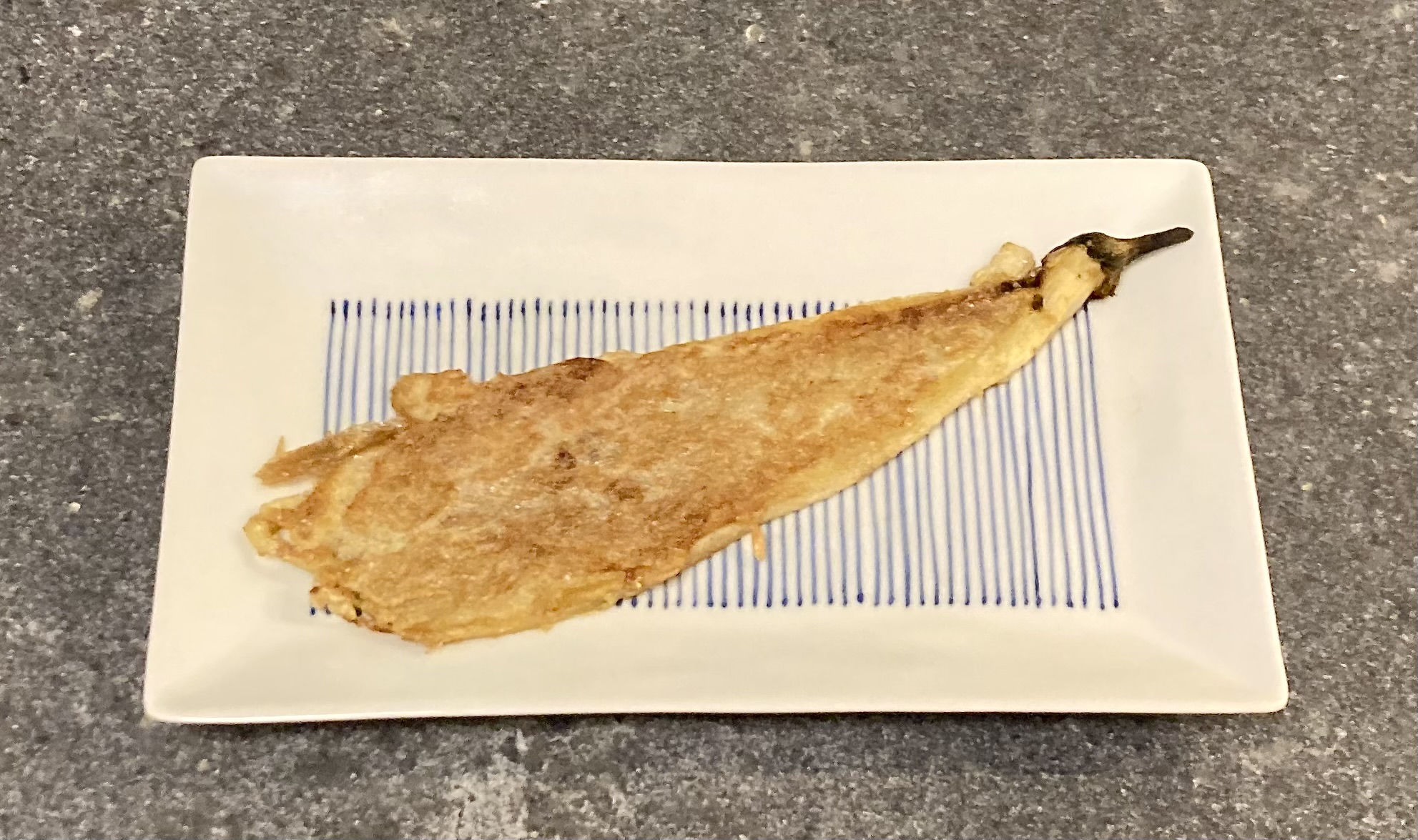
Tortang Talong

Perhaps you wonder what kind of fish we prepared for this post. Well, actually, it’s Tortang Talong, a Philippine dish made with charred eggplant. Earlier this year we made banana ketchup and the idea was to serve it with Tortang Talong, but we couldn’t find the right eggplants. For Tortang Talong you need long, purple, slender eggplants, known as Chinese or Japanse eggplants. They not only look different from the oblong eggplant, their taste is slightly sweeter and softer. The shape is key to a moist and homogenous result.

Thanks Monch Weller for introducing us to the delectable sauce and the very tasty Tortang Talong!

Food Pairing

Serve Tortang Talong with banana ketchup as a starter. We could also imagine it as a side dish with fried vegetables, rice and perhaps chicken.

What You Need
  • 2 Chinese or Japanese Eggplants
  • 1 Egg
  • Black Pepper
  • (optional) Salt
  • Oil
What You Do
  1. Grill the eggplants for 5-10 minutes using the wire rack, following the instructions of your oven
  2. Flip and grill for another 5-10 minutes or until charred
  3. Let cool
  4. Peel of the skin
  5. Use a fork to flatten the eggplants
  6. Combine egg, salt (if using) and pepper
  7. Beat the mixture well
  8. Heat a heavy iron skillet
  9. Add oil to the skillet
  10. Dip the eggplant in the mixture
  11. Fry the eggplant
  12. Flip and use a brush to coat the top with the egg mixture
  13. Repeat step 12, two or three times

Banana Ketchup

A few weeks ago we were reading Monch Wellers food and lifestyle blog. He writes about Via Mare, a Filipino restaurant that opened its doors 50 years ago. In his blog Monch writes about the food Via Mare offers, for instance Spanish Hot Chocolate, Bibingka (rice cake), Crab Omelette with Banana Ketchup, Lumpiang Ubod (spring rolls made with heart of palm) and Puto Bumbong, a glutinous rice dyed violet and steamed in bamboo tubes. We learn so much about the Filipino food culture thanks to Monchs excellent blog!

Why Bananas?

Maria Orosa (1893–1945) was born in the Philippian province of Batangas, some 100 kilometres south of Manilla. She studied food chemistry and pharmacology in the US. She returned to the Philippines in 1922. She was a food chemist, innovator and war hero. She saw the potential of many local products, for instance bananas and soy, and used these to empower the Philippines. She invented Soyalac (a protein-rich powdered soybean product), Darák (bran rice powder rich in vitamins) and Tiki-Tiki cookies. The powders and cookies saved many lives during wartime food shortages in the Philippines.
One of her more frivolous inventions is Banana Ketchup. Why rely on imported tomatoes when it’s possible to make an equally tasty condiment using local bananas?

We loved the philosophy behind the ketchup and began searching for recipes. We noticed that tomato paste is often added, to give the ketchup a more familiar and appetizing colour. We didn’t do this. Afterall, the idea was not to use tomatoes. Plus: what’s wrong with the colour?

Food Pairing

The Banana Ketchup is smooth, its taste long, tangy, spicy and uplifting. The bananas give the ketchup natural sweetness and depth. They also support the spices. A condiment to love.
We asked Monch for his favourite combination. He wrote us: It’s often paired with fried food here in the Philippines – spring rolls (both meat and vegetable versions), fried chicken, and eggplant omelette (which was No. 2 in TasteAtlas’ 50 Best Egg Dishes). We tried it with eggplant omelette and vegetable spring rolls. The ketchup paired perfectly with the moist and more delicate flavours of the omelette.
Thanks Monch for introducing us to this unknown, delectable sauce!

What You Need
  • 2 small ripe Bananas
  • ½ Shallot
  • 2 cloves of Garlic
  • 20 grams fresh Ginger
  • ½ Kashimiri Pepper
  • 1/8 cup Brown Sugar
  • ¼ cup Rice Vinegar
  • ¼ cup Water
  • ¼ teaspoon Turmeric
  • Dash of Cinnamon and Nutmeg plus 1 Clove (replacing dash of All Spice)
  • Oil
What You Do
  1. Chop onion, garlic and ginger
  2. Mash the bananas
  3. Heat oil in a heavy iron skillet
  4. Add chopped onion and glaze, about 5 minutes
  5. Add garlic and ginger
  6. Leave on medium heat, stirring constantly
  7. Add bananas and combine
  8. After a few minutes add vinegar, water, sugar, spices and Kashmiri pepper
  9. When the mixture begins to simmer, reduce heat to low
  10. Leave for 15-20 minutes, stir regularly
  11. Remove from heat and let cool for 10 minutes
  12. Transfer to a food processor and blend until smooth. This may take one or two minutes
  13. Pass through a sieve to get the right velvety smoothness
  14. Leave to cool before transferring the ketchup to the refrigerator
  15. Serve with eggplant omelette (recipe next week!)
  16. The ketchup will remain tasty for up to 3 days.
PS

In general, we find tomato ketchup too sweet, too salty and bland. Have we ever considered making our own tomato ketchup? No, we haven’t. We’re okay with a small bottle of Heinz Tomato Ketchup Zero, in case we have an irresistible craving for ketchup. Heinz doesn’t add sugar and salt to the Zero Ketchup. They add more tomatoes than usual (great) and a sweetener (pity). The taste? Well, still typically tomato ketchup. Fortunately, Banana Ketchup has far more flavour, spiciness and complexity.

Girolle Omelette

Friday morning, beginning of September, we go shopping at the organic street market in the beautiful city of Haarlem. We want to buy fruit and vegetables, cheese and obviously mushrooms. The season just started but already the stall offers lobster mushrooms, truffle, chicken of the wood, mai take, trompette de la mort, cèpes and girolles, also the grey (grise) and the yellow ones (jaune). They look perfect and we decide to buy 150 grams. Greyish cap, bright yellow stem, perfect with an omelette. We cross the street and buy extremely old goat cheese, one that matured for 2 to 3 years. Its taste is full of umami, a bit spicy and makes us think of Roquefort. It will be perfect with the aromas and flavours of the girolle jaune.

Wine pairing

The fried girolle comes with an aroma that will make you think of a forest in autumn. Its taste is complex and nutty. The rich egg in combination with the grated old cheese made us decide to drink a glass of Flor de la Mar, barrel aged Chardonnay, produced by Casa Ermelinda Freitas in Portugal. The wine aged for 4 months in barrels made of American oak. It is medium bodied, nicely oaked and comes with hints of citrus and caramel. In general, you’re looking for a lightly oaked chardonnay, balanced, fresh, not too complex.

What You Need
  • 150 grams of Girolle (Jaune)
  • 2 Organic Eggs (preferably Demeter)
  • Very Old Goat Cheese
  • Garlic Clove
  • Olive oil
  • Butter
  • Black Pepper
What You Do

Whisk the eggs together. Warm a small non-stick pan, add some butter and make sure the pan is warm through and through. Add the mixture and leave on low heat until the omelette is baveuse. In the meantime, clean the mushrooms. Perhaps you need to cut off some of the stem. Slice the mushrooms lengthwise in halve. The stem is hollow and may contain sand or other bits of the forest floor. Quickly fry the mushrooms in olive oil. Grate some garlic and add to the mushrooms. Time to plate up: the omelette, fresh black pepper, the mushrooms and some grated goat cheese, not too much, it can be overpowering.

PS

More mushroom recipes on our mushroom page.

Enoki with Eggs and Soy Sauce

Enoki is one of the most popular mushrooms. It’s been cultivated for many years (or better: centuries) and it is available in Asian supermarkets as enokitake. The cultivated enoki grows in the dark, hence it being white, and needle shaped with a small cap. Wild enoki benefits from the exposure to light and becomes brown and its shape is more mushroom-like. The golden enoki we use is also cultivated. 

Enoki has a pleasant texture and aroma. Its flavour is mild, a bit sweet and fruity. You can use it raw in a salad, in a soup or combine it with soba noodles. Combining it with pork is also a great idea. We decided to prepare an omelette with a light soy sauce. The result is a lovely sweet, rich and intriguing omelette.
We’re not sure if it’s an appetizer in its own right or that is should be served alongside other dishes. Suggestions welcome!

Wine Pairing

We enjoyed our golden enoki with a very special wine: Sint Catharinadal Norbertus 2022. The wine is made in the Netherlands by the sisters of the Norbetine convent, founded in 1271. For centuries the sisters used the grounds for cattle and corn. Since 2017 they also produce wine, with the help of many volunteers and experts. Their motto is I am the true vine, and my Father is the vinedresser.  Amongst the grapes are Chardonnay, Pinot Gris, Pinot Blanc, Pinot Noir, Auxerrois and Gamay. We would suggest opening a bottle of their white wine. It has subtle aromas (apple, pear, melon), some acidity and its taste is very pleasant (fruit, touch of almonds).
More information (in Dutch only) on their website. The wine can be bought via Les Généreux.

What You Need

  • 100 grams of (Golden) Enoki
  • 2 Eggs
  • Light Soy Sauce (we used Tsuyu)
  • 3 cloves of Garlic
  • ½ red Chilli Pepper
  • 2 Spring Onions (Scallions)
  • Olive Oil

What You Do

Remove the stem (bottom) of the enoki. Blanch the mushrooms for 60 seconds in very hot water. Remove and pat dry using kitchen paper. Start making a sauce with soy sauce, garlic, pepper and spring onions. Reduce. Fry the mushrooms in oil, just to remove excess water. Reduce temperature. Beat the eggs and add the mixture to the pan. Allow to become a moist omelette on very low heat. Remember not to fry it! The egg should set and become baveuse. Transfer the omelette to a plate, use a spoon to cover the omelette with the liquid and decorate with a mixture of garlic, spring onion and chilli pepper.

Fromage de Fribourg

When reading La Cuisine Niçoise d’Hélène Barale: Mes 106 recettes, we noticed that she uses only one kind of cheese in her recipes. Not Parmesan, not Pecorino, but Fromage de Fribourg. She adds it to her fish soup, to her ravioli, to her tourte de blette and to various other dishes. But what is Fromage de Fribourg?

It’s also known as Vacherin Fribourgeois and it originates from the region around the Swiss city Fribourg. It’s a semi-hard, creamy cheese made with raw cow milk. It matures for at least 6 weeks in a damp cellar. Its taste is aromatic, floral, full-bodied and lasting, with a touch of sweetness, bitterness and umami. It is used in a fondue called moitié-moitié (50% Gruyère and 50% Fribourg). It’s also possible to make a fondue with Fribourgeois only, using three ingredients: water, cheese and garlic.

Obviously we wanted to taste this cheese and we assumed that in the home town of Hélène Barale we would be able to buy it. We found a great cheese shop and bought a nice slice of this complex cheese. At home we decided to make an omelet with spinach, following a recipe from Hélène Barale for Omelette aux Blettes.

Omelet

For this omelet you need spinach, shallot, garlic, bay leaf, egg and freshly grated Vacherin Fribourgeois. No thyme, black pepper or salt. We were much surprised by the perfectly balanced flavours of spinach, cheese and eggs. Wonderful omelet.
You’ll find all the details you need in La cuisine niçoise d’Hélène Barale: Mes 106 recettes.

Wine Pairing

We enjoyed our omelet with a nice glass of Côtes de Provence Rosé. You could also enjoy it with an unoaked Chardonnay.
If you decide to eat the cheese as dessert, then we suggest a glass of full bodied red wine (Bordeaux, Côtes du Rhône etcetera).

PS

From a culinary point of view we think we understand why Madame Barale favored Fromage de Fribourg. If it’s her personal choice, something typical for the Niçoise cuisine, a culinary trend or perhaps because she was fond of Fribourg, that remains a mystery to us.

Omelet with Artichoke

We love artichokes! It’s such fun to serve a steamed artichoke with a nice dipping sauce made of mayonnaise, whole grain mustard and some lemon juice. Thoroughly relaxing food. And when we have time on our hands, we prepare them à la barigoule.
Recently we wrote about la Cuisine Niçoise d’Hélène Barale. In this very informative book about the traditional food of Nice, you will find a recipe for an omelet with artichokes. We liked the idea, did our shopping and followed the instructions. Unfortunately, sorry Madame Barale!, we were not too happy with the result. The recipe suggests frying the omelet on medium heat on both sides. We think that’s a bit too much: in our case the flavours of the fried egg overwhelmed the subtle taste of the onion, artichoke and garlic. We tweaked the recipe (see below) but that shouldn’t stop you from buying the book and preparing the original.

The taste of the omelet is sweet thanks to cynarine, an intriguing chemical especially found in the leaves of the artichoke. Cynarine will enhance even the slightest trace of sweetness, in this case the sweetness of the onions and the cooked garlic. The taste of the artichoke is also nutty and bitter in a gentle way, which works really well with the eggs.

Wine Pairing

The cynarine will also enhance any sweetness in your wine, so you need a bone-dry, crisp, unoaked white wine with clear, present acidity. For instance a Sauvignon Blanc, Grüner Veltliner or Albariño.

What You Need

  • 1 Large Artichoke
  • 1 Shallot
  • 1 Garlic Clove
  • 2 Eggs
  • Olive Oil
  • Black Pepper

What You Do

Clean the artichoke, steam for 45 minutes depending on the size and let cool. Use a spoon to remove the ‘meat’ from the leaves (bracts) of the artichokes. Use a fork to make a chunky mash of the heart. Set aside.
Chop the shallot. Warm a heavy iron skillet, add olive oil and gently fry the shallot. Add the artichoke, mix and leave for 10 minutes on low heat. Mash the cooked garlic and add to the mixture. Add some black pepper. Beat two eggs, a bit longer than usual. Add the eggs to the mixture and allow to set, very slowly, making sure the omelet is baveuse (moist, warm and soft).

La Cuisine Niçoise

There are not many cities that can rightfully claim to have their own ‘cuisine’. The French city of Nice is one of them. Just think about Salade Niçoise, Bagna Caude, Tourte aux Blettes and Socca. Strongly influenced by Italian cuisine it is flavourful, rich and varied.

Hélène Barale was owner and chef of the restaurant Chez Hélène in the Rue Beaumont, number 39 in Nice. Here she prepared delicious, regional and traditional food. Ravioli à la Niçoise, gnocchi’s, panisses, pissaladière, ragout de mouton, loup grillé, pattissoun, everything freshly cooked in her kitchen for 150 guests per day.

Three examples

Panisses are made with chickpea flour, water, salt and olive oil. You make a hot dough, allow it to cool and set, then cut it into chips and deep fry. Serve with black pepper. Delicious.
Obviously you also want to know what Pattissoun is! If you search for it, you will find references to a nicely shaped squash, but Hélène Barale’s recipe is for a cake. She makes it with flour, yeast, sugar, raisins, orange zest, rum and eau de fleurs d’oranger (orange flower water). Sounds absolutely lovely.
Another very tasty recipe is for an omelette with artichokes. It’s a combination of onions, garlic, artichoke and eggs. Straightforward recipe, yummy result.

Retirement

She retired at the age of 88 in 2004. For a few years the restaurant was a museum, but it is now closed. Thankfully her daughter Paule Laudon wrote down 106 recipes of his mother’s cuisine. Her style is very clear so it’s not too difficult to prepare the dishes. The book looks like a cahier and it is edited with much love and care. It comes with an interesting introduction by Paule Laudon, the text of Nissa La Bella, which is the unofficial anthem of the city (O la miéu bella Nissa/Regina de li flou/Li tiéu viehi taulissa/Iéu canterai toujou/etcetera, meaning something like O my beautiful Nice/Queen of all flowers/Your old rooftops/I will always sing of you/etcetera) and pictures of the restaurant. The book does not contain pictures of the dishes.

La cuisine Niçoise d’Hélène Barale (in French only) was first published in 2006 and is now in its 11th edition. You can buy it via the usual channels and the French publisher for € 15,90.

Omelet with Winter Truffle

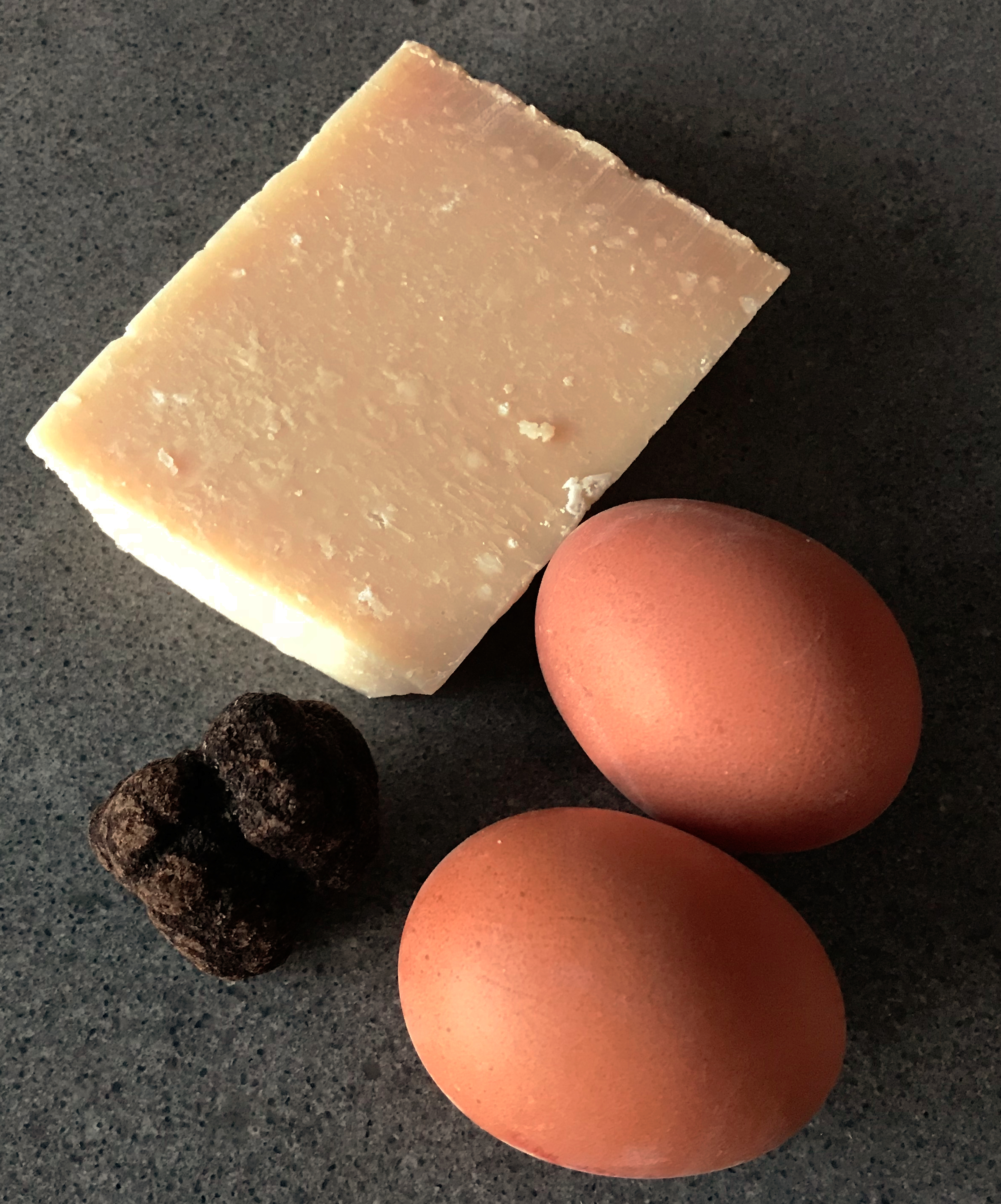
Black truffles are harvested from November to March, so be extravagant and buy one before the season ends. When buying a truffle, please ask if it’s okay to smell them, because the aroma will tell you everything you need to know about the quality.
Black truffles combine really well with a warm purée of potatoes, with scallops, risotto and everything eggs. We used our truffle to make one of the simplest and tastiest truffle dishes ever: an omelet with truffle and Parmesan cheese.
If you store a black truffle for a day or so, then please store it in a small box with some rice and an egg. The rice will prevent the truffle of becoming wet and the egg will embrace the aromas of the truffle and become a treat in its own right.

Wine Pairing

A not too complex white wine goes very well with this omelet, best would be a classic Pinot Blanc or Riesling from the Alsace region (for instance produced by Kuentz-Bas). Think fruity aromas, floral characteristics, minerality and a touch of acidity and sweetness.

What You Need

  • 2 Eggs
  • Butter
  • Parmesan Cheese
  • 10 grams or (budget permitting) more Black Truffle
  • White Pepper

What You Do

Clean the truffle if necessary. Take a fairly small iron skillet and make sure the pan is warm through and through but not hot. Using a fork (a spoon is even better) whisk the two eggs together. Add butter to the pan and wait until it is melted. It should not change colour or sizzle. An omelet should not be fried; the bottom must remain yellow. Add the whisked egg to the pan and wait until the egg is beginning to set. Check the consistency with your fingers. There is no alternative to baveuse! Take your time.
Serve the omelet on a warm dish with some freshly grated Parmesan cheese, white pepper and grated black truffle.

Cèpes à la Bordelaise

Porcino, Steinpilz, Eekhoorntjesbrood, Cèpe de Bordeaux, Penny Bun, Seta (de) Calabaza, Herrenpilz: a diverse range of beautiful names referring to one of the tastiest and most common mushrooms (in Europe): the Boletus Edulis.

The French name refers to the city of Bordeaux and is linked to the classic dish Cèpes à la Bordelaise. It brings out the texture and the flavours perfectly. The standard ingredients of the dish are cèpes, (fresh of course, the dried version can’t be compared to the real, fresh mushroom), olive oil, pepper, shallot and parsley. Some people add breadcrumbs (which doesn’t add any flavour so forget about it).

The interesting aspect of the Bordelaise is that the caps and stalks are separated. The caps are cooked for some 15 minutes; the chopped stalks for 5 minutes. This is a really clever approach because the caps become very tasteful and moist, while the chopped stalks add volume and texture. The downside (we think) is that the shape of the mushroom is gone. That’s why we prefer to slice the mushroom vertically in six parts. Two slices of the side of the cap, two centres (stalk with cap) and two slices of stalk (to make the stalk-with-cap slices more even). We chop the last two slices.

Originally Cèpes à la Bordelaise is a starter, but we prefer to combine it, for instance with an omelet as a starter or with beef or fillet of deer as a main course.

Wine Pairing

This very much depends on how you serve your Cèpes à la Bordelaise. If served as a starter we could imagine a glass of Bordeaux (quelle surprise!). In general a full bodied red wine with gently fruit and present tannins will be a great choice.
With our omelet we drank a glass of Bodegas Mocén Selección Especial made from verdejo grapes. This Spanish wine has big aromas, for instance ripe tropical fruit. In the mouth it is fresh, fruity, round and balanced. Not too complex.
With our beef we enjoyed a classic Medoc: Château Moulin de Taffard with aromas and flavours of red fruit. It is well balanced, with rich, smooth tannins.

What You Need

  • For the Cèpes à la Bordelaise
    • 200 gram Cèpes (or 300 gram if you serve it as a starter)
    • Olive Oil
    • One Shallot
    • Parsley
    • Black Pepper
  • For the omelet
    • Two eggs
    • Parmesan Cheese
    • Butter
  • For the Beef
    • 150 gram of excellent Beef (we served Rib Eye)
    • Olive Oil

What You Do (Cèpes à la Bordelaise)

Clean the mushrooms and slice. Chop the remainder of the stalks. Chop the shallot and the parsley. Add olive oil to a relatively hot heavy iron skillet. Reduce the heat and fry the caps and centre slices of the mushrooms for 5 minutes. Turn and fry for another 5 minutes. Add the chopped stalks and the shallot. Cook on medium heat for 5 minutes. Stir gently, making sure the chopped stalks are nicely coloured. Add chopped parsley, stir and add fresh black pepper. Serve on a warm plate.

What You Do (Omelet)

Whisk the two eggs and add a bit of fresh Parmesan Cheese. Warm a very small heavy iron pan (or a non stick pan if that’s what you prefer) add the mixture and let it set on low heat. This could easily take 10-15 minutes. The omelet must be moist (baveuse) and the bottom may not be colored.
Quarter the omelet and serve with the Cèpes à la Bordelaise.

What You Do (Beef)

Transfer the beef from the refrigerator a few hours (not 30 minutes, that’s too short) before you start cooking. It’s important that the meat is at room temperature. Heat a heavy iron skillet, add olive oil and fry quickly. Let rest. Slice the beef and serve on top of the Cèpes à la Bordelaise.

Tamagoyaki (Japanese Omelette)

Rolled Omelette

Tamagoyaki is best described as a Japanese rolled omelette and it is often served for breakfast or included in a bento box. It’s made by rolling multiple thin layers of egg; let’s say the concept of a Swiss roll but with much thinner layers. Making Tamagoyaki requires years of practice and a special rectangular pan (a makiyakinabe) using chopsticks only. But we, as western cooks with little patience, we use a round small, non-stick pan and two spatulas. The result is very tasty and it will make you think of a real Tamagoyaki.

The ingredients are a bit of a puzzle. Eggs, soy sauce and mirin for sure. Other ingredients include sugar (for a sweet version), sake and dashi (for a savoury version called Dashimaki Tamago).

The technique of rolling thin layers of egg is a great way of making an omelette. Feel free to replace the Japanese ingredients with some chicken stock and finely grated Parmesan cheese. You will love it!

Wine Pairing

Tamagoyaki comes with some umami thanks to the dashi and a touch of sweetness. Enjoy with a sparkling wine, for instance a Crémant de Bourgogne. Our choice was a glass of Blanc de Blanc Brut made by Vitteaut Alberti. Its aromas are fresh and flowery; the flavours suggest honey and pear. You could also serve a dry Riesling or Sylvaner.
Serving sake is also a good idea; our choice would be a Ginjo-Shu because of its delicate and light flavour.

What You Need

  • 2 Eggs
  • 2 Tablespoons of (Light) Dashi
  • 1 Teaspoon of Mirin
  • 1 Teaspoon of Light Soy Sauce
  • Oil

What You Do

Heat a small non-stick pan (10 -15 centimetre) until warm but not hot. Whisk the eggs, add dashi and mirin. Use kitchen paper soaked with oil to coat the pan. Use a (small) sauce spoon to add a bit of the mixture. Make sure you can repeat this as often as possible, so it has to be a really thin layer of egg. When nearly set, roll it up and move to the side. Coat the pan with oil. Add some of the mixture, make sure it connects to the roll, wait until nearly set and roll it up. Repeat until the mixture is used up. The tamagoyaki should be yellow with perhaps a touch of golden brown.
When done, feel free to shape the tamagoyaki by rolling it in a bamboo sushi mat. Slice and serve, perhaps with some grated daikon on the side.